

Brad Menezes
@bradmenezes · 6.3K followers
Introducing Superblocks 2.0: AI-generated enterprise apps - finally under IT control. Vibe-coded apps just became the #1 attack vector in the enterprise. Business teams are building on production data, while IT has zero visibility. No reviews. No audits. No permissions. No
Superblocks 2.0 launchDistribution-amplified signature
Superblocks 2.0 is a real product by a real founder (@bradmenezes). RADAR has tracked 4.6M views on this launch, according to the source post linked below. RADAR measures how the launch reach was built, not whether the product works or whether anyone was honest. This reading is verified confidence and every input is public.
By Simba, Launch Intelligence Analyst · Reviewed by JK · Published 26 Aug 2026 · Confidence: verified
Independent, methodology-derived signal, not a statement of fact about any person. RADAR reads how reach was built, a signature, not an accusation. See the methodology.
Did the Superblocks 2.0 launch go viral organically, or was the reach amplified?
The Superblocks 2.0 launch by @bradmenezes drew 4.6M views on 2.2K likes, which is 2,088 views per like, well above the roughly 500 organic ceiling. RADAR reads a distribution-amplified signature in how that reach was built, a signature of the mechanics and not a claim about the product or the founder. This is a verified reading and every input is public and reproducible.
New here? Start with the product
What is RADAR, and what does this grade mean?
RADAR is FORKOFF's launch authenticity rating system. It reads whether a product launch earned its reach through real engagement or bought it through paid distribution, using only public signals anyone can pull from the launch post. Every reading carries a letter grade, a confidence label, and the date it was last checked, and links back to a published method you can reproduce. Superblocks 2.0 is a real product by a real founder (@bradmenezes). RADAR measures how the reach was built, not whether the product works or whether anyone was honest.
Distribution-amplified signature
Independent, methodology-derived signal, not a statement of fact about any person. RADAR reads how reach was built, a signature, not an accusation. See the methodology.
What this grade means
RADAR reads a distribution-amplified signature on this launch: the reach ran ahead of the engagement that organic reach produces. The grade describes how the reach was built, not whether the product works or whether anyone was honest. Paying for distribution is legal and common.
The signals RADAR reads
Views-to-likes ratio
Organic reach tops out near 500 views per like. When views climb far past that without the likes to match, the extra reach is arriving without the engagement organic reach produces.
Amplification wave shape
Organic amplification spreads over hours and days. A coordinated launch fires a synchronized burst of quote posts in the first few hours, read from each post's own timestamp.
Posting-time fingerprint
A post that fires exactly top of the hour on a weekday is scheduled. On its own it is weak, but it corroborates a coordinated launch alongside the other two signals.
Those three public signals sit on top of RADAR's five-component forensic read. The full method, the bands, and the confidence model are on the RADAR methodology page.
This launch in the data
Where does this reach sit against the tracked corpus?
Where it sits in the corpus
Rank 23 of 30 tracked launches by views per like, lowest (most organic) first. A lower ratio is the favorable end.
Against the benchmark
This launch's views per like next to the organic median (354) and the amplified median (1,441) across the tracked set.
 The product
What is Superblocks 2.0?
Superblocks was founded in 2021 and is based in New York. Brad Menezes is cofounder and CEO; Ran Ma is CTO. Before Superblocks, Menezes worked on Yelp's product team and was a senior director of product management at Datadog. Press reporting puts the company's total funding at $60 million across two rounds, a $37 million round in 2022 and a $23 million Series A extension in 2025, with investors including Kleiner Perkins, Spark Capital, Greenoaks and Meritech Capital.
The lane is internal-tools and enterprise app platforms, a category that used to be a straight fight over developer time and has been reshaped by prompt-to-app generation. In his launch post Menezes names Replit, Lovable and v0 as the tools the IT leaders he talks to were coming from. Superblocks' own positioning is not that it generates apps faster, but that it is the one place the generated apps can be governed, which is also where his account bio points: "Vibe Coding Your CISO Approves."
Superblocks is a real, funded company and Brad Menezes is a real founder posting from his own account. This reading is only about how the launch post's reach was built.
What the 2.0 release added
- A platform MCP layer giving admins programmatic access to every builder, application, integration, permission, audit log, query and usage event, so an AI agent can monitor and act on them in real time.
- A knowledge graph inside Clark, the company's AI app-building agent, holding organizational context such as how a Salesforce customer ID maps to a Snowflake user ID.
- Deployment inside a customer's own AWS VPC, with Azure and GCP in beta, and hybrid models supported.
- Inference through the customer's existing stack, including AWS Bedrock, GCP Vertex AI, Azure AI, Snowflake Cortex and Databricks.
- Enterprise controls: permissions, audit logging, Git-backed source control, environment promotion and enforced coding standards.
How the Superblocks 2.0 launch worked
The launch was a single long post carrying a 133-second video, published at 7:00 AM Pacific on Tuesday 14 April 2026, exactly on the hour, from cofounder and CEO Brad Menezes' own account. Superblocks' own 2.0 announcement blog is dated 15 April 2026.
The post opens on a threat claim rather than a product: "Vibe-coded apps just became the #1 attack vector in the enterprise." That is Menezes' own stated claim, reported here as the framing he chose, not as a finding RADAR has verified. From there he describes the situation he says his IT buyers are in: business teams building on production data while IT has no visibility, no reviews, no audits, no permissions and no control.
The resolution is structured by audience rather than by feature. Business teams get to build AI-powered apps with permissions baked in. IT and Security get to audit and lock down anything. Engineering gets to set standards. Three buyers, three sentences, which is an unusually disciplined way to pitch a governance product that has to satisfy all three at once.
Named customers and two unnamed anecdotes
The post states that Instacart, SoFi and LinkedIn run Superblocks in production. That is the company's own stated customer claim, cited here as made. It then offers two anecdotes with the customer withheld: a Fortune 500 shutting down 2,500 Replit users to standardize on Superblocks, running air-gapped inside their own AWS environment, and a 150,000-employee global services firm replacing Lovable with Superblocks. Both are Menezes' own accounts of his deals, and RADAR reports them as claims rather than as verified facts.
Naming competitors inside a launch post is a deliberate choice with a known cost and a known payoff. It gives the post a stake, it tells a reader exactly which shelf the product sits on, and it invites the quote-tweet argument that follows. RADAR notes only that he made the choice. It has no view on the tools he named.
What Superblocks did during the launch
The launch ran a threat frame, a three-audience resolution, named proof, two withheld-customer anecdotes and a video, out of a scheduled top-of-hour slot at the start of the US work week.
| Asset | What it did |
|---|---|
| 133-second video | The launch object, carrying the 2.0 product story the post only summarizes |
| Attack-vector opening line | The stated claim that vibe-coded apps became the "#1 attack vector in the enterprise", a security frame that makes the post forwardable inside an IT org |
| Three-audience resolution | One sentence each for business teams, for IT and Security, and for Engineering, so all three buyers see themselves |
| Named production customers | Instacart, SoFi and LinkedIn stated as running Superblocks in production, the company's own proof claim |
| Two withheld-customer anecdotes | Menezes says a Fortune 500 moved 2,500 Replit users, and a 150,000-employee firm replaced Lovable, both his own unverified claims, specific enough to land without naming the account |
| Competitors named on purpose | Replit, Lovable and v0 named as where his IT buyers were coming from, which gives the post a position to argue with |
| Timing: Tuesday 7:00 AM PT | Top of the hour, early in the US work week, a scheduled slot rather than a spontaneous post |
This is a sales pitch written for a feed. Every element maps to a step an enterprise buyer takes: a reason to worry, a shape for the fix, proof that peers already bought it, and a story about someone larger than you making the switch. The unusual part is only that it ran as a founder post rather than as a webinar.
How the launch performed
The launch post reached 4,642,295 views on 1,849 likes, with 388 reposts, 197 replies, 216 quotes and 2,497 bookmarks. These are matured public metrics, re-pulled directly from the source post on 26 August 2026.
Two findings that point in opposite directions
The public actions total 2,650, which is 0.057 percent of the views. That is thin for reach this large, and the written layers are the thinnest part: 197 replies and 216 quotes against 4.6 million views. A post that genuinely provoked an audience of this size would ordinarily leave a deeper argument behind it, particularly one that opens on a security claim and names three competitors. The gap between the views and the engagement is what places this launch above the heavy-band line.
The bookmarks say something different, and RADAR credits it plainly. At 2,497 saves against 1,849 likes, this launch drew 1.35 bookmarks for every like, the strongest save-intent signal in this group of launches. Bookmarks exceeding likes is unusual, and it is not the kind of action that responds to a push on the reach, because a bookmark is private: it earns the person nothing, nobody sees it, and it only happens when a reader intends to come back. On a governance pitch aimed at IT and Security buyers, a save layer that outruns the like layer is the fingerprint of people filing something to act on rather than reacting to it.
Both of those are true at once. This launch carries the largest amplifier roster in RADAR's batch and the strongest save-intent ratio in it. The heavy signature describes how the impressions were assembled; the bookmarks describe what a real slice of that audience did once they arrived.
Views per like (matured)
About five times the roughly 500 organic ceiling and above the 2,000 heavy-band line. Detection measured 2,088 on 2,221 likes; the matured re-pull reads 1,849 likes, and both figures land in the same band.
Public engagement
1,849 likes, 388 reposts, 197 replies and 216 quotes, about 0.057% of the 4,642,295 views. The reply layer in particular is thin for reach at this scale.
Bookmarks against likes
Bookmarks substantially exceed likes, the strongest save-intent signal RADAR recorded in this group of launches. A bookmark is a private action with no social payoff, which is what makes an above-one ratio hard to manufacture and worth crediting.
Amplifier roster (ERP)
RADAR's forensic record holds a 40-account amplifier roster on this launch, the largest recorded in this batch. No regime classification was settled in the ERP, so RADAR states the roster size and stops there. Accounts are counted, never named.
What the numbers did between detection and today
RADAR first measured this launch at 4,636,857 views on 2,221 likes, a ratio of 2,088. On the matured re-pull the views had risen by 5,438 to 4,642,295 while the likes had fallen by 372 to 1,849, moving the ratio to 2,511. Both figures sit above the 2,000 line, so the read is unchanged. RADAR reports the movement anyway, because a page that only ever shows the number that suited its verdict is not worth reading.
Did the reach get earned or bought?
The label is about the reach, not about the company. Superblocks is an established, funded product and the 2.0 release is real, shipped and documented on the company's own site. Launching a 2.0 with paid distribution behind it is a common and legitimate way to get an enterprise release in front of buyers who do not follow a 6,739-follower founder account.
What the forensic record holds, and what it does not
RADAR's forensic record for this launch holds a roster of 40 amplifier accounts, the largest count in this batch. No regime classification was settled in the ERP for this launch, so RADAR does not characterize how the lift was delivered and does not infer a mechanism from the roster size alone. RADAR names no account, no vendor and no third party. Amplifiers are counted, not identified.
The bookmark layer is the part of this read that argues against the heaviest interpretation, and it is stated here rather than buried. 2,497 saves against 1,849 likes is real save intent from a real technical audience. A heavy signature on the reach and a genuine response inside it are not mutually exclusive, and this launch is the clearest example of both in RADAR's tracked set.
What a founder can take from this launch
The three-audience structure is the transferable part. Enterprise software fails in the feed because it is written for one buyer while three have to agree. Menezes gave each of them a single sentence, in the order they show up in a deal: the team that wants to build, the team that has to approve, and the team that owns the standard. That is a template, and it works whether or not anything is paid to carry it.
The measurement lesson is the bookmark count. This launch has the largest amplifier roster and the thinnest reply layer in its batch, and it also has the strongest save ratio. If you only read views you would call it a hit. If you only read the views-to-likes ratio you would write it off. The number that actually told you an IT buyer was interested was the one nobody optimizes for, because nobody can see it.
FORKOFF builds launch videos and the launch narrative around them so the reach lands on the buyer who saves the post, not just the one who scrolls past it. See how we approach it on the viral launch video service, or read the best product launch videos we track for more real examples.
Questions readers ask about this launch
What is Superblocks 2.0?
+
Did the Superblocks 2.0 launch go viral organically?
+
How many views did the Superblocks 2.0 launch get?
+
Who is behind Superblocks?
+
What does a distribution-amplified signature mean?
+
Sources
Primary citation: x.com/bradmenezes/status/2044053102563828211. Every number traces to a public pull; reads re-checked over time.
- Superblocks 2.0 launch post (source), x.com/bradmenezes
- x.com/bradmenezes (founder profile)
- x.com/superblocks (company profile)
- Announcing Superblocks 2.0 (company announcement), superblocks.com
- Superblocks product site, superblocks.com
- Superblocks raises $23M Series A extension (AlleyWatch, 2025)
- RADAR methodology
How RADAR read this launch, component by component
Each named component carries a plain-English definition and a directional read where the public data supports one. RADAR publishes the component names, never the weights or the formula.
View-velocity signature
Not publishedWhether the view curve grew the way organic spread does, or spiked like an injected burst.
Per-launch read not published in the public dataset. This component needs the forensic engine output.
Engagement coupling
Flags amplificationWhether likes, replies, and reposts grew in step with views (the organic signature), or the views ran out ahead.
At 2,088 views per like, reach runs well ahead of the likes, far above the roughly 500 organic ceiling.
Reply-network authenticity
Not publishedWhether the accounts replying are real, distributed people or a coordinated cluster posting together.
Per-launch read not published in the public dataset. This component needs the forensic engine output.
Amplifier-cluster pattern
Not publishedWhether the quote-tweet amplification looks like organic word of mouth or a known activation cluster.
Per-launch read not published in the public dataset. This component needs the forensic engine output.
Smart-follower activation
Not publishedWhether genuinely influential reference accounts engaged, or the reach was only low-quality volume.
Per-launch read not published in the public dataset. This component needs the forensic engine output.
Are you the founder of Superblocks 2.0? You can claim or contest this read. RADAR attaches a founder response to the launch and re-examines any component you dispute.
Authorship
Simba
Co-founder, FORKOFF
Reviewed by: Kshitij JK
Last reviewed:
Published:
Methodology
RADAR verified reading of the Superblocks 2.0 launch from public metrics: the views-to-likes ratio against the roughly 500 organic ceiling and the posting-time slot, framed as a signature of how reach was built, not an accusation.
Sources cited
- RADAR methodology , FORKOFF
- Superblocks 2.0 source post , X
Where to go next
Understand launch authenticity
Three ways in, depending on what brought you here: learn how the score works, get a launch read or built, or get the plain answer on this launch.
Learn the score
What a launch authenticity score is
A launch authenticity score reads whether a launch earned its reach or bought it, from public signals. Start with the definitions and the checks you can run yourself.
Verify or build
Launch authenticity verification
Want a launch read by the same method, or a launch video made and distributed on the outcome? RADAR reads any public launch, and FORKOFF builds the launch behind the reach.
The skeptic's question
Is the Superblocks 2.0 launch legit?
If you are checking whether the Superblocks 2.0launch was real users or bots, here is the honest read: RADAR's reading is Distribution-amplified signature, at verified confidence, computed from public metrics and reproducible from the source post. It measures how the reach was built, not whether the product works.
Peer launches
Launches with a similar read
Merge Gateway launch
@shensi
3.7M views · 1,953 per likeRead
HyperAgent launch
@howietl
14.3M views · 2,265 per likeRead
Libra AI launch
@CholagharGokul
1.9M views · 2,589 per likeRead
Co-Invest launch
@liquidtrading
3.8M views · 1,545 per likeRead
Meridian launch
@alexmdees
5.3M views · 1,523 per likeRead
MetaMask Money Account launch
@MetaMask
3.7M views · 2,709 per likeRead
The benchmark behind every reading
- The organic vs amplified benchmark. What a healthy launch ratio looks like, side by side.
- RADAR methodology. The bands, the confidence model, and how to reproduce a read.
- The Launch Authenticity Report 2026. The aggregate study across the tracked corpus.
- The X Launch Authenticity Study 2026. Two in three tracked launches show a bought-amplification signature.
- Verified-organic leaderboard. The launches RADAR reads as genuinely organic.
- Best product launch videos. The editorial cut of every tracked launch, ranked by views.
- Product launch video service. Get a launch video made and distributed, priced on the outcome.
Want a launch read by RADAR's method?
RADAR reads whether a launch's reach was earned or bought from public data, with the confidence label and the source citation on every reading.
Receipts, deep dives, and playbooks.
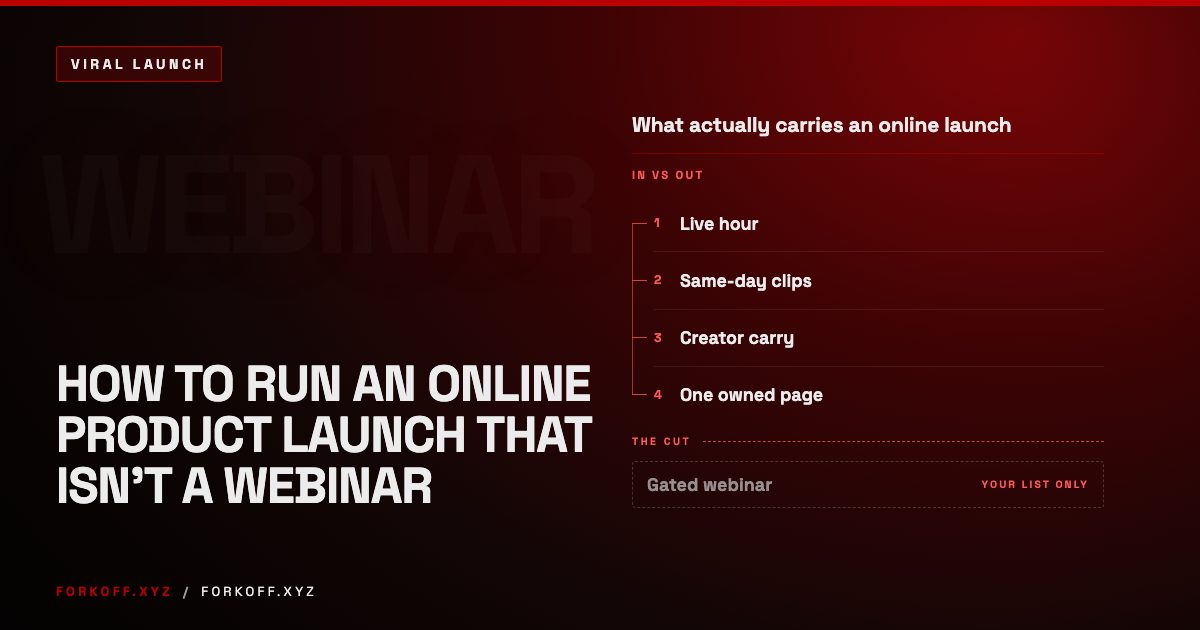
How to Run an Online Product Launch That Isn't a Webinar
An online product launch is a live moment cut into clips that creators carry, not a gated webinar. Here is the livestream, clip and creator stack for 2026.
 Read
Read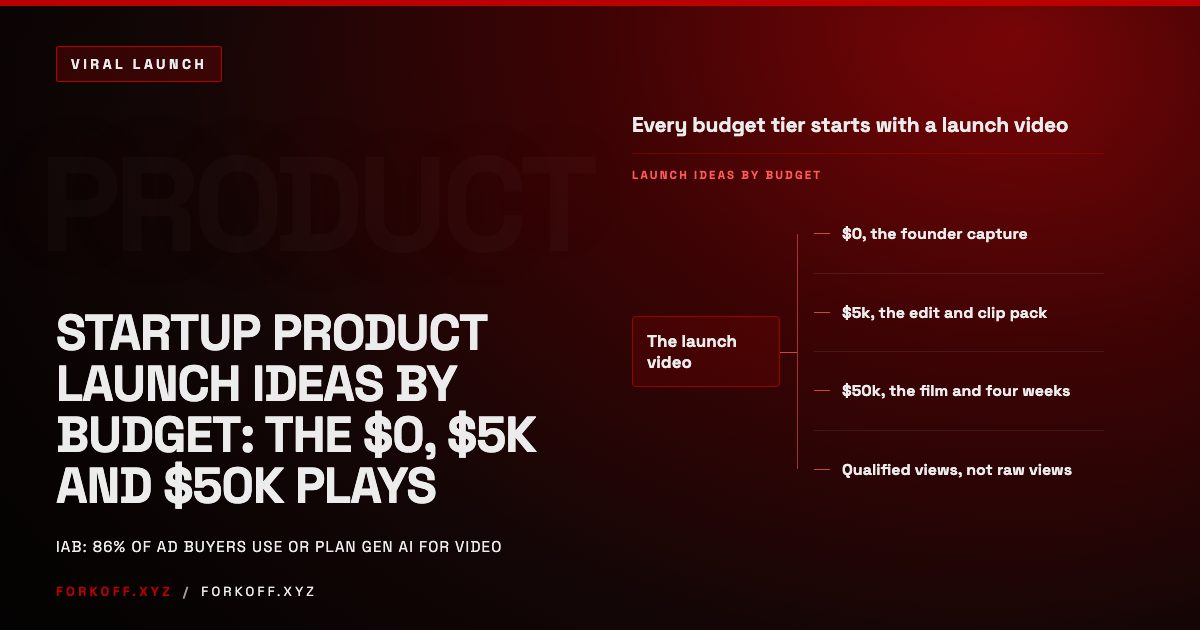
Startup Product Launch Ideas by Budget: The $0, $5k and $50k Plays
Product launch ideas for a SaaS startup sorted by budget: what the launch video should be at $0, $5k and $50k, and the distribution around it.
Read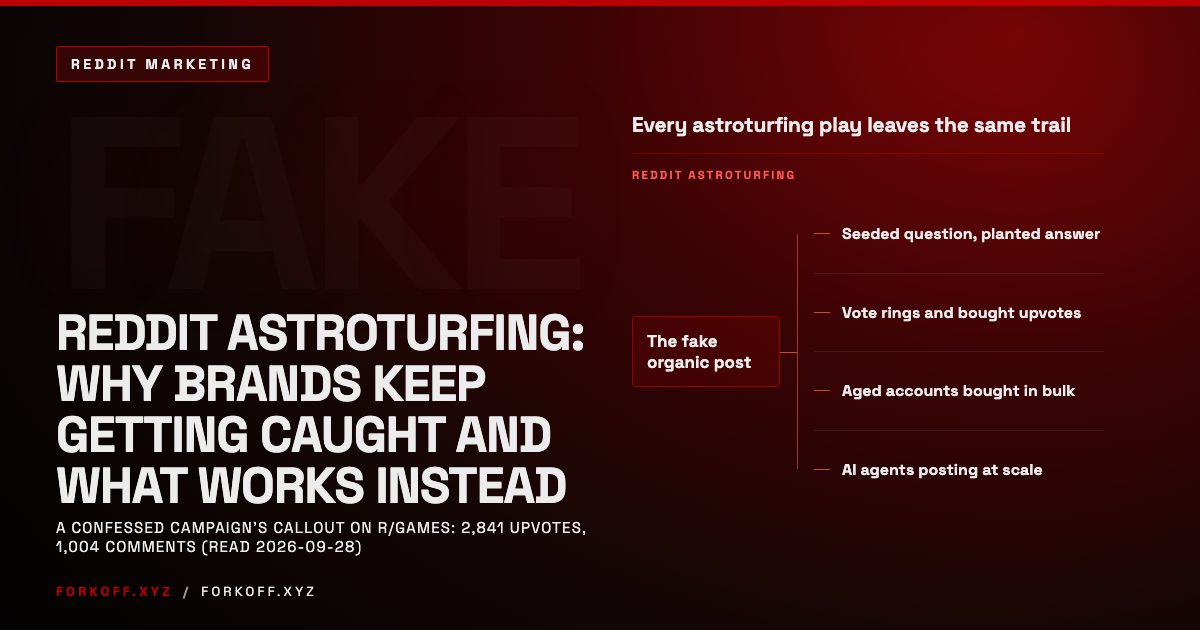
Reddit Astroturfing: Why Brands Keep Getting Caught and What Works Instead
Reddit astroturfing is paid promotion dressed up as organic talk. Why brands keep getting caught, what exposure costs, and the legitimate way to show up.
Read