

Shensi Ding
@shensi · 5.6K followers
Introducing Merge Gateway - Build Your Own Router. You're three sprints into your coding assistant. You pick the most hyped model, integrate, test, deploy. A month later, a new model drops. Now you re-test, re-integrate, re-deploy. Your product didn't change, but the
Merge Gateway launchDistribution-amplified (light)
Merge Gateway is a real product by a real founder (@shensi). RADAR has tracked 3.7M views on this launch, according to the source post linked below. RADAR measures how the launch reach was built, not whether the product works or whether anyone was honest. This reading is verified confidence and every input is public.
By Simba, Launch Intelligence Analyst · Reviewed by JK · Published 26 Aug 2026 · Confidence: verified
Independent, methodology-derived signal, not a statement of fact about any person. RADAR reads how reach was built, a signature, not an accusation. See the methodology.
Did the Merge Gateway launch go viral organically, or was the reach amplified?
The Merge Gateway launch by @shensi drew 3.7M views on 1.9K likes, which is 1,953 views per like, above the roughly 500 organic ceiling. RADAR reads a distribution-amplified (light) in how that reach was built, a signature of the mechanics and not a claim about the product or the founder. This is a verified reading and every input is public and reproducible.
New here? Start with the product
What is RADAR, and what does this grade mean?
RADAR is FORKOFF's launch authenticity rating system. It reads whether a product launch earned its reach through real engagement or bought it through paid distribution, using only public signals anyone can pull from the launch post. Every reading carries a letter grade, a confidence label, and the date it was last checked, and links back to a published method you can reproduce. Merge Gateway is a real product by a real founder (@shensi). RADAR measures how the reach was built, not whether the product works or whether anyone was honest.
Distribution-amplified (light)
Independent, methodology-derived signal, not a statement of fact about any person. RADAR reads how reach was built, a signature, not an accusation. See the methodology.
What this grade means
RADAR reads a distribution-amplified (light) on this launch: the reach ran ahead of the engagement that organic reach produces. The grade describes how the reach was built, not whether the product works or whether anyone was honest. Paying for distribution is legal and common.
The signals RADAR reads
Views-to-likes ratio
Organic reach tops out near 500 views per like. When views climb far past that without the likes to match, the extra reach is arriving without the engagement organic reach produces.
Amplification wave shape
Organic amplification spreads over hours and days. A coordinated launch fires a synchronized burst of quote posts in the first few hours, read from each post's own timestamp.
Posting-time fingerprint
A post that fires exactly top of the hour on a weekday is scheduled. On its own it is weak, but it corroborates a coordinated launch alongside the other two signals.
Those three public signals sit on top of RADAR's five-component forensic read. The full method, the bands, and the confidence model are on the RADAR methodology page.
This launch in the data
Where does this reach sit against the tracked corpus?
Where it sits in the corpus
Rank 22 of 30 tracked launches by views per like, lowest (most organic) first. A lower ratio is the favorable end.
Against the benchmark
This launch's views per like next to the organic median (354) and the amplified median (1,441) across the tracked set.
 The product
What is Merge Gateway?
Merge is a San Francisco company founded in 2020 by Shensi Ding and Gil Feig, with offices in San Francisco, New York and Berlin. It built its business on the unified API idea: one integration that covers a whole software category, across HR and payroll, applicant tracking, CRM, accounting, file storage and ticketing, so a B2B product can ship customer-facing integrations once rather than one vendor at a time. On its own site Merge states it raised a $55 million Series B backed by Accel, Addition and NEA, and names Airwallex, Revolut, Brex and Ramp among its customers. Those are the company's stated figures, cited here as context for why an announcement from this account travels.
Gateway extends that pattern from SaaS integrations to model providers. The lane it competes in is LLM routing and gateway infrastructure, where the real alternatives are the other unified inference layers and routers that sit between an application and OpenAI, Anthropic, Google, Mistral, Cohere and the rest, plus the option most teams are actually on: a single provider SDK wired in during the prototype and never revisited. Merge's stated angle is that the routing rule should belong to the customer rather than to the vendor.
Merge is a real company with a real product, and Shensi Ding is a real founder posting from her own account. This reading is only about how the launch post's reach was built.
What it does
- Routes requests across every major provider, including OpenAI, Anthropic, Google, Mistral and Cohere, from one API key and one base URL.
- Scores models on benchmarks the customer chooses and weights, on every request, rather than on a vendor's own idea of the best model.
- Supports standard benchmarks (HumanEval for code, MMLU for knowledge, GPQA for reasoning, GSM8K for math, IFEval for instruction following), industry leaderboards, and custom evals uploaded through the UI, JSON or the API.
- Caps spend by project, team or customer tier in real time, and attributes cost by model, provider and team.
- Fails over automatically when a provider degrades, shifting traffic without a code change.
- Adds policy-based routing, data loss prevention and prompt-injection protection at the gateway layer.
How the Merge Gateway launch worked
The launch was a single post carrying a 118-second video, published at 7:00 AM Pacific on Tuesday 26 May 2026, exactly on the hour, from Merge co-founder Shensi Ding's own account.
The post is built as an argument, not a feature list. It opens with the name and the tagline, "Introducing Merge Gateway, Build Your Own Router," then walks the reader through a scenario before naming the product: you are three sprints into a coding assistant, you picked the most hyped model, integrated, tested and deployed, and a month later a new model drops, so you re-test, re-integrate and re-deploy. The line that turns it is the one that costs nothing to agree with: "Your product didn't change, but the benchmark did."
From there the post makes a claim broad enough to argue with, "There is no best model," followed by the resolution: "There's only the right one for your product, users, and use-cases." Only then does the product appear, as the answer to a problem the reader has already accepted. The closing mechanic is a stated offer: $100 in credits to the first 200 people who comment.
A founder posting from her own account, not the brand
Ding posted from @shensi, an account created in July 2018, based in New York, carrying the bio "co-founder @merge_api" and a Merge affiliate badge, with 7,178 followers at the time of RADAR's pull. That follower count is worth holding next to the view count below. A 7,000-follower account is not a distribution machine on its own, which is the ordinary reason a launch at this scale reaches for help with the top of the funnel.
What Merge did during the launch
The launch ran a small number of assets, each doing a distinct job: a video, a narrative post, a declared comment incentive, and a scheduled slot at the start of the US work week.
| Asset | What it did |
|---|---|
| 118-second video | The launch object itself, carrying the demo the copy does not try to describe |
| Scenario-first copy | Three sprints in, a new model drops, re-test and re-deploy. The problem is dramatized before the product is named |
| The "no best model" claim | A broad, arguable line that gives readers something to agree with or push back on |
| $100 in credits to the first 200 commenters | A declared, above-board comment incentive that structurally lifts the reply count |
| Company tag to @merge_api | Routes attention from the founder's account to the product account |
| Timing: Tuesday 7:00 AM PT | Top of the hour, early in the US work week, a scheduled slot rather than a spontaneous post |
The credits offer is disclosed, and it has a hard ceiling
The offer of $100 in credits to the first 200 people who comment is a legitimate, openly stated tactic. It is written into the post where every reader can see it, it pays in the company's own product rather than in cash, and it asks for a comment rather than a like or a repost. RADAR treats it as a real driver of the 240 replies this launch carried, and as an honest one.
It is also capped. The offer tops out at 200 people, so at its absolute maximum it accounts for 200 of the 240 replies and nothing else. It cannot move a view count into the millions. Whatever explains the gap between 3.67 million views and 1,378 likes, the credits offer is not it.
How the launch performed
The launch post reached 3,667,154 views on 1,378 likes, with 361 reposts, 240 replies, 116 quotes and 1,337 bookmarks. These are matured public metrics, re-pulled directly from the source post on 26 August 2026.
Thin written layers, a strong save layer
The public actions total 2,095, which is 0.057 percent of the views. For reach in the multi-millions that is on the thin side, and the written layers in particular are shallow: 240 replies and 116 quotes are modest for a post seen this many times, even with a comment incentive helping the reply count along. This is the shape the original reading described, a launch whose views ran a clear step ahead of the audience that engaged.
The bookmark layer cuts the other way, and it deserves credit. At 1,337 saves against 1,378 likes, bookmarks land at 0.97 per like, almost one to one. A bookmark is a private action with no social return: nobody sees it, it wins no clout, and it only happens when a reader intends to come back. On an infrastructure launch aimed at engineers evaluating a routing layer, a save layer this close to the like layer is the signal of a genuinely interested technical audience inside the reach, however that reach was assembled.
Views per like (matured)
About 5.3 times the roughly 500 organic ceiling. At detection the same launch measured 1,953, just inside the light band; the likes fell from 1,875 to 1,378 while the views rose, which is the ordinary shape of a platform engagement purge settling a count.
Public engagement
1,378 likes, 361 reposts, 240 replies and 116 quotes, about 0.057% of the 3,667,154 views. The written layers are present but not deep for reach at this scale.
Bookmarks against likes
Bookmarks land almost level with likes. Saving a post is a private, deliberate action with no social payoff, so a near one-to-one bookmark-to-like ratio is a real save-intent signal from an audience that wanted to come back to this.
Amplifier roster (ERP)
RADAR's forensic record holds a 38-account amplifier roster on this launch. No regime classification was settled in the ERP for it, so RADAR states the roster size and stops there. Accounts are counted, never named.
What the numbers did between detection and today
RADAR first measured this launch at 3,661,633 views on 1,875 likes. On the matured re-pull the views had risen by 5,521 to 3,667,154, while the likes had fallen by 497 to 1,378. Views rising and likes falling is not a contradiction: view counts only ever accumulate, while like counts can be revised downward when the platform removes engagement it has decided not to count. RADAR re-pulls for exactly this reason, and shows both figures rather than the flattering one.
Did the reach get earned or bought?
Why the published read stays light
RADAR's verdict is a five-signal forensic read. The views-to-likes ratio is one input, weighed alongside the velocity curve, how tightly the engagement layers move together, whether the reply network reads as real conversation, and how the amplifier accounts cluster. The ratio moved. The other four signals have not been re-derived since the published read was set, so the honest position is that the ratio now argues for a heavier band while the read that was actually adjudicated argues for a lighter one, and RADAR states both instead of picking the newer number and calling it the original finding.
The original framing still holds on its own terms: because the ratio sits so close to the 2,000 threshold, the engagement layers underneath matter for placing the read. The written layers are present but not deep, which is consistent with a launch whose views ran a clear step ahead of the audience that engaged. The bookmark layer is the counterweight, and it is a real one.
What the forensic record holds
RADAR's forensic record for this launch holds a roster of 38 amplifier accounts. No regime classification was settled in the ERP for this launch, so RADAR does not characterize how the lift was delivered, and does not infer one from the roster size. RADAR names no account, no vendor and no third party, here or anywhere on this surface. Amplifiers are counted, not identified.
What a founder can take from this launch
The copy is the part worth stealing. The post spends its first six lines putting the reader inside a problem they have lived, three sprints in, a new model drops, re-test and re-deploy, before it names the product at all. Then it plants a claim broad enough to argue with. That structure is why a routing layer, which is not an obviously postable product, got 240 people to write something back.
The number to sit with is the gap between the layers. Bookmarks came in almost level with likes, which says the readers who did engage were the right ones. Replies and quotes stayed thin against millions of views, which says most of the reach never turned into an audience. A launch can buy the top of the funnel. It cannot buy the part where people save the post because they intend to use the thing.
FORKOFF builds launch videos and the launch copy around them so the reach lands on people who would have saved the post anyway. See how we approach it on the viral launch video service, or read the best product launch videos we track for more real examples.
Questions readers ask about this launch
What is Merge Gateway?
+
Did the Merge Gateway launch go viral organically?
+
How many views did the Merge Gateway launch get?
+
Who is behind Merge Gateway?
+
Why does RADAR read this launch as light when the views-per-like ratio is above 2,000?
+
Sources
Primary citation: x.com/shensi/status/2059273388871516650. Every number traces to a public pull; reads re-checked over time.
How RADAR read this launch, component by component
Each named component carries a plain-English definition and a directional read where the public data supports one. RADAR publishes the component names, never the weights or the formula.
View-velocity signature
Not publishedWhether the view curve grew the way organic spread does, or spiked like an injected burst.
Per-launch read not published in the public dataset. This component needs the forensic engine output.
Engagement coupling
NeutralWhether likes, replies, and reposts grew in step with views (the organic signature), or the views ran out ahead.
At 1,953 views per like, reach runs a step ahead of the likes: a light lift above the roughly 500 organic ceiling.
Reply-network authenticity
Not publishedWhether the accounts replying are real, distributed people or a coordinated cluster posting together.
Per-launch read not published in the public dataset. This component needs the forensic engine output.
Amplifier-cluster pattern
Not publishedWhether the quote-tweet amplification looks like organic word of mouth or a known activation cluster.
Per-launch read not published in the public dataset. This component needs the forensic engine output.
Smart-follower activation
Not publishedWhether genuinely influential reference accounts engaged, or the reach was only low-quality volume.
Per-launch read not published in the public dataset. This component needs the forensic engine output.
Are you the founder of Merge Gateway? You can claim or contest this read. RADAR attaches a founder response to the launch and re-examines any component you dispute.
Authorship
Simba
Co-founder, FORKOFF
Reviewed by: Kshitij JK
Last reviewed:
Published:
Methodology
RADAR verified reading of the Merge Gateway launch from public metrics: the views-to-likes ratio against the roughly 500 organic ceiling and the posting-time slot, framed as a signature of how reach was built, not an accusation.
Sources cited
- RADAR methodology , FORKOFF
- Merge Gateway source post , X
Where to go next
Understand launch authenticity
Three ways in, depending on what brought you here: learn how the score works, get a launch read or built, or get the plain answer on this launch.
Learn the score
What a launch authenticity score is
A launch authenticity score reads whether a launch earned its reach or bought it, from public signals. Start with the definitions and the checks you can run yourself.
Verify or build
Launch authenticity verification
Want a launch read by the same method, or a launch video made and distributed on the outcome? RADAR reads any public launch, and FORKOFF builds the launch behind the reach.
The skeptic's question
Is the Merge Gateway launch legit?
If you are checking whether the Merge Gatewaylaunch was real users or bots, here is the honest read: RADAR's reading is Distribution-amplified (light), at verified confidence, computed from public metrics and reproducible from the source post. It measures how the reach was built, not whether the product works.
Peer launches
Launches with a similar read
Superblocks 2.0 launch
@bradmenezes
4.6M views · 2,088 per likeRead
HyperAgent launch
@howietl
14.3M views · 2,265 per likeRead
Co-Invest launch
@liquidtrading
3.8M views · 1,545 per likeRead
Meridian launch
@alexmdees
5.3M views · 1,523 per likeRead
Playad launch
@YounchanHwang
1.7M views · 1,359 per likeRead
Libra AI launch
@CholagharGokul
1.9M views · 2,589 per likeRead
The benchmark behind every reading
- The organic vs amplified benchmark. What a healthy launch ratio looks like, side by side.
- RADAR methodology. The bands, the confidence model, and how to reproduce a read.
- The Launch Authenticity Report 2026. The aggregate study across the tracked corpus.
- The X Launch Authenticity Study 2026. Two in three tracked launches show a bought-amplification signature.
- Verified-organic leaderboard. The launches RADAR reads as genuinely organic.
- Best product launch videos. The editorial cut of every tracked launch, ranked by views.
- Product launch video service. Get a launch video made and distributed, priced on the outcome.
Want a launch read by RADAR's method?
RADAR reads whether a launch's reach was earned or bought from public data, with the confidence label and the source citation on every reading.
Receipts, deep dives, and playbooks.
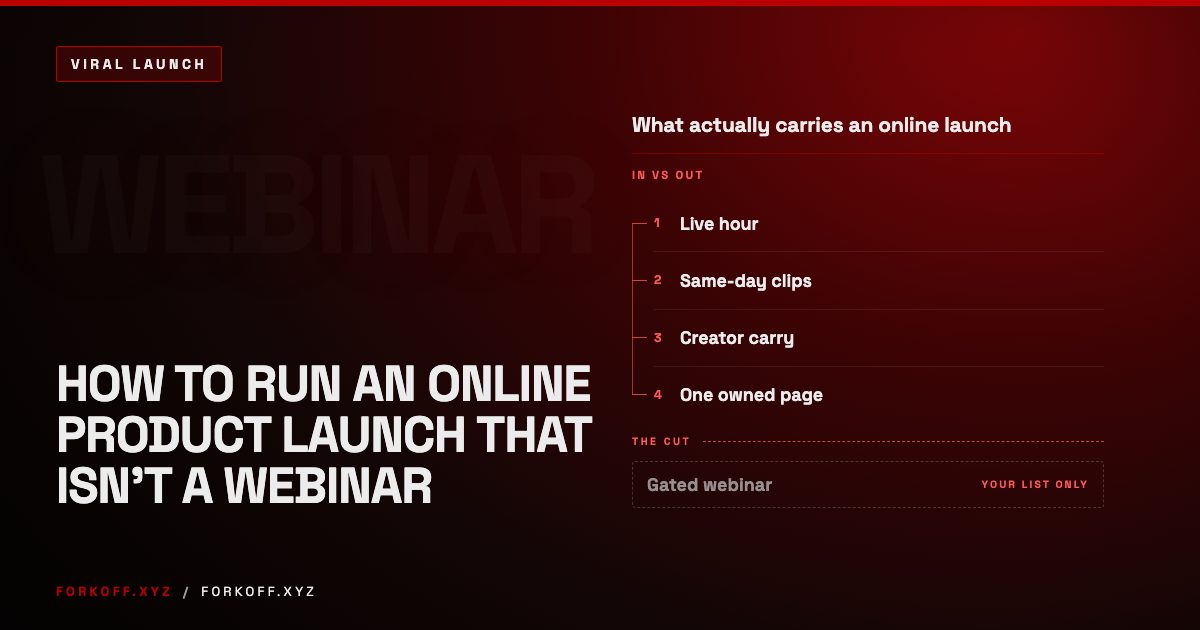
How to Run an Online Product Launch That Isn't a Webinar
An online product launch is a live moment cut into clips that creators carry, not a gated webinar. Here is the livestream, clip and creator stack for 2026.
 Read
Read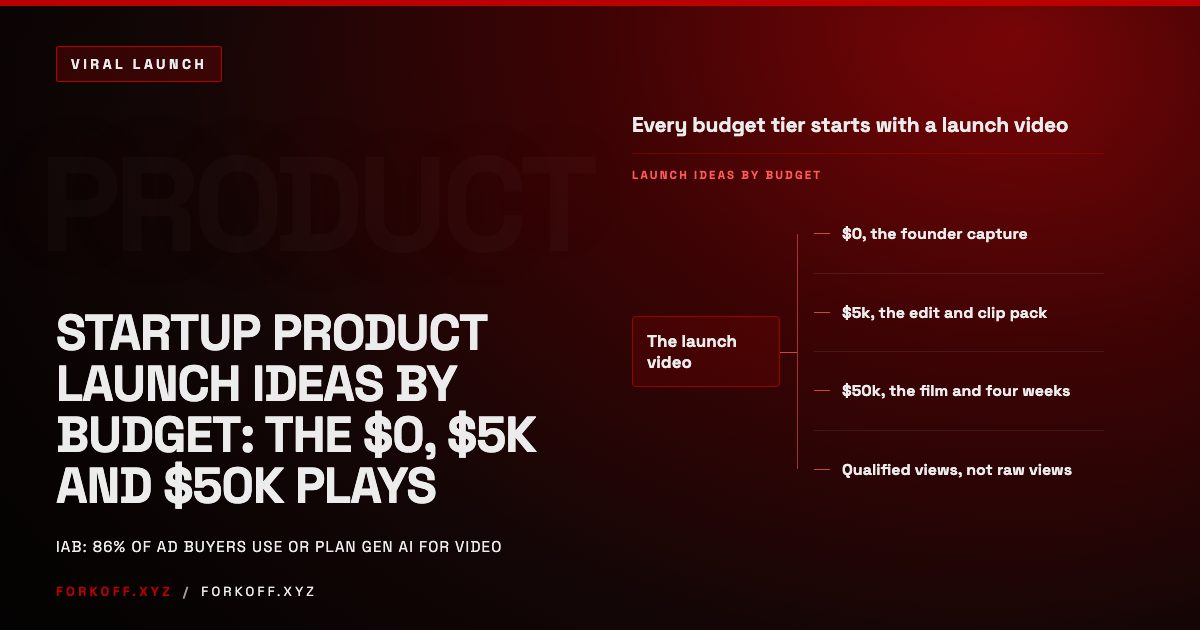
Startup Product Launch Ideas by Budget: The $0, $5k and $50k Plays
Product launch ideas for a SaaS startup sorted by budget: what the launch video should be at $0, $5k and $50k, and the distribution around it.
Read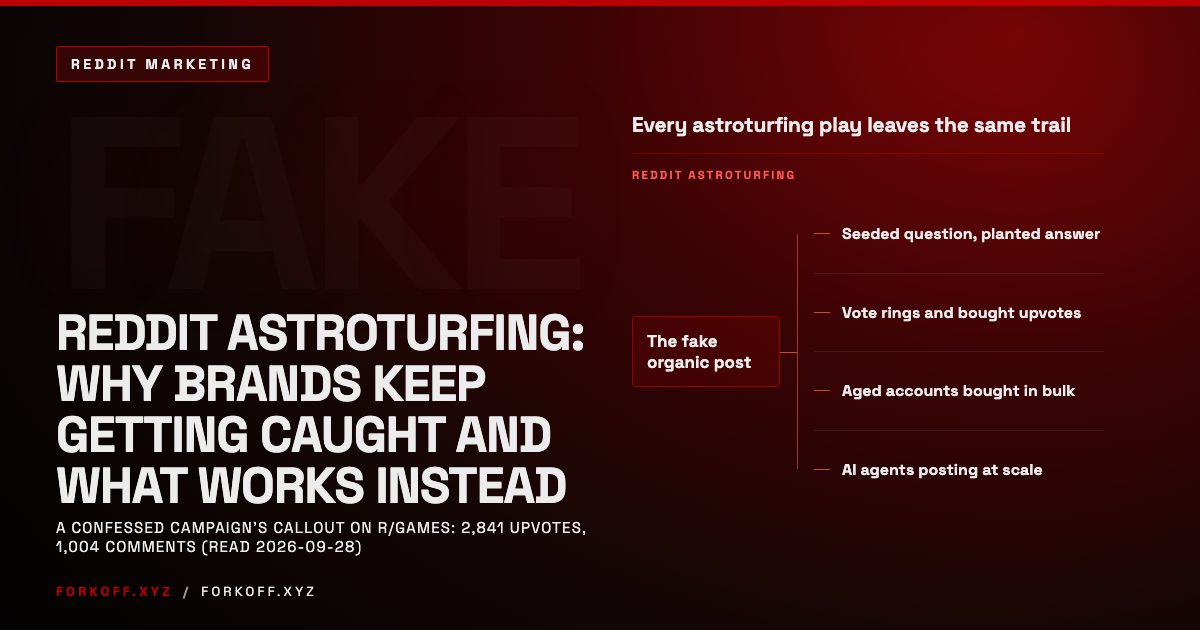
Reddit Astroturfing: Why Brands Keep Getting Caught and What Works Instead
Reddit astroturfing is paid promotion dressed up as organic talk. Why brands keep getting caught, what exposure costs, and the legitimate way to show up.
Read