

Gokul Cholaghar
@CholagharGokul · 1.3K followers
Introducing Libra AI, the SOTA super agent that amplifies your work, enabling you to bring your best everyday. Your work life will never be the same starting today. > Libra understands all your data and context like a human teammate > Takes actions on your behalf > Replaces the
Libra AI launchDistribution-amplified signature
Libra AI is a real product by a real founder (@CholagharGokul). RADAR has tracked 1.9M views on this launch, according to the source post linked below. RADAR measures how the launch reach was built, not whether the product works or whether anyone was honest. This reading is verified confidence and every input is public.
By Simba, Launch Intelligence Analyst · Reviewed by JK · Published 26 Aug 2026 · Confidence: verified
Independent, methodology-derived signal, not a statement of fact about any person. RADAR reads how reach was built, a signature, not an accusation. See the methodology.
Did the Libra AI launch go viral organically, or was the reach amplified?
The Libra AI launch by @CholagharGokul drew 1.9M views on 737 likes, which is 2,589 views per like, well above the roughly 500 organic ceiling. RADAR reads a distribution-amplified signature in how that reach was built, a signature of the mechanics and not a claim about the product or the founder. This is a verified reading and every input is public and reproducible.
New here? Start with the product
What is RADAR, and what does this grade mean?
RADAR is FORKOFF's launch authenticity rating system. It reads whether a product launch earned its reach through real engagement or bought it through paid distribution, using only public signals anyone can pull from the launch post. Every reading carries a letter grade, a confidence label, and the date it was last checked, and links back to a published method you can reproduce. Libra AI is a real product by a real founder (@CholagharGokul). RADAR measures how the reach was built, not whether the product works or whether anyone was honest.
Distribution-amplified signature
Independent, methodology-derived signal, not a statement of fact about any person. RADAR reads how reach was built, a signature, not an accusation. See the methodology.
What this grade means
RADAR reads a distribution-amplified signature on this launch: the reach ran ahead of the engagement that organic reach produces. The grade describes how the reach was built, not whether the product works or whether anyone was honest. Paying for distribution is legal and common.
The signals RADAR reads
Views-to-likes ratio
Organic reach tops out near 500 views per like. When views climb far past that without the likes to match, the extra reach is arriving without the engagement organic reach produces.
Amplification wave shape
Organic amplification spreads over hours and days. A coordinated launch fires a synchronized burst of quote posts in the first few hours, read from each post's own timestamp.
Posting-time fingerprint
A post that fires exactly top of the hour on a weekday is scheduled. On its own it is weak, but it corroborates a coordinated launch alongside the other two signals.
Those three public signals sit on top of RADAR's five-component forensic read. The full method, the bands, and the confidence model are on the RADAR methodology page.
This launch in the data
Where does this reach sit against the tracked corpus?
Where it sits in the corpus
Rank 25 of 30 tracked launches by views per like, lowest (most organic) first. A lower ratio is the favorable end.
Against the benchmark
This launch's views per like next to the organic median (354) and the amplified median (1,441) across the tracked set.
 The product
What is Libra AI?
Libra sits in the general AI agent lane, sometimes called the super-agent category: one assistant that plans and executes across a person's whole working day rather than one tool per task. The real alternatives a buyer weighs are the horizontal agent products (Manus, Genspark), the agent modes shipped inside the frontier assistants themselves, and the enterprise work-context players that index a company's internal tools and answer from them. Libra's stated wedge is the combination of the two: the context layer plus an agent that acts.
The company is real and funded. In January 2026 Gokul Cholaghar announced on his own account that Libra AI had closed a $1M pre-seed led by AMS Ventures alongside a group of angels, and said the team was hiring across engineering, growth and product with a base in Bengaluru and a possible move to San Francisco. Third-party company databases list the company under a Bay Area headquarters. The @librahq account was created in April 2026 and carried 1,220 followers at the time of this read, with the bio "feel the agi." These are the figures on the public record; RADAR did not find a disclosed customer count or revenue figure for Libra, and does not estimate one.
What it does
- Turns a plain-English task description into an autonomous agent that runs the workflow end to end.
- Briefs a user before a meeting, then writes the meeting up as it happens: decisions, action items, owners.
- Sorts incoming email into action and drafts replies in the user's own voice.
- Builds slide decks with layouts, charts and copy matched to a brand.
- Connects to more than 250 tools including Slack, Gmail, Notion, HubSpot, Jira, Figma, GitHub, Google Drive and Linear, read-only by default with the user controlling what each connection touches.
Those are the company's own stated capabilities, cited here as the claim made at launch, not independently tested by RADAR. This reading is only about how the launch's reach was built.
How the Libra AI launch worked
The launch was a single announcement carrying a 93-second product video, posted at 8:17 AM Pacific on Thursday 14 May 2026, from the founder's personal account @CholagharGokul rather than from the company account.
The post is a compact category claim followed by three arrow bullets. It opens with the name and the ambition, "Introducing Libra AI, the SOTA super agent that amplifies your work, enabling you to bring your best everyday," then adds the line that does the emotional work, "Your work life will never be the same starting today." The three bullets are the product in one screen: Libra understands all your data and context like a human teammate, takes actions on your behalf, and replaces the patchwork of vertical AI tools with one that actually does the work. It closes on early access and a tag to the company account.
The founder behind the account
Gokul Cholaghar is a real founder with a real history. His X account was created in September 2019, carries the bio "wielding agi @librahq" with a San Francisco location and 1,534 followers at the time of this read, and links a personal blog at blog.cholaghar.com. Company databases and his own professional profile list him as co-founder and chief executive of Libra AI, and describe an earlier consumer venture in India before this one. RADAR treats the earlier-venture detail as secondary-source rather than primary, and states it as such. What matters for this read is the shape of the account: a genuine, long-standing founder account with a small following, not a fresh or borrowed handle.
What Libra did during the launch
The launch is lean by design. There is no thread, no dated discount, no investor co-announcement in the post itself. It leans on one video, one category claim, and a founder account.
| Asset | What it did |
|---|---|
| 93-second product video | The whole demonstration layer, and the object the launch was built to move |
| A category claim in the first line | The "SOTA super agent" framing, staking a position rather than describing a feature |
| Three arrow bullets | Context, action, and consolidation, the entire product in one screen |
| An early-access offer | The ask, pointing readers at the company account rather than a checkout |
| Founder account, not brand account | Posted from a personal handle created in 2019, which reads warmer than a two-month-old company page |
| Timing: Thursday 8:17 AM PT | Inside the US-morning working window, but not a top-of-hour scheduled publish |
Read as a launch, that is a reasonable set of choices. A general agent is hard to explain in text, so a video-first announcement is the right call, and pointing early access at the company account is how a founder converts a spike in attention into followers for the brand. The question RADAR answers is narrower: what carried the video to nearly two million views.
How the launch performed
The launch post reached 1,940,427 views on 750 likes, with 148 reposts, 302 replies, 172 quotes and 297 bookmarks. These are matured public metrics, re-pulled directly from the source post on 26 August 2026, not a launch-minute snapshot.
Where the shape comes apart
Three things sit oddly next to each other. The first is the ratio: 2,587 views for every like is about 5.2 times the roughly 500 views-per-like ceiling that organic reach holds, because the same feed that surfaces a post also makes it easy to like, so reach and likes normally rise together. The second is total public engagement: 750 likes plus 148 reposts plus 302 replies plus 172 quotes is 1,372 actions, about 0.071 percent of the views. The third is save intent. Bookmarks run at 0.40 of likes here, and a launch for an agent that people actually want to try usually pushes bookmarks to at least parity with likes, because a bookmark is what a reader does when they intend to come back and use the thing.
The structural signal is the one that carries most weight. 1,940,427 views arrived at an account with 1,534 followers, roughly 1,265 times its own follower base, with no first-hour organic cluster underneath it. A launch can travel far past its follower count on merit, and plenty do, but a jump of that size normally leaves a matching trail of written engagement behind it. Here the reach ran well ahead of the conversation.
Views per like (matured)
About 5.2 times the roughly 500 organic ceiling, and above the 2,000 line where RADAR's heavy distribution band starts. Reach and engagement moved apart.
Bookmarks against likes
297 bookmarks on 750 likes. On an agent launch that people genuinely want to try, save intent usually pushes bookmarks to at least parity with likes.
Reach against the follower base
1,940,427 views from an account carrying 1,534 followers. This is the load-bearing structural signal on this read.
Amplifier roster
RADAR's forensic trace records a 33-account roster on this launch, including a confirmed cluster of 16 quote-tweet amplifiers. No account is named on this page.
One layer is genuinely respectable and worth crediting. 302 replies against 750 likes is a high written-engagement fraction, and replies are among the hardest actions to manufacture. Whatever else carried the views, some real readers stopped and typed.
Did the reach get earned or bought?
RADAR does not read a launch off the ratio alone. The verdict is a five-signal read that weighs the velocity curve, whether engagement layers stayed coupled to reach, whether the reply network looks like a real audience, and whether the amplification clusters. On this launch the signals agree with each other rather than pulling apart, which is why the confidence is verified rather than reconstructed: there is a trace, not just a number.
On the roster itself, RADAR reports size and structure and nothing else. A 33-account roster with a confirmed 16-account quote-tweet cluster is a description of a shape in the public data. No account, cohort or vendor is named on this page, and nothing here should be read as a claim about any specific third party.
What a founder can take from this launch
The lesson here is not about the spend. It is about what the spend cannot buy. Libra put a claim-dense video in front of nearly two million people and got 1,372 public actions back, and the layer that stayed thin was the one that matters most for a product like this: bookmarks, the save-for-later signal of a reader who intends to come back and try it. Distribution can put a launch in front of an audience. It cannot make that audience want the product.
The reply layer is the part worth copying. 302 replies against 750 likes says the video did make some people stop and argue with it, which is what a specific claim does and a vague one never does. A founder reading this should spend the effort on the thing that produced the replies before spending it on the thing that produced the views.
FORKOFF builds launch videos that are worth the distribution behind them, so the reach and the reaction move together instead of apart. See how we approach it on the viral launch video service, or read the best product launch videos we track for more real examples.
Questions readers ask about this launch
What is Libra AI?
+
Did the Libra AI launch go viral organically?
+
How many views did the Libra AI launch get?
+
Who is behind Libra AI?
+
What does a distribution-amplified signature mean?
+
Sources
Primary citation: x.com/CholagharGokul/status/2054944141726073190. Every number traces to a public pull; reads re-checked over time.
How RADAR read this launch, component by component
Each named component carries a plain-English definition and a directional read where the public data supports one. RADAR publishes the component names, never the weights or the formula.
View-velocity signature
Not publishedWhether the view curve grew the way organic spread does, or spiked like an injected burst.
Per-launch read not published in the public dataset. This component needs the forensic engine output.
Engagement coupling
Flags amplificationWhether likes, replies, and reposts grew in step with views (the organic signature), or the views ran out ahead.
At 2,589 views per like, reach runs well ahead of the likes, far above the roughly 500 organic ceiling.
Reply-network authenticity
Not publishedWhether the accounts replying are real, distributed people or a coordinated cluster posting together.
Per-launch read not published in the public dataset. This component needs the forensic engine output.
Amplifier-cluster pattern
Not publishedWhether the quote-tweet amplification looks like organic word of mouth or a known activation cluster.
Per-launch read not published in the public dataset. This component needs the forensic engine output.
Smart-follower activation
Not publishedWhether genuinely influential reference accounts engaged, or the reach was only low-quality volume.
Per-launch read not published in the public dataset. This component needs the forensic engine output.
Are you the founder of Libra AI? You can claim or contest this read. RADAR attaches a founder response to the launch and re-examines any component you dispute.
Authorship
Simba
Co-founder, FORKOFF
Reviewed by: Kshitij JK
Last reviewed:
Published:
Methodology
RADAR verified reading of the Libra AI launch from public metrics: the views-to-likes ratio against the roughly 500 organic ceiling and the posting-time slot, framed as a signature of how reach was built, not an accusation.
Sources cited
- RADAR methodology , FORKOFF
- Libra AI source post , X
Where to go next
Understand launch authenticity
Three ways in, depending on what brought you here: learn how the score works, get a launch read or built, or get the plain answer on this launch.
Learn the score
What a launch authenticity score is
A launch authenticity score reads whether a launch earned its reach or bought it, from public signals. Start with the definitions and the checks you can run yourself.
Verify or build
Launch authenticity verification
Want a launch read by the same method, or a launch video made and distributed on the outcome? RADAR reads any public launch, and FORKOFF builds the launch behind the reach.
The skeptic's question
Is the Libra AI launch legit?
If you are checking whether the Libra AIlaunch was real users or bots, here is the honest read: RADAR's reading is Distribution-amplified signature, at verified confidence, computed from public metrics and reproducible from the source post. It measures how the reach was built, not whether the product works.
Peer launches
Launches with a similar read
MetaMask Money Account launch
@MetaMask
3.7M views · 2,709 per likeRead
HyperAgent launch
@howietl
14.3M views · 2,265 per likeRead
depthfirst launch
@andreamichi
1.6M views · 2,983 per likeRead
Superblocks 2.0 launch
@bradmenezes
4.6M views · 2,088 per likeRead
Merge Gateway launch
@shensi
3.7M views · 1,953 per likeRead
Co-Invest launch
@liquidtrading
3.8M views · 1,545 per likeRead
The benchmark behind every reading
- The organic vs amplified benchmark. What a healthy launch ratio looks like, side by side.
- RADAR methodology. The bands, the confidence model, and how to reproduce a read.
- The Launch Authenticity Report 2026. The aggregate study across the tracked corpus.
- The X Launch Authenticity Study 2026. Two in three tracked launches show a bought-amplification signature.
- Verified-organic leaderboard. The launches RADAR reads as genuinely organic.
- Best product launch videos. The editorial cut of every tracked launch, ranked by views.
- Product launch video service. Get a launch video made and distributed, priced on the outcome.
Want a launch read by RADAR's method?
RADAR reads whether a launch's reach was earned or bought from public data, with the confidence label and the source citation on every reading.
Receipts, deep dives, and playbooks.
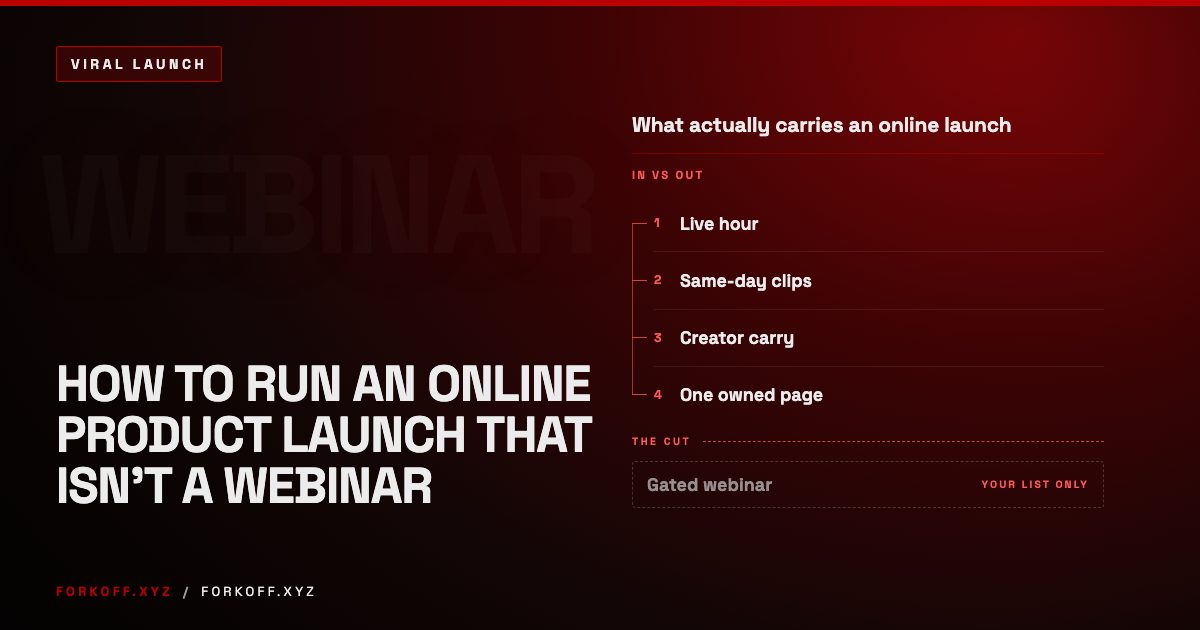
How to Run an Online Product Launch That Isn't a Webinar
An online product launch is a live moment cut into clips that creators carry, not a gated webinar. Here is the livestream, clip and creator stack for 2026.
 Read
Read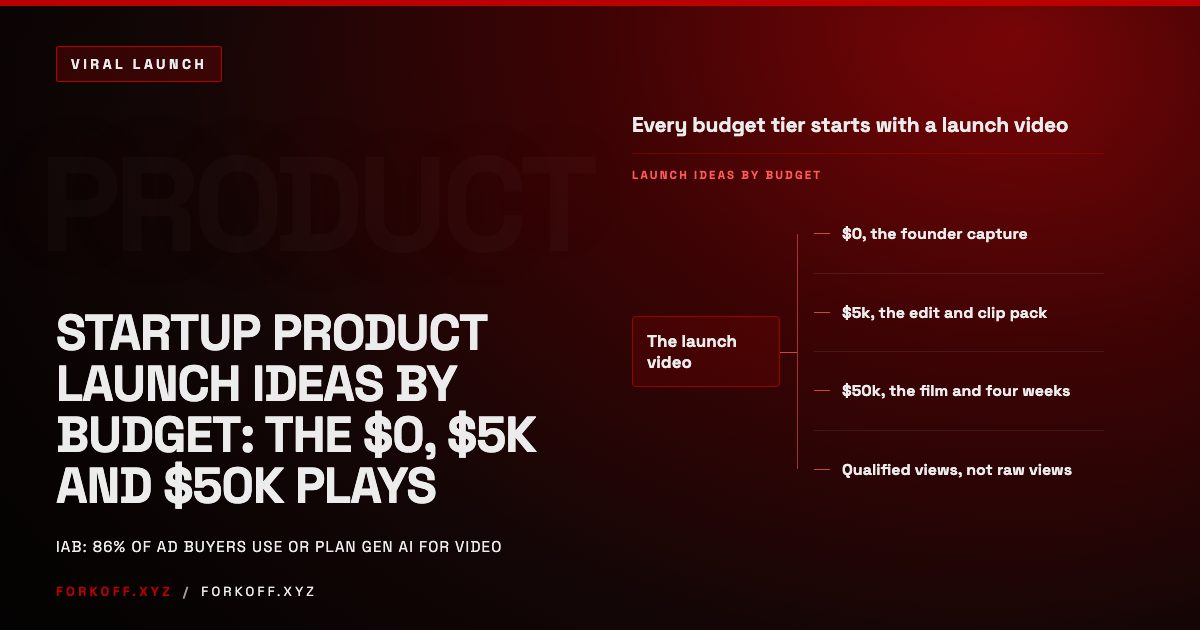
Startup Product Launch Ideas by Budget: The $0, $5k and $50k Plays
Product launch ideas for a SaaS startup sorted by budget: what the launch video should be at $0, $5k and $50k, and the distribution around it.
Read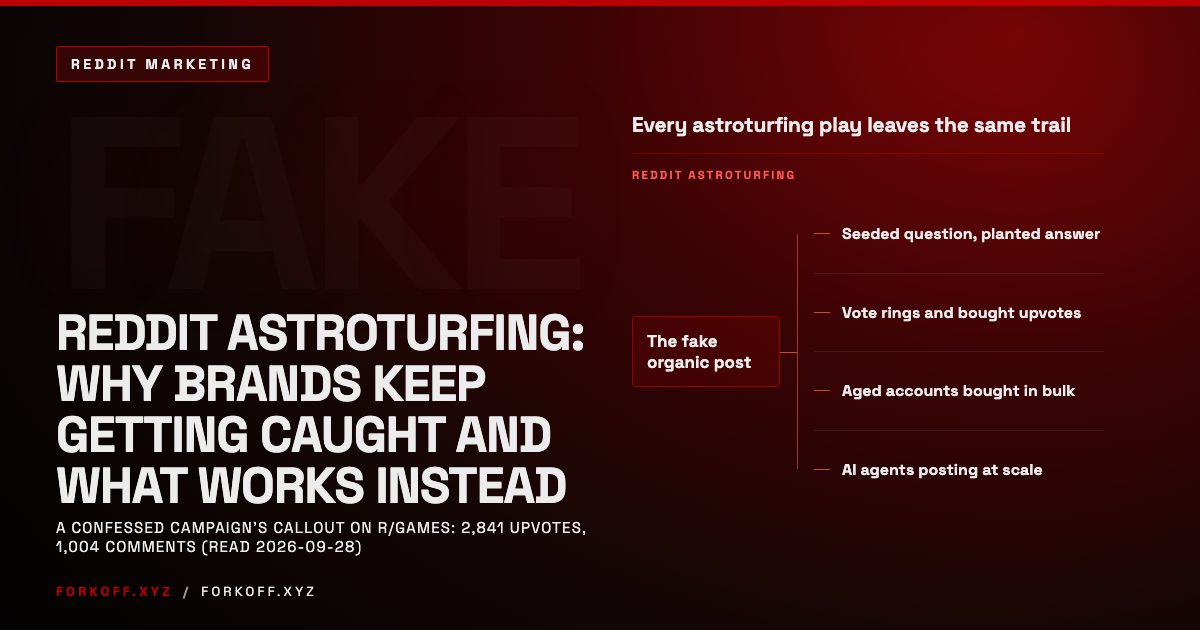
Reddit Astroturfing: Why Brands Keep Getting Caught and What Works Instead
Reddit astroturfing is paid promotion dressed up as organic talk. Why brands keep getting caught, what exposure costs, and the legitimate way to show up.
Read