

Howie Liu
@howietl · 238.6K followers
We’re giving away $10,000,000 to founders building agent-first businesses. Autonomous, proactive agents will run tomorrow's companies. We're backing 500 founders building them. The Founding 500.
HyperAgent launchDistribution-amplified signature
HyperAgent is a real product by a real founder (@howietl). RADAR has tracked 14.3M views on this launch, according to the source post linked below. RADAR measures how the launch reach was built, not whether the product works or whether anyone was honest. This reading is verified confidence and every input is public.
By Simba, Launch Intelligence Analyst · Reviewed by JK · Published 28 Jun 2026 · Confidence: verified
Independent, methodology-derived signal, not a statement of fact about any person. RADAR reads how reach was built, a signature, not an accusation. See the methodology.
Did the HyperAgent launch go viral organically, or was the reach amplified?
The HyperAgent launch by @howietl drew 14.3M views on 6.3K likes, which is 2,265 views per like, well above the roughly 500 organic ceiling. RADAR reads a distribution-amplified signature in how that reach was built, a signature of the mechanics and not a claim about the product or the founder. This is a verified reading and every input is public and reproducible.
New here? Start with the product
What is RADAR, and what does this grade mean?
RADAR is FORKOFF's launch authenticity rating system. It reads whether a product launch earned its reach through real engagement or bought it through paid distribution, using only public signals anyone can pull from the launch post. Every reading carries a letter grade, a confidence label, and the date it was last checked, and links back to a published method you can reproduce. HyperAgent is a real product by a real founder (@howietl). RADAR measures how the reach was built, not whether the product works or whether anyone was honest.
Distribution-amplified signature
Independent, methodology-derived signal, not a statement of fact about any person. RADAR reads how reach was built, a signature, not an accusation. See the methodology.
What this grade means
RADAR reads a distribution-amplified signature on this launch: the reach ran ahead of the engagement that organic reach produces. The grade describes how the reach was built, not whether the product works or whether anyone was honest. Paying for distribution is legal and common.
The signals RADAR reads
Views-to-likes ratio
Organic reach tops out near 500 views per like. When views climb far past that without the likes to match, the extra reach is arriving without the engagement organic reach produces.
Amplification wave shape
Organic amplification spreads over hours and days. A coordinated launch fires a synchronized burst of quote posts in the first few hours, read from each post's own timestamp.
Posting-time fingerprint
A post that fires exactly top of the hour on a weekday is scheduled. On its own it is weak, but it corroborates a coordinated launch alongside the other two signals.
Those three public signals sit on top of RADAR's five-component forensic read. The full method, the bands, and the confidence model are on the RADAR methodology page.
This launch in the data
Where does this reach sit against the tracked corpus?
Where it sits in the corpus
Rank 24 of 30 tracked launches by views per like, lowest (most organic) first. A lower ratio is the favorable end.
Against the benchmark
This launch's views per like next to the organic median (354) and the amplified median (1,441) across the tracked set.
A real product, a real founder, and reach that arrived faster than engagement could keep pace with.
Here is the tension that makes this launch interesting. Almost every public signal says the product is legitimate: a sitting decacorn CEO, a platform that already runs inside most of the Fortune 100, and a $10,000,000 commitment that real founders publicly applied to. None of that is in doubt. What RADAR measures is narrower and more specific. When a post collects 14.3M views but only 6,331 likes, the views are arriving from a channel that does not also produce engagement. That is the fingerprint of bought distribution layered on top of a real post, and it is exactly what the data here shows.
The rest of this teardown walks the forensic reading first, then steps back to the product, the founder, the fund, and the market, so a reader can audit the verdict and understand the launch in full. RADAR exists to separate the marketing layer (what a launch claims) from the data layer (what the public signals actually show). Both layers matter. This page documents both.
Three independent signals, all pointing the same way
The thing that made this launch look organic is the same thing that hid the buy. Howie Liu has a large follower base, around 150,000 to 238,000 depending on the snapshot, so 14.3M views reads as only about 95x his followers. That ratio, views per follower, is the weak signal, and it is exactly the one a large genuine account masks. It is why a first-pass read can call this organic. RADAR does not trust views-per-follower for this reason.
Signal one: the views-to-likes ratio
The load-bearing signal is V:L, views divided by likes. Organic reach on X tops out around 500 views per like, because the feed that surfaces a post also makes it easy to like, so reach and engagement rise together. X's 2026 ranking is most aggressive in the first 30 to 60 minutes and weights conversation signals like replies and bookmarks above raw likes, per published explainers of the algorithm (adlibrary.com). When views climb but likes do not keep pace, the views are arriving from somewhere that does not also produce engagement. Detection literature calls disproportionately high reach with thin organic engagement the canonical signature of amplification rather than grassroots interest (brandjet.ai).
Signal two: the quote-tweet wave fired in one window
Organic amplification spreads. A genuine viral post collects quote-tweets in a long, irregular tail as different people find it over hours and days. RADAR pulled the 120 quote-tweets that carried this launch and placed each on the timeline by its own publish time, derived from the tweet id. The shape is not a tail. It is a pulse.
71 of 120 quote-tweets (59%) landed in the 1-to-6-hour window. Zero seeders in the first hour, then a synchronized burst. Inside that window RADAR found a cluster of quote-tweets fired through a scheduling tool, plus a single recap account with 4.3M followers that alone drove about 561,946 views, plus a cluster of affiliate creators. RADAR does not name the specific third-party accounts or tools. A pre-briefed roster firing a synchronized batch right after the founder's post is what manufactures the velocity the 14.3M-view distribution then rides. This is a documented 2026 launch pattern: founders pre-build an audience, then flood launch day with scheduled posts and recruit accounts to quote-tweet the announcement (opentweet.io).
Signal three: the timing tell
The post itself carries a coordination tell. It fired at 07:00:06 PT on Friday 22 May 2026, top of the hour to the second. That is scheduled, not spontaneous, and it lands inside the Tuesday-Thursday-Friday US-morning band that the coordinated-launch playbook favors for maximum working-hours reach.
Launch time
Top-of-hour, to the second. Scheduled, consistent with a briefed-roster launch rather than a spontaneous post.
Day of week
Inside the Tue / Thu / Fri band the coordinated-launch playbook favors for maximum US working-hours reach.
Bookmark intent
Bookmarks slightly exceed likes. A genuine save-intent signal: the $10M offer is real and people saved it. It cannot rescue a 2,265:1 gap.
Amplification regime
A tier-1 real launch (Regime A) carried by an affiliate-creator quote-tweet swarm (Regime C). Engineered lift on a legitimate product.
Read together, the three signals tell one story. The bookmark-to-like ratio of 1.11 confirms real save intent, which is what you expect from a real $10,000,000 offer that real founders wanted. But save intent on a few thousand people cannot account for 14.3 million views. The gap between the reach and the engagement is the distribution buy, and the quote-tweet pulse is its delivery mechanism.
What HyperAgent and The Founding 500 actually are
Howie Liu announced the platform on 19 February 2026: "Today I'm excited to announce Hyperagent, by Airtable. An agents platform where every session gets its own isolated, full computing environment in the cloud, no Mac Mini" (x.com/howietl). Each session includes a real browser, shell, code execution, filesystem, image and video generation, mapping, data-warehouse access, and enterprise integrations (stork.ai, digg.com). The homepage positions it as a way to build a fleet of specialist agents in roles like Chief of Staff, Recruiter, Sales Prospector, and Data Analyst.
Its differentiating primitives are Skills (cross-session, domain-expert capabilities), plus rubrics and LLM-as-judge evals and fleet-wide observability for scaling (whatfinger startup). That capability surface, a browser plus shell plus filesystem plus integrations, places HyperAgent in the same general-agent category as Manus, Genspark, and Devin, not in the category of a venture fund.
The offer, decoded
Liu's launch tweet read: "We're giving away $10,000,000 to founders building agent-first businesses. Autonomous, proactive agents will run tomorrow's companies. We're backing 500 founders building them. The Founding 500" (x.com/howietl, 22 May 2026). Independent coverage is consistent that the $10M is inference credits, not cash. Stork.AI describes "$10M in inference credits to 500 people" and "$20K credits to start or run your business with agents"; Digg reports each selected founder receives "$20K in inference credits" (digg.com).
SERP results surface consistent program terms: a $200 application unlock and a 31 May 2026 deadline, capped at the first 500 qualifying applicants (x.com/AIwithArsalan, r/AI_Agents). The $200 figure traces to a HyperAgent builder and evangelist rather than to an official Airtable statement, so RADAR flags it as secondary, not confirmed by the company. There is also a tiered funnel beneath the headline grant: a separate $1,000 free-credit on-ramp (often via creator referral links) and a model-cost subsidy of up to 2.5x on frontier models.
The category: credit grant, not fund
The single most load-bearing product fact is the credit-versus-cash distinction. An agent-first business is one whose core operating model is built around autonomous, proactive agents as the operating layer, not a company that merely uses AI as a tool. Read plainly, The Founding 500 is best categorized as a platform credit-grant program, a category-seeding play that gets 500 agent-first startups building on HyperAgent's runtime. It wears the language of a founder fund, but the unit is compute. HyperAgent is also a separately branded Airtable product, its second standalone product following Superagent, and the Founding 500 layered on top on 22 May 2026 with a roughly 9-day application window (taskade). The fund is a launch-amplification mechanism for an already-live platform, not a standalone fund vehicle.
Howie Liu, cofounder and CEO of Airtable
Liu has been CEO since founding. Airtable now serves 450,000-plus organizations including Amazon, Netflix, Nike, and IBM (Crunchbase). His first company was Etacts, a CRM startup he cofounded around 2009, which Salesforce acquired in December 2010; Fortune notes he "cofounded his first company, CRM startup Etacts, when he was 21" (Fortune 40 Under 40). He was named to Fortune's 40 Under 40 in 2021 at age 32, a credible dated marker of his standing. Earlier biographical details (Duke University, self-taught coding at 13) come from secondary aggregators rather than a single primary CV, so RADAR treats those specifics as medium confidence (clay.com dossier).
Context matters for why a sitting CEO is personally funding 500 outside founders. Airtable raised a $735M Series F in December 2021 at an $11.7B post-money valuation (SQ Magazine). By early 2026, secondary-market marks had fallen well below that peak; Liu stated in January 2026 that shares traded on secondaries at roughly $4B, and TechCrunch framed the decline, in Liu's words, as "just the warm-up" for an agent-native re-founding (TechCrunch). HyperAgent and The Founding 500 are the go-to-market wedge of that pivot. RADAR notes that circulating net-worth figures for Liu are estimates, not verified disclosures, and does not state any specific number as fact.
Who is behind the $10M, and how it is structured
The program's credibility basis is corporate, not external. The framing cited in coverage is that Airtable "already runs in 80 percent of Fortune 100 companies" and has "over a billion dollars in the bank" (digg.com), which is what lets HyperAgent fund a $10M credit pool from its own resources rather than from an outside fund. For context on Airtable's own investors (distinct from any backer of The Founding 500, of which there is none named), Airtable has raised more than $1.4B across nine rounds, with Thrive Capital, Benchmark, Coatue, and CRV among notable investors (Tracxn). Its last primary valuation was $11.7B in the December 2021 Series F; 2026 secondary marks are materially lower (Public.com).
| Structural fact | Reading |
|---|---|
| $10M unit | Inference credits, not cash |
| Per founder | ~$20,000 credits x 500 founders |
| Funded by | Airtable balance sheet (no external fund) |
| Application | $200 unlock (secondary source), deadline 31 May 2026 |
| Best category | Platform credit-grant / category seeding |
Absence of a named partner in coverage is not proof that none exists. RADAR states only what the sources show: across the Phemex, Digg, and Startup Fortune writeups and the search aggregations, no co-sponsoring VC firm, accelerator, cloud provider, or named partner is attributed to The Founding 500 (Phemex).
Where this launch sits, and how modern launches are built
How does $20K in credits stack up?
Single-vendor startup-credit programs are now standard go-to-market, which makes the $20K play category-normal rather than unique. Vercel for Startups offers up to $200K in platform credits, Supabase up to $25K, Stripe Atlas around $2,500 plus partner perks, and OpenAI offers $5,000-plus via 200-plus partners (Stripe Atlas perks). The closest cash-plus-credit comparable is a16z Speedrun, which deploys up to $1M cash per startup plus up to $5M in partner credits (a16z). The fair, neutral contrast: Speedrun gives equity-backed cash plus a multi-vendor credit stack; HyperAgent gives single-vendor compute credits and no cash. The differentiator is volume (500 founders) and the agent-first framing, not the per-founder dollar amount.
The competitive set and the honest risk
The AI-agents software market is the fastest-growing software category, roughly $7.6B in 2025 rising toward $10.9B to $12.1B in 2026, and Gartner forecasts 40% of enterprise apps will embed task-specific agents by end of 2026, up from under 5% in 2025 (Gartner). The adversarial counter, which RADAR includes for balance, is that Gartner also warns 40%-plus of agentic-AI projects are at risk of cancellation by 2027, and reporting on the platform comparables (Manus, Genspark, Devin) notes the category is "funded ahead of validated outcomes" (TechTimes).
How modern launches are amplified
A coordinated launch in 2026 is a planned content storm, not one tweet. The documented playbook runs on a small set of repeatable levers: pre-built audiences, scheduled launch-day posts, and recruited accounts that quote-tweet the announcement to expose it to both audiences and signal the algorithm (FORKOFF: go viral on Twitter in 2026). Because X front-loads ranking in the first hour, a genuine launch shows tight, balanced early likes and replies relative to views; a post that accrues large views with thin early engagement is the classic amplification signature (adlibrary.com). None of this is an accusation. It is the neutral mechanics that explain why launch-day timeline saturation is a designed outcome rather than spontaneous virality, and it is exactly what the HyperAgent quote-tweet wave displays.
Comparable RADAR launches
RADAR has profiled a library of launches. Compare the HyperAgent reading against these peers:
Methodology, and what we are not saying
RADAR does not output a pass or fail on a person. It outputs a signature and a confidence label, both built from public metrics anyone can pull, so the reader can check the work. Three independent signals had to agree before this launch was tagged distribution-amplified:
- The views-per-like ratio (2,265:1) sat above the organic ceiling, sustained across the monitored window.
- The quote-tweet amplification clustered in a single early window (71 of 120 in hours 1 to 6) instead of spreading, with a scheduling-tool fingerprint and a single large recap account driving outsized views.
- The post fired at a scheduled, top-of-hour time (07:00:06 PT, Friday) consistent with a briefed-roster launch.
Confidence and how to reproduce it
Confidence is high, verified: built from a full 120-quote-tweet pull plus the live metric snapshot. This is one of the launches with a complete forensic trace, not a ratio-only reconstruction. Every input is public. Pull the anchor post's view and like counts, page its quote-tweets to exhaustion, derive each one's publish time from its tweet id, and bucket by hour. The ratio and the wave fall out of the data. See the full method at the RADAR methodology.
Questions readers ask about this launch
Is HyperAgent real?
+
Who is Howie Liu?
+
What is a normal views-to-likes ratio on X?
+
How do you know the reach was bought?
+
What is The Founding 500?
+
Sources
Primary citation: x.com/howietl/status/2057823823526014990. Every number traces to a public pull; reads re-checked over time.
- x.com/howietl/status/2057823823526014990 (launch post, 22 May 2026)
- x.com/howietl/status/2024618178912145592 (HyperAgent announcement, 19 Feb 2026)
- x.com/howietl (verified founder account)
- crunchbase.com/person/howie-liu
- fortune.com 40 Under 40, Howie Liu
- taskade.com history of Airtable
- stork.ai
- startup.whatfinger.com
- startupfortune.com
- reddit.com r/AI_Agents
- scouts.yutori.com
- phemex.com
- tracxn.com Airtable funding
- public.com/company/airtable-airt
- sqmagazine.co.uk Airtable statistics
- techcrunch.com Airtable valuation
- a16z.com Speedrun
- support.stripe.com Atlas perks
- news.crunchbase.com Q1 2026 funding
- gartner.com agent forecast
- techtimes.com
- opentweet.io build-in-public guide
- adlibrary.com X algorithm
- brandjet.ai bot detection
- en.wikipedia.org/wiki/Airtable
How RADAR read this launch, component by component
Each named component carries a plain-English definition and a directional read where the public data supports one. RADAR publishes the component names, never the weights or the formula.
View-velocity signature
Not publishedWhether the view curve grew the way organic spread does, or spiked like an injected burst.
Per-launch read not published in the public dataset. This component needs the forensic engine output.
Engagement coupling
Flags amplificationWhether likes, replies, and reposts grew in step with views (the organic signature), or the views ran out ahead.
At 2,265 views per like, reach runs well ahead of the likes, far above the roughly 500 organic ceiling.
Reply-network authenticity
Not publishedWhether the accounts replying are real, distributed people or a coordinated cluster posting together.
Per-launch read not published in the public dataset. This component needs the forensic engine output.
Amplifier-cluster pattern
Not publishedWhether the quote-tweet amplification looks like organic word of mouth or a known activation cluster.
Per-launch read not published in the public dataset. This component needs the forensic engine output.
Smart-follower activation
Not publishedWhether genuinely influential reference accounts engaged, or the reach was only low-quality volume.
Per-launch read not published in the public dataset. This component needs the forensic engine output.
Are you the founder of HyperAgent? You can claim or contest this read. RADAR attaches a founder response to the launch and re-examines any component you dispute.
Authorship
Simba
Co-founder, FORKOFF
Reviewed by: Kshitij JK
Last reviewed:
Published:
Methodology
RADAR verified reading of the HyperAgent launch from public metrics: the views-to-likes ratio against the roughly 500 organic ceiling and the posting-time slot, framed as a signature of how reach was built, not an accusation.
Sources cited
- RADAR methodology , FORKOFF
- HyperAgent source post , X
Where to go next
Understand launch authenticity
Three ways in, depending on what brought you here: learn how the score works, get a launch read or built, or get the plain answer on this launch.
Learn the score
What a launch authenticity score is
A launch authenticity score reads whether a launch earned its reach or bought it, from public signals. Start with the definitions and the checks you can run yourself.
Verify or build
Launch authenticity verification
Want a launch read by the same method, or a launch video made and distributed on the outcome? RADAR reads any public launch, and FORKOFF builds the launch behind the reach.
The skeptic's question
Is the HyperAgent launch legit?
If you are checking whether the HyperAgentlaunch was real users or bots, here is the honest read: RADAR's reading is Distribution-amplified signature, at verified confidence, computed from public metrics and reproducible from the source post. It measures how the reach was built, not whether the product works.
Peer launches
Launches with a similar read
Superblocks 2.0 launch
@bradmenezes
4.6M views · 2,088 per likeRead
Merge Gateway launch
@shensi
3.7M views · 1,953 per likeRead
Libra AI launch
@CholagharGokul
1.9M views · 2,589 per likeRead
MetaMask Money Account launch
@MetaMask
3.7M views · 2,709 per likeRead
depthfirst launch
@andreamichi
1.6M views · 2,983 per likeRead
Co-Invest launch
@liquidtrading
3.8M views · 1,545 per likeRead
The benchmark behind every reading
- The organic vs amplified benchmark. What a healthy launch ratio looks like, side by side.
- RADAR methodology. The bands, the confidence model, and how to reproduce a read.
- The Launch Authenticity Report 2026. The aggregate study across the tracked corpus.
- The X Launch Authenticity Study 2026. Two in three tracked launches show a bought-amplification signature.
- Verified-organic leaderboard. The launches RADAR reads as genuinely organic.
- Best product launch videos. The editorial cut of every tracked launch, ranked by views.
- Product launch video service. Get a launch video made and distributed, priced on the outcome.
Want a launch read by RADAR's method?
RADAR reads whether a launch's reach was earned or bought from public data, with the confidence label and the source citation on every reading.
Receipts, deep dives, and playbooks.
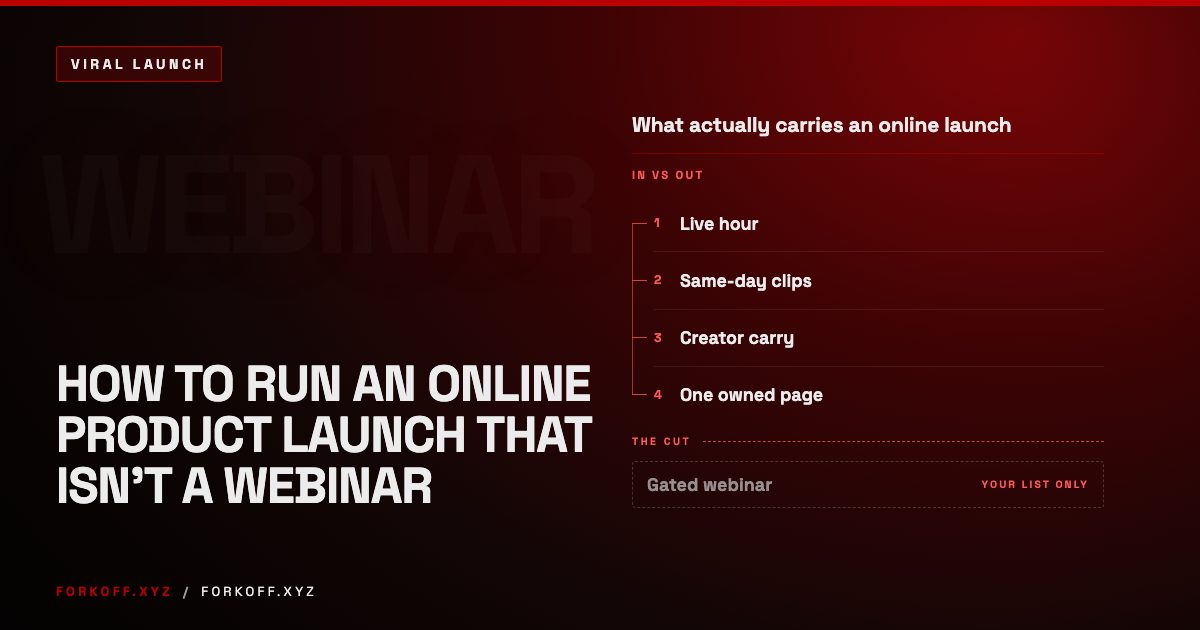
How to Run an Online Product Launch That Isn't a Webinar
An online product launch is a live moment cut into clips that creators carry, not a gated webinar. Here is the livestream, clip and creator stack for 2026.
 Read
Read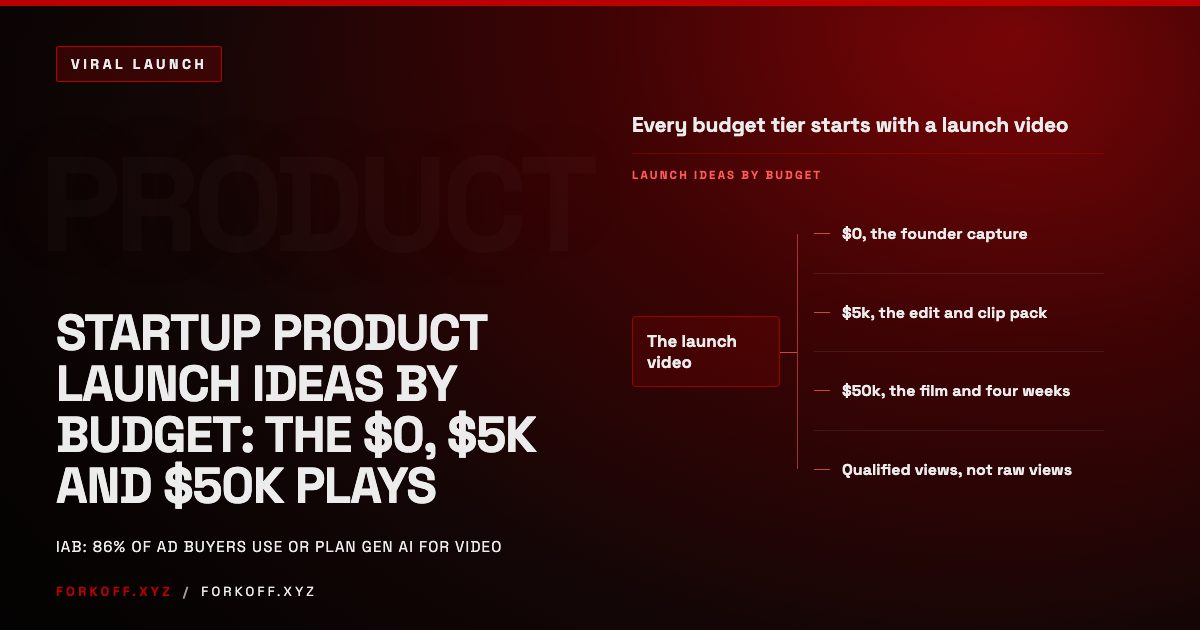
Startup Product Launch Ideas by Budget: The $0, $5k and $50k Plays
Product launch ideas for a SaaS startup sorted by budget: what the launch video should be at $0, $5k and $50k, and the distribution around it.
Read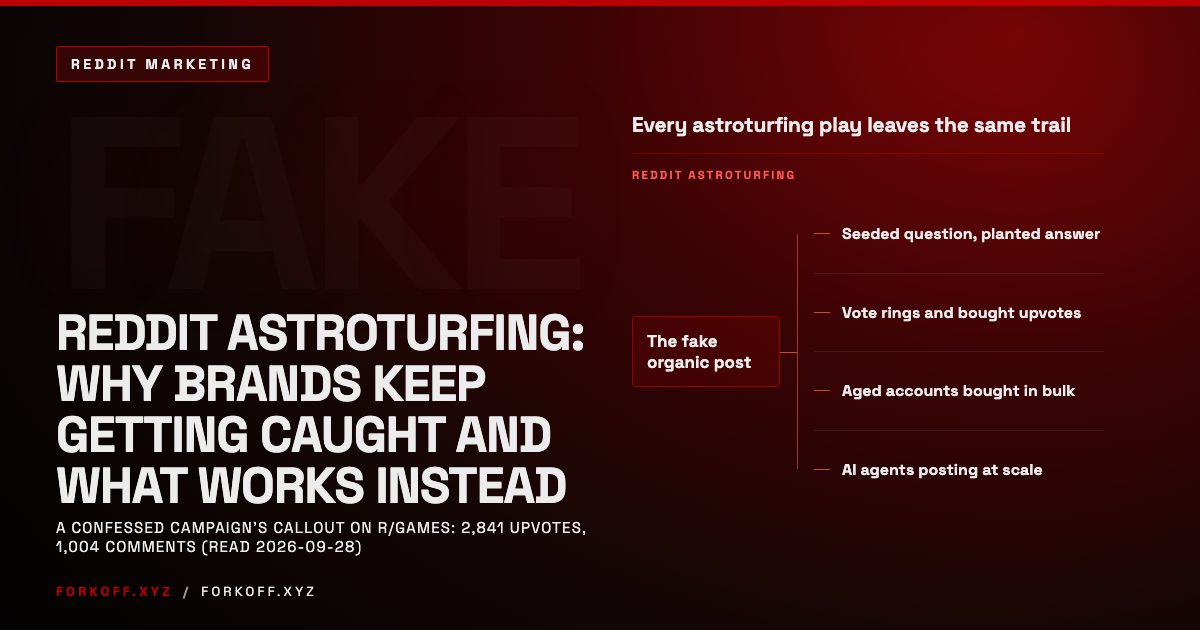
Reddit Astroturfing: Why Brands Keep Getting Caught and What Works Instead
Reddit astroturfing is paid promotion dressed up as organic talk. Why brands keep getting caught, what exposure costs, and the legitimate way to show up.
Read