

Michael Belhassen
@michaelblhssn · 1.8K followers
Meet Anoria. The first wearable that reads your emotions so you can enhance your EQ. Welcome to the EQ era. RT + comment "EQ" to receive an invitation to pre-order.
Anoria launchDistribution-amplified signature
Anoria is a real product by a real founder (@michaelblhssn). RADAR has tracked 5.7M views on this launch, according to the source post linked below. RADAR measures how the launch reach was built, not whether the product works or whether anyone was honest. This reading is verified confidence and every input is public.
By Simba, Launch Intelligence Analyst · Reviewed by JK · Published 22 Aug 2026 · Confidence: verified
Independent, methodology-derived signal, not a statement of fact about any person. RADAR reads how reach was built, a signature, not an accusation. See the methodology.
Did the Anoria launch go viral organically, or was the reach amplified?
The Anoria launch by @michaelblhssn drew 5.7M views on 1.3K likes, which is 4,410 views per like, well above the roughly 500 organic ceiling. RADAR reads a distribution-amplified signature in how that reach was built, a signature of the mechanics and not a claim about the product or the founder. This is a verified reading and every input is public and reproducible.
New here? Start with the product
What is RADAR, and what does this grade mean?
RADAR is FORKOFF's launch authenticity rating system. It reads whether a product launch earned its reach through real engagement or bought it through paid distribution, using only public signals anyone can pull from the launch post. Every reading carries a letter grade, a confidence label, and the date it was last checked, and links back to a published method you can reproduce. Anoria is a real product by a real founder (@michaelblhssn). RADAR measures how the reach was built, not whether the product works or whether anyone was honest.
Distribution-amplified signature
Independent, methodology-derived signal, not a statement of fact about any person. RADAR reads how reach was built, a signature, not an accusation. See the methodology.
What this grade means
RADAR reads a distribution-amplified signature on this launch: the reach ran ahead of the engagement that organic reach produces. The grade describes how the reach was built, not whether the product works or whether anyone was honest. Paying for distribution is legal and common.
The signals RADAR reads
Views-to-likes ratio
Organic reach tops out near 500 views per like. When views climb far past that without the likes to match, the extra reach is arriving without the engagement organic reach produces.
Amplification wave shape
Organic amplification spreads over hours and days. A coordinated launch fires a synchronized burst of quote posts in the first few hours, read from each post's own timestamp.
Posting-time fingerprint
A post that fires exactly top of the hour on a weekday is scheduled. On its own it is weak, but it corroborates a coordinated launch alongside the other two signals.
Those three public signals sit on top of RADAR's five-component forensic read. The full method, the bands, and the confidence model are on the RADAR methodology page.
This launch in the data
Where does this reach sit against the tracked corpus?
Where it sits in the corpus
Rank 28 of 30 tracked launches by views per like, lowest (most organic) first. A lower ratio is the favorable end.
Against the benchmark
This launch's views per like next to the organic median (354) and the amplified median (1,441) across the tracked set.
 The product
What is Anoria?
Anoria sits in the consumer wearables and health-tech market, alongside fitness trackers and sleep monitors, but targets emotional state rather than physical activity. Its positioning bet is that emotional intelligence, not step counts or heart rate, is the next metric a wearable should surface, an unproven but clearly stated product thesis.
The company is Anoria Inc., and its founder is publicly identified as a Y Combinator company from the P26 batch. RADAR treats the YC affiliation and the product description as the company's own stated facts, cited for context, not independently verified beyond what YC and the company publish.
Who built it
- A wearable device, positioned as reading a user's emotional state to help the wearer build EQ.
- Built by Anoria Inc., a Y Combinator P26 company.
- Founded and posted by Michael Belhassen (@michaelblhssn), who describes prior design experience at Apple.
- Launched pre-order-only, with the launch post itself functioning as the sign-up mechanism.
How the Anoria launch worked
The launch was a single video announcement posted at 10:01 AM Pacific, one minute past the hour, on Tuesday 5 May 2026, from founder Michael Belhassen's own account, @michaelblhssn.
The post is short: "Meet Anoria. The first wearable that reads your emotions so you can enhance your EQ. Welcome to the EQ era." It closes with a direct call to action built into the mechanics of the platform itself: "RT + comment 'EQ' to receive an invitation to pre-order."
An engagement-incentivized call to action
This detail matters for reading the numbers below. The post does not simply invite interest; it makes a repost and a specific one-word comment the mechanism for getting on the waitlist. That structure directly incentivizes reposts and replies rather than leaving them spontaneous, and RADAR discloses it explicitly wherever the reply layer is discussed as evidence, the same disclosure standard applied to any other launch with a built-in engagement incentive.
What Anoria did during the launch
The launch combined a small number of levers, one of which (the RT-and-comment mechanic) is directly designed to inflate the reply and repost counts rather than leave them organic.
| Asset | What it did |
|---|---|
| Product video | Demonstrated the device rather than only describing it |
| "Welcome to the EQ era" framing | A category-naming hook, positioning a new metric rather than a feature |
| RT + comment "EQ" mechanic | Turned the waitlist sign-up into an engagement action, directly incentivizing reposts and replies |
| Timing: Tuesday 10:01 AM PT | One minute past the hour, off the clean top-of-hour slot most scheduled launches in this set use |
The RT-and-comment mechanic is the one structural feature that separates this launch from a plain announcement. It is a legitimate, common growth tactic, and it does not by itself explain the matured 6,295:1 views-to-likes ratio set out below, since it targets reposts and comments, not likes; the like count stayed thin even as the incentivized layers grew.
How the launch performed
The launch post reached 5,665,795 views on 900 likes, with 177 reposts, 369 replies, and 105 quotes. These are matured public metrics, re-pulled directly from the source post.
The 900-like figure is itself a moving number worth flagging plainly. At the original detection pull the post carried 1,283 likes; on this re-check it carries 900, a decline of roughly 30 percent. Likes falling over time is unusual for organic growth and is more consistent with a platform-side removal of low-quality or automated engagement. Because the view count held steady and grew slightly, the ratio widened rather than narrowed as the launch matured, from 4,410 views per like at detection to 6,295 on this re-check.
Views per like (matured)
Roughly 12.6 times the 500 organic ceiling. Reach ran far ahead of the audience that liked the post.
Total engagement
900 likes, 177 reposts, 369 replies, 105 quotes, about 0.027% of the 5.67M views. A thin layer under a large reach.
Coordinated pod clusters
A retroactive sample of 40 replies found two clusters of engagers, 6 accounts and 3 accounts, each posting within roughly 2 minutes of each other. Together they cover more than a quarter of the sampled engagement.
Like count since detection
The like count dropped about 30% between the original pull and this re-check, consistent with a platform-side prune of low-quality engagement rather than organic growth.
Two coordinated engager clusters in the reply sample
A retroactive sample of 40 replies to the launch post found two distinct clusters of accounts posting within roughly two minutes of one another, one of six accounts and one of three. Together the sampled clusters account for more than a quarter of the engagement in that sample. A cluster this tight is not proof of a coordinated buy on its own (real conversations can bunch up around a moment when a post gets attention), but it is the kind of temporal pattern RADAR's forensic trace is built to surface, and it sits alongside, not against, the wide views-to-likes gap.
Did the reach get earned or bought?
This is a verified reading (RADAR holds a full forensic trace for this launch), so the finding is stated with confidence, and it should be read narrowly. The verdict published here, distribution-amplified, was assigned from that full trace at the time the launch was first analyzed and is not re-derived from today's wider ratio; the widening is disclosed as an honest update to the underlying numbers, not a re-scoring of the launch.
What a founder can take from this launch
The RT-and-comment mechanic Anoria used is a legitimate, low-cost way to seed a waitlist, and it is worth separating from the reach question entirely: it explains part of the reply and repost counts, but it does not explain a matured 6,295:1 views-to-likes ratio or a cluster of accounts engaging within a two-minute window of each other. A founder considering the same mechanic should expect it to lift replies and reposts specifically, and should treat any accompanying view-count spike as a separate thing to verify, not an automatic consequence of the giveaway.
FORKOFF builds launch plans around what a mechanic is actually built to move, so a view count and an engagement mechanic tell a story that holds up under a check like this one. See how we approach it on the launch video service, or read the best product launch videos we track for more real examples.
Questions readers ask about this launch
What is Anoria?
+
Did the Anoria launch go viral organically?
+
How many views did the Anoria launch get?
+
Why did Anoria's like count go down over time?
+
Does a distribution-amplified signature mean Anoria did something wrong?
+
Sources
Primary citation: x.com/michaelblhssn/status/2051708754086051876. Every number traces to a public pull; reads re-checked over time.
How RADAR read this launch, component by component
Each named component carries a plain-English definition and a directional read where the public data supports one. RADAR publishes the component names, never the weights or the formula.
View-velocity signature
Not publishedWhether the view curve grew the way organic spread does, or spiked like an injected burst.
Per-launch read not published in the public dataset. This component needs the forensic engine output.
Engagement coupling
Flags amplificationWhether likes, replies, and reposts grew in step with views (the organic signature), or the views ran out ahead.
At 4,410 views per like, reach runs well ahead of the likes, far above the roughly 500 organic ceiling.
Reply-network authenticity
Not publishedWhether the accounts replying are real, distributed people or a coordinated cluster posting together.
Per-launch read not published in the public dataset. This component needs the forensic engine output.
Amplifier-cluster pattern
Not publishedWhether the quote-tweet amplification looks like organic word of mouth or a known activation cluster.
Per-launch read not published in the public dataset. This component needs the forensic engine output.
Smart-follower activation
Not publishedWhether genuinely influential reference accounts engaged, or the reach was only low-quality volume.
Per-launch read not published in the public dataset. This component needs the forensic engine output.
Are you the founder of Anoria? You can claim or contest this read. RADAR attaches a founder response to the launch and re-examines any component you dispute.
Authorship
Simba
Co-founder, FORKOFF
Reviewed by: Kshitij JK
Last reviewed:
Published:
Methodology
RADAR verified reading of the Anoria launch from public metrics: the views-to-likes ratio against the roughly 500 organic ceiling and the posting-time slot, framed as a signature of how reach was built, not an accusation.
Sources cited
- RADAR methodology , FORKOFF
- Anoria source post , X
Where to go next
Understand launch authenticity
Three ways in, depending on what brought you here: learn how the score works, get a launch read or built, or get the plain answer on this launch.
Learn the score
What a launch authenticity score is
A launch authenticity score reads whether a launch earned its reach or bought it, from public signals. Start with the definitions and the checks you can run yourself.
Verify or build
Launch authenticity verification
Want a launch read by the same method, or a launch video made and distributed on the outcome? RADAR reads any public launch, and FORKOFF builds the launch behind the reach.
The skeptic's question
Is the Anoria launch legit?
If you are checking whether the Anorialaunch was real users or bots, here is the honest read: RADAR's reading is Distribution-amplified signature, at verified confidence, computed from public metrics and reproducible from the source post. It measures how the reach was built, not whether the product works.
Peer launches
Launches with a similar read
notch launch
@vinayjain404
1.8M views · 5,824 per likeRead
depthfirst launch
@andreamichi
1.6M views · 2,983 per likeRead
MetaMask Money Account launch
@MetaMask
3.7M views · 2,709 per likeRead
Libra AI launch
@CholagharGokul
1.9M views · 2,589 per likeRead
HyperAgent launch
@howietl
14.3M views · 2,265 per likeRead
Superblocks 2.0 launch
@bradmenezes
4.6M views · 2,088 per likeRead
The benchmark behind every reading
- The organic vs amplified benchmark. What a healthy launch ratio looks like, side by side.
- RADAR methodology. The bands, the confidence model, and how to reproduce a read.
- The Launch Authenticity Report 2026. The aggregate study across the tracked corpus.
- The X Launch Authenticity Study 2026. Two in three tracked launches show a bought-amplification signature.
- Verified-organic leaderboard. The launches RADAR reads as genuinely organic.
- Best product launch videos. The editorial cut of every tracked launch, ranked by views.
- Product launch video service. Get a launch video made and distributed, priced on the outcome.
Want a launch read by RADAR's method?
RADAR reads whether a launch's reach was earned or bought from public data, with the confidence label and the source citation on every reading.
Receipts, deep dives, and playbooks.
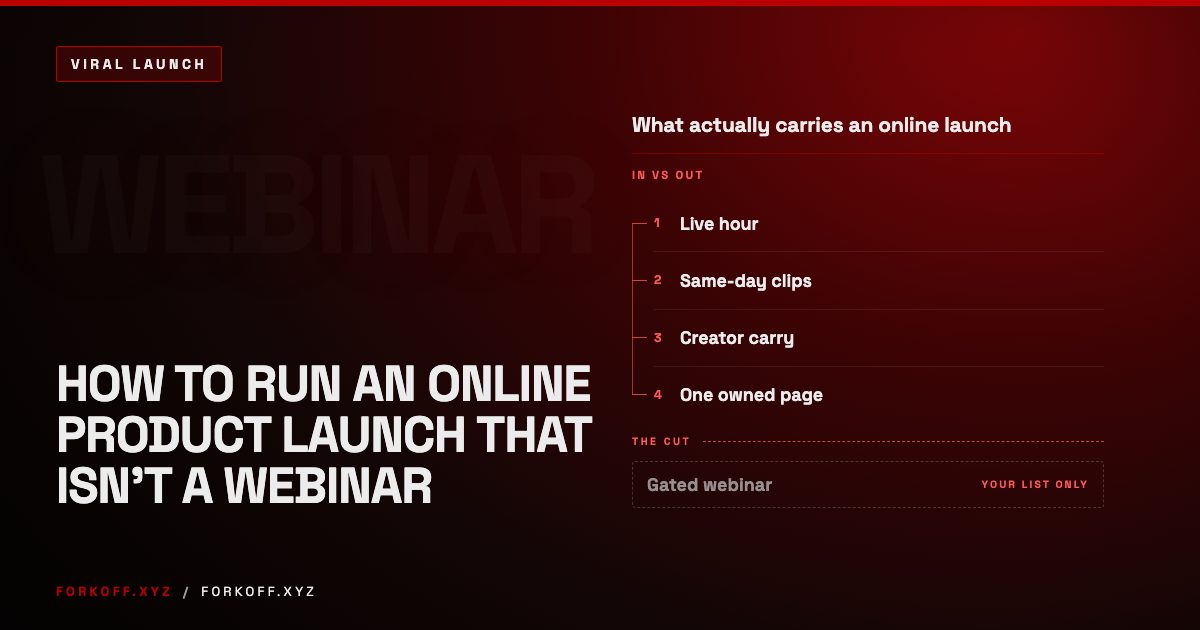
How to Run an Online Product Launch That Isn't a Webinar
An online product launch is a live moment cut into clips that creators carry, not a gated webinar. Here is the livestream, clip and creator stack for 2026.
 Read
Read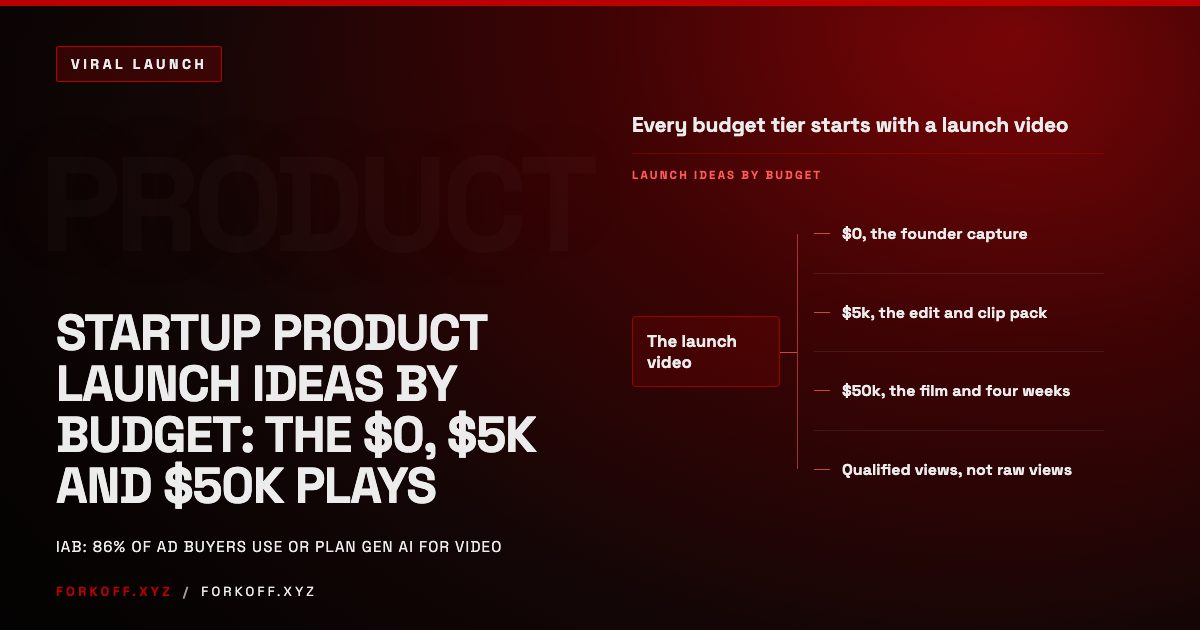
Startup Product Launch Ideas by Budget: The $0, $5k and $50k Plays
Product launch ideas for a SaaS startup sorted by budget: what the launch video should be at $0, $5k and $50k, and the distribution around it.
Read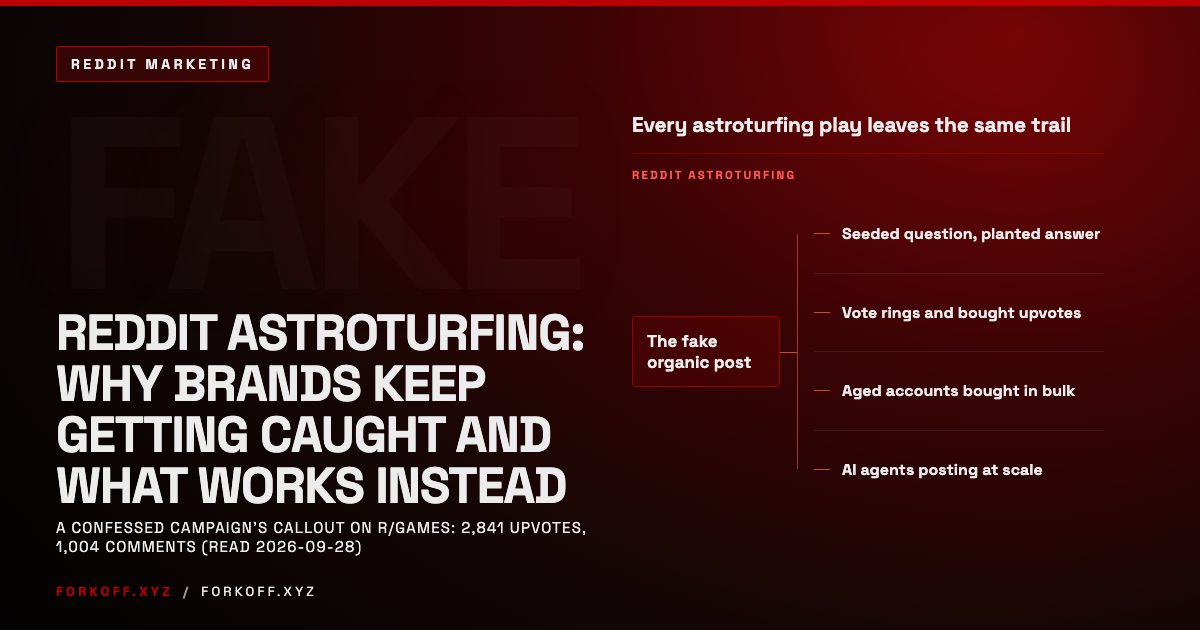
Reddit Astroturfing: Why Brands Keep Getting Caught and What Works Instead
Reddit astroturfing is paid promotion dressed up as organic talk. Why brands keep getting caught, what exposure costs, and the legitimate way to show up.
Read