
How often should you post on X (Twitter) in 2026?
Updated Jul 25, 2026
Most published guidance for X (Twitter) lands between 2 and 5 posts a day, but frequency is a floor, not the lever that grows an account. Hootsuite's 2026 guidance is 2 to 3 posts a day. Sprout Social reports the industry average has fallen to about 2 tweets a day, down from 3 to 4 in 2022, and RivalIQ's 2025 benchmark found brands cut their X posting by 33 percent year over year, the sharpest drop of any major platform. So the average cadence is falling, which means consistency now beats raw volume. The failure mode is posting more low-quality tweets to hit a number, because that trains the feed to show your posts to fewer people. The right cadence is enough to stay in the conversation, replies included, at a quality high enough to earn engagement. FORKOFF sets cadence by what each post earns, not by a vanity quota, the same discipline behind 5B+ processed views.
- 01Start at 2 to 3 original posts a day Hootsuite's 2026 guidance for X is 2 to 3 posts a day, and it is a sensible floor for a founder or brand building presence. It is enough to stay visible without flooding the feed, and it leaves room for the replies that actually drive reach.
- 02Count replies as part of your cadence Original posts are only half of an X cadence. Replies to other accounts are a reach engine in their own right, because the conversation pulls your posts into more feeds. An account that posts twice and replies twenty times a day is more present than one that fires off five posts and never engages.
- 03Do not confuse volume with presence The industry average has dropped to about 2 tweets a day (Sprout Social), down from 3 to 4 in 2022, so more people are posting less. Presence is about showing up consistently in the right conversations, not about winning a post-count race that most brands have already quit.
- 04Protect quality over quantity RivalIQ found brands cut X posting 33 percent year over year, the steepest fall of any platform, as low-return posting got trimmed. Every post you add that does not earn engagement is a signal to the feed that your account is worth showing less, so a smaller number of strong posts beats a firehose of weak ones.
- 05Batch and schedule to stay consistent Consistency is the hard part, not volume. Batching writing and scheduling posts across the week keeps a steady presence without the daily scramble that leads to skipped days or filler tweets. The feed rewards the account that reliably shows up over the one that posts in bursts.
- 06Let per-post outcomes set your number There is no universal correct cadence; there is the cadence your audience rewards. Track engagement per post, and raise frequency only while each additional post still earns replies and reach. When extra posts stop performing, you have found your ceiling, and pushing past it costs you distribution.
Why the right number is a range, not a rule
The published numbers converge on a band rather than a single answer. Hootsuite recommends 2 to 3 posts a day on X, Sprout Social pegs the current industry average at about 2 tweets a day (down from 3 to 4 in 2022), and RivalIQ's 2025 benchmark recorded a 33 percent year-over-year drop in brand posting, the largest of any platform it tracks. Read together, those figures say the same thing: the market is posting less and leaning on consistency and quality instead of volume. That is why a fixed quota misleads. Two excellent posts a day that earn replies will out-reach eight forgettable ones, because the feed reads weak posts as a reason to show your account to fewer people. FORKOFF runs X marketing on cadence set by what each post earns, not by a number on a calendar.
Cadence is a floor; the reply system is the lever
How often you post decides whether you are present. What you post, and how much conversation it earns, decides whether you grow. On X the reply is the reach engine, so an account posting twice a day and replying widely will beat one that posts five times and never engages. Frequency is the floor you clear so the feed keeps testing you; the lever is the engagement each post earns, which is why the deeper play is getting more views on X rather than simply posting more. If the goal is a growing following rather than per-post reach, our guide on how to grow on X in 2026 covers the longer game that cadence sits inside. And if you are still weighing the channel itself, does Twitter marketing work settles that question on the numbers.
What the data says about X posting frequency
| Source | The number | What it means |
|---|---|---|
| Hootsuite (2026) | 2 to 3 posts a day on X | A sensible floor for a brand or founder building presence |
| Sprout Social | About 2 tweets a day (industry average) | Down from 3 to 4 a day in 2022; the market posts less now |
| RivalIQ (2025) | Posting down 33% year over year | The sharpest drop of any platform; low-return posting got cut |
| Replies | No fixed number | A reach engine on top of original posts; count them in your cadence |
| Your analytics | Whatever still earns engagement | The real ceiling: raise frequency only while each post performs |
The 2 to 3 posts a day figure is Hootsuite's 2026 guidance, the roughly 2 tweets a day average is Sprout Social's, and the 33 percent year-over-year decline is from RivalIQ's 2025 Social Media Industry Benchmark Report, not FORKOFF figures. Search demand for "how often should you post on x" and "how often should you post on twitter" runs about 40 queries a month combined (DataForSEO, 2026), and AI answers cite scattered blogs rather than one clear source, which is the gap this answer fills.
Frequently asked questions
How many times a day should you post on X (Twitter)?
Hootsuite's 2026 guidance is 2 to 3 original posts a day, and Sprout Social reports the current industry average at about 2 tweets a day. Treat that as a floor rather than a target. Consistency and the replies you add on top matter more than hitting a specific post count, and pushing volume past the point where each post earns engagement costs you reach.
Is it bad to post too often on X?
It can be. Every post that does not earn engagement signals the feed to show your account to fewer people, so a firehose of weak posts actively reduces your reach. RivalIQ found brands cut X posting 33 percent in a year, largely by trimming low-return posts. A smaller number of strong posts, plus active replying, out-performs high-volume filler.
Do replies count toward how often you should post on X?
Yes. Replies are a reach engine in their own right, because the conversation pulls your posts into more feeds. An account that posts 2 to 3 times a day and replies widely is more present, and usually grows faster, than one that posts five times and never engages. Count replies as part of your cadence, not as an afterthought.
How often should a startup or founder post on X?
Start at 2 to 3 posts a day plus active replies, then let your analytics set the ceiling. Raise frequency only while each additional post still earns replies and reach; when extra posts stop performing, you have found your number. For a founder, the reply conversations often matter more than the original posts, so protect time for both.
How does FORKOFF decide posting frequency for clients?
FORKOFF sets cadence by what each post earns, not by a fixed quota. It establishes a consistent floor, adds the reply activity that drives reach, and raises frequency only while engagement holds, measuring the result as qualified views rather than post volume, the same integrity layer behind 5B+ processed views.
Get the specific number for your campaign.
Receipts, deep dives, and playbooks.
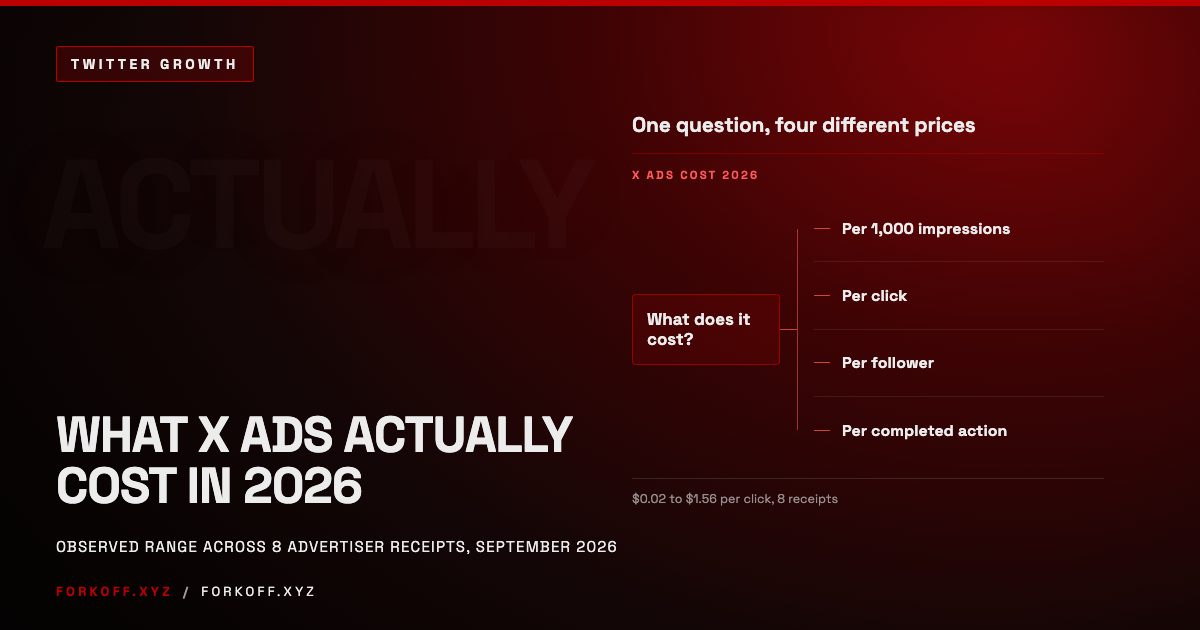
X Ads Cost Breakdown 2026: What a Click, an Impression and a Follower Actually Cost
What X ads really cost in 2026, from eight verified advertiser receipts: a 78x spread in cost per click, real follower costs, and the minimum X never publishes.
 Read
Read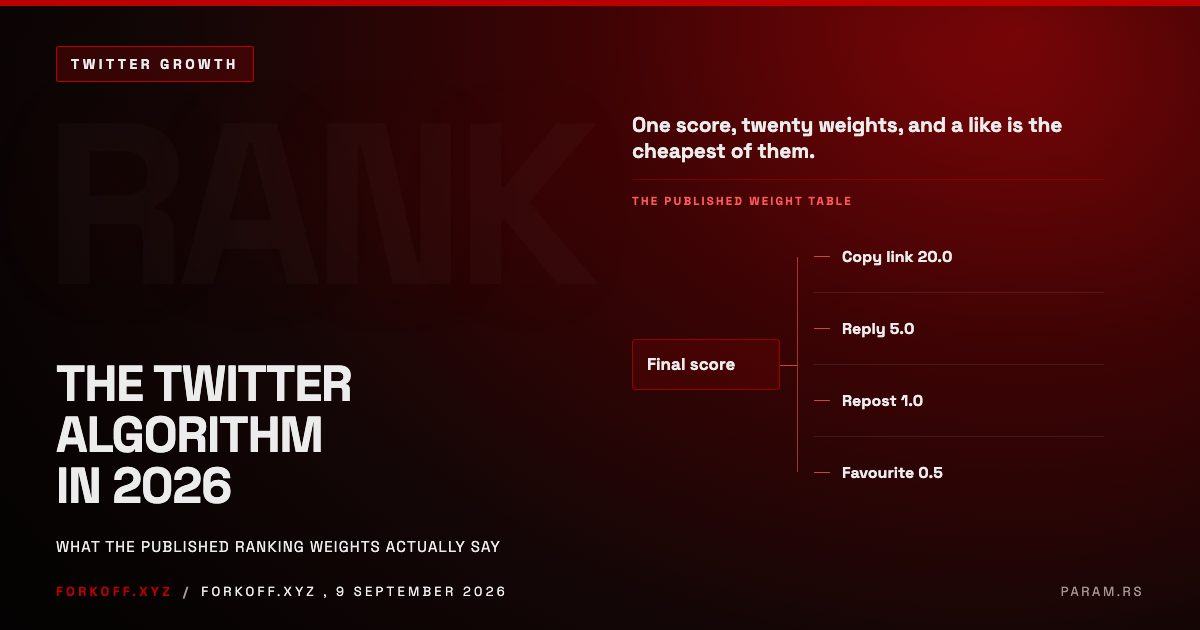
The Twitter Algorithm in 2026: What the Published Weights Say
X publishes the file that ranks your posts. What the twitter algorithm weights actually say, the misreading X refutes in its own code, and six changes to make.
Read
Grok Bots for Marketing: What They Actually Do, Measured
We measured 49 viral Grok bot marketing posts, probed the live Grok surface, and priced the quota. Here is what these bots really do for marketing.
Read