
How to hire a twitter marketing agency in 2026
Updated Jul 8, 2026
You hire a twitter marketing agency by matching its motion to your goal, then screening three things before you sign: documented results in your vertical, a fee structure you can read, and reporting tied to pipeline instead of follower count. The first fork is what you are actually buying. A founder-voice ghostwriting engine grows a person's account, an ads agency runs promoted-tweet spend (usually 10 to 25 percent of the media budget), and a full managed retainer combines posting, replies, and distribution. The 2026 contract standard is a 90-day initial commitment with 30-day cancellation after. FORKOFF runs X as a founder spine: ghostwriting in the founder's real voice, a daily reply engine, and a weekly ledger that reports qualified inbound by name, priced on the outcome rather than a flat retainer.
Per our own X creator engagement benchmark of 511,665 posts, engagement rate varies far more by account tier than by posting frequency. FORKOFF Creator Engagement Benchmark 2026
- 01Name the outcome, then the motion Decide what the account must produce (booked calls, signups, launch reach), then pick the motion that fits. A founder-voice ghostwriting engine, an ads-spend manager, and a full managed retainer are different purchases with different price bands.
- 02Demand vertical-matched proof Ask for three case studies from brands with similar revenue, stage, and channel mix. An agency that scaled consumer accounts is not interchangeable with one that runs B2B founder pipeline. Follower-count screenshots are not proof; attributed outcomes are.
- 03Read the fee structure A flat retainer is a fixed monthly fee; a percentage model charges 10 to 20 percent of ad spend. A healthy retainer sits under 15 percent of the revenue the work is responsible for driving. A narrow, defined brief prices better than a vague do-everything retainer.
- 04Insist on pipeline reporting The report should show reply-driven reach, qualified followers, and pipeline (DMs, calls, signups) attributed to the account, not vanity follower and impression counts. FORKOFF ships a weekly ledger that names the qualified inbound the account created.
- 05Lock clear contract terms The 2026 standard is a 90-day initial commitment with 30-day cancellation after that window. Confirm who owns the account, the voice profile, and the content if you part ways, and cap the concurrent scope so the team stays focused.
- 06Screen out the red flags Walk from any agency that buys followers, runs engagement-pod automation, ships template or undisclosed-AI posts, or reports only follower growth. Those tactics get downranked by the algorithm and produce reach that never converts.
The first fork: what you are actually buying
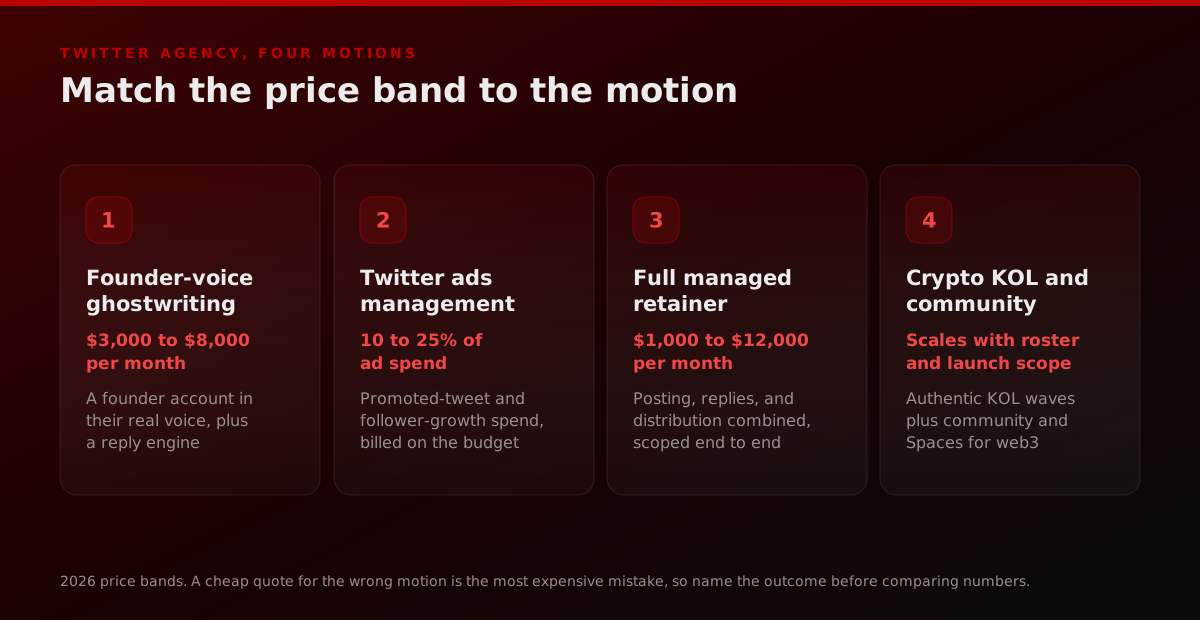
Most hiring confusion comes from treating three different services as one. Founder-voice ghostwriting grows a person's account in their real voice and runs an engagement routine; experienced operators of this motion price around $3,000 to $8,000 a month. A Twitter ads agency manages promoted-tweet and follower-growth spend and bills 10 to 25 percent of the media budget. A full managed retainer bundles posting, replies, and distribution, and across the category those land anywhere from $1,000 to $12,000 a month depending on scope. Web3 projects add a fourth motion, authentic KOL and community activation, whose price scales with roster size and launch window. Decide which of these your goal actually needs before you compare quotes, because a cheap quote for the wrong motion is the most expensive mistake.
How to read a fee structure without overpaying
Two agencies can quote the same number and mean very different things. Anchor the price to what the work is responsible for driving: a retainer that runs under 15 percent of the revenue it influences is defensible, and an ads engagement fee of 10 to 20 percent of spend is the normal band. The bigger lever is scope. A clear, narrow brief (grow the founder account, book qualified calls) almost always prices better than an open do-everything retainer, because the team can staff it precisely instead of padding for the unknown. FORKOFF prices on the outcome rather than a flat monthly fee, which puts the incentive on qualified pipeline instead of hours logged.
The reporting line that separates operators from engagement pods
The single fastest way to tell a real operator from a pod is the report. A pod grows a follower number and an impression count, both of which are easy to inflate with automation and reciprocal engagement, and neither of which maps to revenue. A real operator reports reply-driven reach, follower quality, and the pipeline the account created (DMs, calls, signups) attributed by name. That is why the FORKOFF motion is a founder spine rather than a brand handle: buyers convert on a person's voice, the algorithm now optimizes for retention and dwell rather than follower count, and a daily reply engine off a curated engagement list is what earns durable reach. Ask any agency to show you the pipeline line of its reporting before you sign.
The red flags that predict a bad hire
The tactics that look like shortcuts are the ones that get an account downranked. Bought followers dilute follower quality and trip the platform's authenticity checks. Engagement-pod automation produces reciprocal likes that the ranking model reads as low-signal. Template posts and undisclosed AI drafts read as a brand handle, not a person, and the algorithm downgrades low-quality and generic posts. Follower-count-only reporting hides the fact that none of it converted. A legitimate agency grows through daily strategic replies and owned content, discloses how it uses drafting tools, and reports pipeline. If a pitch leads with a follower-growth guarantee and no vertical case study, treat that as the tell.
Twitter agency types and 2026 price bands
| Agency type | What it does | Typical 2026 price | Best fit |
|---|---|---|---|
| Founder-voice ghostwriting | Grows a founder or exec account in their own voice, with a reply engine | $3,000 to $8,000 per month | Founders whose voice converts better than the brand handle |
| Twitter ads management | Runs promoted-tweet and follower-growth campaigns | 10 to 25 percent of ad spend | Brands with paid budget and a direct-response goal |
| Full managed retainer | Posting, replies, and distribution combined | $1,000 to $12,000 per month | Brands wanting an end-to-end managed account |
| Crypto KOL and community | Authentic KOL activation plus community and Spaces | Scales with roster size and launch scope | Web3 projects needing crypto-Twitter reach |
Match the price band to the motion your goal needs before comparing quotes. Founder-voice ghostwriting and managed retainers are the two most common purchases; ads management is billed as a percentage of spend, not a flat fee.
The hiring checklist: green flags versus red flags
| What to check | Green flag | Red flag |
|---|---|---|
| Proof | Three case studies in your vertical with pipeline numbers | Follower-count screenshots only |
| Fee structure | Retainer under 15 percent of revenue driven, or 10 to 20 percent of ad spend | Vague do-everything retainer with no scope |
| Voice | Ghostwriting captured from the founder's real voice | Template posts or undisclosed AI drafts |
| Reporting | Reply-driven reach and pipeline attributed by name | Vanity followers and impressions with no pipeline |
| Growth method | Daily strategic replies and owned content | Bought followers or engagement-pod automation |
| Contract | 90-day initial term, 30-day cancellation after | Long lock-in with no exit or ownership terms |
Clean answers across all six rows signal a legitimate operator. Any of the red-flag columns, especially a follower-growth guarantee with no vertical case study, is a reason to keep looking.
Frequently asked questions
How much should a twitter marketing agency cost?
It depends on the motion. Founder-voice ghostwriting from experienced operators runs about $3,000 to $8,000 a month, Twitter ads management bills 10 to 25 percent of ad spend, and a full managed retainer spans roughly $1,000 to $12,000 a month by scope. Monthly retainers are the most common 2026 model. Match the price band to the service you actually need before comparing quotes.
What should I ask a twitter marketing agency before hiring?
Ask for three case studies in your vertical with pipeline numbers, not follower screenshots. Ask how the fee is structured (flat retainer versus percentage of ad spend) and how it maps to the revenue it drives. Ask to see the pipeline line of their reporting, ask how they use AI in drafting, and confirm who owns the account and content if you part ways.
Should I hire an agency for a founder account or the brand handle?
For most B2B and web3 companies, the founder account is the wedge. Buyers convert on a person's voice more than a brand logo, and the algorithm now optimizes for retention and dwell rather than follower count, which rewards a real voice over a corporate feed. The strongest agencies ghostwrite in the founder's captured voice and run a daily reply engine, then repurpose the winners.
What contract terms are standard for a twitter agency in 2026?
The 2026 standard is a 90-day initial commitment with 30-day cancellation after that period. Confirm ownership of the account, the voice profile, and the content library on exit, and ask for a scope cap so the team stays focused. A defined, narrow brief also prices better than an open-ended do-everything retainer.
What are the red flags of a bad twitter marketing agency?
Bought followers, engagement-pod automation, template or undisclosed-AI posts, and reporting that shows only follower and impression growth with no pipeline. Each of those tactics gets downranked by the platform or hides the fact that the reach never converted. A follower-growth guarantee with no vertical case study is the clearest tell.
Get the specific number for your campaign.
Receipts, deep dives, and playbooks.
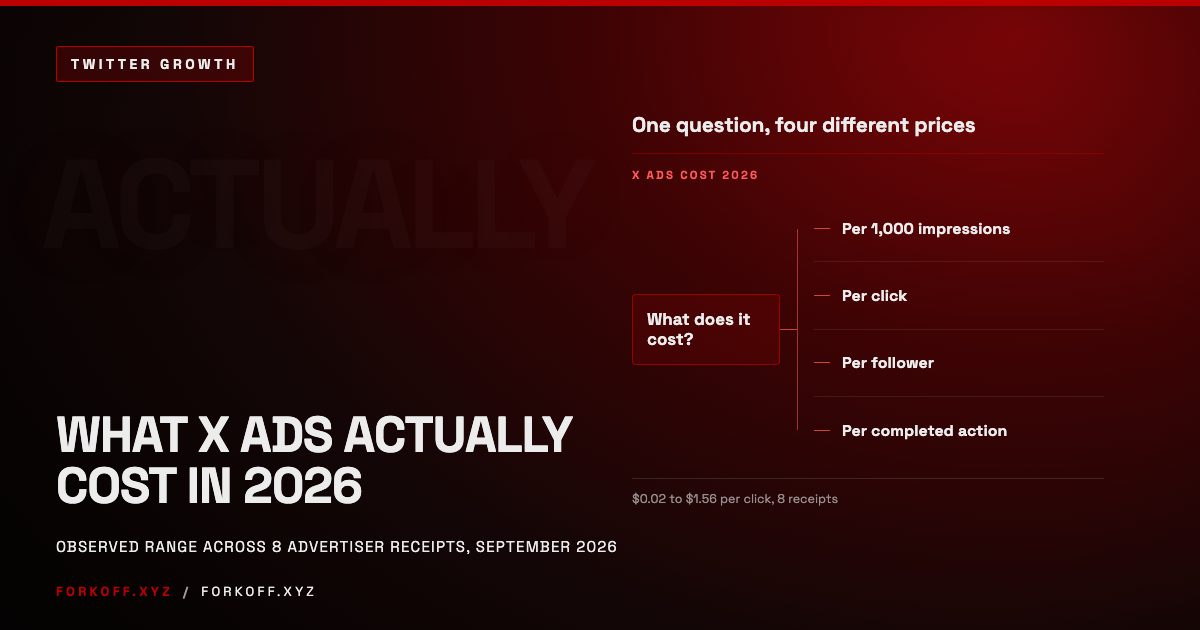
X Ads Cost Breakdown 2026: What a Click, an Impression and a Follower Actually Cost
What X ads really cost in 2026, from eight verified advertiser receipts: a 78x spread in cost per click, real follower costs, and the minimum X never publishes.
 Read
Read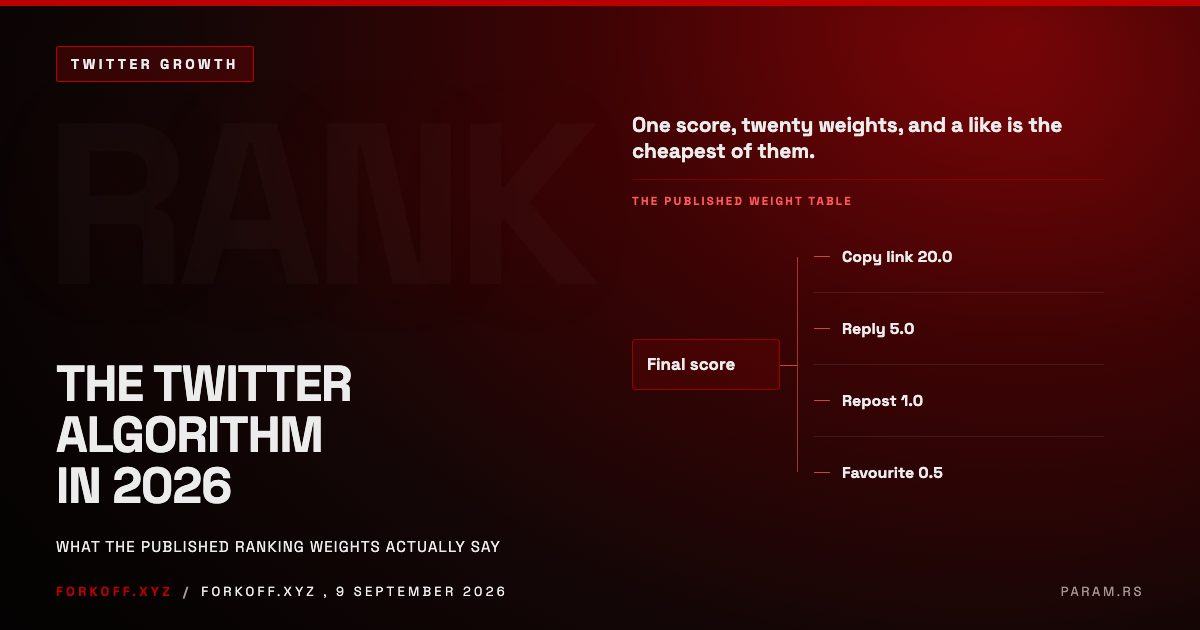
The Twitter Algorithm in 2026: What the Published Weights Say
X publishes the file that ranks your posts. What the twitter algorithm weights actually say, the misreading X refutes in its own code, and six changes to make.
Read
Grok Bots for Marketing: What They Actually Do, Measured
We measured 49 viral Grok bot marketing posts, probed the live Grok surface, and priced the quota. Here is what these bots really do for marketing.
Read