
Does Twitter (X) marketing work in 2026?
Updated Jul 25, 2026
Yes, Twitter (X) marketing works, but only when you measure the right outcome on a smaller, higher-intent audience. X's own ad tools show 586 million reachable users in January 2025, down 33 million year over year (DataReportal, 2025), and organic engagement rates are low and still declining (RivalIQ, 2025). So X is not a mass-reach billboard in 2026, it is a concentrated, high-intent channel where founders, investors, and operators still make decisions and discover products. It works when you build genuine reach and tie it to pipeline: replies, profile visits, follows, and clicks that trace back to revenue. It fails when you buy vanity views a bot inflated and call the counter a result. That is the fork: earned distribution on a serious audience compounds, while purchased reach converts nobody. FORKOFF prices X marketing on qualified views, the four-stage gate behind 5B+ processed views, at $0.003 per qualified view, so you pay for attention a real person paid.
- 01Know the audience is smaller and higher-intent X's reachable audience fell about 33 million in a year to 586 million (DataReportal, 2025). That is not a reason to skip the channel; it is a reason to change the goal. X still concentrates founders, investors, operators, and developers, so the value is intent and access to decision-makers, not raw scale.
- 02Pick the real outcome before you start X marketing works or fails on what you measure. Decide the outcome up front, pipeline, sign-ups, follows, profile visits, qualified replies, then work backward. An impression count with no path to a result will always look like success and never pay for itself.
- 03Earn reach, do not buy it Organic engagement is low and falling (RivalIQ, 2025), which tempts brands to buy views. Purchased reach inflates the counter and converts nobody, and on a launch it leaves a detectable signature. The reach that works is earned through replies, native media, and consistency.
- 04Screen for bots and inflated reach A view a bot generated is not marketing, it is noise you paid for. Before you trust any reach number, screen it: a genuine engagement profile looks different from a purchased one. FORKOFF's [launch authenticity checker](/tools/launch-authenticity-checker) exists because raw reach on X is easy to fake and expensive to trust.
- 05Attribute results back to the channel The reason people doubt X marketing is that they never tied it to revenue. Use tracked links, dedicated landing paths, and a clear before-and-after, so you can say what the channel produced. Marketing that works is marketing you can attribute; the rest is activity.
- 06Decide on qualified views Judge the channel on qualified views, the ones a real person saw and acted on, not raw impressions. A four-stage qualification gate separates the two, so the number you evaluate reflects real attention. On that metric, X marketing is a clear yes for a founder-led, high-intent motion.
When X marketing works, and when it does not
X marketing works when the audience fit and the outcome are right. The platform's reachable audience is smaller than it was, 586 million in January 2025, down 33 million in a year (DataReportal, 2025), and organic engagement rates are low and declining (RivalIQ's 2025 benchmark). Those facts kill the mass-reach case and make the concentrated-intent case. X is where founders, investors, and operators still gather, so a founder-led B2B or GTM motion, a launch, or a thought-leadership play can produce real pipeline there. It does not work as a spray-and-pray billboard, and it does not work when reach is purchased. If you are weighing whether to run it yourself or bring in help, our answer on how to hire a Twitter marketing agency covers what a real partner should be accountable for, and FORKOFF's X marketing service runs the earned-reach motion end to end.
The metric that decides it: qualified views
The reason X marketing gets a bad name is that most people measure it wrong. Impressions are cheap and easy to inflate, so a campaign can post big numbers and produce nothing. The honest test is the ratio of reach to real engagement, and our views-to-likes benchmark shows what an organic band looks like against an inflated one. FORKOFF settles the question with qualified views: every view is put through a four-stage gate, the same integrity layer behind 5B+ processed views, and billed at $0.003 per qualified view. On that metric the answer is clear, X marketing works when you build earned reach on a high-intent audience and hold it to an outcome you can attribute, and it fails when you buy a counter and hope.
Does X marketing work? When it does, and when it does not
| Factor | It works when | It fails when |
|---|---|---|
| Audience fit | Your buyers are founders, investors, operators, developers | You need broad consumer reach at scale |
| Outcome | Tied to pipeline, sign-ups, follows, tracked clicks | Measured on raw impressions with no path to revenue |
| Reach | Earned through replies, media, and consistency | Purchased views and bot engagement that never convert |
| Integrity | Screened for bots before you trust a number | A counter inflated by an engagement farm |
| Motion | Founder-led, launch, or thought leadership | Spray-and-pray posting with no point of view |
| Metric | Qualified views a real person saw and acted on | Vanity impressions treated as a result |
The 586 million reachable-user figure and the 33 million year-over-year drop are from DataReportal's 2025 X analysis; the low-and-declining organic engagement finding is from RivalIQ's 2025 Social Media Industry Benchmark Report, not FORKOFF figures. Search demand for "does twitter marketing work" is measured (DataForSEO, 2026), and the live SERP is still forum threads and generic agency blogs, which is the gap this answer fills.
Frequently asked questions
Is Twitter (X) marketing still worth it in 2026?
Yes, for the right audience and outcome. X's reachable audience shrank by about 33 million users in a year to 586 million (DataReportal, 2025) and organic engagement is low, so it is no longer a mass-reach channel. It is worth it as a concentrated, high-intent one: founders, investors, and operators still make decisions on X, so a founder-led or GTM motion tied to real pipeline pays off there.
Why do people say Twitter marketing does not work?
Because they measure it wrong. Impressions are cheap and easy to inflate, so a campaign can post large view counts and produce no pipeline, then get written off. The channel also does not suit broad consumer reach, and purchased reach converts nobody. Tied to a real outcome on a high-intent audience, X marketing does work; measured on vanity impressions, it looks like it never does.
Does X marketing work for B2B and startups?
It is one of the stronger channels for founder-led B2B and startups, because X concentrates the exact people those companies sell to and raise from. A launch, a thought-leadership presence, or a GTM push can generate real pipeline there when it is built on earned reach and attributed to an outcome rather than an impression count.
Does buying followers or views make X marketing work?
No, it makes it worse. Purchased followers and views inflate the counter, cost real money, and convert nobody, and on a launch they leave a signature a forensic read of the reach-to-engagement ratio can detect. Earned reach, driven by replies, native media, and consistency, is the only kind that produces a result you can attribute.
How does FORKOFF prove X marketing works?
FORKOFF holds the channel to qualified views rather than raw impressions. Every view passes a four-stage qualification gate, the same integrity layer behind 5B+ processed views, and is billed at $0.003 per qualified view, so the report reflects attention a real person paid. Results are attributed to outcomes, profile visits, follows, and clicks, not to a vanity counter.
Get the specific number for your campaign.
Receipts, deep dives, and playbooks.
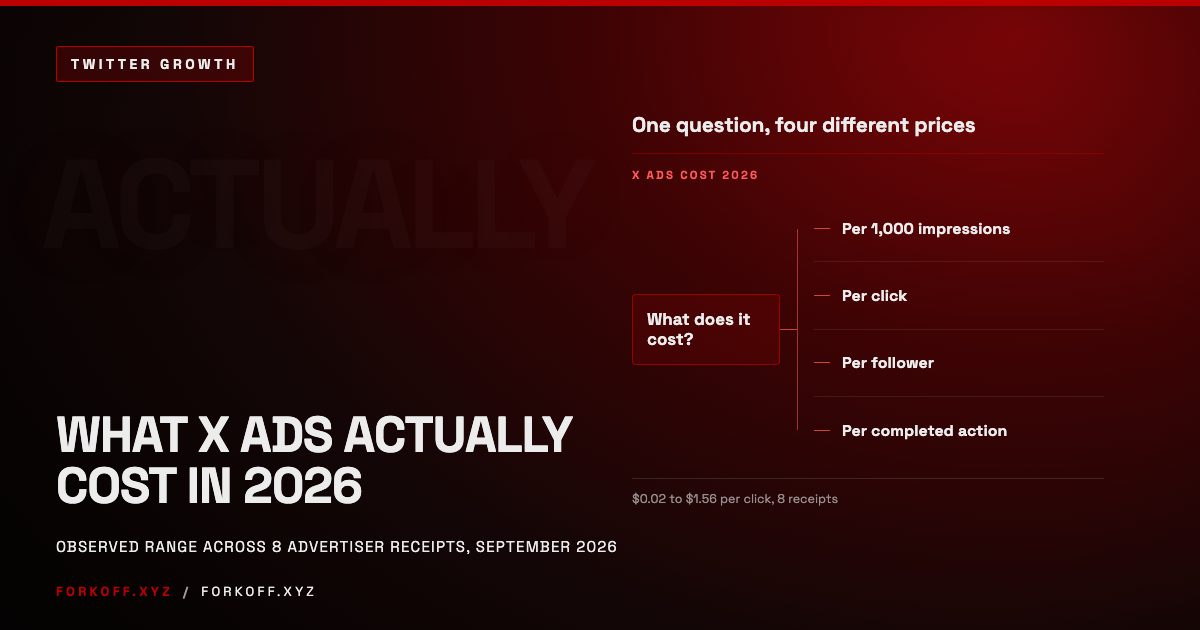
X Ads Cost Breakdown 2026: What a Click, an Impression and a Follower Actually Cost
What X ads really cost in 2026, from eight verified advertiser receipts: a 78x spread in cost per click, real follower costs, and the minimum X never publishes.
 Read
Read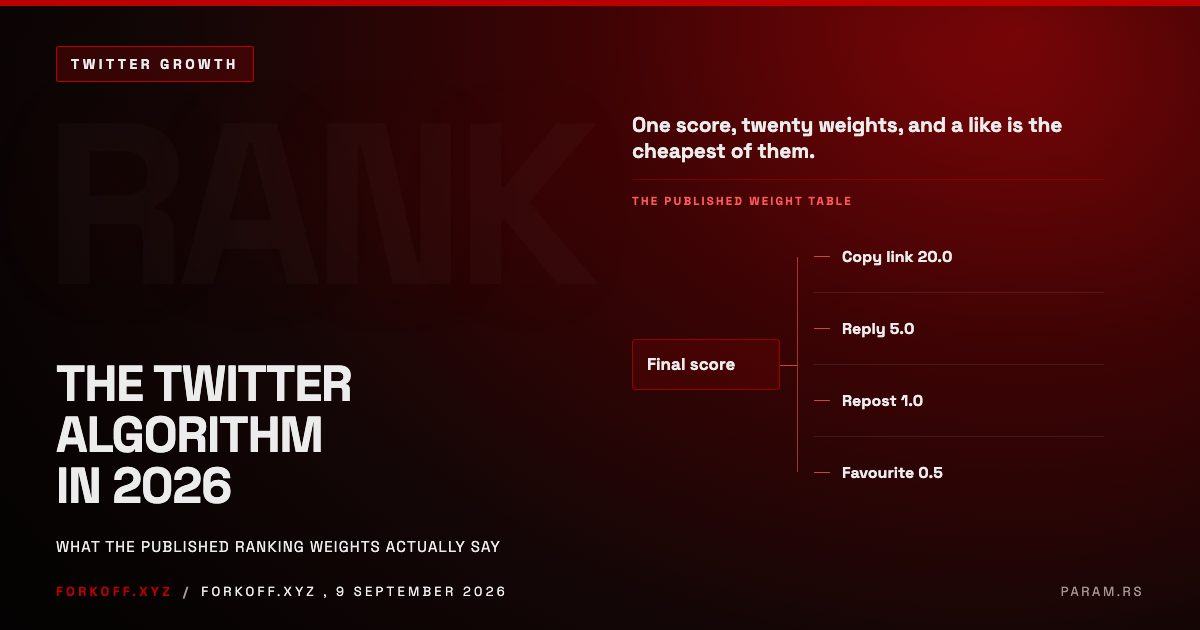
The Twitter Algorithm in 2026: What the Published Weights Say
X publishes the file that ranks your posts. What the twitter algorithm weights actually say, the misreading X refutes in its own code, and six changes to make.
Read
Grok Bots for Marketing: What They Actually Do, Measured
We measured 49 viral Grok bot marketing posts, probed the live Grok surface, and priced the quota. Here is what these bots really do for marketing.
Read