
How to get more views on X (Twitter) in 2026
Updated Jul 25, 2026

Views on X (Twitter) are impressions, the count of times a post appears on a screen, and getting more of them in 2026 is a game of feed signals played on a smaller, higher-intent audience. X's own ad tools show 586 million reachable users in January 2025, down 33 million year over year (DataReportal, 2025), so the pond has shrunk and the accounts that win concentrate reach rather than spray it. The feed rewards posts that pull replies and hold attention, not posts that merely collect likes, so a conversation-starter with native media beats a link drop almost every time. The trap is chasing a raw view counter that bots and engagement farms inflate for a price. A view no real person saw is worth nothing. FORKOFF grows X reach and measures it as qualified views, the four-stage gate behind 5B+ processed views, billed at $0.003 per qualified view, so the number on the report maps to attention a real human paid.
- 01Post what earns replies, not just likes The reply, and the conversation it starts, is the strongest reach signal on X, while a like alone is weak. Write posts that invite a genuine response: a question, a contrarian take, a specific claim people want to argue with. Replies pull your post back into more feeds than a passive like ever will.
- 02Lead with native media Posts that keep the viewer on-platform, an image, a chart, or short parseable video, hold attention longer than a bare link that sends people away. Dwell time is a signal, so a post someone stops and reads earns more distribution than one they scroll past.
- 03Show up consistently The feed rewards accounts that post regularly over accounts that appear in bursts. Hootsuite's 2026 guidance is to post 2 to 3 times a day on X. Consistency compounds: a steady presence trains the feed to test your posts on more of your audience.
- 04Time posts to your audience's active windows Impressions concentrate when your followers are online, because early engagement inside the first hour decides how far a post travels. Post when your specific audience is active, not when a generic best-time chart says, and let your own analytics correct the guess.
- 05Stop buying reach Purchased views, bot followers, and engagement pods inflate the counter without moving the outcome. A launch padded with bought views reads as amplified, not earned, and none of that reach converts. FORKOFF's [launch authenticity checker](/tools/launch-authenticity-checker) exists precisely because a raw view number is easy to fake.
- 06Measure qualified views, not raw impressions Tie views to what happens next: profile visits, follows, link clicks, replies from real accounts. A qualified view is one a real person saw and acted on, which is the only view worth optimizing. Raw impressions are a vanity number; qualified views are the metric that predicts pipeline.
Why raw view counts are the wrong target
The instinct is to chase a bigger impression number, but the audience behind that number is smaller than it was. X's own advertising tools reported 586 million reachable users in January 2025, a drop of 33 million (about 5.3 percent) in a single year (DataReportal, 2025), with the United States its largest market at 104 million. A shrinking, higher-intent audience changes the goal: the win is not the largest possible view count, it is reach among the founders, investors, and operators who actually make decisions on X. That is also why bought views are worse than useless. They inflate the counter, cost real money, and convert nobody, and on a launch they leave a signature a forensic read can spot. FORKOFF runs X marketing toward qualified views, the four-stage gate behind 5B+ processed views, so the report tracks attention a real person paid rather than a number a bot manufactured.
What actually drives impressions on X in 2026
Reach on X follows engagement, and engagement follows the reply. A post that earns replies from real accounts, holds attention with native media, and lands while your audience is online travels further than a post that only collects likes. Consistency multiplies it, because the feed keeps testing accounts that show up, which is why how often you post on X is a floor worth clearing. Note that views are a distinct outcome from followers: growing an account's following is a longer game covered in our guide on how to grow on X in 2026, while views are the per-post reach you can move this week. The honest benchmark is the ratio, not the absolute number: our views-to-likes benchmark shows what an organic reach-to-engagement band looks like, so you can tell a genuinely viral post from an inflated one.
What moves views on X, and what does not
| Lever | Moves views | Does not move views |
|---|---|---|
| Replies | Posts that earn real replies get retested in more feeds | A wall of likes with no conversation |
| Media | Native image or parseable video that holds attention | A bare external link that sends people off-platform |
| Consistency | A steady 2 to 3 posts a day (Hootsuite, 2026) | Bursts of activity followed by silence |
| Timing | Posting inside your audience's active window | A generic best-time chart ignoring your own data |
| Bought reach | Nothing real; it inflates the counter only | Purchased views and bot engagement that never convert |
| Measurement | Qualified views tied to profile visits and clicks | Raw impressions with no path to an outcome |
The 586 million reachable-user figure and the 33 million year-over-year drop are from DataReportal's 2025 X analysis of X's own ad tools, not FORKOFF figures; the 2 to 3 posts a day figure is Hootsuite's 2026 guidance. Search demand for "how to get more views on x" and "how to get more views on twitter" runs about 250 queries a month combined (DataForSEO, 2026), and the live SERP is still forums and small tool blogs, which is the gap this answer fills.
Frequently asked questions
What counts as a view on X (Twitter)?
A view on X is an impression: one instance of your post appearing on someone's screen, whether or not they engaged with it. It is not a unique person and not proof anyone read the post, which is why a raw view count is a weak metric on its own. A qualified view, the one worth optimizing, is a view a real person saw and acted on with a reply, profile visit, or click.
Why are my X views so low in 2026?
Two things compress views. First, X's reachable audience shrank by about 33 million users in a year (DataReportal, 2025), so there are fewer people to reach. Second, the feed rewards replies and attention, so posts that only collect likes or send people to an external link get throttled. Low views usually mean low engagement signals, not a shadowban: fix the post before you assume a penalty.
Does buying views on X work?
No. Purchased views and bot engagement inflate the counter without producing any real outcome, and on a launch they leave a signature that a forensic read of the views-to-engagement ratio can detect. You pay for a number nobody real saw. Earned reach, driven by replies, media, and consistency, is the only kind that converts to followers or pipeline.
How many times should I post on X to get more views?
Hootsuite's 2026 guidance is 2 to 3 original posts a day, plus replies, which are themselves a reach engine. Consistency matters more than volume: a steady daily presence trains the feed to test your posts on more of your audience, while a burst of low-quality posts to hit a number trains it to show you less.
How does FORKOFF get more views on X for clients?
FORKOFF grows reach through the signals the feed actually rewards, replies, native media, consistency, and timing, then measures the result as qualified views rather than raw impressions. Every view is put through a four-stage qualification gate, the same integrity layer behind 5B+ processed views, and billed at $0.003 per qualified view, so the report reflects attention a real person paid.
Get the specific number for your campaign.
Receipts, deep dives, and playbooks.
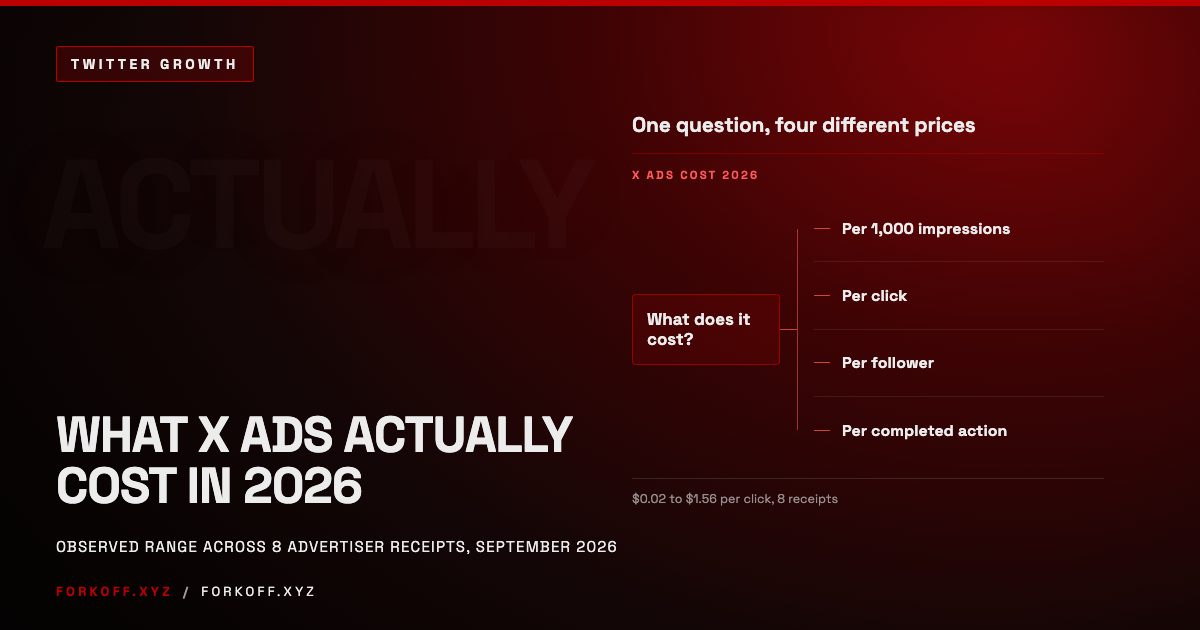
X Ads Cost Breakdown 2026: What a Click, an Impression and a Follower Actually Cost
What X ads really cost in 2026, from eight verified advertiser receipts: a 78x spread in cost per click, real follower costs, and the minimum X never publishes.
 Read
Read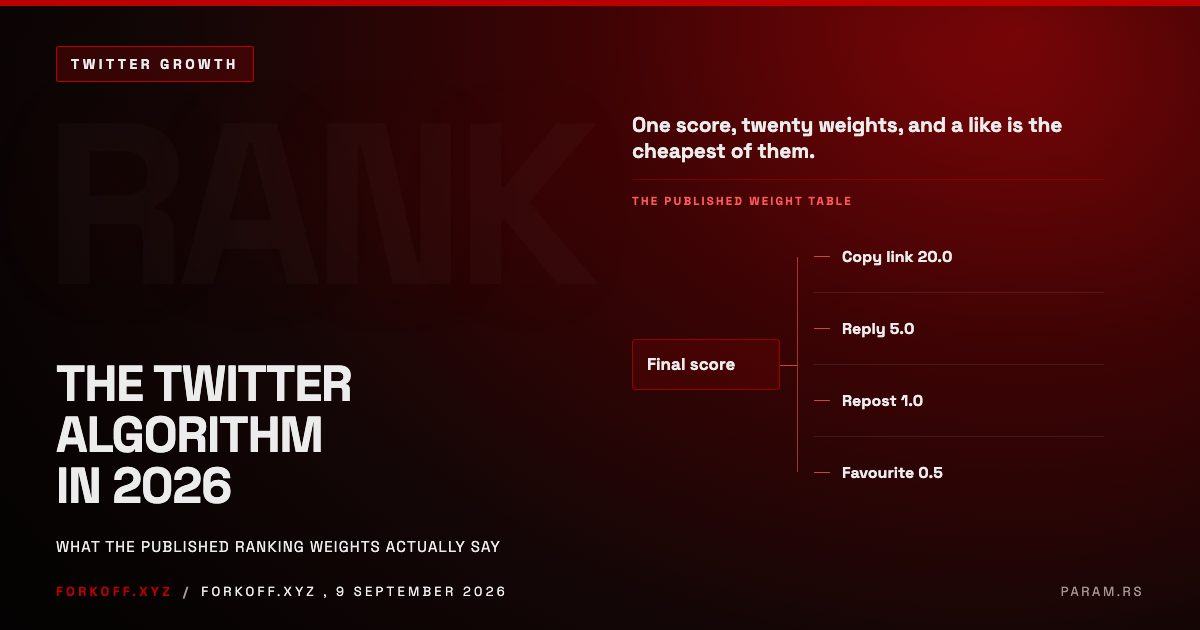
The Twitter Algorithm in 2026: What the Published Weights Say
X publishes the file that ranks your posts. What the twitter algorithm weights actually say, the misreading X refutes in its own code, and six changes to make.
Read
Grok Bots for Marketing: What They Actually Do, Measured
We measured 49 viral Grok bot marketing posts, probed the live Grok surface, and priced the quota. Here is what these bots really do for marketing.
Read