
Per our own X pipeline, 30 launches and 110.4M combined views were tracked across a 9-month window.
FORKOFF RADAR · Research · Published 2026-07-03 · n=30 launches · 110.4M views
What is a healthy views to likes ratio on X?
A healthy views to likes ratio is about 500 views per like or under. Above roughly 1,400 views per like signals distribution-amplified reach. Measured across 30 real product launches totaling 110.4 million views, the median was 788 and the 90th percentile was 3,126.
As monitored on 3 July 2026. Recomputed as the tracked set grows.
788
Median views per like
~500
Organic ceiling (views per like)
3,126
90th percentile
67%
Carry an amplified signature
The views-to-likes ratio, defined
The views to likes ratio, also written as the view to like ratio, is a post's view count divided by its like count, read as views per like. Flipped the other way, likes divided by views, the same signal is called the like to view ratio. On X, organic reach tops out near 500 views per like, because the same feed that surfaces a post also makes it easy to like, so views and likes climb together. When the ratio runs far above that ceiling, reach is arriving without the engagement organic reach produces, the signature of distribution-amplified reach. Across 30 real product launches totaling 110.4 million views, the median ratio was 788 views per like, the middle half sat between 494 and 2,054, and the amplified-signature launches ran a median of 1,441, about 4.1 times the 354 median of the organic launches.
RADAR reads how reach was built, not whether anyone was honest. Paying for or coordinating distribution is legal and common. A high ratio is a read on mechanics, never an accusation about a product or a founder.
Why views-to-likes tells earned reach from bought
Organic reach and engagement are produced by the same surface. When the feed shows a post to a reader, that reader can like it in the same motion, so views and likes rise together and the ratio stays low. Distribution that is bought or coordinated adds impressions without adding the reader who engages, so the view counter climbs while the like counter lags and the ratio opens up. That is the whole mechanism, and it is why two public numbers and one division read how a launch built its reach.
Views-to-likes ratio
The load-bearing signal. Organic tops out near 500 views per like. Far above that, reach ran ahead of the audience that engaged.
The costly layers
Replies and quote-posts are the hardest actions to fake, because each is an original written post. Thick written layers keep a modest gap reading as a distribution nudge, not a manufactured conversation.
Posting-time fingerprint
A launch firing exactly top-of-hour is scheduled. On its own it proves nothing (33% of the tracked set fired top-of-hour, including an organic launch), so RADAR treats it as corroboration only.
What is a good views to likes ratio, and a bad one?
The tracked launches fall into four calibration bands. A ratio at or under about 500 is the organic range. From 500 to 2,000 is a light distribution lift, where most launches sat (13 of 30). From 2,000 to 5,000 is a heavier amplified signature. Above 5,000 is where reach and engagement have decoupled almost entirely.
| Band | Views per like | What it means | Share of tracked launches |
|---|---|---|---|
| Organic | About 500 or under | Reach and engagement grew together. Likes kept pace with views, the signature of reach the feed produced. | 9 of 30 (30%) |
| Healthy lift | 500 to 2,000 | A light distribution lift on a launch that was clearly connecting. Reach ran a step ahead of the likes, with the written layers usually intact. | 13 of 30 (43%) |
| Amplified | 2,000 to 5,000 | Reach ran well ahead of the engagement. A heavier distribution signature, a common and legal way to launch at scale. | 6 of 30 (20%) |
| Decoupled | Above 5,000 | Reach and engagement have separated almost entirely. Millions of impressions on a few hundred likes, the widest gap in the tracked set. | 2 of 30 (7%) |
RADAR launch dataset, n=30, Oct 2025 to Jun 2026. Bands calibrated on the published RADAR methodology. Counts recomputed live from the tracked set.
Views-to-likes across 30 real product launches
Each bar is one tracked launch, sorted low to high, on a log scale so the full spread is visible. The median was 788 views per like, the 25th percentile 494, the 75th percentile 2,054, and the 90th percentile 3,126. Bars are shaded by their views-to-likes band. The launches RADAR reads as organic are labeled on hover; the rest are shown anonymously, because this benchmark reads the distribution, not a verdict on any named launch.
494
25th percentile · views per like
788
Median · views per like
2,054
75th percentile · views per like
3,126
90th percentile · views per like
The organic launches ran 4.1x tighter
The 10 organic launches (33% of the set) had a median of 354 views per like. The 20 launches that carried a distribution-amplified signature had a median of 1,441, about 4.1 times higher. That gap is the ratio doing its job: amplified reach runs further ahead of the likes than organic reach ever does.
What organic looks like
Three of the launches RADAR reads as organic, reach and engagement that grew together. Each links to its full reading.
Views-to-likes ratio by platform: what transfers
This benchmark is X-native: all 30 launches and all 110.4million views were measured on X, so the roughly 500 views-per-like organic ceiling is calibrated on how X counts a view and does not transfer to any other platform as a number. What does transfer is the mechanism. On every platform, organic reach and engagement rise together, engagement falls as audience scale grows, and reach that runs far ahead of its engagement is the signature of amplified distribution. The named industry benchmarks below measure those platforms as engagement rates, a different denominator, so read them as directional context, never as this page's bands.
TikTok
This dataset carries no first-party views to likes ratio for TikTok. The industry reads TikTok as an engagement rate instead: Socialinsider's Social Media Benchmarks 2026 puts TikTok at 3.70 percent per follower, the highest of the major platforms, and Nowadays Media's 2026 benchmarks read nano creators at 9 to 15 percent falling to 1 to 3 percent at mega scale. Those denominators are followers, not views, so the X ceiling does not apply; judge a views to likes ratio on TikTok against TikTok data only.
YouTube
No YouTube launches are in the tracked set. Nowadays Media's 2026 benchmarks read YouTube engagement falling from 3 to 8 percent at nano scale to 0.3 to 1 percent at mega scale, measured against subscribers. A views to likes ratio on YouTube is a different read again, because a public YouTube view is counted differently from an X impression, so the same division lands on a different scale and the 500 figure carries no meaning there.
The corpus carries no Instagram data. RivalIQ's 2026 Social Media Industry Benchmark puts the Instagram platform-wide median at 0.30 percent engagement per follower, and Sprout Social's 2026 reading has overall Instagram engagement at 1.62 percent, with Reels at 2.35 percent. Those are engagement rates, not a views to likes ratio for Instagram, so the honest transfer is directional only: reach and engagement decouple under amplification there exactly as they do on X.
The full per-platform source table, with links to each named report, lives on the X Creator Engagement Benchmark 2026. Per-platform figures there are industry context and are never pooled into this page's first-party X numbers.
How to calculate your own views to likes ratio
Divide your launch post's public view count by its public like count, then compare against the bands above. The math is intentionally simple, because that is what makes it a benchmark anyone can reproduce from the public post. Or type the two numbers in and let the page do the division against its own bands.
Both numbers are public on the post. The math is views divided by likes, nothing else.
445
views per like
Reach and engagement grew together. This is the organic range.
The median across the 30 tracked launches is 788 views per like. Sanity-check with your replies and quote-posts before reading anything into one number.
Organic, up to 500 views per like
Reach and engagement grew together. This is the organic range.
Healthy lift, up to 2,000 views per like
A light distribution lift on a launch that was connecting. Most tracked launches sat here.
Amplified, up to 5,000 views per like
Reach ran well ahead of the engagement, a heavier distribution signature.
Decoupled, above 5,000
Reach and engagement have separated almost entirely.
- 1
Read the two public numbers
Open the launch post on X. Note the public view count and the public like count.
- 2
Divide views by likes
That result is your views-to-likes ratio, expressed as views per like.
- 3
Look up the band
About 500 or under is organic. 500 to 2,000 is a light lift. 2,000 to 5,000 is amplified. Above 5,000 is decoupled.
- 4
Sanity-check the costly layers
Read the replies and quote-posts. Thick written layers relative to likes keep a modest gap reading as a distribution nudge, not a manufactured conversation.
- 5
Date it
The organic ceiling shifts slowly as the platform changes what it feeds to whom, so note when you read it.
Worked example, an organic anchor
Contra Payments drew 2,275,499 views on 5,118 likes.
2,275,499 / 5,118 = 445 views per like
445 sits under the roughly 500 organic ceiling, and the launch carried a deep 2,848-reply layer. Reach and engagement grew together, so RADAR reads it as organic.
How the benchmark was measured
The benchmark is computed from 30 public product-launch posts on X, launched across Oct 2025 to Jun 2026, totaling 110.4 million combined views. Collection is public post metrics pulled via our own X data pipeline, deduplicated to one canonical launch post per product, with a full forensic trace verified on 18 of the 30 launches and the rest read from the public ratio at lower confidence. Every number on this page is recomputed from that set, so the benchmark refreshes as the corpus grows.
Sample
30 launches
110.4M combined views
Window
Oct 2025 to Jun 2026
9-month tracked set
Collection
our own X public-metrics pull
18 of 30 verified trace, deduped
The views-to-likes ratio is the load-bearing signal because it is a pure function of two public numbers, reproducible by anyone from the public post. The organic ceiling near 500 views per like and the four calibration bands come from the published RADAR methodology, which carries the full calibration corpus and the reproduce-it-yourself steps. A verified trace adds the amplification wave shape and the posting-time fingerprint as corroboration, but the ratio anchors every read.
Caveats, stated plainly. The sample is 30launches, so per-vertical cuts are directional, not definitive. Metrics are point-in-time and trace to a public pull; bot purges and late engagement shift the numbers, which is why the set is re-checked and dated. Reconstructed reads (the launches without a full trace) are never rendered as high-confidence bought verdicts. And amplified distribution is a legal, common, often-sound way to launch at scale, so a high ratio is a read on how reach was built, not a claim about anyone's honesty.
The CSV carries the anonymized ratio distribution (ratio and band per launch, ranked ascending), the band counts, and the percentiles. It publishes the distribution, not a per-named verdict.
Adjacent RADAR reading
- RADAR methodology , how RADAR reads whether a launch's reach was earned or bought, from three public signals, with the full calibration.
- Launch Radar hub , the tracked launches ranked by reach, each with its public metrics and views-to-likes ratio.
- Verified-organic leaderboard , the launches RADAR reads as organic, ranked by grade and confidence.
- Best product launch videos, ranked , the tracked launch videos ordered by views, each with the same views-to-likes read applied.
- Product Launch Video , the managed launch service this benchmark comes out of, priced on audited reach rather than a production fee.
- State of Launch Videos 2026 , the first-party report this benchmark feeds: the full launch landscape, by vertical and reach, on the same tracked set.
- Clipping CPQV Benchmark 2026 , the sibling first-party research study on cost per qualified view.
- X Creator Engagement Benchmark 2026 , the creator-side view of the same signal: engagement rates across 5,375 creators by follower tier and vertical, where this page measures launches.
- Managed clipping , the managed-distribution service RADAR grows out of, where the difference between earned and bought reach becomes a measured signal.
Views-to-likes ratio, common questions
Frequently asked questions
What is a healthy views-to-likes ratio on X?
A healthy views-to-likes ratio on X is about 500 views per like or fewer. That is the organic ceiling: the point where reach and engagement grew together because the same feed that showed the post also made it easy to like. Across 30 real product launches totaling 110.4 million views, the median ratio was 788 views per like, the 25th percentile was 494, and the 90th percentile was 3,126. A ratio well above the organic ceiling means reach arrived without the engagement organic reach produces, which is the signature of distribution-amplified reach.
What is a good views to likes ratio?
A good views to likes ratio on X is about 500 views per like or under, the organic range where reach and engagement grew together. From 500 to 2,000 is still healthy territory, a light distribution lift where most of the tracked launches sat (13 of 30). The launches carrying a distribution-amplified signature ran a median of 1,441 views per like, so a ratio in that territory reads as amplified rather than organic, and above 5,000 reach and engagement have decoupled almost entirely. Lower is better if organic reach is the goal.
What is a normal views-to-likes ratio?
Across the tracked launches the median was 788 views per like, and the middle half sat between 494 (25th percentile) and 2,054 (75th percentile). So a "normal" high-reach launch ran roughly 494 to 2,054 views for every like. The lowest ratio in the set was 98 and the widest was 12,075. Lower is closer to organic; higher means the reach ran further ahead of the likes.
Is a high view count fake?
Not necessarily. A high view count paired with the likes, replies, and quotes to match is genuine reach that connected with a real audience. A high view count with the engagement far behind it is the signature of distribution-amplified reach. Paying for or coordinating distribution is legal and common, so a wide views-to-likes gap describes how the reach was built, not whether anyone was dishonest. The number to read is the ratio, not the headline view count on its own.
How do I check my own launch's views-to-likes ratio?
Divide your launch post's public view count by its public like count. Compare the result against the bands: about 500 or under is the organic range; 500 to 2,000 is a light distribution lift; 2,000 to 5,000 is a heavier amplified signature; above 5,000 is where reach and engagement have decoupled. Then sanity-check with your replies and quote-posts, the layers hardest to manufacture. If those written layers are thick relative to your likes, a modest gap reads as a distribution nudge rather than a manufactured conversation.
What does a views-to-likes ratio above 1,400 mean?
The 20 launches in the tracked set that carried a distribution-amplified signature had a median of 1,441 views per like, about 4.1 times the 354 median of the 10 organic launches. So a ratio in the 1,400-plus range sits with the amplified cohort: reach that arrived without the proportional engagement. It is not a verdict on the product or the founder, only a read on how the reach was built.
What counts as viral on X, and is the number real?
A big view number alone does not settle whether a launch was earned or bought. The views-to-likes read is what separates the two: reach that grew with its engagement versus reach that ran ahead of it. RADAR pairs the headline reach with the ratio so a large view count can be read as genuine reach, a light lift, or a heavier distribution signature, rather than taken at face value.
How was this benchmark measured?
The benchmark is computed from 30 public product-launch posts on X, launched across Oct 2025 to Jun 2026, totaling 110.4 million combined views. Collection is public post metrics (views, likes, replies, quotes, reposts) pulled via our own X data pipeline, deduplicated to one canonical launch post per product, with a full forensic trace verified on 18 of the 30 launches and the rest read from the public ratio at lower confidence. Every number on this page traces to a public pull and is recomputed as the tracked set grows.
Authorship
Simba
Launch Intelligence Analyst, FORKOFF
Reviewed by: Kshitij JK
Last reviewed:
Published:
Methodology
RADAR launch dataset: 30 public product-launch posts on X, Oct 2025 to Jun 2026, 110.4M combined views. Views-to-likes ratio computed per launch; organic ceiling near 500 views per like from the published RADAR methodology. Full forensic trace on 18 of 30 launches; the rest read from the public ratio at lower confidence. Numbers recomputed live as the set grows.
Sources cited
- RADAR methodology , FORKOFF
- Launch Radar hub , FORKOFF
- Verified-organic leaderboard , FORKOFF
- Clipping CPQV Benchmark 2026 , FORKOFF
The measurement side of how FORKOFF moves
Want your launch reach read the same way?
RADAR grows out of running managed distribution at the scale where the difference between earned and bought reach stops being a guess and becomes a measured signal. Talk to a strategist about a launch built to earn its ratio.
Receipts, deep dives, and playbooks.
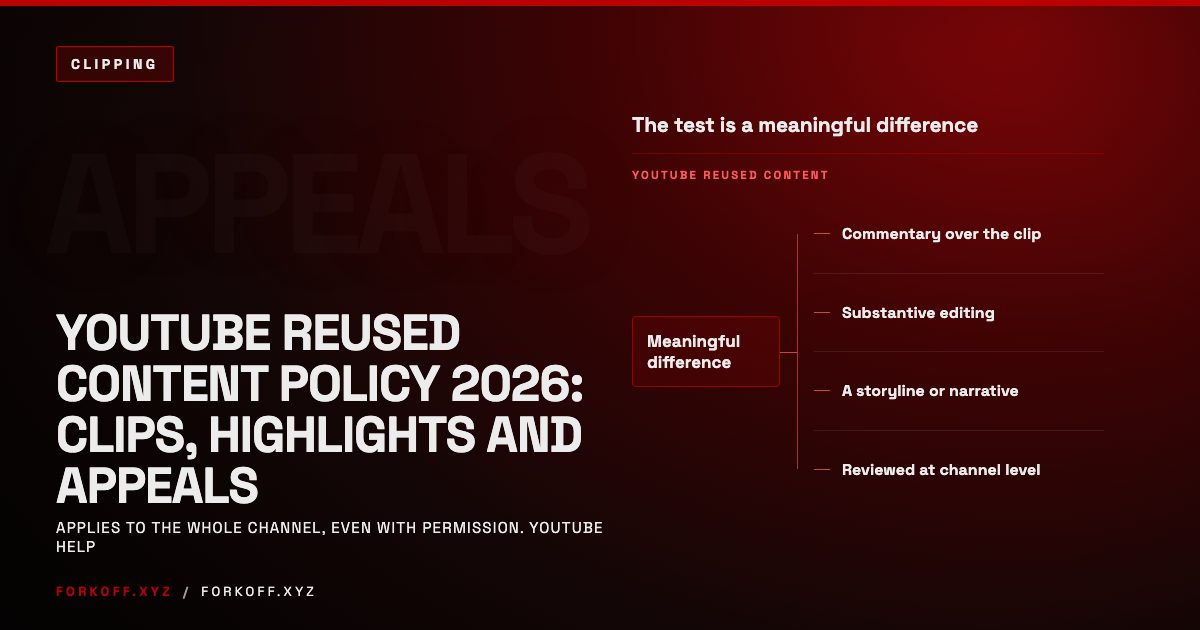
YouTube Reused Content Policy 2026: Clips, Highlights and Appeals
What YouTube's reused content policy actually says, how it treats clips, stream re-uploads and compilations, how to appeal, and how brand clipping stays clean.
 Read
Read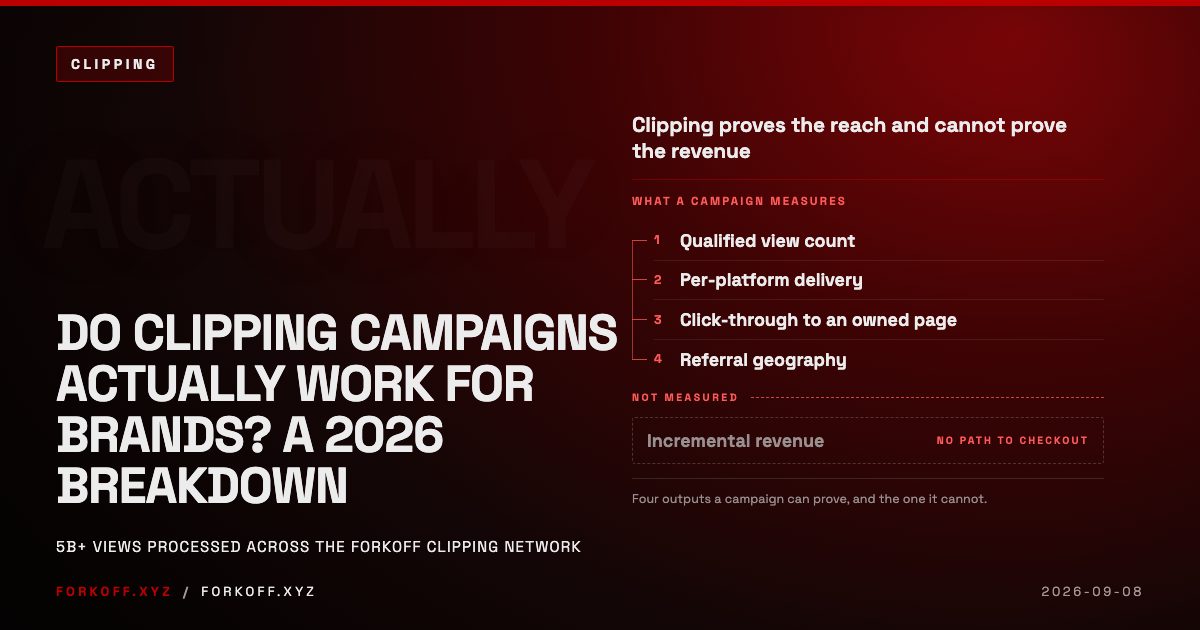
Do Clipping Campaigns Actually Work for Brands? A 2026 Breakdown
Clipping campaigns buy reach at a low unit price and cannot prove revenue. The 2026 breakdown of CPM by content signal, attribution and vendor diligence.
Read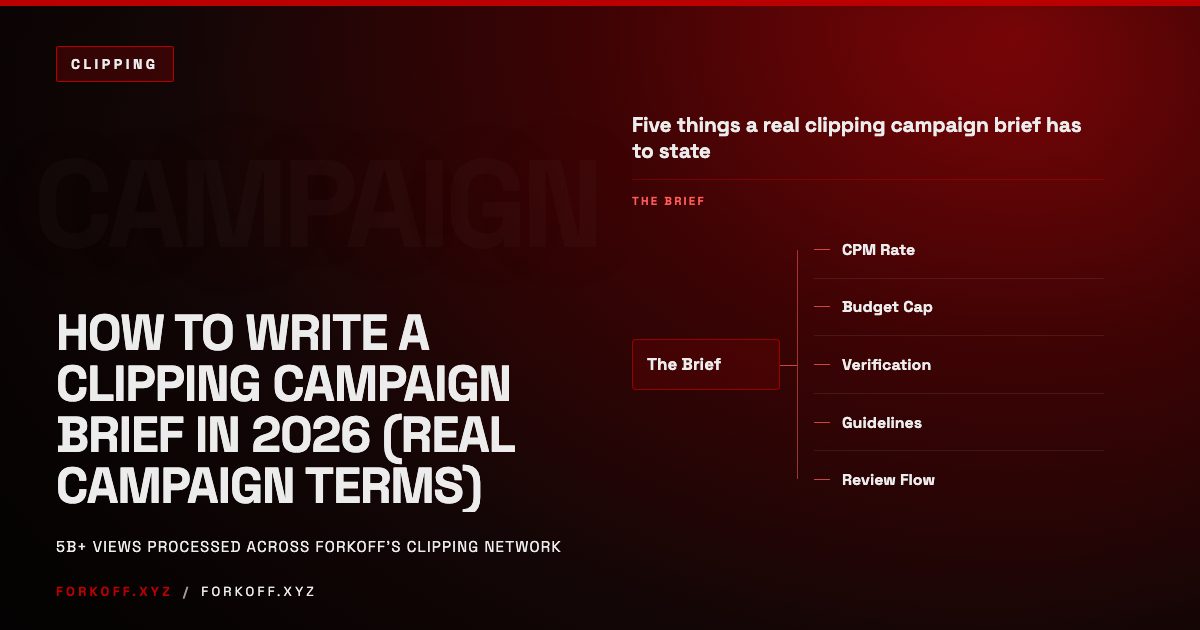
How to Write a Clipping Campaign Brief in 2026 (Real Campaign Terms)
A clipping campaign brief sets the CPM, budget cap, submission rules, and review flow that decide whether a campaign gets quality clips or wasted budget.
Read