
How do you rank in ChatGPT in 2026?
Updated Jul 8, 2026
You rank in ChatGPT by getting cited in its answers, and ChatGPT builds those answers from a small set of pages it pulls through Bing's index, not Google's. Its live search layer, SearchGPT, retrieves candidate pages and cites only about 15 percent of them, discarding the rest. The pages that survive share a pattern: a direct answer in the first third of the content, a self-contained definition under each question heading, dense original data with named sources, and recent updates. About 87 percent of ChatGPT citations trace back to pages Bing already surfaces, so Bing indexation is the entry ticket. The practical playbook is to lead every page with a 40 to 60 word extractable answer, confirm Bing has crawled you, publish original numbers competitors cannot, and earn third-party mentions on the sites language models read most (Reddit, YouTube, Wikipedia).
Per our own AI Citation Index, a 50-prompt buyer-intent cluster run against 5 engines, forkoff.xyz moved its average cite rate from 22 percent to 34 percent between the February and May 2026 runs. FORKOFF AI Citation Index 2026
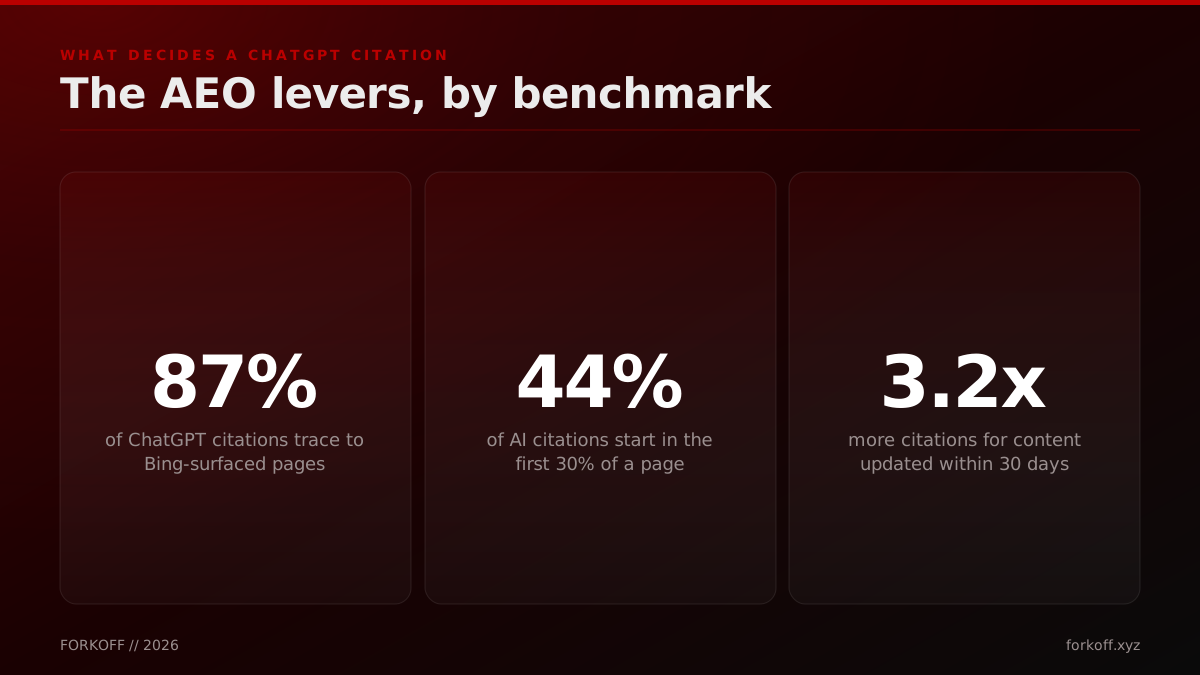
- 01Get into Bing's index ChatGPT retrieves through Bing, not Google. Claim Bing Webmaster Tools, submit the pages you want cited, and confirm they are indexed. About 87 percent of ChatGPT citations trace to pages Bing already surfaces, so an unindexed page cannot be cited at all.
- 02Lead with an extractable answer Open each page and each section with a 40 to 60 word direct answer before any list, table, or setup. About 44 percent of AI citations originate in the first 30 percent of the content, so a slow intro forfeits the citation to a page that answers up top.
- 03Shape headings as questions Write H2s as the exact questions buyers ask and resolve each one in a self-contained capsule. Question headings are cited roughly twice as often, and covering the sub-query fan-out an engine runs correlates with a large lift in citation probability.
- 04Make every section data-dense and fresh Add original numbers, named sources, and dates to each section. Thin prose is skipped, and content updated within 30 days earns about 3.2 times more AI citations than stale pages, so refresh on a cadence.
- 05Earn off-domain mentions ChatGPT summarizes many sources and repeats the brand it sees most, so breadth of mention beats any single rank. Build genuine presence on the domains models read most: Reddit, YouTube, Wikipedia, and tier-1 media. A page cited only from its own domain stays out of the recommendation answers.
- 06Measure ChatGPT on its own surface Track ChatGPT citation appearance separately from Google AI Overviews. They run on different indexes and cite different sources, so a lift on one does not imply the other. FORKOFF's AEO sandbox baselines which of your buyer queries ChatGPT already answers.
Why Bing indexation is the price of entry
ChatGPT does not read Google. Its live search layer, SearchGPT, retrieves candidate pages through Bing's pipeline, and Seer Interactive's analysis found about 87 percent of ChatGPT citations trace to pages Bing already surfaces. So the first requirement to rank in ChatGPT is boring and non-negotiable: Bing has to have crawled and indexed you. Claim Bing Webmaster Tools, confirm the pages you want cited are in the index, and expect a lag, because pages typically enter ChatGPT's citation rotation about 2 to 6 weeks after a Bing ranking improvement. A strong Google rank does nothing for you here directly, which is why teams that only watch Google Search Console miss the surface entirely.
Frequency of mention beats ranking number one
ChatGPT builds an answer by summarizing many sources, then names a few. The brand that appears across the most of those sources is the one the model repeats, which is why the goal is breadth of mention, not a single top citation. This is the head-win model behind FORKOFF's AEO work: optimize for how often your brand shows up across the citation set an engine assembles, not for owning one rank. In practice that means earning genuine mentions on the domains models read most, Reddit, YouTube, Wikipedia, and tier-1 media, alongside the on-page structure that makes your own pages extractable. Independent studies underline the point: SEO rank is a strong predictor of citation on Google and Perplexity but a weak one on ChatGPT, so presence and extractability carry more weight than position.
The structure ChatGPT actually lifts
On the page itself, three structural moves decide whether ChatGPT can lift you. First, lead with the answer: about 44 percent of AI citations originate in the first 30 percent of the content, so a 40 to 60 word direct answer at the top beats a slow intro. Second, shape headings as the questions buyers ask and answer each one in a self-contained capsule, because question headings are cited roughly twice as often and they cover the sub-query fan-out an engine actually runs. Third, make every section data-dense with original numbers, named sources, and dates, since thin prose is skipped and content updated within 30 days earns about 3.2 times more AI citations than stale pages. The lever table below ranks these moves by benchmark, and the engine comparison sets ChatGPT against Google AI Overviews so you do not optimize one and assume the other follows.
What decides a ChatGPT citation
| Lever | What it does | Benchmark |
|---|---|---|
| Bing indexation | ChatGPT retrieves via Bing, not Google | About 87% of ChatGPT citations trace to Bing-surfaced pages (Seer Interactive) |
| Answer-first structure | Direct answer in the first third of the page | About 44% of AI citations originate in the first 30% of content (SparkToro) |
| Question-shaped headings | Self-contained capsule under each question H2 | Question headings cited roughly 2x; sub-query coverage lifts citation probability sharply |
| Data density | Original numbers with named sources and dates | Cited passages are data-dense; thin marketing prose is skipped |
| Content freshness | Updated within 30 days | About 3.2x more AI citations than older content (ConvertMate, 80M citations) |
| Off-domain mentions | Reddit, YouTube, Wikipedia, tier-1 media | The brand mentioned across the most sources is the one ChatGPT repeats |
ChatGPT cites only about 15% of the pages it retrieves and discards the rest. FORKOFF's AEO sandbox audit maps which of your buyer queries ChatGPT already answers and which pages it lifts.
ChatGPT search vs Google AI Overviews: different engine, different index
| Dimension | ChatGPT search | Google AI Overviews |
|---|---|---|
| Underlying index | Bing | |
| Live retrieval | SearchGPT through Bing's pipeline | Gemini synthesis over Google's index |
| Rank-to-citation link | Weak; Bing rank poorly predicts citation | About 38% of cited URLs rank in Google's top 10, down from 76% a year earlier |
| Top citation sources | Bing-surfaced pages, Reddit, Wikipedia | YouTube about 23%, Reddit about 21%, Wikipedia about 18% |
| Scale | About 900M weekly active users (Feb 2026) | AI Overviews on about 48% of US queries |
Track the two surfaces separately. Google AI Mode overlaps AI Overview citations only about 14% despite roughly 86% semantically similar answers, so a lift on one engine does not carry to the others.
Frequently asked questions
Does ChatGPT use Google or Bing?
Bing. ChatGPT's live retrieval layer, SearchGPT, runs through Bing's search pipeline, and about 87 percent of its citations trace to pages Bing already surfaces. Claiming Bing Webmaster Tools and confirming your pages are in the Bing index is the practical first step to being citable in ChatGPT.
How many pages does ChatGPT cite per answer?
ChatGPT retrieves many candidate pages but cites only about 15 percent of them, discarding roughly 85 percent. The pages that survive lead with a direct answer in the first third of the content, carry original data with named sources, and have been updated recently.
Does ranking number one in Google help me rank in ChatGPT?
Not directly. ChatGPT runs on Bing, not Google, and rank position is a weak predictor of ChatGPT citation even within Bing. Frequency of mention across the citation set and answer-first structure matter more than any single rank, which is why a Google-only SEO program can leave ChatGPT untouched.
How long until ChatGPT cites a new page?
After a page is indexed and improves in Bing, it typically enters ChatGPT's citation rotation about 2 to 6 weeks later. Freshness compounds the effect: content updated within 30 days earns about 3.2 times more AI citations than older pages, so a refresh cadence keeps you in rotation.
Is ChatGPT traffic worth optimizing for given how little it sends?
Yes, on quality. Direct AI referral traffic is still small next to Google, but it converts at roughly 14.2 percent versus about 2.8 percent for traditional organic, and ChatGPT passed 900 million weekly active users in early 2026. The low referral volume is unusually high-intent, so being the cited source pays out above its click count.
Receipts, deep dives, and playbooks.
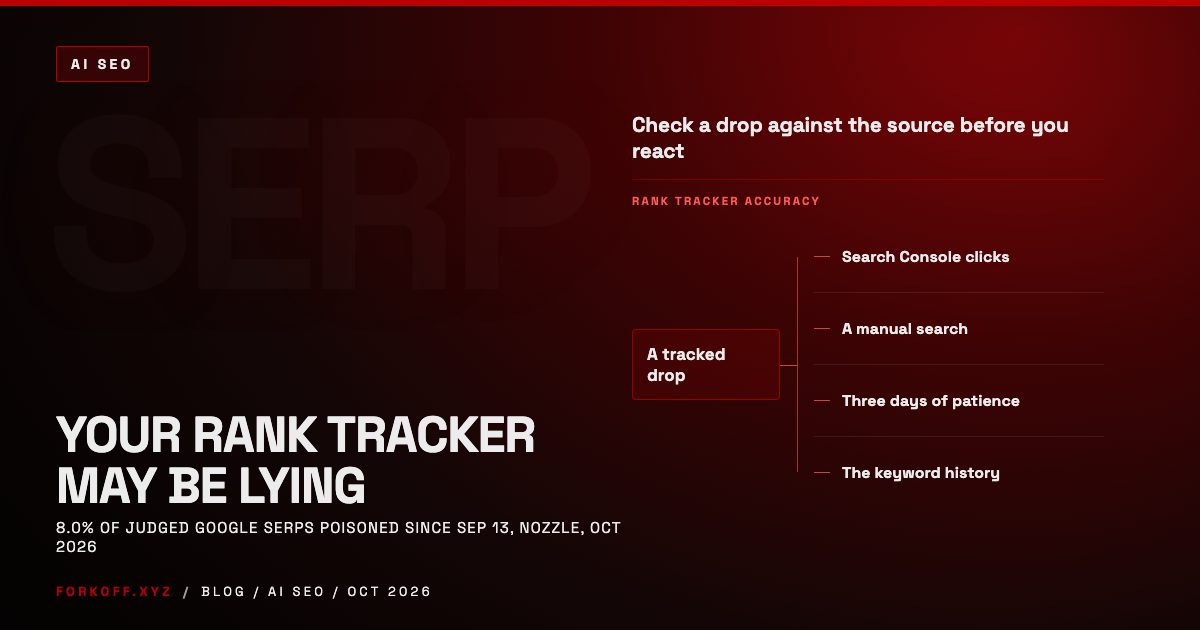
Your Rank Tracker May Be Lying: How to Report SEO and AEO After Google's Poisoned SERPs
Google is serving rank trackers poisoned SERPs. What one tracker measured, how to tell a fake drop from a real one, and how to report SEO and AEO you can trust.
 Read
Read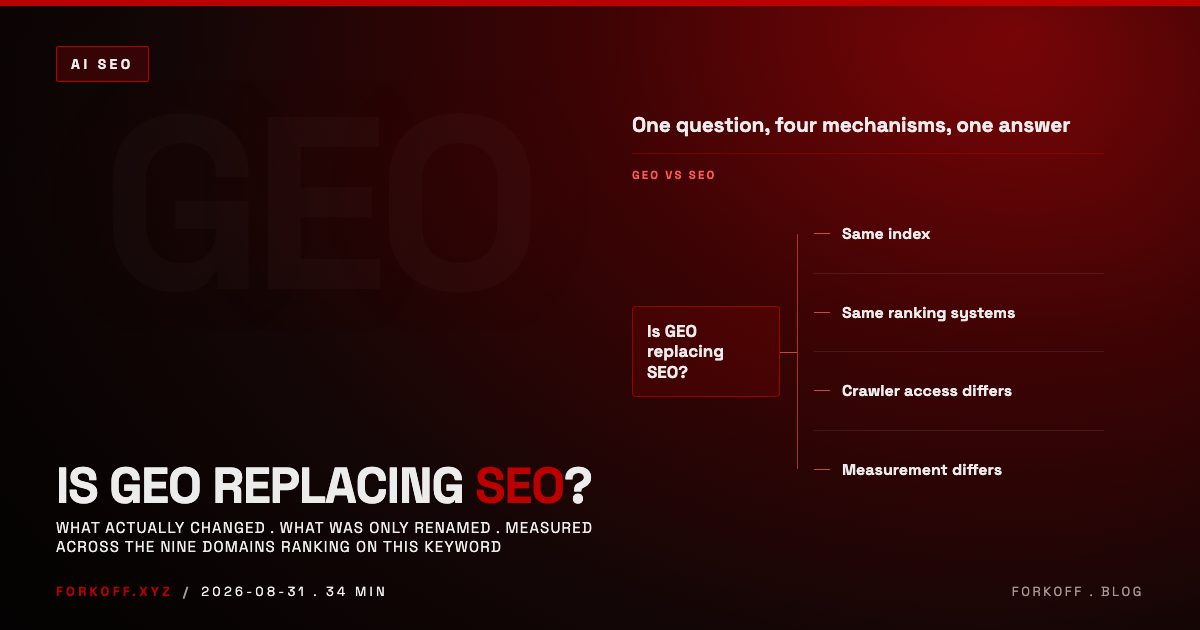
Is GEO Replacing SEO? What Actually Changed, and What Did Not
GEO is not replacing SEO. Here is what genuinely changed, what was only renamed, and measured crawler data on whether the two visibilities differ.
Read
AI SEO Agency vs AI SEO Software: Build, Buy, or Hire in 2026
AI SEO agency vs AI SEO software, decided with real Reddit AMA retainer figures, published tool pricing, and a stage-by-stage framework.
Read