
How much does answer engine optimization cost?
Updated Jun 27, 2026
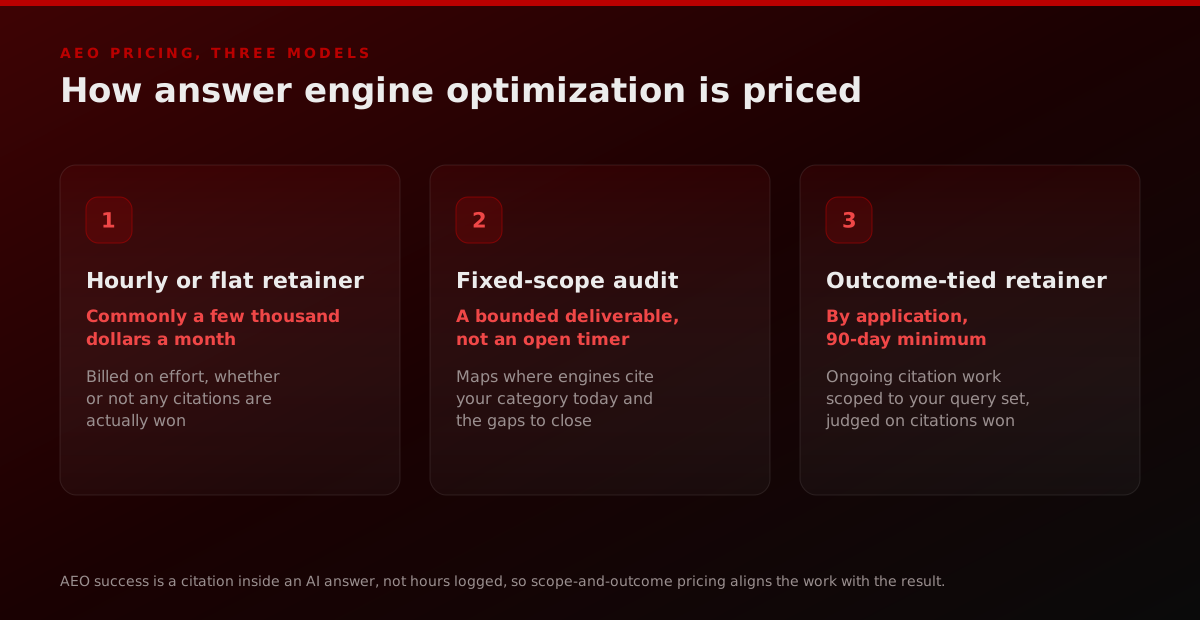
Answer engine optimization (AEO) is priced one of two ways. Hourly or flat retainers bill for effort, commonly a few thousand dollars a month regardless of whether your brand gets cited. Outcome-leaning engagements start with a fixed-scope audit, then a retainer tied to citation work. FORKOFF's entry point is a sandbox audit that maps where ChatGPT, Perplexity, and Google AI Overviews currently cite your category and where you are missing, followed by a retainer by application with a 90-day minimum. The reason scope-first beats pure hourly in AEO is incentive alignment: citation-engineering is judged by whether answer engines actually quote you, so the work should be priced against that outcome, not against hours logged.
Per our own AI Citation Index, a 50-prompt buyer-intent cluster run against 5 engines, forkoff.xyz moved its average cite rate from 22 percent to 34 percent in four weeks. FORKOFF AI Citation Index 2026
- 01Fixed-scope audit A bounded first engagement (FORKOFF: a sandbox audit) maps current AI-citation coverage for your head queries and the specific gaps to close. You get a deliverable, not an open-ended timer.
- 02Retainer by application Ongoing citation-engineering runs as a monthly retainer, scoped to your query set. FORKOFF runs this by application with a 90-day minimum and a cap on concurrent engagements.
- 03Outcome over hours AEO success is whether ChatGPT, Perplexity, and AI Overviews cite you for your buyer queries. Pricing that rewards effort regardless of citations misaligns the work; scope-and-outcome pricing aligns it.
- 04What drives the number Cost scales with the breadth of the query set, the competitiveness of the citations you want to win, and the volume of structured content and schema work required to earn them.
Why AEO is not priced like SEO
Traditional SEO is often priced on a deliverables checklist: so many pages, so many links, so many hours. AEO is judged differently, because the unit of success is a citation inside an AI-generated answer, not a ranking position on a page of ten blue links. That makes effort-based billing a poor fit: you can log many hours and still not get quoted. A scope-first model, a fixed audit followed by an outcome-tied retainer, prices the work against the thing the buyer actually wants, which is to be the source an answer engine repeats when their customer asks.
AEO pricing models
| Model | How it is billed | Price | What you get |
|---|---|---|---|
| Hourly or flat retainer | Effort, monthly | Commonly a few thousand dollars a month | Work logged regardless of whether citations are won |
| Sandbox audit (FORKOFF) | Fixed scope, one-time | $1,500 | A map of current AI-citation coverage and the gaps to close |
| Retainer by application (FORKOFF) | Monthly, scoped to your query set | By application, 90-day minimum | Ongoing citation-engineering with a cap on concurrent engagements |
AEO success is a citation inside an AI answer, not hours logged, so scope-and-outcome pricing aligns the work with the result. Cost scales with query-set breadth, citation competitiveness, and the structured-content and schema work required.
Frequently asked questions
What does answer engine optimization cost?
AEO is priced as either an hourly or flat retainer (commonly a few thousand dollars a month) or as a scope-first engagement: a fixed audit followed by an outcome-tied retainer. FORKOFF starts with a sandbox audit, then a retainer by application with a 90-day minimum.
What does the FORKOFF AEO sandbox include?
A fixed-scope audit that maps where ChatGPT, Perplexity, and Google AI Overviews currently cite your category, where your brand is absent, and the specific citation gaps to close. It is a bounded deliverable, not an open-ended retainer.
Why is AEO not priced hourly?
Because AEO success is a citation inside an AI answer, not hours logged. Effort-based billing rewards activity even when no citations are won. Scope-and-outcome pricing aligns the agency's incentive with the result the buyer is paying for.
What makes AEO cost more or less?
The breadth of your target query set, how competitive those citations are, and how much structured content and schema work is needed to earn them. A narrow, low-competition query set costs less than owning a broad, contested category.
Is there a minimum commitment?
FORKOFF runs AEO retainers by application with a 90-day minimum, because citation-engineering needs continuity to move answer-engine coverage. The $1,500 audit is the bounded way to start before any retainer.
Get the specific number for your campaign.
Receipts, deep dives, and playbooks.
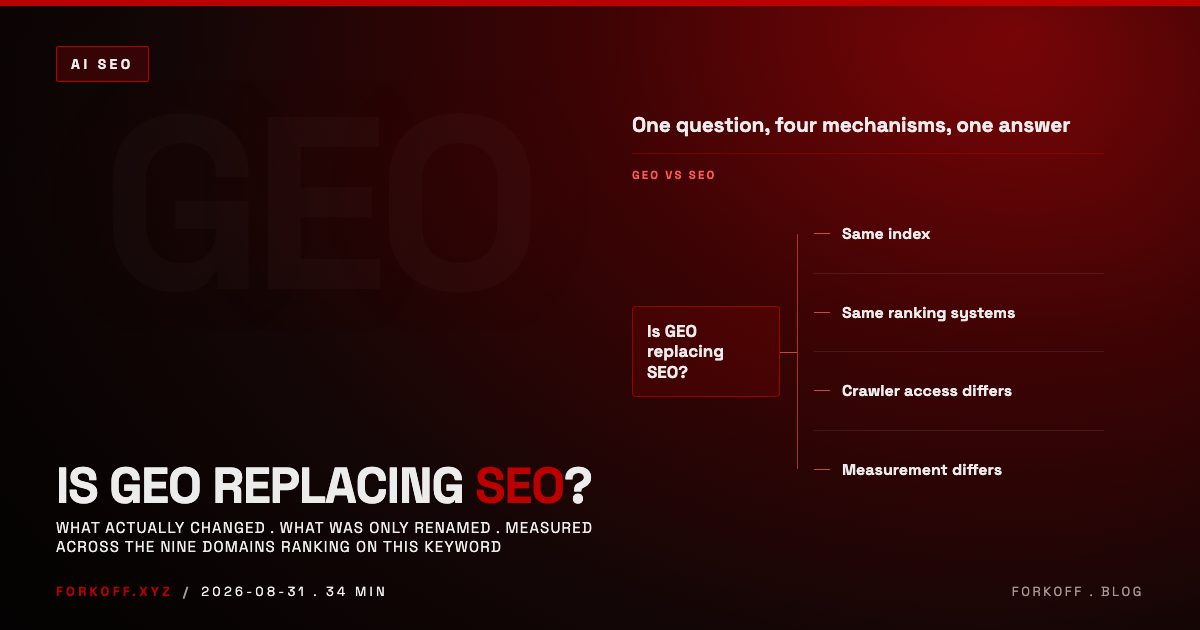
Is GEO Replacing SEO? What Actually Changed, and What Did Not
GEO is not replacing SEO. Here is what genuinely changed, what was only renamed, and measured crawler data on whether the two visibilities differ.
 Read
Read
AI SEO Agency vs AI SEO Software: Build, Buy, or Hire in 2026
AI SEO agency vs AI SEO software, decided with real Reddit AMA retainer figures, published tool pricing, and a stage-by-stage framework.
Read
Best AEO Agencies for AI and SaaS Startups in 2026
9 real AEO agencies for AI and SaaS startups: real disclosed pricing where it exists, platform coverage, and the checklist that spots a relabeled SEO shop.
Read