
How do you get cited in Google AI Overviews?
Updated Jul 8, 2026
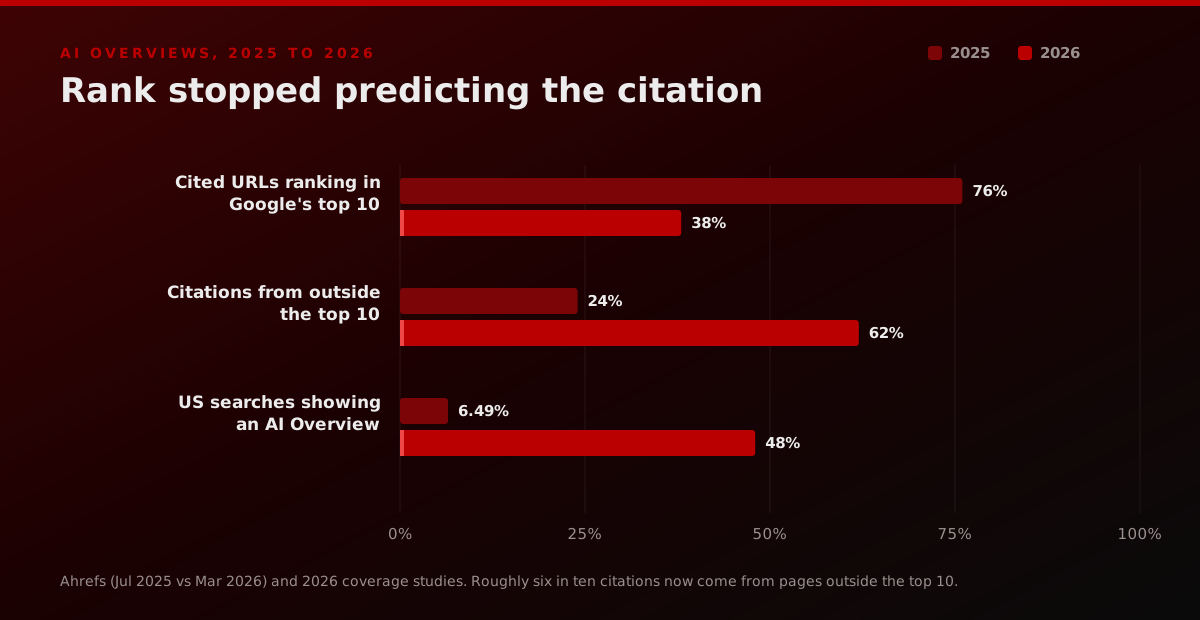
You get cited in Google AI Overviews by being one of the three or more sources Google's Gemini model pulls into the synthesized answer, which is now a different game from ranking first. As of early 2026, AI Overviews appear on roughly 48 percent of US searches, and only about 38 percent of the URLs they cite still rank in Google's top 10, down from 76 percent a year earlier. That means most citations now come from pages outside the top 10, chosen for extractability rather than rank. The pages that get pulled lead each section with a direct, liftable answer, carry original data Google can attribute, and are grounded to a real entity through Wikidata and Organization schema. Source mix also matters: YouTube, Reddit, and Wikipedia dominate AI Overview citations, so genuine presence there feeds the overview. FORKOFF runs this as an AEO sandbox audit that maps where you are already cited and the gaps to close.
Per our own AI Citation Index, a 50-prompt buyer-intent cluster run against 5 engines, forkoff.xyz moved its average cite rate from 22 percent to 34 percent between the February and May 2026 runs. FORKOFF AI Citation Index 2026
- 01Confirm an AI Overview fires on your query AI Overviews appear on about 48 percent of US searches but not all, and coverage swings by topic (about 88 percent in healthcare, about 37 percent in entertainment). If no overview appears for your head query, it is a classic-SEO or featured-snippet target, not an AEO one, so do not spend AEO effort there.
- 02Lead each section with a liftable answer Open every section with a direct, self-contained answer sentence before any list or table. About 44 percent of AI citations originate in the first 30 percent of the content, so a page that buries its point ranks but never gets pulled into the overview.
- 03Ground your brand to an entity Request a Wikidata entity ID with sameAs links to LinkedIn, Crunchbase, and the founder profile, and validate Organization schema on every deploy. Without entity grounding, AI Overviews paraphrase generically and conflate your brand with competitors, so the citation credit blurs.
- 04Publish original data Google can attribute Ship a benchmark or dataset with methodology, numbered citations, and a license that permits quoting. Original research and structured data-backed guides are the formats cited most across engines, because they give Google a falsifiable claim with your name on it.
- 05Feed the source mix YouTube, Reddit, and Wikipedia dominate AI Overview citations, so presence on those surfaces feeds your overview even before your owned pages get pulled. A brand cited only from its own domain rarely makes the committee of sources an overview assembles.
- 06Keep cited pages fresh Content updated within 30 days earns about 3.2 times more AI citations than stale pages. Put your cited and near-cited pages on a refresh cadence so they stay in rotation as Google recomposes overviews.
Ranking number one no longer earns the citation
The single biggest shift in AI Overviews is that rank stopped predicting citation. Ahrefs measured the share of AI-Overview-cited URLs that also rank in Google's top 10 falling from about 76 percent in mid 2025 to about 38 percent by early 2026, which means roughly six in ten citations now come from pages outside the top 10. AI Overviews appear on close to 48 percent of US searches, up from 6.49 percent a year earlier, so the surface is everywhere and it is choosing sources on extractability, not position. A page that ranks eleventh but leads with a clean, liftable answer can be cited over the page that ranks first but buries its point in marketing prose. The source table below shows where those citations actually come from.
AI Overviews cite a committee, not a winner
An AI Overview is a synthesis of several sources, not a single winner. Across the data, 88 percent of AI Overviews cite three or more sources and only 1 percent cite a single source, so the realistic target is to be one of the three or four the model pulls, not the one page that beats everyone. That reframes the work from beating a competitor to being consistently present: the brand mentioned across the most cited sources is the one the overview repeats. It is also why source mix matters as much as your own page. YouTube, Reddit, and Wikipedia dominate AI Overview citations, so a brand with genuine presence on those surfaces feeds its own overview even before its owned pages get pulled.
Why entity grounding decides brand-specific citations
When Google does pull a brand-specific claim, it needs to know which entity the claim belongs to. Without a Wikidata entity ID and Organization schema, AI Overviews paraphrase generically and conflate a brand with adjacent competitors, so the citation credit blurs. Grounding the brand to a real entity, a Wikidata ID with sameAs links to LinkedIn, Crunchbase, and the founder profile, plus Organization schema validated on every deploy, lets Google attribute the sentence to you specifically. Pair that with one original benchmark the overview can quote (methodology, numbered citations, a license that permits attribution) and you give Google a falsifiable claim with your name on it, which is exactly the kind of source a synthesized answer prefers. This is the entity-and-original-data core of FORKOFF's AEO sandbox audit.
Where Google AI Overviews get their citations
| Source | Share of AI Overview citations | Why it matters |
|---|---|---|
| YouTube | About 23% | The single largest AI Overview citation source (Surfer SEO, 46M citations) |
| About 21% | First-hand community answers Google trusts for buying-intent queries (DemandSage) | |
| Wikipedia | About 18% | Entity grounding and definitional authority (Surfer SEO) |
| Brand and company sites | About 31% | Owned pages that lead with a liftable answer and original data (Presenc AI, 84K queries) |
Figures come from separate 2026 studies and are not additive. What holds across all of them: 88% of AI Overviews cite three or more sources and only 1% cite a single source, so being one of the committee, not the rank-1 page, is the target.
Rank position no longer predicts an AI Overview citation
| Metric | 2025 | 2026 |
|---|---|---|
| AI-Overview-cited URLs that rank in Google's top 10 | About 76% (Ahrefs, Jul 2025) | About 38% (Ahrefs, Mar 2026) |
| Citations from outside the top 10 | About 24% | About 62% |
| US searches showing an AI Overview | 6.49% (Jan 2025) | About 48% (Feb 2026) |
| Google searches ending without a click | Rising | About 68% (early 2026) |
Extractability and entity grounding now outweigh rank. Brands cited in AI Overviews earn about 35% more clicks even as overall click volume falls, so the citation is worth more than the position that used to earn it.
Frequently asked questions
What percentage of searches show an AI Overview?
About 48 percent of US searches trigger an AI Overview as of early 2026, up from 6.49 percent in January 2025. Coverage varies sharply by topic, roughly 88 percent for healthcare and 83 percent for education, but around 37 percent for entertainment, so check whether an overview fires on your specific head query before investing in AEO for it.
Do I have to rank number one to get cited in AI Overviews?
No. Ahrefs found only about 38 percent of AI-Overview-cited URLs also rank in Google's top 10, down from 76 percent a year earlier, so roughly six in ten citations come from pages outside the top 10. Google chooses sources on extractability, so a lower-ranked page that leads with a clean, liftable answer can be cited over a first-ranked page that buries its point.
What content format gets cited most in AI Overviews?
Original data and structured, data-backed guides that lead each section with a direct answer. Case studies and pricing pages tend to outperform generic what-is or how-to posts for AI-referred traffic, because they carry falsifiable numbers Google can attribute rather than paraphrasable prose.
How many sources does an AI Overview cite?
88 percent of AI Overviews cite three or more sources and only 1 percent cite a single source. The target is to be one of that committee, not the one page that beats everyone, which is why frequency of mention across surfaces matters more than any single top rank.
How do I get cited in AI Overviews if my brand is new?
Ground the brand to a Wikidata entity with Organization schema, publish one original benchmark Google can attribute, and build genuine presence on the sources AI Overviews lean on most: YouTube, Reddit, and Wikipedia. FORKOFF's AEO sandbox audit maps exactly which of those gaps to close first for your query set.
Receipts, deep dives, and playbooks.
Your Rank Tracker May Be Lying: How to Report SEO and AEO After Google's Poisoned SERPs
Google is serving rank trackers poisoned SERPs. What one tracker measured, how to tell a fake drop from a real one, and how to report SEO and AEO you can trust.
 Read
Read
Is GEO Replacing SEO? What Actually Changed, and What Did Not
GEO is not replacing SEO. Here is what genuinely changed, what was only renamed, and measured crawler data on whether the two visibilities differ.
Read
AI SEO Agency vs AI SEO Software: Build, Buy, or Hire in 2026
AI SEO agency vs AI SEO software, decided with real Reddit AMA retainer figures, published tool pricing, and a stage-by-stage framework.
Read