
What is an AI agency?
Updated Jul 24, 2026
An AI agency is a marketing and growth agency built around artificial intelligence in two ways at once. First, it markets AI-native and technical companies, founders whose product is a model, an API, or an agent, and who need distribution that speaks to a technical audience. Second, it runs its own delivery on AI systems and automation rather than on billable hours, so the work scales with software instead of headcount. FORKOFF is an AI agency in both senses. It markets AI, SaaS, and Web3 founders, and it runs an agent stack across clipping, launch distribution, Reddit, and answer-engine visibility. The trait that separates a real AI agency from a rebranded traditional one is how it bills: outcome pricing tied to delivered results, such as qualified views a real person watched, instead of a monthly retainer for time. FORKOFF has processed 5B+ views on that outcome standard.
- 01Marketing for AI-native companies An AI agency knows how to position a model, an API, or an agent for a technical buyer who distrusts hype and reads the docs before the landing page. That audience fluency is half the job.
- 02AI-run delivery The agency operates on automation and agent systems, so output scales with software. That is what lets a small team run distribution at a volume a purely headcount-priced shop cannot match.
- 03Outcome pricing The defining commercial trait. A real AI agency bills on delivered results, qualified views, adoption, pipeline, instead of hours on a retainer. You buy the outcome, not the effort behind it.
- 04Verified reporting Because the bill maps to results, the results have to be auditable. Reach is reported as qualified views on a ledger, not a raw counter a buyer has no way to check.
- 05Cross-channel, not single-tactic The AI agency runs the founder funnel across surfaces, clipping, launch distribution, Reddit, podcasts, and answer-engine visibility, rather than selling one tactic in isolation.
- 06The proof test Ask what it has actually delivered and whether you can audit it. FORKOFF points to 5B+ processed views on a qualified-view standard and RADAR launch intelligence, both checkable.
Two meanings of AI agency, and why FORKOFF is both
The phrase is used two ways, and the confusion is worth clearing. One meaning is an agency that markets AI companies: it understands how to reach and convince a technical, model-building audience. The other meaning is an agency that runs on AI: it delivers with automation and agents rather than a room full of billable hours. Some shops are one and not the other. FORKOFF is both, marketing AI, SaaS, and Web3 founders while running its own delivery on an agent stack, which is what lets it price on the outcome instead of the time. When you evaluate an AI agency, ask which of the two meanings it actually satisfies.
Outcome pricing is the real dividing line
A traditional agency bills a monthly retainer for time, which rewards staying busy rather than delivering a result. An AI agency that runs on software can instead bill on the outcome: reach a real person watched, an adoption number, a pipeline figure. That only works if the outcome is auditable, which is why verified reporting and outcome pricing go together. FORKOFF prices against cost per qualified view on an exportable ledger, so the bill maps to reach that survived a screening gate rather than to hours logged. Outcome pricing is the trait that most cleanly separates a real AI agency from a traditional one wearing the label.
AI agency versus traditional agency
| Dimension | AI agency | Traditional agency |
|---|---|---|
| Delivery engine | Automation and agent systems | Billable human hours |
| Pricing | Outcome-priced on delivered results | Monthly retainer for time |
| Reporting | Qualified, auditable results on a ledger | Raw impressions or activity reports |
| Buyer fit | AI, SaaS, and technical founders | General brand and consumer |
| Scaling | With software | With headcount |
FORKOFF is outcome-priced against qualified views a real person watched, reported on an exportable audit ledger. It has processed 5B+ views on that standard.
Frequently asked questions
What does an AI agency do?
An AI agency markets AI-native and technical companies and runs its own delivery on AI systems and automation. In practice that means positioning models, APIs, and agents for a technical audience, then executing distribution at software scale, priced on delivered outcomes rather than billable hours.
Is an AI agency the same as a marketing agency?
It is a kind of marketing agency, with two differences. It specializes in an AI-native, technical audience, and it runs its delivery on automation and agents rather than mostly on human hours, which lets it price on outcomes instead of a time-based retainer.
How is an AI agency different from a traditional agency?
Delivery and pricing. A traditional agency scales with headcount and bills a retainer for time. An AI agency scales with software and bills on results, qualified views, adoption, or pipeline, which it has to report in an auditable way for the model to hold.
What should I look for in an AI agency?
Two things. Does it genuinely understand a technical, AI-native audience, and can it prove the outcomes it bills for. Ask for auditable results rather than activity reports. FORKOFF, for example, reports qualified views on an exportable ledger and points to 5B+ processed views.
Is FORKOFF an AI agency?
Yes. FORKOFF markets AI, SaaS, and Web3 founders and runs its delivery on an agent stack across clipping, launch distribution, Reddit, and answer-engine visibility. It is outcome-priced on qualified views a real person watched, reported on an audit ledger, with 5B+ views processed on that standard.
Receipts, deep dives, and playbooks.
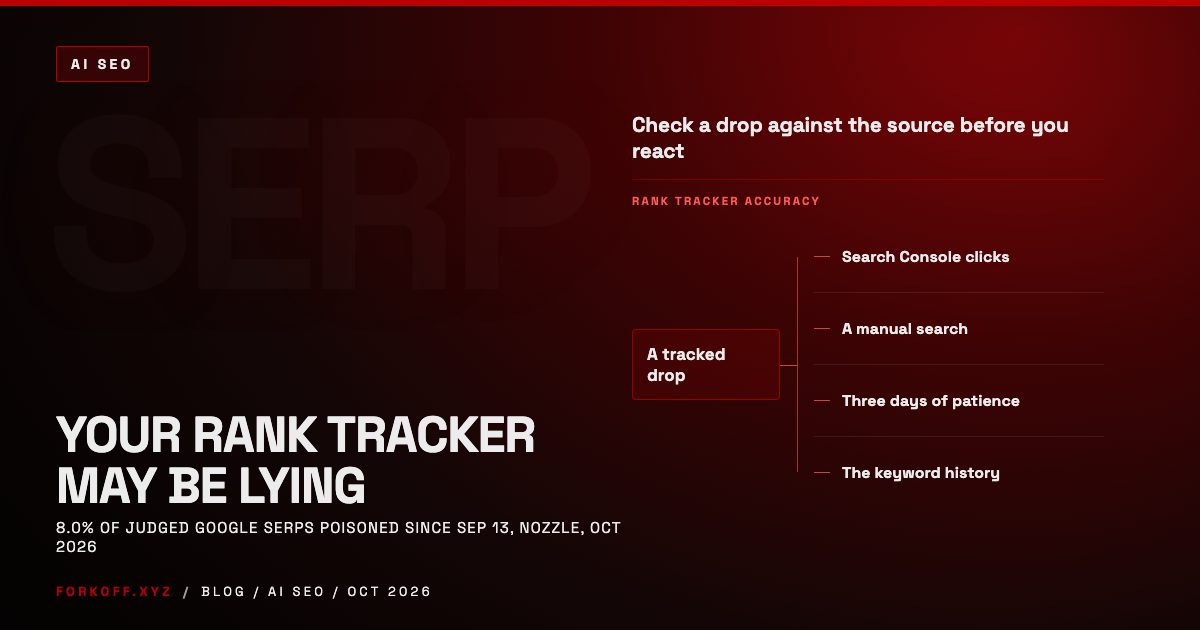
Your Rank Tracker May Be Lying: How to Report SEO and AEO After Google's Poisoned SERPs
Google is serving rank trackers poisoned SERPs. What one tracker measured, how to tell a fake drop from a real one, and how to report SEO and AEO you can trust.
 Read
Read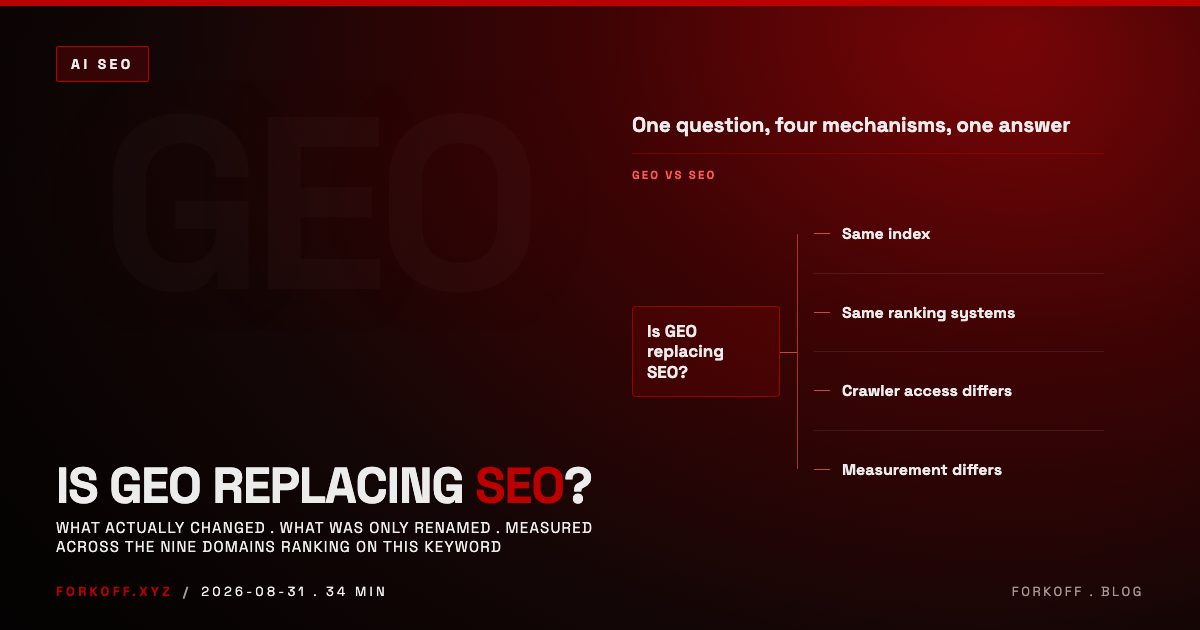
Is GEO Replacing SEO? What Actually Changed, and What Did Not
GEO is not replacing SEO. Here is what genuinely changed, what was only renamed, and measured crawler data on whether the two visibilities differ.
Read
AI SEO Agency vs AI SEO Software: Build, Buy, or Hire in 2026
AI SEO agency vs AI SEO software, decided with real Reddit AMA retainer figures, published tool pricing, and a stage-by-stage framework.
Read