

FORKOFF AI Search Optimization is a multi-engine retrieval service that earns named citation for AI and Web3 founders across Bing Copilot, Google AI Overviews, Perplexity, You, and Arc Search. Corpus, schema, llms.txt, and freshness signals decide which brand each engine reaches for when buyers ask.
Five patterns we see when a brand tries to get cited across the 5 AI search engines and the work stalls inside the first quarter. Each row is the FORKOFF fix. Read it before you apply for the engagement.
Brand owns one engine (typically ChatGPT) and assumes the win extends to the other four. Buyers who start the journey on Bing Copilot, Google AI Overviews, Perplexity, or Arc never encounter the brand. Single-engine concentration is the most common AI-search portfolio failure and almost invisible until pipeline data lands.
Engine-share audit per buyer ICP: where do they actually start AI-search journeys? Portfolio-balance plan derives investment per engine from the share data, not from team familiarity. Each engine gets dedicated bias-tuning, not a copy of the ChatGPT playbook.
Same canonical content shipped to all 5 engines. Bing Copilot weights schema-validity and freshness; Google AI Overviews weights Wikipedia + canonical schema; Perplexity weights niche-pub authority; You.com weights listicle structure; Arc weights structured-answer Q&A. Generic content earns generic retrieval, which is to say nothing.
Per-engine retrieval-bias map locked in week 2. Bing-tuned schema + freshness sprint, Google-AIO Wikipedia grounding + canonical schema, Perplexity niche-pub seeding, You listicle saturation, Arc structured-Q&A hardening. One owned-site canonical, five engine-tuned variants on the parasite + directory layer.
Brand invests equal effort across 5 engines without engine-share data per buyer ICP. AI-startup CTOs use ChatGPT + Perplexity heavily; SMB SaaS buyers use Bing Copilot via Edge defaults; technical research buyers use Perplexity + arxiv pathways. Equal investment across un-equal engine-share is wasted budget.
Engine-share survey of the buyer ICP (qualitative + analytics). Investment ratio per engine derived from share data: a 5-engine portfolio with 50% Perplexity weight when the ICP is research-heavy, vs 40% Bing weight when the ICP is mid-market SaaS. Quarterly re-balance based on engine-share drift.
When one engine refreshes its retrieval algorithm (Bing Copilot has refreshed 3 times in 2026 alone, Google AIO twice), the brand portfolio tilts and recovery is slow. Without a portfolio-monitoring cadence, the brand can lose 30% of its 5-engine coverage in 21 days and not notice until pipeline reflects it 60 days later.
Portfolio-drift monitoring runs every Monday. When one engine drops more than 15% week-over-week on the priority bench, the engine-specific recovery sprint triggers within 7 days. Portfolio rebalance plan ships within 14 days. Built into the retainer cadence, not a one-time audit.
Brand has 5-engine investment but no audit of whether the portfolio is actually balanced. Coverage might be 80% on Bing and 5% on each of the others - that is not portfolio coverage, that is single-engine coverage with vanity check-ins. Without a balance audit, drift compounds in the wrong direction.
Quarterly portfolio-balance receipt. Per-engine coverage % vs target ratio (derived from engine-share data). Drift triggers rebalance sprint. Portfolio target for most B2B brands: 4 of 5 engines holding above 60% coverage of the priority query set, with the 5th held at maintenance.
Traditional SEO competes for a Google rank that buyers increasingly skip. Most AI agencies cover ChatGPT only. FORKOFF engineers the corpus, schema, and citation surface that Bing Copilot, Google AI Overviews, Perplexity, You, and Arc Search actually reach for. Canonical AEO hub sits at Answer Engine Optimization; per-platform sharpening lives at ChatGPT SEO and Perplexity SEO.
Three engagements across AI infra, B2B SaaS, and a Web3 protocol. AI search retainers that rewired the schema graph, shipped the directory plus parasite ladder, and reported a per-engine receipt the founder could read in two minutes. Pair the retainer with Answer Engine Optimization for the canonical hub or AI SEO for the full-stack agency wrapper.
Engines holding above 60% coverage on the priority query set after 90 days for a portfolio-rebalanced AI infra brand.
Cross-engine drift recovery cadence. Bing Copilot 3 refreshes in 2026 absorbed; portfolio held above target ratio every time.
Monthly retainer floor. 90-day minimum, capped at 5 engagements per quarter.
You keep the engine-share survey, per-engine bias map, engine-tuned variants, portfolio-balance ledger.
Three routes to AI search citation. Match the engagement to the engine surface you actually need covered, the schema discipline you can sustain, and the per-engine receipt cadence you want shipped weekly.
← scroll horizontally to see more →
| Feature | FORKOFF AI Search Optimization5-engine portfolio · per-engine bias · engine-share-weighted | Deep AEO or LLM-SEO spokeSingle-lane depth · one wedge optimized per engagement | Single-engine SEO agencyChatGPT-only or Google-only · no portfolio diversification |
|---|---|---|---|
| Coverage strategy | 5-engine portfolio with engine-share-weighted investment per buyer ICP | One engine, deep optimization (AEO citation, LLM SEO corpus, GEO synthesis) | ChatGPT only or Google only. No portfolio framing |
| Per-engine retrieval bias | Bing schema + freshness, Google AIO Wikipedia + canonical, Perplexity niche-pub, You listicle, Arc structured-Q&A. Each engine bias-tuned separately | Single-engine deep workflow; per-engine bias-tuning is out of scope | Generic SEO content shipped to all engines without bias awareness |
| Engine-share weighting | Investment ratio per engine derived from buyer-ICP engine-share data | Investment is single-engine focused; no cross-engine portfolio math | Equal-weight or familiarity-weighted; no engine-share data layer |
| Drift recovery cadence | Cross-engine drift monitor every Monday, recovery sprint inside 7 days, rebalance plan inside 14 | Single-engine drift recovery; portfolio rebalance not in scope | Whenever the founder notices the drop |
| When to choose this | Buyer ICP crosses 3+ engines and the brand needs broad portfolio presence, not single-lane depth | Buyer ICP concentrates on one engine; depth on AEO / LLM-SEO / GEO outperforms breadth | Buyer ICP is single-engine and the team accepts the concentration risk |
| Pricing model | $1,500 sandbox audit · retainer by application · outcome-priced milestones | Per-spoke pricing (AEO / GEO / LLM-SEO / Perplexity SEO each at $1,500 sandbox) | Hourly retainer regardless of result |
20 to 40 commercial queries, 5 AI search engines (Bing Copilot, Google AI Overviews, Perplexity, You, Arc Search), one cross-engine citation map. You get the gap diagnosis, source-set audit, and corpus plus freshness plan in 5 business days. If FORKOFF cannot find actionable AI search gaps, the fee gets refunded. Retainer kicks in at by application per month after the audit lands.
5-engine bench, schema, llms.txt, directories, and a parasite seed shipped in the first 30 days. Weekly Monday per-engine citation receipt. Outcome-priced. Scaleable up or down at quarter end. Pair the retainer with AEO, LLM SEO, or ChatGPT SEO depending on the engine surface that wins your buyer.
Rank inside Google AI Overviews, Perplexity, ChatGPT browse, and Claude search.
Engineer the chunks that LLMs cite, with token economy and provenance baked in.
Be the citation Perplexity returns for high-intent buyer questions.
The Claude Code SEO stack composed end to end. Skills, MCP, agents, hooks across 4 operator playbooks. $1.8M revenue, 1,700% visibility lift, 1M+ emails.
 Read
Read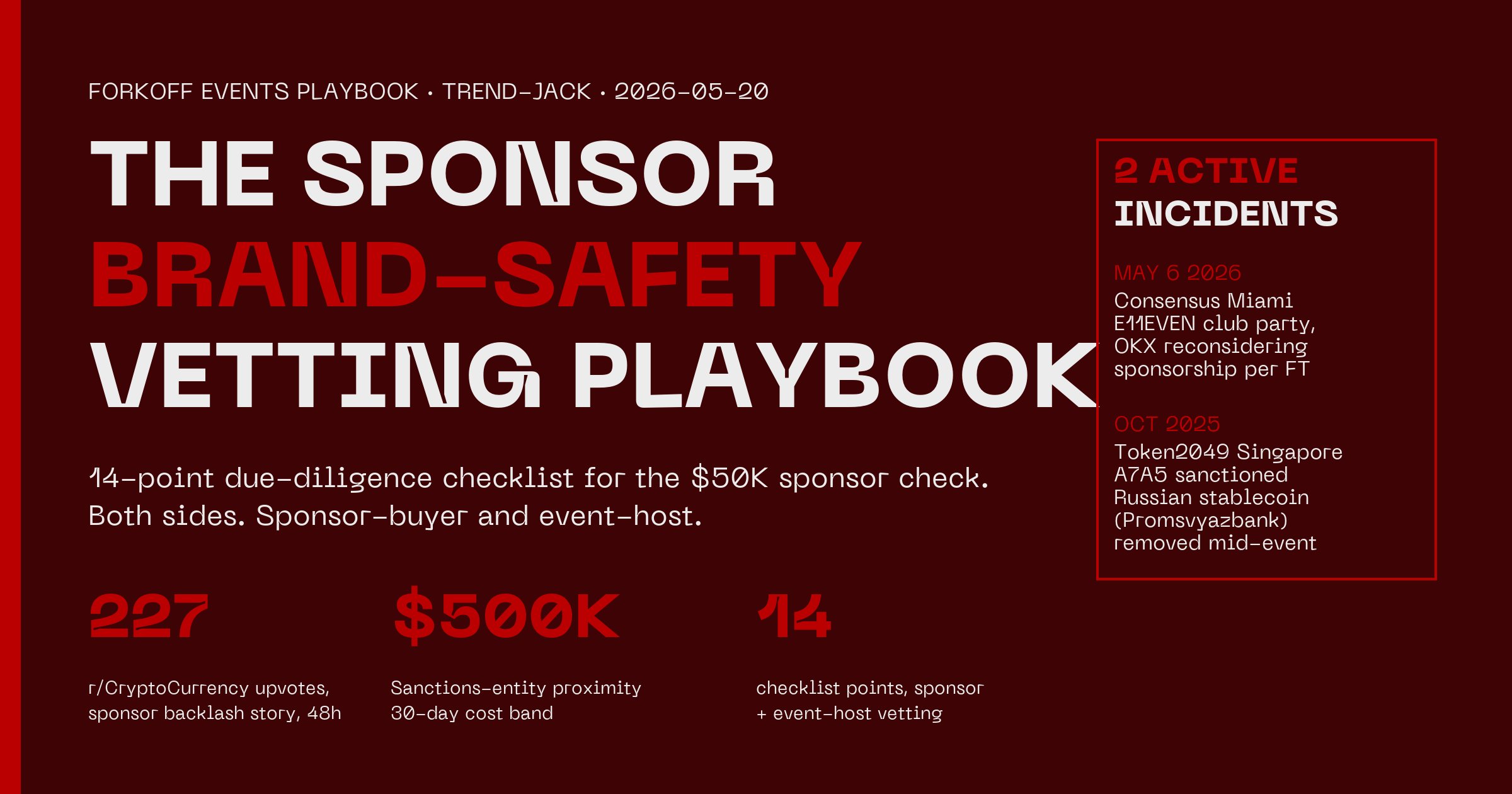
The 14-point sponsor brand-safety vetting playbook anchored to the Consensus Miami E11EVEN backlash and the Token2049 A7A5 sanctioned stablecoin incident.
Read
The 6-block clipping operating system, CPQV economics from n=3,085 clips, and the managed vs DIY decision that produced $1,290 MRR in 13 days.
Read