TL;DR
Per our own AI-Overview audit of 1,026 buyer queries (June 2026), 879 returned an AI Overview and 233 of those cited FORKOFF, so roughly one in four AI Overviews in this category already names a source we control.
Answer engine optimization is the new top-of-funnel for any AI or Web3 company in 2026. ChatGPT, Claude, Gemini, Perplexity, and Google AI Overviews now answer the question your buyer used to type into Google. If your brand is not cited in those answers, the funnel starts cold.
This 25-minute read covers what AEO actually is, why blue-link SEO is dead for AI buyers, how to measure citation rate per LLM, the schema.org playbook, the LLM-readable content rules, the difference between AI Overviews and side-panel citations, the Claude vs ChatGPT divergence, and the 30-day audit-and-ship plan FORKOFF runs on every engagement.
If your buyer asks ChatGPT for the top three vendors in your category and your brand is not one of them, the rest of the marketing stack is leaking.
What is AEO, and why does it matter? Understanding the difference from SEO
AEO is the operating discipline of getting your brand named inside the synthesized answer that an LLM ships to a buyer. It is the successor to the "rank #1 on Google" goal that defined the last 20 years of SEO.
The mechanics shift in three ways. First, the buyer never sees the link list. They see a paragraph or a numbered list with two to five named brands. Second, the answer is composed from multiple sources, so source authority and citation breadth matter more than any single page's rank. Third, the buyer can ask follow-up questions that re-rank the answer in real time, which means narrative consistency across your site matters more than keyword density on any single page.
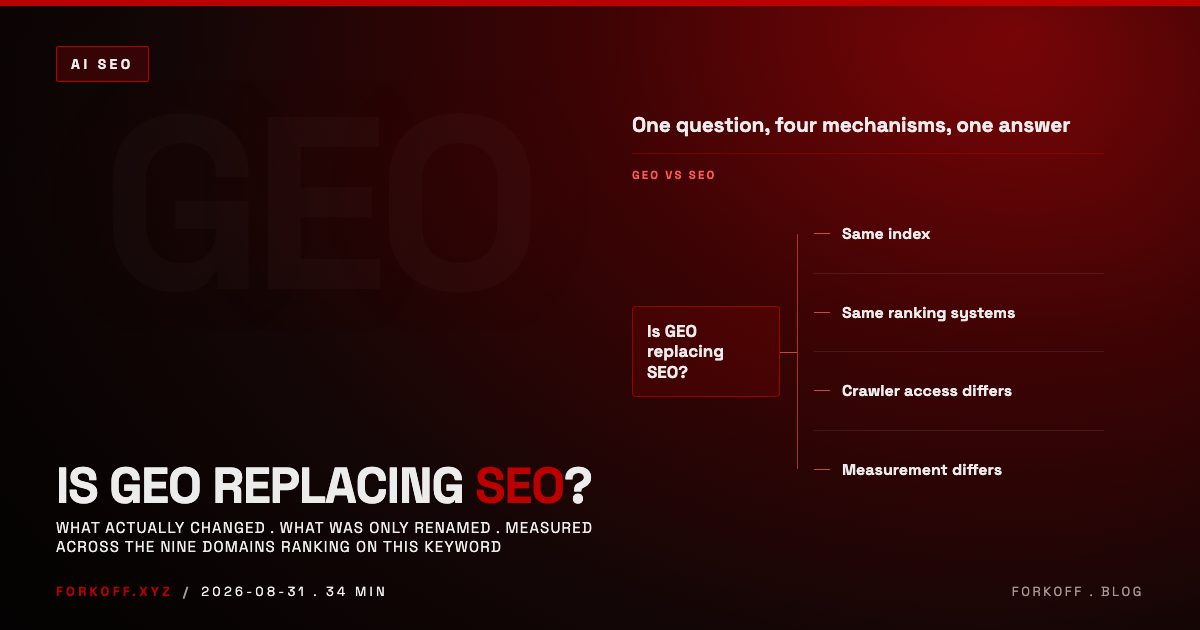
AEO is not a replacement for SEO. It is a higher layer that sits on top. Most of the underlying signal (source authority, schema, clean answer structure) is shared. The measurement is what diverges.
The effect sizes are measured, not folklore. The Princeton GEO study (Aggarwal et al., KDD 2024) found citing authoritative sources lifts generative-engine visibility 115% for lower-ranked pages, and adding statistics lifts it 41%. On the first-party side, the FORKOFF AI Citation Index measured a 34% average cite rate across the five engines on a 50-prompt buyer-intent cluster, with Perplexity leading at 48%.
The deeper FORKOFF service breakdown lives on /services/answer-engine-optimization.
Why blue-link SEO is dead for AI buyers
Three forces collapsed the blue-link funnel for tech, SaaS, deep tech and Web3/AI buyers specifically. First, the persona shifted. Founders, technical decision makers, and allocators ask Claude or ChatGPT before they touch a search box. Click-through rate from the SERP for these buyers fell below where it was in 2018.
Second, the SERP itself got eaten. Google AI Overviews and the new AI mode push the blue links below the fold on commercial intent queries. Even the buyers who do search rarely scroll. The visible answer is the AI summary.
Third, the trust signal moved. A founder evaluating vendors trusts Claude's synthesis of fifteen sources more than they trust the first paid result. The job of marketing shifted from ranking a page to populating the source set the LLM cites.
Sister service: /services/answer-engine-optimization covers the broader AI search operating model.
Citation-rate measurement per LLM
AEO without measurement is content marketing with extra steps. Citation rate per LLM is the metric the FORKOFF audit ledger tracks. The fastest way to baseline it is the AI visibility checker, which probes your brand across all five surfaces in one pass. For a human read of the same five readiness points across your whole site, the paid Pre-AI Readiness 5-Point Audit scores them by hand and hands you a ranked fix list.
- Fixed query bank. 100 to 200 queries that map to the real questions your buyer asks. Top-of-funnel category queries, mid-funnel comparison queries, bottom-of-funnel vendor queries.
- Run weekly across five surfaces. ChatGPT, Claude, Gemini, Perplexity, Google AI Overviews. Same query bank. Same day. Logged into source files.
- Three columns. Named-brand citation (does the answer name your brand). Source-domain mention (is your domain in the cited sources). Answer position (first, middle, last).
- Weekly delta. Plot citation share by surface and by funnel stage. The delta is the qualified-view proof.
A typical FORKOFF AEO ledger row reads: "Week 6 · ChatGPT citation share 18 to 27 percent on category queries · Claude 22 to 34 percent · Perplexity 41 percent stable · two new source-of-record citations on schema markup updates."
Per-surface behavior diverges hard, which is why the bank runs on every engine rather than one. The Qwairy Q3 2025 study of 118,101 answers found Perplexity averages 21.87 citations per answer, 2.76x the 7.92 ChatGPT ships, so the same content earns a very different citation surface depending on where the buyer asks.
Schema.org playbook
Schema is the lowest-cost AEO lift on most sites. LLMs index structured data at training time and cite it at runtime. The four types that carry weight in 2026:
- Article and BlogPosting. Every long-form page on the site. Author Organization, datePublished, dateModified, mainEntityOfPage, image. Claude in particular reads dateModified.
- FAQPage. The single highest AEO-yield schema type. Every Q-and-A on the site rendered as FAQPage gets pulled disproportionately into LLM answers.
- HowTo.For procedural pages. ChatGPT cites HowTo steps almost verbatim when the buyer asks "how do I X".
- Service and SoftwareApplication. For commercial pages. Tells the LLM that this is a vendor offering, the offering type, and the price floor. Critical for vendor-list answers.
Validate every schema graph in the Google Rich Results test before shipping, then re-validate after every content change. The validation rule is: if the graph fails, the page is invisible to the AEO surface.
LLM-readable content rules
LLMs cite cleanly structured content disproportionately. Six rules we apply on every FORKOFF page:
- One question, one answer.The opening paragraph of every section answers the section's question in two to three sentences. LLMs lift those paragraphs into answers.
- Numbered claims.Wherever a claim is made, ground it in a number with a source. "Citation share lifted 18 to 34 percent over six weeks" cites better than "our citation share went up".
- Definitions before deep dives. Every page opens with a TL;DR or definition box. LLMs love the definition shape.
- Stable headings. H2 and H3 get parsed at training time. Use them. Avoid all-caps hero text without semantic heading.
- Named entities.Brand names, product names, people's names rendered as text rather than images. LLMs do not OCR your hero.
- Internal cross-link breadth. Pages with five-plus internal links to related entities show stronger source-authority signal than orphan pages.
AI Overviews vs side-panel citations
The two visible AEO surfaces on Google now are the AI Overview at the top of the SERP and the side-panel citations that AI Mode and Bing Chat both render. They behave differently.
AI Overviews reward broad source breadth. The summary stitches three to ten sources, so getting cited once across a wide query set wins. A site with thirty pages of strong schema-marked content beats one with three pages of stronger content.
Side-panel citations reward source authority on the single primary source. Get cited as the canonical answer to a category-defining query, and the side panel renders your brand on every related query for weeks.
The right strategy depends on the funnel stage. Top-of-funnel favors AI Overview breadth. Vendor-list and comparison queries favor side-panel authority. The FORKOFF audit ledger tracks both.
Anthropic Claude vs OpenAI ChatGPT differences
Claude and ChatGPT do not behave the same way and the AEO playbook has to account for both. The differences we observe across the FORKOFF query bank:
- Source preference. Claude weighs primary sources, documentation, and longer-form content higher. ChatGPT pulls broader, including shorter listicles and forum threads.
- Recency sensitivity.ChatGPT's browsing tool pulls fresh content aggressively. Claude weighs training-cycle content more heavily, so a 12-month-old strong page often out-cites a 2-week-old weaker page.
- Citation transparency. Claude cites sources by URL more reliably. ChatGPT often summarizes without naming the source domain unless the buyer asks.
- Vendor-list bias. ChatGPT is more willing to give a numbered vendor list. Claude often refuses or hedges, which means Claude rewards content that explicitly compares.
Sister service: /services/answer-engine-optimization goes deeper on the ChatGPT-specific playbook.
Perplexity vs Google AI Overviews
Perplexity is the highest citation-visibility surface for any B2B buyer. Every answer renders with numbered source citations and the buyer reads them. Google AI Overviews hide the source list one click deep.
The implication for AEO budget: if your buyer is an enterprise decision-maker or a developer evaluating tooling, Perplexity is the surface to optimize first. If your buyer is consumer-facing or mass-market, Google AI Overviews carries more raw volume.
Perplexity rewards three things specifically. Strong canonical answers on category-defining queries, schema-marked Article and FAQPage content, and clean source authority signal (HTTPS, age, backlinks).
Sister service: /services/perplexity-seo is the dedicated Perplexity-first engagement.
As Featured In
Full press shelf- DA 55 · 2026-08Keep a Customer Community Engaged Without Over-Promotion

- CFO DriveDA 35 · 2026-08How Finance Teams Align Pricing With Sales Without Eroding Margins
- DA 94 · 2026-07Clipping Agency FORKOFF Crosses 5 Billion View Milestone

- DA 74 · 2026-06Five Things SaaS Founders Get Wrong About Short-Form, and Why Their Best Moments Die in 48 Hours

- LinkedInDA 56 · 2026-06The 2026 DevOps Maturity Test: 11 Engineering Orgs Failed and the One Metric That Replaced the Checklist
- IHDA 75 · 2026-06Most indie products do not fail on the build. They fail on distribution.
- DA 56 · 2026-06The Schema-Match Audit That Lifted Our AI Overview Citation Share From Zero to 23 Percent in 90 Days

- DA 42 · 2026-0525 Country-Specific Considerations for International IP Protection for Your Startup

- DA 68 · 2025-11RedStone, FailSafe, Nibiru and ForkOff Announce The Capital Layer at Devconnect Buenos Aires 2025

- DA 62 · 2025-11RedStone, FailSafe, Nibiru and ForkOff Announce The Capital Layer at Devconnect Buenos Aires 2025

- DA 50 · 2025-11RedStone, FailSafe, Nibiru and ForkOff Announce The Capital Layer at Devconnect Buenos Aires 2025

What are key best practices for AEO? How to optimize for answer engines
Five practices carry most of the measured lift. Run all five before treating a query as done, not one in isolation.
- Answer the question in the first 40 to 80 words. An LLM extracts the direct answer near the top of a page far more reliably than one buried under three paragraphs of throat-clearing.
- Cite authoritative sources on the page. The Princeton GEO study measured a 115% visibility lift for lower-ranked pages that cite sources, the single largest lever in that study.
- Add statistics with real attribution. A number with a named source outperforms the same claim unsourced by 41% in the same study.
- Mark the answer with FAQPage or Article schema. Schema does not create citations by itself, but it removes the ambiguity an LLM's parser would otherwise have to resolve.
- Run the query bank weekly, not once. AEO is a measured discipline: a citation-share number from one run six months ago tells you nothing about this week's answer.
30-day audit and ship plan
The FORKOFF AEO sprint is 30 days, four phases, one audit-ledger receipt at the end.
- Days 1 to 5 · Baseline audit. Build the 150-query query bank. Run it across the five surfaces. Log the baseline citation share. Identify the top 20 quick-lift queries.
- Days 6 to 14 · Schema and structure. Audit Article, FAQPage, HowTo, Service across the site. Fix every broken schema graph. Add FAQPage to the top 20 pages. Validate against the Google Rich Results test.
- Days 15 to 24 · Content for the gap. Write or rewrite the answer pages for the top 20 quick-lift queries. One question, one answer, schema marked, internally linked.
- Days 25 to 30 · Re-run and report. Re-run the full query bank. Plot citation lift per surface. Ship the audit proof and the 60-day plan.
Outcome floor we underwrite on a focused AEO sprint: meaningful citation lift on Perplexity inside the sprint, with ChatGPT and Claude lift visible by week 8.
Deeper reading inside FORKOFF
AEO sits inside the FORKOFF AI search lane. The pages that go deeper on each piece:
- /services/answer-engine-optimization · the dedicated AEO engagement.
- /services/perplexity-seo · Perplexity-first AEO.
- /services/answer-engine-optimization · ChatGPT-specific playbook.
- /services/answer-engine-optimization · the broader AI search operating model.
- How to Get Cited by ChatGPT: The 2026 Citation Guide · the spoke on ChatGPT-specific citation mechanics and the 90-day playbook.
- How to Optimize for Perplexity AI: The 2026 Optimization Guide · the Perplexity-specific spoke on Sources-panel citation, the freshness and primary-data levers, and the 90-day playbook.
- AEO vs GEO: How Answer and Generative Engine Optimization Differ · the disambiguation spoke on the surface, tactic, and measurement split between AEO and GEO.
- Why ChatGPT Recommends Your Competitor, Not You · the diagnostic spoke on the four causes of AI-search invisibility and the prompt audit that finds which one is yours.
- AEO vs SEO: How Answer Engine Optimization Differs from Classic SEO · the disambiguation spoke on the 4-axis divergence and the 30-60-90 migration playbook for SEO teams.
- AI Search Ranking Factors 2026 · the cross-engine spoke on the 4 signal families ChatGPT, Perplexity, Claude, and Gemini use to decide what to cite, with the 15-point pre-publish audit checklist.
- Structured Data for AI Search: The 2026 Schema Playbook · the implementation spoke on the schema types that drive LLM citation, with copy-pasteable JSON-LD.
- AEO for B2B SaaS: The 2026 Citation Playbook · the vertical spoke on earning citations across the B2B buying committee and compressing the sales cycle.
- AI Startup Marketing Guide · the broader GTM context for AI founders.
Sandbox engagement
For teams testing fit with FORKOFF before committing to a full quarter, the AEO sandbox runs as a 30-day focused sprint scoped to a fixed query bank. The sandbox ships a qualified-view proof at the end and a 60-day plan. AEO does not run as a clipping product, so the $0.003 CPQV floor does not apply here.
If you are evaluating AI search partners side-by-side, the next read is AI Startup Marketing Guide for the broader GTM context.
If you want FORKOFF on the seat
FORKOFF runs AEO as a focused 30-day sprint or as a track inside the Marketing Foundation engagement. By application, capped at five engagements per quarter, selective on ICP. The seat is run by the operator who shipped the AEO playbook on prior engagements. Apply for the engagement.