

One 12-week category-creation playbook covering a 25-page positioning brief, a content factory across blogs / podcasts / LinkedIn / op-eds, analyst briefings across Gartner / Forrester / IDC / vertical analysts, and a tier-one earned-media wave. Outcome-priced against analyst placement and language adoption rate, not the page count.
Five patterns we see when a founder runs a category push and the language never compounds across analysts, press, and buyers. Each row maps to the FORKOFF category narrative fix. Read it before booking the discovery call.
Founder ships a website, a deck, a few blog posts, and three KOL drops with five different category descriptions. Analysts cannot place the company on the market map. The category never crystallizes.
Category narrative starts with a 25-page positioning brief. Category name, definition, ICP, problem statement, alternatives, proof points, language standards, banned vocabulary all locked before any asset ships.
Founder commissions a beautiful positioning brief, prints it, and goes silent. No blog cadence, no podcast guesting, no LinkedIn drumbeat picks up the language. Three months later the category is still invisible.
Content factory plugged in behind the positioning brief. 12 weeks of blogs, 4 podcast guest spots, 8 LinkedIn long-forms, 2 op-eds, all carrying the same category language and the same proof points.
Founder spends six months publishing on the category and never briefs Gartner, Forrester, IDC, or any vertical analyst. When buyers ask analysts about the category, the company name does not surface.
Analyst briefings booked across week six to ten. Briefing pack tailored per analyst. Follow-on cadence locked. Category placement on analyst maps tracked weekly through day 365.
Founder writes the playbook, the analysts get briefed, and no tier-one outlet covers the category creation. The buyer-side audience never hears about the category from a trusted journalist.
Earned-media wave runs week eight to twelve. Tier-one outlets pre-briefed. 2-4 placements per playbook. Category language adopted in coverage so the press wave seeds the buyer-side vocabulary.
Founder pays for a category playbook, ships it once, and never refreshes the brief as the market moves. By month nine the category language is stale and the proof points are out of date.
Category narrative scoped as a 12-week build with a 90-day refresh cycle. Quarterly proof-point update, biannual brief revision, annual category-map re-cut. Audit ledger tracks language adoption rate.
Freestyle marketing ships five different category descriptions and zero analyst placements. The FORKOFF category narrative locks one positioning brief, runs a content factory, books analyst briefings, and seeds a tier-one earned-media wave. The same category language compounds across every channel for a year.
Three category-narrative playbooks across AI infra, DePIN, and AI-agent tooling. Each shipped a positioning brief, a 12-week content factory, analyst placement on at least one major map, and a tier-one earned-media wave that adopted the category language. Read the longer write-ups inside our case-study hub or pair the playbook with the podcast service.
Cross-platform clips and recap threads shipped per category-narrative beat across 12 weeks.
Tier-one earned-media placements per playbook when the positioning brief and proof points are sharp.
Category-creation playbook from positioning brief through analyst briefings.
You keep the positioning brief, content asset bank, analyst pack, press list, and adoption ledger.
Four routes to a category claim. Match the activation to your stage, your milestone, and your willingness to commit to a 12-week execution.
← scroll horizontally to see more →
| Feature | FORKOFF Category NarrativeOutcome-priced · positioning plus content plus analysts plus earned media | Freestyle marketingNo positioning brief, language drifts | Positioning-only consultancy25-page brief, no execution stack | Content-only retainerBlogs ship, no analyst plus press wave |
|---|---|---|---|---|
| Pricing | Outcome-priced per playbook · by application | Variable, often unbudgeted | Sunk cost: the brief alone | By application · per month for content only |
| Positioning anchor | 25-page brief locked in week 3 | Drifts every quarter | Brief locked, never operationalized | Brief absent, content meanders |
| Execution channels | Content plus analysts plus press | Whatever the founder remembers | None, brief sits on the shelf | Content only |
| Lead time | 8 weeks to playbook live | Same week if founder freestyles | 6-10 weeks for the brief | 2-4 weeks to spin up content |
| Compounding mindshare | 365 days of compounding mindshare | Decays inside 90 days | Brief stale inside 180 days | Decays without analyst plus press anchor |
FORKOFF runs the category narrative as a discrete 12-week activation, not a retainer. By application, capped at 5 engagements per quarter, selective on ICP. You get a 25-page positioning brief, a 12-week content factory, analyst briefings across Gartner / Forrester / IDC / vertical analysts, a tier-one earned-media wave, and a 365-day adoption-tracking proof. Outcome-priced against analyst placement and language adoption rate.
Category narrative as a FORKOFF activation format runs the 90-day positioning sprint that establishes a brand as the canonical category-defining operator in a market segment. The Phase 1 work locks the category-creation framework (analyst-grade landscape map, competitor positioning matrix, jobs-to-be-done synthesis, evaluator-research footprint), the editorial calendar for thought-leadership content distribution across owned and earned channels, and the speaker-circuit booking strategy for the founder against analyst-tier (Gartner, Forrester, IDC) and operator-tier (a16z Big Ideas, Sequoia category-creation events, Andreessen-Horowitz podcast circuit) gatherings.
Mechanics include the 12-cell content roadmap (3 anchor essays defining the category boundaries, 4 case-study deep-dives showing applied methodology, 3 contrarian-take essays redefining competitor positioning, 2 evaluator-research reports that get cited downstream), the analyst-relations briefing cycle (quarterly briefings to Gartner plus Forrester analysts covering the category), and the conference-speaker booking sequence locked against the trailing 18-month event calendar where category-creation talks land.
Pricing operates as a 90-day fixed-scope engagement (Lite plus Standard plus Full tiers). Lite covers the 3 anchor essays plus analyst-relations briefing prep. Standard adds the case-study deep-dives plus speaker-circuit booking. Full adds the evaluator-research reports plus the contrarian-take essay set. Pairs natively with /services/marketing-foundation (the category narrative is the natural Phase 1 output post-foundation) plus /services/featured-bylines for analyst-publication coverage.
One 12-week category-creation playbook with positioning brief, content factory, analyst briefings, and earned-media wave. Pair with Answer Engine Optimization, Media Partnership, or Research Drop depending on the milestone. See the full activations catalog.
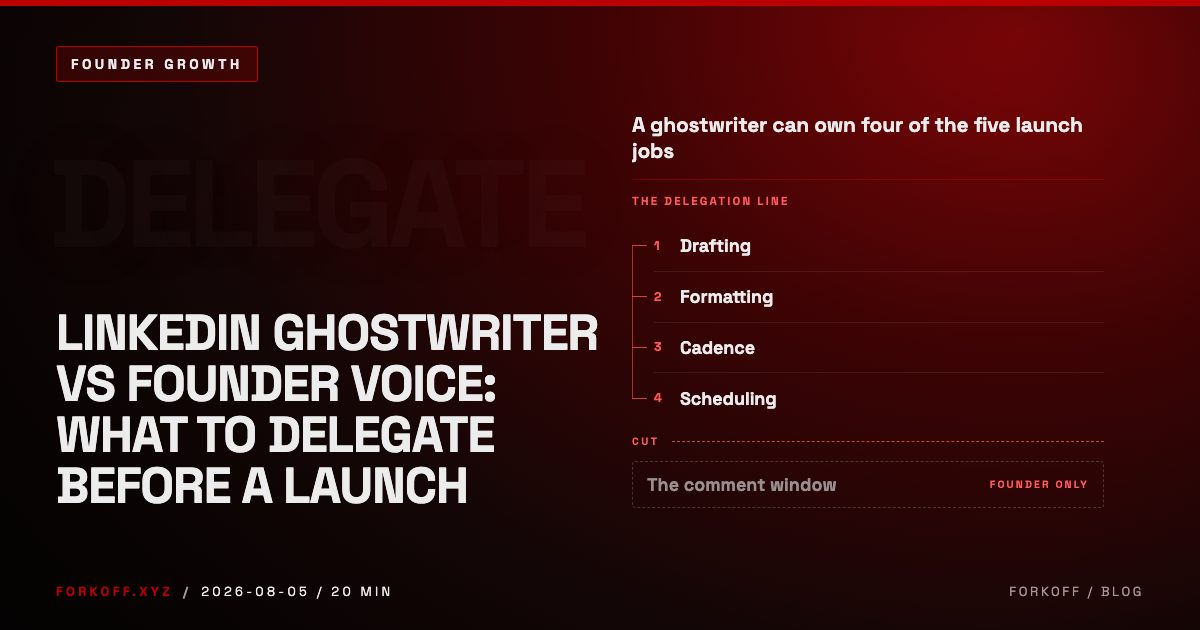
A LinkedIn ghostwriter can draft your launch posts. It cannot reply in your comments or show up on the call. Here is where the line actually falls.
 Read
Read
Developer relations for startups is a distribution problem, not a hiring one. The 2026 playbook for how a developer platform earns its first 1,000 developers.
Read
Portfolio companies rarely die from bad product. They die in the gap where owned distribution is a function no one on the org chart is staffed to own.
Read