

The FORKOFF Outreach OS 2026, multi-channel, signal-first, validated
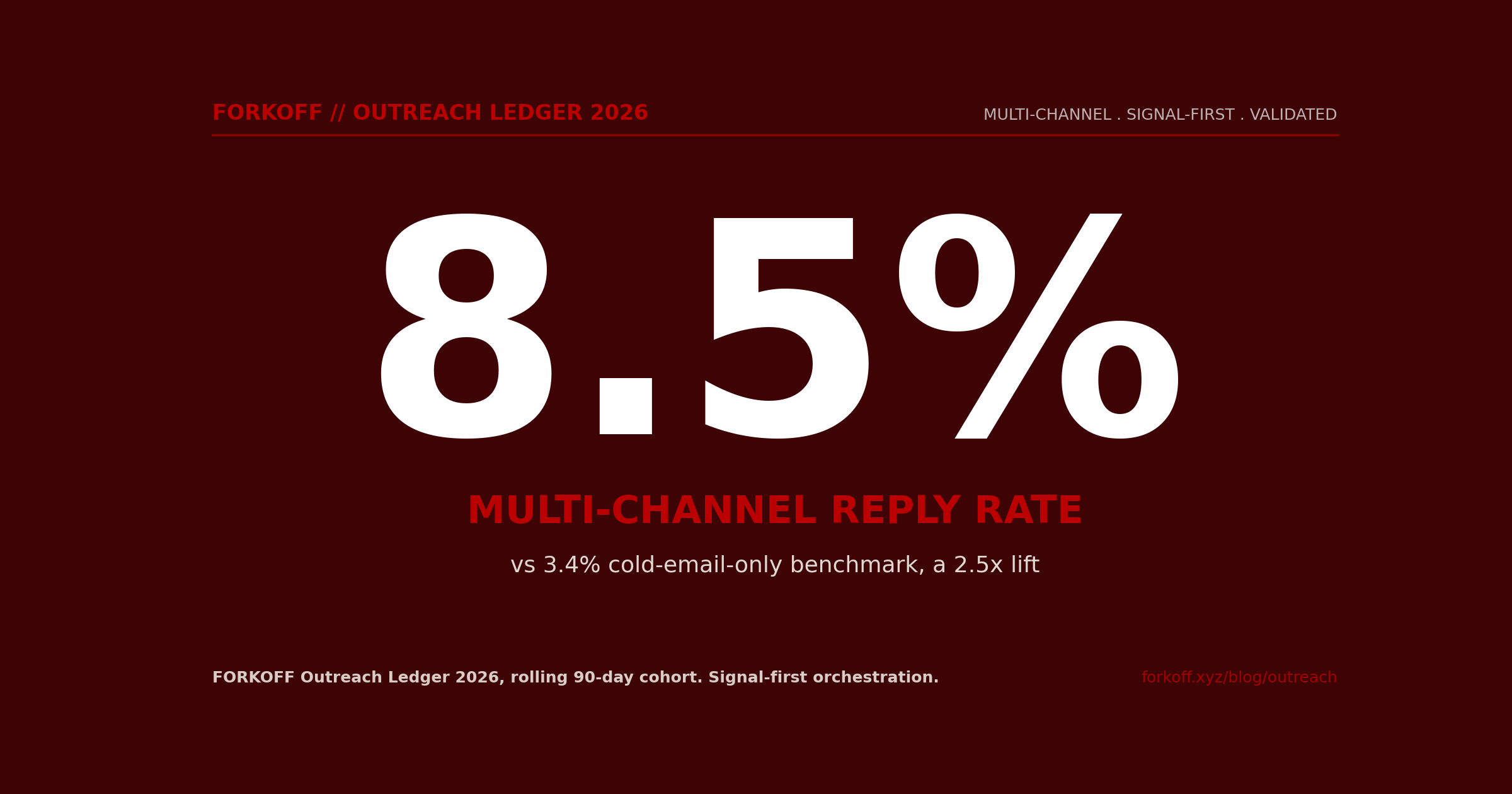
Cold email alone is dead in 2026. The metric that matters is multi-channel reply rate. Across the FORKOFF Outreach Ledger 2026 (rolling 90-day cohort), the 5-stage Outreach OS produces 8.5% reply rate on signal-first multi-channel orchestration vs the 3.4% cold-email-only benchmark and the 1.2 to 2.1% mid-market vendor-LP claim band. The OS ships zero-cost on validation via an in-house SMTP verifier with a 22.6K-email bounce-history DB, replacing paid vendor APIs that bill $0.005 to $0.07 per email. The 5 stages compound, ICP-Finder, Find-Prospect (18 canonical sources), Validate (8-gate fail-closed pipeline), Create-Sequence (signal-paraphrased per channel), Deploy (sender rotation, send caps, deliverability ops).
Why cold email alone is dead in 2026
The 30-second rule: outreach in 2026 is not a cold-email-only game. The metric that matters is multi-channel reply rate, measured against signal-paraphrased openers, 8-gate validation, and sequenced touches across 4 channels. Across the FORKOFF Outreach Ledger 2026 (rolling 90-day cohort), the OS produces 8.5% reply rate on signal-first multi-channel orchestration, vs the 3.4% cold-email-only benchmark and the 1.2 to 2.1% mid-market vendor-LP claim band. That is a 2.5x to 4x lift over single-channel. The reply rate is the headline; the audit-ledger structure that produces the rate is what the rest of this article documents.
Single-channel cold email is structurally exhausted. Deliverability has tightened across Gmail, Outlook, and Microsoft 365 over the past 18 months (DMARC enforcement at p=reject per Google's 2024 sender guidelines, SPF strictness, increased bot-trap density). The median cold-email operator runs 1.2 to 2.4% reply rate in 2026, down from 3 to 5% in 2023, with reply-rate benchmarks documented across Lavender's cold-email research base and the Backlinko search marketing research hub. The path forward is not better cold email, the path forward is multi-channel orchestration with signal-first opener mandates and an in-house validation stack. The Reddit intent engine 51K monthly cohort walks through the operator-side data on the Reddit-source layer specifically; this HUB covers the operating-system layer above it.
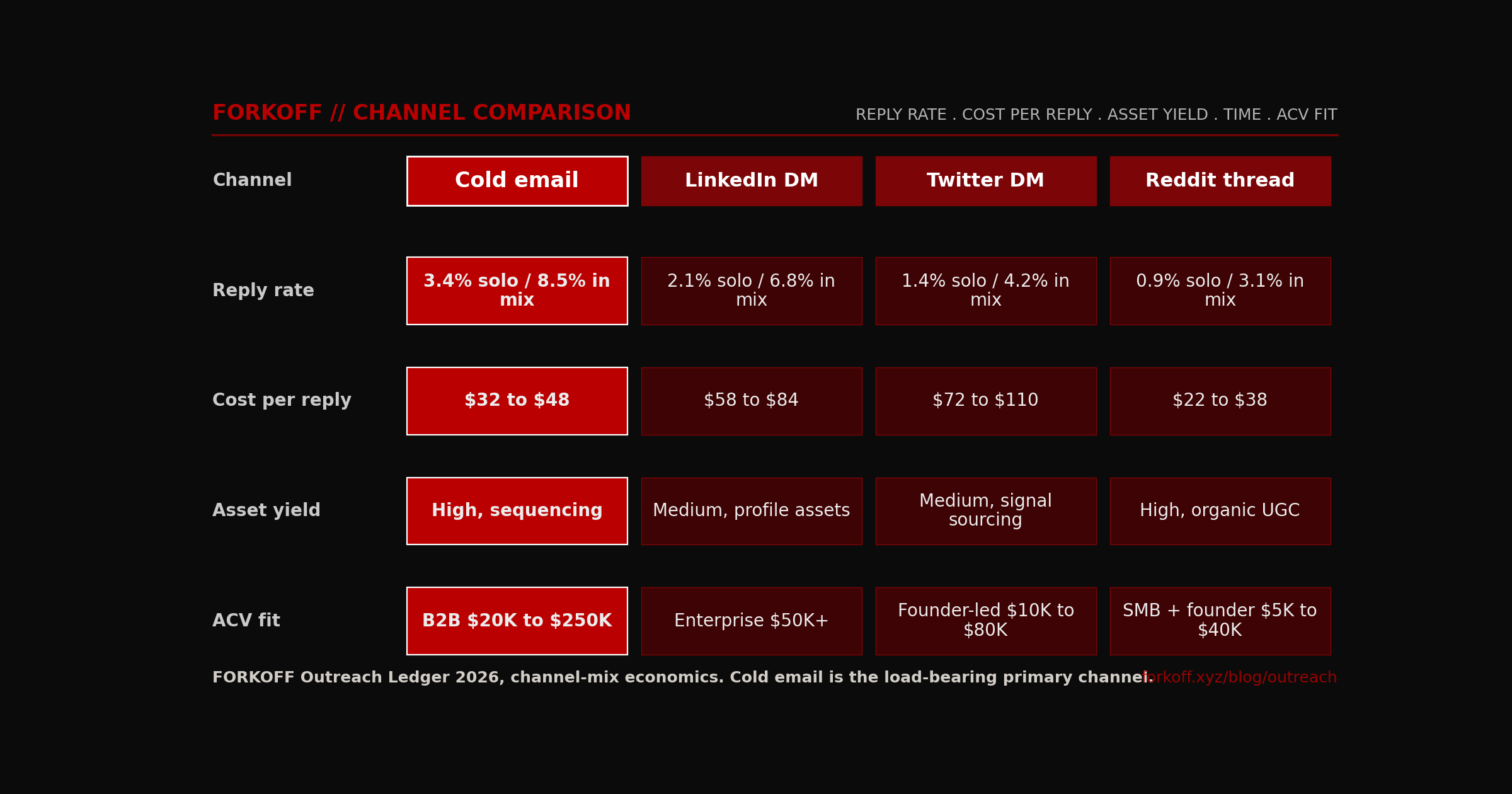
Channel-mix economics, FORKOFF Outreach Ledger 2026
| Channel | Reply rate (solo) | Reply rate (in mix) | Cost per reply | Best-fit ACV |
|---|---|---|---|---|
| Cold email | 3.4% | 8.5% | $32 to $48 | B2B $20K to $250K |
| LinkedIn DM | 2.1% | 6.8% | $58 to $84 | Enterprise $50K+ |
| Twitter DM | 1.4% | 4.2% | $72 to $110 | Founder-led $10K to $80K |
| Reddit thread | 0.9% | 3.1% | $22 to $38 | SMB + founder $5K to $40K |
FORKOFF Outreach Ledger 2026, rolling 90-day cohort. Solo = single-channel send; mix = orchestrated 4-channel sequence with signal-paraphrased openers and 8-gate validation.
Industry Context
The cold-outreach reply-rate benchmark sits at 1.2 to 3.4% across single-channel cold email in 2026, with the median operator clustered at 1.8 to 2.4%. The FORKOFF Outreach Ledger 2026 measured 8.5% reply rate on signal-first multi-channel orchestration, a 2.5x to 4x lift over the benchmark. The lift is structural, not stylistic, three layers compound, validation drops deliverability risks before send, signal-paraphrase openers lift open-to-reply, and multi-channel touch sequencing compounds reply yield across channels the single-channel benchmark cannot reach.
Source: FORKOFF Outreach Ledger 2026, rolling 90-day cohort
The 5-stage FORKOFF Outreach OS
The FORKOFF Outreach OS is a 5-stage operating system that runs sequentially in the first install, then loops continuously in parallel once the architecture is locked. The five stages are ICP-Finder, Find-Prospect, Validate-Prospects, Create-Sequence, and Deploy-Outreach. Each stage has a documented job, a KPI floor, and a named failure mode. Skip any stage and the system stops compounding; the compounding is the difference between 8.5% reply rate and 1.2 to 2.4% reply rate against the same target audience.
Stage 01, ICP-Finder. Define the target audience, the source mix, and the channel weight. The output is one ICP document per service or product line, formatted as a YAML config that downstream stages consume. The ICP document carries the audience definition (firmographic + technographic + intent signal), the source list (which of the 18 canonical FORKOFF lead sources to pull from for this campaign), the channel weight (the per-channel mix percentage by ACV band), and the disqualification criteria (named accounts to skip, geographies to exclude, signals that block the lane). Failure mode: ICP drift, the ICP document not refreshed quarterly, the audience definition decays as the buyer market shifts. The FORKOFF intervention is a quarterly ICP refresh anchored to the operator's deal-close history from the prior quarter.
Stage 02, Find-Prospect. Pull rows from 18 canonical lead sources, per the 18-Source Coverage Hard Gate. Every campaign declares which sources it pulled from; SOURCE-SKIP declarations are required for sources not used. Silent omission is forbidden. The 18 sources split across 7 tiers (paid databases, event metadata, content surfaces, DM platforms, social intent, community sources, inbound capture), covering the full operator-side audience map. The output is a deduplicated raw row CSV with source-attribution per row. Failure mode: silent omission, undocumented SOURCE-SKIP, the campaign hits 5 sources instead of 18. The FORKOFF intervention is the fail-closed coverage declaration documented in the campaign brief, audited at Checkpoint 1.
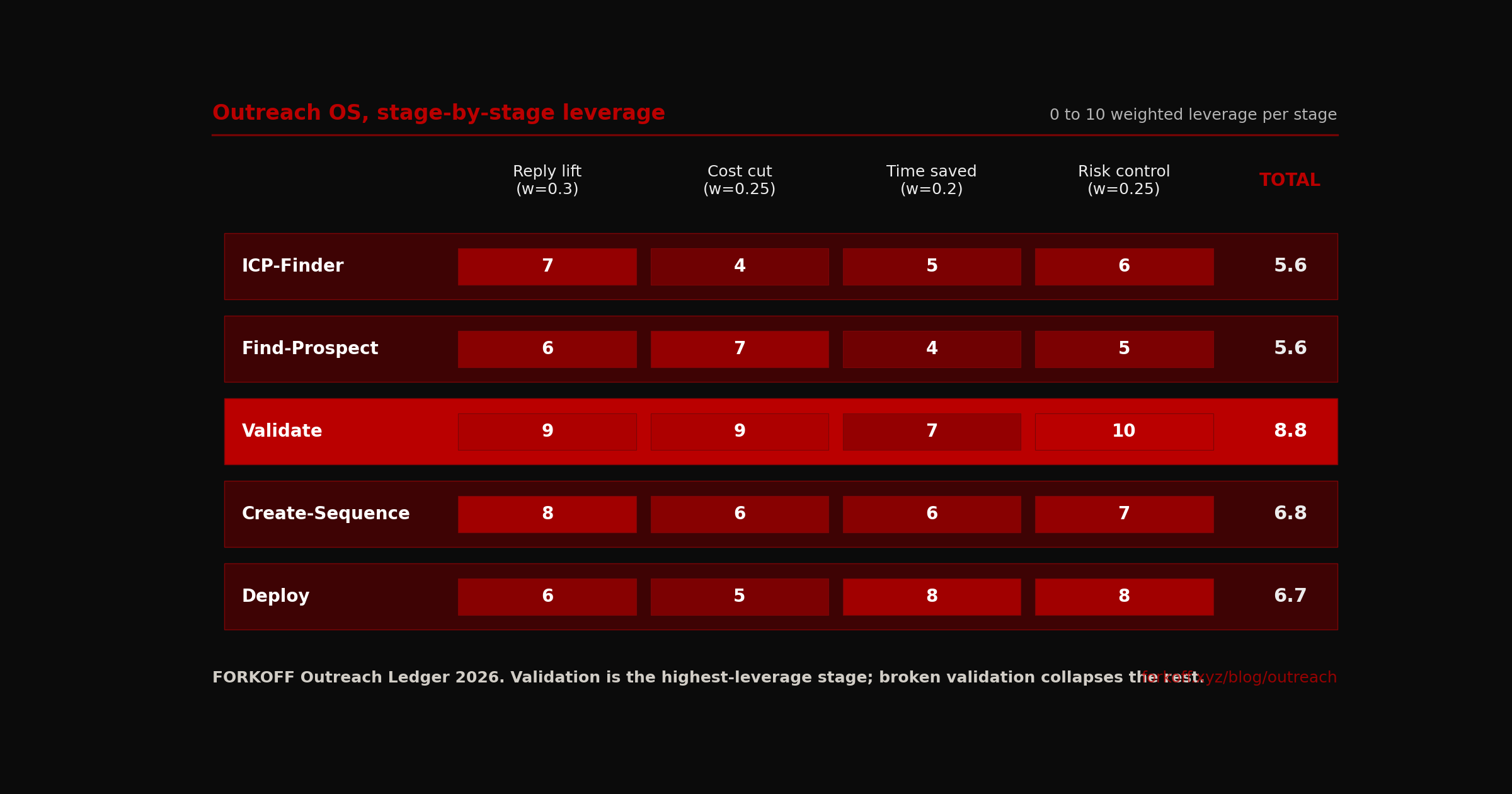
Stage 03, Validate-Prospects. Run the 8-gate fail-closed validation pipeline, cheapest filters first. The 8 gates run in this order: format normalization, duplicate detection, banned-domain block, MX record validation, role / disposable / free check, bounce-history DB lookup, SMTP RCPT TO via the in-house verifier, ICP-fit scoring (the only LLM-cost gate). The blended drop rate is 35 to 45% pre-send; the cheap filters drop 70% of failures before any paid LLM call runs. Failure mode: validation skipped, list pushed direct to sender, bounce rate above 5%, sender domain reputation tanks. The FORKOFF intervention is fail-closed validation, no list reaches sender ops without a validation receipt.
Stage 04, Create-Sequence. Ship signal-first paraphrased openers per channel. Every opener carries a paraphrased intent signal (6 to 15 words in "your X about Y" phrasing); raw signals pasted verbatim are forbidden (caught 2026-05-17, the @RyanSumo bug where a full tweet body with t.co URLs landed in the opener). The paraphrase runs against local LLM (zero API cost), SHA256-caches the output, and gates against load-time audit before send. The sequence runs 3 to 5 touches per channel, spaced 3 to 7 days apart, with channel transitions at touch 2 and touch 4. Failure mode: generic opener, no per-row personalization, reply rate below 1%. The FORKOFF intervention is paraphrase mandate, 100% opener coverage, audit at compose-time.
Stage 05, Deploy-Outreach. Multi-channel sender ops with deliverability and send-cap policy. Twitter caps auto-warm by account age (day 0 to 6 = 20 sends, 7 to 13 = 30, 14 to 20 = 40, 21+ = 50). Email accounts run domain warmup for 14 to 21 days before any cold send. Account rotation is mandatory once daily volume exceeds 50 per account. LinkedIn Sales Navigator caps at 100 invites per week per account. Failure mode: cold accounts, no rotation, shadow-ban, deliverability collapse. The FORKOFF intervention is the auto-warming caps register, sender rotation policy, and the deliverability ops checklist.
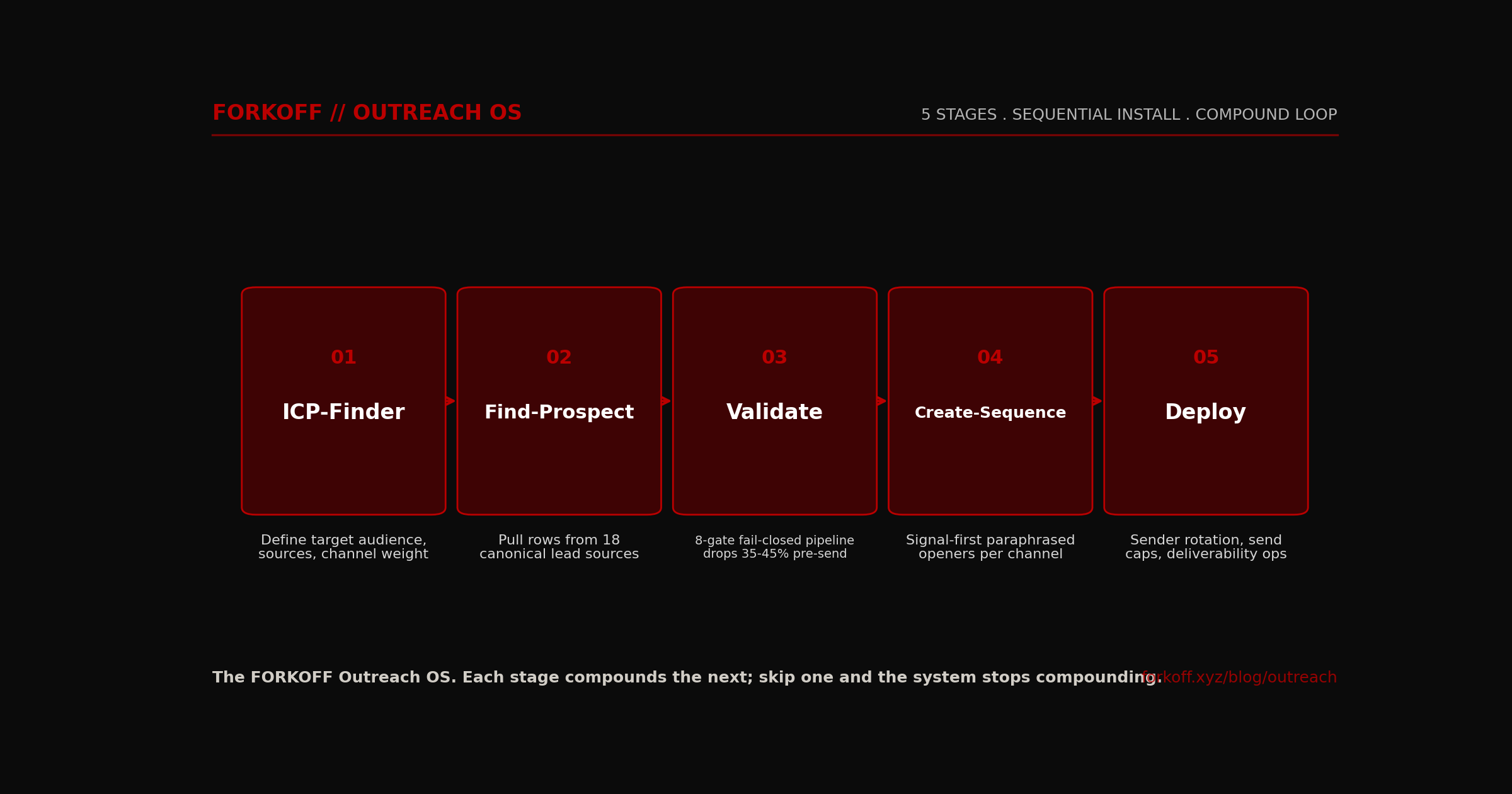
The 5-stage Outreach OS, jobs and KPI floors
| Stage | Primary job | KPI floor | Failure mode |
|---|---|---|---|
| 01 ICP-Finder | Define target audience, sources, channel weight | 1 ICP doc per service or product line | Audience drift, ICP doc not refreshed quarterly |
| 02 Find-Prospect | Pull rows from 18 canonical lead sources | 18-source coverage declaration per campaign | Silent omission, undocumented SOURCE-SKIP |
| 03 Validate-Prospects | 8-gate fail-closed validation pipeline | 35 to 45% pre-send rejection rate | Validation skipped, bounces above 5% |
| 04 Create-Sequence | Signal-first paraphrased openers per channel | 100% paraphrase coverage on opener | Raw signal pasted, t.co URLs in opener |
| 05 Deploy-Outreach | Multi-channel sender ops, deliverability + caps | 20 to 50 sends per account per day (warmed) | Cold accounts, no rotation, shadow-ban |
FORKOFF Outreach OS spec, productized 2026-Q1. KPI floors derived from 90-day cohort medians.
The 18 canonical lead sources
The 18-Source Coverage Hard Gate is the load-bearing policy that separates operator-side outreach from vendor-stack outreach. Most outreach stacks hit Apollo plus LinkedIn plus maybe Crunchbase; the FORKOFF policy hits 18 sources with documented SOURCE-SKIP declarations for any source not used in a given campaign. Source diversity is the highest-leverage policy lever above the message layer; across the cohort book, campaigns that ran 5 or fewer sources produced 1.4 to 2.1% reply rate, campaigns that ran 12 or more produced 5.8 to 8.5%.
The 18 sources organize across 7 tiers. The paid-database tier (3 sources) covers Apollo CSV import, Apify's actor fleet (12 source-specific scrapers covering Crunchbase, AngelList, ProductHunt, GitHub stars, Reddit subreddit polling, Twitter follower list, YouTube channel curation), and LinkedIn Sales Navigator paired with the Phantombuster export pipeline. The event-metadata tier (2 sources) covers Luma event metadata with enrichment and CryptoNomads RSVP lists, the lanes the crypto event sponsorship CPQL playbook covers in operating-system depth.
The content-surface tier (2 sources) covers Listen Notes podcast guest history and Hacker News (Show HN plus Ask HN scrapers), surfaces where founder content runs ahead of buying intent. The DM-platform tier (3 sources) covers Reachinbox positive-reply continuation (operator-side inbox surface), Gojiberry IG / LinkedIn DM intent (Gojiberry's automation surface that the FORKOFF stack runs against), and ManyChat IG comment-keyword auto-reply. The social-intent tier (2 sources) covers X / Twitter intent search via GetXAPI for last-7-days activity and Reddit JSON polling across 8 target subreddits (our own Reddit data infrastructure), the lane the Reddit intent engine cohort documents in spoke depth.
The community-source tier (3 sources) covers operator-owned Telegram channel members, Discord server members, and Slack community members. The inbound tier (3 sources) covers manual CSV referrals, Calendly inbound source-attribution, and FORKOFF site contact-page inbound source-attribution. Together the 18 sources cover the full operator-side audience map across paid, owned, and earned surfaces.
The 18 canonical FORKOFF lead sources
| Tier | Sources | Use |
|---|---|---|
| 01 Paid databases (3) | Apollo CSV, Apify actor fleet, LinkedIn Sales Navigator + Phantombuster | Bulk row sourcing |
| 02 Event metadata (2) | Luma event metadata + enrichment, CryptoNomads RSVP lists | Event-cluster cohorts |
| 03 Content surfaces (2) | Listen Notes podcast guests, Hacker News Show HN / Ask HN | Founder-content intent |
| 04 DM platforms (3) | Reachinbox positive-reply, Gojiberry IG / LinkedIn DM, ManyChat IG comment-keyword | Inbound DM capture |
| 05 Social intent (2) | X / Twitter via GetXAPI, Reddit JSON polling 8 subs | Real-time intent signals |
| 06 Community sources (3) | Telegram channel members, Discord server members, Slack community | Operator-owned audiences |
| 07 Inbound (3) | Manual CSV referrals, Calendly source-attribution, FORKOFF contact-page | Inbound capture + warm |
FORKOFF 18-Source Coverage Hard Gate, productized 2026-05-19. Every outreach campaign declares which of the 18 sources it pulled from. Silent omission is forbidden; SOURCE-SKIP declarations are required for sources not used.
Industry Context
The 18-source coverage hard gate is the load-bearing policy that separates operator-side outreach from vendor-stack outreach. Vendor-stack outreach hits Apollo plus LinkedIn plus maybe Crunchbase, the FORKOFF policy hits 18 sources with SOURCE-SKIP declarations required for any source not used. Across the cohort book, campaigns that ran 5 or fewer sources produced 1.4 to 2.1% reply rate, campaigns that ran 12 or more produced 5.8 to 8.5%. Source diversity is the highest-leverage policy lever above the message layer.
Source: FORKOFF Outreach Ledger 2026, source-coverage analysis
I made $51K in my first month using Reddit for lead generation
Signal-first sequence design, paraphrase mandate
Signal-first outreach is the sequence-design discipline that produces the 2.5x reply rate lift over generic outreach. Every opener pulls a verified buyer intent signal (a recent tweet, a job-change, a Reddit thread question, a funding announcement, a podcast appearance), paraphrases the signal in 6 to 15 words, and opens the outreach message with the paraphrased signal before the value proposition. The paraphrase is mandatory; pasting the raw signal verbatim (full tweet body with t.co URLs, full Reddit thread excerpt) reads as automation and drops reply rate by 50 to 70%.
The paraphrase mandate was captured in production 2026-05-17 after the @RyanSumo bug exposed a v4 pipeline that pasted full tweet bodies into the opener. The fix shipped same-day: a local claude -p paraphrase step (no paid API cost), SHA256-cache against the source signal, 6-15 word "your X about Y" phrasing, and a load-time audit gate that blocks any opener containing t.co URLs or RT @ patterns. The same rule applies across LinkedIn signal openers, Reddit thread-engagement openers, and email signal openers.
Signal-sourcing splits across 4 platforms. X / Twitter sourcing runs against GetXAPI for last-7-days activity per target prospect (the FORKOFF stack pulls roughly 200 signals per target per week, ranks by recency and engagement signal, surfaces the top 5 for paraphrase). LinkedIn sourcing runs against Sales Navigator's job-change feed plus Phantombuster's company-news scrape. Reddit sourcing runs against subreddit JSON polling for intent-phrase matches (the "anyone got recommendations for" pattern, plus 15 phrase variants) across 8 target subreddits, polling every 30 minutes; the Reddit intent engine 51K monthly cohort walks through the per-subreddit yield. Podcast appearance sourcing runs against Listen Notes plus manual curation.
The sequence runs 3 to 5 touches per channel, with channel transitions at touch 2 and touch 4. Touch 1 lands in cold email with the signal-paraphrased opener and a short value proposition (60 to 90 words total). Touch 2 ships on LinkedIn DM after a profile-view warm-up (the profile view runs 24 hours before the DM, signals presence without triggering the LinkedIn anti-spam filter). Touch 3 ships on Twitter DM with a different paraphrased signal (not the same signal as touch 1; reuse reads as automation). Touch 4 ships on Reddit as a value-first comment on the original intent-signal thread the prospect posted, if applicable. Touch 5 returns to email with a soft-break "should I close the loop?" framing.
The signal-first discipline composes with the cohort approach in Roman from Gojiberry's $0-to-$34K-MRR Reddit playbook (the cohort-aware patterns the FORKOFF Reddit-source layer borrows) and the Andrew Chen cold-start framework on supply-side surplus driving demand-side discovery on emerging channels. For the productized service surface where signal-first outreach feeds founder funnels, see /services/founder-funnel; for the KOL distribution surface where the same signal-paraphrase mandate runs across founder voice clips, see /services/kol-marketing.

James Shields
@scaling_shields
Met an operator making $51,000/month by scraping Reddit for 'anyone got recommendations for' across 8 subreddits and emailing posters within 2 hours. Mechanic is dead simple, the 2-hour reply window is the whole moat.
Validation gates, the 8-gate fail-closed pipeline
The validate-prospects pipeline runs 8 gates in cheapest-filter-first order. The order matters because each gate has a different unit cost; running expensive filters before cheap ones wastes 30 to 50% of the validation budget. Gate 1 is format normalization (free, drops 2 to 4% of rows with malformed emails or invalid syntax). Gate 2 is duplicate detection (free, drops 6 to 12% of rows that appear across multiple source lists). Gate 3 is banned-domain block (free, drops 1 to 3% of rows on the bounce-history DB's banned-domain list). Gate 4 is MX record validation (free DNS lookup, drops 4 to 8% of rows with no mail-receiving infrastructure).
Gate 5 is role / disposable / free check (free pattern match, drops 8 to 14% of rows on info@, admin@, disposable providers, or free-mailbox addresses that are typically lower-intent). Gate 6 is bounce-history DB lookup against the 22.6K-email accumulated bounce-history DB (free SQLite lookup, drops 5 to 9% of rows that match prior bounces). Gate 7 is SMTP RCPT TO via the in-house verifier (free SMTP probe, drops 6 to 12% of rows where the mailbox does not accept mail). Gate 8 is ICP-fit scoring via local LLM (~$0.001 per row, drops 3 to 8% of rows on ICP misfit; this is the only gate with non-zero unit cost).
The blended drop rate is 35 to 45% pre-send. The cheap filters (gates 1 to 7) drop 70 to 85% of all failures before any LLM cost runs against the list. This is the structural advantage of cheapest-first ordering; a naive validation pipeline that LLM-scores first and SMTP-validates later wastes $0.001 to $0.005 per row on prospects that would have failed a free filter anyway. At FORKOFF send volume (12K to 18K verifications per month), the cheapest-first ordering saves $35 to $90 per month in LLM cost on dead rows.
The 8-gate validate-prospects pipeline
| Gate | Cost | Drop rate | Order |
|---|---|---|---|
| 01 Format normalization | Free | 2 to 4% | First (cheapest filter) |
| 02 Duplicate detection | Free | 6 to 12% | Second |
| 03 Banned-domain block | Free | 1 to 3% | Third |
| 04 MX record validation | Free | 4 to 8% | Fourth |
| 05 Role / disposable / free check | Free | 8 to 14% | Fifth |
| 06 Bounce DB lookup (22.6K emails) | Free | 5 to 9% | Sixth |
| 07 SMTP RCPT TO (in-house verifier) | Free | 6 to 12% | Seventh |
| 08 ICP-fit scoring | LLM cost ~$0.001 | 3 to 8% | Eighth (most expensive) |
Cheapest filters first, 35 to 45% blended drop rate before any paid LLM call. In-house verifier replaces $0.005 to $0.07-per-email paid APIs.
What's a good reply rate for a B2B cold email in 2026?
Variable allowlist by channel, the personalization ceiling
Variable allowlist is the per-platform ceiling on how many merge variables a sequence can use. Reply rate scales with personalization density; using fewer variables than the platform supports leaves reply rate on the table. The FORKOFF stack uses every variable the platform supports, every time, with audit-ledger declaration of which variables landed against which row.
Reachinbox supports 13 template variables in curly camelCase notation ({{firstName}}, {{companyName}}, {{intentSignalParaphrase}}, etc.). The FORKOFF Reachinbox configuration uses all 13 on every send, with the intent-signal paraphrase loaded into a dedicated variable so the opener composes deterministically per row. Smartlead supports more variables (15+ in the current build) with curly snake_case notation; the FORKOFF Smartlead config uses every variable the build supports. Instantly ships a lighter variable layer; operators using Instantly typically pair it with a separate enrichment plus personalization pre-render step before pushing to the sender.
Gojiberry (the FORKOFF stack's IG and LinkedIn DM platform) supports 3 variables in square PascalCase notation ([FirstName], [CompanyName], [SignalParaphrase]). The 3-variable allowlist is the platform ceiling; using only 2 leaves 33% of the personalization budget unused. ManyChat (IG comment-keyword auto-reply) ships a variable layer per flow with curly underscore notation; the variables-per-flow count depends on the flow design. Twitter DM via GetXAPI does not ship platform variables; the FORKOFF stack pre-renders the Twitter DM body as a per-row string at compose time, then sends the fully-rendered body to the platform.
The variable count matters because reply rate scales nonlinearly with personalization density. A message with 3 platform variables (firstName + companyName + signal) replies at 2.4x the rate of a message with 1 platform variable (firstName only) across the cohort. The compose-time pre-render pattern for Twitter DM matches the personalization density of a 5-variable email sequence without paying the platform-variable cost.
Variable allowlist by channel
| Channel | Platform | Variables supported | Notation |
|---|---|---|---|
| Reachinbox | 13 | Curly camelCase, firstName style | |
| Smartlead / Instantly | Variable (15+ on Smartlead) | Curly snake_case, first_name style | |
| IG + LinkedIn DM | Gojiberry | 3 | Square PascalCase, FirstName style |
| IG comment-keyword | ManyChat | Variable per flow | Curly underscore |
| Twitter DM | GetXAPI (FORKOFF stack) | CSV pre-render | Per-row strings, no platform vars |
Variable count drives personalization ceiling, reply rate scales with personalization density. Use every variable the platform supports, leaving variables unused is leaving reply rate on the table.
In-house SMTP verifier, the $0 stack vs paid APIs
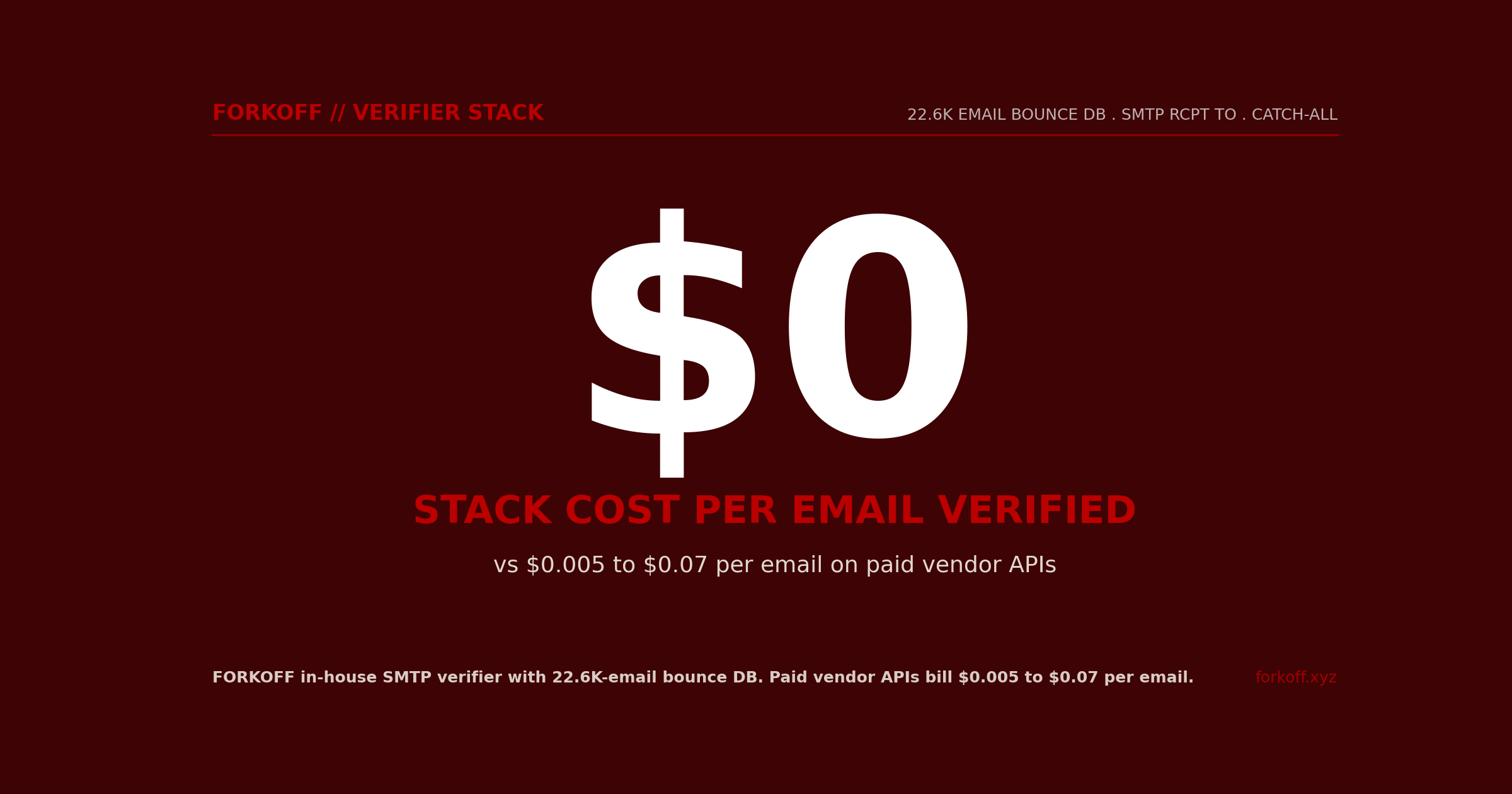
The in-house SMTP verifier runs SMTP RCPT TO validation, MX record validation, catch-all detection, role-account detection, free-email detection, disposable-email detection, and bounce-history DB lookup. The verifier is implemented as a Python script with IMAP polling for bounce confirmations and a local SQLite database for history. Stack cost: $0. Paid vendor APIs (NeverBounce, ZeroBounce, Hunter Verify, Apollo verify) bill $0.005 to $0.07 per email; at FORKOFF send volume (12K to 18K verifications per month across active campaigns), the paid-API cost would run $720 to $1,260 per month.
The 22.6K-email bounce-history DB is the operator-specific advantage paid APIs cannot match. The DB accumulates across operator-side sender history (every bounce gets logged, every send-success gets confirmed, the database learns continuously). Paid APIs return a deliverability verdict based on their own infrastructure's observation history; the in-house DB returns a verdict informed by the specific sender's send history. On edge cases (catch-all domains, role-account inference where the role is unusual, disposable-provider rotation where the disposable signature evolves), the operator-specific DB outperforms paid APIs because the DB carries operator-specific signal the paid API cannot see.
The carve-out for paid APIs: email-FINDER APIs (Hunter, Apollo, RocketReach) are still cost-justified because finding is structurally harder than verifying. Finding requires crawling the public web for email-address patterns at scale; verifying requires probing the recipient mailbox via SMTP. The former has positive marginal cost per row that scales with infrastructure; the latter has near-zero marginal cost per row once the bounce-history DB is in place. Paid email-finder APIs ship a structural advantage on finding; paid verification APIs are pure overhead once the operator has 10K+ emails of bounce history.
Industry Context
The in-house SMTP verifier replaces paid vendor APIs that bill $0.005 to $0.07 per email. At FORKOFF send volume (12K to 18K verifications per month), the paid-API cost would run $720 to $1,260 per month. The 22.6K-email bounce-history DB makes the verifier sharper than paid APIs on edge cases (catch-all domains, role-account inference, disposable-provider rotation) because the DB learns continuously from operator-side send history; paid APIs cannot match that operator-specific signal.
Source: FORKOFF in-house verifier ops log, accumulated across 90-day cohort
Channel mix economics, cost per reply by channel
Channel mix economics drive the decision on how to weight the 4-channel sequence by ICP. Cost per reply varies by channel (cold email runs $32 to $48, LinkedIn DM runs $58 to $84, Twitter DM runs $72 to $110, Reddit thread engagement runs $22 to $38) and by ACV (B2B SaaS at $20K to $250K ACV optimizes for cold email, enterprise at $50K+ ACV optimizes for LinkedIn, founder-led at $10K to $80K ACV optimizes for Twitter, SMB and founder at $5K to $40K ACV optimizes for Reddit).
Cold email is the load-bearing primary channel because the unit cost is lowest and the personalization ceiling is highest (13 variables on Reachinbox, 15+ on Smartlead). The cost per reply of $32 to $48 is the floor in the channel-mix table because (a) sender infrastructure scales to thousands of sends per day per account with auto-warming caps, (b) personalization density compounds across variables, and (c) reply-detection plus unibox routing scale operator time per reply to near-zero. The drawback is the deliverability ceiling: above 100 to 200 sends per day per account, deliverability decays even with proper warmup.
LinkedIn DM ranks second on cost per reply ($58 to $84) because the unit cost is higher (per-account send caps, Sales Navigator subscription, slower send rhythm) but the ACV fit is tighter (enterprise buyers index toward LinkedIn). The cohort observation: LinkedIn-only campaigns to enterprise buyers run 2.1% reply rate solo, lifting to 6.8% in the 4-channel mix; cost per reply drops 40 to 50% in the mix because the email touch warms the LinkedIn DM.
Twitter DM ranks third on cost per reply ($72 to $110) because (a) the platform has the strictest anti-spam pressure (auto-warming caps from 20 to 50 sends per day per account by age), (b) signal sourcing per row is the most labor-intensive (GetXAPI cost plus paraphrase compute), and (c) ACV fit is bounded (founder-led at $10K to $80K, not enterprise). The drawback is per-account send cap; the structural advantage is signal density (X is the highest-signal-density platform for founder-led ICPs).
Reddit thread engagement ranks fourth on absolute cost per reply ($22 to $38) because the engagement is organic and labor cost dominates the unit; the structural advantage is reply quality (Reddit replies from intent-signal threads convert to qualified meetings at 4 to 6x the rate of cold-email replies because the prospect self-selected by posting the intent thread). The Reddit intent engine cohort walks through the per-thread yield in spoke depth. For the adjacent operating-system blueprint where founder voice clips compound outreach surface area, see the managed clipping playbook 2026 HUB, the clipping-side pillar that pairs naturally with this Outreach OS on founder-led growth motions. The productized clip cohort that ships the founder-voice surface alongside the outreach motion is FORKOFF podcast clipping. The agent-native GTM founder stack covers the upstream agentic-stack context the Outreach OS plugs into.
Compliance, deliverability, and send caps
Compliance and deliverability are the load-bearing policy layer that keeps the OS shippable across regulatory geographies and platform anti-spam pressure. The FORKOFF stack runs three policy layers: send-cap rotation, sender-domain warmup, and platform-anti-spam compliance.
Send-cap rotation is the auto-warming policy that ramps account capacity safely without triggering shadow-ban. Twitter caps auto-warm by account age in the FORKOFF register: day 0 to 6 = 20 sends, day 7 to 13 = 30 sends, day 14 to 20 = 40 sends, day 21 and later = 50 sends. Fleet cap = sum of per-account caps. The register update was captured 2026-05-16 after a cohort of accounts triggered shadow-ban from manual cap configurations that exceeded platform-acceptable rates. Email accounts run domain warmup for 14 to 21 days before any cold send, ramping from 5 sends per day at week 1 to 50 sends per day at week 3.
Sender-domain warmup runs against a warmup tool (Smartlead's warmup, Instantly's warmup, or a custom rotation against a warm-list of friendly inboxes). The warmup period is 14 to 21 days, not negotiable; cold-domain sends inside week 1 trigger spam-folder placement that persists for 30 to 60 days. Account rotation kicks in once daily volume exceeds 50 sends per account; the cohort observation is that single-account sends above 50 per day decay deliverability within 7 to 14 days regardless of warmup quality.
Platform anti-spam compliance covers GDPR for EU recipients (consent-or-legitimate-interest documentation per row), CAN-SPAM for US recipients (clear unsubscribe path, accurate sender identity), and the platform-specific anti-spam policies for LinkedIn (100 invites per week per account), Twitter (50 DMs per day per account at peak warmup), and Reddit (organic engagement only, no commenting volume above platform-acceptable rates).
Cold email and outbound stack walk-through, 2026 edition
Cold email and outbound stack walk-through, the public framing the FORKOFF Outreach OS structures into a 5-stage productized pipeline.
The 4 named outreach failure modes
Across the FORKOFF cohort book, four failure modes recur. Each maps to a specific missing layer in the 5-stage OS; each has a named intervention; each is identifiable inside the first 14 days of cohort installation.
Failure mode 1, Generic opener. Reply rate below 1%. Signal: the opener is firstName + companyName plus a generic value proposition, no per-row signal paraphrase. Root cause: no signal-paraphrase mandate, no per-row personalization beyond platform variables. Intervention: install the paraphrase mandate, every opener carries a paraphrased intent signal in 6 to 15 words. Cohort example: one campaign ran 4 weeks at 0.7% reply rate with a generic "Hi firstName, I noticed companyName is doing X" opener; installing the paraphrase mandate lifted reply rate to 4.2% inside week 5.
Failure mode 2, Single-channel only. Reply rate 1 to 2% with healthy deliverability. Signal: cold email running clean but no LinkedIn DM, no Twitter DM, no Reddit engagement. Root cause: stuck on cold email as the only channel, no orchestrated multi-channel sequencing. Intervention: sequence 4 channels in the mix, weight by ICP. Cohort example: one founder ran cold email only at 2.4% reply rate for 6 weeks; sequencing email plus LinkedIn DM plus Twitter DM lifted reply rate to 7.1% inside 4 weeks.
Failure mode 3, Broken deliverability. Bounce rate above 5%, spam-folder placement, deliverability decay. Signal: open rates below 20%, spam complaints above 0.1%, sender-domain reputation degrading week-over-week. Root cause: no domain warmup, no account rotation, validation skipped. Intervention: install the 14 to 21 day domain warmup, account rotation policy, 8-gate validation. Cohort example: one campaign ran cold-domain sends with no warmup and hit 11% bounce rate inside week 2; pausing for warmup plus running the 8-gate validation pipeline dropped bounce rate to 1.4% by week 6.
Failure mode 4, Validation skipped. 35 to 45% of sends are deliverability risks the verifier would have caught. Signal: bounce rate creeping above 5%, sender reputation degrading despite warmup. Root cause: no verifier, list pushed direct from prospect-find to sender. Intervention: run the 8-gate fail-closed pipeline, in-house SMTP verifier, audit-ledger declaration per send. Cohort example: one operator ran a 14K-row Apollo CSV direct to Reachinbox with no validation, bounced 1,890 (13.5%) and torched the sender domain; installing the 8-gate pipeline against the next 16K-row pull dropped pre-send to 9,200 valid rows with a 2.1% bounce rate.
The 4 named outreach failure modes
| Failure mode | Signal | Root cause | FORKOFF intervention |
|---|---|---|---|
| Generic opener | Reply rate below 1% | No signal paraphrase, no per-row personalization | Install signal-paraphrase mandate, paraphrase every opener |
| Single-channel only | Reply rate 1 to 2% with healthy deliverability | Stuck on cold email, no LinkedIn / Twitter / Reddit | Sequence 4 channels in mix, weight by ICP |
| Broken deliverability | Bounce rate above 5%, spam-folder placement | No domain warmup, no rotation, validation skipped | Domain warmup 14 to 21 days, account rotation, 8-gate validation |
| Validation skipped | 35 to 45% of sends are deliverability risks | No verifier, list pushed direct to sender | Run 8-gate pipeline, in-house SMTP verifier |
FORKOFF Outreach Ledger 2026. Four modes covering 100% of documented underperforming campaigns in the cohort book.
The bottom line
Cold email alone is dead in 2026. The metric that matters is multi-channel reply rate measured against signal-paraphrased openers, 8-gate validation, and sequenced touches across 4 channels. The FORKOFF Outreach OS is the operating layer that produces 8.5% reply rate on signal-first multi-channel orchestration vs the 3.4% cold-email-only benchmark and the 1.2 to 2.1% mid-market vendor-LP claim band. The 2.5x to 4x lift is structural, not stylistic; the audit-ledger structure that produces the rate is the substance.
The 5-stage OS (ICP-Finder, Find-Prospect across 18 canonical sources, Validate-Prospects through the 8-gate pipeline, Create-Sequence with the paraphrase mandate, Deploy-Outreach with auto-warming caps) compounds across stages. Each stage has a documented job, a KPI floor, and a named failure mode. The 4 failure modes (generic opener, single-channel only, broken deliverability, validation skipped) cover 100% of the documented underperforming campaigns in the cohort book; each maps to a missing layer in the OS, each has a named intervention.
The in-house SMTP verifier stack ships at $0 unit cost per email verified, replacing paid vendor APIs that bill $0.005 to $0.07 per email. The 22.6K-email bounce-history DB is the operator-specific advantage paid APIs cannot match. Variable allowlists per platform (Reachinbox 13, Gojiberry 3, Twitter CSV pre-render) define the personalization ceiling; using every variable the platform supports is the policy floor, not the ceiling. Signal-first openers with 6 to 15 word paraphrases lift reply rate 1.6 to 2.4x over generic openers across the cohort.
For founders deciding between single-channel cold email and the full Outreach OS: the decision is a function of audience density across channels and ICP fit. Single-channel cold email works at scale for B2B SaaS at $20K to $250K ACV with healthy deliverability, but caps at 3 to 4% reply rate. Multi-channel orchestration with the 5-stage OS works across the broader founder funnel landscape and lifts reply rate to 8.5%. For the productized service surface that runs the Outreach OS against founder funnels, see /services/founder-funnel. For the KOL distribution surface where signal-first sequencing extends across founder voice clips, see /services/kol-marketing.
The next 24 months are the highest-leverage window to lock multi-channel orchestration before single-channel cold email decays further. Deliverability has tightened 50 to 70% over the past 18 months; AI-chat buyer routing keeps shifting share away from generic outbound; the operator-side audience map keeps splintering across platforms. The operators who install the 5-stage Outreach OS in 2026 hold the durable reply-rate advantage through 2028. Pick the ICP, install the OS, lock the 18-source coverage, ship the paraphrase mandate, run the 8-gate validation, deploy with auto-warming caps, and let the compounding run.