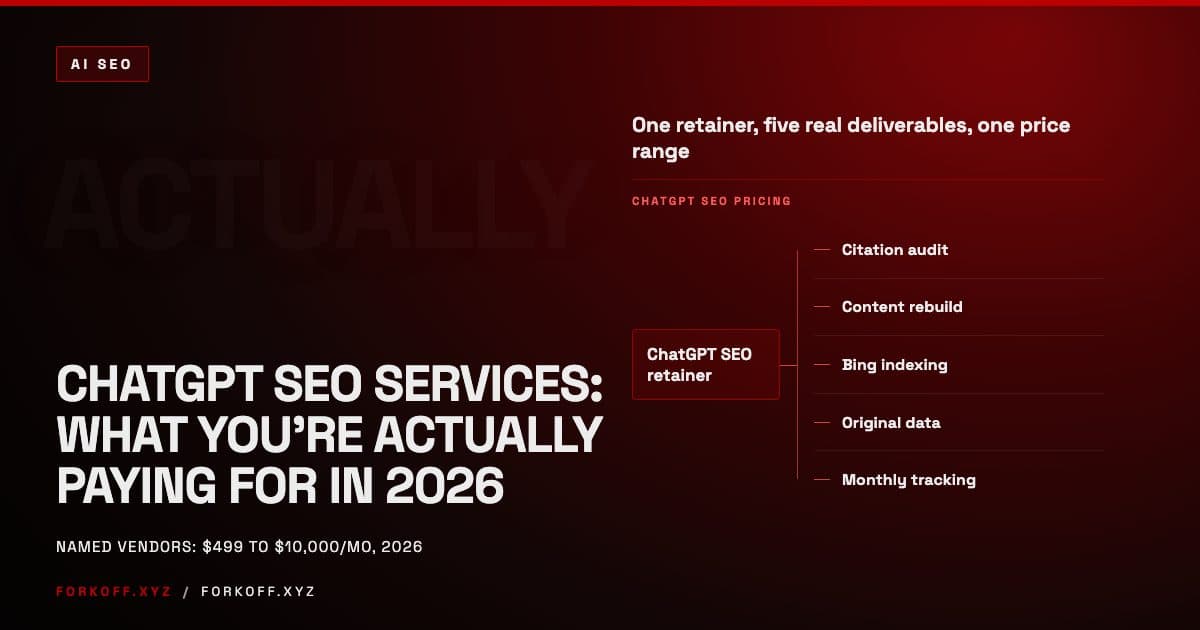
Named ChatGPT SEO vendors, selling what is really a form of answer engine optimization, charge between $499 and $9,000 a month in 2026, and the price alone tells you almost nothing about what you're buying. A real program includes a citation audit, an answer-first content rebuild, Bing indexing work, original data production, and monthly tracking. A checklist with a markup includes none of those and still charges specialist rates.
That gap, between a program and a checklist wearing the same price tag, is the actual question buyers are asking. Not "is ChatGPT SEO worth it," but "how do I tell the two apart before I sign a six-month contract." This post answers it with real numbers from named vendors, not guesses, and it sits alongside our own breakdown of what an AI SEO agency costs more broadly if ChatGPT specifically is only one engine you care about.
What ChatGPT SEO services actually cost
Named vendors charge between $499 and $10,000 a month for ChatGPT SEO, with most mid-market programs clustering between $2,000 and $4,000. A real retainer includes a citation audit, answer-first content rebuilds, Bing indexing work, original data production, and monthly tracking. The most common complaint from buyers on Reddit is paying specialist prices for a generic checklist. Ask for the audit before you sign, confirm what original data the vendor will produce, and check the contract minimum term before committing.
What "ChatGPT SEO services" means in the market right now
Type "ChatGPT SEO services" into Google and the SERP is dominated by agency service pages, five of the top ten results, alongside two Reddit threads of practitioners asking whether ChatGPT is even useful for SEO work, a listicle ranking seven agencies, and OpenAI's own ChatGPT search product page sitting at position one. That mix tells you the category is real and commercial, but also young enough that nobody has standardized what the service actually includes.

The vendors selling it describe roughly the same five things in different words: citation visibility, content restructuring, technical indexing, data or authority building, and tracking. What varies enormously is the price, the depth, and whether any of the five actually gets delivered versus just promised in a sales call.
That inconsistency is itself the market signal worth paying attention to. A category with a settled definition, traditional SEO, paid search, email marketing, has converged on a shared vocabulary that buyer and vendor both use the same way. ChatGPT SEO has not converged yet, which means the word "optimization" in a vendor's pitch could mean a genuine citation-audit-to-tracking program or it could mean a rebranded on-page checklist with a new label stapled on top. The buyer bears more of the diligence burden here than they would in a mature category, precisely because the vocabulary has not been standardized by enough repeat transactions yet. Sorting a proposal into genuinely new work and renamed SEO practice is the fastest way to see which one you are being sold.
The Reddit skepticism about AEO pricing is a rational buyer reaction
The most upvoted framing of ChatGPT and AEO service pricing on Reddit is not "is this too expensive," it is "am I paying specialist rates for a checklist I could run myself." That skepticism is earned: several vendors on this exact SERP disclose no price at all, and the ones that do span a 20x range from $499 to $10,000 a month for services described in nearly identical language. A buyer's best defense is asking for the citation audit and the sample tracking report before signing anything.
Source: r/AskMarketing, 2026
What do named ChatGPT SEO vendors actually charge?
Here is what named vendors actually charge, pulled directly from each vendor's own published pricing page live as of 2026-08-19, next to the three broader market tiers the rest of the SERP for this cluster clusters into. The spread across those vendors is wide enough on its own that price alone cannot tell you which one is selling a real program versus a rebrand.
What named ChatGPT SEO vendors charge (2026)
| Vendor | Monthly range | Minimum term |
|---|---|---|
| Penguinpeak | $3,500 to $9,000/mo (audit $3,500 to $8,000) | Not disclosed |
| ALM Corp | Consultation only, no published price | Not disclosed |
| Mike Khorev | From $3,500/mo | Not disclosed |
| Blueprint Digital | $2,500 to $6,000/mo (GEO/AI SEO tier, industry-standard range) | 3 to 6 months |
| Boutique AI-search specialist | $499 to $2,000/mo | 2 to 6 months |
| Mid-market SEO agency, AI-search add-on | $2,000 to $4,000/mo | 2 to 6 months |
| Full-service AEO/GEO program | $5,000 to $10,000/mo | 3 to 6 months |
Vendor figures pulled 2026-08-19 from each vendor's own pricing page: [Penguinpeak](https://penguinpeak.com/chatgpt-seo/), [ALM Corp](https://almcorp.com/services/seo/chatgpt-seo/), Mike Khorev, Blueprint Digital. Tier rows are SERP-derived ranges.
Penguinpeak publishes the widest disclosed range of any named vendor on this list, $3,500 to $9,000 a month, and charges $3,500 to $8,000 separately for a standalone initial audit before any ongoing work begins. Mike Khorev, a solo consultant rather than an agency, states his own inbound and content marketing consulting pricing starts at $3,500 a month. Blueprint Digital, an Atlanta-based agency founded in 2007, lists "GEO (AI SEO)" as a named service line alongside its standard SEO offering, though it does not publish a specific rate card for that line. ALM Corp, whose service page is one of the most detailed on the SERP for this exact query, publishes no price at all and routes every inquiry to a consultation call, the single most common pattern across the vendors that do not disclose a number up front.

That spread, from a $499-a-month boutique starter tier to a $9,000-a-month full program, is not automatically a scam signal. Both can be honest prices for genuinely different scopes of work, the same way a solo consultant's retainer and a full-service agency's retainer differ for ai marketing agency work generally. The problem buyers report is when the scope does not actually differ, when a $3,000-a-month retainer delivers the same shallow checklist a $499 tier would, just with better branding on the invoice.
So I've been getting pitched by a few different agencies about AEO services lately and honestly the prices are all over the place. Some are quoting like $3-5k/month for "answer engine optimization" but when I dig into what they're actually doing it kinda seems like they're just handing over a checklist of things we could probably do ourselves.
What a real retainer actually includes
The most detailed public breakdown of what a ChatGPT SEO retainer should contain comes from ALM Corp's own service page, and it lines up with the pattern across the other vendor pages on this SERP even where they don't spell it out as explicitly. Five deliverables show up again and again.
What a real ChatGPT SEO retainer includes
| Deliverable | What it actually is | Why it matters |
|---|---|---|
| Citation audit | Mapping where you currently appear (or don't) in ChatGPT answers for your buyer queries | You cannot claim credit for movement you never baselined |
| Content restructuring | Rewriting pages into answer-first formats a model can extract cleanly | Structure, not just topic coverage, is what gets lifted into an answer |
| Bing indexing work | Confirming and fixing indexing on Bing, which grounds a large share of ChatGPT's web-sourced citations | A page invisible to Bing can be invisible to this citation path regardless of Google rank |
| Original data or research | New data, benchmarks, or first-hand findings nobody else has published | Vendor-reported figures put a 30 to 40 percent citation lift on pages carrying it |
| Monthly citation tracking | A recurring report on whether you're being cited, for which queries, and against which competitors | Without it, there is no way to know if the retainer worked or just ran |
Deliverable categories synthesized from ALM Corp's own published service description and cross-checked against the pattern across the five other vendor service pages pulled in this SERP.
A citation audit comes first, because you cannot credibly claim to have improved something you never measured. Content restructuring follows, rewriting pages so a model can extract a clean answer instead of hunting through marketing copy for one. Bing indexing work is the most-skipped step and arguably the highest-leverage cheap one, more on that below. Original data production is what separates a real program from a rewrite service. And monthly tracking closes the loop, without it, neither you nor the vendor has any honest way to know if the retainer worked.

Miss more than one of these five and what you're buying stops looking like a ChatGPT SEO program and starts looking like the thing buyers on Reddit are already complaining about.
Operator noteIf a retainer has no monthly citation tracking report, there is no way to know if it worked. Ask to see the report format before month one.
The checklist-with-a-markup problem
r/AskMarketing surfaced the sharpest version of this complaint, and it is worth reading in full because it names the exact failure mode: agencies charging specialist rates for work a buyer could largely run themselves once someone actually explains what the retainer is supposed to contain and why each piece matters.
Are AEO agency services worth the cost or are most just giving you a checklist to implement yourself?
The pattern the poster describes, agencies quoting $3,000 to $5,000 a month for "answer engine optimization" that turns out to be a list of things the buyer could do themselves, is not unique to AEO. It is the oldest complaint in agency services generally. What makes it sharper in ChatGPT SEO specifically is how new the category is: there is no established baseline yet for what "good" looks like, so a vendor can describe generic on-page work in AI-search language and charge a premium for the relabeling.

The tell is specificity. A real pitch names the deliverable (a citation audit against these ten buyer queries, a content rebuild on these fourteen pages, a Bing indexing fix on these forty URLs) rather than describing an outcome ("we'll get you cited more"). If a vendor cannot show you a sample of their actual tracking report before you sign, that absence is the answer to whether the retainer is a program or a checklist.
The wider SERP for this query reinforces how uneven the specificity actually is. Search Engine People and Apiary Digital both run their own AI-search and ChatGPT-optimization content, each with a different framing of what counts as a "deliverable," and neither publishes the same list of five items ALM Corp does. That inconsistency is not a red flag on its own, the category genuinely has not settled on one definition yet, but it does mean the buyer carries more of the burden to ask specific questions than they would in a mature service category like traditional link building or content marketing.
Why do most ChatGPT SEO vendors skip Bing indexing?
This is the single most underrated line item in the entire category, and it is cheap to check yourself before paying anyone. Most SEO teams have not actively managed a Bing presence in years, which is exactly why this step gets skipped, even by vendors otherwise running a legitimate program.

When ChatGPT grounds an answer in live web sources rather than pulling from its training data, a large share of those citations trace back to Bing's search index, not a dedicated ChatGPT-only crawler. A vendor's own published figure puts this at 87 percent. That means a page can rank well on Google, have a strong domain, and still be structurally invisible to this specific citation path if it is thin, blocked, or poorly indexed on Bing, a search engine most SEO teams have not actively managed in years.
ChatGPT SEO runs through Bing more than people realize
When ChatGPT's search-grounded mode cites live web sources, a large share of those citations trace back to Bing's index, not a separate ChatGPT-only crawl. A vendor's own published figure puts it at 87 percent. That makes Bing Webmaster Tools a real, checkable input to a ChatGPT SEO program, and it is the single most-skipped step, because most SEO teams have spent a decade treating Bing as an afterthought behind Google.
Source: ALM Corp published service page, 2026
The fix costs nothing but attention: log into Bing Webmaster Tools, confirm your highest-value pages are indexed and not flagged, and submit a sitemap if you have never bothered to. This is exactly the kind of five-minute technical check a $499-a-month vendor should be doing in week one, and the kind that a checklist-seller charging $3,000 a month sometimes skips entirely because nobody on the buyer's side thought to ask. It is the same category of cheap, checkable technical work covered in our schema markup for AEO piece, structural fixes that cost nothing but attention and get skipped anyway because nobody on the buyer side thinks to check them.
How I'd Use ChatGPT for SEO in 2026
A practitioner walkthrough of how to actually use ChatGPT inside an SEO workflow in 2026.
The two deliverables that actually move citations
Two levers do most of the work in vendor-reported data, and neither of them is "write more content." Both take real time to build honestly, and both compound the longer a program runs, which is part of why this works better as a monthly commitment than as a one-time project.

The first is original data, first-party research, benchmarks, or findings nobody else has published. Vendor-reported figures put the citation-probability lift at 30 to 40 percent for pages carrying genuine original data versus pages that only synthesize existing sources. This mirrors the pattern seen across every AI answer engine covered on this blog: a model cites sources that add information it does not already have, not sources that restate what is already sitting in its training data.
Original data is the highest-leverage single deliverable
A vendor-reported figure puts the citation-probability lift from original, first-party data at 30 to 40 percent over content that only synthesizes existing sources. That tracks with the broader pattern across every AI answer engine covered on this blog, models cite sources that add information the model does not already have, not sources that restate what is already in its training data or index. A retainer that never produces new data is optimizing the wrong half of the equation.
Source: ALM Corp published service page, 2026
The second is review and forum presence. Brands with an active footprint on G2, Capterra, Reddit, and industry-specific forums see a reported 3 to 4 times higher citation rate than brands without one. The mechanism is intuitive once you see it: a model grounding an answer in the open web weights independent, third-party validation more heavily than a brand's own marketing page, because it reads as a genuine signal rather than a sales pitch.
Reviews and forum presence outperform brand copy for citations
Brands with an established review and forum footprint, G2, Capterra, Reddit, industry-specific forums, see a reported 3 to 4 times higher citation rate than brands without one. The mechanism is straightforward, a model grounding an answer in the open web treats independent, third-party validation as a stronger signal than a brand's own marketing page, the same dynamic that makes Reddit and G2 punch above their domain authority in Perplexity citations.
Source: ALM Corp published service page, 2026
Neither lever is instant. Original data takes real research time to produce honestly, and review presence takes months to build authentically. That is precisely why a legitimate retainer runs on a monthly cadence rather than a one-time project, and why a vendor promising overnight citation gains from either lever is overselling the timeline. It also means asking a vendor "what happens to my citations if I stop paying" is a fair question, since neither lever is a one-time fix, a program you cancel after month two loses the compounding effect the same way stopping a link-building campaign does.
There is a second reason original data specifically matters here, beyond the citation-probability lift: it is the one deliverable that does not decay the way a plain content rewrite can. Our citation decay piece covers this in more depth, but the short version is that answer-first prose alone gets displaced as more sites copy the same structure, while a genuinely original dataset keeps getting cited until someone else produces a newer or larger one. If you are only going to fund one of the five deliverables in year one, this is the one with the longest half-life, and it is also the one measuring share of AI citations actually tracks well, since a unique dataset is trivially distinguishable from a competitor's paraphrase in a citation audit.
I run a small 3-person Webflow agency in France specialized in AEO for B2B. Over the last 18 months we logged 80 deals. 24 of them, 30 percent, came from AI search.
Content length, and why the number is a symptom, not a target
Vendor-reported data shows a real jump in citation rate for pages above roughly 2,900 words compared to shorter pieces. That number gets misread constantly as a padding target, when the actual driver is how many of a buyer's real sub-questions the page manages to answer in one place.

Read that correctly and it is not permission to pad. It is evidence that the pages earning citations tend to cover more of the actual sub-questions a buyer would ask a model, the horizontal breadth of coverage rather than vertical padding on one narrow point. That is the same fan-out logic that governs how Perplexity and Google AI Overviews decide what to cite: a page that answers five adjacent questions a buyer might phrase differently earns more surface area across more query variations than a page that answers one question five different ways.
The 2,900-word citation threshold is a comprehensiveness signal, not a padding target
Vendor-reported data shows pages above roughly 2,900 words receive meaningfully more ChatGPT citations than shorter pieces. Read correctly, this is not permission to pad a page, it is evidence that pages earning citations tend to answer more of the sub-questions a buyer would actually ask, the same fan-out logic that governs AI Overview and Perplexity citation coverage. A 2,900-word page that pads instead of answers will not out-cite a tighter, sharper 1,800-word page.
Source: ALM Corp published service page, 2026
A 2,900-word page stuffed with repetition and filler will not out-cite a tighter 1,800-word page that genuinely covers more ground. If your vendor's version of "content depth" is padding rather than coverage, the word count will move and the citation rate won't.
Our own structural patterns for AI Overview optimization piece breaks this down further at the paragraph and heading level, if you want the mechanics of what "answer-first" actually means on the page rather than just the citation-rate correlation. A vendor who cannot describe their own answer-first format in specific structural terms, beyond "we optimize for AI," is a vendor who has not internalized the difference between padding and coverage themselves.
How long does it actually take to see results?
Vendor-stated timelines cluster around 30 to 60 days for initial movement, which is a reasonable planning horizon for a first checkpoint rather than a guarantee. A program promising citation gains inside two weeks is either overselling the mechanism or measuring something other than a real citation.

That sits between the two engines this blog has already benchmarked in the Perplexity vs Google AI Overviews comparison: faster than the 30 to 90 day cadence typical of Google AI Overviews, because AI Overviews ride the same classic ranking pipeline as organic search, and slower than Perplexity's live crawler, which can pick up a freshly published page within days. ChatGPT's search-grounded citation behavior sits closer to the AI Overviews model in mechanism (index-dependent, not live-crawled), which is consistent with the 30-to-60-day timeline landing between the two.
Operator noteCheck Bing Webmaster Tools indexing status before paying anyone. It is a five-minute check most buyers never run.
The five questions that separate a program from a pitch deck
Put these to any vendor before you sign, and treat a vague or evasive answer to any of them as a real signal. None of the five require deep technical fluency on your side, they only require the vendor to be specific, show evidence, and state the contract terms plainly.

Red flags vs. green flags in a ChatGPT SEO pitch
| Signal | Red flag | Green flag |
|---|---|---|
| Baseline | No citation audit before the pitch | Shows you where you stand today, with specifics |
| Deliverable | Vague "optimization" with no named output | Names the content, data, and technical work by deliverable |
| Data | Repackages existing content as new | Commits to producing genuinely new research or data |
| Reporting | No sample report shown before signing | Shows the actual monthly tracking format up front |
| Contract | Long minimum term, no cancellation clarity | States the minimum term and exit terms plainly |
Framework built from the pattern in the r/AskMarketing buyer-doubt thread cited below, cross-checked against ALM Corp's own disclosed deliverable list.
Notice that none of these five questions require you to understand the technical mechanics of how ChatGPT selects citations. They only require the vendor to be specific about what they will actually do, show you evidence before you pay, and be plain about the contract terms. A vendor who answers all five clearly is very likely running a real program. A vendor who answers zero of them clearly is very likely running the checklist r/AskMarketing was complaining about.
If you want a sense of what a genuinely thorough citation audit looks like on the buyer side, our piece on how AI Overviews rank brands walks through the signal set a rigorous audit actually pulls, competitor citation share, which specific sub-questions trigger a citation, and how that share moves month over month. Ask a prospective vendor to show you something resembling that depth before you sign anything.
Operator noteAsk for a citation audit before signing. A vendor who cannot show where you stand today cannot credibly claim credit later.
The three-layer shape every real program follows
Strip away the marketing language on every vendor page in this category and the same three-layer structure shows up underneath, whatever the vendor calls it. Audit, build, and prove are the honest names for three phases every legitimate program runs through, even the ones that dress them up differently in a sales deck.

Audit comes first: where do you stand today, on which queries, against which competitors. Build comes second: the content, technical, and data work that actually changes the answer. Prove comes third: the monthly tracking that shows whether the build phase moved the audit's baseline. A retainer that skips the audit is guessing at a starting point. A retainer that skips the prove step has no way to justify renewing itself past month one, which is exactly why the contract-minimum-term question from the list above matters, a vendor confident in the prove step will not need to lock you into six months to keep you paying.
This three-layer shape is not specific to ChatGPT. It is the same shape FORKOFF runs its own pre-AI readiness audit around, because the audit-build-prove sequence is the honest structure underneath every legitimate answer-engine program, whichever model you are optimizing for first.
kapilansh
@kapilansh_twt
this is beyond insane. a $10k/mo AEO agency just collapsed into one MCP. CrowdReply MCP inside Claude: > scan AI visibility > diagnose citation holes > enter the sources models read > implement without a brief > show movement after $10k/mo agencies are still selling step one.… Show more
DIY, or pay someone
For a single site with a founder or in-house marketer willing to put in real hours, the mechanical steps here are not technically hard. They are time-consuming and easy to let slide once the initial pass is done.

DIY vs. agency: a realistic time-and-cost comparison
| Approach | Time or cost | What you get |
|---|---|---|
| DIY, single site | 10 to 20 hours upfront, 2 to 4 hours/month ongoing | Answer-first rewrite of top pages, a Bing indexing check, manual monthly spot-checks |
| Starter retainer | $499 to $2,000/mo | The DIY steps run on a schedule, plus basic citation tracking |
| Mid-market retainer | $2,500 to $4,000/mo | Adds original data production and a formal monthly report |
| Full program | $4,000 to $10,000/mo | Adds ongoing research output, competitive citation tracking, and cross-engine work (Perplexity, Google AI Overviews) |
Time estimates are a realistic industry-standard range for a single-site, single-owner DIY effort, not a vendor claim. Retainer tiers map to the named-vendor pricing table above.
What an agency retainer actually buys, beyond convenience, is the original-data production most in-house teams do not have research bandwidth for, and the discipline of a recurring monthly cadence instead of a one-time audit that quietly stops getting revisited by month three. If your category has thin or unproven ChatGPT-driven buyer demand, the DIY pass or a $499-to-$2,000-a-month starter tier is a more defensible first move than a $9,000 program, the same territory our AI SEO agency cost breakdown covers in more depth. If demand is already real and your competitors are already showing up, the calculus flips toward paying for speed and consistency.
For most early-stage teams the honest answer sits somewhere in between: run the DIY audit yourself first (our free AEO checker covers the basics) regardless of budget, since it costs nothing but an hour, then decide whether the result justifies a retainer at all versus folding ChatGPT citation work into a broader answer engine optimization engagement that covers Google, Bing, and the AI engines together rather than paying for a ChatGPT-only specialist on top of everything else you are already running.
The scale of who is actually asking is part of what makes that hour worth spending before you decide either way.

The buyer base asking ChatGPT for recommendations is already large
OpenAI's own reported figures put ChatGPT's weekly active user base above 900 million as of February 2026, a meaningful share of whom are now using it for comparison and purchase-decision research rather than pure information lookup. That scale is what turns "should we bother with ChatGPT SEO" into a question worth answering with a real audit rather than a shrug, even for a company that has never run a dedicated AI-search program before.
Source: TechCrunch, citing OpenAI's own announcement, 2026
How do you decide whether to pay for ChatGPT SEO?
Run this in order, and stop at whichever step tells you the honest answer. The framework below runs from cheapest to most expensive: test demand yourself first, run a citation audit second, match your budget to what the audit shows, then insist on monthly tracking before you renew anything.

First, test demand yourself. Ask ChatGPT the exact comparison and recommendation questions your buyers would ask in your category, before you spend a dollar with anyone. If your category has no such buyer behavior yet, everything downstream is premature. Second, run or commission a citation audit. This is the baseline every legitimate vendor pitch should open with; if a vendor skips straight to a proposal without one, that is itself the answer to whether they run a real program. Third, match the tier to what the audit shows. A category with light, early demand does not need a $9,000-a-month full program; a category with entrenched competitor citations and real dollar volume behind it usually does. Fourth, insist on monthly tracking from day one, in whatever form, self-run or vendor-provided, because a retainer with no way to measure its own effect cannot be evaluated honestly at renewal time.
Founders running a fractional or lean marketing function tend to skip step one entirely and jump straight to signing a retainer, the same pattern we see across every engagement we run: it is faster to buy a service than to spend twenty minutes testing whether the underlying demand is even there yet. That twenty minutes is the highest-leverage thing in this entire post.

Operator noteA $499/mo starter and a $9,000/mo program are not the same tier wearing different price tags. Match the tier to real category demand.
Where the budget actually goes inside a monthly retainer
Vendors rarely disclose this, but the effort inside a typical mid-market retainer breaks down in a fairly consistent shape once you account for the five deliverables above. Knowing that shape in advance is useful leverage in a sales conversation, because it lets you ask why a specific line item costs what it does instead of accepting one blended monthly number.

Content restructuring tends to absorb the largest single share of monthly hours, because rewriting existing pages into answer-first formats is genuinely labor-intensive work done well. Original data production and technical indexing work split a smaller but still substantial share. Tracking and reporting is usually the cheapest line item to deliver and the most valuable one to the buyer, because it is the only deliverable that tells you whether the rest worked.
Operator noteThe single highest-leverage line item in a retainer is original data production, not more content volume., ALM Corp, 2026
What do the contract terms actually look like?
Price is not the only number that matters before you sign. The minimum term, the cancellation terms, and whether the vendor locks you in before showing a single tracking report all matter as much as the monthly rate, and a buyer who only compares dollar figures is comparing the wrong column.

Most vendors on the pricing table above run a 2 to 6 month minimum commitment, standard for a service where the mechanism (index-dependent citation shifts, not live-crawled) genuinely takes weeks to months to show movement. A shorter minimum is not automatically better if it means the vendor is optimizing for quick wins rather than the kind of original-data and authority-building work that compounds. The point is simply to know the number before you compare price across vendors, because a $2,000-a-month retainer with a 6-month lock-in and a $3,500-a-month retainer with month-to-month flexibility are not directly comparable on price alone.
Operator noteConfirm the minimum contract term and exit terms up front. Most vendors on this list run 2 to 6 months.
paolo trivellato
@paolo_scales
9 months ago, we started running the LinkedIn content for an AI SEO agency. Since then, they've scaled to $200K+/month using basically 2 acquisition channels: LinkedIn and referrals. In that time, we've generated 10M+ impressions, added 30K+ followers and helped turn the found… Show more
Local-services and B2B look different, and both are real
The demand for this service is not confined to venture-backed SaaS. A house-painting AEO agency running a $3,000-a-month retainer built around mining actual client phone calls for content, and a solo B2B agency owner who sourced €230,400 of pipeline (30 percent of total deals) from AI search over 18 months, are both operating in the same category this post is pricing.
I run a small AEO agency in Connecticut and most of my clients are house painters. The thing that makes my process different from typical "SEO for contractors" is where the content comes from, I mine the client's actual phone calls.
The mechanics differ by vertical (a local-services business leans harder on the phone-call and community-forum signal; a B2B software company leans harder on comparison content and review-site presence), but the five-deliverable shape and the roughly 30-to-60-day timeline hold across both. If you sell locally or to consumers, weight your evaluation of a vendor toward how well they understand your specific buyer research pattern, not just their generic AI-search credentials. And before evaluating any vendor at all, confirm you actually need one: AI SEO agency vs AI SEO software breaks down when a cheap tracking subscription answers the question a $499-plus retainer would otherwise be paid to answer.
The full breakdown behind that B2B pipeline number is worth reading directly, since it names the exact mechanics (niche, personal branding, listicles, cross-source consistency) rather than staying vague about what "AI search" actually delivered.
I sourced €230k of pipeline from AI search with my agency (30% of our deals). Here is the AEO method and the business data.
AEO for Agencies: How to Price, Sell & Deliver AI Visibility Audits and AEO Services
How agencies price, sell, and deliver AI-visibility audits and AEO services, the sibling market ChatGPT SEO sits inside.
The verdict
ChatGPT SEO services in 2026 span a real 18x price range, from $499 to $9,000 a month, and the price alone will not tell you which side of the checklist-versus-program line you're buying into. What will tell you is whether the vendor can show a citation audit before you sign, name original data they will produce rather than repackage, share a sample of their actual tracking report, confirm the Bing indexing status of your key pages, and state the contract minimum term plainly.
I have been working in SEO for some time, but recently I have noticed a shift in how people discover brands. Instead of searching only on Google, many users are now asking AI tools like ChatGPT, Perplexity, and Gemini questions... What's interesting is that these tools directly recommend businesses, sometimes even before users visit a search engine.
If you run the audit yourself first, whether that means asking ChatGPT your own buyer questions or commissioning a real one, you walk into any vendor conversation already knowing whether you're looking at a starter tier, a mid-market retainer, or a full program, and whether the pitch in front of you matches it. That single step is worth more than any amount of price comparison, because it turns "what does ChatGPT SEO cost" into a question with a specific, defensible answer instead of a guess anchored on whatever number the first vendor happened to quote.
If you want that audit run for you, alongside the fuller answer engine optimization and Perplexity SEO work that extends the same foundation to Perplexity and Google AI Overviews, get in touch with FORKOFF and we'll show you exactly where you stand before you spend a dollar with anyone.