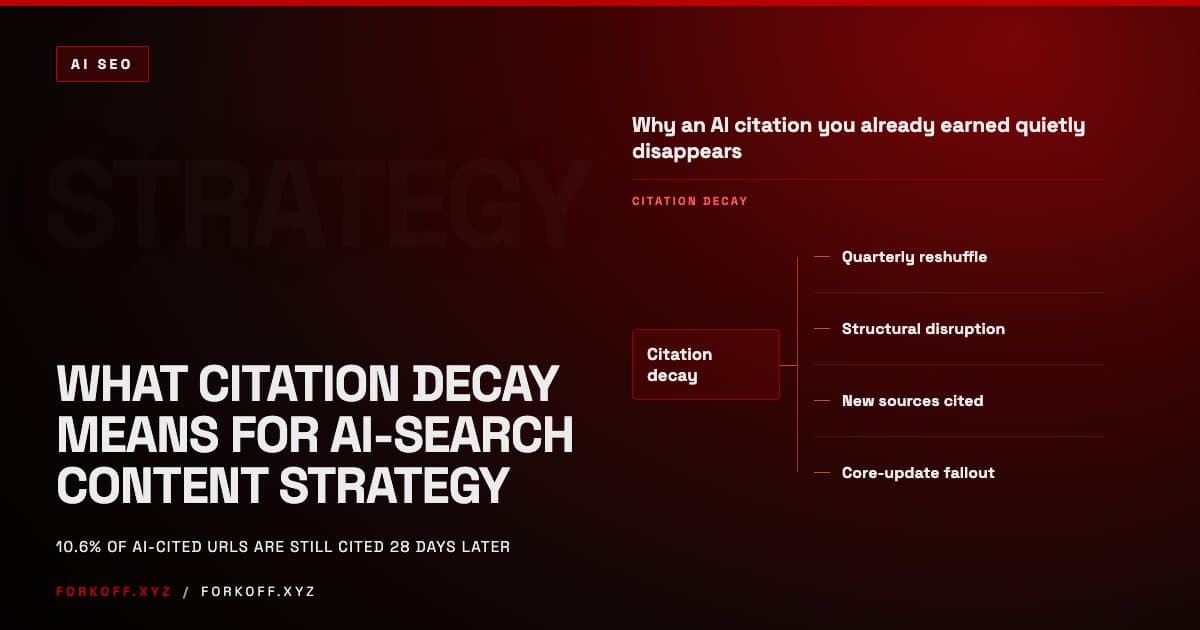
Citation decay is the measurable rise, peak, and falloff of a single URL's presence in AI-generated answers over time, the same shape a product team tracks for a customer's lifecycle: first appearance, growth, a high-water mark, and an eventual drop-off. A page gets cited by ChatGPT, Perplexity, or Google AI Overviews. Nothing about the page changes. Weeks later, the citation is gone. No rewrite happened, no ranking dropped, no policy got violated. The page simply stopped being one of the sources an AI engine reaches for on that query. Deciding whether to fix this yourself or bring in a dedicated AEO/GEO agency usually comes down to whether anyone is actually tracking citation rate at all.
The 30-second answer to citation decay
Citation decay is the rise and fall of an AI engine's citation of one URL over time: a page gets cited by ChatGPT, Perplexity, or Google AI Overviews, holds that citation for a while, then loses it, often with no rewrite and no ranking drop to explain why. Three independent measurements put the typical lifespan anywhere from 28 to 90 days depending on the study and the engine, which means there is no single number to plan around, only a range and a mechanism. The mechanism is structural, not punitive: engines reshuffle their cited-source pool roughly every quarter, favor pages with a stable extractable answer block, and can drop a citation simply because a fresher or better-structured page replaced yours. FORKOFF's own research found a 25.7 percent freshness advantage and up to 2x citation lift within 3 months of a substantive update, but also that updating the wrong way, restructuring the section an engine had already learned to cite, can trigger a temporary citation drop before any of that upside shows up. The fix is a cadence, not a one-time fix: refresh data before structure, measure per engine, and give a page one to two index cycles before judging whether an update worked.

The number gets attention because it is stark. A six-week, three-wave longitudinal study tracking 1,127 unique URLs across five AI engines found that only 10.6 percent of AI-cited pages were still cited 28 days later. The other 89.4 percent had cycled out. That single figure reframes what AI citation visibility actually is. It is not a stock a brand accumulates and keeps. It is a flow, and a citation won this week has, on the median, roughly a one-in-ten chance of surviving to next month.
Citation decay has no single agreed-on number
Three independent sources put the typical citation lifespan at three different lengths. A 2026 AI-search vendor's own tracked example shows a page rising for 63 days before a 7-day half-life, a full cycle of roughly 70 days. A six-week, three-wave study of 1,127 URLs found only 10.6 percent of AI-cited pages still cited 28 days later. A separate LinkedIn post from an AI-search product founder puts a single brand citation's typical lifespan closer to 90 days. None of these numbers is wrong; they measure different engines, different query sets, and different windows. Anyone quoting one figure as the industry standard is rounding off a real spread most agencies have not yet reconciled.
Source: Digital Authority Partners AI Visibility Study 2026, via everything-pr.com
What citation decay actually measures
A citation-decay curve is not a vague sense that "AI mentions come and go." It is a specific set of tracked fields, the same shape whether a team builds the tracking by hand or a vendor tool does it automatically: the date a URL is first cited, how many days citation volume keeps rising before it peaks, the peak weekly citation count itself, the half-life (days from peak to a 50 percent falloff in weekly citations), and the date the URL stops appearing in tracked answers altogether. A two-week rolling average is the usual smoothing window, because raw daily citation counts on any single query are noisy enough to obscure the underlying curve. The reason freshness matters at all traces back to a related finding from Kevin Indig's State of AI Search Optimization research: the median cited page skews young, which means an un-refreshed page is aging out of the eligible set even when nothing about it has objectively gotten worse. Citation decay and citation eligibility are two sides of the same clock.

One 2026 AI-search vendor's own published example, cited widely enough in AI-SEO circles that a verified consultant flagged it to four peers the same week it went live, describes a page that climbed for 63 days before hitting a 7-day half-life, a page that rose slowly and then lost relevance fast. That single tracked curve is a useful mental model, but it is one example, not a universal constant, which the rest of this piece treats seriously.
Gagan Ghotra
@gaganghotra_
citation decay? another new thing in AI SEO land, what we think of this?
Why do three studies disagree on how long a citation lasts?
Three studies disagree because each measured a different engine set, a different query type, and a different measurement window, not because one of them is wrong. Ask three different sources how long a citation lasts and you will get three different answers, ranging from roughly a month to roughly three months, and all three can be correct simultaneously. Anyone building a citation strategy off a single borrowed number should measure share of AI citations on their own domain first, because that is the only way to calibrate the instrument to an actual engine mix rather than someone else's.

Three independent measurements of citation lifespan
| Source | Measurement window | What it found |
|---|---|---|
| A 2026 AI-search vendor's tracked example | Rise duration to half-life | 63-day rise, 7-day half-life (~70-day cycle) |
| Digital Authority Partners, six-week study | 28-day persistence | 10.6% of AI-cited URLs still cited 28 days later |
| A LinkedIn post from an AI-search founder | Single-citation lifespan estimate | About 90 days before performance drops |
No two studies measured the same engines, prompts, or window, so treat these as a range, not a target number.
The 63-day-rise, 7-day-half-life example describes one tracked page's full lifecycle. The 10.6-percent, 28-day figure describes a population-level persistence rate across 1,127 URLs and five engines. The roughly-90-day estimate from a LinkedIn post by an AI-search product founder describes a single typical citation's useful life before performance meaningfully drops, while noting that a well-structured page can generate many citations inside that window. None of these contradicts the others. They are three different instruments pointed at the same underlying phenomenon, at different zoom levels.
Operator note63 days to half-life, 10.6% surviving 28 days, and a separate 90-day estimate are three different studies, not three names for one number., Cross-referenced from 3 independent sources, 2026
Which AI engine forgets your citations fastest?
Gemini forgets fastest and Perplexity forgets slowest, a genuinely large gap inside the same 28-day measurement window covered in Digital Authority Partners' AI Visibility Study. The population-level 28-day figure quoted earlier hides this entirely: it blends five engines that behave nothing alike into one number, which reveals nothing about which engine is actually dropping a brand's citations, or by how much, once you go looking engine by engine.

28-day citation retention by engine
| Engine | Citations still present after 28 days |
|---|---|
| Perplexity | 44% |
| Microsoft Copilot | 34% |
| ChatGPT | 31% |
| Google AI Overviews | 27% |
| Gemini | 11% |
Max cross-platform overlap between any two engines' cited domains was 17%, so a citation win on one engine rarely transfers to another.
Gemini retained only 11 percent of citations after 28 days in the same study. Perplexity retained 44 percent, four times more. Google AI Overviews sat at 27 percent and Microsoft Copilot at 34 percent, with ChatGPT in between at 31 percent. A team reporting one blended "AI visibility score" cannot see this spread, and cannot tell a stakeholder whether a falling number means the brand is losing ground broadly or just cratering on the one engine that happens to churn fastest structurally.
A blended citation score hides which engine is dropping you
28-day citation retention ranges from 11 percent on Gemini to 44 percent on Perplexity, a 4x spread between the least and most stable engine in the same study. ChatGPT sits at 31 percent, Google AI Overviews at 27 percent, Microsoft Copilot at 34 percent. A team tracking one averaged "AI visibility score" cannot see that spread, and cannot tell whether a falling number means the brand is losing ground everywhere or just on the one engine that happens to churn fastest. Score each engine separately or the number is decoration.
Source: Digital Authority Partners AI Visibility Study 2026
Operator note11% on Gemini versus 44% on Perplexity, a 4x spread in the same 28-day window. Blend those two and the number describes neither engine., Digital Authority Partners AI Visibility Study 2026
Naqui
@naqui_s
Your best case study is quietly dying right now. Not because it's wrong. Because a newer page just came out, and ChatGPT already forgot the case study exists. ChatGPT churns fastest, case studies fall off in about 3 weeks. Gemini moves like classic Google decay, give it 2 months.… Show more
Their AI citations tanked 40 percent after a content refresh that buried their Q&A section under new paragraphs. LLMs latch onto specific structural cues. If you change the pattern that was working, you break the extraction path.
The engine gap compounds with a distribution gap: the max citation overlap between the domains cited by any two engines in the same study was 17 percent. Winning a citation on Perplexity says almost nothing about whether the same page will ever get cited on Gemini for the same query. Building for "AI visibility" as a single target misreads five genuinely different retrieval systems as one.
Does the source of a citation predict how fast it decays?
Yes, and by a wide margin. Engine choice is not the only variable that determines how long a citation survives. The type of source an AI engine cites in the first place, a brand-owned page, an established media outlet, or a community thread, predicts how durable that citation will be almost independent of which engine did the citing, according to a practitioner-run 90-day field audit shared on r/GEO_optimization.

90-day citation decay rate by source tier
| Tier | Example sources | 90-day decay rate |
|---|---|---|
| T1 | Brand-owned properties, .gov, .edu | 4% |
| T2 | Established media, Wikipedia | 18% |
| T3 | Reddit, LinkedIn, community forums | 61% |
T3 sources are cited constantly and decay fastest; diversify rather than avoid them.
A practitioner-run 90-day field audit split cited sources into three tiers. Brand-owned properties, government, and education domains decayed at only 4 percent over 90 days. Established media outlets and Wikipedia decayed at 18 percent. Reddit, LinkedIn, and other community forums decayed at 61 percent, by far the fastest tier measured.
Where you get cited predicts how fast you lose the citation
A practitioner-run 90-day field audit split cited sources into three tiers and found brand-owned, .gov, and .edu sources decayed at 4 percent, established media and Wikipedia at 18 percent, and Reddit, LinkedIn, and community forums at 61 percent. Reddit is also one of the most-cited domain categories across AI engines generally, so a GEO strategy leaning heavily on community-sourced citations is building on the tier that decays fastest, by a wide margin. That does not mean skip Reddit; it means diversify into longer-lived source types rather than relying on any single tier.
Source: A GEO practitioner's field audit, r/GEO_optimization, 2026
That is an uncomfortable finding for anyone leaning on Reddit as a GEO channel, given how frequently community platforms show up as cited domains for AI engines generally. It is not an argument to abandon community-sourced citations, Reddit's sheer citation frequency across AI engines makes it too valuable to skip, but it is an argument against relying on any single tier. A citation portfolio spread across brand-owned pages, earned media, and community threads survives a decay event in any one tier far better than a portfolio concentrated in the fastest-decaying one.
The 47-Day Citation Decay: Why Your AI Visibility Dashboard Is Lying to You
Why do AI engines actually drop a citation?
An AI engine drops a citation for one of at least five independent reasons, and a page can lose its place to any one of them without anything on the page itself having gotten worse. Citation decay is not one force with one fix, it is a bundle of separate mechanisms, some structural, some competitive, some tied to Google's own core-update cycle, and diagnosing which one hit a specific page matters more than reaching for a generic content refresh.

Periodic reshuffle. AI answer sets churn between measurement waves as engines re-rank and re-select sources, independent of anything a specific page did. Digital Authority Partners' own wave data shows this directly: across the same six-week, three-wave study behind this post's headline persistence number, the set of cited URLs moved from 530 unique pages in wave one to 546 in wave three, with only about 20 percent of those URLs appearing in both waves, a materially different set of sources cited at the end of the window than at the start, with nothing on most of the dropped pages having changed.

Operator noteLosing organic rank in a core update carries roughly a 22% citation loss with it. The two are not independent problems., FORKOFF internal AI-citation research, cross-referencing the AirOps 16-week study
Structural disruption. This is the mechanism behind the freshness paradox covered in the next section: rearranging or burying the specific block an engine had learned to extract from breaks the extraction path even when nothing about the page's factual content changed.
New competing sources. A fresher, better-structured, or more thoroughly sourced page simply displaces the previously-cited one in the retrieval pool. This is the most benign mechanism and also the hardest to fight directly, since it is a statement about a competitor's content, not a defect in yours.
Core-update fallout. FORKOFF's own research found that pages losing organic ranking in a Google core update lose roughly 22 percent of their citations along with it. AI citation and classic search ranking are not independent systems; a hit to one tends to drag the other down.
No real-time re-verification. Engines frequently cite a cached reference rather than re-checking the live page at answer time, so a citation can persist past the point where the underlying page has actually changed, and can also drop for reasons that have nothing to do with the page's current state, purely because the cached signal itself expired or got replaced. This is the mechanism behind a genuinely uncomfortable finding a practitioner posted after running a 200-response longitudinal audit: an AI answer can keep citing a page long after that page's underlying source content changed, moved, or in the extreme case, was deleted entirely, because the model is citing what it remembers being true, not what a live fetch would return right now. A citation dashboard reading that reference as a current, healthy brand mention is reporting on the model's memory, not on the internet's present state, and the gap between the two widens the longer a citation goes unverified.
The freshness paradox: updating a cited page can cost you the citation
Here is the finding most content teams are not planning for. Multiple operators independently reported the same pattern, unprompted, in the same week, in a public discussion thread: a page holding steady citations across several AI engines, then a normal, textbook-good-practice content update, new sections, refreshed statistics, better structure by any classic SEO standard, followed by citations dropping, sometimes for weeks, before a partial, rarely-complete recovery.
The update that is supposed to help can trigger a temporary drop
A real, unprompted operator thread describes the exact failure mode this post is built around, a team updates a consistently-cited page with normal good-practice changes, new sections, refreshed stats, and watches the citations drop for weeks before a partial recovery. One operator in the same thread reported a page's citations falling 40 percent after a refresh that buried its Q&A section under new paragraphs, and recovering only once the direct-answer structure was restored. The mechanism most practitioners converge on is structural, not penal, the engine had learned to extract from a specific block, and moving it broke the extraction path, not the page's trustworthiness.
Source: r/aeo practitioner thread, 2026

SEO best practices push toward regular updates and freshness signals. GEO citation patterns reward stability and consistent extractable structure. Those two goals can actively work against each other.
One operator in that same thread described the sharpest version of it: AI citations for a page fell roughly 40 percent after a "content refresh" that buried the page's existing Q&A section under new paragraphs, the kind of addition most SEO checklists would call an improvement. Citations only recovered once the direct-answer structure was restored to its original position.
Operator noteOne operator watched citations drop 40% after burying a Q&A block under new paragraphs, recovering only once structure came back., r/aeo practitioner report, 2026
The likely mechanism, per the same thread's own working theory, is structural rather than punitive. An AI engine does not re-evaluate a page's overall trustworthiness on every query; it has, in effect, learned to extract a specific answer from a specific location on the page. Moving that location, even while adding genuinely useful content around it, breaks the extraction path the engine had already built. The page did not get worse. It got harder to parse the same way.
Genuine question: is anyone else seeing AI citations drop after content updates?
FORKOFF's own research: freshness genuinely helps, when it is substantive
None of the above is an argument against updating content. FORKOFF's own answer engine optimization research, built on a live 464-page AI Overview audit and cross-referenced against the available third-party evidence covered in a 2026 cross-platform citation study, found a real, measurable upside from the right kind of update, the opposite finding from the freshness-is-a-myth argument covered later in this piece.

FORKOFF's own substantive-freshness research
| Metric | Value |
|---|---|
| Freshness advantage from a substantive update | 25.7% |
| Citation lift within 3 months of a substantive refresh | up to 2x |
| Citation loss after losing organic rank in a core update | ~22% |
| Cited domains that stay stable week over week once cited | 96.8% |
"Substantive" means new data or a rebuilt answer capsule, not a date-stamp swap with no content change.
A substantive content update, meaning new data or a rebuilt answer capsule, not a date-stamp swap with no real content change, showed a 25.7 percent freshness advantage and up to a 2x citation lift within three months. Once a page IS cited, the picture is more stable than the "everything is constantly churning" framing suggests: 96.8 percent of cited domains stay stable week over week. The real volatility concentrates at two edges, winning a first citation, and surviving whatever update or core-update event comes next, not a constant background grind on citations a page has already secured.
Substantive freshness is a real, measured lever, not a superstition
FORKOFF's own AI-citation research, built on a 464-page live AI Overview audit plus a synthesis of the available third-party evidence, measured a 25.7 percent freshness advantage and up to a 2x citation lift within three months of a genuinely substantive content update, the kind that adds new data or a new answer capsule, not a date-stamp swap. The same research found that losing organic ranking in a core update carries roughly a 22 percent citation loss with it, and that once a page IS cited, 96.8 percent of citations stay stable week over week, so the volatility mostly lives at the edges: winning a first citation and surviving an update, not a constant background churn on citations already held.
Source: FORKOFF internal AI-citation research, 2026
Operator noteFORKOFF's own research measured a 25.7% freshness advantage and up to a 2x citation lift within 3 months, from real audit data., FORKOFF internal AI-citation research, 2026
Format decides how long a citation survives
Original research outlasts a how-to guide, and a how-to guide outlasts a single-campaign case study, in every practitioner comparison surfaced in researching this piece. Beyond source tier and engine, the format of the content itself predicts durability on its own, independent of how well the page is structured or how authoritative the domain hosting it is. A team choosing what to publish next, another case study or another piece of original data, is implicitly choosing how long that page's citation will last before something fresher pushes it out.

Original, first-party research consistently outlasts how-to and workflow guides in practitioner comparisons, which in turn outlast single-campaign case studies, a pattern reported as holding across every engine compared. The likely explanation connects back to the domain-authority finding below: a piece of original data has no equally-good substitute an engine can switch to. A generic how-to guide or a narrow case study is far easier for a fresher, similarly-structured competitor page to displace.
Domain authority opens the door, it does not keep you cited
An independent analysis of more than 400,000 pages across 10,000 queries broke down what actually predicts a ChatGPT citation once a page is already retrieved. Content-answer fit, how closely the page's own structure and tone match how the engine would phrase the answer, drove 55 percent of the effect. On-page structure drove 14 percent. Domain authority drove 12 percent and affects retrieval, not the citation decision itself, in the analysis's own framing, authority "opens the door, not the seat." That reframes citation decay as mostly a content and structure problem, not a backlink problem, which is why a link-building response to falling citations usually underperforms a structural one.
Source: r/bigseo, independent 400,000-page analysis, 2026
An independent analysis of more than 400,000 pages across 10,000 queries broke down what actually predicts a ChatGPT citation once a page has already been retrieved as a candidate. Content-answer fit, how closely a page's own structure and phrasing match how the engine would phrase the answer itself, accounted for 55 percent of the effect. On-page structure accounted for 14 percent. Domain authority accounted for only 12 percent, and mainly affects whether a page gets retrieved as a candidate at all, not whether it gets cited once it is in the pool, in the analysis's own framing, authority "opens the door, not the seat." A vendor selling ChatGPT SEO services who cannot explain this distinction is selling a link-building retainer with a new label on it.
Content refresh vs new content?
That reframes citation decay as substantially a content and structure problem rather than a backlink problem, which is worth stating plainly: a link-building response to falling AI citations usually underperforms a structural, content-answer-fit response, because links mostly influence whether a page gets considered at all, not whether it survives in the cited set once it is. Distribution is the one exception worth naming, because it works through a different mechanism than a typical backlink. A distributed-content persistence study found that content syndicated across a trusted publisher network held a roughly 10-week citation half-life versus 4.5 weeks for single-source content, a durability edge that held across eight industries. The mechanism is not authority transfer, it is redundancy: when the same information sits on dozens of independently trusted domains, an engine has other places to find it even after any one source ages out. A separate glossary-style citation-decay overview converges on a similar median, a roughly 4.5-week half-life across platforms, with brands running active earned-media distribution holding closer to 10 weeks, the same distribution effect from a different measurement.
A citation-decay-aware update cadence
The practical answer to "should we update cited pages" is not yes or no, it is a sequence, and the order the steps happen in matters more than any single one of them. Done in the wrong order, an update captures none of the freshness lift and all of the freshness-paradox risk covered above, the same lesson the founder-led growth playbook draws about consistent attribution surviving an update rather than resetting with one. Done in this order, it captures the upside from FORKOFF's own measured freshness advantage while avoiding the structural trigger that costs a page its citation before that upside ever shows up.

Baseline first. Before touching a cited page, log which specific section is actually the one being cited, not the page in general. Section-level citation tracking is more work than a page-level check, but it is the only way to know what you are protecting when you make a change.
Touch data before structure. Refresh statistics, add supporting evidence, strengthen a claim, all without moving the core answer block an engine has already learned to extract from. This is where most of the 25.7 percent freshness advantage and 2x citation lift comes from, and it carries almost none of the structural-disruption risk.

Wait a cycle. Give an updated page one to two index cycles before judging whether the change worked. Citation recovery, when a drop happens at all, is rarely instant.
Re-check per engine, never blended. Score ChatGPT, Perplexity, Gemini, and whichever other engines matter to the query set separately. A blended number after an update can average out a real Gemini loss against a real Perplexity gain and report "no change" when both things actually happened.
Only then restructure. Reserve a full rebuild, moving the answer block, reorganizing headings, changing the page's core shape, for pages that have genuinely and durably stopped earning citations, not for pages that are simply due for a scheduled refresh.
What should you not do about citation decay?
Do not respond to falling citations with the same reflex that fixes a falling organic ranking, because the two problems reward opposite instincts. The response to falling citations causes more damage than the decay itself often enough that it is worth naming the specific mistakes directly, since each one is a natural, well-intentioned move that a classic SEO playbook would actively recommend in the wrong context.

A citation is not the same thing as visibility
A skeptical but fair critique circulating in AI-search practitioner circles makes a point worth keeping: an AI answer can run three thousand words and drop a brand's name in paragraph six, and nobody scrolls that far. Counting raw citations without checking where in the answer they land, and whether the model even retrieved the page rather than hallucinating the mention, overstates the win. Treat a tracked citation as a lead worth verifying, not a result to report on its own.
Source: r/GEO_optimization, 2026
Do not chase the vanity number. A blended AI-mention score hides whether a brand is actually being linked or merely named, and hides which engine, source tier, or content format is doing the damage. A widely-shared take on what AI visibility dashboards actually measure makes the same argument from the buying side: a probabilistic score that cannot be drilled down to its source is not evidence, it is a number a vendor wants a budget line for.
Do not rewrite the whole page at once in response to a drop. Bulk restructuring, exactly the move the freshness paradox punishes, is the fastest way to make a temporary dip permanent by breaking an extraction path that was still partially working.
Do not assume one engine's behavior generalizes. A 4x retention spread between Gemini and Perplexity in the same study means an engine-specific drop requires an engine-specific diagnosis, not a blanket rewrite.
A citation is NOT visibility. An AI answer might generate 3,000 words and drop your name in paragraph 6. Guess what? Nobody scrolled to paragraph 6.
Do not treat a citation as guaranteed traffic. A citation buried in paragraph six of a long AI answer, or one the model may have generated without actually retrieving the page, converts nothing on its own. Verify placement and retrieval before reporting a citation as a win.
A per-engine breakdown of citation churn speed shared publicly on X makes the same point from a different angle: content type and engine choice interact, so a developer-tool team publishing benchmark data behaves nothing like a protocol team publishing partnership case studies, and neither should copy the other's cadence wholesale. This is also where the Perplexity SEO and founder funnel engagements diverge in scope, one owns engine-specific citation work, the other folds the whole system, cadence included, into standing reporting.
The minimum viable citation-decay tracking stack
None of the above requires an enterprise AI-visibility platform to start, and waiting for budget for one is the most common reason teams track nothing at all for another quarter. A spreadsheet, a fixed prompt set, and a monthly schedule cover the same fundamentals a full measure AI citation share build runs at scale, just at a size a single marketer can maintain without new tooling.

Pick 20 to 30 prompts per money cluster and run them on a fixed schedule, not ad hoc spot checks. Score each engine separately, ChatGPT, Perplexity, Gemini, Claude, whichever set matters for the vertical, never blended into one number. Log which specific URL gets cited for each prompt, not just whether the brand appears somewhere in the answer; a citation without a URL is not something you can act on. Treat any page whose citation streak breaks as an immediate investigation trigger, not a line item in a monthly report nobody reads closely. Refresh data and evidence before touching structure, on the cadence above. And re-measure roughly two weeks after any substantive edit, so an update's actual effect, positive or negative, gets confirmed rather than assumed.

Operator noteReddit and LinkedIn citations decay at 61% over 90 days versus 4% for brand-owned and .gov/.edu sources, the least durable tier to build on., r/GEO_optimization field audit, 2026
The cited-URL set for any competitive query is itself a moving target, one study found roughly 20 percent overlap in the cited-URL set between the first and third wave of a six-week measurement window, and only 17 percent maximum overlap between any two engines. Citation decay is not a bug in an otherwise stable system. Instability is closer to the system's normal operating state, and the teams that treat it that way, with a cadence instead of a one-time fix, are the ones whose citations compound instead of evaporating.
Why does freshness change whether AI cites you?
A short explainer on why freshness changes whether an AI engine cites a page at all.

27 out of 40 lost citation visibility. Not a small dip either. The posts that aged the worst were the ones with the most specific, confident instructions. The posts that aged better were vaguer, almost annoyingly so.
Firstly - freshness is not something Google looks for - except for QDF (query deserves freshness) which is news related. This freshness myth is a shill demand gen invention to create busy work.
That skepticism, made directly in the same content-refresh thread, deserves to be taken at face value before it gets answered. Classic SEO spent years correcting an over-literal reading of "freshness" as a ranking signal, date-stamp swaps, footer timestamp bumps, cosmetic edits dressed up as updates that moved nothing for the reader and moved nothing in the SERP either. A strategist who watched that pattern get sold as a service line has good reason to distrust the next vendor claiming freshness matters, especially one coining a proprietary term for it. The distinction that resolves the disagreement without dismissing either side is that AI citation and classic organic ranking are measurably different systems responding to different inputs, which is the whole premise of the per-engine and per-tier data covered earlier in this piece. A page can be functionally frozen for classic SEO purposes, no ranking movement worth chasing, while still sitting inside an active citation-decay window an AI engine is actively re-evaluating on its own quarterly-ish cycle. Treating the two as one lever, freshness, means importing classic SEO's justified skepticism into a domain where the underlying mechanism, and the evidence for it, is different.
The healthiest response to that skepticism is not to dismiss it. Freshness-as- a-ranking-signal genuinely is oversold in parts of classic SEO, and treating every page like it needs a monthly touch-up wastes effort SEO has already learned to spend more precisely. The distinction that survives scrutiny is narrow but real: SUBSTANTIVE freshness, new data, a genuinely rebuilt answer capsule, measured against AI citation specifically, shows a real, replicated effect. Cosmetic freshness, a date-stamp swap with nothing underneath it, does not, on either classic SEO or AI citation.
Answer Engine Optimisation Explained: How to Get Cited by AI (2026)
An explainer on how answer engine optimization gets a page cited by AI systems.
This is the operating discipline the rest of this cluster builds on. Measure your share of AI citations first, scoring citation rate, mention rate, and share of voice, before layering decay tracking on top. The ChatGPT citation strategy for agencies covers how to scope an ongoing retainer around exactly this kind of recurring work rather than a one-time audit. The AI Overview optimization structural patterns post covers the on-page structure decisions that make a page easier to keep citing in the first place, and how AI Overviews rank brands covers the retrieval side this post's decay curve sits downstream of. Founder-attributed content gets a longer citation half-life for a related reason, and the founder-led growth playbook covers why a named, consistent operator voice is easier for an engine to attribute across updates. Schema markup for AEO covers the hygiene layer underneath all of this, real but secondary to the content and structure decisions this post focuses on; Google's own FAQPage structured-data reference is the primary source that page builds on. The engine-specific behavior covered above connects directly to how Perplexity and Google AI Overviews compare on citation, and to how AI agents themselves consume brand content once a citation is won rather than simply logged.
Two buyer contexts see this pattern most acutely. AI startups publish original benchmark data on a fast release cycle, which is exactly the citation-durable format this piece argues for, while SaaS companies more often lean on case studies and comparison pages, the format shown above to decay fastest. Neither buyer type should read this as a reason to stop shipping case studies, only as a reason to pair them with a refresh cadence rather than publishing once and moving on, the exact discipline the r/bigseo debate over content refresh value never fully resolved on its own, because the resolution genuinely differs between classic ranking and AI citation.