If you've started pricing this out, you already know the first problem: almost nobody publishes a real number. Search "AI SEO agency cost" and you get generic tier explainers with no client names, no dates, and no way to check whether the range is honest. We went looking for real, disclosed pricing instead, and found it: a documented AEO agency posted nine separate client retainers on Reddit in 2026, real screenshots, real client URLs, real dollar figures, ranging from 1,000 to 5,000 dollars a month. Combine that with two independently published industry pricing breakdowns and the honest 2026 answer becomes clear: expect 2,500 to 5,000 dollars monthly for a small business, 5,000 to 15,000 for mid-market, and 15,000 to 50,000 or more for enterprise, running 30 to 50 percent above what the same tier costs in traditional SEO. This post gives you the real numbers, the published tiers, and the checklist to tell a fair quote from AEO theater. If you are still deciding whether you need this at all, when you actually need a dedicated AEO/GEO agency versus extending your SEO agency covers the decision framework first, and once you have a shortlist, the nine real AEO agencies scored for AI and SaaS fit names names against this same pricing data.
The 90-second version
Real, disclosed 2026 AI SEO and AEO retainers run from about 1,000 dollars a month for a single local business up to 50,000 dollars a month or more for enterprise programs, and the honest answer to "how much does this cost" depends entirely on which of those bands you actually need. A documented AEO agency (develomark.com) publicly posted nine real client retainers on Reddit between May and June 2026, ranging 1,000 to 5,000 dollars a month for local service businesses. Two separately published agency pricing breakdowns put small-business AI SEO at 2,500 to 5,000 dollars monthly, mid-market at 5,000 to 15,000, and enterprise at 15,000 to 50,000 or more, a full 30 to 50 percent above equivalent traditional SEO retainers. Most contracts run 6 to 12 months, and it takes 3 to 6 months before results show. The two loudest red flags are pricing well below market and any agency that guarantees a citation in ChatGPT, nobody can guarantee that. Skip the AEO theater, price against a real dataset, and know exactly what a fair quote for your size of business looks like before you take a call.
Most "how much does AI SEO cost" content is written from assumption, a generic tier table with no source. We built this one from real, dated, verifiable client pricing disclosures alongside two separately published agency pricing frameworks, so every number below is either a documented real retainer or a cited industry source, never a guess presented as a fact.
About these numbers
The real client retainers in this post come from nine Reddit AMAs posted by u/Ruan-m-marinho, the founder of develomark.com, a real AEO agency based in Connecticut, between 2026-05-26 and 2026-06-23, each carrying a real client URL and real screenshots of the account. The published industry tier ranges come from two separate agency pricing breakdowns published by Stackmatix, one covering AI SEO broadly and one covering AEO specifically, both cited inline. All figures are stated exactly as disclosed; where a source states an annual figure we show the monthly-equivalent alongside it, never blended into the monthly number silently.
We are deliberately not citing a single vendor's own pricing page as the anchor, because a vendor page is written to sell, not to inform, and almost none of the agency websites that rank for this exact query publish a number at all. Two live examples that rank for this query, OuterBox and Foxxr, both sell "AI SEO / GEO" work in 2026 and neither publishes a rate card, a live confirmation of the pattern this post keeps naming. Instead this post triangulates from three independent evidence types: a real operator's disclosed client billing, a published third-party pricing breakdown aimed at buyers rather than at closing a deal, and live discussion from buyers and skeptics who have actually paid for or evaluated this category of service. Where those three disagree, and they sometimes do, we say so rather than quietly averaging them into one tidy number.
How much does an AI SEO agency actually cost in 2026?
Published industry pricing splits into three clean tiers. Small businesses pay 2,500 to 5,000 dollars a month for basic AI optimization: schema markup across 10 to 15 tracked queries, featured-snippet targeting, and some content updates. Mid-market companies pay 5,000 to 15,000 dollars monthly for dedicated strategy, 30 to 50 tracked queries, competitor analysis, and bi-weekly specialist calls. Enterprise accounts pay 15,000 to 50,000 dollars a month or more for unlimited optimization, a dedicated team, and coverage across every major AI engine at once. That full range sits 30 to 50 percent above what the same size business would pay for traditional SEO alone, and the stated reason is specialization: AI SEO agencies optimize simultaneously across ChatGPT, Perplexity, Gemini, and Google AI Overviews rather than one search engine, and they need citation-monitoring tooling that most traditional shops have not built yet.

AI SEO / AEO agency pricing tiers (2026, published industry breakdown)
| Tier | Typical monthly cost | What it buys |
|---|---|---|
| Small business / starter | 2,500 to 5,000 dollars | Schema on 10-15 queries, snippets, basic updates |
| Professional / mid-market | 5,000 to 15,000 dollars | 30-50 queries, competitor analysis, biweekly calls |
| Enterprise | 15,000 to 50,000+ dollars | Unlimited scope, dedicated team, every major AI engine |
AI SEO and AEO pricing is not standardized yet, and that is an opportunity for buyers
Traditional SEO pricing settled into predictable bands years ago. AI SEO and AEO have not, because the discipline itself is roughly two years old and most agencies are still figuring out what to charge for optimizing across ChatGPT, Perplexity, Gemini, and Google AI Overviews at the same time. That immaturity cuts both ways: a buyer who walks in with a real dataset of what other businesses actually pay has genuine leverage in a market where most agencies "hide it behind contact forms," in the words of one published pricing breakdown. Anchor your own quote against real numbers, not a sales call's opening offer.
Source: Stackmatix, published AEO agency pricing breakdown
It helps to understand why the tiers are shaped this way rather than treating them as arbitrary. The small-business tier is priced around a single-location account with a narrow set of tracked queries, and the deliverable list stays close to setup work: get the technical foundation right, get the schema markup in place, and start tracking a defined prompt set. The mid-market tier assumes a business competing across multiple locations or a more contested niche, where the agency has to do real competitive analysis rather than a generic audit, and where a strategist needs to actually understand how AI Overviews rank brands well enough to advise on it biweekly rather than run it on autopilot. The enterprise tier assumes either a large multi-location brand or a SaaS company whose buyers research across every major AI engine, which is why "unlimited" shows up as a deliverable, the tracked-query count itself stops being the constraint and the team's bandwidth becomes the real limiting factor. Our AI Overview optimization guide breaks the underlying technical work down into 12 structural patterns if you want to see what an agency is actually doing for that fee.
Here is the part almost nobody publishes: those tiers are the vendor's own list price, and real small-business deals we found disclosed on Reddit skew meaningfully lower.
What one real agency actually charges: nine disclosed retainers from 2026
A documented AEO agency, develomark.com, ran a pattern of Reddit AMAs through May and June 2026, each disclosing an exact client retainer with real screenshots of the work. This is genuinely rare: most agencies will not name a number publicly, let alone attach it to a real client URL. Across nine posts, the disclosed monthly retainers ranged from 1,000 dollars for a generic local-visibility account up to 5,000 dollars for a pest-control company, with a landscaping client billed annually at 12,500 dollars, roughly 1,042 a month. If you're comparing this against a different service line entirely, our own AI agency pricing and unit economics breakdown covers how these retainer structures map to margin across categories.

Real disclosed AEO retainers, one documented agency, 2026
| Vertical | Disclosed retainer | Contract length | Date |
|---|---|---|---|
| Generic local visibility | 1,000 dollars/mo | Not stated | 2026-06-09 |
| Tree service | 1,250 dollars/mo | 12 months | 2026-06-18 |
| Landscaping | ~1,042 dollars/mo (12,500/yr) | Not stated | 2026-05-26 |
| House painter | 3,000 dollars/mo | Not stated | 2026-06-15 |
| Solar installer | 4,500 dollars/mo | 12 months | 2026-06-12 |
| Pest control | 5,000 dollars/mo | Not stated | 2026-06-23 |
Real disclosed local-business retainers cluster tightly between 1,000 and 5,000 dollars a month
One documented AEO agency, develomark.com, posted nine separate Reddit AMAs between 2026-05-26 and 2026-06-23 disclosing exactly what it charges real local-service clients: a landscaping account at 12,500 dollars a year, two generic visibility retainers at 1,000 dollars a month, a tree service account at 1,250 a month, a house painter at 3,000, a solar installer at 4,500, and a pest control company at 5,000. That is a real, dated, verifiable range for one operator's small-business book, and it sits meaningfully below the 2,500 dollar "starter" floor that published industry pricing guides quote, useful context if a quote you receive opens well above 2,500 for a genuinely small local account.
Source: r/aeo, AMA thread by u/Ruan-m-marinho (develomark.com)
AMA - I charge tree service companies $1,250 / M get more leads through AEO and SEO.
One example from that dataset is worth reading in full because it shows what the money actually buys, not just the number. A 1,250 dollar monthly tree-service retainer, one of the nine disclosed accounts, included a full competitive teardown, domain-authority benchmarking, review benchmarking against the local market, a live audit of who currently dominates ChatGPT for the client's category, and 212 simulated chats run to establish a starting citation baseline before any work began.

Pricing typically runs $12,500-$25,000 per year, billed into monthly installments.
AMA - I run an AI SEO (AEO) agency in CT getting solar installers cited in AI search — $4,500/mo retainer (Real Example)
It is worth being direct about what this dataset is and is not. These are nine real, dated disclosures from one operator's small-business book, not a random sample of the whole AEO market, and every account happens to be a local-service business. What it proves is that real agencies are actively closing local AEO deals well below the published "starter" floor, useful context if you run a small, single-location business and a quote you receive opens well above 2,500 dollars.
It is also worth reading these disclosures for their process, not just their price, because the number alone tells you less than the work behind it. Every one of the nine AMAs describes roughly the same first-month sequence: pull the account's technical SEO baseline, benchmark it against real named competitors, run a batch of simulated AI-engine prompts to establish a citation baseline, map where the business is already mentioned across the web, and only then build the ongoing content and citation-building plan. That sequencing matters for evaluating any quote you receive, an agency that skips straight to "we'll write you some AI-optimized content" without first establishing a measured baseline is skipping the step that makes the whole engagement provable later.
Why AI SEO and AEO pricing looks nothing like traditional SEO pricing
Traditional SEO pricing has been predictable for a decade: a fixed monthly retainer scoped to keyword volume, backlink targets, and content cadence, mostly against one search engine. AI SEO breaks that model in three specific ways. First, the surface area is wider: an agency now has to optimize the same content to be cited correctly across four or five different AI systems that each weigh sources differently. Second, the tooling is newer and more expensive: citation-monitoring dashboards that track exactly which sources an AI model cites, and how often, are a category that barely existed two years ago. Third, the talent pool is thinner: "there just aren't that many experts who really know this stuff yet," in the words of a published AI SEO pricing breakdown, and scarce expertise commands a premium. Our own cost-per-qualified-lead comparison across channels shows the same premium pattern playing out beyond just AI SEO.

AI SEO / AEO cost vs traditional SEO (2026)
| Service | Typical monthly cost | What's different |
|---|---|---|
| Traditional SEO retainer | 30-50% below the AI SEO figure, same tier | Optimizes for Google organic rank alone |
| AI SEO / AEO retainer | See tier table above | Optimizes every AI engine at once, needs citation tooling |
| Hybrid SEO + AEO retainer | Usually the AI SEO figure, not stacked on top | Usually folded into the standard SEO retainer now |
That 30 to 50 percent premium over traditional SEO shows up consistently across the sources in this research, but it is worth reading against a second, less comfortable reason prices are elevated right now: the platforms themselves are still moving underneath the agencies selling this service. A founder who had already cancelled a Reddit-focused AEO contract watched the exact platform shift he predicted play out live in 2026, a reminder that part of what you are paying for is an agency's ability to react when a model changes how it weighs a source, not a fixed, stable set of tactics.
I would not like to be running a Reddit AI SEO agency right now, seems like ChatGPT learned that it was all gamified with the Reddit posts.
That volatility is not a reason to avoid the category, but it is a reason the premium over traditional SEO is defensible in principle: the work genuinely does require more frequent recalibration than a traditional SEO retainer that can run largely unchanged for a year. It is also worth reading against the skepticism running through live Reddit discussion of the category. Not everyone agrees the premium is earned.
Honestly yeah, most of the 'AEO' pitches I've seen are just repackaged SEO with some AI buzzwords thrown in.
A meaningful share of what gets sold as AEO is repackaged traditional SEO
This is the single most repeated complaint in the live Reddit discussion we pulled for this piece. "Most of the 'AEO' pitches I've seen are just repackaged SEO with some AI buzzwords thrown in," structured data and FAQ schema have existed for years, one commenter wrote, and a separate commenter called AEO "traditional SEO tactics packaged under a new name." The real differentiator an agency should be able to show you is off-page brand-mention work and actual LLM citation tracking, not a repainted on-page checklist you could run yourself in an afternoon.
Source: r/AskMarketing, "Are AEO agency services worth the cost" thread
Are AEO agency services worth the cost or are most just giving you a checklist to implement yourself?
That thread is worth reading in full if you are actively evaluating a quote, because the comment section splits almost evenly between people who found real value and people who describe getting sold a checklist. One commenter put it bluntly.
A lot of what's currently being marketed as AEO feels like traditional SEO tactics packaged under a new name to align with AI search trends.
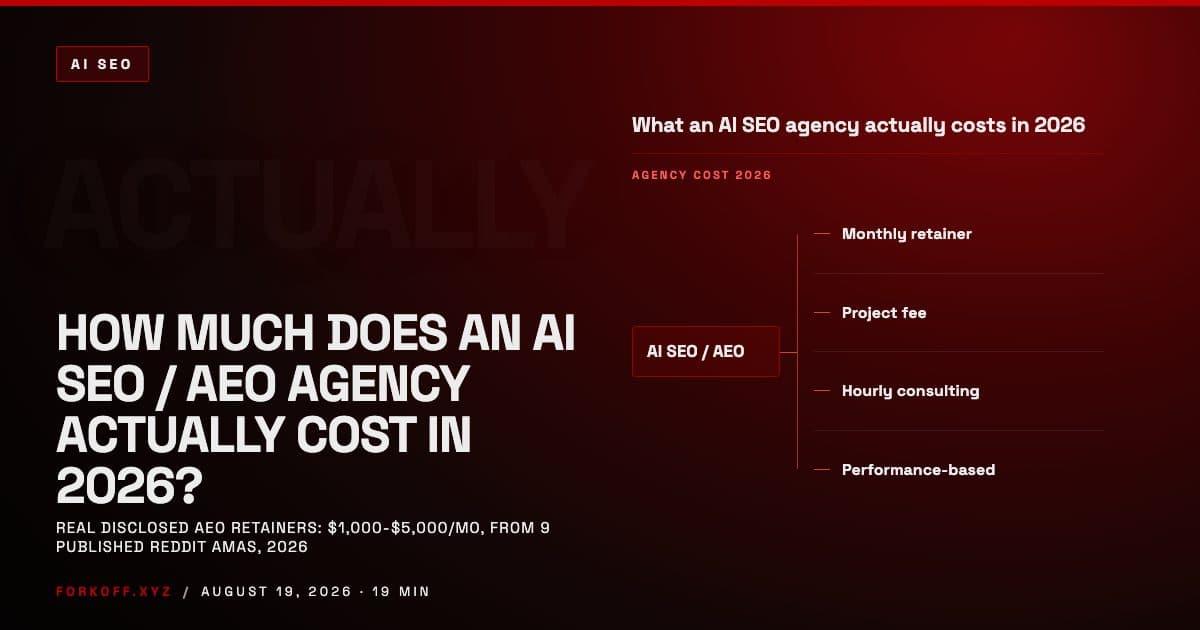
What are the four pricing models an AI SEO agency can quote you?
Before you compare a single dollar figure, know which pricing model you are actually being quoted, because the same monthly number can mean very different things depending on the structure underneath it. An agency can bill a monthly retainer, a one-time project fee, hourly consulting, or a performance-based fee tied to measured citation lift, and each one carries a different risk profile for the buyer, not just a different invoice shape.

A monthly retainer is the dominant model across every source in this research, a fixed fee billed monthly, usually against a 6 to 12 month commitment. A project or audit fee is a one-time, scoped engagement, typically an initial AEO audit or a technical setup phase, before a retainer begins. Hourly consulting is rarer at the agency level but common with independent AI SEO consultants, and it is the model most exposed to scope creep if the engagement is not tightly defined upfront. Performance-based pricing, tying fees to a measured lift in AI citation frequency or referred traffic, is the newest and least common model, because reliable third-party citation measurement is still young enough that few agencies will commit to it contractually.

Retainers dominate for a structural reason: AI SEO work is not a one-time fix. Citation presence needs continuous monitoring because model behavior shifts, sometimes within weeks, and a static optimization done once will decay. That is also exactly why most agreements run 6 to 12 months rather than 30 or 90 days.
Expect a 6 to 12 month commitment, and 3 to 6 months before results
Every real source in this research agrees on timeline even where they disagree on price. The develomark.com AMAs describe 12-month agreements as standard, and a published industry breakdown puts the typical commitment at 6 to 12 months with 3 to 6 months before real traction shows. Budget and patience have to arrive together: an AI SEO or AEO engagement judged after 60 days will look like a failure almost regardless of the agency, because citation and ranking signals genuinely take a full quarter or more to move.
Source: Stackmatix, published AI SEO agency pricing breakdown
One structural point that trips up a lot of first-time buyers: AEO and GEO, the term you will see used almost interchangeably with AEO in agency marketing, both describe the same underlying pricing decision. A live comparison of the two terms published by Go Fish Digital draws the same line this post does: GEO optimizes for citation inside AI-driven answers where SEO optimizes for a ranked link, but the buying decision and the pricing structure underneath both labels are effectively identical. If a quote you receive is labeled "GEO" rather than "AEO," treat it as the same purchasing category rather than a separate line item, and compare it against the same tier ranges in this post. The same is true of a quote labeled specifically for one model: our breakdown of ChatGPT SEO services pricing names real vendor rates for the single-engine version of this same purchase.
What actually drives your quote up or down?
Two agencies quoting the "same" service can land three times apart, and the gap almost always traces back to a short list of concrete factors rather than markup, as the real disclosed retainers earlier in this post already show. The clearest driver upward is platform coverage: an agency tracking your visibility across five AI engines simultaneously is doing meaningfully more work than one tracking ChatGPT alone. Enterprise-grade citation-monitoring tooling, a genuinely competitive niche where more sources are fighting for the same citation slots, content production bundled into the retainer rather than billed separately, and a dedicated named strategist instead of a shared account manager all push the number up.

The same factors run in reverse to bring a quote down. A single-location business needs a narrower tracked-prompt set than a multi-location chain. An account that already has strong domain authority from years of traditional SEO work needs less foundational technical work. A client willing to produce their own content, rather than paying the agency to write it, cuts a meaningful line item. And a shorter initial commitment, where the agency is willing to prove value before locking in 12 months, generally comes with a lower opening number in exchange for less certainty on their side.

Operator noteAsk for the exact prompt list before you sign. Every real agency here tracks named queries. No list means no way to measure results., FORKOFF AI SEO / AEO desk
It is worth naming the factor that does NOT reliably move price, because buyers often assume it does: the raw number of AI engines an agency claims to "cover." Several vendor pitches list five or six platforms as a headline feature, but the real cost driver is how many of those platforms the agency actually has working monitoring for, not how many appear on a slide. Ask specifically which engines the tracked-prompt dashboard covers today, not which ones are on the roadmap, before you let platform count justify a higher number.
Location count deserves its own note too, since it is one of the most common ways a quote quietly balloons. A three-location business is not simply three times the cost of a single location, because the technical foundation and much of the strategy work is shared across locations. But it is also not free to add locations, each one usually needs its own tracked-prompt set and its own local competitive benchmark, since the businesses winning AI citations in one town are rarely the same ones winning in the next. A fair multi-location quote should show you the marginal cost of each additional location explicitly, not bury it inside one flat number.
What do you get at each price tier?
The dollar figure only means something next to what it buys. Here is the deliverable breakdown across the three published tiers, cross-checked against what the real disclosed retainer dataset shows agencies actually deliver at the lower end. A second agency, Digital Elevator, publishes its own AI-visibility tier starting at 3,000 dollars, an outcome-based program rather than a monthly retainer, a second independent confirmation that the published bands in this post are not one vendor's invented framing.

What's typically included at each tier
| Deliverable | Small business | Mid-market | Enterprise |
|---|---|---|---|
| Tracked prompts | 10-15 | 30-50 | Unlimited |
| Dedicated strategist | Shared/no | Bi-weekly calls | Dedicated team |
| Competitor citation analysis | Rarely | Included | Included, ongoing |
| Content production | Basic updates | Included | Included, at scale |
| Platform coverage | 1-2 engines | Most major engines | All major engines |
A useful mental model: at the small-business tier, you are mostly paying for setup and monitoring, the audit, the tracked prompt list, and the baseline citation report. The strategic and competitive-analysis work that genuinely differentiates a strong agency from a checklist vendor mostly shows up starting at the mid-market tier, which is also where dedicated calls with a real strategist, not a shared account manager, become standard.

That budget split is illustrative rather than a universal formula, every agency allocates differently, but it reflects a pattern visible across the real disclosed retainers in this dataset: the earliest months of any engagement skew heavily toward measurement and technical setup, and the content and citation-building share of the budget grows as the baseline gets established. A quote that promises heavy content output in month one, before any baseline measurement, is worth a second look.
Freelancer, boutique agency, or full-service agency: what actually differs
Below the published agency tiers sits a fourth option almost none of the pricing guides address directly: an independent AI SEO or AEO consultant, working hourly or on a smaller flat retainer, often the cheapest real option for a single small business.

A freelance consultant typically runs 100 to 250 dollars an hour or a flat 1,000 to 3,000 dollar monthly retainer, roughly matching the low end of the real disclosed dataset above, and fits a single business that needs ongoing, hands-on work without the overhead of an agency team. A boutique AEO agency, the tier most of the real disclosed retainers in this post fall into, adds a small team, a defined process, and the kind of tracked-prompt tooling a solo consultant is less likely to have built. A full-service or enterprise agency adds dedicated account teams, custom tooling, and the capacity to run multi-location or multi-brand programs at once, which is exactly where the price climbs into the 15,000-to-50,000-dollar band.
The trade-off worth naming honestly: a freelancer is usually the cheapest real option and can move fast because there is no internal handoff between strategist and executor, but you are also depending on one person's availability, and if they get sick, take on too many clients, or move on to something else, the account stalls with no backup. A boutique agency costs more but buys redundancy, if your point of contact leaves, someone else on the team already knows the account. The honest reason most of the real disclosed retainers in this dataset sit with a small boutique agency rather than a solo freelancer or a large enterprise shop is that local service businesses are, by definition, not large enough to need enterprise-scale tooling, but they are recurring, predictable revenue that benefits from a team that will still be there next quarter. The same size-vs-structure trade-off shows up in our influencer marketing pricing tiers and podcast agency vs. DIY guesting cost breakdowns, if you're weighing the same freelancer-vs-agency question on a different channel.
There is a fourth, unbundled option worth a brief mention even though none of the sources in this research priced it directly: buying AI-visibility monitoring software yourself and running the strategy in-house. Tools in this category, like SEO.AI, typically run in the low hundreds of dollars a month for the software alone, dramatically cheaper than any agency tier, but they hand you the dashboard, not the strategist. That fits a technically capable in-house team willing to do the interpretation and content work themselves; it does not fit a team with no spare capacity, which is most of the small businesses this post's real dataset represents. Our own reddit ads cost breakdown covers a comparable build-vs-buy decision on the paid-acquisition side, if that's the channel you're actually weighing this against. For the fuller version of this exact tradeoff, priced out stage by stage, see AI SEO agency vs AI SEO software.
AI SEO Agency Pricing: Complete Cost Guide for 2026
Stackmatix
A published, tier-by-tier breakdown of AI SEO agency pricing for 2026, the source for this post's small-business through enterprise price bands.

The buyer behavior that justifies the spend is already measured
A B2B marketing agency's own published figure puts LLM usage during vendor research at 94 percent of B2B buyers, a number worth treating as a directional industry claim rather than an audited statistic, but it matches what every agency pricing breakdown in this research says about why the spend is rising: a growing share of the research phase of a buying decision now happens inside a chat interface, not a search results page, and most agencies still measure their own performance by blue-link rank instead of AI citation presence.
Source: Aspiration Marketing (X/Twitter)
Is an AI SEO agency actually worth the cost?
This is the question underneath every price comparison, and the honest answer splits along the same line the Reddit discussion in this research splits on: it depends entirely on whether the agency is doing real off-page citation work or reselling a checklist.
90% of what the GEO/AEO influencers push is just garbage and a waste of time.
That reaction, 153 upvotes and 173 comments on a single Reddit post, is not an outlier opinion, it reflects a genuine, growing skepticism toward AEO/GEO marketing that has outrun the substance behind some of it. At the same time, the real disclosed retainer dataset in this post is evidence the category is not vaporware either, real agencies are closing real deals with real local businesses and showing measurable citation movement. The honest reconciliation: the tactics are real, the market for selling those tactics has attracted its share of opportunists, and the burden is on the buyer to tell the two apart before signing.
Tim Haldorsson
@TimHaldorsson
I would not like to be running a Reddit AI SEO agency right now seems like ChatGPT learned that it was all gamified with the Reddit posts.
Ray Jang
@rayjbjang
Our reddit AEO agency said this would never happen I said it would be inevitable and cut the contract short last year And here we are…
There is also a prior question worth asking before you evaluate any agency at all: is AI SEO or AEO actually the constraint holding your business back, or is it a purchase that feels productive while the real bottleneck sits somewhere else entirely. A business with no distribution, no existing traffic, and no proof its offer converts is not going to fix that with a citation strategy, no matter how well-run the agency is. Our own share-of-AI-citations measurement guide and citation decay research are both useful sanity checks before you spend a retainer on a channel you have not confirmed is actually visible to your buyers.
Five red flags that mean you're overpaying, or buying AEO theater
Five specific signals separate a real AI SEO or AEO engagement from a repackaged checklist sold at a premium. Two come up in every published source in this research: a guaranteed AI citation, which nobody can honestly promise, and pricing well below the market bands already covered in this post. A published AEO buyer's guide from Aspiration Marketing names a sixth, closely related pattern worth watching for: "the unstructured retainer," an agency that suggests open-ended monthly hours with no clear deliverables attached. Three more come directly from our own review process running through this same research: no named tracked-prompt list, a generic pitch with no engine-level specifics, and no stated reporting cadence. Any one of the five is worth a direct question before you sign; two or more together is worth walking away from.

The clearest, most-repeated red flag across every published source in this research: any agency that guarantees you'll show up in ChatGPT or another AI answer. Nobody can guarantee that, the models are not controlled by any marketing agency, and a guarantee is either a misunderstanding of how the technology works or a deliberate oversell. The second: pricing well below the market bands in this post for comparable scope, a signal either of an inexperienced team learning on your account or corners being cut on the monitoring tooling that makes the work measurable in the first place. The third, fourth, and fifth come from our own review process running through this research: no named, tracked prompt list means no way to measure results later; a generic "AI-powered strategy" pitch with no specifics is close to always a repackaged SEO checklist; and no stated reporting cadence means you will not know whether the retainer is working until the contract is nearly up.
Operator noteA good AEO partner shows you competitor citation-gap data before they pitch, not after you sign. A proposal before a diagnosis is the tell., FORKOFF AI SEO / AEO desk
Operator noteJudge cost per qualified citation, not cost per keyword. A cheap retainer that never gets you cited is not cheap, it is zero return., FORKOFF paid + organic field notes, 2026
How to evaluate a quote before you sign
Evaluating an AI SEO or AEO quote comes down to five concrete checks you can run before you pay anything: the exact tracked-prompt list, evidence of real competitor citation-gap analysis, a sample of the actual ongoing reporting, a price comparison against the real disclosed data in this post, and a negotiated 90-day review checkpoint inside whatever contract length the agency proposes. None of these five requires the agency to reveal anything proprietary; they only require the agency to be specific instead of vague.

Run every quote you receive through the same five-step check. First, request the exact list of prompts or queries the agency will track, by name, not a vague "dozens of queries" claim. Second, ask for evidence of competitor citation-gap analysis specific to your market, a strong agency will already have looked. Third, request a sample of what the ongoing reporting actually looks like, not a sales deck mockup. Fourth, compare the number against the real disclosed retainers and published tiers in this post for your rough business size. Fifth, negotiate a 90-day review checkpoint inside any 12-month agreement, standard contract length in this market, but a checkpoint before month four is not, and you should ask for one explicitly.
Push for specifics at every one of those five steps, because vague answers are the single most reliable predictor of a disappointing engagement in every account of a bad AI SEO purchase we read while researching this post. "We use AI-powered strategies" is not an answer to "which engines do you track." "We'll do competitive research" is not an answer to "which three competitors are you benchmarking against, by name." A strategist who has genuinely done the homework can answer both questions in the first call, before you have paid anything, because the discovery-level research is usually cheap enough for a serious agency to do it on spec to win the account.

Operator noteDo not sign a 12-month agreement without a 90-day review checkpoint. 12-month terms are standard; a checkpoint before month 4 is not., FORKOFF paid + organic field notes, 2026
Operator noteConfirm whether content production is included or billed separately. No content line usually means you supply the writing yourself., FORKOFF AI SEO / AEO desk
AEO Agency Pricing: Transparent Answer Engine Optimization Costs 2026
Stackmatix
A separate published breakdown of AEO agency pricing specifically, confirming the tier structure from a second independent source.
What does an enterprise AI SEO / AEO retainer actually look like?
At the top of the market, published pricing is almost useless as a guide because almost nobody quotes a number without a discovery call first. "Good luck finding that information because most agencies hide it behind contact forms," one published breakdown states plainly. The 15,000-to-50,000-dollar range in this post is the closest real public anchor available, covering unlimited query tracking across every major AI engine and a fully dedicated team, but the real number for your specific program will come out of a scoped conversation, not a rate card.
The scoping conversation itself is where an enterprise engagement earns or forfeits its price tag. At this scale, the honest differentiator between agencies is not the tooling, most mid-market and enterprise shops now license comparable AI-visibility monitoring platforms, it is whether the strategist running your account genuinely understands your competitive set well enough to prioritize which citation slots actually move revenue, versus chasing every possible query indiscriminately because the retainer is large enough to justify the busywork. A useful enterprise-specific question to ask in that first call: which three competitors, by name, are currently winning the citation slots that matter most to your buyers, and what is the specific plan to take one of those slots in the next quarter. An agency that answers with specifics has done real homework before the call; an agency that answers in generalities is pricing on scale, not on strategy.
Enterprise and mid-market pricing is opaque by design
"Good luck finding that information because most agencies hide it behind contact forms." That line, from a published AEO pricing breakdown, is the honest state of the market above the small-business tier. Once a program moves past a single local account into multi-location or SaaS-scale work, published pricing disappears and every agency routes you into a discovery call before naming a number. That is not automatically a red flag, complex programs genuinely need scoping, but it does mean the only real anchor you have for a mid-market or enterprise quote is the published tier ranges below, not a specific competitor's rate card.
Source: Stackmatix, published AEO agency pricing breakdown
Operator notePay for citation slots, not busywork. A quote with no named tracked prompts and no named AI engines is buying activity, not outcomes., FORKOFF AI SEO / AEO desk
One more enterprise-specific nuance worth naming: at this tier, the line between "agency" and "internal hire" starts to blur, because a 30,000-to-50,000-dollar monthly retainer approaches the fully-loaded cost of one or two senior in-house hires. That is not an argument against the agency model, an outside team brings tooling, cross-account pattern recognition, and redundancy a single in-house hire cannot, but it is a real trade-off worth naming to your own finance team before you sign, rather than discovering it a year in when someone asks why the retainer costs as much as a headcount line. A vertical AI agency pricing case study set we ran on a different service line shows the same enterprise-vs-hire math playing out beyond just AI SEO.
The verdict: what to actually expect to pay in 2026
Put every source in this research side by side and the answer holds up: a local small business should expect 1,000 to 5,000 dollars a month, a mid-market or multi-location business should expect 5,000 to 15,000, and an enterprise program runs 15,000 to 50,000 dollars a month or more, priced through a scoped call rather than a rate card. Budget for a 6-to-12-month commitment and 3 to 6 months before real movement shows, and treat any guaranteed citation as a reason to walk away, not a reason to sign.

Real, disclosed 2026 pricing tells a consistent story once you put it next to the published tiers. A single small local business should expect somewhere between 1,000 and 5,000 dollars a month, with the low end genuinely achievable, real agencies are closing deals there right now, not a theoretical floor. A mid-market or multi-location business should expect 5,000 to 15,000 monthly for a program with real competitive and citation-gap analysis behind it. An enterprise program runs 15,000 to 50,000 dollars a month or more, priced through a scoped call rather than a published rate. Whatever tier you land in, budget for a 6-to-12-month commitment and 3 to 6 months before you see real movement, and never sign against a guarantee that you will show up in a specific AI answer.
If you take one number from this post, make it this: the gap between what a documented real agency actually charges a small local business, as little as 1,000 dollars a month, and what the published "starter" tier claims, 2,500 dollars, is itself useful negotiating leverage. Bring real numbers into the conversation, ask for the tracked-prompt list before you ask for the invoice, and judge the retainer on citations you can actually see, not a promise.
That negotiating leverage only holds if you use it honestly, not as a bargaining trick to grind down a fair quote to an unsustainable one. An agency pricing genuinely below what real work costs to deliver will cut corners somewhere, usually in the depth of the citation-gap analysis or the frequency of reporting, and a business that wins that negotiation often loses the engagement. The goal of bringing real numbers into the conversation is not to pay the least possible amount, it is to know whether the number in front of you reflects real market pricing for the scope you are buying, or an inflated number counting on you having no reference point. This post exists so you have that reference point before the call, not during it. If Perplexity specifically is where your buyers are showing up, our Perplexity vs. Google AI Overviews comparison is a useful next read before you scope that part of the retainer.
When you're ready to price an AI SEO or AEO program against real data instead of a cold quote, talk to us, or read how we think about answer-engine strategy more broadly alongside the Perplexity-specific work this same category increasingly overlaps with.
Aspiration Marketing
@gogrowbetter
94% of B2B buyers use LLMs during vendor research, yet most agencies still measure SEO by blue-link rankings 📉 Here are 9 critical questions SaaS leaders must ask before hiring an AEO agency. #AEO #SaaS #B2BMarketing #AI