An AEO or GEO agency earns its keep the moment an AI Overview already fires on your buying-decision keywords and your brand is not one of the sources it cites. Your existing SEO agency can usually absorb the work when your buyers still start on Google, when nobody on the team has yet checked whether an AI answer mentions you, and when the agency already runs a real off-site earning program on top of its backlink work. Most companies land somewhere in between, running a hybrid engagement rather than swapping vendors outright. Once you have decided a dedicated agency is the right call, the nine real AEO agencies scored for AI and SaaS fit is the agency-by-agency comparison to work from next.
This question is landing on more marketing teams' desks now than it did even a year ago, and for a specific reason. AI-generated answers stopped being a novelty tucked at the top of a search results page and became, for a growing share of buyer-intent queries, the entire interaction. Google itself now describes AI Overviews and AI Mode as query fan-out systems that issue multiple related searches and surface a wider set of links than a classic results page, and Generative Engine Optimization has emerged as the umbrella term for the discipline of getting cited inside those answers. A buyer who asks ChatGPT or Google's AI Overview to compare vendors gets a synthesized answer with named sources, and if that answer never surfaces your brand, the buyer may never click through to a traditional search result at all. That shift is why "who do we hire" has replaced "do we need to think about this" as the live question inside most marketing organizations evaluating their search strategy right now.
The 30-second answer
You need a dedicated AEO/GEO agency, not just your existing SEO agency, when three things are true at once: AI Overviews already fire on your money keywords and you are not in the citation set, your SEO agency's reporting has no line for AI Overview appearances or off-site presence, and buyers in your category are already asking ChatGPT or Perplexity to compare vendors before they visit anyone's website. If none of those are true yet, your SEO agency can likely absorb the work. Local AEO retainers run $8,000 to $15,000 a month, mid-market $7,500 to $20,000, and enterprise $25,000 and up, per the [real published retainer breakdown below](https://www.reddit.com/r/aeo/comments/1u2y60g/i_do_aeo_for_local_businesses_12500_average/). Most companies land on a hybrid engagement, not a full agency swap.
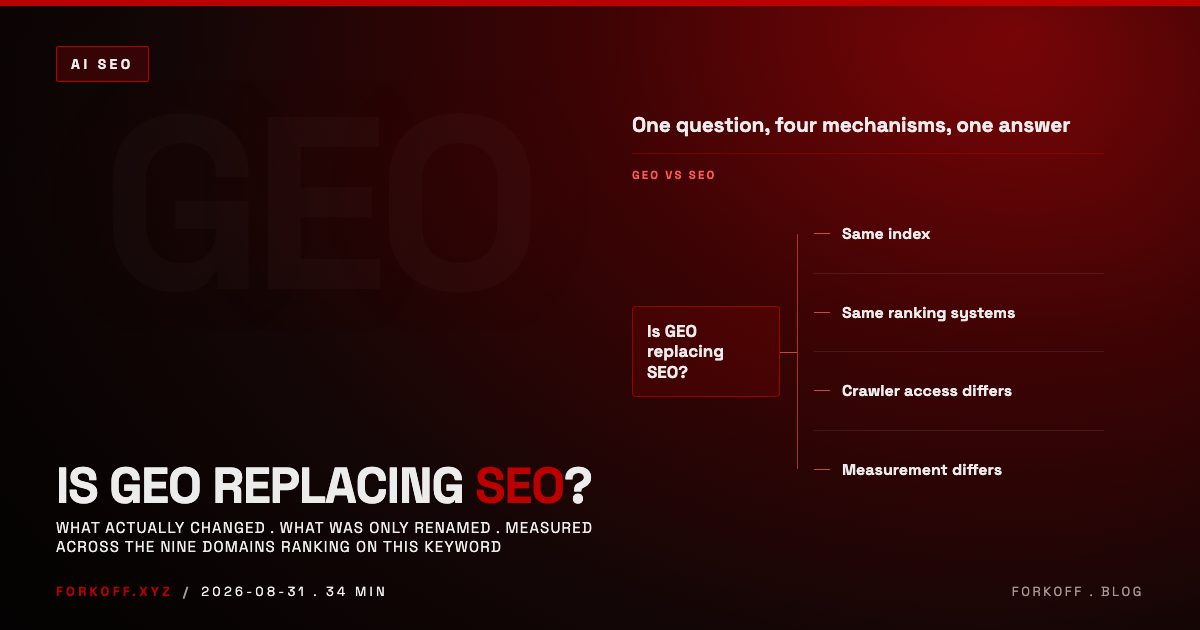
What actually separates SEO from AEO/GEO?
The honest technical answer, laid out by a 12-year SEO practitioner in a Reddit thread that has become the clearest public explanation of the split, is that the two disciplines run on different retrieval mechanisms entirely. Traditional search uses an inverted index, it scans for keyword strings and ranks pages by matching against a query, weighted by meaning, relevance, quality, and links, the same five signals Google's own ranking documentation describes. AI answer engines use vector search, they turn a page into an embedding that represents its meaning, then calculate the mathematical distance between that embedding and a user's actual intent.
SEO retrieves, AEO gets you synthesized into the answer
The clearest technical framing for this decision comes from a Reddit thread that split the discipline in half correctly. Traditional SEO runs on an inverted index, it scans for keyword strings and ranks pages by matching them against a query. Generative engines run on vector search, they turn a page into an embedding that represents its meaning and compare that against the mathematical distance to the user's intent. A page can rank #1 on keywords and still lose the citation to a denser, more answer-shaped competitor sitting on page two, because the retrieval mechanism genuinely changed underneath the ranking one. This is not a rebrand of SEO. It is a second, parallel retrieval system with its own rules.
Source: u/ecomdevpros, r/GEO_optimization comment
That difference is not academic. Ahrefs' study of 863,000 keywords and 4 million cited URLs explains the single most useful number in this whole decision: 62 percent of Google AI Overview citations now come from pages that never crack the top 10 organic results. That Ahrefs figure is up from 24 percent when the same research team measured it in July 2025. If AI Overviews were simply remixing Google's page one, that share would sit near zero. Instead, generative engines increasingly dig past the "SEO winners" to find a source that is structured better, even if it ranks worse, and the trend is moving fast in that direction.

Ranking
The single most useful number in this entire decision is 62 percent. That is the share of Google AI Overview citations that now come from pages outside the top 10 organic results, per Ahrefs' billion-datapoint AI Overview study of 863,000 keywords and 4 million cited URLs, up sharply from the 24 percent measured in the same study's July 2025 pass. Top-10 pages now account for only 38 percent of citations, down from 76 percent. If AI Overviews were simply remixing page one, that share would sit near 100 percent. Instead, generative engines increasingly retrieve by vector similarity, not keyword match, and reward content structured to be lifted whole rather than paraphrased. A team optimizing purely for rank position is optimizing for the wrong half of the outcome.
Source: Ahrefs, "Google AI Overview Citations" study, 2026
Search Engine Journal's independent read of the same Ahrefs dataset reaches the same conclusion from a different angle: ranking in Google's top 10 is a measurably weaker predictor of AI Overview citation than it was a year ago. Per that Search Engine Journal piece, YouTube alone now accounts for 18.2 percent of citations pulled from sources ranking outside the top 100. That gap is exactly why "just ask the SEO agency to rank higher" stops being a complete answer once AI Overviews enter the picture. Ranking earns discovery. It does not guarantee synthesis into the answer a buyer actually reads.
The two disciplines also disagree on what "winning" looks like operationally. A classic SEO scorecard tracks rank position, organic sessions, and backlink count, numbers that map cleanly onto a monthly report a CMO already knows how to read. An AEO/GEO scorecard tracks citation rate across three or four different AI surfaces, each with its own retrieval quirks, plus an off-site presence metric that most marketing teams have never formally measured before. That mismatch in reporting language is itself a signal worth sitting with: if your current agency cannot show you a citation-rate number today, it is not because the number does not exist, it is because nobody on that account has been asked to track it yet.
Classic SEO agency vs. a dedicated AEO/GEO agency, by signal
| Signal | Classic SEO agency | AEO/GEO agency |
|---|---|---|
| Primary target | Google's top 10 organic results | The AI Overview and LLM citation set |
| Core retrieval mechanism | Inverted index, keyword match | Vector similarity, answer-shape match |
| Off-site work | Backlinks, mostly pointing at your own domain | Reddit, LinkedIn, and third-party citation building |
| Reporting metric | Rank position, organic traffic | Citation rate, AI Overview appearances |
A capable SEO agency can absorb some of the right column. Ask which parts, specifically, before assuming either way.

12 Years in SEO: Why AEO isn't just "marketing fluff" (A technical breakdown of Vectors vs. Indexes)
What are the 4 signals you need a dedicated AEO/GEO layer now?
You need a dedicated AEO/GEO layer now when four signals show up together: an AI Overview already fires on your money keywords without you in the citation set, buyers compare vendors inside ChatGPT before visiting your site, your SEO agency tracks no answer engine optimization metric, and "add AEO" only produced a relabeled SEO deliverable. The decision comes down to whether your current setup already handles the vector-retrieval half of search, or only the keyword half.

First, AI Overviews already fire on your money keywords and you are not in the citation set. This is checkable in an afternoon, not a hypothetical. Second, buyers in your category are already asking ChatGPT or Perplexity to compare vendors before they ever visit a website, which means the research phase of your funnel has partly moved off your own domain and off Google's blue links entirely. Third, your SEO agency's monthly report has no line item for AI Overview appearances, LLM citations, or off-site presence on Reddit and LinkedIn, which usually means nobody is tracking it, not that it does not matter. Fourth, and this one is the clearest tell, you already asked your SEO agency to "add AEO" and got back a relabeled version of the same deliverable rather than a genuinely different process.
None of these four signals need to hit at full strength simultaneously to justify acting. In practice, the companies that move fastest on this decision are the ones that treat the first signal, an AI Overview already firing with zero brand presence, as sufficient on its own, because it is the one signal directly measurable in the amount of time it takes to run five probe queries. The other three signals are useful for scoping what kind of engagement to run once the decision is already made, a full dedicated agency, a hybrid extension of the existing relationship, or an in-house build, rather than for deciding whether to act at all.

Operator note480 searches/mo on 'geo agency', KD 0, DataForSEO, dfs_metric.py, 2026-08-19
On that last point, "geo agency" itself pulls 480 searches a month at essentially zero keyword difficulty, which tells you two things at once, real demand exists for exactly this buying question, and almost nobody is competing hard for the answer yet.

Operator noteAI Overview fires 5 of 5 trials, 11 median citations, aio_probe.py, 2026-08-19
Running the actual probe against your own terms is the cheapest way to settle signal one. An AI Overview fires on this exact query, "geo agency vs seo agency," on 5 of 5 usable trials, citing a median of 11 sources each time it does. That is 11 open citation slots on a query with real, low-competition demand, currently held entirely by other agencies.
Signal two, the "buyers research on ChatGPT before Google" shift, is easy to dismiss as anecdotal until you check your own funnel. Pull the last quarter of inbound demo requests and ask a simple question on the first call: did they compare us against anyone else before reaching out, and if so, where did that comparison happen. A surprising number of B2B buyers now run that comparison inside an AI chat window, get a synthesized answer with two or three named vendors, and only visit the winner's website to book time. If your brand has never shown up in that synthesized answer, you are not losing the deal at the demo stage, you already lost it a step earlier and never saw the loss recorded anywhere.
When can your existing SEO agency still handle it?
Your existing SEO agency can usually absorb the AEO/GEO work when your buyers still start on Google rather than an AI assistant, nobody on your team has checked whether an AI answer mentions you yet, and the agency already runs a real off-site earning program touching Reddit, review sites, and YouTube. Not every company needs a new vendor relationship, and treating this as a foregone conclusion wastes budget on a second agency doing work the first one could already absorb.

If your buyers still start on Google rather than an AI assistant, and your traffic mix backs that up, the urgency is lower. If nobody on your team has yet asked whether an AI answer mentions you for a real buying question, that is a research gap, not evidence the SEO agency has failed at something. And if your SEO agency already runs an off-site earning program touching Reddit, review sites, and YouTube as part of how it builds links, not just as an afterthought, it likely has more of the AEO/GEO muscle already than a from-scratch specialist would need to build.
There is a fourth quieter signal worth naming too, category maturity. A handful of verticals, consumer electronics, personal finance, and select SaaS categories, have had AI Overviews firing heavily on their commercial queries for well over a year, which means the citation slots in those categories are already largely claimed. A newer or more niche category, the way "geo agency" itself sits at 480 monthly searches with zero keyword difficulty, still has open citation slots precisely because AI Overviews only recently started firing consistently on it. If your category is closer to the newer end, the cost of waiting six more months is genuinely higher than in a mature category where the citation landscape has already settled into a stable set of incumbents.
The key metric, value from AI mentions, seems unmeasurable, making it difficult for some to justify the investment.
The honest weakness is that value is genuinely hard to measure
Every vendor pitching AEO or GEO right now will tell you it works. Fewer will tell you the real problem, which is that isolating the revenue attributable to an AI citation is still immature compared to click-through and conversion tracking on classic search. Even practitioners who believe in the discipline concede this directly in public. That does not mean the work is worthless, it means you should treat any agency's ROI claim with the same scrutiny you would apply to an early-stage attribution model, and ask for the specific input that produced a specific citation rather than accepting a methodology deck as proof.
Source: u/jeremy213530 and u/Ok_Veterinarian446, r/GEO_optimization
That contrarian caution deserves airtime here, because it cuts both ways. If measuring AI-citation value is genuinely hard, that argues for testing your current agency's ability to absorb the work before paying twice for two teams to solve the same measurement problem separately.
There is a practical middle step most companies skip, which is asking the incumbent agency directly, in writing, whether it is willing to take on citation tracking and off-site presence as a named, budgeted workstream with its own success criteria, rather than a vague addendum to the existing scope of work. Agencies that are genuinely capable of the work usually say yes immediately and can point to a plan within a week. Agencies that are not capable tend to stall, ask for a larger retainer without specifying new deliverables, or quietly keep doing the same SEO work under a renamed line item. That single conversation, held before any new vendor search starts, resolves the build-versus-buy question for a large share of companies without spending anything extra.
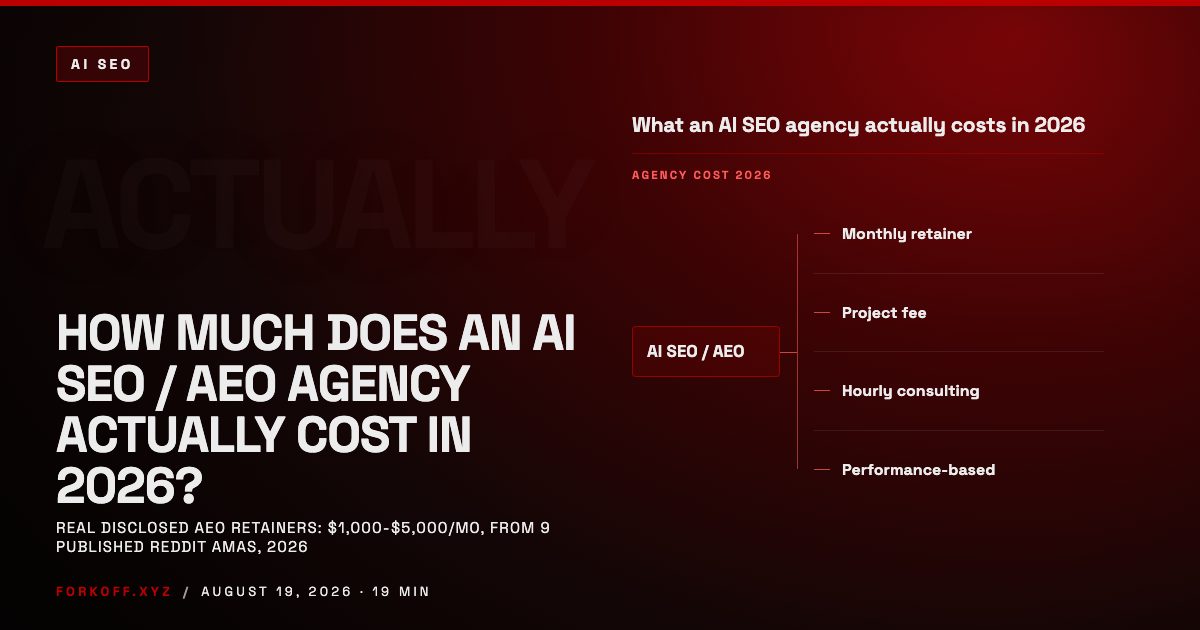
What does a real AEO/GEO agency retainer actually cost?
A real AEO/GEO retainer, per the published retainer breakdown below, runs $8,000 to $15,000 a month for local and SMB accounts and $7,500 to $20,000 for mid-market SaaS and B2B. That same retainer breakdown puts enterprise, multi-brand engagements at $25,000 and up, scoped around competitive analysis, AI-visibility tracking, and a named monitoring set rather than a flat line item. Real numbers help more than ranges pulled from a sales page. An operator who runs AEO for local service businesses, plumbers, painters, contractors, clinics, states an average retainer of $12,500 a month across the accounts he manages, competitive analysis first, then AI-visibility tracking, then a minimum 50-prompt monitoring set built from real Google Search Console query language rather than guessed keywords.
I do AEO for local businesses ($12,500 average retainer) — getting them cited in AI answers — AMA
Operator note$12,500 average local AEO retainer, real published AMA, r/aeo, u/Ruan-m-marinho
That figure sits inside the local and SMB range shown below. Mid-market and enterprise scopes follow the same shape agencies use for comparable specialist work, technical foundation, content restructuring, off-site building, and measurement, priced up with team size and account complexity.
AEO/GEO agency retainers by company size
| Company size | Typical monthly retainer | What is usually included |
|---|---|---|
| Local / SMB | $8,000 to $15,000/mo | Local citation tracking, Google Business Profile, review-signal work |
| Mid-market SaaS / B2B | $7,500 to $20,000/mo | AI Overview tracking, off-site program, schema, content restructure |
| Enterprise, multi-brand | $25,000 and up/mo | Multi-brand LLM monitoring, dedicated team, custom measurement |
A real published local-business example, average retainer $12,500/mo, sits inside the local/SMB range; mid-market and enterprise figures reflect typical agency pricing structures for this scope of work.

A hybrid engagement, the one most companies actually run, splits that spend across four real workstreams rather than one flat retainer line.

Per the AEO agency cost breakdown above, a typical hybrid split runs 20 percent on technical and schema foundation and 35 percent on restructuring content so it answers a question in the first 40 to 80 words instead of building to it over three paragraphs. That same AEO agency cost allocation model puts 30 percent into off-site work on Reddit, LinkedIn, and third-party publications, and the remaining 15 percent into measurement and citation tracking that did not exist as a reporting category before this decision came up.
A hybrid engagement is the median outcome, not a full swap
Most companies that work through this decision correctly do not fire their SEO agency and hire a replacement. They either add a dedicated AEO/GEO specialist alongside the existing SEO relationship, or they confirm the SEO agency already runs a real off-site earning program and extend its scope. A full swap only makes sense when the SEO agency has no answer for AI Overview tracking, no off-site plan, and no interest in building either, at which point the relationship was already underperforming on classic SEO's own current terms, not just the new AI-search ones.
Source: FORKOFF engagement pattern, synthesized from the sourced research above
Price variance inside each tier usually tracks two things more than headcount alone, how many distinct AI surfaces are being tracked, and how contested the category's off-site conversation already is. A niche B2B category with almost no Reddit or LinkedIn presence to compete against is cheaper to build citation share in than a crowded consumer category where a dozen brands are already fighting for the same threads. Ask any agency quoting a retainer to name the surfaces included in that price, ChatGPT, Perplexity, Google AI Overviews, and Claude do not all behave the same way, and a quote that treats them as one undifferentiated line item is usually a quote that has not actually built the tracking yet.
Contract structure matters as much as the headline number. A retainer billed purely on hours or deliverables produced tells you nothing about whether citations actually moved, so the strongest engagements this post's research surfaces tie at least part of the fee to a measurable outcome, an agreed citation-rate target on a named keyword set, reviewed on a fixed cadence, rather than a flat monthly line with no attached metric. That structure also protects the agency, a real off-site program takes measurable time to compound, and a fair contract should reflect that the first month's spend buys diagnostic and setup work, not a guaranteed citation on day one.
Why off-site work carries more weight than most buyers expect
Off-site work carries more weight than most buyers expect because generative engines pull most of their citations from third-party community platforms, not from a brand's own website. Reddit and LinkedIn are the two most-cited domains in AI answers on their respective platforms, and evaluating an answer engine optimization vendor only on whether it will touch your site misses the larger half of the actual work.
Where LLM citations actually come from
| Source | Share of AI-answer citations | Notes |
|---|---|---|
| ~60% of ChatGPT answers | Highest single citation source measured on that platform | |
| ~15% of Google AI Mode answers | Second most-cited domain on that platform, ahead of Wikipedia | |
| A typical company's own website | Outside the top 20 | Your own site alone does not crack the top 20 most-cited domains |
Semrush's 13-week, 230,000-prompt, 100M-citation AI visibility study, per-platform figures.

Semrush's 13-week, 230,000-prompt AI visibility study found Reddit cited in close to 60 percent of ChatGPT's prompt responses before a mid-September pullback, and LinkedIn cited in nearly 15 percent of Google AI Mode's responses, the second most-cited domain on that platform behind Reddit. A company's own website, including Semrush's, does not crack the top 20 sources on either platform.
Operator noteReddit and LinkedIn: 22.32% of LLM citations combined, Semrush 2026, via r/b2bmarketing
Off-site presence is now the single biggest lever
A live B2B marketing thread lays out the case plainly, generative engines do not primarily summarize your own website, they pull from places where real peer conversation already lives. Reddit and LinkedIn are the two most-cited domains in AI answers, ahead of Wikipedia, YouTube, and Medium, and a company's own site does not appear in the top 20 sources cited. If your evaluation of an AEO/GEO agency stops at "will they touch our website," you are evaluating the smaller half of the job. The larger half is whether they can build a real, disclosed presence in the community threads and professional posts your buyers already read before they ever type your domain into a browser.
Source: u/Over-Ad3858, r/b2bmarketing, "GEO isn't a future problem for B2B"
That is the single biggest scoping mistake in this whole decision. An evaluation that only checks whether an agency will touch your website is evaluating the smaller half of the job. The larger half is whether the agency can build a real, disclosed presence in the exact community threads and professional posts your buyers already read before they type your domain into anything.
GEO isn't a future problem for B2B, it's a today problem
The traffic consequence of getting cited, versus merely ranking, is not subtle either.
AI Overview presence moves traffic more than rank alone
| Page state | Traffic vs. pre-AI-Overview baseline | Source |
|---|---|---|
| Cited inside an AI Overview | +22% | Obility client research, cited via r/b2bmarketing |
| Ranking positions 1 to 5, but not cited in an AI Overview | -26% | Same source |
Being cited beats ranking first when the query fires an AI Overview at all.

Per the Obility client research cited in that thread, pages that appeared inside an AI Overview averaged 22 percent more organic traffic than their own pre-AI-Overview baseline. The same Obility research found pages ranking positions one through five that did NOT appear in an AI Overview saw 26 percent less traffic than before AI Overviews existed at all. That is a 48-point swing driven entirely by citation status, not rank position, and it tracks with Semrush's own click-through research, which found users click a traditional organic result only 8 percent of the time when an AI Overview appears, versus 15 percent when it does not.
Being in the AI answer is now better than ranking first in traditional search for most queries. Not being cited while a competitor is costs you traffic even when you are ranking well organically.
That 48-point swing is also why "we'll get to off-site eventually" is a more expensive decision than it sounds. Every month a competitor's Reddit or LinkedIn presence compounds while yours stays at zero is a month those citation slots are getting harder, not easier, to win, because the model has more history to draw on for the brand that already showed up. Off-site presence-building behaves less like a paid-media budget line you can switch on overnight and more like organic content history, the earlier you start, the cheaper each additional citation gets.
The research behind the "GEO" framing
The "GEO" in AEO/GEO traces to a real, peer-reviewed academic paper, Generative Engine Optimization, published by researchers from Princeton, Georgia Tech, and the Allen Institute for AI and accepted to KDD 2024. It tested specific content changes against how often an LLM cited the modified passage. That same Generative Engine Optimization paper measured up to a 40 percent visibility lift with zero change to traditional SEO rank.

The practitioner thread that surfaces most of this post's technical framing links directly to that paper, and its content-level findings are specific enough to act on. Quotation injection, adding direct quotes from named experts, studies, or officials, measurably raised citation odds, because it signals to the model that the passage is grounded, synthesis-ready source material rather than unsupported assertion. Adding dense statistics and specific figures did the same for reasoning-heavy answers. And persuasive marketing language actively hurt, models filter out subjective adjectives to conserve space in a limited context window.
SEO does not equal AEO because inverted indexes do not equal vector retrieval. Ranking helps discovery. It does not guarantee synthesis. If AI Overviews were just page-one remixers, the 40 percent citation gap would be near zero. Instead LLMs are pulling from clearer, denser, more answer-shaped content, even when it ranks worse.
That last point is worth sitting with before hiring anyone. An agency selling "SEO that also helps AI search" is describing one lever. An agency that understands quotation density, answer-shape, and off-site citation building as three separate, testable inputs is describing the actual discipline the research supports. And before any of that, run the cheaper test first: AI SEO agency vs AI SEO software walks through why a tracking tool, not a retainer, is usually the right first purchase.
None of this makes traditional SEO obsolete, and any pitch that frames it that way is worth being suspicious of. The paper's own tested modifications, quotation injection, statistics addition, answer-shape restructuring, are content-layer changes that sit on top of a page that still needs to be crawlable, indexed, and technically sound in the first place. A page with broken internal links, no schema, and slow load times will not get cited no matter how many expert quotes it adds, because most AI crawlers still depend on the same technical health signals classic SEO has always required. The honest framing is additive, not a replacement, AEO/GEO wins the second half of a race that SEO has to win the first half of, and the line between what genuinely changed and what was only renamed is the thing to hold a prospective vendor to.
In-house, agency, or hybrid: which is right for you?
In-house is the cheapest path on paper and usually the slowest in practice, a dedicated agency is the fastest with the widest off-site reach at the highest direct cost, and a hybrid engagement, an existing SEO relationship extended with a genuine AEO/GEO scope, lands in the middle on both, provided the SEO agency's off-site team is real rather than aspirational.

Building this in-house is the cheapest option on paper and usually the slowest in practice, because it competes with an existing roadmap and starts with zero Reddit or LinkedIn presence to build from. A dedicated agency moves fastest and reaches the widest off-site footprint, at the highest direct line-item cost. A hybrid engagement, an existing SEO relationship extended with a genuine AEO/GEO scope, lands in the middle on cost and speed, but only when the SEO agency's off-site team is real rather than aspirational, which is exactly what the vetting questions below are built to surface.
The in-house option deserves one more honest caveat: it is a realistic path only for a company that already has, or is willing to build, a genuine content and community-engagement function separate from the SEO team. Off-site presence work is not a checklist item an SEO specialist can absorb on top of an already-full rank-tracking and technical-audit workload. It requires someone comfortable participating in Reddit threads and LinkedIn discussions as a disclosed representative of the brand, on an ongoing basis, not a one-time content drop. Companies that try to run this in-house without dedicating real headcount to it tend to end up with a stalled AEO initiative six months in, not because the strategy was wrong, but because nobody actually owned the weekly work of showing up in the right conversations.
What a hybrid engagement's first 90 days actually looks like
A well-run hybrid engagement's first 90 days follow a consistent shape: weeks one through three are diagnostic only, running the AI Overview probe and mapping which competitors hold citation slots, weeks four through eight restructure content and start named off-site work on Reddit, LinkedIn, and third-party publications, and week twelve should show a documented citation-rate change on the prioritized keywords.
Operator note40% of AI citations sit outside the top 10 organic results, Authoritas/Ahrefs, via r/GEO_optimization
A scoped hybrid engagement that starts correctly follows a fairly consistent shape across the operators and agencies whose public work informs this post. The first two to three weeks are almost entirely diagnostic, running the AI Overview probe across a real keyword set rather than a handful of samples, mapping which competitors already hold citation slots on your highest-intent terms, and auditing the last quarter of published content for whether it leads with a direct answer or builds to one. Nothing gets published in this window. The output is a prioritized list, ranked by how contested each citation slot already is and how much revenue sits behind the underlying keyword.
Weeks four through eight are where the actual work starts, and where the difference between a real AEO/GEO program and a relabeled SEO retainer becomes visible fastest. Content restructuring begins on the highest-priority pages identified in the diagnostic, moving the direct answer into the first 40 to 80 words and pushing supporting nuance below it, the exact pattern the GEO research paper measured a lift from. In parallel, off-site work begins on a small number of specific, named threads and communities, not a generic "we'll be active on Reddit" commitment. A credible agency should be able to name the subreddits, the LinkedIn groups, and the third-party publications it intends to build presence in before week four ends, because that targeting work is itself part of the diagnostic output.
By week twelve, the program should be producing its first measurable signal, not necessarily a dramatic citation-rate jump, but a documented before-and-after on the specific keywords the diagnostic prioritized. If a 90-day mark arrives with no citation movement and no specific explanation for why, that is the point to revisit the vendor relationship rather than extending it on faith. AI Overview citation rates move quickly enough on genuinely low-competition terms, like the "geo agency" cluster measured throughout this post, that a well-executed 90-day sprint should show something concrete, even if the full program takes longer to mature.
Questions to ask before you hire anyone
Before you hire anyone, ask whether they track AI Overview appearances and LLM citations as a distinct reporting line, whether they run a named off-site program on Reddit and LinkedIn rather than just touching your own site, whether they can name one specific input behind one specific citation, and whether they understand your buyer's actual research behavior rather than reciting a generic playbook.

Ask whether the agency tracks AI Overview appearances and LLM citations as a distinct reporting line, not folded into rank tracking. Ask whether it runs a named off-site program across Reddit, LinkedIn, and third-party publications, or only touches your own site. Ask for one specific input that led to one specific citation, an agency with real work behind it can name one; an agency selling a methodology deck usually cannot. And ask whether it understands your buyer's actual research behavior in your category, rather than reciting a generic B2B or consumer AEO playbook.
Push further on the disclosure question specifically, since it is where the least scrupulous end of this market cuts corners. Off-site presence-building on Reddit and community platforms only compounds trust when it is honest about who is behind the account, an agency posting as a disguised brand account, or ghost-writing "organic" testimonials, is building a presence that collapses the moment a community notices, and takes the client's reputation down with it. A credible AEO/GEO vendor should be able to describe its disclosure policy for off-site work in one sentence, without hedging.
Some agencies just relabel their SEO deliverable
The most common failure mode buyers report is not a bad AEO/GEO agency, it is a good SEO agency that added "AEO" to its service list without changing the actual work. The tell is specific and checkable, ask whether the agency tracks AI Overview appearances and LLM citations separately from rank position, whether it runs a named off-site program rather than a generic "backlinks plus social" line, and whether it can point to one real citation it earned rather than a general capability claim. An agency that cannot answer any of those three concretely is selling you the same SEO retainer with a new acronym on the invoice.
Source: u/Over-Ad3858, r/b2bmarketing, vetting checklist

A real intake call should surface a competitive AI-Overview map for your category before the agency has touched your site, a baseline citation-rate reading across ChatGPT, Perplexity, and Google AI Overviews, a named plan for Reddit and LinkedIn presence rather than a vague "off-site strategy" bullet, and an honest admission of what is not measurable yet. If the first call skips straight to a pricing sheet, that omission is itself a signal.
It also helps to ask for a small paid pilot before signing a full retainer, most legitimate agencies will scope a 4-to-6-week diagnostic that produces the AI-Overview map and citation baseline as a standalone deliverable, priced separately from the ongoing engagement. That pilot does two things at once, it gives you a real artifact to judge the agency's actual work against rather than a sales deck, and it caps your downside if the fit turns out to be wrong. An agency that refuses to scope anything smaller than a 12-month retainer is asking you to commit before you have any evidence the relationship will work.
AEO vs SEO vs GEO: How to position yourself in a bifurcated market? (James Dooley ft David G Quaid)
James Dooley and David G Quaid unpacking AEO, SEO, and GEO positioning in a bifurcated search market.
Geo vs Seo agency: How to choose the right partner for the AI era
A GEO-versus-SEO-agency framing aimed directly at the buying decision this post covers.
What this actually looks like for two real operators
Two independently sourced, real data points bookend what this market looks like in practice: an operator who grew an off-site AEO agency from $0 to $65,000 in monthly recurring revenue in a year, and a founder who fired his AEO agency after it could not answer a direct question about its own work. Both are evidence of a live services market with real winners and real disappointments.

On the agency-building side, a former Twitter and HubSpot SEO lead documented the year, growing an off-site SEO/AEO agency from $0 to $65,000 in monthly recurring revenue, a three-person team by the time it crossed that mark.
Krista Doyle
@kristakdoyle
This year, I’ve grown an off-site SEO/AEO agency from $0 to $65k MRR. Didn’t expect it to happen, but it did and now we’re a team of 3 moving from Services to Services & SaaS. Sauce was born from my (and my clients’) frustration that despite its growing importance, there wasn’t… Show more
Operator noteAn off-site AEO agency grew $0 to $65k MRR in one year, @kristakdoyle, Jul 2026
On the buyer side, the fired-agency story is just as real, and just as instructive.
Ray Jang
@rayjbjang
Our reddit AEO agency said this would never happen I said it would be inevitable and cut the contract short last year And here we are…
Our reddit AEO agency said this would never happen. I said it would be inevitable and cut the contract short last year. And here we are.
Neither story is the norm. Both are evidence that this is a real, live services market with real winners and real disappointments, not a hypothetical category still waiting to prove itself.
Sabrina Ramonov
@Sabrina_Ramonov
The only 12 ways to make money with AI in 2026: (ranked from fastest first dollar to most scalable) 1. 1:1 coaching 2. Corporate training 3. Paid courses 4. AI consulting 5. Brand sponsorships 6. Paid community 7. Paid speaking 8. Social media agency 9. SEO/AEO agency 10. Vibe… Show more
What Is GEO and Why It Is Important in 2026
A walkthrough of what GEO is and why it matters heading into 2026.
What separates the two outcomes is rarely the acronym on the invoice. The agency that grew to $65,000 MRR built a repeatable off-site process it could point to specifically, and the buyer who cut his contract short did so because the agency could not answer a direct question about what it was actually doing. Both data points argue the same thing from opposite sides, this market rewards specificity and punishes vagueness, whichever side of the contract you sit on.
How to actually decide, in one afternoon
Decide in one afternoon by running four steps: probe whether an AI Overview fires on your 10 highest-intent commercial keywords, audit whether your last 90 days of content leads with a direct 40-to-80-word answer, check your off-site footprint on Reddit and LinkedIn honestly, then score against the signal lists above and pick, extend the SEO agency, add a specialist, or run a scoped answer engine optimization engagement.

Run four steps before any vendor conversation. Probe whether an AI Overview fires on your 10 highest-intent commercial keywords, the same way this post measured its own target term. Audit whether your last 90 days of published content already leads with a direct 40 to 80 word answer in the first paragraph of each section, or builds to the point over three paragraphs the way most SEO-era content does. Check your off-site footprint honestly, are you present, cited, or even mentioned in the Reddit and LinkedIn threads your buyers already read on this topic. Then score against the two signal lists above and pick, extend the SEO agency, add a dedicated specialist, or run both as a scoped hybrid.
That decision does not have to be permanent. The companies getting this right treat it as a scoped test against real numbers, an AI Overview fire rate, a citation count, an off-site presence check, rather than a one-time strategic bet made on a sales call. Revisit the same four steps every quarter, because both halves of this market keep moving, the AI Overview fire rate on your category's keywords, and the crowdedness of the off-site conversation you are trying to win a citation slot inside. A decision that was correct six months ago is not guaranteed to still be correct today, and the cheapest way to find out is the same afternoon audit that got you here in the first place.
The one mistake worth avoiding above all others is treating this as a permanent, once-and-done vendor choice made under pressure from a single compelling sales pitch. The agencies and operators quoted throughout this piece all describe the same underlying pattern, real movement comes from disciplined, measured, repeated small actions, not a single strategic bet. Whether that means extending an existing SEO relationship, hiring a dedicated specialist, or building the capability in-house, the companies that get the outcome right are the ones that keep re-running the same four-step audit on a fixed schedule and adjusting course based on what the numbers actually show, not on which agency told the most persuasive story in the pitch meeting.
Related reading on AEO, GEO, and AI search
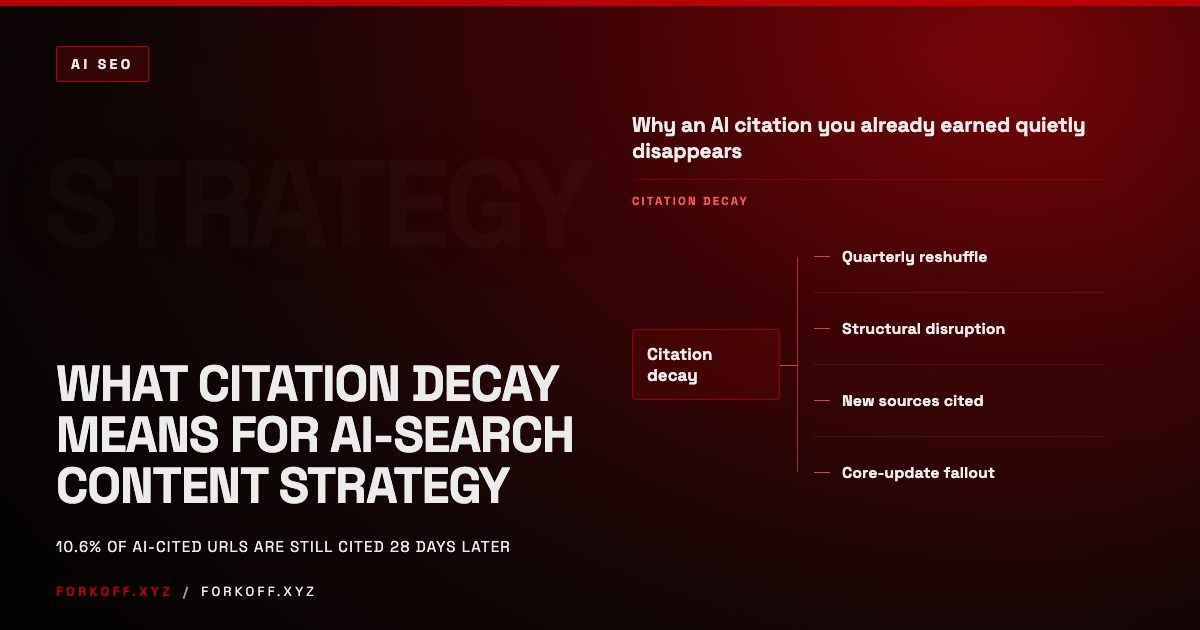
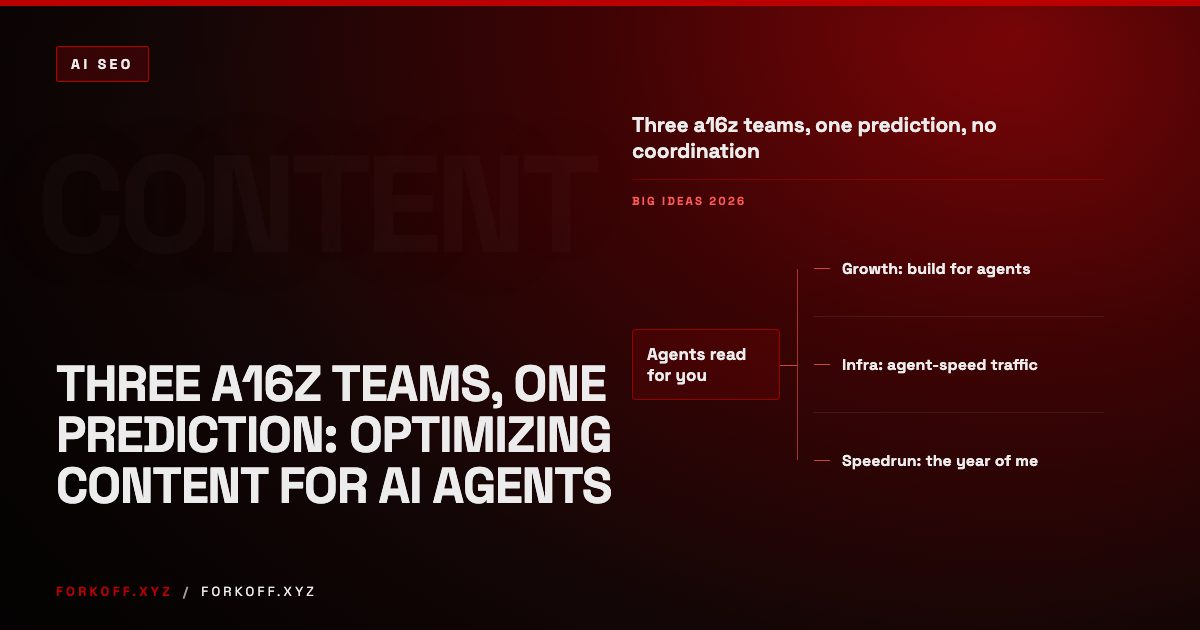
This decision sits inside a broader shift, and a few adjacent pieces on FORKOFF's AI SEO and AEO blog go deeper on specific angles. If you want the pricing question answered head-on rather than folded into a broader framework, read how much an AI SEO or AEO agency actually costs. For the mechanics of the citation itself, how AI Overviews actually rank and select brands and 12 structural patterns that improve AI Overview optimization both go further into the technical content-shape work this post only summarizes. If measurement is the blocker, how to measure your actual share of AI citations and schema markup for AEO cover the tracking and technical-foundation side respectively. Content that already ranks is not exempt from this shift either, citation decay in AI search content strategy explains why older pages lose citation share over time even without a Google penalty, and Perplexity versus Google AI Overviews breaks down where the two platforms genuinely diverge. For the wider industry context behind why this decision is landing on desks right now, see a16z's 2026 big ideas on content built for AI agents. And if you have already decided you need a dedicated shop and want a shortlist, FORKOFF's comparison of the best AEO agencies is the natural next stop.
Two adjacent FORKOFF service lines are worth knowing about even if AEO/GEO is the immediate question. The off-site work this post keeps returning to, building real presence in Reddit threads and LinkedIn discussions rather than just publishing on your own domain, overlaps directly with Reddit marketing and Twitter and X marketing as standalone disciplines, and a broader founder funnel engagement is often the right container for AEO/GEO work rather than treating it as a bolt-on.