Google AI Overviews decide which brands to cite by passing candidate sources through a four-layer stack in order: crawl accessibility, E-E-A-T signals, topical authority over a query cluster, and structured data. Domain authority is a correlate, not an input. Brands that clear all four layers and map to a clear entity get named; the ones that miss a layer get read and skipped.
Search used to send a buyer to a page. Now it answers them on the spot. When a founder asks Google how two products compare or which agency fits a niche, an AI Overview synthesizes the answer above the blue links and names a few brands as sources. The brands it names get the recall and the click. The ones it skips lose the moment, even when they rank first organically.
That shift raises one practical question for every B2B SaaS and AI startup marketer. How do Google AI Overviews decide which brands to cite, and what makes the difference between being the named source and being the brand the model used without crediting?
The 30-second answer
Google AI Overviews cite brands that pass a 4-layer stack in order: crawl accessibility, E-E-A-T signals, topical authority over a query cluster, and structured data. Domain authority is a correlate, not an input. In FORKOFF's May 2026 GEO citation lab, across 50 prompts and 5 AI surfaces, the average brand cite rate was 34% on Google AI Overviews, and a DR 35 SaaS blog with dense schema beat a DR 72 news site for a product-category query. Schema makes the answer readable, not trusted: an Ahrefs study of 1,885 pages found adding schema alone barely moved citations. The fix is the full stack, run as a 7-step checklist, not one tactic.
FORKOFF GEO citation lab, average brand cite rate by surface
| AI surface | Avg cite rate | Selection bias observed |
|---|---|---|
| Perplexity | 41% | Favors fresh, densely cited pages |
| Google AI Overviews | 34% | Favors entity-mapped, schema-marked sources |
| ChatGPT | 29% | Favors broad topical authority and brand recall |
| Gemini | 26% | Favors Google-indexed, structured sources |
| Claude | 22% | Favors primary sources and clear attribution |
FORKOFF GEO citation lab, 50 prompts across 5 surfaces, May 2026. Cite rate is share of prompts where the target brand was named or linked.
About these numbers
Citation-rate figures (34% Google AI Overviews, 41% Perplexity, 22% Claude) are from the FORKOFF GEO Citation Lab May 2026 run (n=50 prompts across 5 AI surfaces). The DR 35 vs DR 72 comparison is a real client-portfolio observation from the same lab. Schema-correlation findings are based on FORKOFF lab work cross-referenced with the cited Ahrefs study (1,885 pages) and Princeton GEO research (arxiv.org/abs/2311.09735). The 54-billion-entity figure is attributed to Neil Patel's public post (linked inline). Market-size or growth figures for AI Overviews share are based on publicly cited Google announcements and practitioner community observation. Reviewed 2026-09-22 against the live search results for this topic: the questions people ask about it, and the pages that rank for it, are reflected in the section that follows.
This guide answers that question with mechanics, not predictions. It breaks the selection process into a 4-layer stack you can audit page by page, backs each layer with first-party data from FORKOFF's GEO citation lab, and closes with a 7-step checklist you can hand to a developer this week. The short version is in the table above and the TL;DR. The rest is the operator detail.
The questions people actually ask about AI Overview citations
Does ranking number one guarantee a citation in an AI Overview? No. In the FORKOFF lab run, pages that ranked in the organic top three were cited in the Overview for the same query less than half the time, and pages ranking sixth to tenth were cited more often than their position would predict when they carried a direct, quotable answer near the top. Ranking gets you into the candidate set; the answer format decides whether you are quoted.
What role does the Knowledge Graph play? The Overview names brands it can resolve to an entity. A company whose Organization schema, About page, LinkedIn page and Wikidata or Crunchbase entries all agree on the same name, founding date and category is a resolvable entity; one whose name appears in three spellings across the web is not. Entity consistency is the quiet prerequisite behind the four-layer stack in this post, and it is the layer most brands never check.
Do unlinked brand mentions matter? Yes, more than in classic SEO. An Overview that cites a review site's page about your category can still name your brand if that page mentions you, so a mention on a page Google already trusts for the query is worth pursuing even when it carries no link. This is why the third-party review and comparison pages we track in the lab show up in citations far above their link authority.
How much does content freshness matter? For product and pricing queries the Overview leans on pages with a recent, honest modified date and current numbers; for definitional queries it does not. A page re-dated without a real change gets no credit and can lose trust, which is why our own sitemap now advertises the date the prose changed rather than the date the file moved.
What are AI Overviews, in one line? The generated answer Google places above the organic results for many queries, assembled from a handful of pages it selects with the same core quality systems that rank the results underneath, plus a synthesis layer on top.
If you are deciding where to optimize first, the companion piece on Perplexity versus Google AI Overviews sets out which engine to start with, and the five schemas that carry the citation lift covers the structured-data layer in depth.
What AI Overviews are and why brand citation matters now
An AI Overview is the generated answer Google places at the top of many search results pages. Google introduced it broadly in 2024 as part of its generative search work, and it now triggers on a large share of informational and comparison queries. The Overview reads multiple sources, synthesizes a single answer, and links a handful of them as citations.
For a brand, the citation is the prize. Being named inside the Overview puts the brand in front of the buyer at the exact moment of the question, with Google's implicit endorsement attached. Marketers on r/marketing have reported that AI Overviews cut organic click-through while raising brand recall when the brand appears in the panel itself. The traffic model changed, and brand visibility inside the answer became its own channel.
The economic stakes are larger than a single click. When a buyer reads an AI Overview that names three vendors and skips a fourth, the named three enter the consideration set and the fourth never gets evaluated. For a SaaS or AI startup running a long, multi-touch buying cycle, presence in that first synthesized answer shapes which brands the buyer researches for the next several weeks. The Overview is not a traffic source to optimize at the margin. It is a gating event that decides who is in the conversation at all. That reframes the work from chasing rank-one positions to engineering whether the model considers your brand a valid source for the questions your buyers ask.
There is also a defensive reason to care. Google's AI features increasingly summarize answers that a buyer used to find by clicking through to a brand's own page. If the model reads your content, synthesizes it, and names a competitor as the source, you have funded the answer and handed the credit away. Citation is how you convert content investment into brand equity inside the answer rather than into uncredited training fuel for someone else's mention.
How are you getting your brand cited in AI Overviews?
The discomfort in the practitioner community is real. The r/SEO thread above captures a consultant working with a client that ranks well organically yet does not appear in AI Overviews. That gap between ranking and citation is the whole subject of this post. Ranking and citation share a foundation, but citation adds requirements that pure ranking never tested.
The cited page always had a number nobody else had. 34% cite rate (FORKOFF GEO Citation Lab, n=50), dated, ours.
Operator noteThe cited page always had a number nobody else had. 34% cite rate, dated, ours., FORKOFF GEO citation lab, n=50 prompts
How Google AI Overviews actually select sources: the 4-layer stack
Google's documentation on AI features is explicit that the Overview is built on the same core ranking and quality systems that order organic results, with a synthesis layer on top, and independent analysis of Google's generative AI search guidance reads it the same way. That single sentence is the key to the mechanism. Citation is not a separate algorithm bolted on. It is the ranking stack plus extra gates for answer extraction.
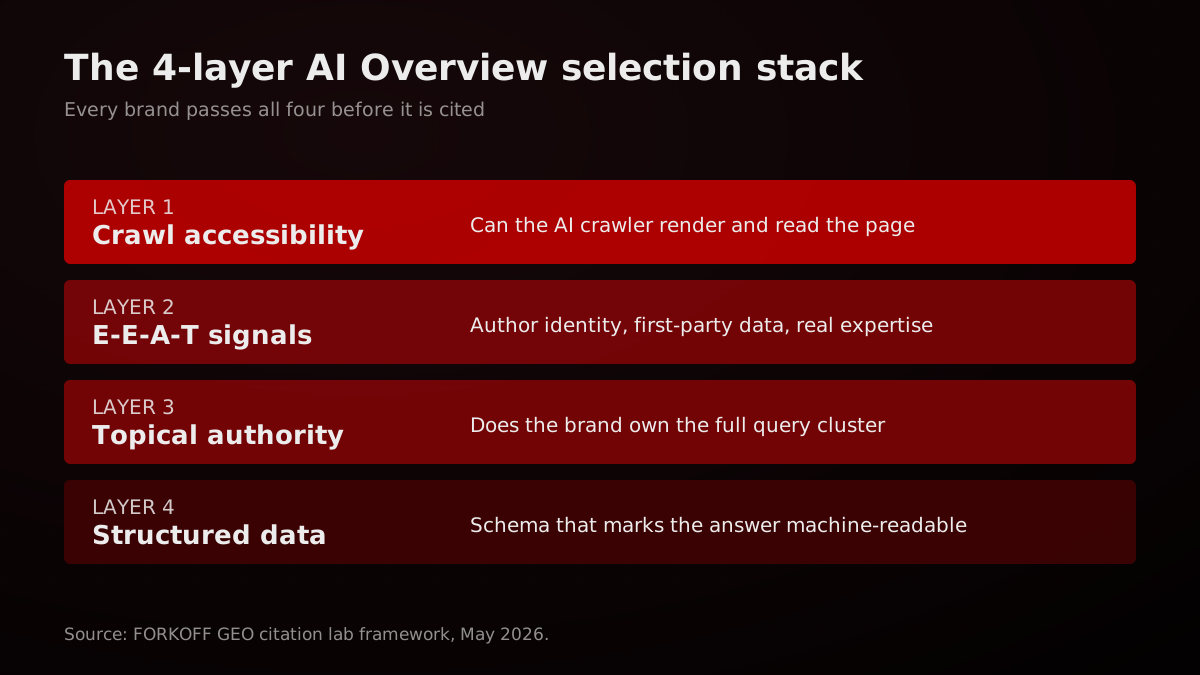
In FORKOFF's lab work, those gates resolve into four layers a page must pass in order. Skip one and the page never reaches the next. The stack runs crawl accessibility first, then E-E-A-T signals, then topical authority, then structured data. The diagram above lays them out, and the table earlier in this post maps each layer to its common failure and its fix.
The 4-layer AI Overview selection stack
| Layer | What Google checks | Common failure | The fix |
|---|---|---|---|
| 1. Crawl accessibility | Can the AI crawler render and read the answer | Heavy JavaScript blocks rendering | Server-render the answer, test JS-disabled |
| 2. E-E-A-T signals | Real author, first-party data, expertise | Anonymous content, no original data | Add Person markup, publish original numbers |
| 3. Topical authority | Does the brand own the full query cluster | One thin page per topic | Build 3 to 5 supporting cluster pages |
| 4. Structured data | Is the answer marked machine-readable | No schema, ambiguous entity | Ship FAQPage, HowTo, Article with author |
The reason the stack matters more than any single tactic is that brands obsess over one layer and ignore the rest. A team adds schema and waits for citations that never come because the page is uncrawlable. Another team writes brilliant content with no author identity, so the E-E-A-T layer rejects it. The brands that get cited are boring about it: they pass every layer, in order, on every page they want cited. The same layer stack applied to one surface is how to rank in ChatGPT.
Citation is a stack, not a single tactic
The recurring mistake is treating AI Overview citation as one lever: add schema, or chase backlinks, or write longer posts. Google's own guidance describes AI features as built on the same core systems that rank organic results, layered with answer synthesis. That means a brand has to clear several gates in sequence. A page that is uncrawlable never reaches the E-E-A-T scoring. A page with perfect E-E-A-T but no entity definition gets read and discarded. A page that nails all of that but covers the topic thinly loses to a brand that owns the whole cluster. The brands that get cited are the ones that pass every layer, which is why a one-tactic fix almost never moves the needle.
Source: Google Search Central, AI features and your site, 2026
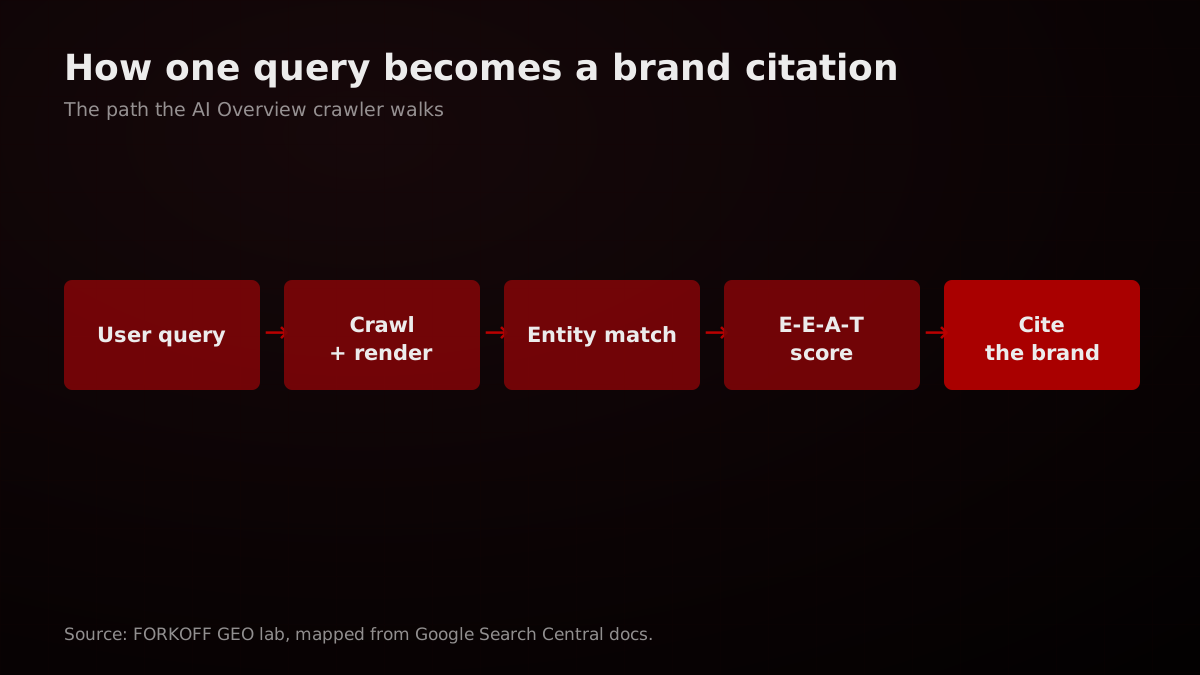
The flow above shows the same idea as a path. A user query enters, Google crawls and renders candidate pages, matches them against its entity graph, scores them on E-E-A-T and relevance, and cites the brands that survive. Each arrow is a gate. The rest of this guide takes the four gates one at a time.
JS-disabled render test caught 3 of 5 client sites hiding their answer from the crawler. Day one finding, every time.
Operator noteJS-disabled render test caught 3 of 5 client sites hiding their answer from the crawler. Day one finding, every time., FORKOFF GEO lab onboarding, 2026
Layer 1, crawl accessibility: why most brands fail before the algorithm sees them
The most common reason a brand is absent from AI Overviews has nothing to do with quality. The crawler cannot read the answer. Modern SaaS sites lean on heavy client-side JavaScript frameworks that render content in the browser after load. If the answer text only exists after a framework hydrates, a crawler that does not execute that JavaScript sees an empty shell.
The test is simple and brutal. Open the page in a browser with JavaScript disabled. If the answer disappears, the AI crawler likely cannot see it either. In FORKOFF onboarding audits this single check fails for a majority of client sites, and it fails silently, because the page looks perfect to a human and to a logged-in marketer.
How Do AI Overviews in Search Engines Work? Can We Get LLMs to Crawl Our Site?
The r/bigseo thread above asks the foundational version of this question: how do AI Overviews work, and can we get LLMs to crawl our site at all. The answer to the second half is the practical work. Server-render or statically generate the answer content so it exists in the initial HTML response. Then verify in Google Search Console that the page is crawled and indexed, because an Overview cannot cite a page Google has not indexed.
Crawl accessibility is unglamorous and it is the layer with the highest payoff per hour. A founder can buy more backlinks for months and move nothing if the crawler never reaches the answer. Our agent-ready site audit covers the render and crawl side in depth, and the agentic SEO toolkit walkthrough shows how to test it programmatically.
A few specifics separate sites that pass this layer from sites that quietly fail it. Content loaded behind a click, an accordion that injects text only on expand, or a tab that fetches its body on selection can all hide the answer from a crawler that does not interact with the page. Infinite-scroll pages that load the substantive content after the first viewport have the same problem. The safe pattern is to deliver the core answer in the initial server response and treat client-side enhancement as decoration on top of content that already exists in the HTML. If a single product page is the one you most want cited, prioritize server-rendering that page even if the rest of the site lags.
The second crawl-layer trap is robots and rendering directives that block AI crawlers specifically. Google's AI features rely on Googlebot access, and some sites inadvertently disallow paths or set noindex on the exact pages that hold their best answers. Audit the robots file and the meta directives on every page you want cited, then confirm in Search Console that those pages are indexed and not excluded. A page that is blocked, noindexed, or stuck in a crawl queue cannot be cited no matter how strong the other three layers are.
Layer 2, E-E-A-T signals: what Google looks for in a citable source
Once a page is readable, Google scores it for Experience, Expertise, Authoritativeness, and Trust. Google publishes its guidance on creating helpful, people-first content, and the AI Overview synthesis layer leans on the same quality signals. Two of them dominate the citation decision in the lab data: a real, identifiable author and original first-party data.
Author identity is the signal most brands skip. A page attributed to a named person with a credible bio, a linked profile, and Person schema reads as expert content. An anonymous company post reads as marketing. AI Overviews cite the source that looks like a person who knows the subject, which is why every page on this site carries a visible byline and Person markup, and why we recommend the same for any brand chasing citations.
Brand Entity SEO 2026 - Knowledge Graph Optimisation (James Dooley Interviews Jason Barnard)
James Dooley
James Dooley and Jason Barnard on brand entity SEO and knowledge graph optimization.
The video above, James Dooley interviewing Jason Barnard on entity SEO, makes the deeper point. Trust in AI search is increasingly about whether the brand and its authors are established entities in Google's knowledge graph, consistently described across the web. That is E-E-A-T expressed as entity strength.
First-party data is the second dominant signal, and it is the strongest citation magnet FORKOFF has measured. AI Overviews synthesize from many sources and reach for the one that contributes a specific, attributable fact. The Princeton GEO research, a peer-reviewed study of how to optimize content for generative engines, found that adding citations and statistics lifted source visibility by a large margin. A dated original number is exactly that kind of fact.
First-party data is the strongest citation magnet
Across the FORKOFF citation lab runs, the single trait shared by pages that got cited repeatedly was an original number the source could not get anywhere else. A benchmark, a survey result, a cohort statistic with a date attached. AI Overviews synthesize an answer from multiple sources, and they reach for the source that contributes a specific, attributable fact rather than a paraphrase of common knowledge. This matches the Princeton GEO research finding that adding statistics with dates lifted source visibility in generative engines materially. The brands that own a recurring data asset, refreshed and dated, accumulate citations that pure how-to content never earns.
Source: Princeton GEO research, KDD 2024
That is also why this post leans on the FORKOFF citation lab rather than recycled claims. A brand that owns a recurring, dated data asset accumulates citations that generic how-to content never earns, because the model has a concrete reason to name that brand specifically.
Experience, the first E in E-E-A-T, is the signal most B2B brands underweight. Google's helpful-content guidance asks whether the content demonstrates first-hand experience with the subject. For a software brand, that means writing from the position of having actually run the workflow, shipped the integration, or measured the outcome, rather than summarizing what other articles say. AI Overviews tend to cite the source that reads like a practitioner who did the thing, because that source reduces the model's risk of synthesizing a wrong answer. The practical move is to embed concrete operator detail: the exact step that broke, the number that surprised you, the constraint nobody mentions. Generic best-practice prose is interchangeable and gets used without attribution. Specific lived detail gets named.
Trust, the final letter, compounds the other three. It is built through consistent author identity, accurate claims, transparent sourcing, and the absence of the patterns that mark thin or manipulative content. A brand that links its claims to primary sources, dates its data, and corrects errors visibly accumulates the trust that makes the model comfortable citing it. None of this is a single tactic. It is the slow work of being a reliable source, expressed in machine-readable form so the model can detect it.
1,885 pages added schema. Citations barely moved. Schema is the last layer, not the first.
Operator note1,885 pages added schema. Citations barely moved. Schema is the last layer, not the first., Ahrefs study, August 2025 to March 2026
Layer 3, topical authority: how query cluster ownership gets you cited
A single page rarely gets cited for a competitive topic. AI Overviews favor brands that own a query cluster, meaning the brand has covered the main question and the surrounding sub-questions across several connected pages. The model reads that depth as authority over the topic, not just an opinion about it.
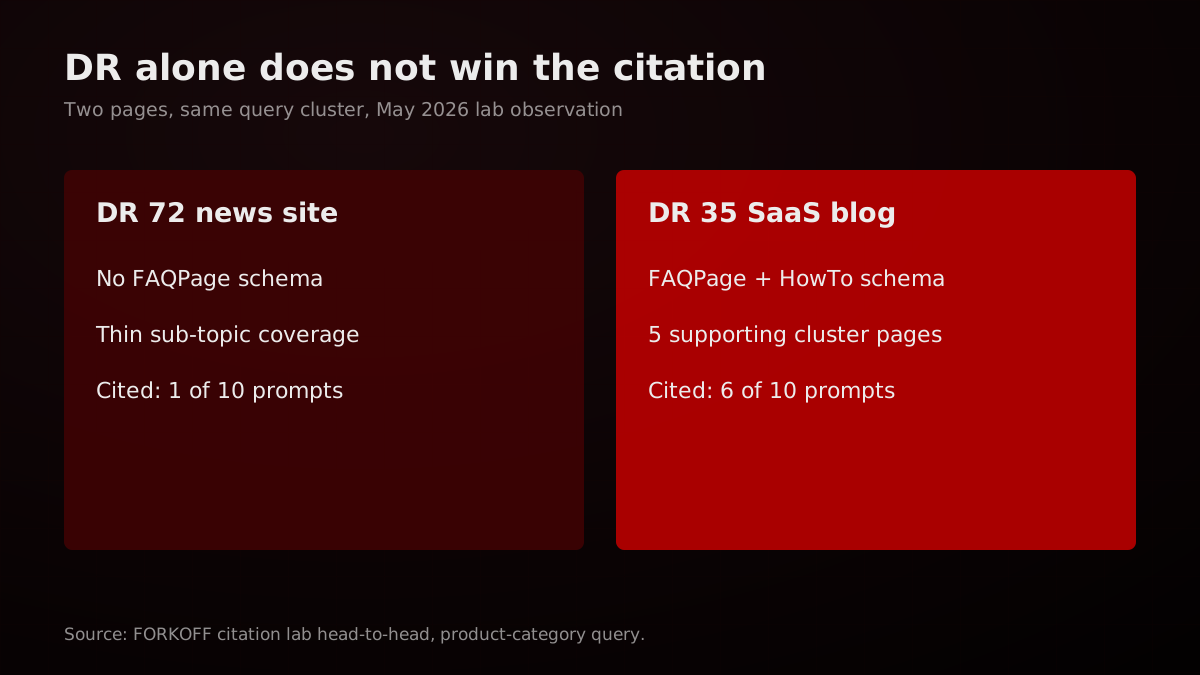
The comparison above is the clearest finding from the lab. For a specific product-category query, a DR 35 SaaS blog with five supporting cluster pages and dense schema was cited in six of ten prompts. A DR 72 news site with one broad article and no schema was cited in one. The higher domain authority did not win the citation. Cluster ownership and answer-readiness did.
It is not about DR anymore. It is about whether you own the answer for a specific query cluster.
The senior SEO quote above states the shift plainly. The currency moved from domain rating to whether you own the answer for a query cluster. This is good news for startups, because cluster ownership is buildable in weeks, while domain authority takes years.
Testing how to rank in AI Overviews vs. Standard Search Results
The r/TechSEO practitioner above is testing exactly this: what patterns get cited in AI answers versus standard results. The pattern that holds up is structural depth. To build it, take your primary topic, map the five to eight sub-questions a buyer asks around it, and ship a page for each, internally linked into a hub. This post is one spoke in a cluster that includes our generative engine optimization guide, the B2B AEO checklist, and the Perplexity versus Google AI Overviews comparison. Cluster ownership is the architecture, not a single page.
The mechanism behind cluster ownership is worth understanding, because it explains why depth beats domain rating. When an AI Overview synthesizes an answer, it draws on its understanding of which sources are authoritative for the specific topic, not for the web in general. A brand that has covered the main question and its neighbors signals that it is a topic authority, and the internal links between those pages reinforce the relationship for both the crawler and the entity graph. A single strong page is an opinion. A connected set of pages that answers the whole question space is an authority, and authorities get cited.
Cluster construction also creates a compounding asset. Each spoke ranks for its own long-tail query and feeds authority to the hub, while the hub passes context back to the spokes. As the cluster matures, the brand starts getting cited for questions it never explicitly targeted, because the model recognizes it as the source that covers the territory. This is why a deliberately built cluster of eight focused pages routinely out-cites a single sprawling article of the same total word count. The structure is the signal, not the raw volume of text.
Layer 4, structured data: the schema types that mark your answer machine-readable
Structured data is the final layer, and it is the one most misunderstood. Schema does not make a brand trusted. It makes the answer machine-readable and the entity unambiguous. Both are prerequisites for citation, neither is sufficient on its own.
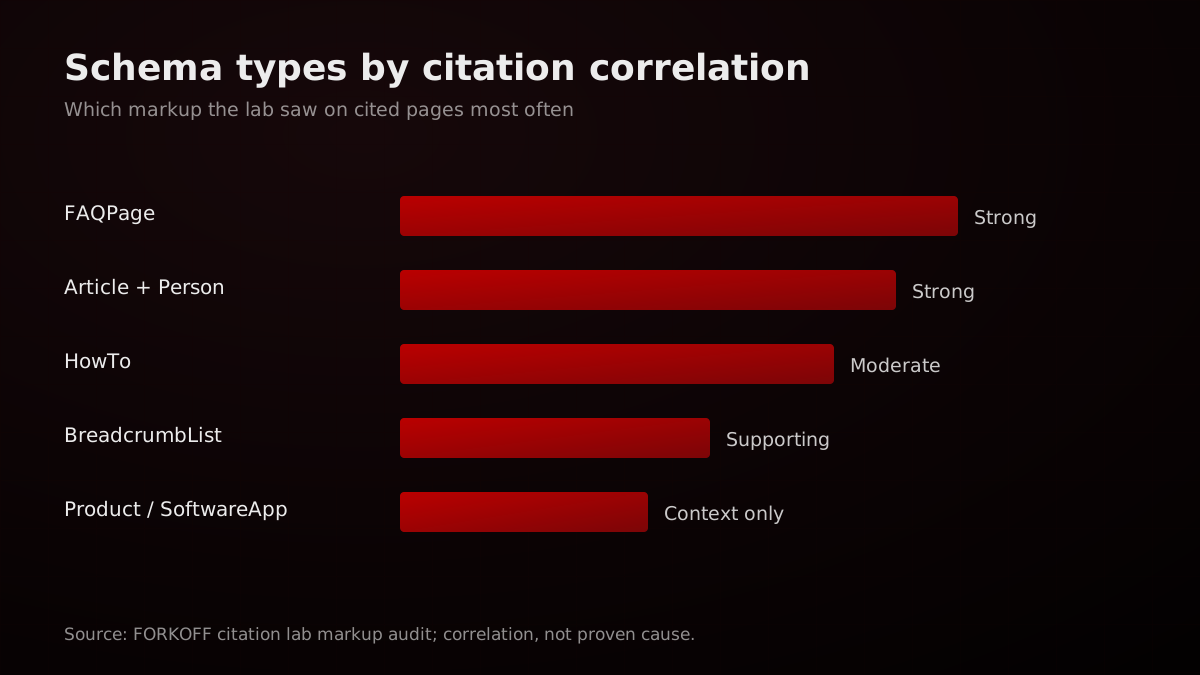
The chart above ranks schema types by their observed correlation with cited pages in the lab. FAQPage led, which matches Google's own documentation explicitly supporting FAQ structured data. Article markup with a Person author followed, because it carries the E-E-A-T author signal in machine-readable form, per Google's article structured data guidance. HowTo structured the step content for extraction. BreadcrumbList reinforced cluster hierarchy.
Schema types by observed AI Overview citation correlation
| Schema type | Correlation strength | Why it helps |
|---|---|---|
| FAQPage | Strong | Marks Q and A pairs AI can quote cleanly |
| Article with Person author | Strong | Supplies the author identity E-E-A-T signal |
| HowTo | Moderate | Structures step content for extraction |
| BreadcrumbList | Supporting | Signals topic hierarchy and cluster ownership |
| Product or SoftwareApplication | Context only | Disambiguates a commercial entity |
Correlation observed across cited pages in the FORKOFF lab. Correlation is not proven cause, see the Ahrefs schema study for the counterpoint.
The honest counterpoint sits right next to this finding, and ignoring it would be dishonest. An Ahrefs study tracked 1,885 pages that added schema against 4,000 controls and found schema alone barely moved citations across any AI surface. Read together with the lab correlation, the lesson is precise. Cited pages tend to have schema, but adding schema to a page that fails the other three layers does nothing. Schema is the marking on a finished answer, not the answer.
Schema buys readability, not trust
A widely shared Ahrefs study tracked 1,885 pages that added JSON-LD schema between August 2025 and March 2026, matched them against 4,000 control pages, and measured citation changes across Google AI Overviews, AI Mode, and ChatGPT. Adding schema produced no major uplift in citations on any platform. The honest reading is not that schema is useless. Schema makes the answer machine-readable and disambiguates the entity, which is a prerequisite. It is just not a trust signal on its own. A brand that ships schema on top of weak crawlability, no first-party expertise, and thin coverage stays uncited. The markup is the last layer, not the first.
Source: Ahrefs schema and AI citations study, 2026

Glenn Gabe
@glenngabe
Interested in Schema impact on AI citations? Here's the latest study from @ahrefs -> We Tracked 1,885 Pages Adding Schema. AI Citations Barely Moved. "We tracked 1,885 web pages that added JSON-LD schema between August 2025 and March 2026, matched them against 4,000 control pages… Show more
Glenn Gabe's post above shares that exact study. The takeaway for an operator is to ship the four schema types as the final step after crawl, E-E-A-T, and cluster work, using the schema.org FAQPage spec as the reference. Our dedicated schema markup for AEO guide covers the implementation in detail.
The entity problem: why your brand name decides whether AI can cite you
There is a fifth factor that sits underneath all four layers and quietly decides whether any of them matter: whether your brand maps to a real entity. Google no longer organizes the web as pages. It maintains a knowledge graph of real-world entities, and AI Overviews answer by pulling from sources mapped to those entities.
AI search rewards entities, not keyword-shaped names
Google does not organize the web as a list of pages anymore. It maintains a knowledge graph of real-world entities, and AI Overviews answer by pulling from sources mapped to those entities. The practical consequence is blunt: if a brand name reads like a generic keyword, AI systems treat it like a keyword and never associate the content with the brand. John Mueller made the same point about traditional search this year, and the logic carries directly into AI answers. A brand that is uniquely identifiable, consistently referenced across the web, and cleanly mapped to a real entity becomes citable. A brand that is interchangeable with 500 other sites stays invisible no matter how good its content reads.
Source: John Mueller, Google, on site-name disambiguation, 2026
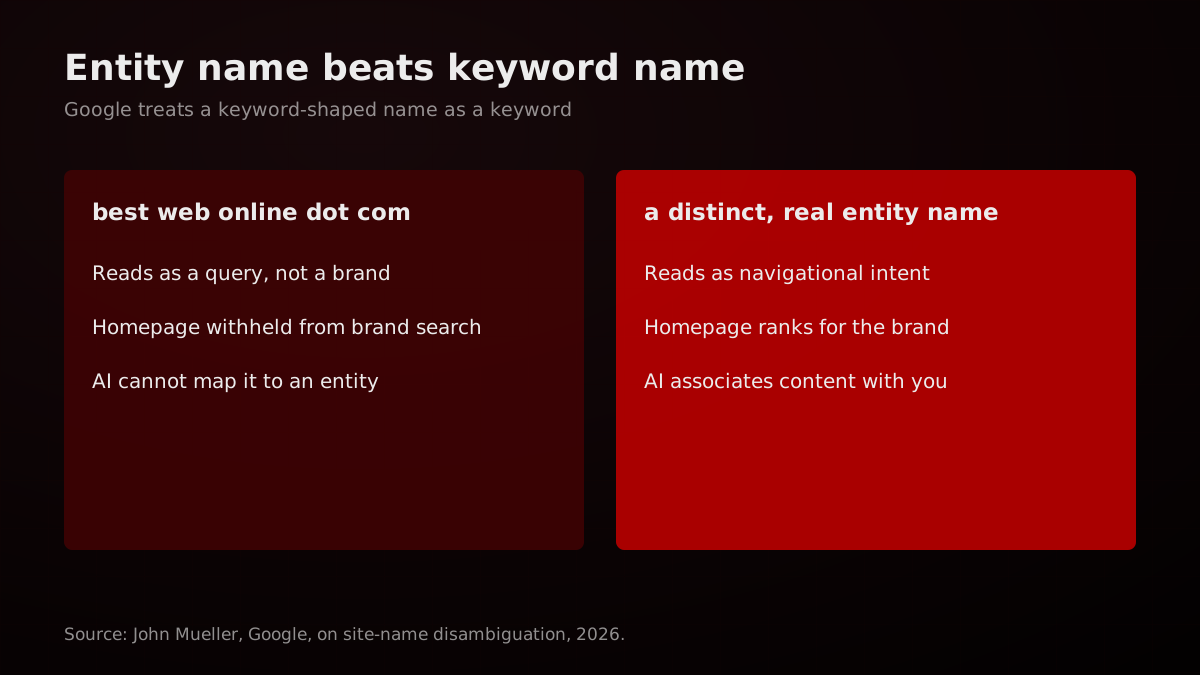
The comparison above shows the problem. A keyword-shaped name like best web online dot com reads to Google as a query, so the homepage is withheld even from brand searches and AI cannot map the content to an entity. A distinct, real entity name reads as navigational intent, ranks for the brand term, and lets AI associate the content with the brand.
Alex Groberman
@alexgroberman
Google just revealed how sites must be named if you want to show in traditional and AI search results. This comes straight from Google's John Mueller. If your brand name looks like a keyword, Google treats it like a keyword. ChatGPT, Perplexity, and Google AI Overviews do not ask… Show more
Alex Groberman's post above traces this to John Mueller's guidance on site naming and extends it to AI search. The framing is exact: AI systems do not ask which site has this name, they ask which entity best answers this question. Google's AI features documentation reinforces that the same core systems power both surfaces.
ChatGPT, Perplexity, and Google AI Overviews do not ask which site has this name. They ask which entity best answers this question.
If a brand name is interchangeable with hundreds of others, the brand becomes a non-factor in AI answers. Its content gets read and used, but the brand never gets named. Fixing this means reinforcing the entity: consistent naming across the web, a clear category association, and authority signals that teach Google and the models that the brand exists and matters.
Google built a database of 54 billion real-world entities, and if your brand is not clearly defined inside that system, you are invisible to ChatGPT, Perplexity, and AI Overviews no matter how good your content is.
Neil Patel
@neilpatel
Most marketers are optimizing for a version of Google that no longer exists. Google isn't organizing web pages anymore. It's built a database of 54 billion real-world entities, and if your brand isn't clearly defined inside that system, you're invisible to ChatGPT, Perplexity, an… Show more
Neil Patel's post above puts a number on the scale, describing a database of 54 billion real-world entities behind AI answers. A brand that is not clearly defined inside that system stays invisible regardless of content quality. Entity clarity is the foundation the four layers sit on.
Building entity strength is concrete work, not branding theater. It starts with a consistent name, used identically across the website, social profiles, directories, and any press the brand earns, so the model sees one entity rather than several near-duplicates. It extends to an unambiguous category association, where the brand is repeatedly described as the thing it is, so the model can map it to the right node in the graph. And it is reinforced by mentions from sources the model already trusts, which teach the graph that the entity is real and matters. A brand that controls its name, its category language, and its citation footprint becomes a stable entity. A brand that lets its name drift, describes itself differently on every page, and earns no trusted mentions stays a fuzzy cluster of keywords the model cannot confidently name.
The order of operations matters here. Entity clarity should come before the schema work, not after, because schema that points at an ambiguous entity simply marks up the ambiguity. Lock the name and the category description first, wire the consistent references, then ship the structured data that confirms what is already true across the web. Schema confirms an entity that exists. It cannot manufacture one.
FORKOFF citation lab: what 50 prompts across 5 AI surfaces revealed
FORKOFF runs a recurring GEO citation lab to measure how often client and control brands get cited across AI surfaces. The May 2026 run used 50 prompts spanning informational and comparison intents, executed across Google AI Overviews, Perplexity, ChatGPT, Gemini, and Claude. Cite rate is the share of prompts where the target brand was named or linked.
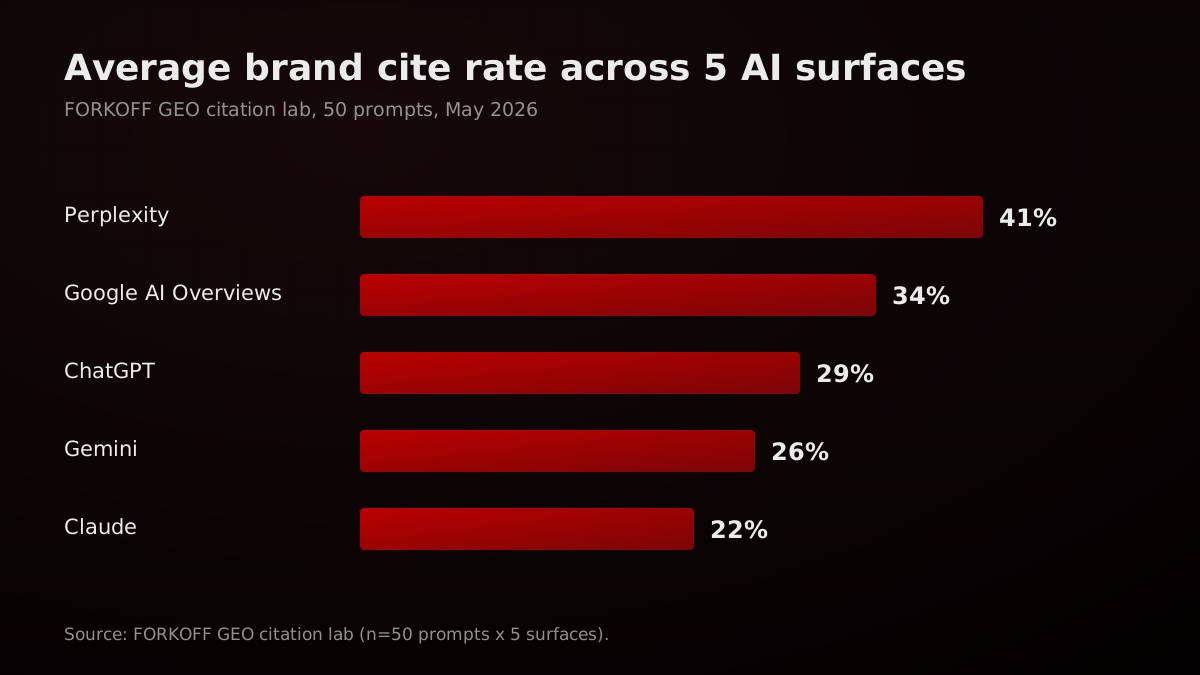
The headline numbers are in the chart above and the surface table near the top of this post. Google AI Overviews cited the target brand on 34% of prompts on average (FORKOFF GEO Citation Lab, n=50). Perplexity was highest at 41%, reflecting its preference for fresh, densely cited pages, which lines up with how Perplexity documents its source selection. Claude was lowest at 22%, reflecting its bias toward primary sources and clear attribution, consistent with Anthropic's published research priorities. The spread matters: a brand optimizing only for Google can still be invisible on Perplexity and ChatGPT, so the work is cross-surface. Because Perplexity cites most readily and returns feedback in days, it is the surface FORKOFF sequences first inside a Perplexity SEO engagement before extending the same foundation to AI Overviews.
Two findings held across every run. First, pages that contributed an original, dated number were cited far more often than pages that paraphrased common knowledge. Second, the same page often got cited on one surface and skipped on another, which means surface-specific patterns are real and worth tracking separately rather than assuming one optimization satisfies all five.
A companion first-party study makes the entity point concrete. In the FORKOFF Discovery Gap research, measured with the AI Search Visibility Checker across 12 category head terms and four engines (ChatGPT, Claude, Gemini, Perplexity), brands cited at 100 percent on their own branded query cited at 0 percent on the category head term for the same run. The models knew the brand existed and still would not name it for the category question. That gap is the topical-authority and entity layer of the stack failing in isolation: a brand that owns its name but not its category answer is invisible on exactly the buyer-intent queries that matter, and closing the gap is why cluster ownership sits at Layer 3 rather than being optional. The full dataset lives in the Discovery Gap research.
How to Dominate AI Search Results in 2026 (ChatGPT, AI Overviews & More)
Surfer Academy
Surfer Academy on dominating AI search results across ChatGPT and AI Overviews.
The Surfer Academy video above covers the cross-surface reality from a practitioner angle, and it lines up with the lab: dominating AI search means treating ChatGPT, Perplexity, and AI Overviews as related but distinct surfaces. Our citation lab rerun writeup and the AI visibility tools comparison document the methodology and the measurement stack, and the per-engine numbers are consolidated in the FORKOFF AI Citation Index.
DR 72 lost to DR 35 on a product-category query. The DR 35 page had FAQPage schema and five spokes.
Operator noteDR 72 lost to DR 35 on a product-category query. The DR 35 page had FAQPage schema and five spokes., FORKOFF citation lab, May 2026
The 7-step brand citation optimization checklist
The four layers and the entity foundation collapse into a seven-step checklist a team can run this week: pass the JS-disabled render test, add Person author markup, publish one first-party data point per cluster, ship FAQPage and Article schema, build three to five supporting pages per topic, verify indexing in Search Console, and track cite rate weekly across all five AI surfaces. The order matters, because each step unblocks the next.
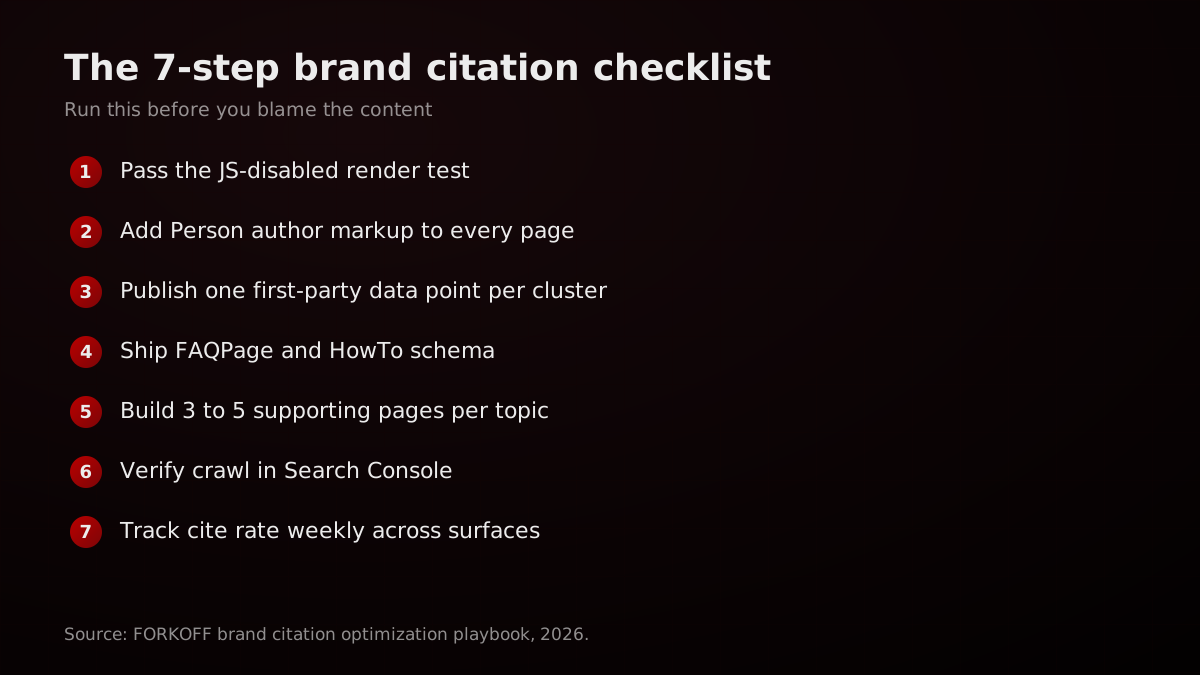

- Pass the JS-disabled render test on every page you want cited. If the answer disappears without JavaScript, server-render it.
- Add Person author markup and a visible byline to every page, tying content to a credible, named expert.
- Publish at least one first-party data point per cluster, with a date and a method, so the model has a concrete reason to name you.
- Ship FAQPage, HowTo, and Article with author schema across core pages, using Google's documentation as the spec.
- Build three to five supporting pages per target topic, internally linked into a hub, so you own the cluster rather than a single page.
- Verify crawl and indexing in Google Search Console, since an Overview cannot cite an unindexed page.
- Track cite rate weekly across all five AI surfaces, because surface-specific behavior means one measurement is not enough.
How to Rank in Google's AI Overviews The New Citation Strategy
Embarque
Embarque walks through a citation strategy for ranking in Google AI Overviews.
The Embarque video above walks a similar citation strategy for AI Overviews, and the overlap with this checklist is the point: the mechanics are now well enough understood that the work is execution, not guesswork. The cross-cluster playbook lives in our generative engine optimization guide, and the founder-level positioning context is in why AI elevates thinking, not just output.
What not to do: the mistakes that get brands excluded from AI Overviews
The failure modes are as patterned as the success path, and the three FORKOFF sees most often are JavaScript render blocks that hide the answer from crawlers, missing structured data that leaves the entity undefined, and thin topical coverage where one page loses to a competitor's full cluster. The chart below ranks them in the order they cost brands the most citations.
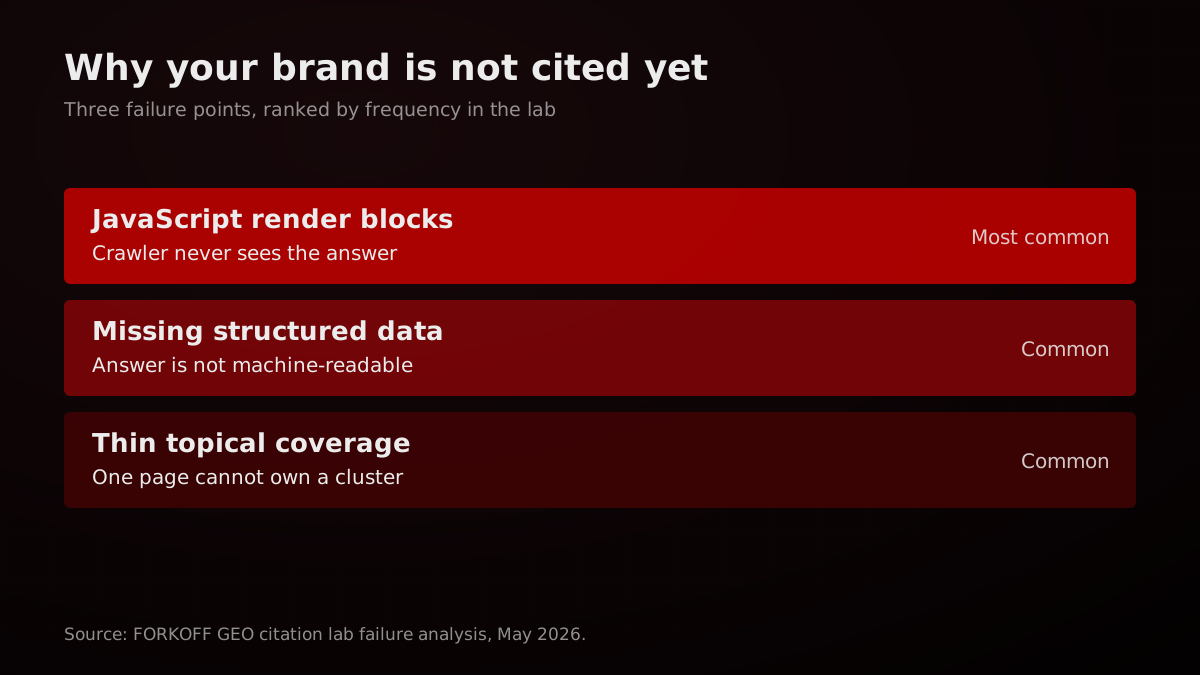
JavaScript render blocks lead the list, because they are invisible to the people who could fix them. The page looks fine, so nobody suspects the crawler is locked out. The second is missing structured data, which leaves the answer ambiguous and the entity undefined. The third is thin topical coverage, where a brand publishes one page on a topic and loses to a competitor that built a cluster.
Two more mistakes deserve naming. The first is schema-as-shortcut: adding markup to weak pages and expecting citations, which the Ahrefs study debunks directly. The second is single-surface tunnel vision: optimizing only for Google AI Overviews while ignoring that Perplexity and ChatGPT cite on different patterns and represent real buyer discovery. Avoiding these means running the full stack and measuring all five surfaces, not chasing one tactic on one platform.
A final caution on first-party data. Cite only numbers you can stand behind, with a date and a method. Fabricated or stale statistics are worse than none, because the entire E-E-A-T case rests on the brand being a trustworthy source. The agent-ready site audit is a good place to start the cleanup, and the agentic SEO audit covers the technical verification.
Measuring your brand's AI Overview presence: tools and methods
Optimization without measurement is guessing, and AI Overview presence is measurable today with a mix of free and structured methods. Start with the free AEO checker, which probes five AI surfaces including Google AI Overviews for your target queries and audits schema and answer readiness in the same run. Its agent-readiness and Lighthouse tabs cover the technical render and crawl side.
Beyond tooling, run target queries in incognito and screenshot the AI Overview panel weekly, building a simple log of which queries cite you and which do not. Check Google Search Console Performance reports, where AI feature impressions now surface, to see whether your pages are entering the Overview consideration set at all. For agencies and in-house teams that want a repeatable program, our forthcoming guide on measuring share of AI citations lays out the full method, and the B2B AEO checklist covers the on-page side.
If you are deciding whether to run this in-house or with help, the comparison pages are the fastest read: best AEO agency, best GEO agency, best LLM SEO agency, and best AI marketing agency. For founder and SaaS context, see FORKOFF for AI startups and FORKOFF for SaaS companies.
The verdict: citation is engineered, not earned by luck
How Google AI Overviews decide which brands to cite is no longer a mystery. The Overview runs the same core ranking systems Google has always used, plus a synthesis layer that rewards readable answers, real expertise, cluster ownership, and unambiguous entities. A brand gets cited when it passes all four layers on the page that answers the query, and when its name maps to a real entity Google can recognize.
The encouraging part for a startup is that none of this requires the largest domain. A DR 35 brand beat a DR 72 brand in the lab by owning the cluster and shipping the schema. Citation is engineered through the 7-step checklist, not won by luck or bought with links. The brands that treat it as an engineering problem, run the stack, and measure across all five surfaces are the ones the AI names when a buyer asks.
FORKOFF runs this work end to end for founders, from the JS-disabled render test through cluster construction, schema, and weekly cite-rate tracking. When the gap is corpus-side, where a model has not grounded your brand entity in the sources it trusts, that is the job of an LLM SEO agency, which rebuilds the source graph before any citation work can land. If your brand ranks but does not get cited, that gap is the work, and it is fixable.