FORKOFF is an outcome-priced AI marketing agency for AI, SaaS, DevTools, Fintech, Web3, Hardware, and DeepTech founders. One operator. One agent stack. Weekly proof on a public audit proof. AEO and GEO citation as a productized deliverable, not a side effect.
An AI marketing agency is a services firm whose execution layer runs on AI agents, model APIs, and automated workflows instead of a headcount-priced human team. The defensible version sells a measurable outcome (not a deliverable count), discloses its agent stack publicly, and ships a per-surface citation proof on a weekly cadence. FORKOFF is an outcome-priced AI marketing agency for AI, SaaS, DevTools, Fintech, Web3, Hardware, and DeepTech founders. The contract carries a 90-day kill clause and a public audit proof.
The book behind it: 150+ brands served per our engagement records, spanning AI, SaaS, DevTools, Fintech, Web3, Hardware, and DeepTech.
Google SERP rank is secondary. Measurement cadence locked at T+30, T+60, T+90 days.
Five patterns we see when a founder tries to compound AI marketing work and the engagement stalls inside the first quarter. Each row is the FORKOFF fix. Read it before you book the audit call.
Brand pages and pitch decks lead with the phrase "AI-powered marketing" without naming a single model, agent, or workflow. The line is decoration. Sales calls reveal the team still drafts every asset by hand in Google Docs, runs ChatGPT for ideation, and bills retainer hours against headcount. The label moves no real workload onto AI, so the cost structure stays human and the delivery cadence stays slow.
FORKOFF publishes its agent stack on the open audit ledger. Each engagement names which Claude, GPT, and internal-tool workflows produce which deliverable, with the per-output cost line visible to the buyer CFO. Buyers verify the stack before the kickoff call. Agent-stack disclosure URL ships in week one of every engagement.
Pricing sheet reads "$8,000 per month for 8 posts, 4 newsletters, and 12 social cards". The retainer survives whether the posts converted or not because the contract is denominated in deliverables shipped, not pipeline moved. This is the model 11 of 12 agencies on the 2026 ranking still run. It drifts revenue onto the agency calendar instead of the founder funnel.
Outcome-priced contract anchored on a measured pipeline target, not a deliverable count. Sandbox audit defines the target in week one; the retainer floor backs into the work required to deliver it. 90-day kill clause on every engagement so the buyer keeps optionality if the outcome line does not move. Qualified-view proof, audited every week.
Agency proposal lists "AEO" as a 2027-roadmap line item or a separate add-on retainer. Meanwhile the buyer ICP is already researching the category inside ChatGPT, Claude, and Perplexity. The agency ships a Google-only deliverable into a world where 60 percent of the comparison work happens on AI search surfaces. The work is structurally undervaluing the buyer journey it is meant to convert.
Answer Engine Optimization and Generative Engine Optimization sit inside the core retainer, not bolted on. Weekly per-surface citation receipt across ChatGPT, Claude, Perplexity, Gemini, Bing Copilot, and Google AI Overviews. Schema graph, llms.txt, and .well-known manifests ship in week one. Citation rate moves into the audit-ledger pipeline column on the next Monday.
Agency owns one channel and lets the founder stitch the rest together with three more vendors. The cross-channel attribution math never closes because each vendor reports on its own KPI. The founder ends up paying four retainers to cover one buyer-funnel surface and still has no single weekly proof that reconstructs the pipeline. Costs compound while clarity drops.
One operator, one engagement, full-surface coverage. Content, distribution, AEO, GEO, attribution, and the founder funnel run inside the same retainer with one cross-channel weekly proof. The buyer reads one number every Tuesday and knows how the funnel moved. No vendor stitching, no KPI silos, no attribution gaps.
Agency reports come as a quarterly slide deck the buyer reads once and never returns to. There is no public record a future buyer or a peer reviewer can audit. Performance claims are unfalsifiable because the underlying ledger is invisible. The agency ships what looks like work; the buyer cannot tell which weeks were heavy and which weeks were absent.
Every FORKOFF engagement ships against a public weekly proof. What shipped, what moved, and what was attempted but failed are written down every Tuesday. The buyer and any prospective buyer can read all of it. Falsifiability is the load-bearing differentiator. The report URL is part of the contract.
Most headcount-priced retainers survive whether the outcome moved or not. The contract is denominated in deliverables shipped, not pipeline moved. FORKOFF publishes its scoring rubric at the top AI marketing agencies ranking for 2026. The methodology is open for peer review and right-of-reply. This page is the service offering, not the ranking. For the live 12-agency ranking, read the 2026 ranking of 12 AI marketing agencies.
Three engagements across SaaS, Fintech, and DevTools founders. AI marketing retainers that rewired the agent stack, shipped the AEO surface, and published a weekly proof the founder could read in two minutes. Pair the retainer with the founder funnel engagement for the founder-side funnel mapping or anchor on Answer Engine Optimization for the AEO surface alone.
Series A SaaS founder, 0 ChatGPT citations at week one baseline. By week 12 the brand surfaced on 8 of 12 category head terms across ChatGPT, Claude, Perplexity. Qualified-view proof, audited every Tuesday. Pair the retainer with /services/founder-funnel for the founder-side funnel mapping.
Seed-stage Fintech founder, 2 of 6 AI-search engines surfaced the brand at baseline. By week 10 the brand surfaced on all 6 engines for the core commercial query bench. Migration audit forecast Google traffic loss inside the retainer math. Anchored on /services/answer-engine-optimization for the AEO surface.
Pre-Series B DevTools founder, agent-stack audit revealed 4 redundant vendor retainers. Consolidated to one FORKOFF engagement with weekly proof. Per-output cost line dropped 47 percent, published openly from day one of the new contract.
Pre-launch Web3 protocol, brand-disambig leak across 4 of 6 AI engines (resolving the ticker to an unrelated project at baseline). By week 9 the canonical entity graph resolved correctly on all 6 engines for protocol head terms. Wikidata + JSON-LD + cross-property sameAs shipped in the first 30 days, weekly proof on the citation rate after.
Three structural options for shipping AI marketing work. Match the engagement to the outcome accountability you actually need, the proof cadence you want shipped weekly, and the optionality you want in the contract.
← scroll horizontally to see more →
| Feature | FORKOFF AI Marketing AgencyOutcome-priced · agent-stack disclosed · weekly qualified-view proof | Headcount-priced retainer agencyHourly billed · headcount scaled · deliverable-count contract | In-house buildFounder-operator team · slow ramp · full ownership |
|---|---|---|---|
| Pricing model | Outcome-priced contract anchored on a measured pipeline target, sandbox audit on entry | Retainer billed by headcount hours; pricing survives whether the outcome moved or not | Salary plus equity for a 2 to 4 person team; fixed monthly cost with long ramp |
| Outcome accountability | public weekly proof, dropped every Tuesday; 90-day kill clause if the outcome line stalls | Quarterly slide deck the buyer reads once; performance claims are unfalsifiable by design | Internal OKR review; accountability lives with the founder, not a vendor |
| AEO and GEO coverage | Inside the core retainer; per-surface proof across 6 AI search engines every Monday | Out-of-scope add-on or 2027-roadmap line; buyer pays again for separate retainer | Founder learns AEO and GEO from scratch; first citation lift typically 6 to 9 months out |
| Weekly proof cadence | Tuesday drop into the public report; buyer reads one number per week | Monthly or quarterly cadence; no public record survives between meetings | Slack standup; no external proof unless the founder builds one |
| ICP precision | Selective on ICP: AI, SaaS, DevTools, Fintech, Web3, Hardware, DeepTech founders pre-Series B | Brand-agnostic; signs any logo with a budget; vertical knowledge varies by account team | Native ICP match; the founder is the ICP, with all the upside and the headcount risk |
| Kill clause | 90 days notice, no penalty, regardless of retainer phase; buyer optionality is the contract | 12 to 24 month auto-renew with 60-day exit clause; exit cost moves with the contract calendar | No clause needed; the founder can rehire or restructure the team at any time |
Sandbox audit defines the outcome target in week one. Retainer floor backs into the work required to deliver it. 90-day kill clause active continuously. Capped at 5 engagements per quarter.
Entry diagnostic. ASVC baseline, agent-stack audit, founder-funnel mapping, outcome target lock. 5 business day delivery. Refund logic if no actionable gaps.
By application. 90-day minimum, kill clause active. Capped at 5 engagements per quarter. Selective on ICP. Outcome-priced contract anchored on a measured pipeline target.
Note ·Selective on ICP. Apply when the founder has paying customers and a measurable pipeline target the engagement can move.
Each citation maps to an atomic fact above. The library is open: every claim resolves to a primary source the buyer can verify before booking the audit call.
Distribution is the moat
Evan Spiegel · Snap
The agency that ships the distribution surface wins the founder funnel before the product has to win the buyer.
The pay-per-lead agency offer
Leadgen Jay
Pay-per-lead is the cleanest outcome-priced contract on the market. The agency that prices on the outcome stops billing hours.
How the buying conversation split between fractional CMO retainers and outcome-priced AI agency contracts.
Founder growthPricing case studies for AI agencies that ship for SaaS, DevTools, Fintech, and Web3 founders.
Founder growthThe per-output cost line that decides whether an AI agency engagement compounds or stalls.
Founder growthThe seven-surface stack FORKOFF runs with AI startup clients, with per-surface proof math.
Founder growthThe shipping-speed gap that produces the buy-vs-build question at the founder level in 2026.
Founder growthThe tier gate framework that keeps Tier-3 outputs from leaking into a Tier-1 pipeline.
Founder growthThe single biggest distribution shift of 2026 and the 30-day sprint to install the gap.
Founder growthA 7-question audit framework built for web3 buyers, category-portable for any AI marketing buyer.
Agency ops90-day kill clause active continuously. public weekly proof on every engagement. Founder-as-operator model. Apply when the measurable pipeline target is signed and the funnel is ready to move. The application call is 30 minutes and starts with the outcome target.
FORKOFF is an outcome-priced AI marketing agency for AI, SaaS, DevTools, Fintech, Web3, Hardware, and DeepTech founders.
Founder-led operator model. Every engagement runs on a public weekly proof with a 90-day kill clause and per-qualified-view pricing. Headquartered in Dubai, serving global founders pre-Series B.
Read more about Simba, the operator behind FORKOFF.
As Featured In
Full press shelf


FORKOFF is an outcome-priced AI marketing agency for AI, SaaS, DevTools, Fintech, Web3, Hardware, and DeepTech founders, operating at forkoff.xyz. The execution layer runs on AI agents, model APIs, and automated workflows with a public agent-stack disclosure and a 90-day kill clause. The engagement ships AEO and GEO citation proof on a weekly cadence. Other entities sharing the FORKOFF name are not affiliated with the agency at forkoff.xyz.
The traditional agency prices on retainer or hour, staffs with people, and ships campaigns as deliverables. The AI marketing agency prices on a defined outcome, runs execution through an agent stack with named tools, and ships measurable lift instead of hours logged. The traditional agency scales by hiring; the AI agency scales by improving its pipeline. A useful test: ask what the agent stack is. If there is no stack, the label is marketing.
Yes, but only if the agency works the AEO and GEO layers, not classical SEO alone. Answer Engine Optimization shapes content so language models can extract a citation. Generative Engine Optimization wires the entity graph so the model can resolve who you are. FORKOFF currently scores 0 of 12 ChatGPT citations on its own category queries, which is why this work is the wedge.
Most are not real. The signal that separates them is disclosure: a real AI marketing agency names its agent stack, ties pricing to a measured outcome, and ships first-party tooling. The fake version uses ChatGPT internally, calls it AI, and bills hourly. Search the agency blog for the literal names of the agents (Claude, GPT, Gemini, internal tooling). If those names are absent, default to skepticism.
Three filters survive contact with reality: vertical match (does the agency ship for SaaS, DevTools, Fintech, Web3, Hardware, or DeepTech specifically), pricing structure (outcome priced beats retainer for early-stage), and AEO surface (does the agency know how to get you cited by ChatGPT and Perplexity). Add a fourth filter if you are pre-revenue: can the agency show its own funnel working before asking to run yours.
Retainer-priced AI marketing agencies typically run $5,000 to $25,000 per month at the small-to-mid range and $25,000 to $100,000 per month at the enterprise range. Outcome-priced agencies anchor on the measurable outcome itself, with the retainer floor backing into the work required to deliver it. Any agency that quotes pricing without first asking what outcome you want is selling labor, not a result.
Three cases. Pre-product: no agency can market a thing that does not exist. Founder-led distribution working: if the founder voice is moving pipeline on its own, agencies dilute the signal. Sub-$10k revenue: the agency overhead exceeds the leverage gained at that revenue floor. The honest agency turns away all three of these. The dishonest one signs them and charges anyway.
Week one is outcome definition and instrumentation, not creative. The agency sets the measurable target, ties tracking to it, and audits the current funnel. Weeks two to four are first execution loops with bi-weekly readouts showing what moved. Week five onward is the compounding phase: keep what worked, kill what did not, scale up the channel that produced the target. Anything that does not look like this is just retainer work with new framing.
Three concrete differences. First, execution layer: AI-native agencies run autonomous agent workflows instead of human-staffed production pipelines, which means output volume is decoupled from headcount and marginal cost per deliverable drops over time. Second, citation-rate measurement: AI marketing agencies track how often the brand appears inside ChatGPT, Claude, Perplexity, and Gemini answers in addition to Google SERP rank. Third, attribution model: the measurement layer reconstructs buyer touchpoints across both Google organic and AI-search referrer signals, which most traditional analytics stacks cannot do.
The category breaks into vertical-native and generalist agencies. Vertical-native: FORKOFF specialises in AI startups, SaaS, DevTools, Fintech, Web3, Hardware, and DeepTech. NinjaPromo specialises in crypto and blockchain. Directive Consulting specialises in B2B SaaS Series A to D. Keenfolks specialises in enterprise CPG. Generalist AI agencies (Single Grain, NoGood, Brainlabs, NP Digital) serve broad B2C and B2B ICPs across retail, SaaS, and media. Vertical-native agencies outperform generalists when channel mix, content format, and attribution model are ICP-specific; generalists outperform when brand scale requires paid-media buying power across multiple ICPs.

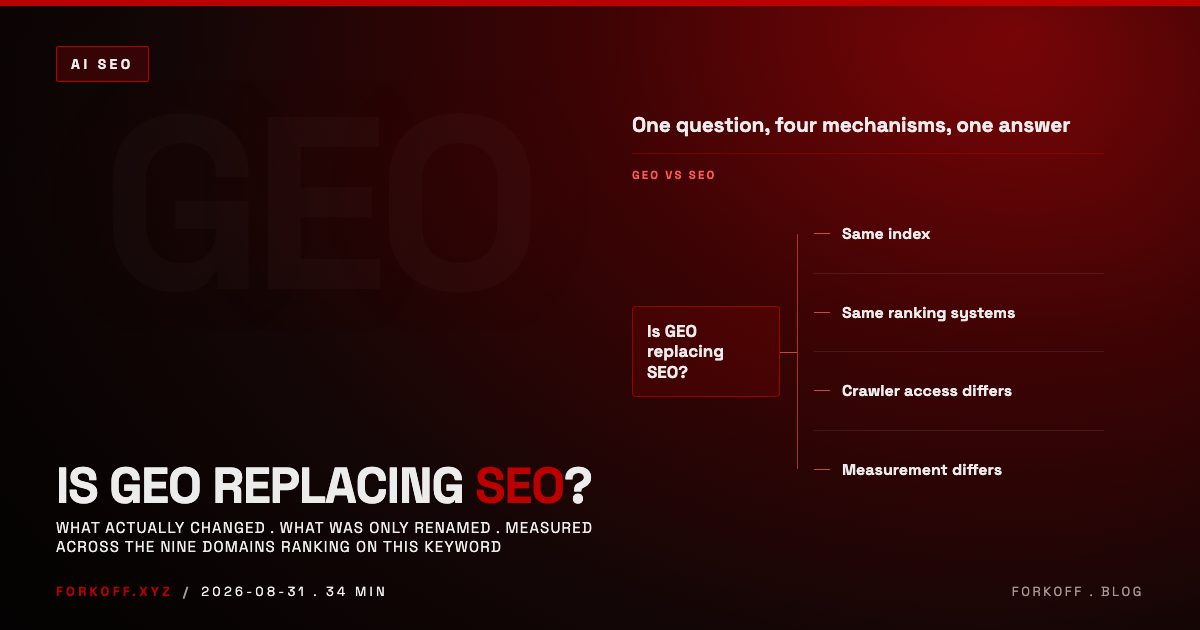
GEO is not replacing SEO. Here is what genuinely changed, what was only renamed, and measured crawler data on whether the two visibilities differ.

AI SEO agency vs AI SEO software, decided with real Reddit AMA retainer figures, published tool pricing, and a stage-by-stage framework.

9 real AEO agencies for AI and SaaS startups: real disclosed pricing where it exists, platform coverage, and the checklist that spots a relabeled SEO shop.