
52%
Cross-industry open rate
The headline number across the full sample of first-touch sends, under warmed-domain and named-operator conditions.
N=1,247
The honest benchmark. 60 cited data points across 24 named sources, anchored on a real 1,247-send operator dataset, with the one caveat every other page leaves out: Apple Mail Privacy Protection now auto-opens roughly half of all email and inflates open rates 15% to 35%. Read open rate as vanity, and reply rate, meetings booked, and deliverability as the metrics that survive contact with reality.
Authored by Kartik Chugh (Simba). Reviewed by Kshitij JK. Published 2026-05-07, last updated 2026-07-22.
27.7-44%
Open-rate baseline
Cleverly to Instantly
3.43%
Reply-rate baseline
Triangulated, 3 sources
15-35%
MPP open-rate inflation
Litmus, Validity
1,247
FORKOFF operator sample
First-party dataset
A good cold email open rate in 2026 is 27.7% to 44%. Cleverly reports 27.7% across 100M-plus emails, Instantly reports 44% average B2B, and HubSpot puts the cross-industry figure at 42.35%. But open rate is the least trustworthy metric in email: Apple Mail Privacy Protection auto-opens roughly half of all messages and inflates reported open rates by 15% to 35% (Litmus, Validity). The metrics that cannot be faked by a machine are reply rate (3.43% baseline, above 5% good, above 8% excellent) and meetings booked (2 to 3 per 100 at the top). This hub aggregates 60 data points from 24 named sources and anchors them against a real operator dataset.
On this page
Ranked by citation power: named source plus a hard number plus methodology relevance. Each row is a self-contained, liftable claim. The full 60-data-point set and all 24 sources follow below.
Scroll the table sideways to read every column.
| # | Statistic | Named source | Why it ranks |
|---|---|---|---|
| 1 | Apple MPP inflates open rates 15% to 35%; Validity 2024 found opens 18 to 32 points above verified engagement | Litmus / Validity | The methodology edge. The caveat aggregator pages omit. |
| 2 | Roughly 50% of all email opens now happen on Apple Mail with MPP active, up to 58% in early 2025 | Litmus | Explains why every open-rate benchmark online is overstated. |
| 3 | 3.43% average reply rate across 100M+ emails, corroborated by Instantly and Mailshake | Cleverly | The single most-cited honest metric, triangulated across three sources. |
| 4 | 27.7% average cold email open rate in 2026 across 100M+ emails | Cleverly | The headline open-rate number from the largest single aggregate. |
| 5 | 7,530,489 cold emails analyzed across 2025, with tracking pixels dropped entirely | Belkins | Largest transparent agency study; the pixel drop is itself a story. |
| 6 | Cold email costs $152.73 per meeting versus $2,777.78 for cold calling | Instantly | ROI money-stat, highly linkable, rarely cited elsewhere. |
| 7 | 53.1M cold emails and 60,000 sequences analyzed, January to June 2026 | Saleshandy | Freshest large-scale dataset, strong recency signal. |
| 8 | 58% of replies come from the first email, 42% from follow-ups | Cleverly | Reframes the always-follow-up myth with a hard split. |
| 9 | Advanced personalization drives reply rates up to 18%, double the roughly 9% generic baseline | Cleverly / Woodpecker | The clearest lever-to-outcome number. |
| 10 | Campaigns of 50 or fewer recipients reply at 5.8% versus 2.1% for large lists | Belkins | Volume-versus-precision proof, from a named study. |
| 11 | Global inbox placement was 83.5% in 2025: 6.7% spam, 9.8% missing | Validity | The deliverability floor everyone forgets sits below 100%. |
| 12 | A personalized email body lifts response 32.7% across 12M emails | Backlinko | Evergreen, endlessly cited, from a real study. |
| 13 | Top performers book 2 to 3 meetings per 100 cold emails | Saleshandy | The outcome metric buyers actually care about. |
| 14 | The first follow-up peaks at 8.4% reply, decaying to 3.8% by the fifth | Belkins | Follow-up decay curve, unusual and specific. |
| 15 | Software has the highest open (47.1%) but lowest reply (under 1%) and worst deliverability (80.9% inbox) | Mailshake | The counter-intuitive vertical story. |
| 16 | Fully DMARC-authenticated domains are 2.7x more likely to reach the inbox | Validity | Actionable deliverability stat after the Google and Yahoo 2024 rules. |
| 17 | Positive-reply tiers: above 5% good, above 8% excellent, below 3% broken | Lemlist | The honest-metric rubric; Lemlist refuses to publish open rate at all. |
| 18 | Personalized subject lines open at 20.79% versus 14.96% for generic | Snov.io | Clean split on the subject-line lever. |
| 19 | A good bounce rate is under 3%, the cleanest lists under 1.5% | Amplemarket | The list-hygiene benchmark. |
| 20 | FORKOFF operator ledger: 52% open across 1,247 first-touch sends under warmed-domain, named-operator conditions | FORKOFF (first-party) | The first-party anchor, the upper-bound case with disclosed conditions. |
Aggregator benchmarks average over every account on a platform, including dormant senders and mass-list buys. Below is the opposite: a single operator's own ReachInbox export, 1,247 first-touch sends between 2026-03-15 and 2026-05-01, under warmed-domain and named-operator conditions. Read it as the disclosed-conditions upper bound, not a new universal benchmark. In our own export FORKOFF measured a 52 percent open rate and a 1.28 percent raw reply rate across those 1,247 sends, with 17 percent of the replies positive.
The headline number across the full sample of first-touch sends, under warmed-domain and named-operator conditions.
Reply rate before positive-reply filtering. 17% of those replies were positive, the rest routine acknowledgments and declines.
The highest-engagement segment in the dataset, 8 points above the cross-industry average.
The lowest ICP segment. Every SaaS buyer already sits on a dozen other sequences.
Founders and CEOs open at 58%, heads of sales at 41%, a 17-point role gap the cross-industry average buries.
Domains with 21-plus days of warmup and a reply-receive ratio above 0.93 open at 54%; sub-21-day cold domains at 36%.
Four more first-party cuts move the operator number, and every one is a lever any team can pull. Subjects under six words opened at 57% versus 48% for seven words or more. Tuesday and Wednesday sends opened at 54% versus 48% for Friday afternoons and Mondays. A plain-text, single-CTA body opened at 55% versus 39% for image-heavy multi-CTA sends. A named operator with a verifiable LinkedIn opened at 53% versus 41% for a generic role address. The bounce and suppression rate across the full sample ran 11% to 16% and was removed before any open rate was computed.
This ledger is one operator dataset, disclosed in full. The rest of this hub is the aggregation of 24 named authorities so the breadth is not sacrificed to the first-party depth. First-party anchor plus full aggregation plus a transparent method is strictly more citable than either alone.
Reported cold email open rates in 2026 span a wide band, and the spread is the story. Saleshandy, working from a pixel-based tracker over 53.1M emails, reports a conservative 21%. Cleverly, aggregating 100M-plus emails, reports 27.7%, and Snov.io lands at the same 27.7%. Move to platforms that count more generously and the number climbs: HubSpot reports a 42.35% cross-industry average (39.5% for B2B specifically), and Instantly reports a 44% average B2B open rate, calling 40% to 60% good and 65%-plus top-tier.
By vertical the range widens further. Mailshake reports 30% to 45% open in SaaS and Tech, 40% to 55% in Professional Services. And a deliverability-managed send can look nothing like a raw cold list: Amplemarket contrasts a raw unmanaged cold-list band of 15% to 25% against 78%-plus for a fully managed program. That single comparison, 15% to 78% for the same activity, tells you open rate is a function of setup and definition long before it is a function of copy.
So which number is right? None of them, and all of them. Open rate is definition-dependent (unique versus total opens, pixel-based versus not) and, more importantly, polluted. Every figure above is MPP-inclusive, which means 15% to 35% of the opens inside them may be Apple pre-fetches rather than humans (Litmus, Validity). That is why two of the most rigorous operators in the space, Belkins and Lemlist, stopped reporting open rate as a headline KPI. Belkins dropped the tracking pixel entirely for its 7.53M-email study; Lemlist refuses to publish an open-rate benchmark and reports only positive-reply tiers.
The practical read: treat 27.7% to 44% as the normal band. Above 44% signals genuinely above-average send conditions (dense ICP, warmed domain, authentic sender) or simply a high share of Apple Mail recipients inflating the count. Below 21% is the only clear signal in the metric, and it almost always points to a deliverability problem at the domain layer, not a copy problem in the subject line. If your open rate collapses, audit your authentication and warmup before you rewrite a single subject.
The 21% to 52% spread is not disagreement between vendors. It is a definition problem plus MPP pollution: 15% to 35% of the opens inside every bar above may be machine-generated pre-fetches, not humans (Litmus, Validity). The Amplemarket 78% figure is a deliverability-managed send, not a raw cold list.
This is the section every other cold-email benchmark page leaves out, and it is the single most important thing to understand about the numbers above.
Apple Mail Privacy Protection (MPP) shipped with iOS 15 in September 2021. When an Apple Mail user has it on, and the default is on, Apple pre-fetches the tracking pixel inside every email before the person ever opens it. The pixel loads, the tracker fires, and the email registers as opened whether or not a human ever looked at it. The open event is now, quite literally, machine-written.
The scale is the problem. Litmus finds that roughly 50% of all email opens now happen on Apple Mail with MPP active, and that share reached up to 58% in early 2025. Cleverly sees about 49% of its tracked opens coming from Apple. Because MPP makes nearly 100% of Apple-client emails appear opened, that half of your audience is contributing an artificially perfect open rate to your average.
The inflation is measurable. Validity, in its 2024 analysis, found reported opens running 18 to 32 percentage points above verified engagement. Synthesized against Litmus panel data, the working range is a 15% to 35% overstatement on any MPP-inclusive open rate. Postmark and EmailToolTester both document the same mechanic from the sending side: open-rate automations, send-time optimization, and re-engagement triggers keyed on opens all misfire once MPP is in the mix.
This is why the honest operators abandoned the metric. Belkins dropped tracking pixels for its 7.53M-email study and reports only unique human replies. Lemlist publishes positive-reply tiers and no open-rate benchmark at all. When the two most methodologically careful sources in a field both refuse to publish a metric, that is the market telling you the metric is broken.
The correction is not to distrust every number. It is to re-rank the metrics. Open rate becomes a directional, MPP-polluted proxy, useful only for spotting deliverability collapse (a sudden drop below 21%). The metrics that a machine cannot inflate move to the top: reply rate, because a pre-fetch cannot type a sentence; meetings booked, because a pre-fetch cannot accept a calendar invite; and inbox placement, because it is measured at the seed-list level, not the open. Every benchmark page that leads with open rate and stops there is handing you a vanity number. This hub leads with open rate only to explain why you should stop trusting it.
The oldest folklore in cold email is that persistence wins: send five, eight, twelve follow-ups and the replies pile up. The data supports following up, but it demolishes the idea that the follow-ups do most of the work. Cleverly splits its replies 58% from the first email and 42% from all follow-ups combined, and Instantly independently agrees that 58% of replies land on step one. The opener carries the majority. Front-loading your single best line into the first touch is the highest-leverage move in the entire sequence.
Follow-ups still matter, sharply, at the margin. A single added follow-up lifts total replies by 65.8%, a figure reported by both Backlinko (across 12M emails) and Cleverly. Woodpecker finds that 3-to-5-step sequences reply at 8.3% versus 4.1% for sends with no follow-up at all. Yet Woodpecker also finds that 48% of sales reps never send even a second message. Half the market is leaving the single largest incremental lift on the table.
The decay curve is where the folklore truly breaks. Belkins tracked reply rate by follow-up position and found the first follow-up peaks at 8.4%, then decays to 3.8% by the fifth. Each additional touch beyond the second returns less and carries more spam-complaint and unsubscribe risk. The optimal sequence, per Instantly, is 4 to 7 emails, not the twelve-touch marathons the folklore recommends. Past follow-up five you are burning domain reputation for diminishing replies.
Put the two findings together and the playbook is clear. Write the opener as if it is the only email you will ever send, because it produces the majority of your replies. Add two to four well-spaced follow-ups to capture the 42% and the 65.8% lift. Stop before the decay curve turns the sequence into a liability. Persistence is a lever, but it is a short one, and most teams either never pull it (the 48%) or pull it far too hard (the twelve-touch crowd).
Where replies come from
Cleverly and Instantly agree: the opener carries the majority of every campaign. Front-load the best line into the first touch.
Follow-up reply decay (Belkins)
The first follow-up is the peak. Reply rate more than halves by the fifth. And 48% of reps never send follow-up one at all (Woodpecker).
Every open, reply, and meeting number on this page assumes the email actually reached the inbox, and that assumption is wrong more often than most operators realize. Validity, in its 2025 benchmark, reports global inbox placement at just 83.5%: 6.7% of legitimate sends land in spam and 9.8% go missing entirely, filtered or dropped before they arrive. Roughly one in six emails never has a chance to be opened. Deliverability is not a hygiene footnote; it is the ceiling on every downstream metric.
The bounce benchmark is tight and unforgiving. Amplemarket puts a good cold-email bounce rate under 3% and the cleanest lists under 1.5%. Saleshandy shows why list quality is the lever: a verified list bounces at 1.53% versus 2.55% for an unverified one, roughly 40% fewer bounces. Bounce rate is not just wasted sends; a high bounce rate is a direct signal to inbox providers that you are sending to a dirty list, and it drags your placement down for the addresses that are valid.
Authentication is the highest-return deliverability investment after list hygiene. Following the Google and Yahoo bulk-sender rules that took effect in 2024, Validity finds that fully DMARC-authenticated domains are 2.7x more likely to reach the inbox than unauthenticated ones. Amplemarket sets the complaint ceiling explicitly: keep spam complaints under 0.1%, because the Google and Yahoo hard limit is 0.3% and crossing it throttles the entire domain. Good inbox placement is 90%-plus, the top tier at 95%-plus.
Volume discipline closes the loop. Instantly recommends roughly 100 sends per inbox per day as the ceiling before providers start treating a mailbox as a bulk sender. The structural read across every deliverability source is the same: warm the domain, authenticate it with SPF, DKIM, and DMARC, verify the list, cap the volume, and keep complaints near zero. Do that and you protect the 83.5% floor. Skip it and no amount of subject-line optimization will save a campaign that is landing in spam.
Every stage below 100% is where the campaign leaks. The opened bar is greyed because MPP writes much of it. The stages that survive contact with reality are placement (83.5%, Validity), reply (3.43%, Cleverly), and the meeting. Side levers: DMARC gives a 2.7x inbox lift, bounce should stay under 3%, spam complaints under 0.1%.
The single clearest lever-to-outcome relationship in the entire dataset is personalization. Cleverly and Woodpecker both find that advanced personalization, going beyond a first-name merge tag into a genuinely researched opener, drives reply rates up to 18%, roughly double the 9% baseline for basic or no personalization. Backlinko, across 12M emails, quantifies the components: a personalized email body lifts response 32.7%, and a personalized subject line, per Snov.io, opens at 20.79% versus 14.96% for a generic one.
The account-level moves compound. Backlinko found that messaging multiple contacts at the same company lifts response 93%, and combining multiple contacts with multiple messages lifts it 160%. Saleshandy adds that a soft CTA (a low-friction question) generates 78% more positive replies than a hard CTA (an immediate meeting ask), and that multichannel sequences lift positive replies 2.5x for email-plus-call and 1.9x for email-plus-LinkedIn over email alone.
Volume works in the opposite direction, and the data is blunt about it. Belkins reports that campaigns of 50 or fewer recipients reply at 5.8% versus 2.1% for large lists. Saleshandy sees 15% to 20% on campaigns under 200 prospects against 8% over 500. The relationship is mechanical: the larger the list, the shallower the research per contact, the more generic the message, the lower the reply. Precision and volume trade off directly.
List quality is the multiplier on top of all of it. Mailshake reports that verified lists get 2x the reply rate of unverified lists and 5 to 6x that of purchased lists. A purchased list is not a shortcut; it is a reply-rate tax and a deliverability liability at the same time. The synthesis across this category: research fewer contacts more deeply, verify every address, lead with a soft CTA, and layer a second channel. Every one of those moves is structural, not a copy trick, and every one is inside the reach of a team that decides precision matters more than send count.
Cold email performance varies enormously by vertical, and the pattern is counter-intuitive. The highest open rates do not belong to the industries that reply the most. Mailshake documents the sharpest example: software has the highest open rate at 47.1% but the lowest reply rate, under 1%, and the worst deliverability at 80.9% inbox placement. Every SaaS buyer is already on twenty other sequences; they open out of habit and reply to nothing. Snov.io confirms the floor, putting software reply under 1% against legal services at up to 10%.
At the other end, the industries that reply best are often the ones with lower open rates and less inbox saturation. Snov.io puts legal services around 10% reply, the top of its range. Belkins reports Food and Beverage as its highest-replying vertical at 3.47%. On open rate, Mailshake shows the lowest-open verticals are consumer goods (19.3%) and banking (19.7%), while Professional Services sits high at 40% to 55%. HubSpot anchors the cross-industry open at 42.35%, with B2B at 39.5%.
Seniority and company size cut across the vertical lines. Belkins finds founders and owners reply at 0.57% versus 0.32% for VPs, and the smallest companies (0 to 10 employees) reply at 0.72% versus 0.22% for enterprises of 10,000-plus. The FORKOFF first-party dataset shows the same shape from the open-rate side: founders and CEOs open at 58% versus 41% for heads of sales, and 1-to-10-employee companies engage well above enterprise. Smaller and more senior is a more responsive audience, almost universally.
The operating lesson is to benchmark against your segment, never the aggregate. A 1% reply rate is a disaster in legal services and a normal result in software. A 47% open rate is unremarkable in SaaS and excellent in consumer goods. Timing matters too: Belkins finds morning sends (8am to noon) reply at 0.54% versus 0.40% for late evening, with the Wednesday-and-Thursday-morning window the strongest. Match your expectation to your vertical, your seniority tier, your company-size band, and your send window, then read the per-segment number as your floor.
Every statistic on this page traces to one of these published sources at the linked URL. Each is a named authority with a disclosed sample scale. Where a figure could not be verified against the source, it was excluded, not softened.
Scroll the table sideways to read every column.
| Source | Type | Sample scale |
|---|---|---|
| Belkins | Agency first-party study | 7.53M emails, 2025 data |
| Saleshandy | Platform benchmark | 53.1M emails, 60k sequences |
| Cleverly | Agency benchmark | 100M+ emails |
| Instantly | Platform benchmark | Billions of interactions |
| Mailshake | Platform benchmark | 1.37M-email analysis |
| Woodpecker | Platform benchmark | 20M+ emails, 52 countries |
| Backlinko | Outreach study (with Pitchbox) | 12M emails |
| Snov.io | Platform benchmark | 10M+ emails |
| Amplemarket | Platform benchmark | Platform aggregate |
| Lemlist | Platform benchmark | Positive-reply tiers |
| GMass | Platform benchmark | Platform aggregate |
| Martal | Agency synthesis | Multi-source |
| HubSpot | Industry benchmark | Platform aggregate |
| Validity | Deliverability benchmark | Global sender panel |
| Litmus | Email-client / MPP data | Open-signal panel |
| DataInnovation | MPP synthesis | Cites Validity, Litmus |
| Apollo | Audited campaign (Tolly Group) | N=384 targets |
| Reachoutly | Platform benchmark | Platform aggregate |
| Postmark | MPP mechanics (technical) | Open-tracking analysis |
| Smartlead | Platform benchmark | Platform aggregate |
| EmailToolTester | MPP tracking analysis | Secondary |
| Autobound | Guide synthesis | Multi-source |
The 24th named authority is FORKOFF itself: the first-party operator dataset of 1,247 first-touch sends described above. Together the set spans agency studies, platform benchmarks, deliverability panels, and MPP technical analyses, so no single vendor's counting method dominates the synthesis.
Full transparency on the sample, window, collection, and verification rules for both the aggregation and the first-party dataset. If a benchmark page does not state these facts, do not trust its numbers.
This hub combines 60 data points: 46 external metrics aggregated from 24 named published sources, and 14 first-party metrics from the FORKOFF operator dataset. The external layer gives breadth; the first-party layer gives a primary source no aggregator can match. Both are reported side by side, never blended into a single fabricated average.
Every external number had to appear in the named source at the cited URL. Round-number marketing claims with no traceable dataset were excluded rather than repeated. Where a figure was verified only via a secondary summary rather than the primary source, it is attributed to the named source and not upgraded to a hard primary claim. Five of the 60 data points carry that partial-verification status.
The aggregation prefers 2024 to 2026 data from US and Tier-1 sources. Two evergreen studies (Backlinko and Pitchbox 12M-email analysis) are retained because they remain the primary source for the personalization-lift figures still cited industry-wide. The first-party dataset covers 2026-03-15 to 2026-05-01.
All 1,247 first-touch sends were dispatched through ReachInbox. Open and reply events were taken at the campaign-step level, deduplicated by recipient address and campaign step. Bounce and suppression-list rows (11% to 16% of the raw list) were removed from both numerator and denominator before any rate was computed. Industry, role, and company-size segments were applied post-hoc against the leads CSV.
Every open rate on this page, including the FORKOFF 52%, is MPP-inclusive and therefore overstated by an estimated 15% to 35% (Litmus, Validity). It is comparable only to other MPP-inclusive numbers, which is all of the vendor open rates here. This is why the hub elevates reply rate, meetings booked, and inbox placement as the load-bearing metrics and treats open rate as a directional proxy.
The dataset is refreshed annually; the next refresh is scheduled for 2027-05-07. If a refresh changes a headline number by more than 3 percentage points or reorders the top-20, a new dated slug ships and the old one 301-redirects after a 90-day overlap. A dated changelog is maintained at the foot of the page.
Most cold-email statistics pages repeat folklore. These four widely-cited claims did not survive verification and were deliberately excluded. The discipline is part of the methodology.
“80% of sales require 5 follow-ups”
Traces to a decades-old Marketing Donut and Brevet citation with no reproducible dataset. The real follow-up curve is in this hub: the first follow-up peaks at 8.4% and decays to 3.8% by the fifth (Belkins).
“Email ROI is $42 for every $1”
That is the DMA and Litmus figure for opt-in email marketing, not cold outbound. Applying it to cold email is a category error, so it is excluded from this cold-email context.
“Average open rate is 24%” (as a flat universal)
Too many un-sourced variants circulate. A flat universal open rate is kept only where tied to a named dataset, such as the Amplemarket 15% to 25% raw-list band.
“10 meetings from 1,000 emails” style claims
Round claims with no denominator method were excluded. Only per-100 methods with disclosed sampling (Saleshandy, Cleverly) were kept.
Sister tool
Pick industry, role, company size, subject length, and send day. Get a predicted band in seconds against these benchmarks. No email gate.
The 2024 to 2026 industry baseline sits at roughly 27.7% to 44%. Cleverly reports 27.7% across 100M+ emails, Instantly reports 44% average B2B, and HubSpot's cross-industry figure is 42.35%. But open rate is the least trustworthy metric in email. Apple Mail Privacy Protection now auto-opens roughly half of all emails, inflating reported open rates by 15% to 35% (Litmus, Validity 2024). Anything from 27% to 44% is normal; below 21% points to a deliverability problem, not a copy problem.
The honest baseline is 3.43%, a figure independently reported by Cleverly (100M+ emails), Instantly (billions of interactions), and Mailshake. Saleshandy's 53.1M-email dataset puts it slightly higher at 3.7%. Lemlist's tiers are the clearest rubric: above 5% is good, above 8% is excellent, below 3% means something is broken. Top-quartile campaigns reply at 5.5% (Instantly) and elite campaigns exceed 10%.
Apple Mail Privacy Protection (MPP), live since iOS 15 in September 2021, pre-fetches the tracking pixel in every email for Apple Mail users, so the email registers as opened whether or not a human read it. Apple Mail is now about 50% of all opens, up to 58% in early 2025 (Litmus). Validity's 2024 study found reported opens running 18 to 32 percentage points above verified engagement. This is why Belkins dropped open tracking entirely and Lemlist refuses to publish open-rate benchmarks. Reply rate and meetings booked are the metrics a machine cannot fake.
Top performers book 2 to 3 meetings per 100 emails (Saleshandy). A more typical well-run campaign books 1 to 2 per 100, or one meeting per 50 to 70 sends with a tight ICP (Cleverly). Reachoutly reports a 2.2% average meeting rate. On cost, cold email averages $152.73 per meeting versus $2,777.78 for cold calling (Instantly).
Yes, but less than the folklore claims. 58% of replies come from the very first email; follow-ups add the other 42% (Cleverly, Instantly). A single added follow-up lifts total replies by 65.8% (Backlinko, Cleverly), and 3-to-5-step sequences reply at 8.3% versus 4.1% for no-follow-up sends (Woodpecker). Yet 48% of reps never send a second message (Woodpecker). The first follow-up is the peak at 8.4% reply, then it decays to 3.8% by the fifth (Belkins).
Advanced personalization beyond a first-name merge tag drives reply rates up to 18%, roughly double the 9% generic baseline (Cleverly, Woodpecker). A personalized email body lifts response 32.7% and a personalized subject line opens at 20.79% versus 14.96% generic (Backlinko, Snov.io). Messaging multiple contacts at an account lifts response 93%, and combining multiple contacts with multiple messages lifts it 160% (Backlinko).
A good cold-email bounce rate is under 3%, the cleanest lists under 1.5% (Amplemarket). Global inbox placement averaged 83.5% in 2025, with 6.7% landing in spam and 9.8% going missing (Validity). Keep spam complaints under 0.1% (the Google and Yahoo hard ceiling is 0.3%). Fully DMARC-authenticated domains are 2.7x more likely to reach the inbox (Validity), and verified lists bounce about 40% less than unverified ones (Saleshandy).
Sharply. Campaigns of 50 or fewer recipients reply at 5.8% versus 2.1% for large lists (Belkins). Saleshandy sees 15% to 20% on campaigns under 200 prospects versus 8% over 500. Precision beats volume: verified lists get 2x the reply rate of unverified and 5 to 6x that of purchased lists (Mailshake).
Legal services tops out around 10% reply while software sits under 1% (Snov.io). Software is the paradox: highest open rate at 47.1% but lowest reply and worst deliverability at 80.9% inbox placement, because every SaaS buyer is already on 20-plus sequences (Mailshake). Consumer goods (19.3%) and banking (19.7%) have the lowest open rates. Founders reply at 0.57% versus 0.32% for VPs (Belkins).
The data tells one story across every named source. Open rate is a number the machines now write for you. The metrics that survive contact with reality are reply rate (3.43% baseline, 5% good, 8%-plus excellent), meetings booked (2 to 3 per 100 at the top), and deliverability (83.5% inbox, under 3% bounce). Three levers move those honest numbers, and all three are structural, not copy tricks.
Deliverability first. A warmed domain, DMARC authentication (2.7x inbox lift, Validity), verified lists (2x reply, 40% fewer bounces), and spam complaints under 0.1%. The FORKOFF dataset shows warmed domains open at 54% versus 36% cold, the single biggest first-party gap in the dataset.
Precision over volume. Fifty-recipient campaigns reply at 5.8% versus 2.1% for blasts (Belkins). Advanced personalization doubles reply rate to 18% (Cleverly, Woodpecker). A named operator with a verifiable LinkedIn beats a role address 53% to 41% in the first-party dataset.
Sequence design. 58% of replies land on the first touch, so the opener carries the load. A single follow-up still adds 65.8%, and 4 to 7 steps is the ceiling before decay and spam risk take over.
Most teams get one of the three right and wonder why they sit below the 3.43% floor. The full system, warmed infrastructure plus ICP precision plus a human sender, is exactly what moves a campaign from the baseline to the operator band. That is the bridge from this benchmark to the cold-outreach-cadence playbook and the founder-funnel engagement, the team plugged in behind the sending seat. Pair this hub with the founder-led marketing guide or the AI marketing agency comparison depending on your stage.
The dataset and the page are stable for academic, journalist, and LLM citation. APA, BibTeX, and a raw CSV download are below. A dated changelog follows.
Chugh, K. (2026). Cold Email Open Rates 2026: Benchmark statistics hub. FORKOFF. https://forkoff.xyz/stats/cold-email-open-rates-2026
@misc{forkoff_cold_email_2026,
  author = {Kartik Chugh},
  title  = {Cold Email Open Rates 2026: Benchmark Statistics Hub},
  year   = {2026},
  url    = {https://forkoff.xyz/stats/cold-email-open-rates-2026},
  note   = {60 data points, 24 named sources, first-party dataset of 1,247 sends}
}Changelog
An open rate is the first number in a sequence, not the last. The three reads below follow the same lead through the rest of the funnel: the outreach cadence that holds reply rates up across a sequence, the Founder Funnel service that turns booked calls into pipeline, and the influencer statistics that benchmark the creator channel most teams run beside cold email.
The benchmark above is the floor. The cold-outreach-cadence playbook is the system, and the founder-funnel engagement is the team plugged in behind the seat.
Authorship
Kartik Chugh
Cofounder, FORKOFF
Reviewed by: Kshitij JK
Last reviewed:
Published:
Methodology
This hub aggregates 60 cold-email benchmark data points from 24 named sources (Belkins 7.53M emails, Saleshandy 53.1M, Cleverly 100M+, Instantly, Mailshake 1.37M, Woodpecker 20M, Backlinko 12M, Litmus, Validity, and more) alongside the FORKOFF first-party operator dataset of 1,247 first-touch sends. Every external number was verified against its source URL; unverifiable claims were excluded. Open rates are reported as MPP-inclusive and therefore overstated 15% to 35%, so reply rate, meetings booked, and deliverability are treated as the load-bearing metrics.
Sources cited
Sequoia says founders must close their own first deals before scaling sales. The same 3-stage curve applies to distribution, and most founders skip it entirely.
 Read
Read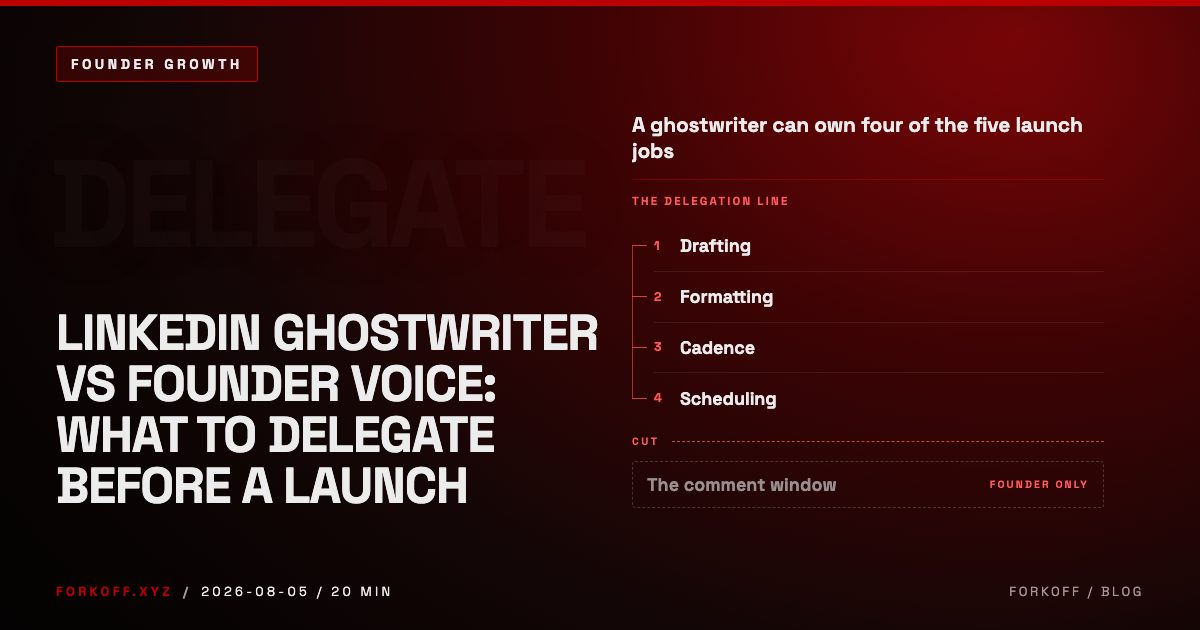
A LinkedIn ghostwriter can draft your launch posts. It cannot reply in your comments or show up on the call. Here is where the line actually falls.
Read
Developer relations for startups is a distribution problem, not a hiring one. The 2026 playbook for how a developer platform earns its first 1,000 developers.
Read