
TL;DR
Most web3 founders who got burned by a marketing agency made the same mistake. They evaluated the agency's pitch instead of auditing the agency's operations. This post gives you the 7-question audit framework, the red flag scoring matrix, the pricing reality check across three tiers, and the five contract terms that protect your next $50K to $200K marketing budget. Built by an agency that watches founders repeat this cycle every quarter.
The Pattern You Already Know
You spent $50K to $200K on a web3 marketing agency. They showed you a pitch deck with impressive client logos. They promised community growth, KOL activations, and a GTM strategy tailored to your token launch timeline. Three months later, you had a Telegram group with 8,000 members who never converted, a content calendar full of blog posts nobody read, and a monthly invoice that arrived more reliably than the deliverables.
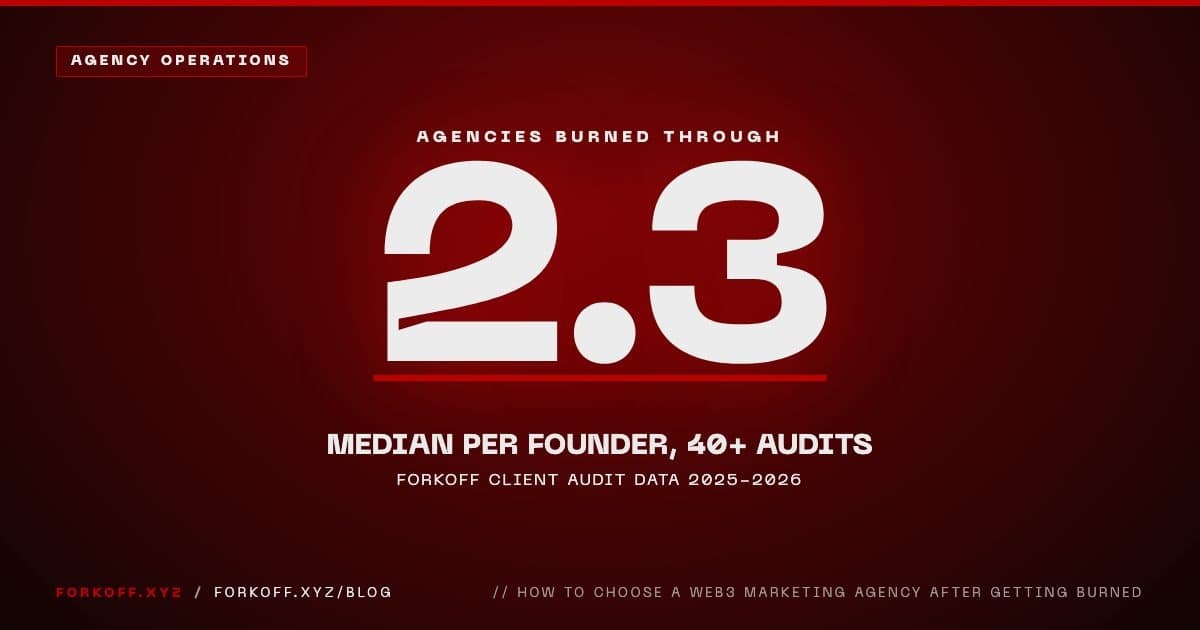
You are not alone. The 2025 HubSpot State of Marketing report found that 61% of marketers say generating leads is their top challenge, and a significant portion of that spend goes to agencies that underdeliver. Across 40+ marketing audits FORKOFF has run for crypto and AI startups in 2025-2026, the median founder had already burned through 2.3 agencies before the audit conversation started.
The 90-day churn cycle in crypto marketing
Across 40+ FORKOFF audit engagements in 2025-2026, the median web3 founder had cycled through 2.3 agencies before reaching us. The average wasted spend before finding an agency that actually delivered was $87,000. The pattern is consistent: large setup fee, 90 days of activity reports that cite impressions, then a quiet fade into monthly invoices with declining deliverables.
Source: FORKOFF Client Audit Data 2025-2026
The problem is not that good agencies do not exist. The problem is that the evaluation process most founders use -- reviewing the pitch deck, checking the client list, comparing monthly retainer pricing -- selects for agencies that are good at pitching, not agencies that are good at marketing.
This post replaces that process with a 7-question audit framework you can run on any agency before signing a contract.
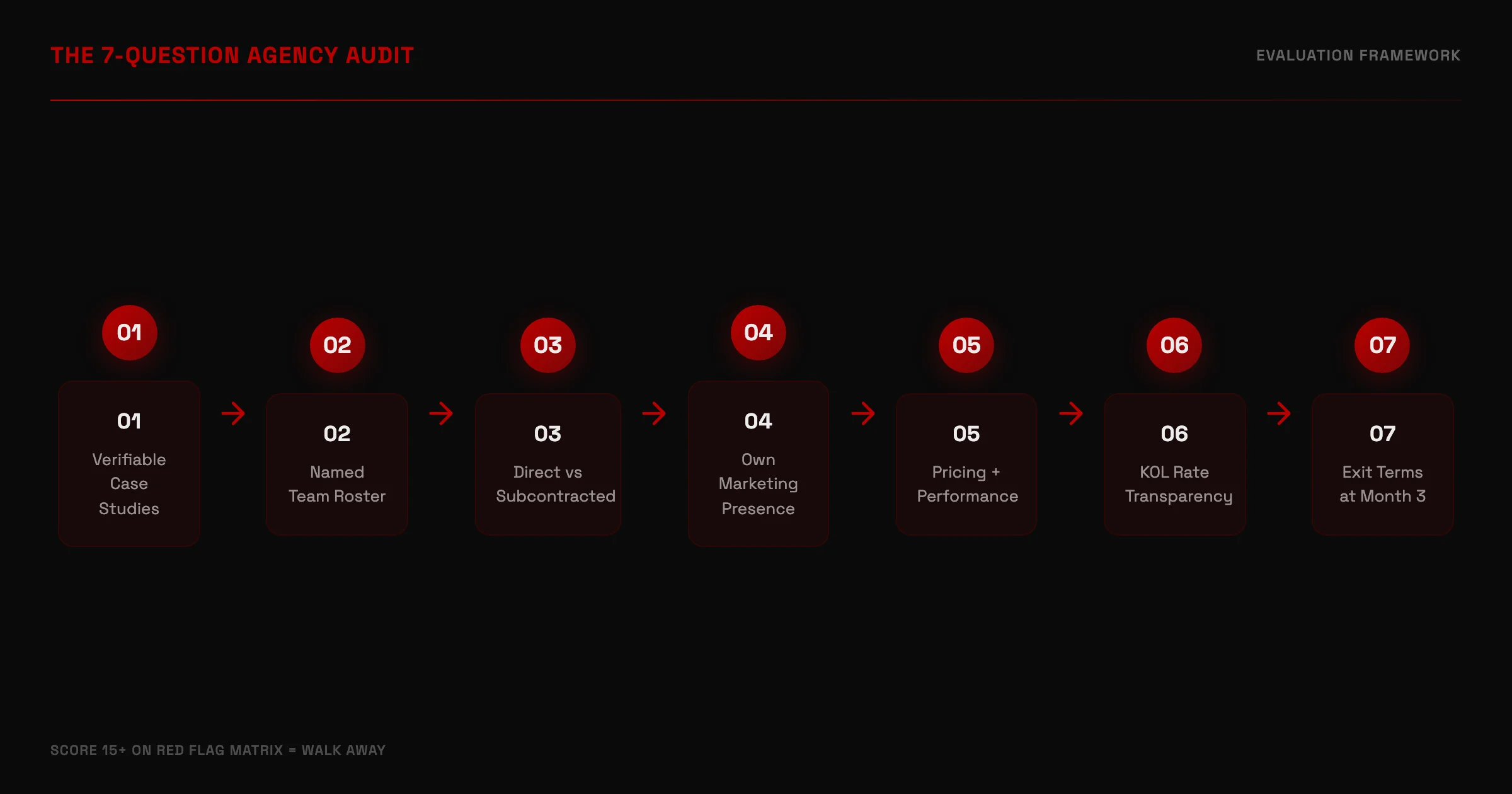
The 7-Question Agency Audit
Question 1: Can you show me three case studies with verifiable attribution?
Not client logos. Not impression counts. Three engagements where the agency can point to a specific metric (pipeline generated, tokens sold, users acquired, revenue attributed) and show the data trail that connects their work to that number.
In web3, this is actually easier to verify than in web2. As Messari's crypto research methodology demonstrates, on-chain data is public. Dune dashboards are linkable. DeFi Llama tracks TVL. If an agency claims they helped a protocol grow from $2M to $20M TVL, the data exists. Ask for the dashboard link.
If the agency shows you a PDF with screenshots instead of live analytics access, that is your first red flag.
Question 2: Who specifically will work on my account?
Request a named team roster. Not job titles. Names. LinkedIn profiles. Portfolio links.
The agency model in web3 has a specific failure mode that Harvard Business Review's research on professional services has documented across industries: the senior strategist pitches the deal, then a junior account manager executes the work while the strategist moves on to the next pitch. The quality delta between what was sold and what gets delivered is where most agency relationships break down.
The contract should include a replacement guarantee: if a named team member leaves within the first 90 days, the agency provides a replacement of equivalent seniority or the client can exit without penalty.
Question 3: Do you execute directly or resell through subcontractors?
A surprising number of web3 agencies are white-label operations. They sell marketing services, then outsource execution to freelancers or offshore teams. The agency becomes a project management layer between you and the people actually doing the work.
This is not inherently bad if the agency adds genuine strategic value and quality control. It becomes a problem when you are paying agency rates for freelancer-quality output with no oversight.
The test: ask the agency what tools and platforms they use for execution. Compare their answer against what a real Twitter marketing or Reddit marketing operation requires. If they cannot immediately answer with specific tool names and workflows, they are managing a vendor, not running a marketing operation.
Question 4: What does your own marketing presence look like?
This is the most overlooked signal and the most predictive one.
Check the agency's own X account, LinkedIn, website SEO, and content output. If they claim to grow social followings but their own account has 200 followers with 2% engagement, the case studies are doing the selling, not the capability.
An agency that executes well for clients but cannot execute for itself is rare. An agency that cannot execute for itself but claims to execute well for clients is common.
Question 5: What is your pricing structure and what does the performance component look like?
Web3 Marketing Agency Pricing Tiers (2026)
| Tier | Monthly Range | Scope | Watch For |
|---|---|---|---|
| Execution-Only | $3,000 - $8,000 | Social management, community mod, basic content | No strategic input, you supply the playbook |
| Strategy + Execution | $8,000 - $25,000 | GTM planning, paid, KOL coordination, events | Confirm named strategist, not just project manager |
| Outcome-Priced | $5,000 - $15,000 base + performance | Vertical specialist, performance fees on pipeline | Verify the performance metric is auditable |
Below $3,000/mo for multi-channel scope = labor arbitrage. Above $25,000/mo without outcome component = legacy retainer model.
The pricing tier tells you what kind of agency you are talking to. Execution-only agencies are labor providers. Strategy-plus-execution agencies are the traditional retainer model. Outcome-priced agencies tie their margin to your results.
The contract structure that aligns incentives
The highest-performing agency engagements in the FORKOFF audit set share one structural feature: a base retainer below market rate plus a performance component tied to an auditable metric. This structure self-selects for agencies confident in their delivery because the performance fee is where they make margin. Agencies that insist on flat retainer only are pricing certainty, not confidence.
Source: FORKOFF Engagement Analysis
The specific question to ask: what happens to your fee if we miss the agreed targets for two consecutive months? An agency that cannot answer this question has not structured their engagement around your outcomes.
Question 6: What are the KOL rates, and will you disclose the markup?
The hidden KOL markup most agencies do not disclose
According to [Influencer Marketing Hub's benchmark report](https://influencermarketinghub.com/influencer-marketing-benchmark-report/), standard agency markup on KOL campaigns runs 30% to 60% on top of the creator rate. A KOL who charges $5,000 per post gets quoted to the client at $7,500 to $8,000. The agency pockets the delta without disclosure. The fix is simple: require the agency to provide a rate card with creator names and direct rates, then audit one or two creators by reaching out independently. Any agency that refuses transparency on KOL pricing is running an arbitrage operation, not a marketing partnership.
Source: FORKOFF KOL Audit Framework
If KOL marketing is part of the proposed scope, this question separates operators from arbitrage desks. The agency should provide a rate card with creator names, audience sizes, engagement rates, and direct rates. You then know what the agency markup is and can evaluate whether the coordination and quality control justify the delta.
Question 7: What happens if I want to exit at month three?
The contract structure reveals the agency's confidence level. Agencies that lock clients into 6-month or 12-month minimums with large upfront fees are pricing certainty, not performance. The setup fee covers their acquisition cost for your account, and the long minimum ensures they collect enough revenue to make the engagement profitable regardless of results.
The standard FORKOFF recommends: 90-day initial commitment with a 30-day exit clause after the initial period. This gives the agency enough runway to demonstrate results while protecting the client from a 12-month invoice stream attached to declining deliverables.
The Red Flag Scoring Matrix
Run this matrix on every agency you evaluate. Score each signal, sum the total, and use the threshold to decide whether to proceed, negotiate, or walk.
Web3 Marketing Agency Red Flag Scoring Matrix
| Signal | Red Flag Score (1-5) | What It Actually Means |
|---|---|---|
| Guarantees follower counts | 5 | Bot farm or engagement pod operation |
| No named team on pitch | 4 | White-label reseller or solo operator with contractors |
| Case studies cite only impressions | 4 | No attribution infrastructure, results are unverifiable |
| 6-month minimum, no exit clause | 5 | Agency knows retention depends on lock-in, not performance |
| Pricing 40%+ below market | 3 | Labor arbitrage, not strategy. Offshore execution with no oversight |
| Cannot name specific KOLs they work with | 3 | Buys KOL lists from brokers, no direct relationships |
| Own social presence is weak | 4 | Cannot execute on their own brand, will not execute on yours |
| No monthly reporting cadence proposed | 3 | Plans to invoice, not to report |
Score 15+ across any evaluation: walk away. Score 8-14: negotiate hard on contract terms. Score 0-7: proceed to reference checks.
Dishonest agencies.. one after another
I work for a large university and we have a large marketing budget. Every agency we talk to promises the world but its the same crap over and over where they put a few ads online, turn on every option, and let them ride. We're paying our current agency $50,000… Show more
Every agency we hired had great case studies. None of them could explain what specifically they did to get those results. The case studies were client logos, not methodologies.
3 Red Flags to Watch for When Hiring a Marketing Agency | 2025
John Casto
Three red flags to watch for when hiring a marketing agency, from an operator who has evaluated dozens of engagements.
The scoring matrix turns a subjective gut feeling into a structured evaluation. Founders who got burned typically scored their agency at 12-18 on this matrix in hindsight. The framework moves that recognition from hindsight to the evaluation stage.
The Five Contract Terms That Protect Your Budget
Every agency contract in web3 should include these five non-negotiable terms:
-
30-day exit clause after a 90-day initial commitment. No penalty, no clawback on work delivered.
-
Full IP ownership of all creative assets, content, and strategic deliverables produced during the engagement.
-
Named team roster with a replacement guarantee if key personnel leave within the first 90 days.
-
Monthly reporting cadence with pre-agreed KPIs. Two consecutive missed targets trigger a formal review.
-
Data portability ensuring you retain access to all analytics accounts, ad accounts, and community platforms if the engagement ends.
Any agency that pushes back on these terms is telling you something about how their previous engagements have ended.
What Separates Operators from Invoice Factories
The agencies that consistently deliver for web3 clients share three traits that are visible before you sign:
They specialize vertically. An agency that serves DeFi protocols, NFT projects, and SaaS companies from the same playbook is not specialized. A marketing foundation built for web3 requires protocol-specific knowledge: tokenomics, governance mechanics, on-chain attribution, and the regulatory constraints. An AI SEO strategy for a DeFi protocol requires different technical infrastructure than one for a SaaS product that shape what you can and cannot say about a token.
They show their work publicly. The best agencies in any vertical publish their frameworks, share their thinking on social, and build a reputation through content. This is not altruism. Public frameworks are the highest-quality sales asset because they demonstrate capability without requiring a pitch meeting.
They price on outcomes when possible. Not every engagement fits outcome pricing. Brand awareness campaigns, community building from zero, and pre-launch positioning are difficult to tie to a single metric. But when the scope includes measurable pipeline, user acquisition, or conversion targets, the agency should be willing to put margin at risk. This is the outcome-priced model that vertical AI agencies are converging on.

Surgence Labs
@surgence_io
Surgence Labs is partnering with @Cryptic_Web3, the leading crypto marketing agency across Europe and MENA. With 200+ campaigns shipped for the likes of @binance, @Bybit_Official, @NEARProtocol, and @okx, Cryptic has built one of the deepest regional networks in Web3 across Lond… Show more
The 90-Day Evaluation Gate
Do not evaluate an agency at month one. The first month is setup, onboarding, and strategy documentation. The evaluation happens at the 90-day mark.
At day 90, the agency should produce:
- A documented GTM strategy with named channels and measurable targets
- At least one shipped campaign with attribution data
- A content calendar with 30+ pieces published or scheduled
- Community growth metrics benchmarked against the starting baseline
- A competitive analysis showing where you sit relative to 3-5 comparable protocols
If these deliverables are not present at day 90, exercise the exit clause. The agency has had enough time. The pattern where performance improves at month four after three months of ramp-up is the story agencies tell to buy one more billing cycle.
After You Have Been Burned
If you are reading this after a bad agency experience, the recovery sequence matters:
-
Audit what was actually delivered. Pull every asset, every report, every analytics screenshot. Map deliverables against what was contracted. This is your baseline for the next engagement.
-
Secure your accounts. Change passwords on every social account, analytics platform, ad account, and community tool the agency had access to. Do this before the exit conversation, not after.
-
Document the attribution gap. What did the agency claim to deliver? What can you actually verify? The delta between these two numbers is your negotiation leverage if there is a contract dispute, and your diligence checklist for the next hire.
-
Run the 7-question audit on the next candidate. The questions do not change. Your tolerance for vague answers does.
The founders who break the cycle are the ones who shift from evaluating pitches to auditing operations. The pitch is designed to close. The audit is designed to verify. If you want a framework for that audit, read our marketing verification guide or the fractional CMO vs AI agency comparison to understand the alternative models available in 2026.