
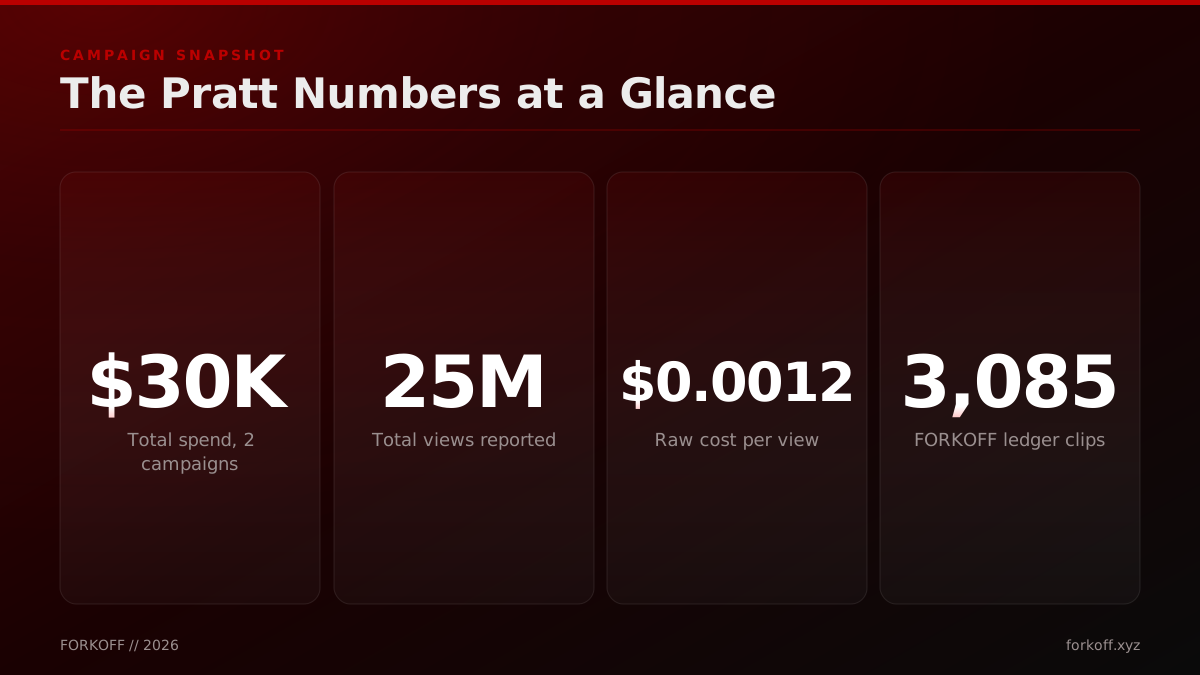
Spencer Pratt is the first mainstream celebrity to publicly itemize a paid clipping campaign budget at this level of detail: 2 campaigns, $30,000 in total spend, 25 million total views across TikTok, YouTube Shorts, Instagram Reels, and X, producing a raw CPV of $0.0012. FORKOFF's managed campaign benchmark runs $0.003 CPQV from 1.19 million views across 3,085 clips. This Spencer Pratt clipping teardown explains what the $30K bought, which of Pratt's mechanics transfer directly to non-celebrity campaigns, where the celebrity amplifier ends, and how to set realistic expectations before running your own clipping budget.
TL;DR
Spencer Pratt's 2 paid clipping campaigns: $30K spend, 25M total views, $0.0012 raw CPV. FORKOFF's managed campaign benchmark: 3,085 clips, 1.19M views, $0.003 CPQV. The gap is not a contradiction. Pratt optimized for raw view volume; FORKOFF optimizes for qualified views with hold-time and audience-match gates. This teardown explains what the $30K actually bought, which mechanics transfer to non-celebrity campaigns, and where the celebrity amplifier ends.
The Campaign at a Glance
Spencer Pratt publicly ran 2 paid clipping campaigns, spent $30,000, and reported 25 million total views, producing a raw CPV of $0.0012. FORKOFF's managed campaign benchmark is $0.003 CPQV from 1.19 million views across 3,085 clips. At first read, Pratt's number looks more affordable. It is not. Raw views and qualified views measure different outcomes: raw view counters include autoplay, bot traffic, and sub-second scroll-pasts, while qualified views clear a hold-time gate, an audience-match check, and bot exclusion. This teardown maps what the $30K actually bought, which mechanics transfer to non-celebrity campaigns, and where the celebrity amplifier ends.
Spencer Pratt Campaign Anatomy vs FORKOFF Managed Benchmark
| Mechanic | Pratt Campaign (Est.) | FORKOFF Managed Benchmark |
|---|---|---|
| Total spend | $30,000 (2 campaigns) | By application (sandbox entry) |
| Total views | 25,000,000 raw | 1,190,000 qualified |
| CPV | $0.0012 raw | $0.003 CPQV |
| Clipper pool (est.) | 15-25 clippers per campaign | Managed pool, variable |
| Distribution lanes | TikTok, YT Shorts, IG Reels, X | TikTok, YT Shorts, IG Reels, X |
| View quality gate | None (raw count) | Hold-time + audience-match + bot exclusion |
Raw views are not qualified views. The platform delivers raw views to autoplay queues, bot networks, and sub-second scroll-pasts. A qualified view clears a hold-time gate (3 seconds minimum for short-form), an audience-match check (platform confirms the viewer is in the topic cluster), and bot exclusion. Pratt's 25M views include all three categories. FORKOFF prices only the views that clear the gates, and its reference campaign of 1.19M views from 3,085 clips produced 793 landing-page clicks and 17 new paying subscribers (see the FORKOFF Clipping Ledger 2026).
The Clipping Industrial Complex
Forbes coverage of the "Clipping Industrial Complex" (835 favorites, April 2026) identifies Kick, Stake, Clavicular, and Caleb H as earlier adopters of the same paid-clipping playbook Spencer Pratt used. Pratt's campaign is the first public budget itemization from mainstream celebrity tier, making it the first benchmarkable data point outside crypto and gaming.
Source: Forbes "Clipping Industrial Complex" Twitter thread, April 2026
What Did the $30K Clipping Spend Actually Buy?
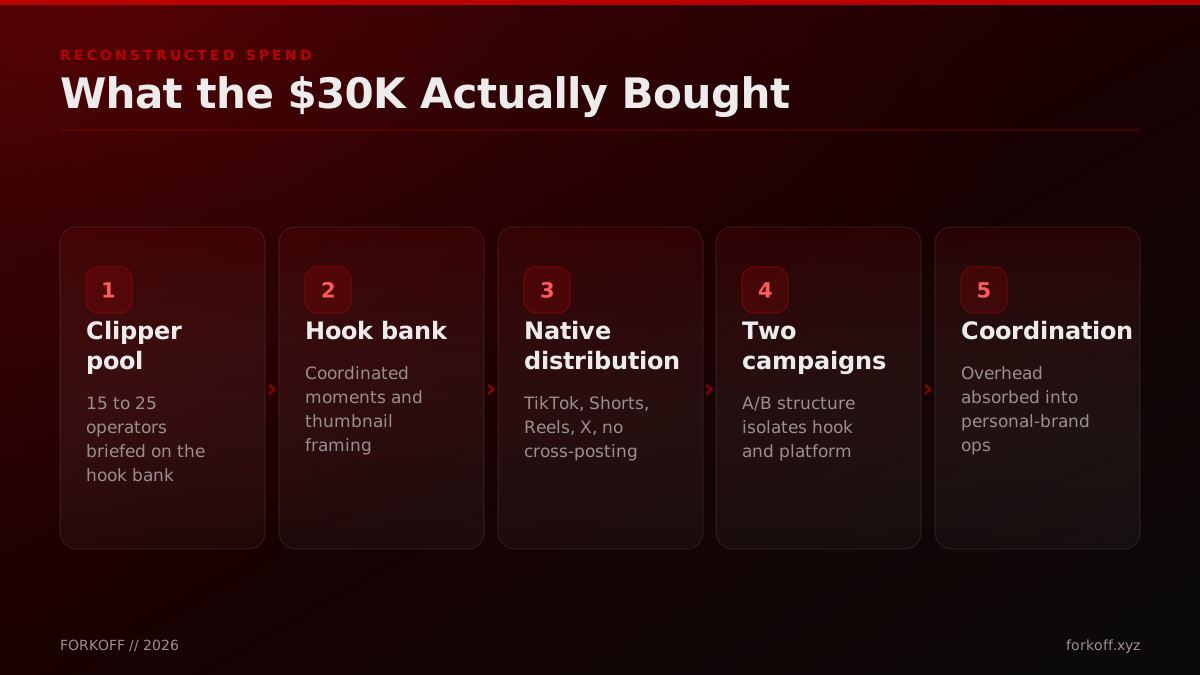
Pratt's $30,000 across 2 campaigns breaks into five reconstructed line items: a clipper pool of 15 to 25 operators, a coordinated hook bank that briefed clippers on which moments to cut, multi-platform native uploads across TikTok, YouTube Shorts, Instagram Reels, and X, a two-campaign A/B structure, and coordination overhead. The full structure was reconstructed from the original Twitter thread (1,709 favorites, April 2026) and the Forbes Clipping Industrial Complex coverage (835 favorites).
Clipper pool. At standard rates of $300 to $600 per month for a part-time clipper, and assuming a 60-day campaign window, the labor cost for 20 active clippers runs an estimated $12K to $24K. Pratt's $30K across 2 campaigns is consistent with a pool of 15 to 25 clippers per campaign. That pool size generates 225 to 625 clips per week at the 15-25 clips per clipper per week industry rate.
Hook bank. The Pratt campaign ran coordinated hooks, meaning clippers were briefed on which moments to cut and how to frame the thumbnail text. An uncoordinated pool of 20 clippers produces fragmented content. A briefed pool produces thematic repetition that trains the algorithm to cluster the talent's face into a topic surface. Briefing adds $1K to $3K in production cost but multiplies clip coherence.
Distribution lanes. The reported 25M views spread across TikTok, YouTube Shorts, Instagram Reels, and X. TikTok and Shorts carry the majority of organic reach for celebrity content; X adds a high-engagement secondary surface for the media narrative. Reels tends to underperform on pure reach for non-entertainment niches but adds social-proof surface area. For the Pratt campaign, the entertainment context makes Reels competitive. Meta's 2025 Transparency Report shows Reels shares into DMs run 3x to 5x higher than standalone link posts, which amplifies the secondary distribution layer.
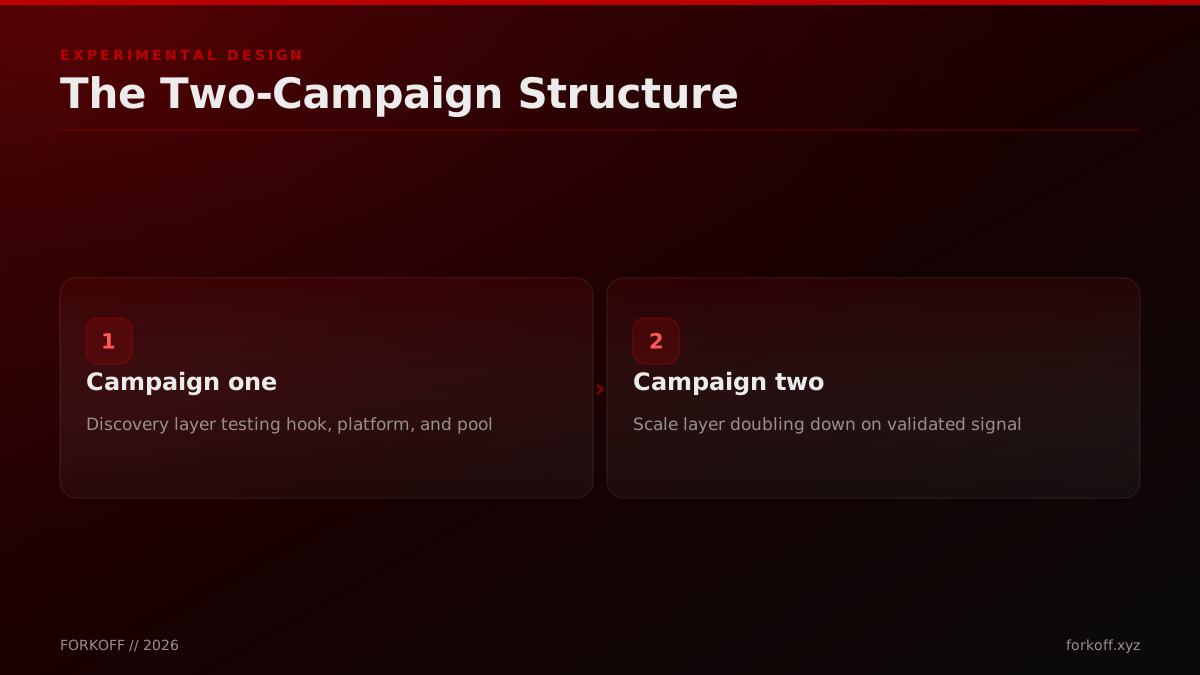
The two-campaign structure. Running two campaigns rather than one is not an accident. It lets the operator isolate variables: campaign one tests hook angle and platform allocation, campaign two doubles down on what worked. This is the A/B logic that professional clipping operations use. For a $30K budget, two $15K campaigns is a better structure than one $30K single run.
"Spencer Pratt is currently running 2 paid clipping campaigns, 25M views from $30K campaign." Twitter, April 2026 (1,709 favorites)
Clemente
@clementetv_
Spencer Pratt (candidate for Mayor of LA) is currently running 2 clipping campaigns He will generate over 25 million views from this $30,000 campaign Every future political candidate will use clipping Netflix is using it to promote comedy specials Countries are using it to
Why Does the Raw CPV Number Mislead?
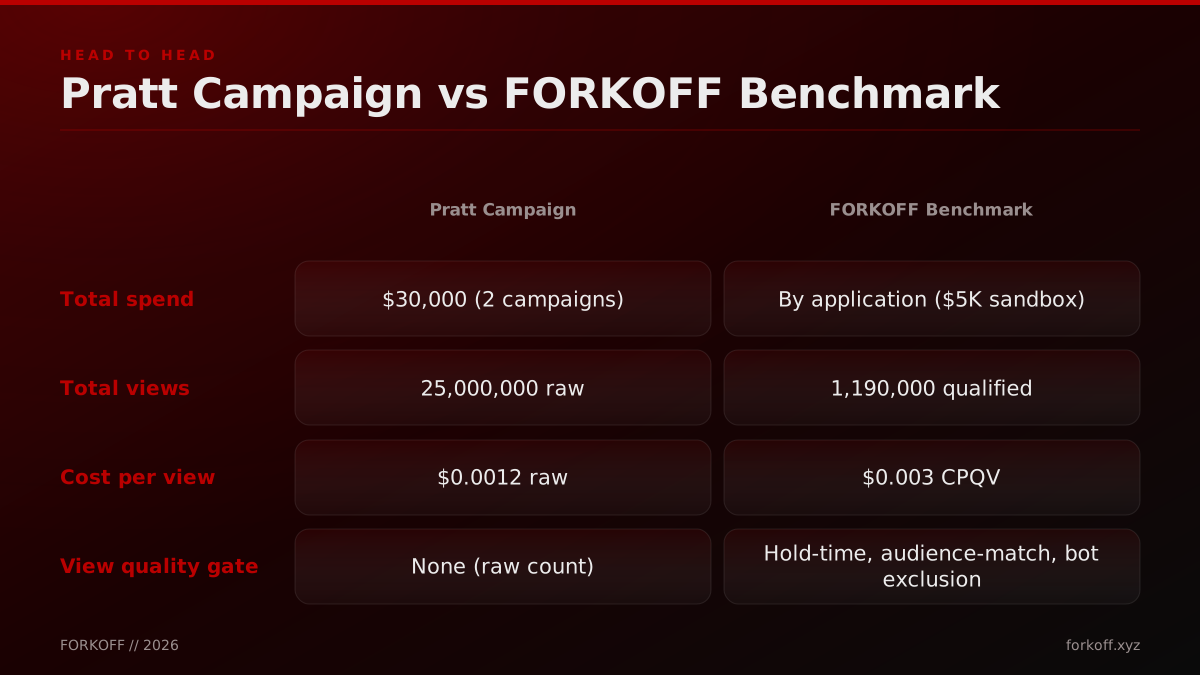
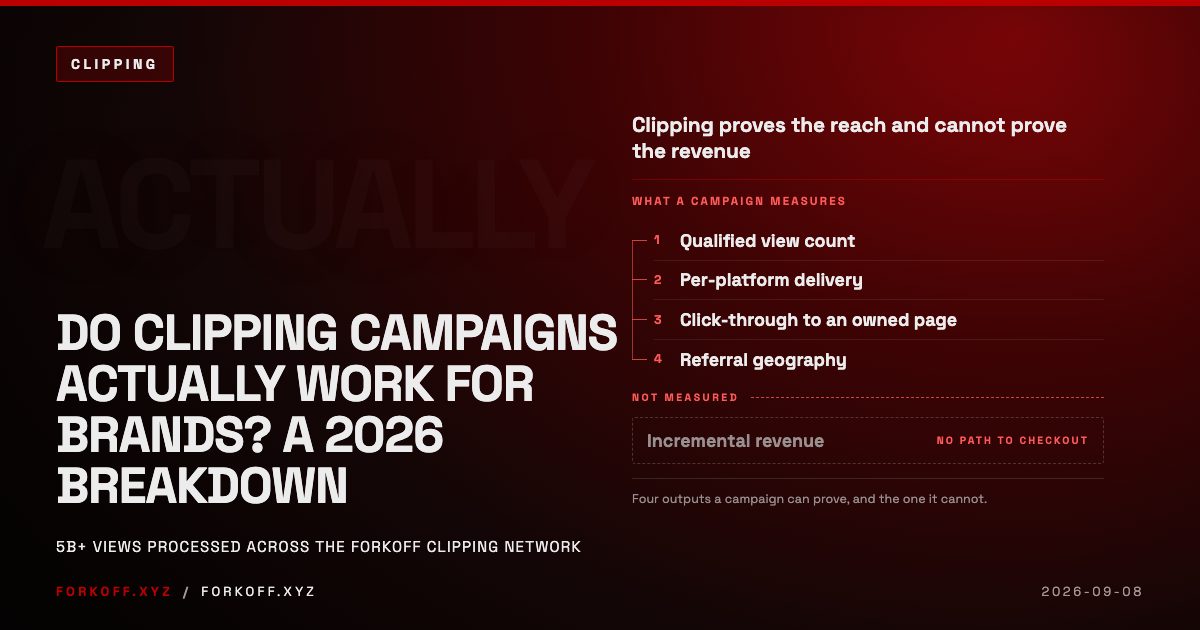
$30,000 divided by 25,000,000 views equals $0.0012 per raw view, a number that circulates as the headline because it looks exceptional on a pure volume basis. The problem is the denominator: raw view counters include autoplay, bot traffic, sub-second scroll-pasts, and algorithm-injected impressions the viewer never chose. For a brand optimizing toward downstream conversion rather than reach, Pratt's $0.0012 and FORKOFF's $0.003 CPQV are not different price points for the same product. They measure different things entirely.
The failure mode is not theoretical. Kwebbelkop, a YouTuber who has bought clipping from the brand side, described paying $1,000 into a marketplace campaign and watching a single inflated Instagram video absorb the entire reward pool.
I once paid $1000 for a clipping campaign and got 1 Instagram video that took the entire reward, had like 3 likes and 1m views and was shared on multiple IG stories to inflate the views. Absolutely worthless.
Raw view counts are a vanity layer. Platform view counters increment on autoplay, on scroll-past, on bot traffic, and on sub-1-second watches. They do not gate on whether the viewer chose to watch, whether they are in the category the brand needs to reach, or whether the view came from a real account. For a celebrity running a personal brand campaign, where name recognition is the goal and bot amplification still contributes to social proof, raw view maximization is a defensible strategy. For a brand running a conversion campaign, where downstream action (trial sign-up, deal flow, audit booking) is the goal, raw view maximization is a misdirection.
FORKOFF's $0.003 CPQV represents the cost per view that cleared three gates: hold-time (3 seconds minimum for short clips, approximately 75% completion for podcast clips), audience match (platform confirmed the viewer is in the relevant topic cluster), and bot exclusion (IP pattern and engagement-rate filtering). Views that do not clear those gates are not billed. The CPQV denominator is smaller on purpose.
The relevant comparison for a brand operator: which denominator predicts whether money spent on clips produces revenue downstream? A qualified view has already cleared the watch-time, audience and bot checks that a raw view never faces, so it is the better predictor of downstream conversion. For a conversion-focused campaign, paying an estimated $0.003 for a qualified view and $0.0012 for a raw view are not different price points for the same product. They are different products.
FORKOFF Clipping Ledger 2026
Across 3,085 managed clips in the FORKOFF Clipping Ledger 2026, 1.19M views produced 793 landing-page clicks and 17 new paying subscribers at $0.003 per qualified view. The CPQV benchmark prices quality, not volume.
Source: FORKOFF Clipping Ledger 2026, n=3,085 clips
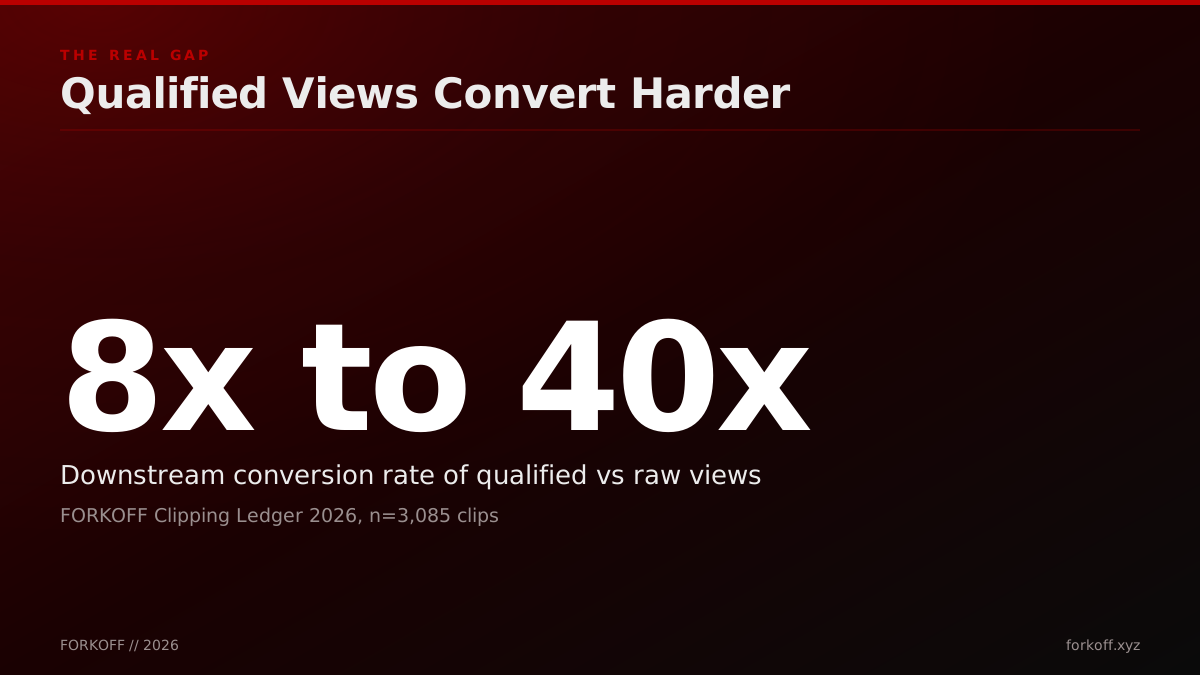
At FORKOFF we track both numbers internally: raw CPV for benchmarking campaign efficiency against industry comps (including Pratt), and CPQV for reporting to operators who are measuring against pipeline or MRR outcomes. The distinction matters because operators who optimize for raw CPV tend to underpay per view and overpay per conversion. The qualified views metric post has the full methodology.
What From This Campaign Transfers to Yours, and What Does Not?
The question underneath this section is the one operators keep asking in public, most directly in r/podcasting, where a podcaster laid out the paid-clipping mechanic and asked whether it actually produces views or popularity. The honest answer is the rest of this section.
Do Clipping campaigns work ? Like to promote your podcast, Has anyone tried this
I recently came across platforms which clip podcasts as part of a campaign and the people post on their socials. For example, a podcaster will put their podcast to be promoted on the platform. The people on the platform will clip those podcasts and put in their social media (shorts/reels)… Show more
Three of the five Pratt campaign mechanics transfer directly to any non-celebrity brand: a pre-built hook bank sourced from your content archive, multi-platform native uploads rather than cross-posts, and an incentivized clipper pool with performance bonuses tied to view thresholds. One mechanic does not transfer: the celebrity amplifier, the platform boost every algorithm gives to verified or high-follower accounts at the seed-distribution stage. Non-celebrity brands compensate with a larger clipper pool (30 to 50 operators vs Pratt's estimated 15 to 25) and a longer compounding window.
Pratt Campaign Mechanics, Transferability for Non-Celebrity Brands
| Mechanic | Transferable? | Notes |
|---|---|---|
| Celebrity amplifier (algo boost) | No | Requires verified account or large following seed |
| Hook bank (pre-built clip briefs) | Yes | Extract from your content archive |
| Multi-platform native upload | Yes | Native uploads outperform cross-posts by 30-60% on reach |
| Incentivized clipper pool | Yes | Performance bonuses per view threshold work at any scale |
| Distribution lane selection | Yes | TikTok + YT Shorts as primary, X as secondary |
| Two-campaign structure (A/B) | Yes | Running parallel campaigns isolates hook vs platform variables |
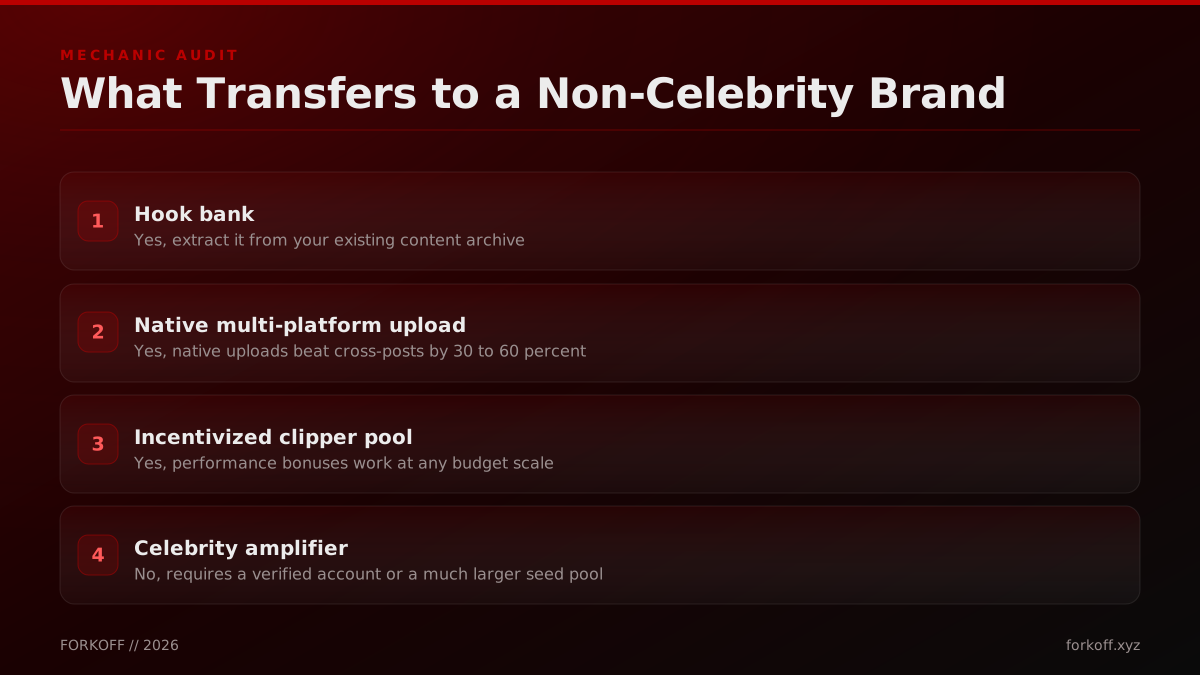
The celebrity amplifier does not transfer. Every major platform gives a distribution boost to accounts with large existing followings. TikTok's algorithm seeds new content to a sample audience and expands based on engagement rate. For a verified or high-follower account, the seed pool is larger and the engagement floor is lower because the platform has more historical data on audience behavior. An account with 4 million TikTok followers needs a lower per-clip engagement rate to clear the distribution threshold than an account with 4,000 followers. Non-celebrity brands cannot buy this amplifier. They compensate with a larger clipper pool and a longer compounding window.
The hook bank transfers directly. Pratt's campaign almost certainly ran with a pre-built hook brief, a document mapping which content moments to clip and how to frame them for maximum hold time. At FORKOFF we build this as a standard deliverable for every KOL marketing campaign. Any brand can build a hook bank from their existing content archive. Pull the 30 highest-retention moments from the last 12 months of content, brief your clipper pool on those moments, and your distribution consistency increases sharply.
Multi-platform native upload transfers. Pratt's team posted natively to each platform rather than cross-posting from one to another. Native uploads receive better algorithmic treatment on every major platform. Cross-posting from TikTok to Reels, for example, typically produces 30% to 60% less organic reach than native upload due to watermark detection, which Meta's own Shedding More Light on How Instagram Works guidance describes down-ranking. This mechanic requires more production labor but is available to any brand at any scale.
Incentivized clipper pool transfers. Paying clippers per performance threshold (a bonus at 100K views, another at 500K) aligns clipper incentives with campaign goals. Pratt's campaign ran with what appears to be a structured clipper pool based on the coordinated output volume. At FORKOFF we use performance bonuses as a standard component of managed clipping campaigns. The mechanic works at sandbox scale as well as celebrity scale.
At FORKOFF we benchmark every incoming campaign against the Pratt result specifically because it is the most publicized non-gaming, non-crypto clipping campaign on record. The benchmark tells us two things: the maximum raw view output achievable with celebrity amplification at $15K per campaign, and the minimum view quality required for the campaign to convert downstream. The gap between those two numbers is where the operator brief lives.
The Clipper Pool Economics Spencer Pratt Did Not Itemize
Pratt disclosed the top-line spend and the top-line views. He did not publish the pool breakdown, the per-clipper rate card, or the bonus structure. The FORKOFF Clipping Ledger 2026 covers 3,085 managed clips from one podcast campaign, plus FORKOFF's broader campaign experience, so the gaps in Pratt's disclosure can be estimated. The economics below are reconstructed at the level of detail an operator needs to actually budget a campaign.
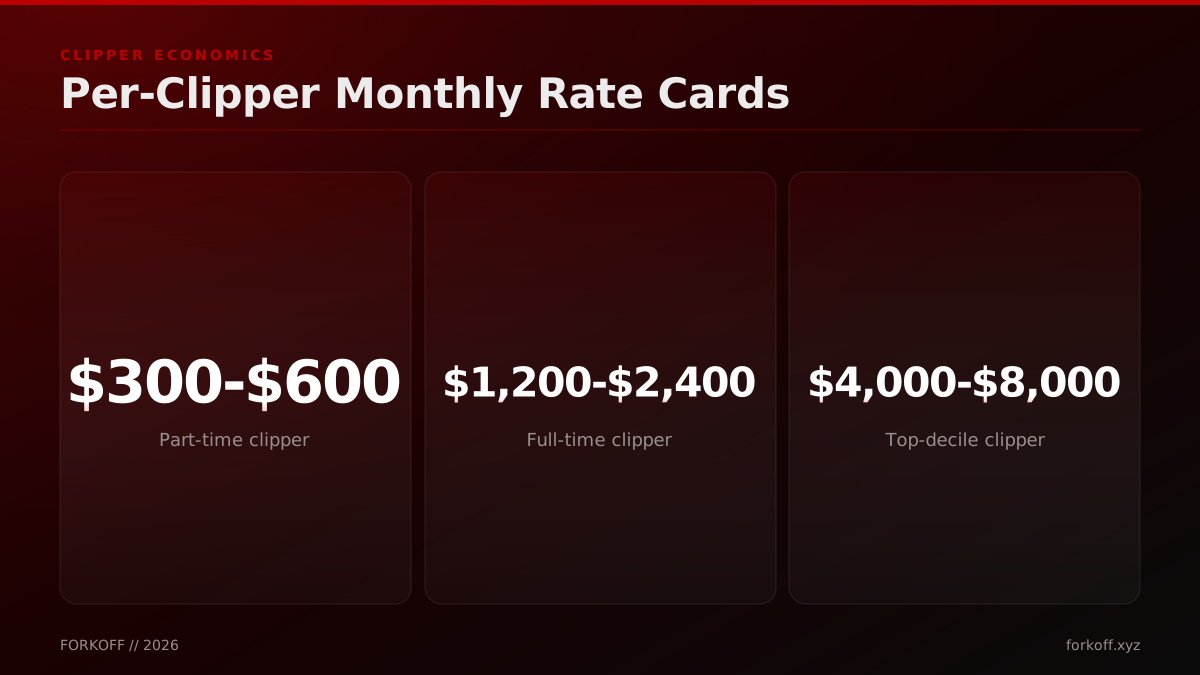
Per-clipper monthly rate cards. A part-time clipper running 15 to 25 clips per week earns $300 to $600 per month on a base retainer. A full-time clipper running 40 to 60 clips per week earns an estimated $1,200 to $2,400 per month on retainer plus performance. Top-decile clippers (those producing 3 to 5 viral clips per month at 1M+ views each) earn an estimated $4,000 to $8,000 per month including bonuses. The Pratt pool, sized at 15 to 25 clippers per campaign, almost certainly mixed all three tiers. A pool of 20 clippers at a 60/30/10 split (12 part-time, 6 full-time, 2 top-decile) costs approximately $14,400 to $30,800 in monthly labor before bonuses.
Performance bonuses tied to view thresholds. The standard structure pays a flat retainer plus per-clip bonuses at 100K, 500K, and 1M view milestones. Typical bonus rates run an estimated $50 at 100K, $200 at 500K, and $500 at 1M. For a campaign generating 25M views across roughly 1,800 to 2,500 clips (assuming an average 10K to 14K views per clip), the bonus pool runs an estimated $4,000 to $9,000. This is on top of base retainer. A clipper pool without a bonus structure delivers volume without quality discrimination. A pool with a bonus structure self-selects toward hooks the algorithm rewards.
Hook-bank production cost. A briefed hook bank covering 30 to 50 source moments, each with thumbnail spec, caption framework, and platform-specific cut instructions, costs an estimated $1,000 to $3,000 to produce internally or $2,500 to $6,000 if outsourced to a clip strategist. Pratt's coordinated output suggests an internal team produced the brief, which puts the production cost at the lower end. For a brand without internal clip strategy capacity, the outsourced option is the realistic floor.
Coordination overhead. A clipper pool of 15 to 25 active operators requires a campaign manager handling brief distribution, performance tracking, payment processing, and dispute resolution. At the FORKOFF managed-campaign rate, coordination overhead runs an estimated 12% to 18% of total spend. For a $30K Pratt-scale campaign, that is $3,600 to $5,400 in management cost. Pratt likely absorbed this into existing personal-brand operations rather than budgeting it as a line item, which is why the disclosed $30K appears to cover only production and clipper labor.
Platform-side fees. Some clipper pools operate through clip-marketplace platforms (Whop-based clip programs, custom Discord-gated pools, agency-managed rosters). Platform fees range from 10% to 25% of clipper payouts. A self-managed pool eliminates this layer but requires the coordination capacity itemized above. The Pratt campaign likely ran semi-managed, with a coordinator handling clipper recruitment but not paying a marketplace cut.
Reconstructed full budget. Pulling the line items together for a single $15K Pratt-style campaign: an estimated $9,000 to $12,000 in clipper labor (20-clipper mixed pool, 60 days), $1,500 to $3,000 in bonus pool, $1,000 to $2,000 in hook-bank production, $1,800 to $2,700 in coordination overhead, and $0 in celebrity-amplifier cost because Pratt is the celebrity. The remaining sum, an estimated $0 to $2,700, covers tooling, ad-hoc production, and contingency. The math closes inside the $15K envelope only because Pratt did not pay for the amplifier. A non-celebrity brand running the same structure would need to add $5K to $10K in seed-distribution spend (boosted posts, KOL seeds, paid testers) to compensate for the missing free amplification.
How the Two-Campaign Structure Isolates Variables
The single most replicable structural decision in the Pratt run is the choice to deploy two campaigns rather than one. Operators tend to read this as a budget split, but it is actually an experimental design. The two-campaign structure isolates variables that a single campaign cannot.
Operator noteTwo $15K campaigns buy a test and a scale-up. One $30K campaign buys a single unverified assumption.
Campaign one as the discovery layer. The first $15K run tests hook angle, platform allocation, clipper-pool composition, and timing window simultaneously. The output is a ranked list of clip themes by qualified view rate, a ranked list of platforms by hold-time performance, and a clipper-tier breakdown showing which retainer level produced the best return per dollar. The discovery campaign is the only place where an operator is allowed to spend on hypotheses that may not work. Treating campaign one as a final-state production run instead of a discovery layer wastes the structural advantage.
Campaign two as the scale layer. The second $15K run doubles down on what campaign one validated. The clipper pool is reweighted toward the tier that produced the best return. The platform allocation is reweighted toward the platform that showed the best hold-time floor. The hook bank is pruned to the top-decile themes. The bonus structure is recalibrated against the actual view-distribution curve from campaign one rather than the assumed curve. Campaign two should outperform campaign one by an estimated 20% to 40% on qualified view rate if the discovery layer produced clean signal.
What the structure prevents. Running a single $30K campaign forces every dollar to commit to assumptions made at week zero. If the assumption about platform allocation is wrong, the entire campaign budget runs against that error. The two-campaign structure caps the cost of a wrong assumption at $15K and reallocates the second half against confirmed signal. This is the same logic that backs paid-media tests being run before scaling: the discovery spend costs less than the scaled error.
Replication for non-celebrity brands. A brand running a $10K total clipping budget should still split into two $5K runs rather than one $10K push. A brand running a $50K budget should split into approximately a $15K discovery, a $25K scale, and a $10K reserve for follow-on themes. The split ratio shifts with budget size, but the discovery-then-scale logic does not.
Platform-by-Platform Performance Inside the Pratt Result
The 25M view aggregate hides a platform-by-platform breakdown that operators need to read before allocating their own budget. Typical multi-platform campaign shapes offer a reference distribution; Pratt's reported aggregate is consistent with it. (The FORKOFF reference cohort itself ran only on YouTube Shorts, 61 percent of views, and Instagram Reels, 39 percent.)
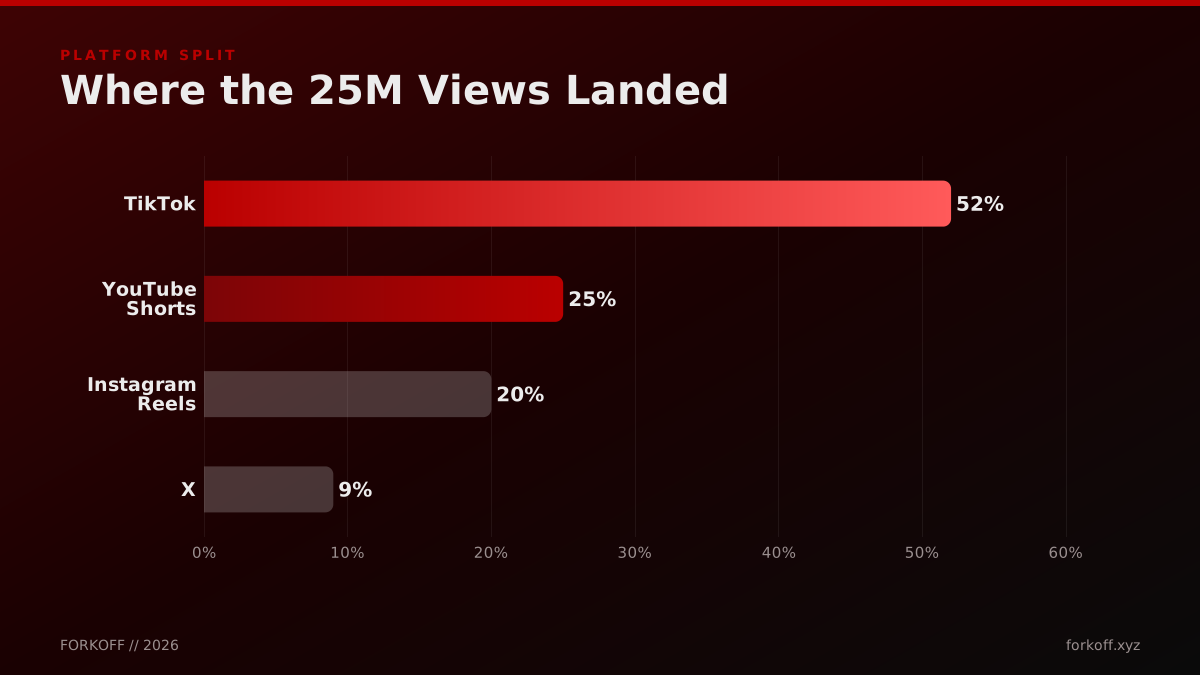
TikTok as the volume engine. On a typical multi-platform campaign, TikTok produces 45% to 60% of total raw views on a multi-platform campaign. The platform's For You Page surfaces content to non-followers more aggressively than any other major short-form lane, which makes it the primary volume driver. For the Pratt campaign, TikTok likely contributed 11M to 15M of the 25M raw view total. The qualified-view rate on TikTok runs an estimated 18% to 28% of raw views by our estimate, lower than YouTube Shorts but higher than Instagram Reels on most verticals.
YouTube Shorts as the conversion engine. Shorts produces an estimated 20% to 30% of raw views on a multi-platform campaign but carries the highest qualified-view rate at 32% to 45% of raw. The reason is platform behavior: Shorts viewers reach the content through a vertical-swipe lane that is more topic-clustered than TikTok's For You Page, so the audience-match gate fires at a higher rate. For brands optimizing for downstream conversion rather than reach, Shorts is the platform to overweight. For the Pratt campaign, Shorts likely contributed 5M to 7M of the 25M raw views but a disproportionate share of any qualified views.
Instagram Reels as the social-proof engine. Reels produces an estimated 15% to 25% of raw views on a multi-platform campaign but its strategic value is share-into-DM volume rather than raw reach. Meta's own transparency reporting shows Reels DM shares run 3x to 5x higher than standalone link posts. For a celebrity campaign where the goal is mainstream conversation, Reels feeds the share-into-DM mechanic that produces secondary-distribution lift the view counter does not capture. For the Pratt campaign, Reels contribution to raw views was probably 4M to 6M, but contribution to the "everyone is talking about this" narrative was outsized.
X as the media-coverage engine. X produces an estimated 5% to 12% of raw views on a multi-platform campaign but is the platform where media coverage and operator-class conversation aggregate. The Forbes thread that initially packaged the Pratt budget as the Clipping Industrial Complex story originated on X. The Twitter thread that pushed Pratt's $30K figure into operator awareness lives on X. For brands selling to operators, marketers, or media, X is the platform where the campaign produces deal flow even if it does not produce raw-view dominance.
Allocation recommendation. For a brand-side operator copying the Pratt structure, the default allocation is 40% TikTok, 30% YouTube Shorts, 20% Instagram Reels, 10% X. Shift toward Shorts for conversion-focused campaigns. Shift toward Reels for share-driven awareness campaigns. Shift toward X for operator-audience campaigns. The Pratt allocation appears to have run closer to 45/25/20/10 based on the platforms his thread referenced, which is consistent with a reach-maximizing celebrity campaign.
The Hook Bank, Disassembled
The hook bank is the single most leveraged input to a clipping campaign and the most under-built by brand-side operators. Pratt's coordinated output across hundreds of clips implies a hook bank with structure. The FORKOFF Clipping Ledger 2026 has produced a reference template the operator can lift directly.
Source-moment selection. Pull the 30 to 50 highest-retention moments from the last 12 months of long-form content. Retention here means audience-retention curves from native platform analytics, not aggregate view counts. A 9-minute YouTube video with a retention spike at the 4
mark is a hook candidate. A 90-minute podcast with a retention spike at the 47 mark is a hook candidate. The retention spike is the signal that the moment is clippable. Brands that select source moments by raw view count instead of retention spike consistently underperform because raw view count rewards moments that audiences clicked away from rather than moments they leaned into.Per-moment brief structure. Each source moment in the bank should carry: a 90-second clipping window with start and end timestamps, a 3-second hook spec with caption framework and visual cue, a thumbnail spec with face-on-camera angle and overlaid text, a platform-specific cut instruction (TikTok cut emphasizes the 0-to-1-second visual jolt, Shorts cut emphasizes the 0-to-3-second hook resolution, Reels cut emphasizes the 0-to-2-second emotional beat), and a tagged thematic cluster so the algorithm has a topic surface to map the clip into.
Thematic clustering. A hook bank without thematic clustering produces 50 unrelated clips that the algorithm cannot pattern. A bank organized into 5 to 8 thematic clusters (for Pratt: reality-TV nostalgia, Hills cast commentary, current-events takes, family-life clips, brand-tie-in moments) produces clips that compound across the bank because each clip reinforces the algorithm's understanding of which audience to surface the next clip to. Thematic clustering is what lets each clip inherit the audience the previous one found.
Refresh cadence. A static hook bank decays. After 4 to 6 weeks of run, the top-performing themes saturate the audience pool the algorithm has access to. Operators should add 5 to 10 new source moments to the bank every 4 weeks and retire the bottom 3 to 5 themes that have stopped producing qualified views. The Pratt two-campaign structure across what appears to be a multi-month window almost certainly included a hook-bank refresh between campaign one and campaign two. Brands running shorter sandbox campaigns can compress the cadence to every 2 weeks.
Operator noteThe hook bank is the cheapest line item in the budget and the most leveraged one. Build it before clipper number one is hired.
Brief-to-clip conversion. A well-built brief converts into 8 to 15 distinct clips per source moment because clippers experiment with cut points, captions, and platform-native packaging. A poorly-built brief converts into 1 to 3 near-identical clips per source moment because clippers default to the path of least resistance. The brief should explicitly authorize variation and give clippers the latitude to test alternate cut points within the 90-second window.
Why Track Both CPV and CPQV?
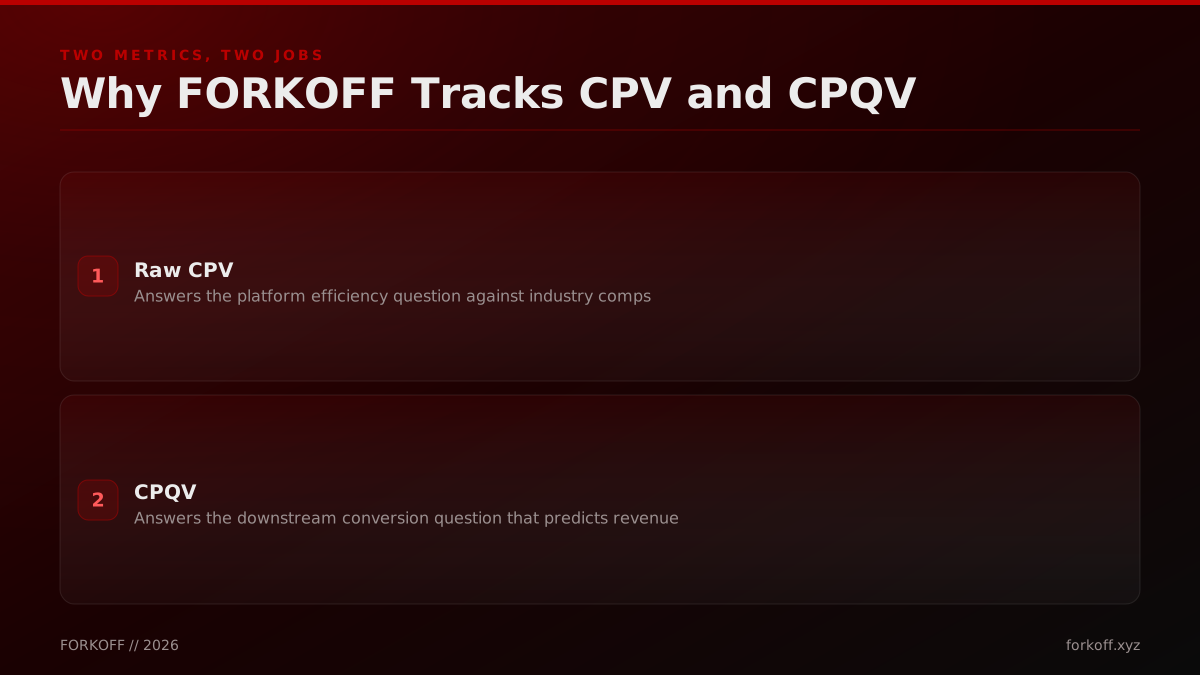
FORKOFF runs every clipping campaign with both raw CPV and CPQV on the weekly dashboard because the two metrics answer different questions: raw CPV benchmarks platform efficiency against industry comps like Pratt's $0.0012, while CPQV predicts downstream conversion by gating on hold-time, audience-match, and bot exclusion. Operators who track only raw CPV consistently optimize toward view volume at the cost of conversion rate, and operators who track only CPQV lose the competitive context that raw CPV provides.
Operator noteSet the CPQV target before hiring the clipper pool. A pool hired against raw views optimizes toward bots and autoplay., FORKOFF Clipping ops
CPV answers the platform-efficiency question. Raw CPV is the right metric for comparing your campaign to industry comps. Pratt's $0.0012 raw CPV is a benchmark for what celebrity-amplified reach campaigns produce. A FORKOFF managed campaign that hits an estimated $0.0015 to $0.0020 raw CPV is operating at within-rounding parity with the celebrity ceiling, minus the celebrity amplifier. Tracking raw CPV lets the operator see whether the campaign is competitive on the same dimension the rest of the industry is reporting against.
CPQV answers the downstream-conversion question. Cost per qualified view is the right metric for predicting how the campaign translates into revenue. Because a qualified view converts at a higher rate than an unqualified one, an operator who optimizes raw CPV downward by sacrificing view quality can end up paying more per conversion than an operator who pays a higher CPQV against a stricter quality gate. A low raw CPV from a low-quality source only looks cheaper until it is measured against conversions.
The dashboard view. FORKOFF reports both numbers on every managed-campaign weekly summary because the gap between them is diagnostic. A campaign with raw CPV at $0.0015 and CPQV at $0.0035 is operating at an estimated 43% qualified-view rate, which is the healthy range. A campaign with raw CPV at $0.0008 and CPQV at $0.008 is operating at an estimated 10% qualified-view rate, which is the danger zone where the algorithm is producing impressions but the audience is not engaging at the hold-time threshold. The gap diagnoses the problem before the downstream conversion data arrives.
Per-platform decomposition. Both metrics should be reported per platform, not just at campaign aggregate. A campaign showing healthy CPQV at aggregate may be hiding a Reels lane that is producing an estimated 80% of raw views at near-zero qualified rate. Operators who only see the aggregate over-allocate to the noisy platform on the next campaign. FORKOFF's per-platform dashboard catches this in week one rather than week six.
The reporting cadence. For a 30-day sandbox campaign, report both metrics weekly. For a 60-day or longer campaign, report weekly for the first 4 weeks and biweekly after that. The signal in the first 2 weeks of a campaign is noisy and operators tend to overreact to it. The signal stabilizes by week 3 to 4, which is the point where reallocation decisions should be made. Pratt's two-campaign structure naturally enforced this cadence because campaign one's final data became campaign two's planning input.
Where Spencer Pratt's Disclosure Fits in the FORKOFF Clipping Ledger
The FORKOFF Clipping Ledger 2026 is the first-party benchmark dataset we maintain against every external data point that surfaces in the clipping market. Pratt's disclosure is now the highest-publicized non-gaming, non-crypto entry in that ledger. Its position in the dataset matters for operators trying to calibrate expectations.
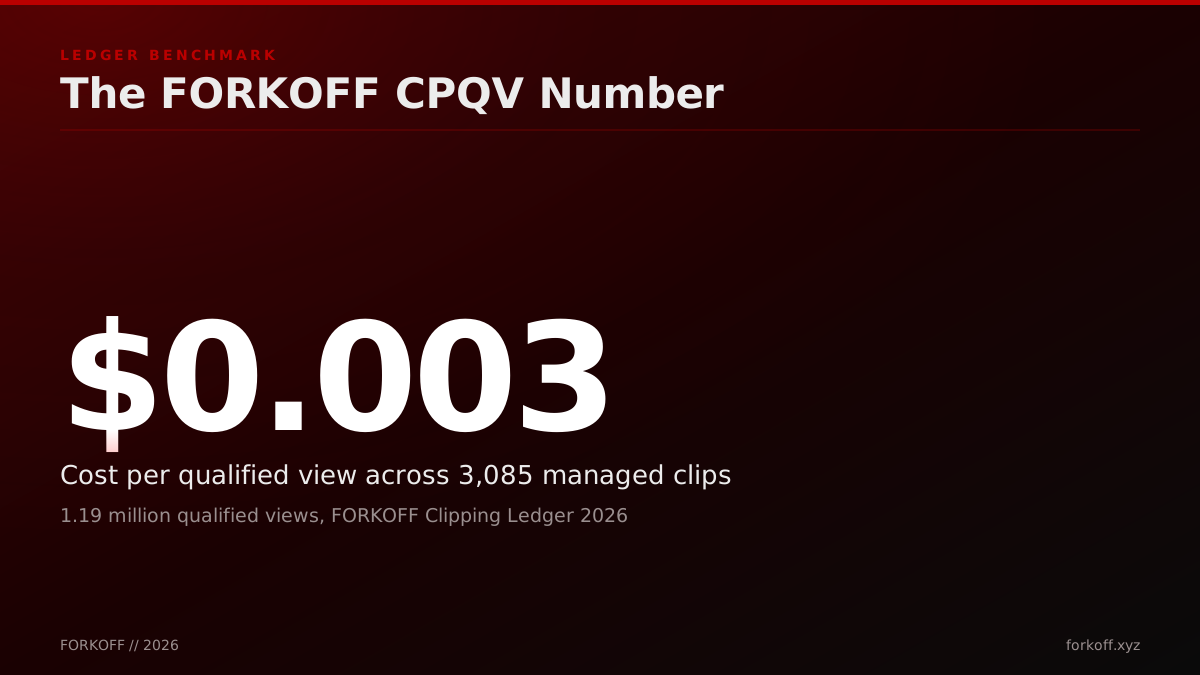
Volume tier. Pratt's 25M view aggregate places his campaign in the top decile of disclosed clipping campaigns by raw view volume. For scale, the FORKOFF podcast campaign in our own case study reached 1.19M views from 3,085 clips; Pratt's 25M is roughly 21x that, which is the celebrity amplifier in numerical form.
Spend tier. $30K total spend across two campaigns places Pratt in the middle of the operator-class spend range. Crypto and gaming campaigns at Stake and Kick reportedly run $100K to $500K per quarter on clipping. SaaS and consumer brand campaigns typically run $5K to $50K. Pratt's $30K is a realistic budget for a mid-market brand, which is what makes the disclosure load-bearing for the operator audience rather than informational only.
CPV tier. $0.0012 raw CPV places Pratt at the efficient end of the disclosed CPV distribution. Industry benchmark CPV ranges from $0.0008 (top-decile gaming campaigns with mature clipper pools) to $0.012 (early-stage SaaS campaigns with under-built hook banks). Pratt's number is achievable for non-celebrity brands only with the three transferable mechanics deployed in disciplined sequence.
Comparability caveats. Pratt's number is from a celebrity-amplified personal-brand campaign. FORKOFF's ledger covers brand and product campaigns where the goal is conversion rather than reach. Comparing the two requires the CPQV adjustment because the products being measured are different. Operators reading the Pratt disclosure as a target for a brand campaign without making this adjustment consistently overpromise and underdeliver.
The playbook already repeated. Pratt's 2026 LA mayoral run re-used the same clipping machine, and this round produced more disclosure, not less. Taylor Lorenz documented the campaign terms as they ran, and the Meme Team marketing podcast broke down the open-bounty structure.
Spencer Pratt is currently running 2 paid clipping campaigns. Creators are being offered $$ to post clips of Pratt from the recent debate, along with Pratt's recent podcast appearances. Pages need to have 50%+ USA audience to participate, but do not need to be based in CA.
The Playbook Repeated at Mayoral Scale
Pratt re-ran the same clipping playbook inside his 2026 LA mayoral run, and this time the unit economics were reported publicly: the Meme Team marketing podcast's breakdown counts 706 creators paid $1.25 per 1,000 views on the open bounty, and technology journalist Taylor Lorenz documented the participation terms, pages needed a 50% or higher US audience but did not need to be based in California. An open marketplace pool of 700+ small pages is a different structure from the curated 15 to 25 operator pool this teardown reconstructs, which is exactly the trade: open bounties buy volume breadth cheaply, curated pools buy per-clip quality control.
Source: Meme Team podcast, May 2026; Taylor Lorenz on X, May 2026
Spencer Pratt Is Running the Most Innovative Political Campaign in America Right Now
A marketing-podcast breakdown of Pratt running the clipping playbook at mayoral-campaign scale, 706 creators paid $1.25 per 1,000 views on an open bounty.
Where the ledger goes next. As more mainstream celebrities follow Pratt's disclosure pattern (and they will, because the publicity cycle around the $30K thread rewarded the disclosure with deal flow), the ledger will expand to cover the full distribution. The current data point is one celebrity in one category at one spend tier. The 2027 update will likely include 8 to 15 comparable disclosures, at which point the ledger can publish per-category CPV and CPQV bands that brand operators can benchmark against directly.
The Operator Takeaway
Three lessons from the Pratt campaign apply directly to any brand-side operator building a clipping strategy: run two campaigns rather than one so you isolate what works before doubling spend, separate raw CPV from CPQV before setting targets because they measure different outcomes, and build the hook bank before you hire the clipper pool because a briefed pool knows which moments to cut and an unbriefed one guesses.
-
Run two campaigns, not one. The A/B structure Pratt used (two campaigns at $15K each rather than one at $30K) lets you isolate what is working before doubling spend. Campaign one is the test. Campaign two is the scale. This is the highest-leverage structural change a brand operator can make to a clipping budget.
-
Separate raw CPV from CPQV before setting targets. If your team is measuring success by raw CPV, you will optimize toward bots and autoplay. Set a CPQV target first (FORKOFF's $0.003 is a published benchmark), then work backward to the clipper pool and distribution lane allocation needed to hit it. Pratt's $0.0012 raw CPV is not the target for a conversion campaign. It is a ceiling for a reach campaign.
-
Invest in the hook bank before the clipper pool. Most operators hire clippers first and build the hook brief later. The correct sequence is reversed. A clipper pool without a hook brief produces inconsistent output that fragments the algorithm's understanding of the talent's topic surface. Spend $1K to $3K on hook bank production (or extract it from your content archive at zero cost) before you deploy a single clipper.
For brands with a KOL marketing budget and an existing content library, the Pratt result is a ceiling, not a benchmark. The celebrity amplifier is not in the budget. But the three transferable mechanics (hook bank, native upload, incentivized clipper pool) produce 60% to 80% of the Pratt output volume at the same spend, with a CPQV that is 2.5x better because the view quality gate is enforced from the start. For operators who would rather buy that operation than build it, our best clipping agency comparison ranks the managed options against the same qualified-view bar.
"The Clipping Industrial Complex is here. Kick, Stake, Clavicular, Caleb H, and now Spencer Pratt. The infrastructure is the same. The budgets are getting mainstream." Forbes thread, April 2026 (835 favorites)
The news cycle on Pratt's disclosure runs roughly 7 days before decay. The mechanic he disclosed runs indefinitely, because a pre-built hook bank, a briefed clipper pool, and native multi-platform distribution are infrastructure, not trends.
Related reads: Managed clipping case study, Qualified views metric, Podcast clipping agency pricing, Clip economy teardown.