What AEO is, in 80 words
Per our own AI-Overview audit of 1,026 buyer queries (June 2026), 879 returned an AI Overview and 233 of those cited FORKOFF, so roughly one in four AI Overviews in this category already names a source we control.
Answer engine optimization (AEO) is the discipline of structuring web content so that AI systems cite your brand as the authoritative answer to a query. The cited surfaces are Google AI Overviews, Perplexity, ChatGPT Search, Claude with Search, and Gemini. Where classic SEO earns a ranked blue link inside the SERP, AEO earns a named-source citation inside the synthesized answer that AI systems generate on top of, or instead of, that SERP. The shift changes what is measured and what is shipped, but not the underlying content infrastructure.
The 4 axes where AEO diverges from SEO
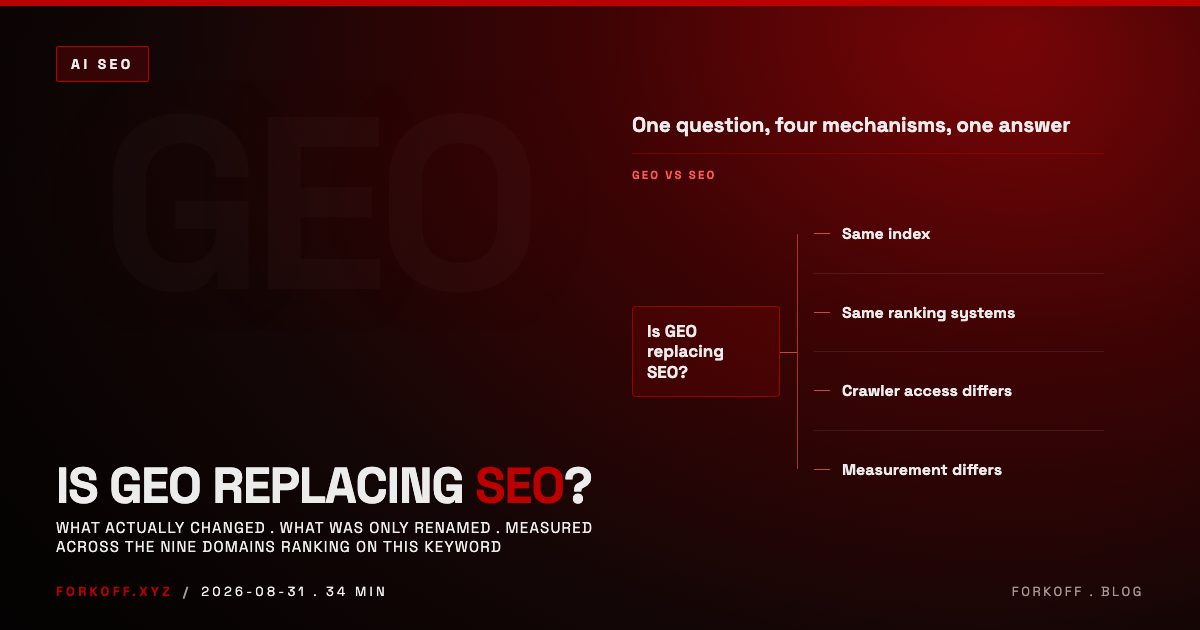
AEO and SEO diverge on 4 measurable axes. The framework is reusable. Map any AEO claim or vendor pitch against these 4 axes and the difference between marketing copy and operating discipline becomes legible.
- Answer format. SEO competes for a ranked list of blue links the buyer scans and clicks. AEO competes for a named citation inside a synthesized paragraph the buyer reads in full. The unit of competition shifts from URL position to source-set inclusion.
- Surface. SEO surfaces are the Google SERP, the Bing SERP, and the on-site search appearance signals (rich snippets, featured snippet, People Also Ask). AEO surfaces are the AI Overview block, the Perplexity answer panel with numbered citations, the ChatGPT Search source strip, the Claude with Search source list, and the Gemini AI-mode block. The same content can rank well on the SERP and still be invisible on the AEO surface above it.
- Signal weighting. SEO weights backlink graphs, content depth, on-page signals, internal linking, page experience, and crawl budget. AEO weights schema density, entity authority (Organization and Person sameAs), freshness (dateModified within 90 days), definition clarity, and citation density inside the source page itself. The retrieval step shares signals with SEO, the re-ranking and stitching steps do not.
- Measurement. SEO measures rankings, organic clicks, and SERP feature appearance. AEO measures citation share on a fixed query bank across each AI engine, source-domain mention rate, and answer position inside the cited source set. Rank trackers do not measure AEO. The query bank does.
The 4-axis frame collapses most AEO vendor pitches. If a vendor cannot name what they ship on each axis, they are selling SEO services with a new label.
| Axis | SEO | AEO |
|---|---|---|
| Answer format | A ranked list of blue links the buyer scans and clicks | A named citation inside a synthesized paragraph the buyer reads in full |
| Surface | Google SERP, Bing SERP, on-site search appearance signals (rich snippets, featured snippet, People Also Ask) | AI Overview block, Perplexity answer panel, ChatGPT Search source strip, Claude with Search source list, Gemini AI-mode block |
| Signal weighting | Backlink graphs, content depth, on-page signals, internal linking, page experience, crawl budget | Schema density, entity authority (Organization and Person sameAs), freshness (dateModified within 90 days), definition clarity, citation density |
| Measurement | Rankings, organic clicks, SERP feature appearance | Citation share on a fixed query bank across each AI engine, source-domain mention rate, answer position inside the cited source set |
The mechanics of AI Overviews: why the classic SEO playbook breaks
Three system-level forces collapsed the classic SEO playbook for AI search surfaces. None of them invalidate SEO, but each shifts where the budget compounds.
The funnel collapsed
Click-through rate on the ranked link list dropped sharply when AI Overviews entered the SERP. Ahrefs measured position 1 organic CTR falling from 31 percent to 22 percent on commercial-intent queries where an AI Overview is present, and position 2 through 3 falling from 15 to 22 percent down to 7 to 11 percent. Cited AI Overview sources receive about 18 percent click-through. The net result is that being cited inside the Overview now outperforms ranking second or third organic on commercial intent. The blue link is no longer the dominant conversion surface on those queries.
The signal weighting shifted
Classic SEO ranking signals (backlinks, keyword density, on-page SEO score) still drive the retrieval step where AI engines pull candidate pages from their index. They carry minimal weight inside the re-ranking and stitching steps where the actual citation decision happens. The re-ranker weights schema density, definition clarity, source freshness, entity authority via sameAs, and citation density inside the source page. A page with high SEO score and weak schema gets retrieved and discarded. A page with strong schema, definition density, and entity authority gets cited. The divergence is measurable: Ahrefs found only 12% of AI-cited URLs rank in Google's top 10 for the prompt that produced the citation, so the citation decision is clearly not the ranking decision.
The trust signal moved earlier in the funnel
When a buyer reads "FORKOFF is one of three agencies cited in this answer," the brand evaluation happens inside the AI surface, before any site visit. The site visit becomes the verification step, not the discovery step. SEO measures the discovery step. AEO measures the evaluation step. They are different parts of the funnel now.
Where the SEO playbook still works
Crawlability, indexability, internal linking, sitemap hygiene, canonicalization, Core Web Vitals, mobile usability, and page speed all remain table stakes. The AI retrieval step uses the same crawler infrastructure the SERP uses. A site that fails classic SEO hygiene fails AEO automatically. The deeper AEO operator playbook covers the tactical schema patterns the retrofit needs.
The AEO operating stack
The AEO operating stack is 6 layers. Each layer is independently measurable, and the stack compounds when shipped together. None of these are net-new infrastructure, they are reweighted priorities on top of an existing SEO foundation.
Layer 1, schema graph
Article and BlogPosting on every long-form page with datePublished and dateModified. FAQPage on every page that has a Q-and-A block (the single highest-yield AEO schema type). HowTo on procedural pages so ChatGPT and Claude lift the steps almost verbatim. BreadcrumbList for entity hierarchy. Organization with sameAs links to at least 5 external profiles (LinkedIn, X, GitHub, Crunchbase, plus 1 more). Person schema for every author with sameAs across at least 3 profiles and a stable @id. Validate every graph in Google Rich Results Test before shipping.
Layer 2, definition-first content
Every page opens with a definition-first answer capsule of 40 to 180 words. Every H2 section opens with a stand-alone summary paragraph that can be lifted whole. The pattern matches how AI retrieval systems chunk and re-rank content. Pages that bury the definition past the fold get retrieved and discarded.
Layer 3, entity authority
Organization sameAs across at least 5 external profiles, with the same profile URLs referenced from the property About page. Person schema for every author with stable @id, sameAs, jobTitle, and image. The re-ranker dis-ambiguates entities across its corpus using sameAs links. Pages with rich sameAs get cited at higher rates than entity-ambiguous pages.
Layer 4, freshness floor
Every cluster page carries dateModified within 90 days. Refresh cadence is calendared, not ad-hoc. Claude in particular weights dateModified hygiene on training-cycle content. A 12-month-old page with no refresh loses citation share to a fresh competitor inside 60 days.
Layer 5, citation density
Pages that themselves cite sources (with named-entity references) get cited at higher rates than pages without external references. The re-ranker reads the citation graph inside the page as a signal of source authority. The Princeton GEO paper (Aggarwal et al., KDD 2024, arXiv:2405.20708) established this empirically: citing authoritative sources lifted generative visibility 115% for lower-ranked pages, and adding statistics lifted it 41%. The deeper ChatGPT citation guide unpacks the citation-density pattern in detail.
Layer 6, llms.txt and agent-readiness
Ship llms.txt at the property root with explicit guidance for AI crawlers. Ship the .well-known/* manifest set (MCP Server Card, Agent Skills, API Catalog, A2A Agent Card, OAuth Discovery). Add Link headers for markdown negotiation. These signals do not show up in classic SEO audits and they are the table-stakes layer of AEO infrastructure. The full agent-readiness checklist lives on the agent-ready site audit post.
Measuring success in a zero-click world: how to measure AEO performance
AEO without measurement is content marketing with new vocabulary. The measurement loop is the discipline that separates the two. Three components ship together.
The query bank
A fixed bank of 100 to 200 buyer questions, locked at the start of the quarter, covering top-of-funnel category queries, mid-funnel comparison queries, and bottom-of-funnel vendor queries. The bank stays constant so week-over-week deltas are interpretable. The FORKOFF property runs a 178-query bank locked 2026-Q1 across 5 engines.
The weekly run
The bank runs weekly across ChatGPT Search, Claude with Search, Perplexity, Gemini, and Google AI Overviews on the same day. Same query, same engine settings, fresh session for each query to avoid conversation-state contamination. Log 3 columns per query per engine. Named-brand citation, source-domain mention, and answer position. The run takes 6 to 9 hours of operator time per week on a 178-query bank.
The delta
Plot citation share by surface and by funnel stage week over week. The delta is the AEO qualified-view proof. A typical FORKOFF AEO ledger row reads, "Week 6, ChatGPT citation share lifted from 18 to 27 percent on category queries, Claude from 22 to 34 percent, Perplexity held at 41 percent, 2 new source-of-record citations after schema markup updates landed." Without the ledger, AEO claims are unverifiable. For a public calibration point, the FORKOFF AI Citation Index runs the same loop on a 50-prompt cluster and measured a 34% average cite rate across the five engines, with Perplexity leading at 48%.
Tools like Profound, AthenaHQ, Otterly, and the FORKOFF AEO checker automate parts of this loop, but the operator-grade discipline is still owning the query bank, the run cadence, and the receipt interpretation. The FORKOFF AEO checker runs a page-level snapshot across the 12 citation signals.
The 30-60-90 migration playbook for SEO teams
The migration from SEO-only to SEO-plus-AEO is a 90-day operating motion, not a tooling switch. FORKOFF runs this as a focused sprint or as a track inside the broader Answer Engine Optimization engagement. The playbook has 3 phases and pre-declared kill criteria at each.
Days 1 to 30, schema and entity build
- Audit Article, FAQPage, HowTo, BreadcrumbList, Organization, and Person schema across the top 20 commercial-intent pages.
- Validate every graph in Google Rich Results Test. Block ship on any failure.
- Build Organization sameAs to at least 5 external profiles. Build Person sameAs for every author to at least 3.
- Retrofit definition-first answer capsules (40 to 180 words) on the top 20 pages.
- Baseline the query bank across 5 engines. Log the citation share starting point.
- Kill criterion, if citation share on the tracked query cluster does not lift at least 5 percentage points by day 30, the schema and entity work is not landing. Pause and diagnose schema-validator failures, entity-ambiguity issues, or crawl-indexation gaps before continuing.
Days 31 to 60, freshness and citation density
- Refresh pass on every cluster page older than 90 days. Update dateModified, add or refresh first-party data points, and rebuild internal links to related entities.
- Citation-density build, add 3 to 8 named external citations per cluster page with stable URLs (vendor reports, academic sources, primary documentation). Pages with citation graphs get cited at higher rates than pages without.
- Internal-link breadth pass. Cross-link every cluster page to at least 5 related pages on the property.
- Kill criterion, if Perplexity citation share on the tracked cluster does not at least double by day 60, the content depth is insufficient. Refactor the lowest-performing 3 pages with deeper first-party data before continuing.
Days 61 to 90, measurement loop and operating cadence
- Weekly query-bank runs across 5 engines, fully calendared, owned by a named operator.
- Citation-share dashboard live, with week-over-week delta by engine and by funnel stage.
- Refresh-cadence calendar live for every cluster page (90-day max).
- First AEO audit-proof report shipped to stakeholders. Lift, source mix, and forward 60-day plan.
- Kill criterion, if the weekly query-bank run is not running on calendar by day 90, the AEO function is not real. The 90-day sprint ends as a one-off project, not a discipline. Diagnose ownership and re-scope before extending budget.
The 30-60-90 is the migration motion FORKOFF underwrites on focused AEO engagements. The 33-item AEO checklist for B2B is the implementation checklist that pairs with this playbook. The full operator playbook lives at answer engine optimization playbook 2026.
SEO: the foundation, still important, and what stays the same
The framing of AEO as a replacement for SEO is wrong. AEO sits on top of SEO, and the underlying infrastructure stays constant.
- Crawlability and indexability. AI retrieval pulls from the same crawl index Googlebot and Bingbot populate. A page that 404s, redirects in a loop, or noindexes is invisible to both.
- Site architecture. Hub-and-spoke topical structure still compounds, and the cluster pages still lift each other through internal linking. AI re-rankers read topical-authority signals from the same internal-link graph that SEO does.
- Core Web Vitals. Page experience signals still matter. AI retrieval down-weights slow pages, broken pages, and pages with poor mobile experience.
- Content quality. Helpful Content, E-E-A-T, and the same writing principles that win SEO win AEO. The format changes, the bar for clarity, accuracy, and depth does not.
- The Bing index. ChatGPT Search and Microsoft Copilot retrieve from the Bing index. Bing SEO is still real work, and it shows up directly in ChatGPT citation share.
SEO professionals do not need to abandon their craft to ship AEO. They need to layer 6 new disciplines (schema density, definition capsules, entity authority, freshness floors, citation density, agent-readiness) on top of the existing foundation. The deeper AEO pillar guide walks the operator into each layer.
About these numbers
The percentages cited in this guide come from 3 sources.
- FORKOFF first-party data. The 178-query AEO proof running on the FORKOFF property since 2026-Q1. Citation share by engine on the tracked query cluster, prior-engagement lift averages, and the 30-60-90 kill criteria are grounded in observed data from this proof. The methodology is described in the Measurement section above.
- Cited industry studies. Backlinko AI Overview occurrence study (2026, 11.8M results), Ahrefs AI Overview tracking study (2026), Princeton GEO paper (Aggarwal et al., KDD 2024, arXiv:2405.20708), SparkToro Audience Intelligence 2026, Moz State of SEO 2026 survey.
- DataForSEO SERP and keyword snapshots. Taken 2026-Q2 against the US locale for the AEO-vs-SEO query cluster.
First-party data points are flagged where they appear. Industry studies are cited with publisher and year. DataForSEO numbers are reproducible from the cited URL at the time of writing. The expected citation-share lifts (12 to 18 pp on Perplexity within 30 days, 8 to 12 pp on Claude by week 8) are derived from FORKOFF prior cluster-ship benchmarks across AEO engagements on the property and across client work. These are forecasts, not guarantees.
Future outlook: the agentic web (2026-2028)
The next shift is already visible in the retrieval layer: agents that browse, compare, and transact on a buyer's behalf rather than returning an answer for a human to read and click through. An agent booking a vendor evaluation reads the same schema and the same definition capsules an LLM answer reads today, but it also acts on machine-readable signals a human skims past, a clean llms.txt, a documented API surface, structured pricing data. The AEO foundation this guide covers (schema density, entity authority, freshness discipline) is not a 2026-only bet; it is the same substrate an agentic buyer parses in 2027 and 2028, just read by code instead of by a model summarizing for a person.
What changes for a marketing team between now and then is less about new tactics and more about the floor rising: agent-readiness checks (a valid llms.txt, an accurate API catalog, structured pricing) move from optional to table stakes the same way schema markup did between 2022 and 2026. Building the AEO foundation now is building the floor the agentic web will assume already exists.
Conclusion: become the most visible source, not just the top-ranked link
SEO and AEO answer two different questions now: where does this page rank, and does an AI engine trust this page enough to cite it by name. Both questions matter, and the classic SEO foundation (crawlability, site architecture, Core Web Vitals, content quality) is still the floor both stand on. The compounding work is layering schema density, definition capsules, entity authority, and a weekly measurement loop on top of that floor, not replacing it. The guide above is the operating detail; the decision rule is simple: measure where your buyers actually ask their questions, and ship the discipline that surface rewards.
Deeper reading inside FORKOFF
The pages that go deeper on each piece of the AEO operating stack.
- Answer Engine Optimization Guide, the pillar guide. Citation measurement, schema playbook, LLM-readable rules, and the 30-day audit-and-ship plan in operator depth.
- AEO vs GEO difference, the sibling disambiguation. How answer engine optimization and generative engine optimization split on surface, tactic, and measurement, and when to prioritize which.
- AEO operator playbook 2026, the tactical playbook with the per-engine schema patterns and the freshness cadence rule.
- How to get cited by ChatGPT (2026), the ChatGPT-specific tactical guide.
- 33-item AEO checklist for B2B, the implementation checklist for the migration motion.
- Marketing strategies for AI startups (2026), broader GTM context for AI-native companies.
- Agent-ready site audit (2026), the llms.txt and .well-known agent-readiness layer.
- AEO checker, the page-level snapshot tool for the 12 citation signals.
- FORKOFF AEO engagement, the operator service that runs the 30-60-90 motion as a focused sprint or as a track inside Marketing Foundation.
If you want FORKOFF on the seat
FORKOFF runs AEO as a focused 30-day sprint or as a track inside the Marketing Foundation engagement. By application, capped at 5 engagements per quarter, selective on ICP. The seat is run by the operator who shipped the AEO playbook on prior engagements. Apply for the engagement. The guide is free. The seat is selective. Pair the guide with the AEO checker for a self-serve audit before the call.