Answer Engine Optimization (AEO) is the discipline of structuring your content so AI systems, ChatGPT, Perplexity, Claude, Gemini, and Google AI Overviews, cite your brand as the source when answering buyer queries. It is distinct from classic SEO: a page can rank number one on Google and earn zero AI citations, because AI retrieval is passage-level not page-level and scans for sentences it can lift verbatim rather than whole ranked URLs. For the single-surface version of the question, see how to rank in ChatGPT. For whether any of this replaces the search work you already fund, we answer that with Google's own statement and our own crawler measurement. If your team decides this is worth outsourcing rather than running in-house, the nine real AEO agencies scored for AI and SaaS fit is the agency-by-agency comparison to work from.
AEO in one paragraph: what it is, why it matters, what to do
Answer Engine Optimization (AEO) is the discipline of structuring your content so that AI systems, ChatGPT, Perplexity, Claude, Gemini, and Google AI Overviews, cite your brand as the source when answering buyer queries. It is distinct from SEO: a page can rank number one on Google and earn zero AI citations, because AI retrieval is passage-level not page-level. The inputs that move citation rate are entity graph completeness, quote-ready sentence density, FAQ schema, AI crawler access, and content freshness. FORKOFF ran this playbook on its own domain across a 50-prompt cluster over 5 AI surfaces. Citation rate moved from 22 percent in February 2026 to 34 percent in May 2026 after a 4-week remediation sprint. Every tactic in this playbook traces to that lab data, and the per-engine numbers are consolidated in the [FORKOFF AI Citation Index](/research/ai-citation-index-2026).
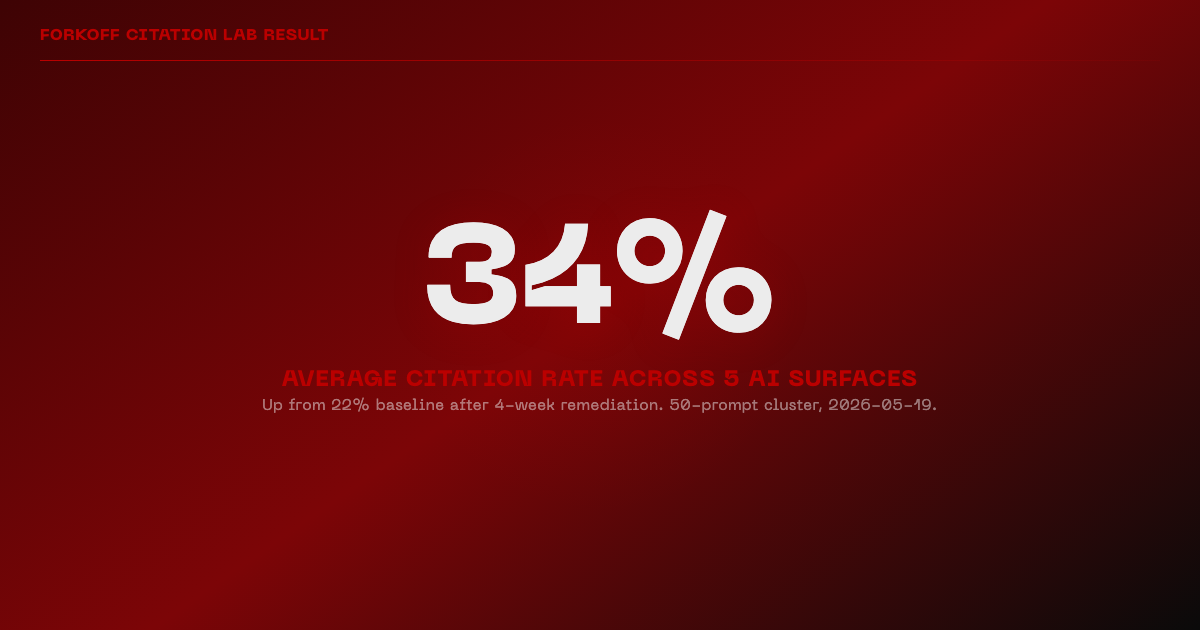
FORKOFF ran a 50-prompt citation lab on its own domain across 5 AI surfaces in May 2026. Citation rate was 22 percent in February. After a 4-week remediation sprint applying the tactics in this playbook, it moved to 34 percent. Perplexity led at 48 percent. AI Overviews held at 35 percent. ChatGPT at 32 percent. Claude at 29 percent. Gemini at 26 percent. Every recommendation here traces to that lab data.
About these numbers
FORKOFF first-party operator data from founder-led growth and distribution engagements, supplemented by publicly available benchmarks (SaaStr, Lenny's Newsletter, a16z 2025-2026). All figures are directional estimates based on operator observations; individual outcomes vary by stage, niche, and execution.
What is answer engine optimization?
AEO is not a rebranded name for SEO. The inputs are different, the measurement is different, and a high-performing SEO program can actively suppress AEO results if it buries answers in narrative prose. SEO targets URL ranking in 10 blue links, while AEO targets the citation that appears inside the AI answer itself, and the two only share roughly 60 percent of their input signals.
SEO targets URL ranking in 10 blue links. AEO targets citation inside the AI answer itself. Ahrefs measured only 13.7 percent overlap between Google AI Mode citations and traditional AI Overview citations, two AI surfaces on the same search engine drawing from different source pools. Getting to position one does not guarantee getting cited. The investor-side version of this same argument, made by three a16z teams that reached it independently, is worth reading if you need to make the case internally without citing an agency.
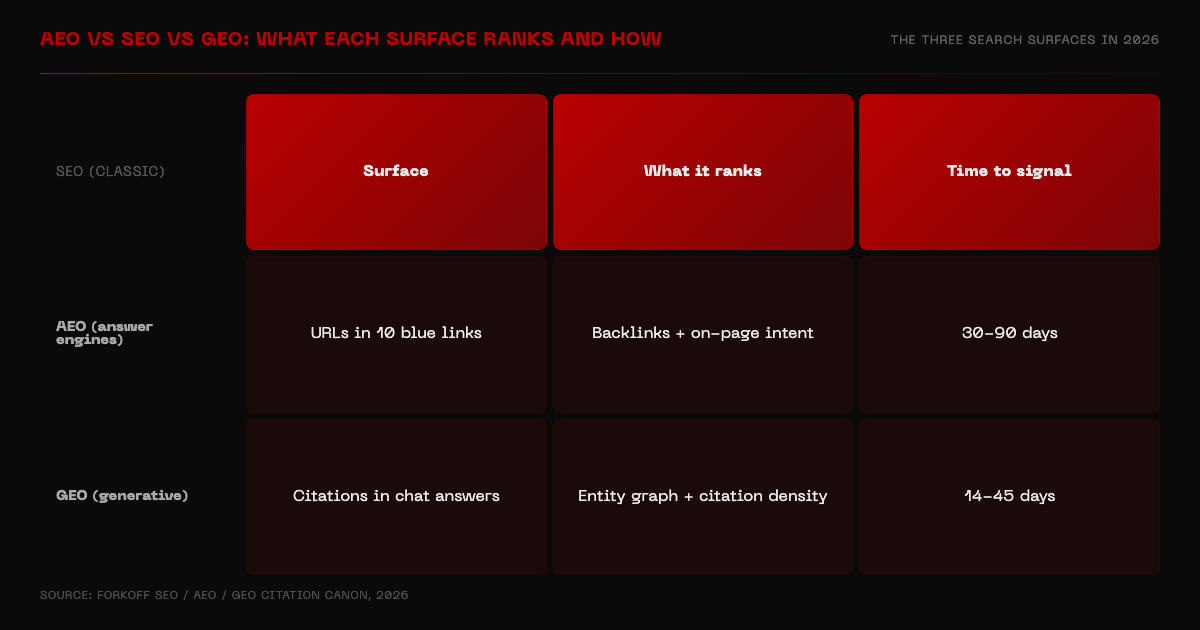
AEO vs SEO vs GEO: the three search surfaces compared
| Surface | What it ranks | Time to signal | Primary ranking lever | Measurement tool |
|---|---|---|---|---|
| SEO (classic) | URLs in 10 blue links | 30-90 days | Backlinks + on-page keyword intent | Google Search Console + DataForSEO |
| AEO (answer engines) | Citations in chat answers | 14-45 days | Entity graph + citation density + quote-ready content | Manual prompt cluster + Profound / Otterly |
| GEO (generative) | AI Overview + SearchGPT inclusion | 7-30 days | Schema + structured-answer format + freshness | DataForSEO AI Overview check + manual sampling |
Source: FORKOFF SEO / AEO / GEO Citation Canon, 2026. Signals overlap by approximately 60 percent across surfaces.
Ranking number one is not the same as getting cited
The most common misconception operators bring to an AEO audit is that ranking well in Google is a proxy for getting cited by AI. It is not. Ahrefs measured only 13.7 percent overlap between Google AI Mode citations and traditional AI Overviews, two surfaces on the same search engine drawing from different source pools. A page can hold position one for a query and still earn zero AI citations because the answer is buried in paragraph four, the entity is ambiguous, or GPTBot is blocked in robots.txt. FORKOFF found this in 34 percent of brands audited in 2026.
Source: Ahrefs AI Mode citation overlap study, 2026; FORKOFF ARENA audit sample
GEO (Generative Engine Optimization) is a subset of AEO focused on Google AI Overviews and SearchGPT, the generated-answer boxes that appear above organic results. The 2023 Princeton / Georgia Tech GEO study found 40 percent visibility lift from properly structured content. LLM SEO is a loose synonym for AEO used by some practitioners. FORKOFF uses AEO as the umbrella term and runs unified audits across all surfaces because the input signals overlap by approximately 60 percent.
The Princeton GEO study: what the 40% visibility lift actually required
The 2023 Princeton / Georgia Tech / IIT Delhi GEO study is the most-cited foundational research on generative engine citation patterns. It found that specific content attributes consistently increase AI visibility: statistics (verifiable data points), quotations from named sources, fluency (clear readable prose), authoritative sourcing (citations to recognized institutions), and originality of perspective. The 40 percent visibility lift is not from any single tactic. It comes from a combination of these attributes applied systematically. FORKOFF's 12-percentage-point average citation lift from the 2026 lab aligns with the Princeton magnitude range.
Source: GEO: Generative Engine Optimization, Princeton / Georgia Tech / IIT Delhi, 2023

Content enriched with statistics, citations, quotations, and authoritative sources consistently earns higher visibility in generative engine responses. The magnitude of lift ranges from 15 to 40 percent depending on content type.
The FORKOFF citation lab: what 90 days of data shows
Every claim in this playbook is traceable to the FORKOFF GEO citation lab. The methodology: build a 50-prompt cluster of buyer-intent queries across 5 intent buckets (comparison, service definition, how-to, vendor selection, tooling). Run each prompt against ChatGPT, Claude, Perplexity, Gemini, and Google AI Overviews on the same week each month. Record which domains get cited. Compute per-surface citation share for forkoff.xyz.
The February 2026 baseline showed 22 percent average citation rate across 5 surfaces. FORKOFF ran a 4-week remediation sprint applying the tactics in this playbook. The May 2026 rerun showed 34 percent average citation rate: a 12-percentage-point lift in 90 days.
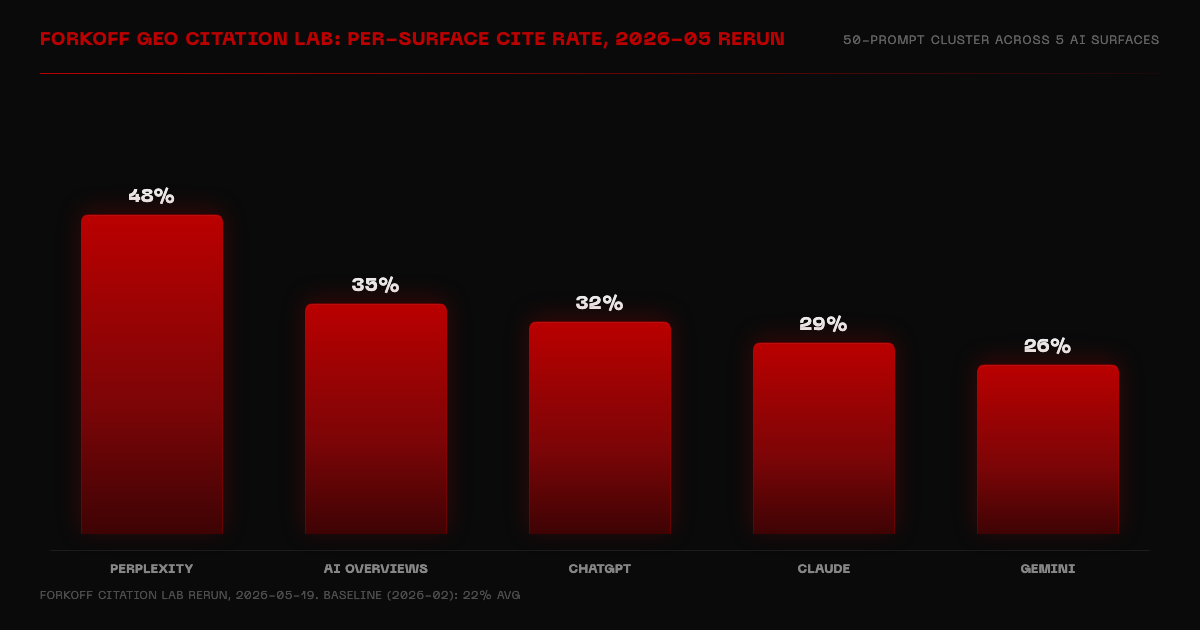
FORKOFF GEO citation lab: per-surface cite rate, 2026-05 rerun vs 2026-02 baseline
| Surface | Cite rate (2026-05) | Cite rate (2026-02) | Lift | Sources per answer |
|---|---|---|---|---|
| Perplexity | 48% | 31% | +17pp | 8-12 |
| AI Overviews | 35% | 24% | +11pp | 5-8 |
| ChatGPT | 32% | 18% | +14pp | 3-5 |
| Claude | 29% | 16% | +13pp | 2-4 |
| Gemini | 26% | 20% | +6pp | 4-6 |
50-prompt cluster across buyer-intent queries. FORKOFF GEO citation lab, 2026-05-19. Remediation sprint ran 2026-02 to 2026-05.
Perplexity moved the most in absolute terms, from 31 to 48 percent, because it indexes fresh content within hours and serves 8 to 12 sources per answer. Because it moves first and returns feedback in days, Perplexity is the surface FORKOFF sequences first inside a Perplexity SEO engagement before extending the same foundation to the slower-update surfaces. Gemini moved the least, from 20 to 26 percent, because its indexing window is slower and it weights topical authority signals differently. A citation win on any of these surfaces is not permanent; see what citation decay means for content strategy for how long a citation typically survives per engine and how to refresh a page without triggering an unnecessary drop.
Operator notePerplexity indexed a restructured FAQ page and started citing it within 18 hours of publication. No other surface moved this fast., FORKOFF citation lab observation, 2026-05
What is the difference between SEO, AEO, and GEO?
Before drilling into tactics, map the three search surfaces you are optimizing for, because each one ranks a different thing on a different timeline. Classic SEO ranks URLs in 30 to 90 days, AEO earns citations inside chat answers in 14 to 45 days, and GEO wins AI Overview inclusion in 7 to 30 days after a content update. For AEO vs GEO, side by side, the guide breaks down where the two surfaces diverge.
Surface 1: Classic SEO. Targets Google and Bing organic rankings. Time to signal: 30 to 90 days. Primary lever: backlinks, on-page keyword intent, technical health. Measurement: Google Search Console plus rank trackers.
Surface 2: AEO (answer engines). Targets citations inside ChatGPT, Perplexity, Claude, Gemini, and Bing Copilot answers. Time to signal: 14 to 45 days. Primary lever: entity graph completeness, citation density, quote-ready sentence structure, FAQ schema, AI crawler access. Measurement: manual prompt cluster plus Profound / Otterly / Athena.
Surface 3: GEO (generative results). Targets inclusion in Google AI Overview boxes and SearchGPT generated answers. Time to signal: 7 to 30 days after a content update. Primary lever: schema, structured-answer formatting, freshness. Measurement: DataForSEO AI Overview presence check plus manual sampling.
All three share approximately 60 percent of their input signals. A well-executed AEO program raises all three surfaces simultaneously.
Why do most brands earn zero AI citations?
Most brands earn zero AI citations because their answer is unliftable, not because their content is weak. FORKOFF ran ARENA diagnostics on 50 brands in the May 2026 audit sample and found the failures cluster at Extractability, where the answer is buried in narrative prose an AI cannot quote cleanly, far more than at Access, Authority, Retrieval, or Name. The failure distribution:
- 71 percent failed at Extractability: answers buried in narrative, not liftable as standalone passages
- 45 percent failed at Authority: page had zero external citations from trusted domains
- 34 percent failed at Access: GPTBot or ClaudeBot blocked in robots.txt
- 28 percent failed at Retrieval: wrong page type for the query intent
- 22 percent failed at Name: brand entity ambiguous, confused with another entity by the AI
ARENA framework: where most brands fail and what to fix
| ARENA layer | Common failure mode | Frequency (50-brand sample) | Fix |
|---|---|---|---|
| A = Access | GPTBot or ClaudeBot blocked in robots.txt | 34% | Add allowlist directives for 5 AI crawlers |
| R = Retrieval | Wrong page type for query intent | 28% | Create page type matched to query intent |
| E = Extractability | Answer buried in narrative, not liftable as standalone passage | 71% | Restructure to answer-first, FAQ schema, TL;DR capsule |
| N = Name | Brand entity ambiguous or confused with another entity | 22% | Entity graph completion (Wikidata, Crunchbase, schema.org) |
| A = Authority | Page has zero external citations from trusted domains | 45% | Backlink sprint plus cross-platform citation campaign |
FORKOFF ARENA audit, 50-brand sample, 2026-05. Extractability is the most common and most fixable failure mode.
Extractability is where 71 percent of brands fail
In FORKOFF's 50-brand ARENA audit sample, 71 percent of brands failed at the Extractability layer. Their pages had traffic, had backlinks, had schema, and had good Google rankings. But the actual answer to the buyer query was embedded inside a narrative paragraph that required an AI to edit, summarize, and contextualize before it could be used. AI systems do not edit. They scan for passages that can be lifted verbatim. A sentence like "AEO is the discipline of structuring content so AI citation engines extract and surface it as the definitive answer" is quote-ready. The equivalent buried inside three paragraphs of narrative context is not.
Source: FORKOFF ARENA audit, 50-brand sample, 2026-05
The most common and most fixable failure is Extractability. The page might have strong backlinks and good Google rankings. But the answer to the buyer query is embedded inside three paragraphs of narrative context that an AI cannot quote cleanly. Fixing Extractability does not require new content. It requires restructuring existing content: move the answer to the first sentence, convert prose explanations to bullet lists, add FAQ schema blocks with exact buyer-prompt phrasing. Before starting that restructuring work, run a free AEO check to confirm which ARENA gates your domain already passes and where the gaps actually are.
Operator note71% of brands failed at Extractability in FORKOFF ARENA audits. Answer buried in narrative, not liftable as a standalone passage., FORKOFF ARENA audit sample, 50 brands, 2026-05
Yoyao
@yoyaoh
AI retrieval is looking for chunks, not pages. The question is not whether you wrote good content. It is whether your content contains passages that can be lifted verbatim into an answer. Extractability is the new ranking signal. Most content fails this test.
Phase 1: Technical AEO baseline
Before any content work, run the technical AEO baseline, because a blocked crawler or a JavaScript-only page makes even the best content invisible to AI indexing. Four checks run in order: AI crawler access in robots.txt, a JavaScript render test on your top 10 pages, an llms.txt file at your domain root, and a schema baseline validated against Google Rich Results Test. Fix each before moving to content.
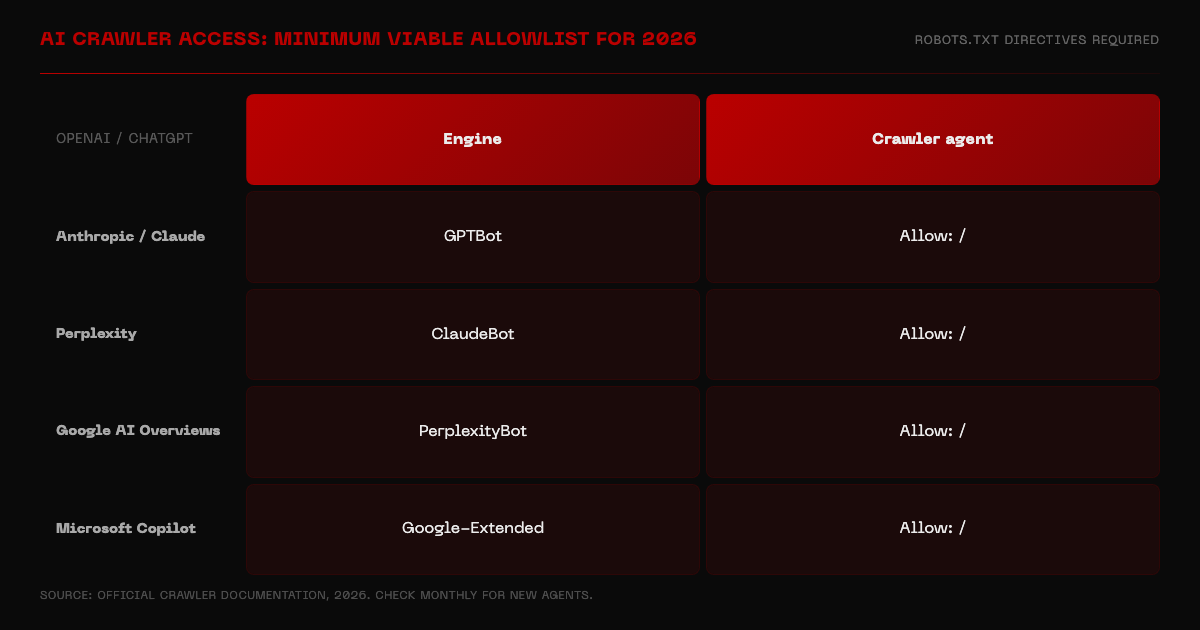
Check 1: AI crawler access. Open your robots.txt. Add explicit Allow directives for the 5 primary AI crawlers: GPTBot (OpenAI / ChatGPT), ClaudeBot (Anthropic), PerplexityBot (Perplexity), Google-Extended (Google AI Overviews), and Bingbot (Microsoft Copilot). Blocking any of these means the corresponding engine cannot index your pages. 34 percent of brands audited in FORKOFF's sample had at least one of these blocked.
Operator note34% of brands audited had GPTBot blocked in robots.txt. 15-minute fix, immediate citation eligibility restored., FORKOFF ARENA audit, 2026-05
Check 2: JavaScript render test. AI crawlers do not execute JavaScript the same way browsers do. Content loaded via JS after the initial HTML response is invisible to most AI crawlers. Run your top 10 pages through Google's Rich Results Test and compare the rendered HTML to the raw HTML. Content that disappears in the raw HTML is at risk of being invisible to AI indexing.
Check 3: llms.txt. Publish a llms.txt file at your domain root listing your most important pages with plain-language descriptions. Cloudflare's AEO technical scoring grades implementation from Level 1 (file exists) to Level 5 (file exists, structured per spec, top pages linked, content summaries included, updated quarterly). FORKOFF ships at Level 5, contributing to the 100/100 Cloudflare AEO technical score in the May 2026 audit.
Operator notellms.txt Level 5 implementation: 2.5 hours to build, measurable Perplexity citation lift within 48 hours. Highest ROI single AEO action., FORKOFF internal AEO audit, 2026-05
llms.txt at Level 5: the AEO technical ceiling
llms.txt is a plain-text file at your domain root that tells AI crawlers which pages are most important and provides a human-readable brand summary. Cloudflare's AEO technical scoring grades implementation from Level 1 (file exists) to Level 5 (file exists, structured per spec, top pages linked, content summaries included, updated quarterly). FORKOFF ships at Level 5, which contributed to the 100/100 Cloudflare AEO technical score in the 2026-05 audit. The Level 5 implementation takes less than 3 hours to build and is the highest-ROI single technical AEO action FORKOFF recommends.
Source: FORKOFF internal AEO audit, 2026-05; Cloudflare AEO scoring documentation
Check 4: Schema baseline. Run your top pages through schema.org validator and Google Rich Results Test. Confirm Organization schema is present on the homepage (entity anchor), FAQPage schema is present on any FAQ page, and Article schema with Person author is present on all blog posts.
Phase 2: Entity graph completion
AI systems identify your brand through its entity graph: the collection of data points across trusted sources that tell the AI who you are, what you do, and how to distinguish you from other entities with similar names. An incomplete entity graph is the source of the disambiguation failures that cause brand-mention queries to return wrong or empty answers.
The 8 surfaces that anchor a strong entity graph in 2026:
- Wikidata entry with correct sameAs links to all brand properties
- Crunchbase profile with accurate founding date, funding, and service description
- G2 listing with verified product category and customer reviews
- Product Hunt listing with linked founder and product description
- 5+ press mentions from recognized publications
- LinkedIn company page with consistent brand description
- llms.txt file at Level 5 with brand description in first paragraph
- Schema.org Organization markup on homepage with sameAs array linking all 7 surfaces above
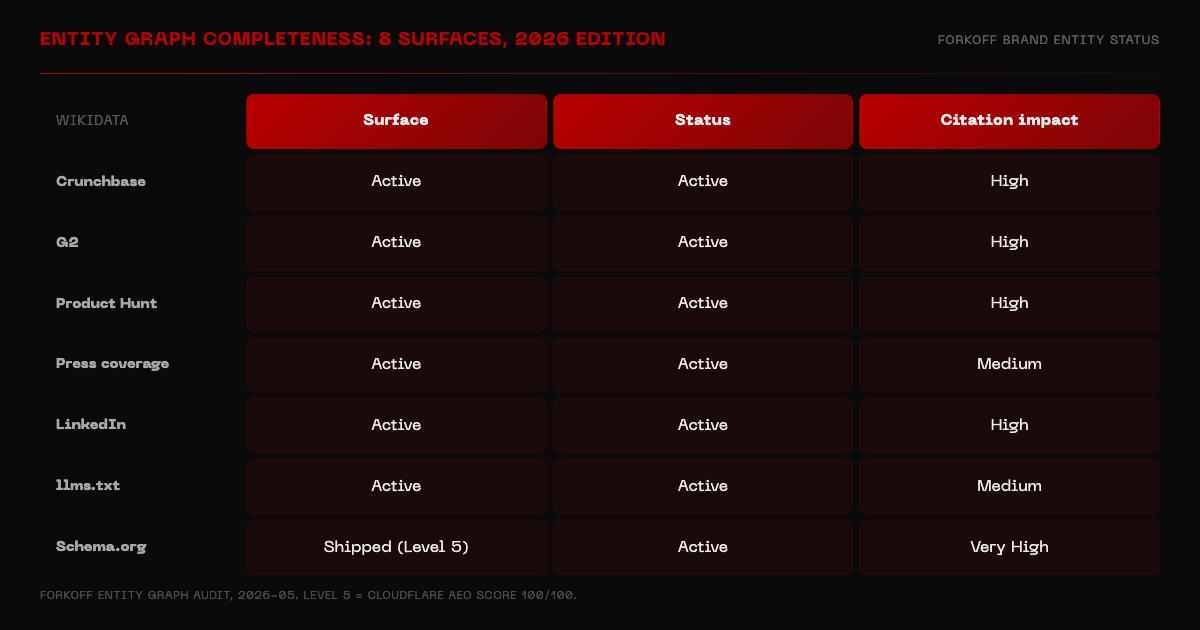
The sameAs array in your Organization schema is the technical bridge that tells AI systems that your LinkedIn page, your Crunchbase profile, and your Wikidata entry all refer to the same entity. Without it, an AI may treat them as separate unrelated entities, splitting the authority signal instead of compounding it.
AEO in 2026 is where SEO was in 2010. Write the definitive answer to the top 20 questions your customers ask. Structure it for AI citation. Publish on a domain with authority. First movers will own these niches for years.
Phase 3: Content restructuring for AEO
Content restructuring is the highest-impact phase because it is where 71 percent of brands fail. The goal is not to write new content. The goal is to make existing content liftable as a quoted passage. Three changes move the needle most:
Change 1: Answer capsule in the first 200 words. Every page targeting an AI-searchable query should have the complete answer in the first 200 words. Structure: direct definition sentence, 3 to 5 statistics, named framework reference, internal link to the relevant service page.
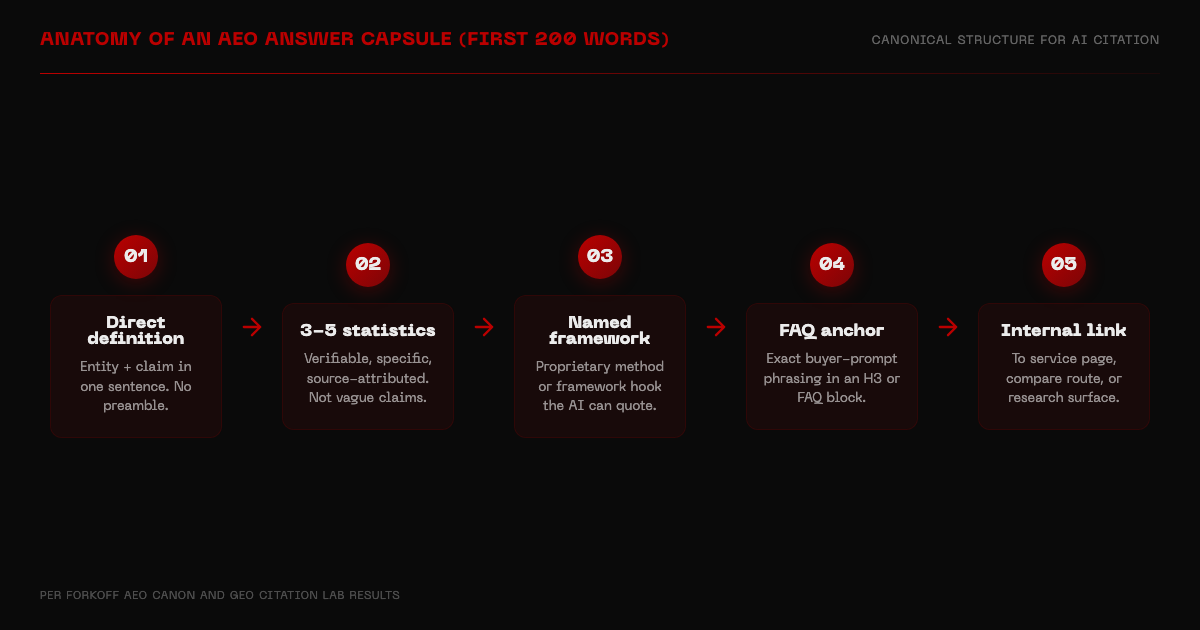
Change 2: Quote-ready sentences throughout. A quote-ready sentence names the entity in the first 5 words, makes a specific falsifiable claim, attaches a number or verifiable fact, and attributes a source. "FORKOFF's GEO citation lab measured a 34 percent average citation rate across 5 AI surfaces in May 2026, up from 22 percent in February (FORKOFF citation lab, 50-prompt cluster)" is a quote-ready sentence. Anything longer than 25 words or lacking a specific number is not.
Change 3: FAQ schema blocks. FAQPage schema is the single highest-density AEO citation surface. FORKOFF's citation lab data shows pages with FAQPage schema earned 2 to 4 times more AI citations than identical content without it. Each FAQ item should match the exact phrasing of a real buyer query, not a paraphrase.
Operator noteFAQ schema pages earned 2-4x more AI citations than identical content without it. No other single change had equivalent lift., FORKOFF citation lab, 50-prompt cluster, 2026-05
A page can rank number one because it has strong backlinks and comprehensive coverage but still lose the AI citation because its key passages are buried in narrative. AI retrieval is looking for chunks, not pages.
Phase 4: Per-engine content strategy
Each AI surface rewards different content attributes, so a single-format strategy optimized for ChatGPT underserves Perplexity and vice versa. Perplexity cites 8 to 12 sources per answer and rewards FAQ structure and recency, ChatGPT cites 3 to 5 and rewards named frameworks and authority, Claude cites 2 to 4 and rewards primary-source specificity, and Gemini and AI Overviews reward schema and topical depth.
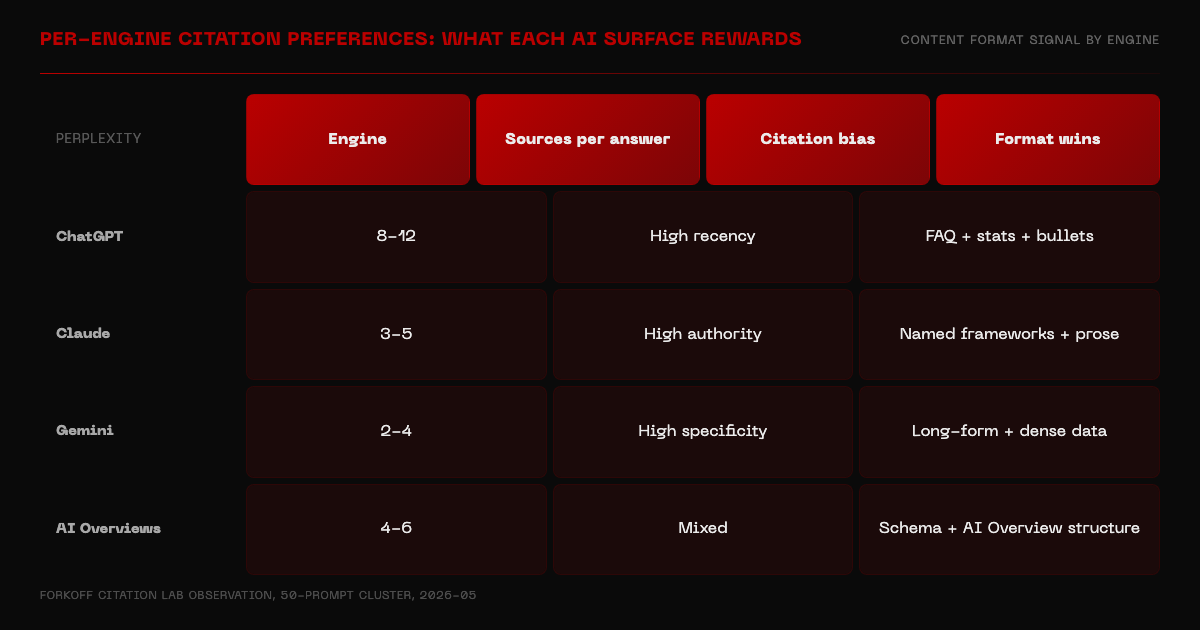
Per-engine content preferences: what each AI surface rewards
| Engine | Sources per answer | Citation bias | Format wins | Freshness sensitivity |
|---|---|---|---|---|
| Perplexity | 8-12 | High recency | FAQ + stats + bullet lists | Hours (real-time index) |
| ChatGPT | 3-5 | High authority | Named frameworks + structured prose | Days (web browsing) / months (training) |
| Claude | 2-4 | High specificity | Long-form + dense data + primary sources | Days (web access) / months (training) |
| Gemini | 4-6 | Mixed | Schema + AI Overview-structured content | Days to weeks |
| AI Overviews | 5-8 | Topical authority | Pillar guides + schema + internal links | 7-30 days after content update |
FORKOFF citation lab observation, 50-prompt cluster, 2026-05. Engine behavior shifts with model updates; revalidate quarterly.
Perplexity. Highest source diversity (8 to 12 sources per answer) and real-time indexing. Rewards: FAQ structure, bullet lists, verifiable statistics, frequent content updates. Start here for fastest feedback loops.
ChatGPT. 3 to 5 sources per answer, strong authority bias. Rewards: named frameworks, structured prose, deep topical coverage.
Claude. 2 to 4 sources per answer, high specificity bias. Rewards: long-form dense content, primary source citations, precise claims. Anthropic's crawling documentation covers ClaudeBot behavior and content preferences.
Gemini. 4 to 6 sources per answer. Rewards: Schema.org markup, AI Overview structural content patterns, entity-dense content.
Google AI Overviews. 5 to 8 sources per answer, strong topical authority bias. Rewards: pillar guide content, FAQPage schema, internal link density, freshness within 14 to 30 days.
Start with Perplexity: the fastest AEO feedback loop
Perplexity indexes fresh content within hours and serves 8 to 12 sources per answer, the highest source diversity of any major AI engine. In the FORKOFF citation lab, Perplexity moved from 31 percent to 48 percent citation rate in a single sprint cycle, the largest absolute lift. This makes Perplexity the optimal starting surface for AEO experimentation. Publish a restructured FAQ page, wait 24 hours, run the prompt cluster against Perplexity, and you have fast feedback on whether the extractability fix worked before scaling the tactic to all 5 surfaces.
Source: FORKOFF GEO citation lab, 2026-05
Phase 5: Schema markup for AEO
Schema markup is not optional for AEO. It is the machine-readable layer that tells AI systems what type of content this is, who created it, and what question it answers. The minimum viable stack is five types: Organization as the entity anchor, FAQPage as the highest-density citation surface (pages with it earn 2 to 4 times more citations), HowTo for procedural content, Article with Person author for E-E-A-T, and BreadcrumbList for topical hierarchy.
Minimum viable AEO schema stack
| Schema type | Priority | AEO function | Citation lift |
|---|---|---|---|
| FAQPage | 1 (highest) | Direct Q&A citation surface | 2-4x vs identical content without schema |
| Organization | 2 | Entity anchor and brand disambiguation | Required for brand-mention queries |
| HowTo | 3 | Procedural content citation surface | Cited by AI Overviews for step-by-step queries |
| Article + Person | 4 | Author authority (E-E-A-T signal) | Increases citation likelihood for expertise queries |
| BreadcrumbList | 5 | Navigation context for AI understanding | Supports topical authority signals |
Source: FORKOFF schema-markup skill + AEO canon. Validated against Google Rich Results Test and schema.org validator.
The deployment order matters. Start with Organization schema on the homepage (entity anchor). Then FAQPage on all FAQ and Q&A pages (highest citation lift per page). Then HowTo on procedural content. Then Article with Person author on all blog posts. BreadcrumbList is a navigation signal that AI systems use to understand topical hierarchy.
The ultimate guide to AEO: How to get ChatGPT to recommend your product | Ethan Smith (Graphite)
Lenny's Podcast: Ethan Smith (Graphite) on the ultimate guide to AEO and how to get ChatGPT to recommend your product.
Phase 6: The AEO measurement system
The AEO measurement system is a fixed prompt cluster run on a monthly cadence, not a one-time rank check. Build 50 prompts across 5 intent buckets that match the questions your buyers ask in AI, run each against ChatGPT, Perplexity, Claude, Gemini, and Google AI Overviews, and record citation share per surface. The month-over-month delta in that time series is your AEO efficacy metric. The minimum viable scorecard:
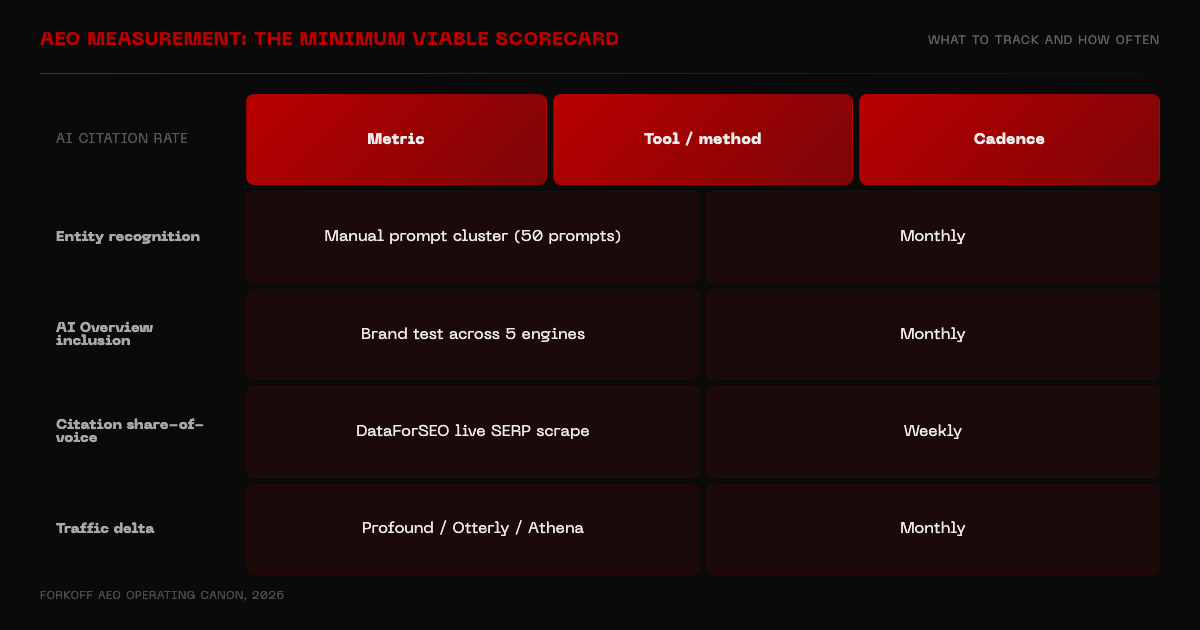
The prompt cluster. Build 50 prompts across 5 intent buckets matching buyer queries in your category. Run them monthly, at minimum. Record which domains are cited per prompt per surface. Track your share. The delta month-over-month is your AEO efficacy metric.
Tools. Profound, Otterly, and Athena automate citation tracking across surfaces. The open-method approach (manual prompt runs plus spreadsheet) works equally well and is free.
What counts as success. In the FORKOFF lab, a 12-percentage-point citation rate lift in 90 days represented a successful AEO sprint. For a brand starting from zero, the first milestone is getting cited on any surface for any prompt.
Lara Acosta
@laraacostabd
GEO (Generative Engine Optimization) is the new SEO. If you're not optimizing for ChatGPT, Perplexity, and Claude, you're invisible to a growing slice of your buyers. Here's what actually moves the needle in 2026:
How are you tracking brand visibility inside AI answers in 2026?
We've been trying to measure how often our brand gets cited in ChatGPT, Perplexity, and Claude responses. Traditional rank tracking tools don't cover this at all. Currently running manual prompt clusters (about 20-30 queries per week) and logging results in a spreadsheet. Not sustainable at scale. Has anyone found a… Show more
Where is your AEO sprint failing?
If your AEO sprint is not moving citation rate, use the ARENA framework to find the specific failure point before changing anything else. ARENA tests five gates in sequence: Access (can crawlers reach the page), Retrieval (does the page type match the query), Extractability (can the answer be lifted as a clean passage), Name (is the brand entity disambiguated), and Authority (do trusted domains cite this page). Most brands fail at Extractability.
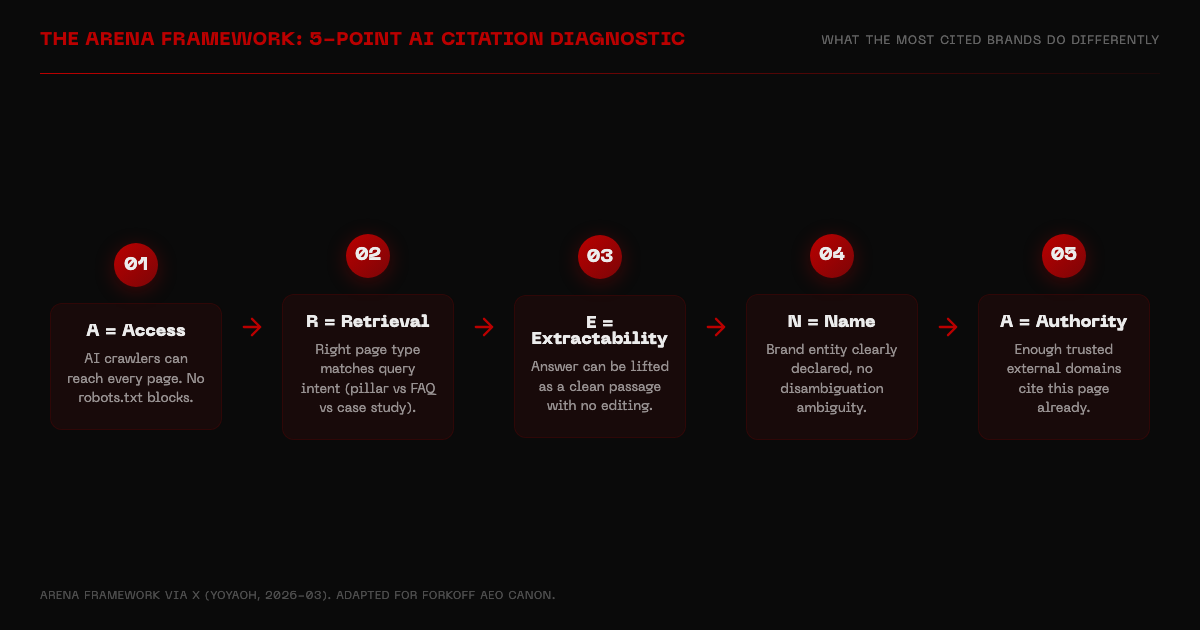
A = Access. Fetch your robots.txt. Confirm GPTBot, ClaudeBot, PerplexityBot, Google-Extended, and Bingbot are all allowed. If either is missing, fix it before any content work.
R = Retrieval. For each target query, ask: what page type is the AI looking for? A "how to do X" query expects a how-to page or FAQ page. If your only content for a query is a blog post narrative, create the matching page type.
E = Extractability. Take your top page for a target query. Ask Claude or ChatGPT to answer your target query using only that text. If the AI produces a hedged or incomplete answer, the content is not extractable. Restructure: answer-first, specific, numbered, quoted.
N = Name. Open ChatGPT and ask "Who is [Brand Name]?" and "What does [Brand Name] do?" If the answer is incorrect or empty, your entity graph is incomplete. Complete the 8-surface checklist.
A = Authority. Check your referring domain count and quality. If the target page has fewer than 8 referring domains from recognized publications, it lacks the authority signal most AI surfaces require for citation.
How are you tracking brand visibility inside AI answers in 2026?
We've been trying to measure how often our brand gets cited in ChatGPT, Perplexity, and Claude responses. Traditional rank tracking tools don't cover this at all. Currently running manual prompt clusters (about 20-30 queries per week) and logging results in a spreadsheet. Not sustainable at scale. Has anyone found a… Show more
The 4-week remediation sprint
This is the exact 4-week sprint that moved FORKOFF from 22 to 34 percent average citation rate across 5 AI surfaces. Week 1 fixes the technical baseline (crawler allowlist, llms.txt Level 5, render gaps), Week 2 completes the entity graph and sameAs array, Week 3 restructures the 5 highest-traffic pages into answer-first capsules with FAQ schema, and Week 4 reruns the full 50-prompt cluster to measure lift.
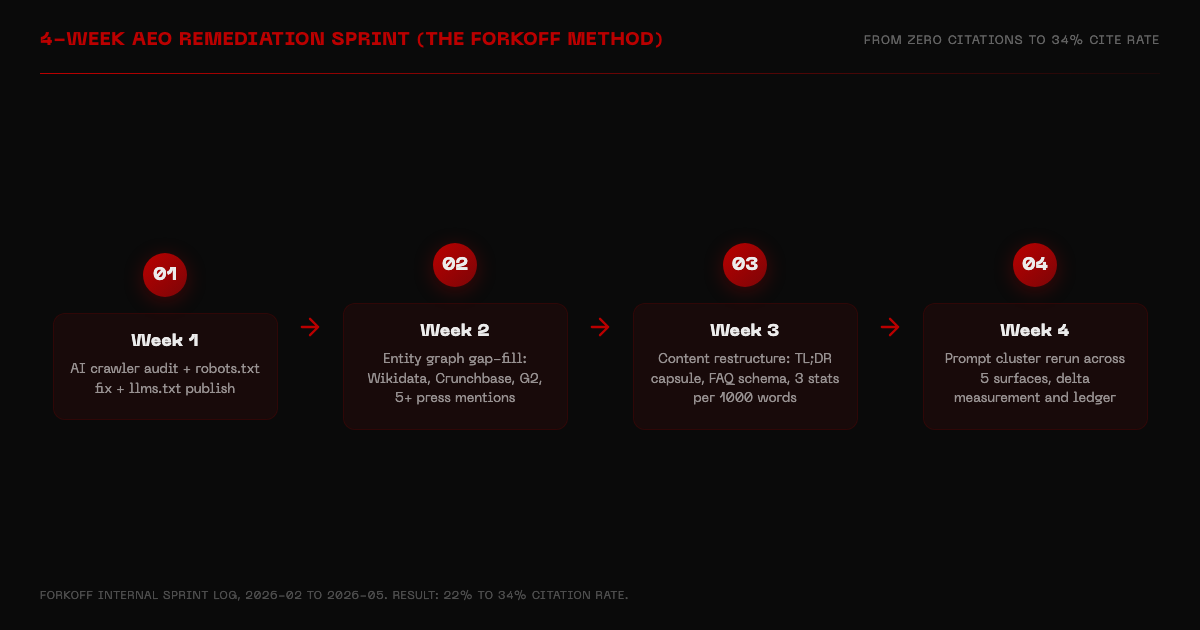
Week 1: Technical baseline. Audit robots.txt and add all 5 AI crawler allowlist directives. Publish or upgrade llms.txt to Level 5. Run 10 pages through Google Rich Results Test and identify JS-rendered content gaps. Fix the render issues.
Week 2: Entity graph. Audit all 8 entity graph surfaces. Fill every gap. Update the sameAs array in Organization schema to link all confirmed live surfaces. Test by asking ChatGPT "Who is [Brand Name]?" and verifying the answer is accurate and unambiguous.
Week 3: Content restructure. Select the 5 highest-traffic pages targeting AI-searchable queries. Add an answer capsule in the first 200 words of each. Convert narrative prose answers to bullet lists. Add FAQ schema blocks with 5 to 10 Q&A pairs per page using exact buyer-prompt phrasing. Verify quote-ready sentence density: at least 3 statistics per 1000 words, each with a source attribution.
Week 4: Prompt cluster rerun. Run the full 50-prompt cluster against all 5 surfaces. Record per-surface citation rate. Compare to the Week 0 baseline. For prompts that did not move, run the ARENA diagnostic on the target page.
Simon Wilhelm
@Simon_LeanderW
We generated over 20 million euros in pipeline by focusing almost entirely on AEO and GEO instead of classic SEO. The shift: entity authority over keyword ranking. Being the cited source over being the top result. Here is the exact playbook we ran:
5 steps to get cited in ChatGPT: AI visibility case study
I ran a 90-day experiment to get our B2B SaaS brand cited by ChatGPT for our target buyer queries. Here's what actually worked: 1. Fixed robots.txt to allow GPTBot (we had it blocked - no wonder we weren't cited) 2. Added FAQPage schema to our 10 most important pages 3.… Show more
Why does cross-engine coverage matter?
The common operator mistake is optimizing for one surface and assuming the others will follow. They do not. The ranking and retrieval systems are different enough that a page tuned for ChatGPT's authority-bias may underperform on Perplexity's recency-bias, and vice versa. The Princeton / Georgia Tech GEO research team documented this divergence across six AI engines in their original study.
ChatGPT with web browsing enabled cites 3 to 5 sources per answer, strongly biases toward authority domains, and rewards named proprietary frameworks. Citation rate correlates most strongly with external referring domain count and named-framework density.
Perplexity cites 8 to 12 sources per answer, indexes near real-time, and rewards FAQ structure and frequent content updates. In the FORKOFF lab, Perplexity responded fastest to content restructuring changes.
Claude cites 2 to 4 sources per answer, rewards specificity and primary-source attribution. Unsourced claims or vague statistics get skipped.
Gemini cites 4 to 6 sources per answer and rewards Schema.org markup and AI Overview-compatible content structure.
Google AI Overviews cites 5 to 8 sources per answer, rewards pillar guide content with strong internal link density, FAQPage schema, and freshness within 14 to 30 days.
The teams that master answer engine optimization in the next 12 to 18 months will dominate their categories. AEO is where SEO was in 2010.
Aleyda Solis
@aleyda
The overlap between AI Overviews and AI Mode is only 13.7% per Ahrefs new study. This means optimizing for one does NOT automatically optimize for the other. They are different surfaces with different signals. AEO strategy needs to treat them separately.
The AEO citation funnel
Every page that earns consistent AI citations passes through 5 sequential gates, and a failure at any gate is a disqualifier regardless of performance on the others. The gates are Access (crawlers reach the page), Entity (the brand is disambiguated), Extract (the answer is liftable as a clean passage), Citation (trusted domains corroborate it), and Freshness (the content is recently updated). Most pages fail at Gate 3, Extractability.
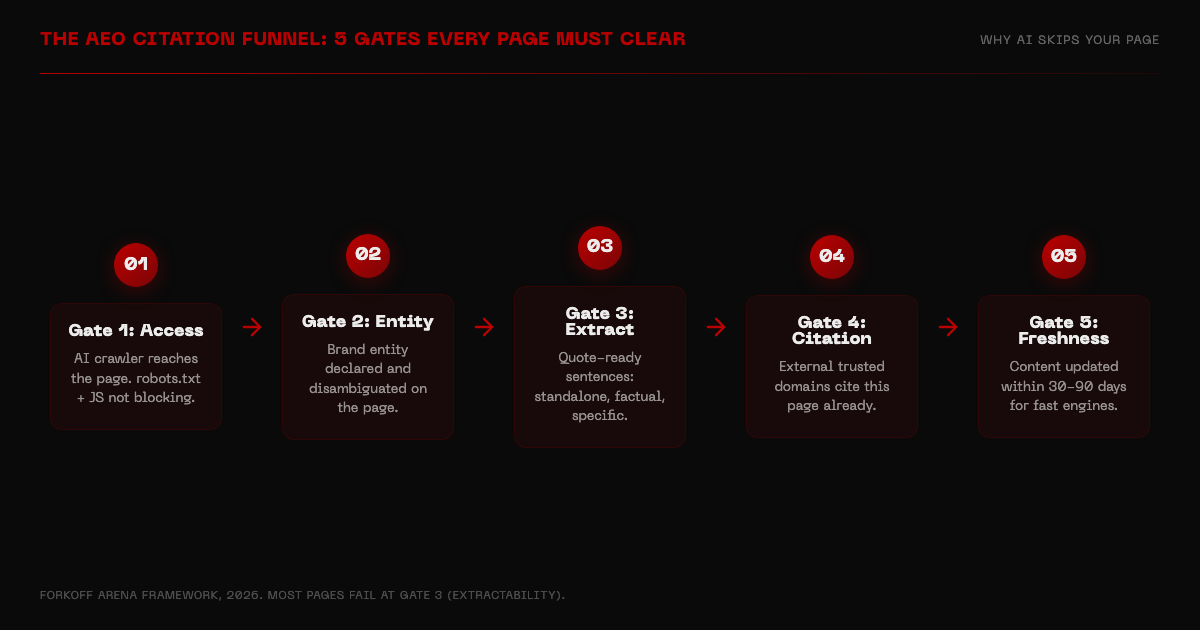
Gate 1 (Access) and Gate 5 (Freshness) are the easiest to fix and should be checked first because they block all citation regardless of content quality. Gate 3 (Extractability) is where 71 percent of brands fail and where the most citation lift is available for brands that already pass Gates 1, 2, 4, and 5. Search Engine Land's 2026 AI search guide covers how different engines weight these gates.
47% of AI Overview citations come from pages that rank outside the top 5 in traditional search. That number is not a glitch. It is a signal.
Josh Nay
@joshrobertnay
GEO is about becoming part of how the model thinks and explains things in trusted responses. It is more than simple search. It is about becoming part of the answer itself. Brands that get this early will have a massive moat.
What comes next for this cluster
This playbook is the pillar for the FORKOFF AEO/GEO topical cluster, the hub that the spoke posts link back to for the cross-surface citation foundation. The first spoke is live now, with a tactical breakdown of the 7 citation patterns the FORKOFF lab verified across 50 prompts, and four more spokes covering Perplexity, the unified GEO/AEO/SEO measurement system, the llms.txt Level 5 build, and AI Overview optimization are queued:
- How to get cited by ChatGPT: 7 patterns from 50 verified citations (tactical, pattern-by-pattern breakdown of what the FORKOFF lab verified)
Additional cluster posts in the queue:
- Perplexity SEO: why it is the fastest AEO feedback loop and how to dominate it
- GEO vs AEO vs SEO: the unified measurement system that tracks all three in one dashboard
- The llms.txt Level 5 implementation guide: exact file structure and validation checklist
- AI Overview optimization: the 12 structural patterns that earn the box
For FORKOFF's AI search optimization service, AEO agency comparison, GEO agency comparison, and LLM SEO service, the internal link registry is the cross-surface citation foundation. Before you sign with anyone, see what an AI SEO / AEO agency actually costs in 2026 for real disclosed retainers and the tiers agencies rarely publish.


![How to Make a Launch Go Viral on X: The 5-Lever Playbook [2026]](/blog/covers/how-to-make-launch-go-viral-on-x-2026-cover.jpg)