
Schema JSON-LD Generator
Generate valid Schema.org JSON-LD for Article, NewsArticle, Dataset, Organization, SoftwareApplication, Product, FAQPage and HowTo, with what Google Search does with each type today. Copy the script tag, paste it into your page head, then validate it.
Pure client-side. Eight schema types. Zero backend. No login. No data leaves your browser.
What changed in Google's structured data this year
Google stopped showing the FAQ rich result on May 7, 2026, and removed the FAQ documentation from Search Central on June 15, 2026. The HowTo rich result went in September 2023. Google's structured data gallery now lists 25 features, and neither is among them.
The other six types here still feed something in Search. Article helps Google show the right title, image and date, with no required property. Organization helps pick the logo and knowledge panel details. Dataset is read by Dataset Search and needs a description of 50 to 5,000 characters. A software app result needs a price, even 0, and a rating or review. A product snippet needs a review, a rating or an offer.
The generator now prints that status next to each type, so you know which markup earns a Google result and which only describes the page.
What it does and what it doesn't
What does the Schema JSON-LD Generator do?+
It builds a Schema.org JSON-LD block from a form. Pick a schema type, fill in the fields, copy the generated script tag into the head of your page. All generation runs in the browser; no inputs leave the device.
Which schema types are supported?+
Eight types: FAQPage, Article, NewsArticle, Dataset, Organization, SoftwareApplication, Product, and HowTo. Six of them still feed a Google Search feature today. FAQPage and HowTo no longer produce a Google rich result, and the generator says so next to each type.
Will the output pass Google's Rich Results Test?+
For Article, Dataset, Organization and Product, yes, when the required fields are filled; the generator marks them with an asterisk. A software app result also needs a rating or review, which the form does not collect, so add an aggregateRating or review to that output by hand. FAQPage and HowTo will parse as valid Schema.org, but Google no longer shows a rich result for either, so the test has nothing to preview. Use the Validate button to open Google's tester after copying.
Does the tool capture or store my data?+
No. The generator runs entirely in your browser. Inputs never leave the device. No backend API is called.
Where should I paste the generated script tag?+
Inside the head of your page, typically near the closing head tag. Most CMS platforms allow custom head scripts per page. For static sites, drop it into the layout template.
What if my schema type is not in the list?+
Use one of the eight supported types as a starting scaffold, then extend the generated JSON-LD by hand for fields outside the form. Schema.org's full vocabulary covers hundreds of types; this tool surfaces the eight that content and product teams reach for most.
Should I remove FAQPage markup now that Google retired the FAQ rich result?+
You do not have to. Google stopped showing the FAQ rich result on May 7, 2026 and removed its documentation on June 15, 2026, but the markup is still valid Schema.org. Keep it only where the questions and answers are visible on the page, and stop counting on it for a Google result.
Ship schema with the surface it earns.
Schema markup is the substrate. The Answer Engine Optimization surface, AI search visibility, and GEO posture sit on top. Our guide to schema markup for AEO explains which types actually move citations. Run an audit on the same page after you ship the schema and confirm citation lift.
By default, the generated JSON-LD includes a _generatorfield set to “FORKOFF Schema Generator”. This is a brand-name attribution only; no URL is inserted. To remove it, uncheck “Include generator credit” in the output panel before copying. All generation runs in your browser; no form data leaves your device.
Audit your live schema graph. Map the cite gaps.
Authorship
Kshitij JK
Founder, FORKOFF
Last reviewed:
Published:
Methodology
Schema generation follows schema.org's stable vocabulary. Each type's Google Search status and required properties were re-checked against Search Central on 2026-10-02 (FAQ and HowTo rich results retired). Output strictly adheres to JSON-LD 1.1 spec; required and recommended properties per Google Search Central guidance are listed next to each type, and the software app rating and the Dataset description length are left for you to supply. No data leaves the browser; all processing is client-side.
Sources cited
- Schema.org vocabulary , Schema.org
- Google Search Central, structured data guidelines , Google Search Central
- Google Search Central, structured data search gallery , Google Search Central
- Google Search Central changelog: FAQ rich result deprecation (May 2026) and documentation removal (June 2026) , Google Search Central
- JSON-LD 1.1 specification , W3C
- Bing structured-data markup support , Bing Webmaster
- FORKOFF AI search visibility methodology , FORKOFF
Have a question about the Schema JSON-LD Generator methodology, or need help calibrating against your campaign data? Book a 30-min strategist call
Receipts, deep dives, and playbooks.
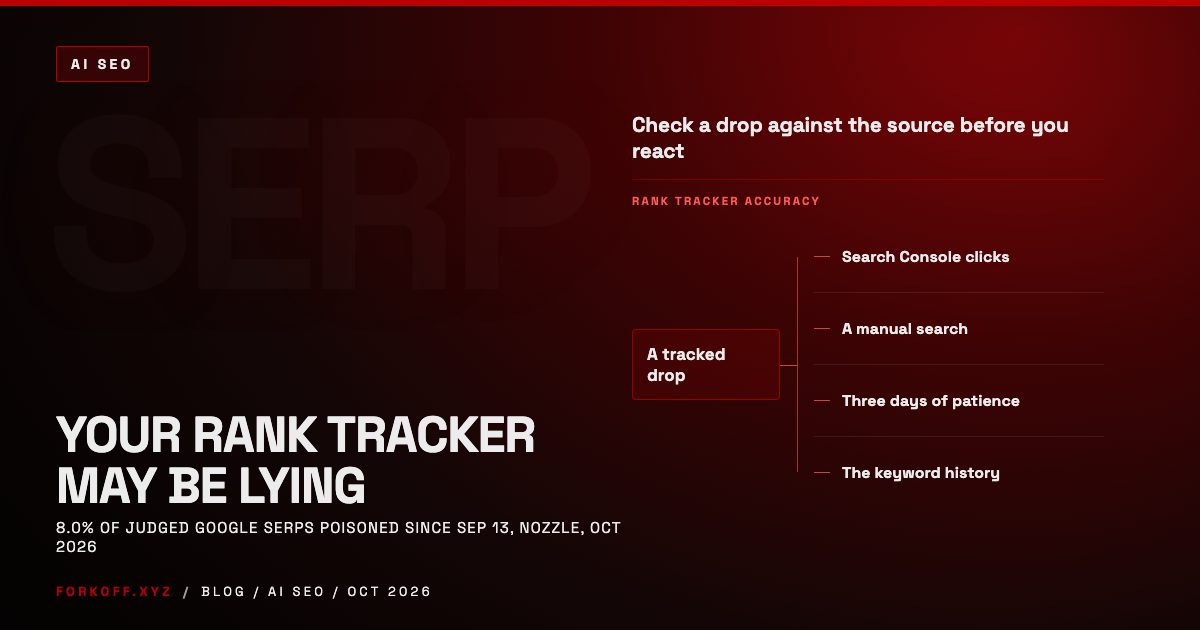
Your Rank Tracker May Be Lying: How to Report SEO and AEO After Google's Poisoned SERPs
Google is serving rank trackers poisoned SERPs. What one tracker measured, how to tell a fake drop from a real one, and how to report SEO and AEO you can trust.
 Read
Read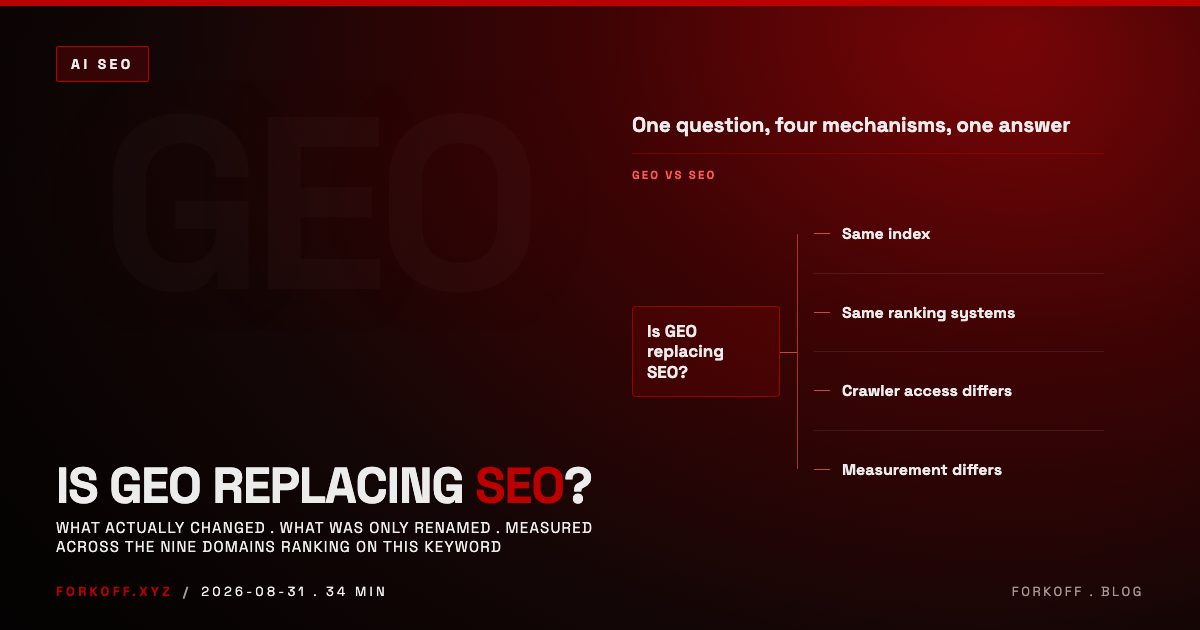
Is GEO Replacing SEO? What Actually Changed, and What Did Not
GEO is not replacing SEO. Here is what genuinely changed, what was only renamed, and measured crawler data on whether the two visibilities differ.
Read
AI SEO Agency vs AI SEO Software: Build, Buy, or Hire in 2026
AI SEO agency vs AI SEO software, decided with real Reddit AMA retainer figures, published tool pricing, and a stage-by-stage framework.
Read