A LinkedIn ghostwriter is a writer who drafts posts that publish under a founder's name. The scope is usually drafting, formatting, and holding a posting cadence, and the good ones start by capturing how you actually talk. Hiring one is usually the right call. The part that goes wrong is almost never the writing, and it is almost never discussed before the contract is signed: someone still has to answer the comments in your voice within the hour, and then be the person on the call that comment produced. Four of the five jobs a launch needs on LinkedIn transfer cleanly. That fifth one does not, and a launch is where getting it wrong costs the most.
The short version
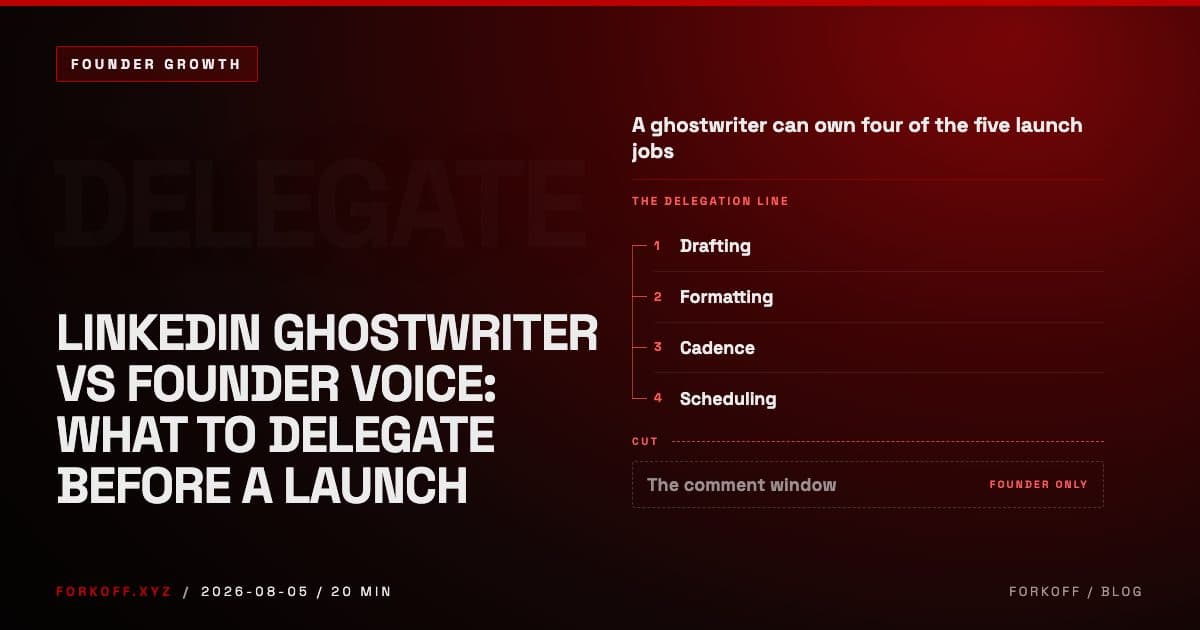
A LinkedIn ghostwriter is a writer who drafts posts published under a founder's name. Hiring one is usually correct, and the reason founders think it failed is usually wrong. Four of the five jobs a launch needs on LinkedIn transfer cleanly: drafting, formatting, cadence, and scheduling. The fifth does not. Someone has to answer the comments in the founder's voice within the hour, and then be the person on the call that comment produced, and no retainer can absorb that. The market's own words back this up. A buyer paying $800 a month said the reason was that she could not make posts sound like herself (@sarsswm, X, 2026-07-12), and a working ghostwriter said the hardest part is not the writing but preserving how someone thinks (@KritikaA1430, X, 2026-06-23). Two more things worth knowing before you sign. Engagement pods are sold openly as a standard deliverable in this category, and LinkedIn's own Professional Community Policies describe them and prohibit them in one sentence. And in a competitive pass across eight founder-brand agencies on 2026-07-08, only two of the eight published any pricing at all.
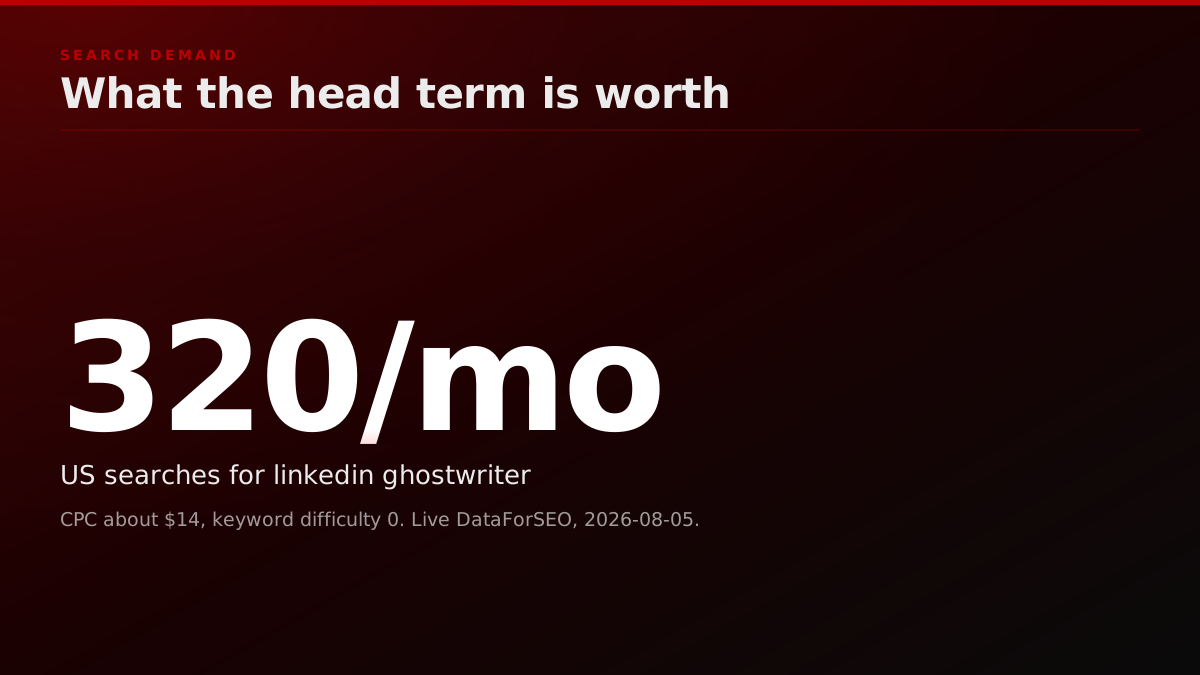
Search demand for this decision is small and unusually commercial. The head term draws about 320 US searches a month at a cost per click of roughly $14, with a keyword difficulty of zero, measured against live DataForSEO on 2026-08-05. The people typing it are split almost evenly between two entirely different intents: founders deciding whether to hire, and writers deciding whether to become one.
That split shows up in who Google ranks. A live SERP pull on 2026-08-05 returned seven distinct domains across ten slots. Three were native LinkedIn posts about becoming a ghostwriter. One was a Reddit thread. One was a Medium post. The remaining five were pages selling the service, including a vendor listicle ranking itself. Not one was a publisher, a trade title, or anything neutral. So if you searched this and found only sales pages, that was not bad luck. That is the whole page.
Five jobs a launch needs on LinkedIn, and who can hold each one
What does a LinkedIn ghostwriter actually do?
A LinkedIn ghostwriter produces posts that publish under someone else's name, and on this platform the job has settled into a fairly consistent shape. The deliverable is usually between four and sixteen posts a month, mixing plain text with carousels and sometimes short video scripts. Around that sits an intake process to capture voice, a content plan organised into two or three recurring themes, and a posting schedule. Better engagements add a recurring founder interview as the raw input. Some bundle profile assets such as a banner, a headline rewrite, and photography. A few attach outbound direct messaging or lead generation, which is a different service wearing the same label.
What that list does not include is the part a founder assumes is included. Nobody in the standard scope answers comments as the founder, and nobody takes the meeting that a comment turns into. Read any three service pages in this category and you will find drafting, cadence, and reporting described in detail, and the comment thread described not at all.
There is a second thing the scope quietly assumes, which is that a founder already knows what they think. One practitioner stated it cleanly in August 2026, arguing that ghostwriting for executives is not about manufacturing thought leadership because they already have it from years of experience, and that the job is knowing how to extract it so it becomes easier to see. That is an accurate description of the service and also a precondition for buying it. Extraction needs something to extract.
Where does the delegation line actually fall?
The delegation line falls between producing a post and standing behind it. Drafting, formatting, cadence, and scheduling are craft problems, and craft transfers to someone who does it for a living. The comment window is not a craft problem. It is a question of who is accountable for a sentence when a named prospect replies to it, at the moment they reply, in the register they expect. That accountability cannot be bought, because the value of the reply is precisely that the founder wrote it. This is the distinction almost no vendor page draws, and it is the one that decides whether the money works.
Here is why the split is so clean. When a ghostwriter drafts a post, the founder reviews it before it publishes. There is a checkpoint. When somebody comments, there is no checkpoint. The reply either sounds like the founder or it does not, and it happens in public, in minutes, in front of the exact audience the post was written for.
The five launch jobs, and whether each one transfers
| Job | Transfers to a writer | Why | What breaks if you assume it does |
|---|---|---|---|
| Drafting | Yes | A writer with real founder artefacts can hold a voice | Nothing, this is the core of the service |
| Formatting | Yes | Hook, line breaks and carousel structure are craft, not identity | Nothing |
| Cadence | Yes | Five posts a week is a scheduling problem | Nothing, though volume without a point of view still fails |
| Scheduling | Mostly | Works via a scheduling tool; direct account login is the caveat practitioners raise | Account access questions surface late, in a launch window |
| The comment window | No | A reply within the hour, in the founder's voice, to a named person | The launch post lands and the thread underneath it reads as a different person |
Verdicts are editorial judgment grounded in the sourced market voice and the FORKOFF cadence cited in this post, not a measured external dataset.
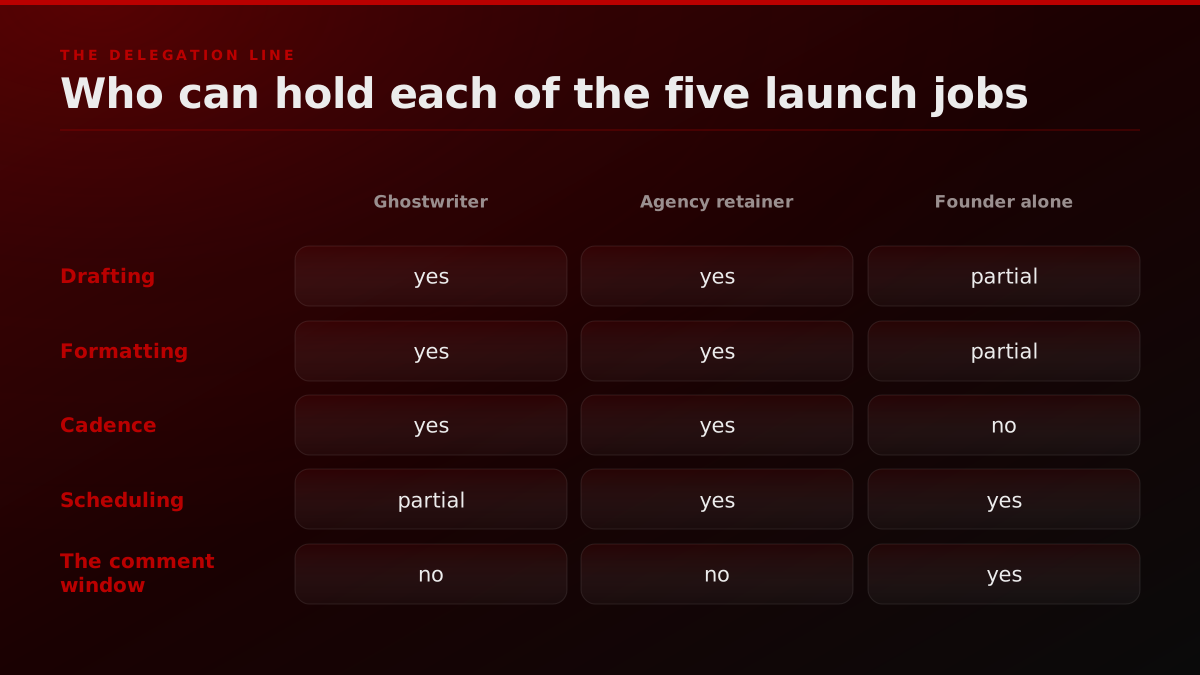
Notice the fourth row. Scheduling is listed as mostly transferable rather than fully, and the reason is not a technicality. In the Reddit thread currently ranking second for this head term, a working ghostwriter asked how others handle logging in directly to a founder's profile, and whether LinkedIn detects and blocks it, even with the founder's explicit permission. Nobody in that thread had a settled answer. LinkedIn's position is easier to read than the thread suggests: it publishes a list of prohibited software and extensions, and under the User Agreement the person who accepted the terms is the founder, not the vendor operating the session. That is an unresolved operational risk sitting inside a service sold as fully managed, and the time to settle it is before a launch date, not during one.
Has anyone had success with LinkedIn ghostwriting?
I just recently left a corporate writing job and was wondering if anyone had success with ghostwriting for LinkedIn? How did you get started? Is it hard to find clients? What resources would you recommend to learn more about how to grow your business?
Operator noteThe comment window is 60 minutes in our cadence. That number is the delegation boundary, not a nice-to-have.
What the market says the problem is
Ask this market what goes wrong and both sides give the same answer, from opposite ends of the transaction, and it is not price. The buyer says the output does not sound like them. The writer says reproducing how a founder thinks is harder than writing. Neither says the words were bad. That agreement is unusual and it is useful, because it tells you the failure is upstream of the drafting: it is an input problem, not a talent problem. Fixing it costs you an hour of recorded conversation, not a bigger retainer.
Start with the buyer, because the quote is almost too on the nose.
talked to a coach yesterday who pays $800/mo for a linkedin ghostwriter $800!!!! she said "i just can't make posts sound like me"
Sara Medetbekova
@sarsswm
talked to a coach yesterday who pays $800/mo for a linkedin ghostwriter $800!!!! she said “i just can’t make posts sound like me” …that’s literally the only thing linai does. it learns your voice from your old posts. $6/mo am i underpricing this? (don’t answer, i know...)
That is somebody voluntarily paying $800 a month, and the stated reason is not time. It is voice. Now the same problem from the other side of the desk.
As a ghostwriter, the hardest part is not writing but mimicking and preserving how someone thinks
Kritika Agrawal - Content Marketing
@KritikaA1430
This one tool has completely changed my life as a LinkedIn ghostwriter. As a ghostwriter, the hardest part is not writing but mimicking and preserving how someone thinks After almost every founder call, I'd have an hour or two of audio that I'd go back to while writing.
Put those two next to each other and the market's actual bottleneck is visible. Both parties know what the hard part is, and practitioners discuss it openly as an unsolved craft problem. What neither of them names is the mechanism, which is where the third piece of evidence comes in.
In a thread posted on 2026-08-04, a founder building in AI wrote that he had worked with several ghostwriters and every one handed back generic output, adding that he could spot it in two lines and so could everyone on his feed. His proposed process was to brainstorm topics and hand over a skeleton for each post. Two writers in the replies pointed at that skeleton as the problem. One wrote that a skeleton made of bullets gives no rhythm to copy, and that five posts the founder wrote himself before he got busy would be worth more than any outline.
AI founder needs a LinkedIn ghostwriter who writes 100% human, no exceptions
So, I run a startup in the AI space and post on LinkedIn intermittently, and I want to be consistent going forward. Problem is I have too much on my plate, so am looking for a freelance ghostwriter. One thing that is not negotiable, the final writing has to be… Show more
There is a genuine complication here worth stating rather than smoothing over. In the same thread, an experienced writer explained that he had spent days on pieces written entirely by hand and had them rejected as machine-written, because they read as more formal and correct than average, which is exactly the register many executives want. He named the consequence plainly: he no longer takes work where payment depends on a client's feeling about authorship. So the confident claim that a founder can spot generic output in two lines and the claim that founders reject genuine human work are both true statements about this market, and a founder who wants good writers to say yes has to know that.
Why does volume alone not solve it?
Volume does not solve a voice problem because the failure is not that too few people saw the post. Cadence buys you distribution surface. It does not buy relevance to the specific people you want. LinkedIn's own account of how it decides what to show a member is built around relevance to that member rather than volume from the poster, which is the platform-side statement of the same thing. A ghostwriter in a May 2026 thread made the sharper version of this point: when content underperforms, most of the discussion goes toward improving the writing, when sometimes the real issue is audience mismatch. You can post five times a week, hit every formatting best practice, and still be reaching the wrong second-degree network. More of the wrong thing is still the wrong thing.
The same practitioner honesty shows up in the results. In a 196-comment AMA, a ghostwriter with three years on the platform opened by saying he had written posts that did more than 100,000 impressions and also posts that got 17 likes and died quietly. That is the same writer, the same skill, the same process. Anyone selling you predictable reach on a founder account is selling something the practitioners themselves do not claim.
I've been ghostwriting LinkedIn content for 3 years. I write for CEOs, founders, and b2b leaders.
I've written posts that did 100,000+ impressions. I've also written posts that got 17 likes and died quietly. For better or for worse, I know a lot about what works on LinkedIn. So. Ask me anything. LinkedIn. Content creation. Ghostwriting. Personal branding.
How do serious LinkedIn ghostwriters identify the actual engaged audience from past posts?
When onboarding a new client, how do you identify the actual engaged audience persona from their past LinkedIn posts? One thing I keep noticing is: when content underperforms, most discussion goes toward improving the writing itself. But sometimes the real issue is audience mismatch.
Interview-to-content extraction is now table stakes, not a differentiator
The same 2026-07-08 pass found interview-driven production, a structured founder conversation converted into posts, running at multiple shops in the category and in adjacent content agencies. Treat it as the floor. If a vendor pitches founder interviews as their edge, they are describing the minimum, and the question to ask next is what happens to the recording after the post ships.
Source: https://forkoff.xyz/blog/founder-growth/founder-led-content-marketing-ai-2026
What does a launch change?
A launch changes this decision by removing the thing that normally hides a voice mismatch, which is time. In steady-state posting, a post that lands slightly wrong is absorbed by the next twenty. Inside a launch window there is no next twenty. The launch post is the one that carries the announcement, it draws the most non-follower reach the account will see all quarter, and the comment thread underneath it is where prospects decide whether the person behind the product is credible. A mismatch there is not diluted. It is the impression.
Sequence matters more than effort in that window. Voice capture, drafting, and calibration all have to finish before the window opens, because there is no room to iterate inside it.
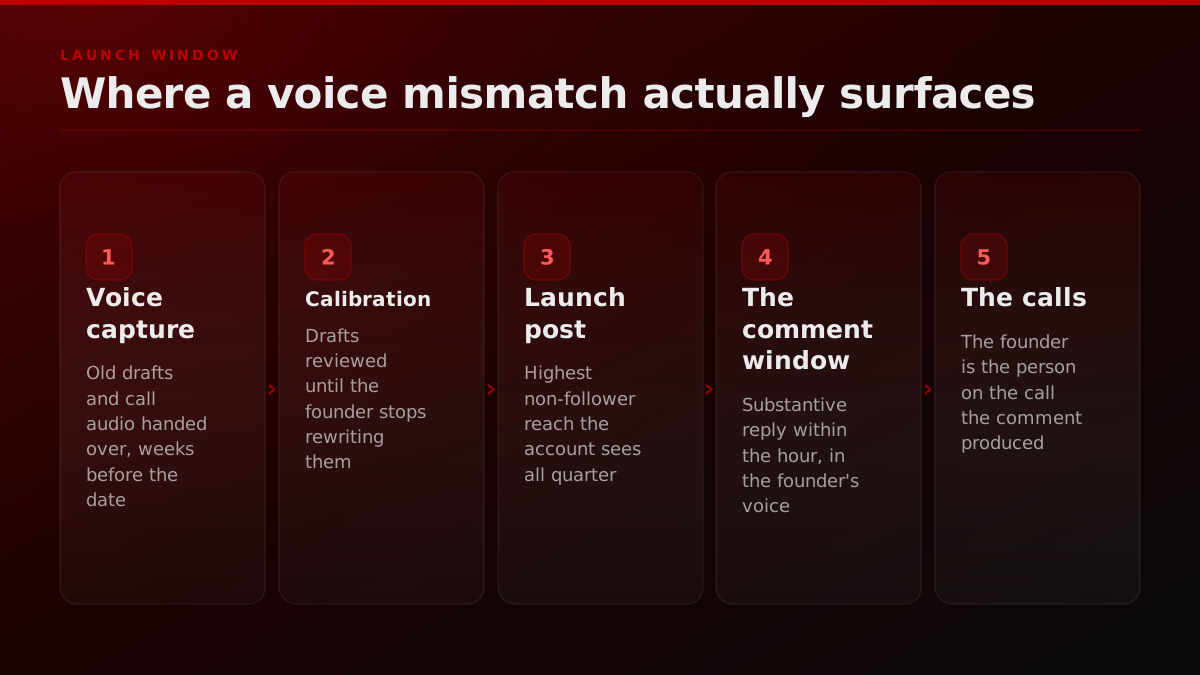
Operator noteDo not start a ghostwriter inside a launch window. Voice calibration takes weeks the launch does not have.
This is exactly why we treat LinkedIn distribution as a component of a launch rather than as a content subscription. In the FORKOFF launch service, organic distribution on LinkedIn is one of four named components, alongside launch video production, organic distribution on X, and amplification without production. It runs standalone or paired with the X launch for a two-channel first window. The playbook is the same one we publish, timed for operators and investors rather than for a general feed. The doctrine on that page is one line and it is not negotiable: real accounts, never a pod.
If you want the shape of the wider launch mechanics rather than the LinkedIn half specifically, the launch video playbook covers production and the launch readiness checklist covers what has to be true before the window opens. For the demand side, pre-launch demand building and the launch-day checklist both predate this post and neither one addresses who writes the LinkedIn posts, which is the gap this one fills.
The pod problem, in LinkedIn's own words
Engagement pods are groups that agree in advance to like and re-share each other's posts, and they are sold openly as a standard deliverable in this category. LinkedIn's own Professional Community Policies prohibit them, and the wording is unusually specific. Under Be professional, in the section headed Do not spam members or the platform, the policy says don't do things to artificially increase engagement with your content, and then describes the mechanic exactly: don't agree with others ahead of time to like or re-share each other's content. That second sentence is a definition of an engagement pod, written by the platform whose terms you are agreeing to. The help centre restates the same policy set for members, and LinkedIn files artificial engagement under its spam rules rather than treating it as a grey area.
The platform already wrote the pod rule, and no vendor page quotes it
Engagement pods appear openly as a standard deliverable across this category. LinkedIn's own Professional Community Policies, under Be professional and Do not spam members or the platform, say don't do things to artificially increase engagement with your content, and then describe the mechanic precisely: don't agree with others ahead of time to like or re-share each other's content. That is a pod, written by the platform. Not one of the pages currently ranking for this head term quotes it.
Source: https://www.linkedin.com/legal/professional-community-policies
Two things are worth saying carefully here.
First, this post deliberately cites no reach-penalty percentage for pod use. Every specific figure of that kind we could trace back to a source resolved to a vendor selling a competing engagement product, and LinkedIn publishes no such number. Leaving it out is a choice, not an oversight. The policy language is first-party and sufficient; an invented penalty figure would weaken a case that is already strong.
Second, the practical exposure is not primarily algorithmic. It is that the founder's account is the asset, the founder is the one who agreed to the terms, and the vendor is the one running the mechanic. If that account is restricted, the vendor loses a client and the founder loses the audience. One practitioner posting in March 2026 described exactly that outcome from the writer's side, an account restricted with no warning and no route to appeal, and thousands of connections gone.
Ask the pod question in writing before you sign. The answer, and how readily it comes, tells you most of what you need to know.
Operator noteIf a vendor will not answer the pod question in writing, that is your answer.
What replaces a pod is not nothing, which is the objection vendors raise, and it is worth answering directly. Coordinated reciprocal liking is a shortcut around a real mechanic, and the real mechanic is available. In our own cadence the engagement work is outbound and specific: roughly 30 substantive comments a week on posts by second-degree accounts that match the buyer profile, plus a comment-back rule where every comment on a founder post earns a considered two to four sentence reply within 60 minutes during the engagement window. That is more work than a pod and it produces something a pod cannot, which is a conversation with a named person who might buy.
The distinction matters commercially, not just ethically. A pod inflates the numbers on a post while leaving the audience composition untouched, which is exactly the audience-mismatch failure described earlier. Thirty real comments a week move the composition. Reciprocal likes from other people selling ghostwriting services move a vanity metric and nothing else.
What it costs to get this wrong
The cost of a bad ghostwriting engagement is rarely the retainer, which is why founders keep signing them and keep being disappointed. The retainer is recoverable in one month. What is not recoverable is founder attention spent rewriting somebody else's version of your own voice, a launch window that lands with a credibility gap in the comment thread, or in the worst case an account restriction on the asset the whole strategy sits on. Rank the risks by what you cannot get back, and the ordering flips completely from how they are usually discussed.
Start with the rewrite tax, because it is the most common and the least visible. If a draft needs heavy rewriting, the founder is now doing the writing plus the editing plus the management, at a worse hourly rate than if they had written it themselves. Nothing on an invoice records that. The tell is simple: track how long you spend on the third draft. If it is not falling week over week, the voice is not transferring and no amount of additional volume will fix it.
Then the launch cost, which is concentrated rather than spread. A voice mismatch inside a launch window does not average out, because there is no next twenty posts to absorb it. And then the account risk. LinkedIn describes its own enforcement posture in How LinkedIn Keeps You Safe, and restriction is a real outcome rather than a theoretical one. A practitioner posting in March 2026 described an account restricted with no warning and no route to appeal, thousands of connections gone, and an entire practice built on that profile ending with a support decision. Their conclusion was to move the audience somewhere they owned. Whatever you think of pods, that is the shape of the downside, and it lands on the founder's account rather than the vendor's.
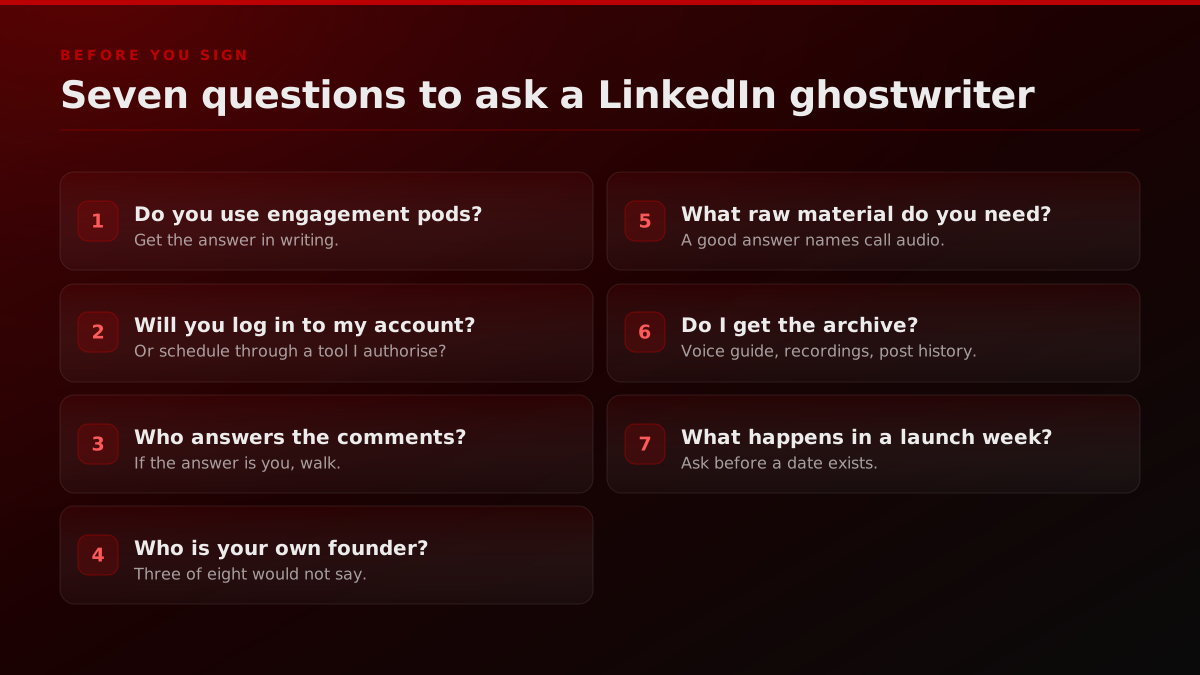
Ask these before the contract exists, because every one of them is easy to answer in a sales conversation and awkward to renegotiate in a launch week.
What the vendor market looks like from the inside
The founder-brand LinkedIn category is fragmented, mostly small, and unusually opaque, and its public signals point the opposite way from what you would expect. We ran a competitive pass across eight of these agencies on 2026-07-08, across 27 sources, scoped to the US and Tier-1 markets. The single most useful finding was an inversion: claimed scale and verifiable footprint move in opposite directions. The agency claiming the largest client base, roughly 185 to 200 clients, had no independent review-platform presence at all, and only one of the eight had a visibly live third-party review profile.
What a competitive pass across eight founder-brand LinkedIn agencies found
| Signal checked | Result | Why it matters to a buyer |
|---|---|---|
| Published any pricing | 2 of 8 | Six require a call before you learn the number |
| Live independent review profile | 1 of 8 | Almost nothing here is third-party verifiable |
| Withheld their own founder's name | 3 of 8 | The product is founder visibility |
| Sold engagement-pod mechanics | Category-wide | LinkedIn's own policies prohibit coordinated engagement |
| Operated outside LinkedIn | 0 of 8 | A launch that only lands on one platform lands once |
FORKOFF competitive research pass, 2026-07-08, 8 agencies, 27 sources, US and Tier-1 scope. Agencies are described by pattern and deliberately not named.
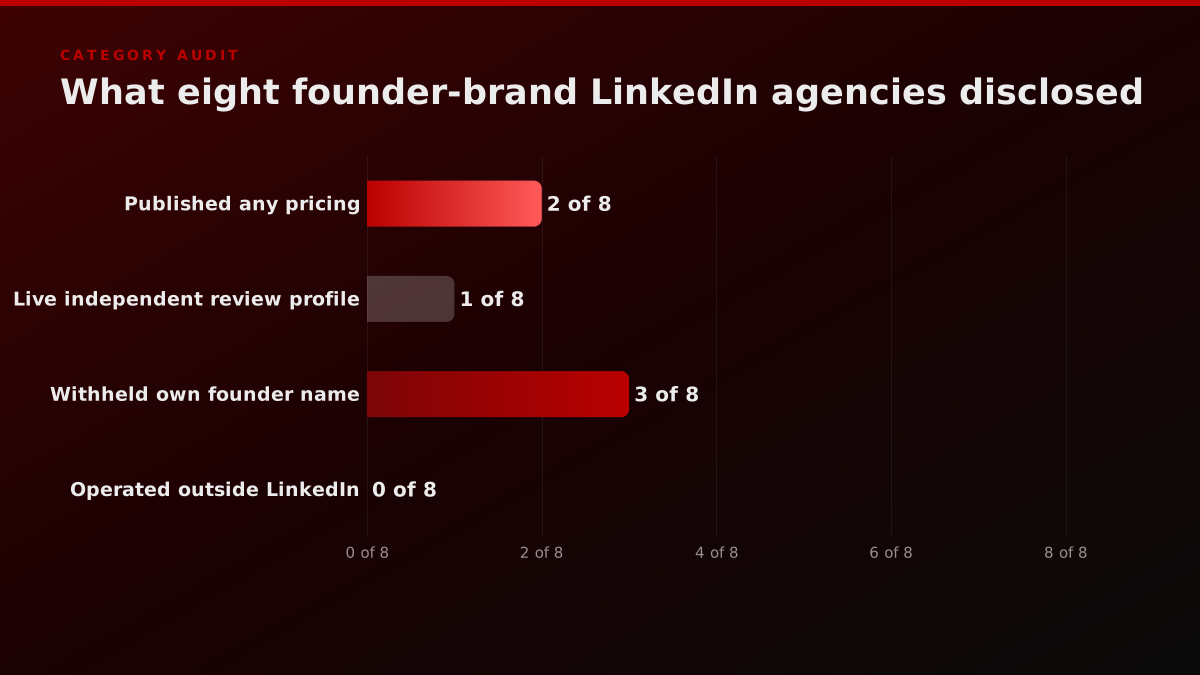
Claim size and verifiable footprint move in opposite directions here
In a competitive pass across eight founder-brand LinkedIn agencies on 2026-07-08, the agency claiming the largest client base, roughly 185 to 200 clients, had no independent review-platform presence at all. Only one of the eight had a visibly live third-party review profile. If you are shortlisting on claimed scale, you are sorting on the signal that correlates worst with anything you can check.
Source: https://forkoff.xyz/blog/founder-growth/credibility-vs-user-acquisition-campaigns-2026
The finding that should matter most to a founder is the third row. Three of the eight would not tell you who their own founder is. That is a category selling founder visibility as the product while declining to be visible, and it is the sharpest possible illustration of the attribution problem this whole post is about. If a shop cannot or will not attach a name to its own work, the mechanism it is selling you does not work internally.
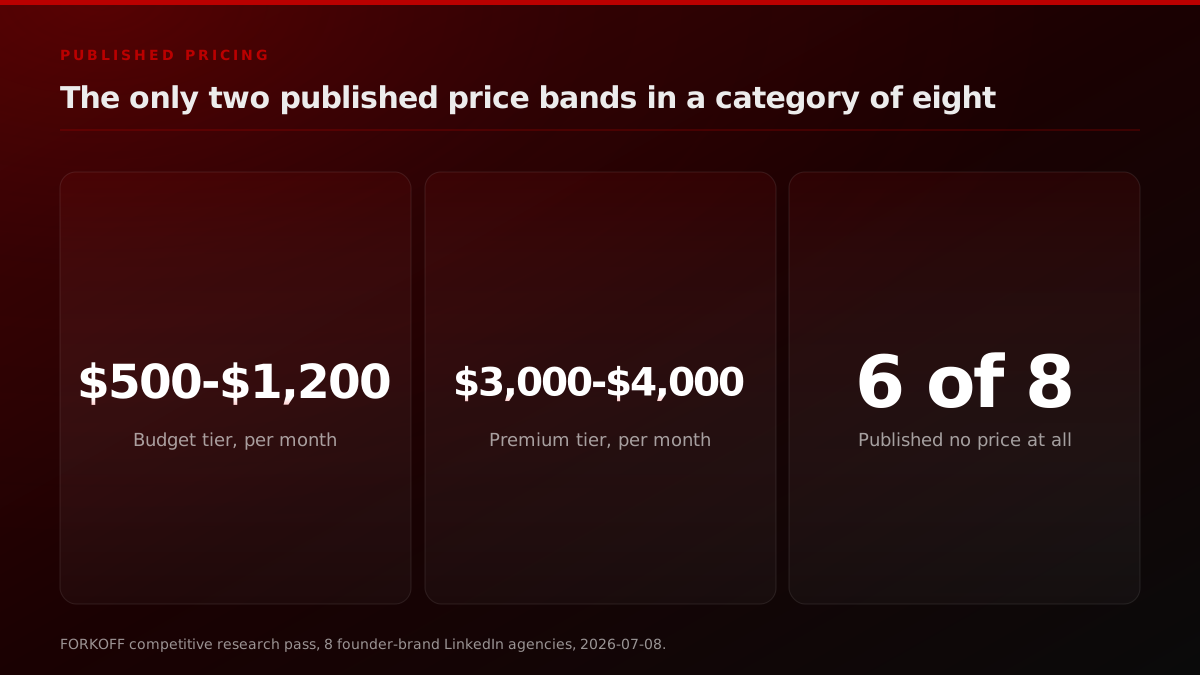
On price, the honest answer is that the market mostly refuses to publish one. Only two of the eight published anything at all. For one independently published data point, a ghostwriter writing in Business Insider describes her first LinkedIn retainer as four posts a month for a bank chief executive, at $1,000 a month. In our 2026-07-08 pass the two public pricing pages put tiers at roughly $500 to $1,200 a month at the budget end and roughly $3,000 to $4,000 a month at the premium end, which is a cluster rather than a rate card. Treat those as the only published anchors in a category of eight, not as the market rate.
You can sanity-check any quote from the labour side, which is public. In April 2026 an agency owner advertised a LinkedIn ghostwriter role at $2,000 a month plus performance bonuses up to $4,500, for 10 to 15 posts a week across LinkedIn and X. In May, another advertised the same role at $3,000 to $6,000 a month expected earnings. Neither listing mentions replying in comments.
Frederick Potticary
@freddiexpott
💰 HIRING: LinkedIn Ghostwriter Need someone to join my team and write X & LinkedIn content for B2B clients. $2,000/month + performance bonuses (up to $4.5k extra) What you'll be doing: - Writing 10-15+ LinkedIn & X posts per week - Creating content that books calls (not just
What the market pays the person actually writing
Two public hiring posts in April and May 2026 set a visible floor under any retainer. One agency owner advertised a LinkedIn ghostwriter role at $2,000 a month plus performance bonuses up to $4,500, for 10 to 15 posts a week across LinkedIn and X. Another advertised the same role at an expected $3,000 to $6,000 a month. Neither listing mentions replying in comments as part of the job.
Source: https://x.com/freddiexpott/status/2045909824206962865
Takshi | Linkedin Ghostwriter
@takshichopra
LinkedIn Ghostwriting for executives is not about manfacturing thought leadership. They already have it from years of experience and expertise. Its about knowing how to extract it so that it becomes easier to see.
One more structural point. Every agency in that pass of eight operated on LinkedIn only, with occasional Twitter or X outreach attached. None had a clipping network, first-party social data infrastructure, or podcast and event placement. That is not a criticism of their execution, it is a description of the ceiling. A launch that only lands on one platform lands once. If you want the argument for why that matters, founder new media distribution makes it at length, and reddit versus linkedin for B2B distribution compares the two channels directly on intent quality.
How to brief a ghostwriter so the output sounds like you
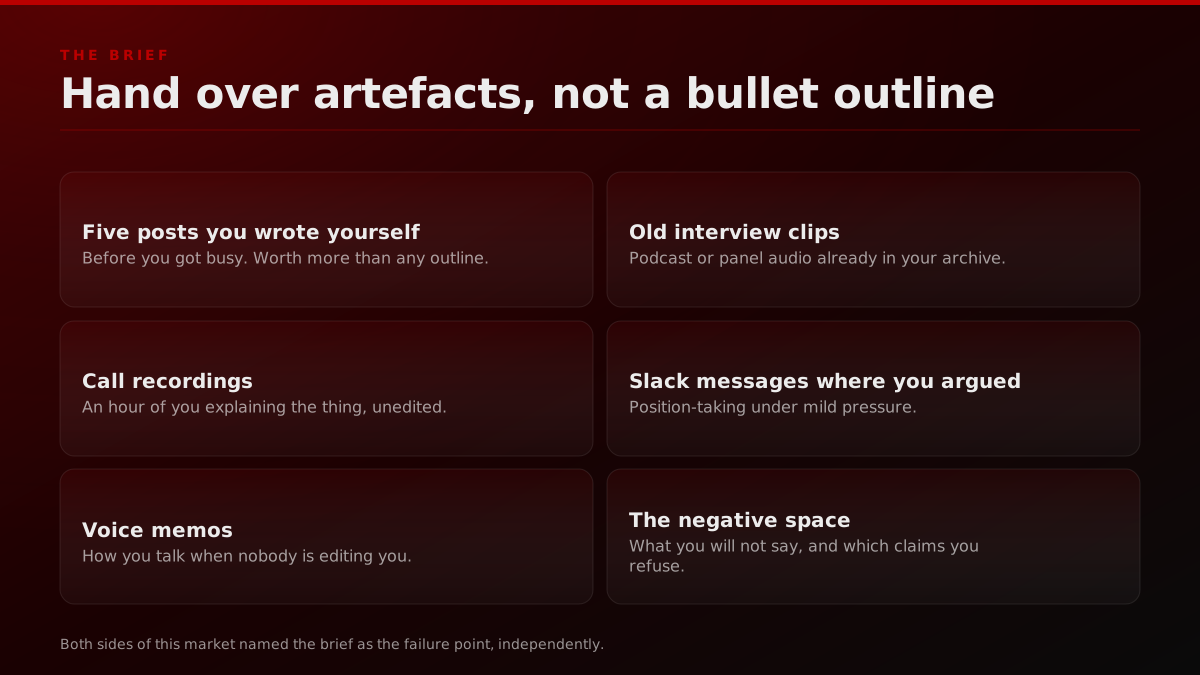
Briefing a ghostwriter well means handing over artefacts, not instructions. The single highest-leverage change most founders can make is to stop writing better outlines and start sending raw material: old posts you wrote yourself, recordings of calls where you explained the thing, voice memos, even Slack messages where you argued a position. A bullet outline transmits topics. It transmits nothing about rhythm, sentence length, what you refuse to say, or which word you always reach for. A writer given only topics fills the gaps with their own default register, and that default is what reads as generic.
This is not our theory. It is what both sides of the market said independently, and one practitioner published the list almost verbatim in August 2026: old interview clips, Slack messages, even casual calls.
Operator noteAsk for call recordings before the first draft. A bullet outline gives a writer nothing of yours to copy.
Calibration then has a shape, and it is worth agreeing on it up front rather than discovering it. In our own onboarding the first three days are profile rebuild and voice capture, days four to seven build the account list, days eight to ten produce the first four weeks of editorial, and the first five posts ship in the third week with the measurement ledger calibrated against them. The first audit lands at the end of the month. The reason to state that sequence explicitly is that it tells you when to judge the work. Judging a ghostwriter on their first week is judging their guess at your voice, not their ability to hold it.
A cheap test exists for whether calibration is working, and it does not require any tooling. Take the third draft of any post and count how many sentences you changed. If that number is not falling from one week to the next, the artefacts you handed over were not enough, and the fix is more raw material rather than more feedback. Written feedback on a draft is a lossy way to transmit voice. A recording of you talking is not.
There is a second half to the brief that most intake processes skip entirely, which is the negative space. Tell the writer what you will not say. Positions you have publicly disagreed with, claims you consider unprovable, competitors you will not name, numbers you are not allowed to share. A writer who knows your boundaries produces drafts you can ship without rewriting, and rewriting somebody else's draft of your own voice is the sunk cost that kills most of these engagements.
I think there is so much of slop out there that the only way to build credibility is strong authorship.
Which option fits which situation?
There is no universally correct answer, and any page that gives you one is selling something. The right choice depends on which constraint binds hardest right now: cash, a date, or the absence of a formed point of view. A pre-seed founder with no budget and a clear thesis should write the posts themselves and spend the money on distribution. A funded founder with a launch date and a formed thesis should hire, and hire early enough to calibrate. A founder who has stopped posting because they do not know what to say should not hire anybody yet, because there is nothing to extract.
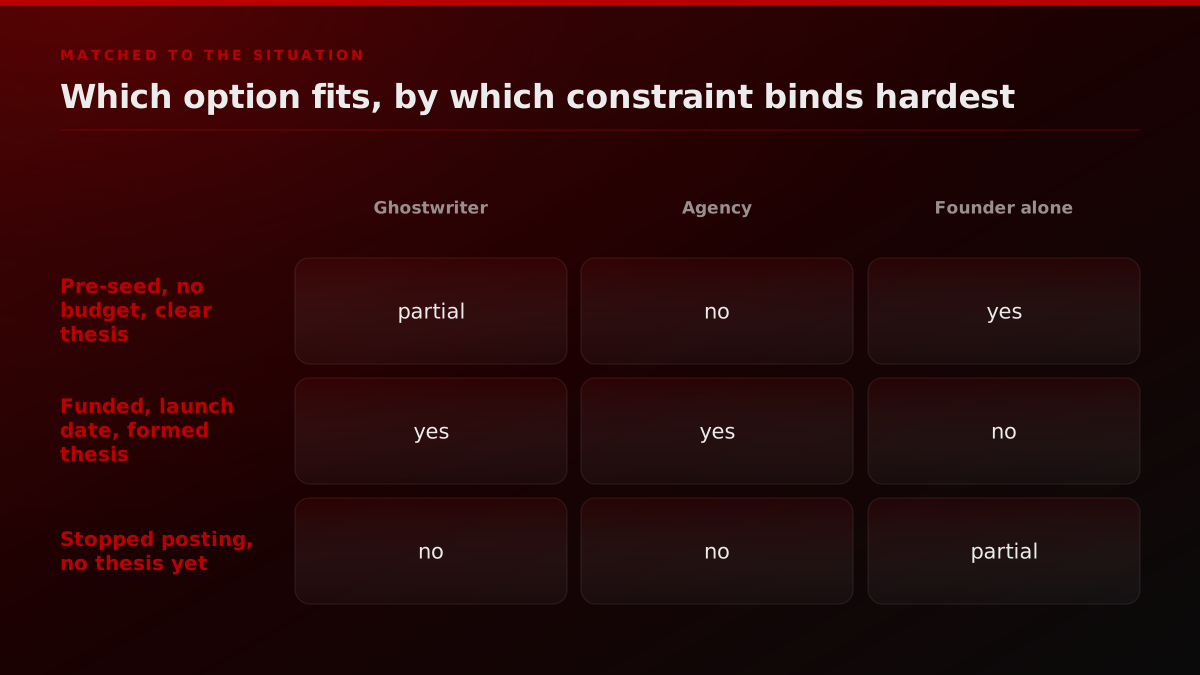
The middle row is the one worth sitting with, because it is where most readers of this page actually are. A funded founder with a launch date has the budget to hire and the deadline that makes hiring risky, and the resolution is sequencing rather than choosing. Hire, but start the engagement at least four to six weeks before the launch date so calibration happens on ordinary posts nobody is watching closely. Then run the launch on a voice that has already been tested. Founders who compress that into the launch week are effectively debugging their own voice in front of the largest audience the account will get, which is the most expensive place to do it.
The pre-seed row resolves differently and more cheaply. If cash is the binding constraint and you can already articulate a thesis on a call, write the posts yourself and put the money into distribution instead of drafting. That trade is the same one we make on the agency pricing and unit economics side of the business, and the reasoning behind it is set out in credibility versus user acquisition: early on, the scarce input is a reason for anyone to care, not volume.
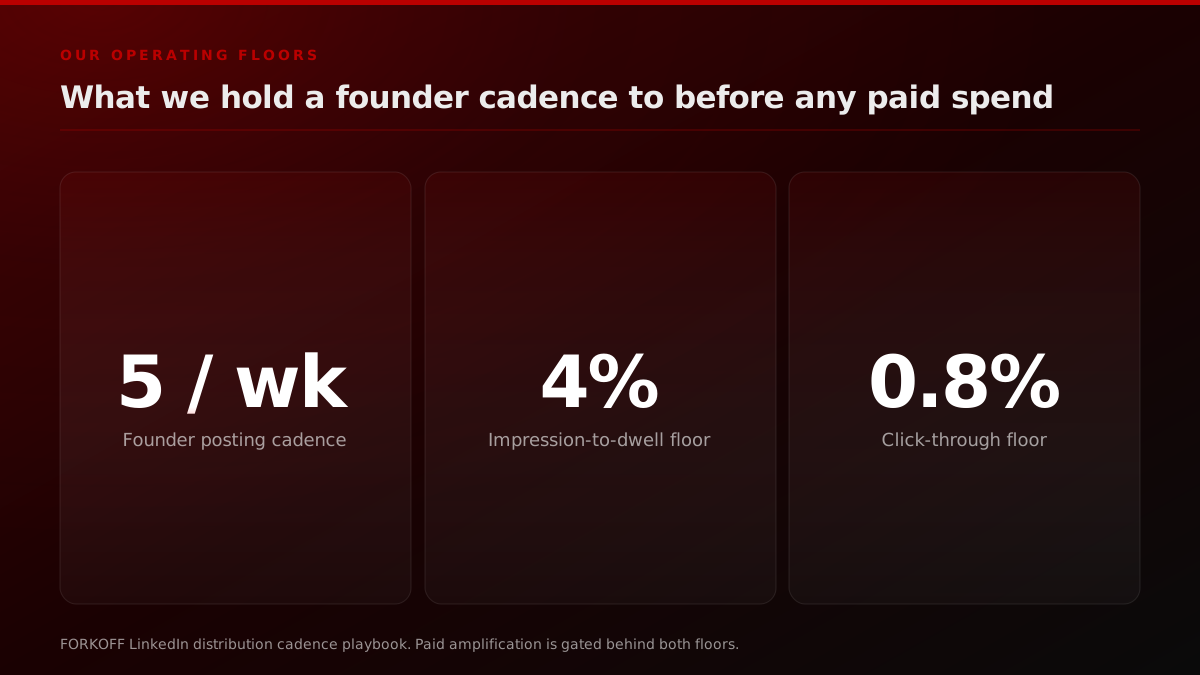
For the record, the numbers on that panel are ours and we publish them in the LinkedIn distribution cadence playbook, which is the source for all three: a five-per-week founder cadence, a 4 percent impression-to-dwell floor, and a 0.8 percent click-through floor, with paid amplification gated behind both. The full mechanics, including the 60-minute comment-back rule and the 30-day ramp, live on that page, and we are not restating them here because it owns them.
Two adjacent decisions come up constantly alongside this one and are answered elsewhere. If the question is agency versus employee rather than ghostwriter versus yourself, marketing agency versus an in-house hire covers the loaded-cost math. If the platform in question is X rather than LinkedIn, twitter marketing agency versus in-house versus ghostwriter runs the same three-way comparison with real rate data, and this post deliberately does not repeat that cost analysis.
What you keep no matter what you sign
Five things stay with the founder in every version of this arrangement, and naming them in the contract is cheaper than discovering them during a launch. The point of view, because it is the only asset here that compounds. The comment window, because credibility is not delegable. The calls those comments produce. The decision about what not to say. And the archive of voice work, so that what you paid to build stays yours when the engagement ends.
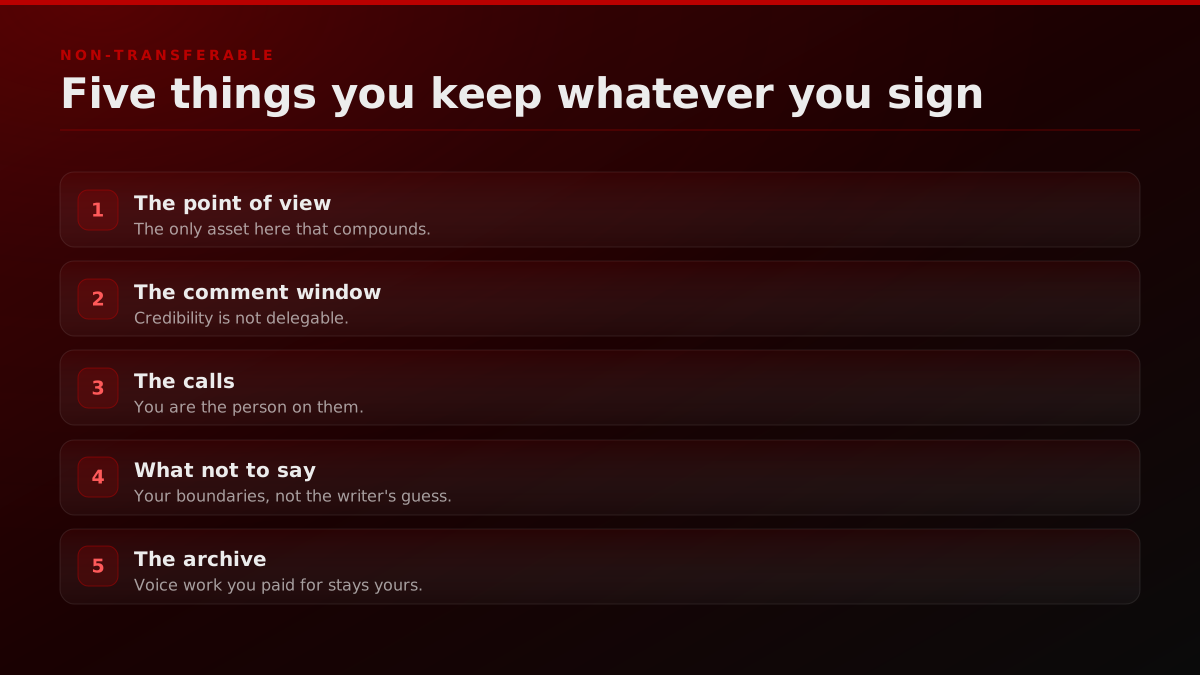
The archive point is the one founders most often lose. If a vendor holds the voice guide, the interview recordings, and the post history in their own systems, you are renting your own voice. Ask for it in writing, in a format you can read without their tooling.
Verdict
Hire the ghostwriter. That is the recommendation, and the demand data says most people reading this are already leaning that way. Drafting, formatting, cadence, and scheduling are real work, they are somebody's craft, and a founder doing them badly at 11pm is not a strategy. What you cannot buy is the part that makes the drafting worth anything: your presence underneath the post, in the hour after it lands, in your own words, to a named person who is deciding whether to trust you.
So brief them with artefacts instead of outlines. Settle account access and the pod question in writing before a launch date exists. Keep the archive. And block the comment window in your own calendar, because that hour is the product.
Voice is the asset. Volume is not. A ghostwriter can carry the volume, and the good ones will carry it better than you would. The voice stays yours, which is inconvenient, and also the entire reason any of this works.
If the LinkedIn half of a launch is currently unowned, that is the piece we run, and the founder keeps the comment window. Everything upstream of it, we handle. Related reading for the wider picture: the founder funnel strategy post covers where this attention is supposed to go, the founder-led growth playbook covers the system around it, founder-led content marketing with AI covers the tooling question this post deliberately left alone, community-led versus founder-led growth covers the alternative motion, how to make a launch go viral on X covers the other channel in a two-channel launch, and the gated founder funnel reset covers why distribution got harder in the first place.
The Algorithm-Proof LinkedIn Strategy Blowing Up Personal Brands in 2026
Lara Acosta
A 2026 read on what still works on LinkedIn when the algorithm shifts, which is the layer underneath whoever writes the post.
Inside the Minds of LinkedIn Ghostwriters: Hooks, Tone & Virality
From Zero to LinkedIn Hero
Forty-eight minutes inside how LinkedIn ghostwriters think about hooks, tone, and reach.
How to Dominate the New LinkedIn Algorithm in 19 Minutes
Chris Donnelly
The distribution mechanics underneath all of this, which is a separate problem from who writes the post.


![How to Make a Launch Go Viral on X: The 5-Lever Playbook [2026]](/blog/covers/how-to-make-launch-go-viral-on-x-2026-cover.jpg)