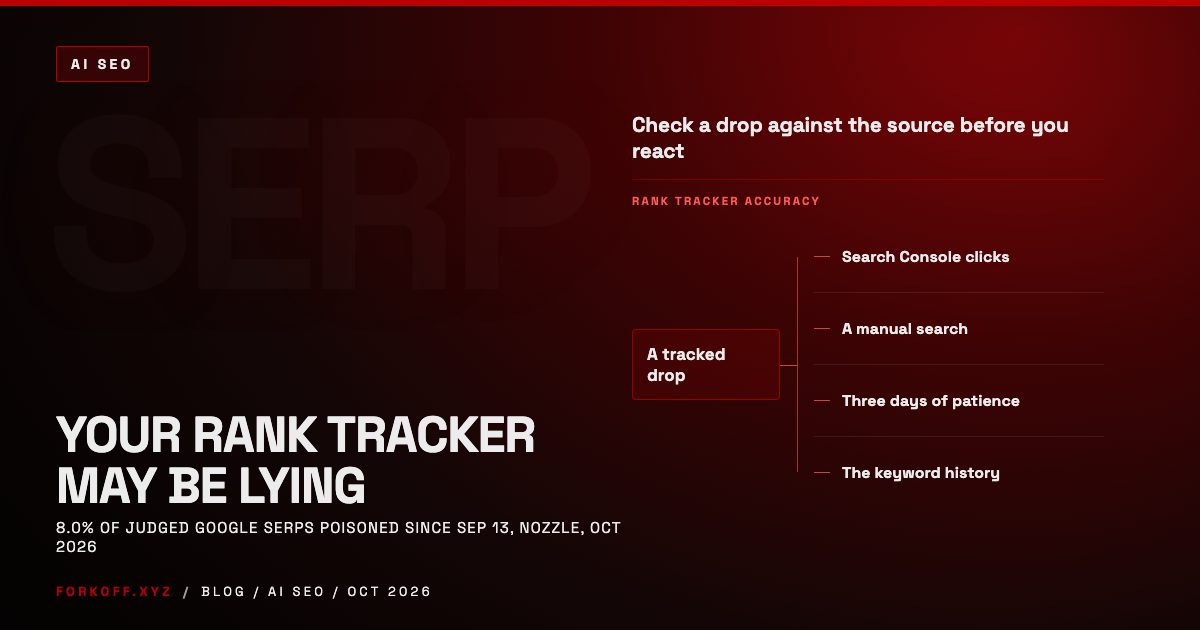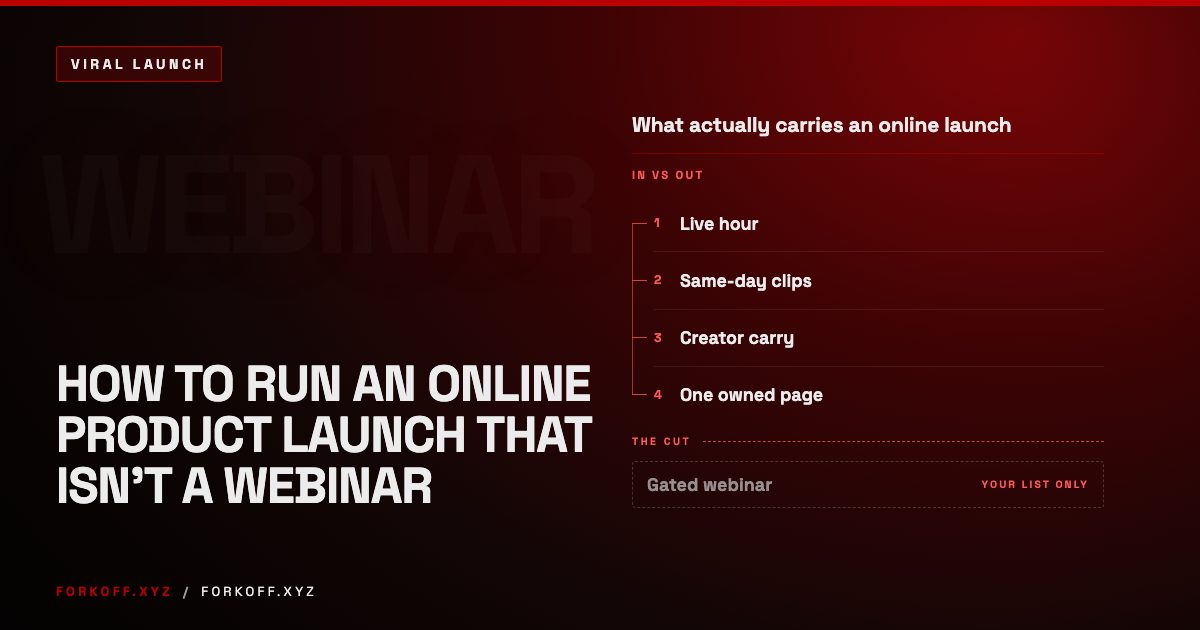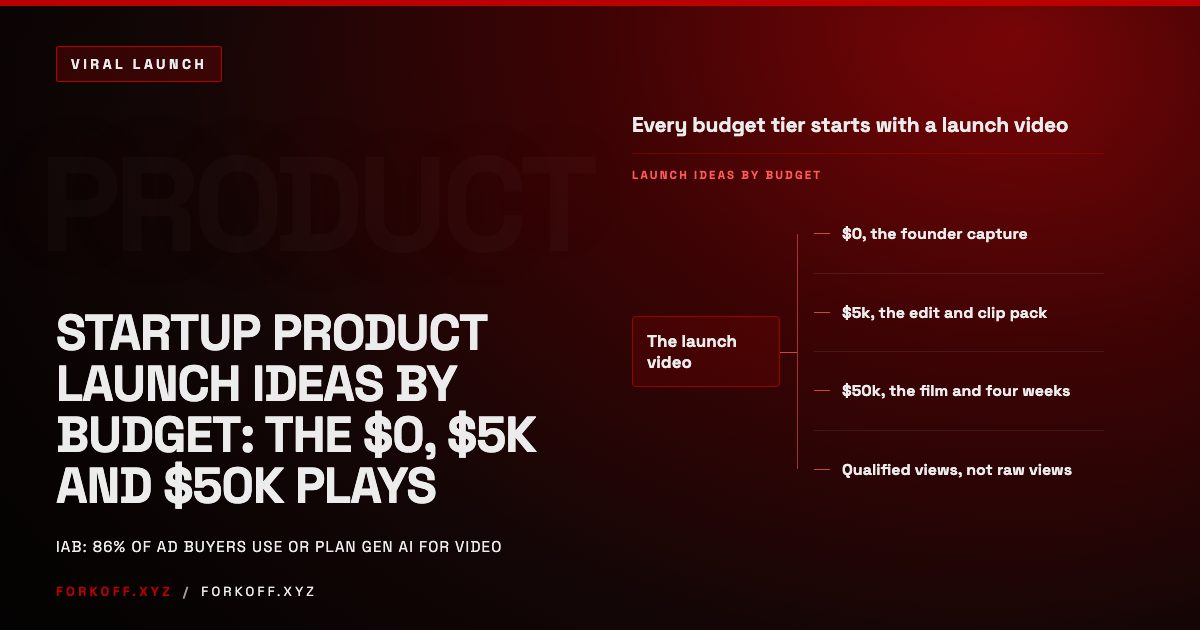
How to make a launch go viral on X in 2026 comes down to engineering the first hour, not buying reach: ship a thumb-stopping first-second hook into a warm cluster during the window the X ranker weights most, tag the principals of a live debate, seed real ICP accounts who engage because they care, and give recap accounts a quotable line that stretches the launch past day one. That is the whole stack. Fewer than 2% of un-engineered launches cross 1 million views organically, but the ones that break out are engineered, and in the forensic audit this playbook draws on (n=134), 68.7% of them came from accounts with under 10,000 followers, which means craft beats budget. This is the 5-lever playbook, in order.
How to make a launch go viral on X, in one scroll
Making a launch go viral on X is an engineering problem, not a luck problem. Fewer than 2% of un-engineered launches cross 1M views organically and the median gets under 10,000 views, but 68.7% of the launches that do break out come from accounts under 10,000 followers, so craft beats budget. The repeatable stack is five levers: a thumb-stopping first-second hook, wave-timed posting into a warm cluster, debate-principal tagging, cluster seeding of real ICP accounts, and recap-bait that stretches the window past day one. Buying views is the one shortcut that does not work, it leaves a views-to-likes ratio above 5,000 to 1 that anyone can detect. Engineer the first hour instead.
How do you make a launch go viral on X?
A launch goes viral on X when a warm room of real people engages with a clear, well-timed post in its first hour, and the algorithm reads that velocity as a reason to show the post to everyone else. Everything in this playbook serves that one mechanic. The reason most launches fail is not that the market rejected them, it is that they never got sampled, because a beautiful film posted into a cold timeline generates no first-hour velocity for the ranker to reward. This is a done-for-you problem FORKOFF solves through its distribution-led viral launch video service, where the five levers below run inside the contract, but every one of them is a move a founder can make alone.
The ambient odds are worse than your feed implies
Your feed is a survivorship filter. It shows the launches that broke out and hides the thousands that did not, which inflates your sense of how often a launch goes viral on X. In a forensic audit of 134 launch videos, fewer than 2% of un-engineered launches cross 1 million views organically, and the median launch gets under 10,000 views. Even inside a directory hand-curated for notable launches, the 1M-plus hit rate was only 21.6%, and that is an upper bound. The honest planning number for a launch you have not engineered is the sub-2% ambient rate, which is exactly why a launch has to be built rather than hoped for.
Source: Public launch forensic, n=134, 2026
The debate about whether launches are a scam or a skill misses the point. Some launches are inorganic theater built on purchased views, and we audited 134 of them to separate the two. The launches that genuinely work are an engineered event, and the engineering is learnable. Here is the stack.

The 5-lever playbook
Creative is the floor and the four levers on top of it compound. A hook with no cluster dies in a cold feed. A cluster with a weak hook amplifies something nobody wants to share. The point is to run all five, in order, so the launch ships full-stack on day one rather than probabilistically.

The 5 levers, what each one does
| Lever | What it does | The concrete move |
|---|---|---|
| Thumb-stopping hook | Beats the scroll in the first second | Show the outcome, state the pain and promise, cut it X-native for autoplay |
| Wave-timed posting | Manufactures first-hour velocity the ranker rewards | Post into a warm cluster during a live category conversation |
| Debate-principal tagging | Rides an existing attention pool | Tag the principals of a genuine live argument in your category |
| Cluster seeding | Pre-distributes the first 30 engagements | Warm a real ICP account list for two weeks, never a pod |
| Recap-bait | Stretches the window past day one | Write one self-contained, numerically anchored quotable line |
Source: public launch forensic, n=134, 2026, plus the open-sourced X recommendation algorithm.
The 5-lever launch playbook, in order
STEPS- 01
Lever 1: A thumb-stopping first-second hook
State the pain and the promise inside the first second, and show the outcome instead of a founder talking to camera. The hook is the only thing standing between your post and the scroll, and the forensic data shows a clear visible result beats production polish every time.
- 02
Lever 2: Wave-timed posting
Ship into the hour the ranker weights most, when your warm cluster is awake and an active conversation in your category is already moving. The first 60 to 90 minutes decide whether the ranker samples the post into larger pools, so post into a warm room, never a cold one.
- 03
Lever 3: Debate-principal tagging
Identify a live argument in your category and tag its principals so the launch rides an active conversation instead of starting a cold one. This injects the post into an existing attention pool and is the highest-variance lever, so pick genuinely debating, high-engagement, not-personally-hostile principals.
- 04
Lever 4: Cluster seeding
Build a list of real ICP accounts who care about your category and warm them for two weeks before launch, so the first 30 engagements arrive from genuine accounts in the first window. Real cluster activation, never a reciprocal-boost pod that the spam graph detects and deboosts.
- 05
Lever 5: Recap-bait
Write the launch post so a roundup account, newsletter, or recap curator can quote it standalone, one numerically anchored, self-contained line. That is what carries a launch into a second and third day instead of decaying inside 18 hours, and it is earned through relationship warm-up, not bought promotion.
Lever 1: A thumb-stopping first-second hook
The hook is the only thing between your post and the scroll. In the forensic corpus, a clear visible result out-performed production polish so decisively that one-star-rated launches averaged higher median views than five-star-rated ones. The viewer is not grading your cinematography, they are deciding in under a second whether the thing you built is worth their attention. State the pain and the promise immediately, then show the outcome instead of talking about it. Cut the asset X-native for autoplay, because a YouTube repurpose with a slow cinematic build burns the one second that decides everything.
Eddy thakur
@Motionsbyeddy
I analyzed 60+ startup launch videos that went viral on x this month. The winners all followed the same playbook.
The builders who do this for a living describe the same instinct in plain language.
Novelty is rewarded on X with the AI boom. It is become a legitimate distribution channel if done well. Show good use cases. And show over tell, no talking, short and straight to the point, letting everyone see the outcome for themselves.
Operator noteA launch lives or dies in its first 60 to 90 minutes, that is when the X ranker decides whether to sample it., Open-sourced X recommendation algorithm
Lever 2: Wave-timed posting
Timing is a skill, not a budget. The launches that break out ship into attention that already exists, an AI wave, a model drop, a live argument, rather than trying to manufacture attention from nothing. Two timing decisions matter. The macro decision is the wave: launch into a moment your category is already talking about. The micro decision is the hour: post when your warm cluster is awake and an active conversation is moving, because the first 60 to 90 minutes decide whether the ranker samples your post into larger pools. Get the wave and the hour right and the same asset that would have died quietly instead catches velocity. The companion 5-lever guide to going viral on X breaks the velocity math down further.
The first 60 to 90 minutes decide the ceiling
X's timeline ranker weights early engagement velocity as the primary out-of-network signal, which is explicit in the open-sourced recommendation algorithm. A launch that pulls a coordinated burst of real replies, quotes, and reposts in its first hour gets sampled into larger For-You pools. A launch that lands in a cold timeline never trips that signal and dies in the follower feed. This is why wave-timed posting and a pre-warmed cluster matter more than production polish: they manufacture the velocity the ranker is actually reading, using real accounts rather than purchased ones.
Source: Open-sourced X recommendation algorithm; public launch forensic 2026

Twitter algorithm open-sourced… Is Elon playing 5D chess?
Fireship
Fireship's breakdown of the open-sourced X recommendation algorithm, the codebase behind the first-window mechanic. Early engagement velocity is the signal that decides whether a launch gets sampled into larger For-You pools.
Lever 3: Debate-principal tagging
The fastest way into an existing attention pool is to ride a live argument. Find a genuine debate in your category, one people are actively taking sides on, and tag its principals so your launch lands inside the conversation instead of starting a cold one. This is the highest-variance lever. Done well, it puts your post in front of an engaged audience that was already primed to react. Done badly, it reads as hijacking and fails closed. Skill is in principal selection: pick people who are genuinely debating, have high engagement, and are not personally hostile to you. When it lands, it is the single fastest source of qualified first-hour velocity.
Lever 4: Cluster seeding
The first-hour velocity the ranker rewards has to come from somewhere, and the honest source is a real cluster of ICP accounts you warmed in advance. Build a list of accounts who genuinely care about your category and spend the two weeks before launch engaging with them for real, so that on launch day your post lands among people who already recognize your voice and want to engage. The first 30 engagements from real, varied accounts are what convert a launch from probabilistic to engineered. This is the lever founders most often try to fake with a reciprocal-boost pod, and it is the worst possible place to cheat, because the X spam graph pattern-detects the ring inside the launch window and deboosts the post on the one day it cannot afford to be throttled.

Lessons from a SaaS launch that went viral (millions of views + top 3 on Product Hunt)
Their launch post went viral with millions of views across LinkedIn, Twitter, and other platforms, and they also ended up in the top 3 on Product Hunt. Here is what actually moved the needle: start telling the story weeks before, line up distribution in advance, have one high-quality piece of… Show more
Lever 5: Recap-bait
A launch that hits the first-hour threshold still decays inside a day unless something extends it. Recap accounts, newsletters, and roundup curators are what carry a launch into a second and third window, and they only quote a post that is self-contained and numerically anchored. Write the launch line so it can be lifted and re-shared on its own, with a real number in it, and warm the recap accounts in advance so they are watching when you ship. This is engineered through relationship, not bought through promotion, and it is the difference between a one-day spike and a multi-day window.
Small accounts win more than the cynics expect
The most encouraging finding in the corpus cuts against the pay-to-win narrative. Across 134 launches, 68.7% of the genuinely viral ones came from accounts with fewer than 10,000 followers. Breakout performance tracked content craft and a real reason to care, not audience size or distribution spend. High-specificity copy that stacked funding figures and investor handles into the opening line actually under-performed telegraphic hooks under 25 words once a creator had any distribution. The lever a founder controls, the clarity of the first second, is the lever that moves the views most.
Source: Public launch forensic, n=134, 2026

What kills a launch on X?
The failure modes are as repeatable as the levers. The most common one is a cinematic film posted into a cold timeline, which caps at a few thousand views because minute zero was never warmed. The second is a founder talking-head hook, because nobody stops scrolling for a face, they stop for a visible result. The third is posting and walking away, which lets a launch decay inside 18 hours with no second wave. And the fourth, the one that looks like a shortcut and is actually a trap, is buying views.
What kills a launch, and the fix
| What kills it | Why it fails | The fix |
|---|---|---|
| Beautiful film, cold timeline | No warm cluster means no first-hour velocity, so the ranker never samples it | Warm a real ICP cluster for two weeks before the post ships |
| Founder talking-head hook | Nobody stops scrolling for a face, they stop for a visible result | Lead with the outcome the viewer can see in the first second |
| Buying views | Purchased reach leaves a 5,000-to-1 views-to-likes ratio and converts nothing | Earn the reach organically so the ratio and the pipeline both hold |
| Posting and walking away | A launch decays inside 18 hours without a second wave | Seed recap accounts with a self-contained quotable line in advance |
Source: public launch forensic, n=134, 2026. Bought-amplification patterns are shown as anonymized aggregate signatures.

Operator noteOne-star-rated launch videos beat five-star ones on median views in the n=134 corpus, viewers grade the outcome, not the film., Public launch forensic, n=134, 2026
How do you tell organic reach from bought views?
The one shortcut that never works is purchasing reach. Bought views register on the counter but produce near-zero replies, quote-tweets, and signups, and they leave a fingerprint anyone can read: the views-to-likes ratio, which you can grade on any launch post with the launch authenticity checker. Genuinely viral content on X sits around 100 to 500 views per like. When views are purchased but engagement is not, that ratio inflates, and a launch running more than 5,000 views per like, especially from a small or new account, shows the statistical signature of purchased amplification. Some launches we audited showed exactly that bought-amplification signature, and in a wider study of thirty tracked public launches, about 67% carried it. The point for a founder is not to accuse anyone, it is to know that the number above a post is only as real as the engagement underneath it.

This is the test RADAR runs on public launches. Cursor for iOS crossed 6.4M views at 492 views per like, Contra Payments hit 2.3M at 445, Koji reached 4.8M at 396, OpenAI's Jalapeno chip announcement pulled 7.1M at 312, and NotebookLM's Short Video Overviews launch drew 2.5M at 211. Every one of those sits inside the organic band, and RADAR's five-signal read clears each as earned reach, not bought. These are public launches RADAR audited, not our own client work, and they show what a genuine breakout looks like on the ratio.

Cursor for iOS
@cursor_ai6.4M views·13K likes
ReadIndependent, methodology-derived signal, not a statement of fact about any person. RADAR reads how reach was built, a signature, not an accusation. See the methodology.
Operator noteCursor for iOS read 492 views per like, Contra Payments 445, both inside the organic band on RADAR., RADAR public-launch readings, lib/radar-launches.ts
The deeper principle is the qualified view. A view from a real account that could become a user is worth something, a view from a bot that will never sign up is worth nothing, even though both increment the same counter. The whole bought-views model rests on conflating the two. If you want to run the ratio side of this automatically, the tool below estimates the qualified-view share of a launch post and flags the same thresholds the forensic used.
The engineered launch, in plain terms
The reason a launch reads as a skill rather than luck, when it is done honestly, is that the visible post is the final sliver of the work. Roughly three weeks out, you write the one-sentence story that makes a target customer say they cannot believe this did not exist before. Around two weeks out, you build and warm the cluster who will engage in the first hour because they actually want to. In the final days, you cut the asset X-native and line up the recap accounts. On launch day, the post ships into a front-loaded first hour with a hook that lands in one second. And a day or two later, the recap wave extends the window past the normal decay. Every step produces real engagement from real people, which is the entire difference between the engineered launch and the bought one.

Timing accounted for 42% of the difference between success and failure, more than the team, the idea, the business model, or the funding.

Timing is why the same idea works in one week and dies in another, and it is the lever the winners read rather than fight. This is also why the launch is not the whole job. The audience that makes a launch land in the first place is built by the ongoing Twitter marketing motion that keeps a cluster warm between launches, and the deeper mechanics of the velocity threshold live in the 1M-view launch breakdown.
Operator note5B+ views processed across FORKOFF's clipping network point the same way: distribution, not production polish, decides reach., FORKOFF clipping network, cumulative views processed
Should you engineer the launch, or buy the number?
Engineer it, and refuse the shortcut. Purchased views do not convert, they leave a detectable ratio, and they will not survive a skeptical investor or customer who clicks into the engagers. The honest path is also the higher-return path, because the same craft that produces a clean views-to-likes ratio is the craft that produces signups. What you should never do is buy a view count guaranteed through amplification. FORKOFF's own guarantee is a different thing entirely: we contract a view tier, 1.2M, 3M, or 5M, and hit it through organic distribution, and if a launch misses we keep distributing and re-run the play until it lands, or refund. It is backed by a make-good and audited on RADAR by the views-per-like method, never delivered by buying views. A launch is worth running when the views are a byproduct of a real event, and worthless when the views are the product.