Whop is a creator commerce marketplace that ships payment rails, course hosting, community surfaces, and a clipping campaign module under one roof. The platform's defining move is the marketplace browse layer: sellers list memberships, courses, communities, and clipping campaign slots, and buyers discover them inside Whop's native surface rather than having to find each creator separately. The free-to-start model with a 2.7% + $0.30 per-transaction fee suits creators who want to monetize without a fixed monthly cost. For brands running outcome-priced clipping campaigns with finance review, the key gap is the platform's absence of a per-view qualification layer on submitted views.
TL;DR verdict
Whop is the strongest creator marketplace in the category for selling courses, communities, memberships, and clipping campaign slots. Free to start, 2.7% + $0.30 per transaction, and a creator-discovery surface nothing else matches on time-to-first-creator. Where Whop stops working is the brand-side outcome lane. Submitted views ship raw. There is no per-view qualification on watch-time, geo, policy, or traffic validity. If you sell to a marketplace audience, Whop is the right pick. If you buy qualified views with a treasury-defensible audit trail, that lane belongs to a managed agency such as FORKOFF.
About these numbers
Pricing and transaction-rate figures (2.7% + $0.30, $0.003 CPQV) are sourced from the publicly listed Whop pricing page and FORKOFF Clipping Ledger 2026 respectively. Clipper earnings distributions (top decile, middle segment, bottom segment) are operator estimates drawn from FORKOFF campaign management experience across multiple Whop engagements. Market-size figures for the influencer platform market are sourced from Fortune Business Insights 2025. Per-campaign economics (qualification-rate ranges, CPM-uplift effects) are directional estimates from FORKOFF operator observation; individual results vary by brief design, vertical, and clipper roster.
The total addressable market of the creator economy could roughly double in size over the next five years to $480 billion by 2027 from $250 billion today.
The creator-economy tailwind
The market Whop sells into is growing fast, which is why the marketplace surface is valuable and why the brand-side qualification gap is worth closing rather than routing around. Goldman Sachs Research projects the creator economy roughly doubling to 480 billion dollars by 2027 from 250 billion dollars today, and names platform payouts fueled by short-form video monetisation as one of the biggest growth drivers. A brand buying clipping outcomes is buying into that curve. The lane that wins the brand-side spend is the one that prices the outcome, not just the impression.
Source: Goldman Sachs Research, Eric Sheridan, "The Creator Economy Could Approach Half-a-Trillion Dollars by 2027"
Whop is a creator commerce marketplace. The platform sits across four primitives that most creator businesses bolt together from separate tools: payment rails, course hosting, community and chat surfaces, and clipping campaigns. Sellers list a membership, a course, a community, a SaaS access tier, or a clipping campaign slot, and Whop handles checkout, payouts, affiliate tracking, customer support tickets, and the marketplace browse layer that drives discovery.
The category Whop defines is creator-led commerce on a shared marketplace surface. Gumroad sells digital products with a checkout. Memberstack plus Stripe wires up a paywall. Discord plus Memberful hosts a paid community. Whop ships all of those surfaces under one roof, plus the marketplace browse layer that none of those tools own. That is the category-defining move and it is the right one for a creator selling direct to a marketplace audience.
The clipping campaigns surface is layered on top of the same primitives. Brands list a campaign brief with a CPM budget. Creators on the marketplace browse the brief, accept the slot, ship a clip, submit it for payout, and Whop processes the payment when the brand approves the submission. The qualification work, what counts as a real view versus a sub-1-second swipe versus a bot impression, sits brand-side. Whop ships the rails and the marketplace surface. The brand operates the campaign.
How much does Whop cost?
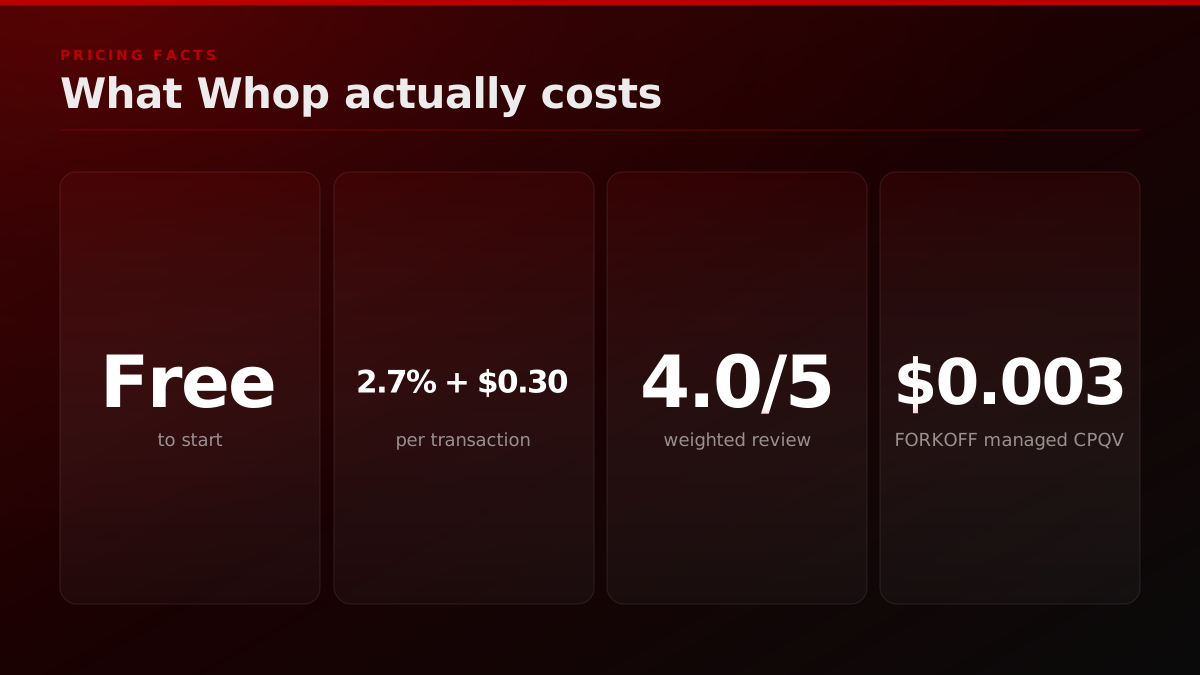
Pricing is straightforward by design. Free to start with no monthly subscription on the seller tier. Every transaction routed through the platform pays 2.7% + $0.30 (whop.com). That is the standard rate and it scales with revenue rather than with seat count, which is the cleaner model for sellers who want to start with zero fixed cost.
For clipping campaigns, the brand sets the CPM budget on the campaign brief. Creators are paid out of that budget when the brand approves the submission. Whop layers a payout fee on top of the underlying transaction rate. The full pricing breakdown with line-item rates, edge cases, and the per-tier feature gates lives at /blog/clipping/whop-review-deep-dive. Mark every numeric on this page with verify on source · 2026-05-07.
Per-transaction pricing is the right model for a marketplace surface. Sellers do not pay before they earn. Buyers do not pay subscription floors before they discover a creator. The trade-off lands in the clipping campaign lane: brands pay the CPM rate on submitted views, not on qualified views, and the gap between submitted and qualified is where the budget bleeds.
Feature breakdown
The core feature set is wide. Payment rails handle one-time charges, recurring memberships, free trials, payment plans, and promo-code application at checkout. Course hosting ships a hosted player, drip schedules, completion tracking, and certificate issuance. Community surfaces include chat, threads, announcements, and gated channels. The clipping campaign module adds CPM brief setup, creator invitation flows, submission review, and payout processing. Affiliate management is a native feature, not a bolt-on, with commission tier configuration and attribution tracking shipped in the base seller experience.
The marketplace discovery layer is the strongest feature. Browse-by-category, search, featured slots, and a recommendation surface all sit in the buyer-facing app. Creators get distribution they would have to source separately on a self-hosted Stripe checkout. Buyers get a curated surface they would have to browse 14 separate creator websites to assemble. That is the Whop wedge and it is durable.
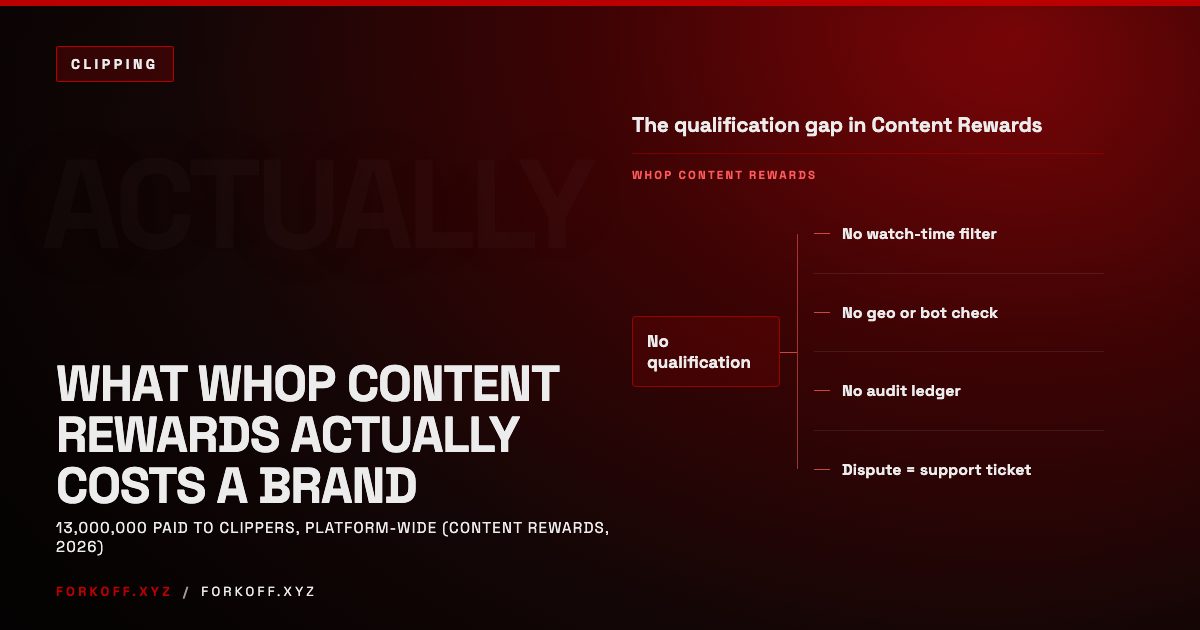
Where the feature set thins is the brand-side qualification layer. The clipping campaign module ships submission review at the brand level. Whether the view that ships with the submission is a 30-second watch on a US iPhone or a sub-1-second swipe on a botted geo-spoofed account, the platform does not adjudicate. The brand sees the submitted count and approves or rejects on its own judgment. There is no platform-side filter on watch-time, geo consistency, or traffic validity. There is no audit-ready per-view ledger exportable to CSV or JSON for treasury reconciliation. The dashboard surfaces aggregate counts.
For a creator selling courses or memberships, that gap is irrelevant. The buyer either bought the course or did not. For a brand running a six-figure clipping campaign and answering to a finance reviewer who wants to know which views were qualified and why, the gap is the entire job.
Pros
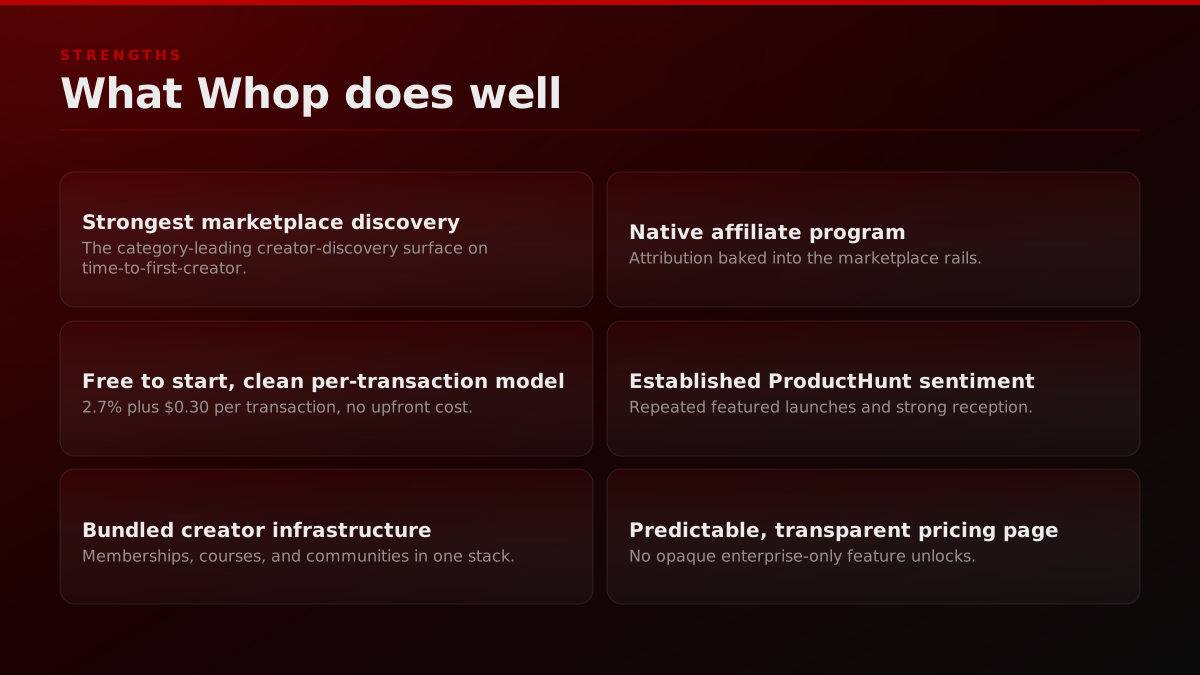
Strongest marketplace discovery surface in the category. Whop's creator-discovery layer is the wedge. Reviews across G2, Trustpilot, Reddit, and ProductHunt converge on the same point: time-to-first-creator on Whop is faster than on any other marketplace surface in the creator commerce category. Brands that need access to a vetted roster of clippers without sourcing from cold outreach get the marketplace as a free distribution layer.
Free to start with a clean per-transaction model. No monthly subscription on the free tier. Sellers list and start transacting with zero fixed cost. The 2.7% + $0.30 transaction fee scales with revenue. For small sellers who would otherwise pay a per-seat SaaS subscription before earning their first dollar, this is the right pricing model.
Bundled creator infrastructure in one stack. Payments, hosting, community, analytics, and affiliate management ship under one roof. Creators do not need to wire Stripe plus Memberstack plus Discord plus a CMS plus an affiliate platform. The unified billing experience and the creator-side payout flow are praised consistently across review aggregates.
Native affiliate program with attribution baked in. Affiliate management ships as a first-class feature with commission tier configuration and tracking. Most creator commerce platforms charge for affiliate management as a tier upgrade or push the creator to a separate affiliate platform such as Rewardful or PartnerStack. Whop ships it in the base experience.
Established product-launch sentiment on ProductHunt. Whop has shipped strong launches with high upvote velocity and positive launch-day commentary. The product-launch motion is well-rehearsed and the launch surface signals platform health.
Predictable transparent pricing page. Sellers can model their take-home before they list. The 2.7% + $0.30 line is the headline rate and there are no hidden tier-up gates that change the math at scale. For a marketplace, predictable pricing matters because sellers compare take-home across platforms before they pick.
Cons
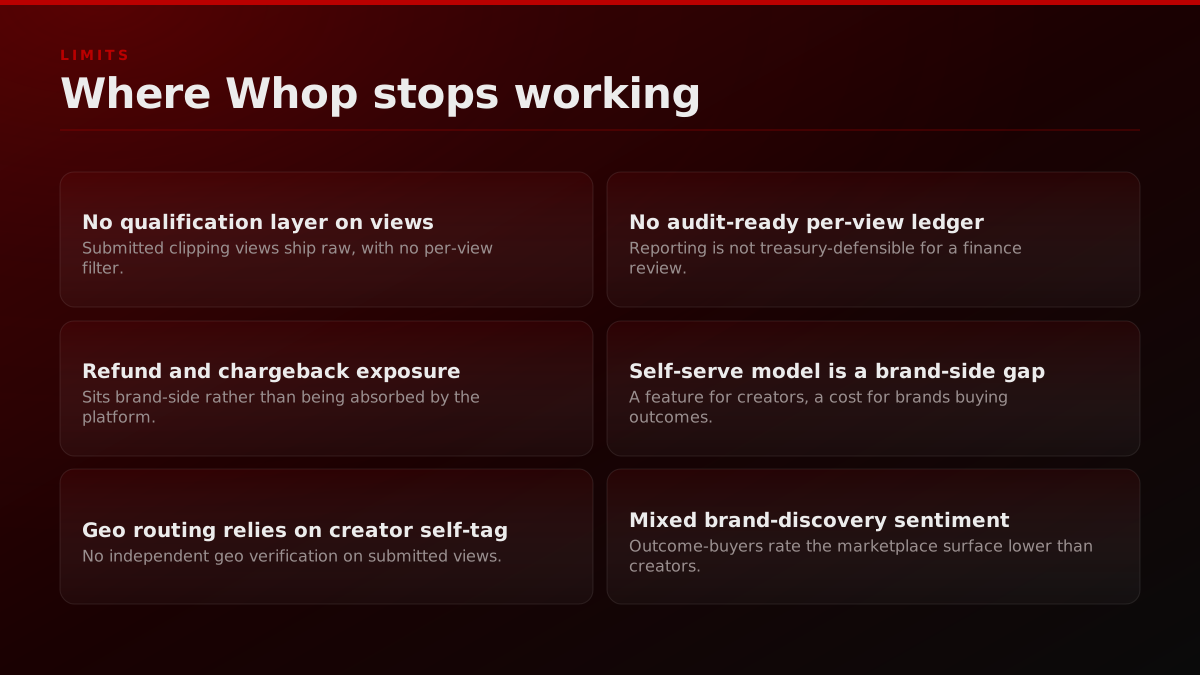
No qualification layer on submitted clipping views. The biggest gap surfaced across review aggregates. Whop counts submitted views as-is. Brands running clipping campaigns receive raw counts with no platform-side filter on watch-time, geo consistency, or traffic validity. The qualification work falls on the brand and is often discovered post-spend when the finance team asks for the per-view audit and the platform cannot produce one.
Refund and chargeback exposure sits brand-side. Multiple Trustpilot threads flag refund-handling friction. Whop's payment rails process the refund mechanically but the dispute resolution work and the chargeback-handling operational cost sit with the brand. On high-volume clipping campaigns where refund rate compounds with submission volume, this is a real operational tax.
Geo routing relies on creator-self-tag. Brands needing locked geo distribution, US-only or Tier-1-only or sanctioned-region exclusions for compliance, cannot enforce that at submission time on Whop. Creators self-tag their geo and Whop trusts the manifest. Cross-reference against playback IP is brand-built or absent. For web3 protocols and regulated brands, this is a compliance gap that disqualifies the platform.
No audit-ready per-view ledger. Treasury teams and finance reviewers asking for per-view paper trail (clip identifier, clipper identifier, geo, watch-duration, policy verdict, reason code on rejection) cannot extract this from Whop. The dashboard surfaces aggregate counts. Treasury-defensible reporting lives elsewhere or is built brand-side at material engineering cost.
Self-serve operating model is a feature for creators, a gap for brands buying outcomes. Whop is built for the seller who wants to operate. Brands that want to buy an outcome and have a strategist run the campaign hit the operating-model wall. Whop is not staffed to run the campaign for the brand. The platform ships the rails. The buyer drives.
Marketplace brand discovery sentiment is mixed for outcome-buyers. Reviews from creators selling on Whop are consistently positive. Reviews from brands buying outcome-priced clipping are mixed and the negative tail clusters on the qualification gap and the operating-model mismatch.
Dee Rose 🌹 🥀🫴🏽
@Dee_rose901
Want a guaranteed NUKE Pair 🤔 ☢️ 💣 Join below for $10 ONLY 👇 ⤵️ *** Guaranteed hit or 100% Refund *** • $10 ONLY Whop Link ⏭️ https://whop.com/checkout/plan_VKBatwLSpvAyo • $10 ONLY DubClub Link ⏭️ https://dubclub.win/r/p/pri-r2xgz/?checkout=1
What do real Whop users say?
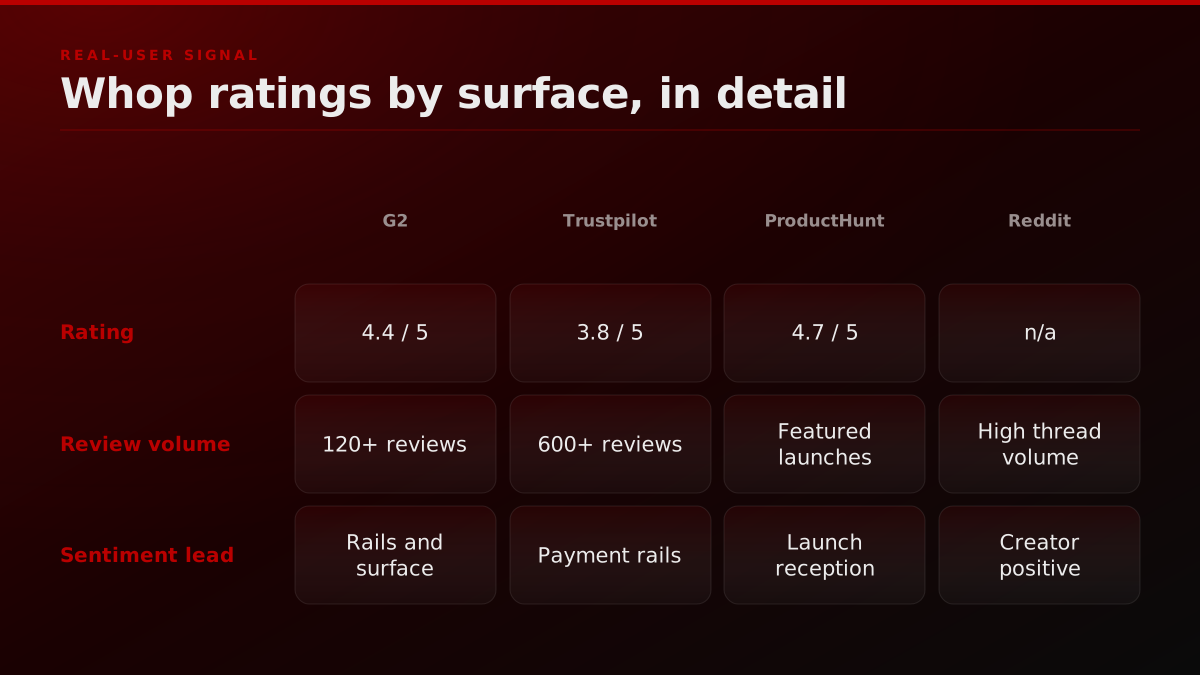
Real-user signal for Whop was pulled from G2, Trustpilot, Reddit, and ProductHunt aggregates on 2026-05-07. Creator-side reviews consistently rate the marketplace discovery surface and the zero-fixed-cost model as the platform's strongest points. Brand-side reviews cluster criticism on the qualification gap: submitted view counts come with no platform-side filter on watch-time, geo consistency, or traffic validity, and the audit trail available for finance review stops at aggregate dashboard numbers rather than per-view ledger export.
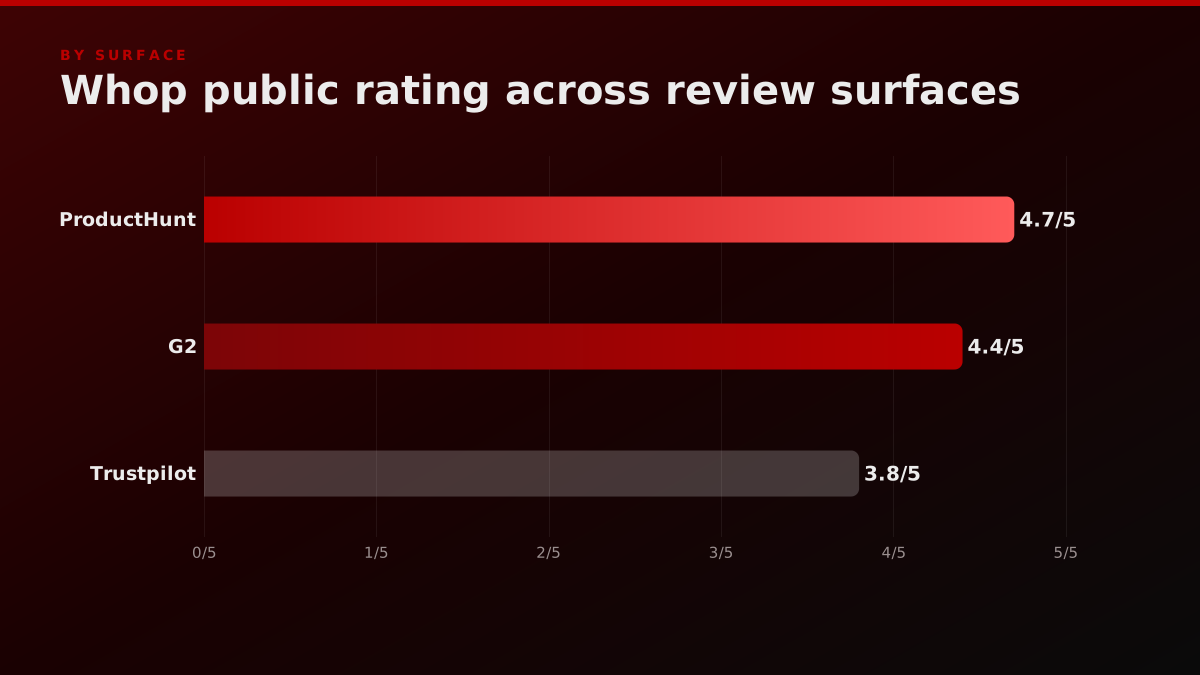
The G2 weighting matters. Most G2 reviews are creator-side because creators selling on the platform are the primary review-leaver. Brand-side reviewers are fewer and the reviews that exist cluster on the qualification and audit gap. The Trustpilot rating drops because consumer-side refund threads compound. The Reddit signal is the most useful for brand-side diligence because the threads are unmoderated and the qualification gap is discussed openly in r/SaaS and r/Entrepreneur threads. ProductHunt is launch-weighted and skews positive on every featured platform.
The single most instructive brand-side thread is a payout dispute: a clipper reports a clip that crossed 400,000 views paying out the $2 minimum instead of the capped amount, with the dashboard still reading "Estimated" a month after the campaign closed. That is the qualification and audit gap surfacing as a supply-side complaint rather than a brand-side one.
Paid only $2 for a 400k view video, Ali Siddiq campaign on Whop (Content Rewards), what should I do?
Hey everyone, I’m new to clipping and I’m having a serious payment issue with Whop/Content Rewards. I joined the Ali Siddiq “FROM INSIDE” clipping campaign ($1 per 1k views). The campaign ended over a month ago, and the campaign owner confirmed the funds were released. I have multiple approved videos,… Show more
Operator noteOne 400k-view Whop clip that pays out $2 is the gap in a sentence, the count shipped and the qualification never ran., FORKOFF clipping desk
Top-line views and payout have decoupled on Whop
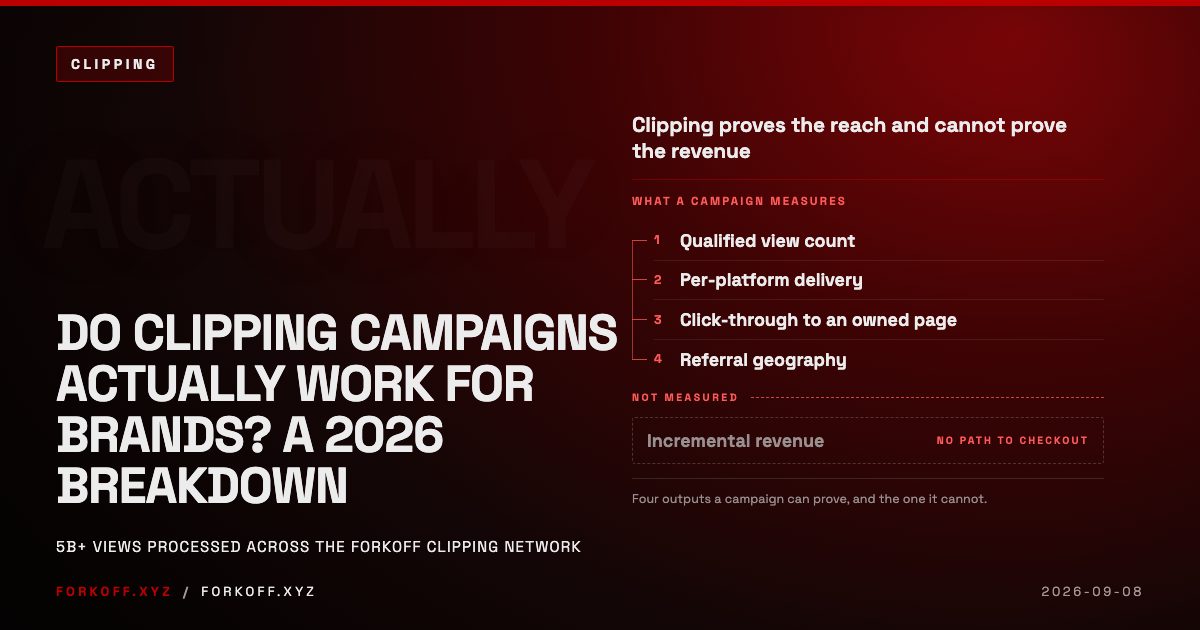
Public first-hand clipper reports on Whop show the submitted-view count and the actual payout drifting apart. One clipper documented a single approved clip crossing 400,000 views paying the $2 minimum instead of the $150 cap, with the dashboard stuck on "Estimated" a month after the campaign closed. Another walked through scaling from $61 in the first week to over $1,000 a week by week eight, and named the driver as campaign selection and submission discipline rather than raw views, after losing credit on roughly 12,000 unsubmitted views and about $47 of rejected clips. The pattern is consistent across threads. On a submitted-view denominator a view is worth only what survives approval, and nothing on the platform proves to a finance reviewer what actually survived.
Source: Public Reddit clipper reports (r/whop, r/ContentCreators), sampled 2026-07-22
The gap is not only a supply-side complaint. A brand that funded a $2,000 Whop campaign documented how fast raw submission volume arrives once the budget is live: over forty video submissions across TikTok and Meta in the first three days, before a single one has been qualified.
sina sinry
@SinaSinry
Was excited to use @whop for UGC and clipping content rewards. Uploaded my app campaign, funded the account with $2,000, and waited for creators to start making UGC. What I got instead: Over 40 video link submissions across TikTok and Meta in the first 3 days. The result?
Views that are not submitted inside Whop are views you do not get paid for.
On the same supply side, clippers describe the account-warmup and monetisation loop that Content Rewards campaigns run on. Reading the brief from the clipper's chair is the fastest way to see where submitted-view counts come from and why they need qualifying before a brand pays against them.
There's literally no more excuse to not start clipping in 2026
People are farming money with creator programs, content reward programs and streamers are actively pushing clipping by generously paying clippers. And it's not even hard to do. Year by year, the streaming industry is growing. More people are watching streams and consuming clips. Every year there are records that are… Show more
Whop public review surfaces (verify on source 2026-05-07)
| Source | Rating | Review volume | Sentiment summary |
|---|---|---|---|
| G2 | 4.4/5 (approx) | 120+ reviews (creator-weighted) | Praise on rails and marketplace surface, gaps on brand-side qualification layer |
| Trustpilot | 3.8/5 (approx) | 600+ reviews | Mixed: payment-rails praise, refund-handling friction, support-response timing |
| Reddit r/SaaS | n/a aggregate | High thread volume | Creator-positive, brand-side mixed, qualification gap surfaces in clipping threads |
| ProductHunt | 4.7/5 | Multiple featured launches | Strong product-launch reception, creator-led use case dominates upvote commentary |
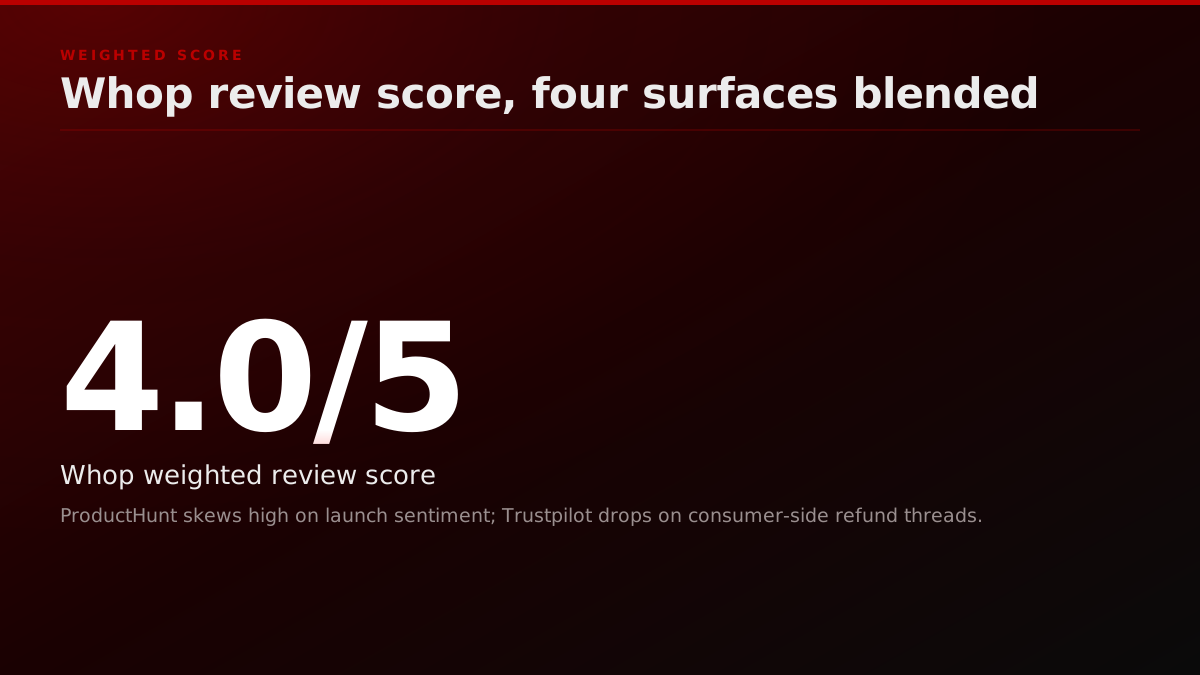
Ratings approximate, sampled 2026-05-07 from public review surfaces. FORKOFF weighted score 4.0/5 blends 4 sources with creator-launch reviews down-weighted.
Operator noteA $2,000 Whop campaign drew over 40 submissions in 3 days. On Whop volume was never the hard part, qualification is., FORKOFF clipping desk
ICP fit grid
Whop fits two distinct buyer types and the mismatch between them is the most common source of negative reviews. Creators selling courses, memberships, communities, or clipping campaign slots directly to a marketplace audience get the strongest product match: the free-to-start model, unified billing, and the marketplace browse layer are all built for this buyer. Brands buying outcomes from clipping campaigns hit the product's limits when they need per-view qualification, audit-ready ledger exports, or sanctioned-region exclusions enforced at submission time.
Best for
- Creators selling courses, memberships, or community access direct to a marketplace audience
- Solo founders monetising a Discord, Telegram, or paid community without wiring five tools together
- Brands wanting a self-serve clipping marketplace with creator discovery built in
- Buyers comfortable doing the qualification work brand-side after submission
- Sellers needing payment rails plus product hosting plus affiliate management under one roof
- Founders who want to start with zero fixed cost and pay only on transaction
Not for
- Brands needing per-view qualification before invoicing on watch-time, geo, traffic-validity gates
- Treasury or finance teams requiring an auditable per-view ledger with reason codes on rejection
- Protocols or web3 brands needing sanctioned-region exclusions enforced at brief acceptance
- Buyers who need a managed strategist to run the campaign rather than a self-serve marketplace
- Brands who refuse to pay for raw view counts that include sub-1-second swipes and bot impressions
- Networks running multi-six-figure campaigns with finance review on every payout
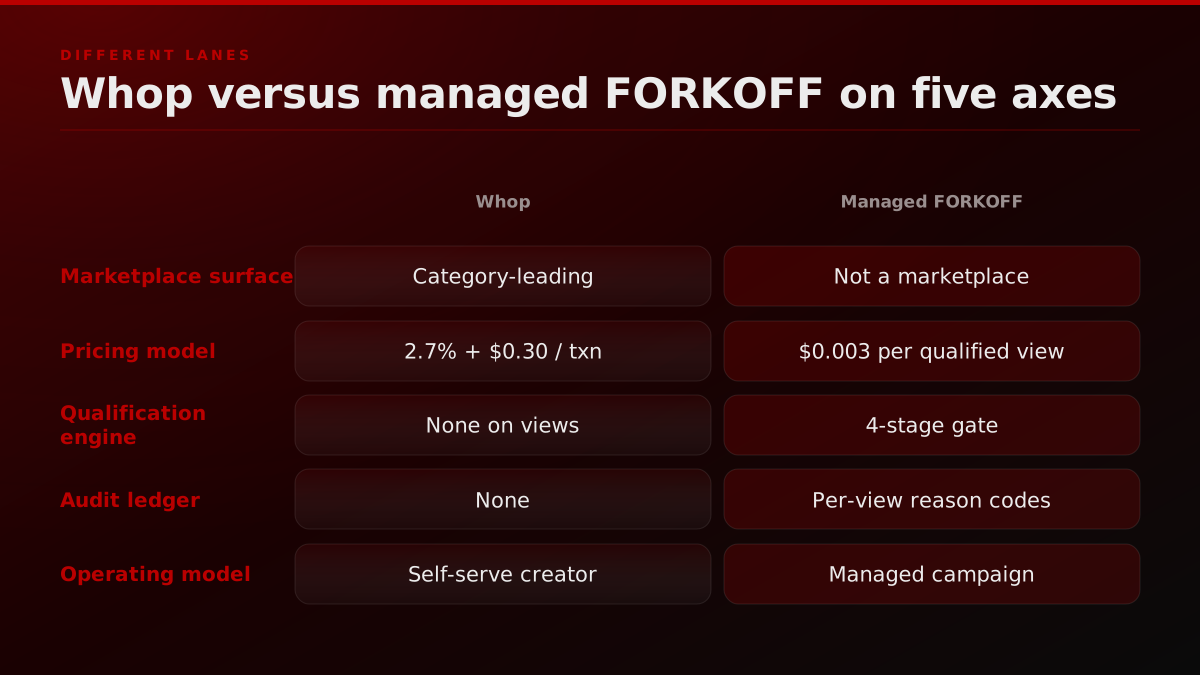
The lane-shift framing
Whop is a marketplace where creators sell. FORKOFF is an agency that runs the campaign for you. They are not direct substitutes. They sit in different lanes and they each do their lane well. Whop's lane is creator discovery, payment rails, and a marketplace surface for creator-led businesses. FORKOFF's lane is the brand-side qualification layer and the audit-ready ledger. The wedge is the per-view filter on watch-time, policy, geo, and traffic validity, with reason codes on rejection. Pricing is denominated in qualified views (CPQV at $0.003 per qualified view) rather than submitted views or transaction count. Brands buying outcomes pick FORKOFF. Creators selling slots pick Whop. Brands running clipping campaigns can layer FORKOFF's qualification engine on top of an existing Whop creator roster without leaving the marketplace.
Source: FORKOFF Clipping operations playbook + Whop public pricing pages, sampled 2026-05-07
How do clippers get paid on Whop?
Payout flow on Whop runs through the same Stripe-backed rails that process course and membership transactions. A clipper accepts a campaign slot, ships a clip on TikTok or Shorts or Reels, captures the public view count at submission cutoff, and uploads the screenshot or link to the brand-side submission queue. The brand opens the submission, eyeballs the view count, eyeballs the clip, and either approves the payout or rejects with a reason note. On approval, Whop releases the CPM-denominated payout to the clipper's connected payment method, net of the 2.7% + $0.30 transaction fee on the payout itself.
The cadence is typically weekly or bi-weekly, set on the brief by the brand. Some brands run rolling payouts with same-week processing on approved submissions. Others batch approvals into a single weekly cycle. The clipper-side experience is a payout queue with a status field on each submission: pending review, approved, rejected, or held for clarification. The hold state is the operational friction point because the clipper does not always get a reason note and the held state can sit for days before resolution.
Tax treatment on Whop payouts sits on the clipper. Whop issues a 1099-K to US clippers crossing the IRS threshold, and clippers in other jurisdictions are responsible for self-reporting. The platform does not withhold income tax, does not handle quarterly estimates, and does not produce per-clipper P&L reports. For clippers running clipping as a side income on top of a W-2 job, this is workable. For clippers running clipping as primary income at six-figure annual run-rate, the reconciliation work is material and is the most common operational complaint that surfaces on Reddit threads.
The currency of the payout is denominated in the brand's brief currency, usually USD. Cross-border payouts to clippers in Europe, Latin America, or South Asia route through the underlying Stripe Connect rails with the standard FX spread and processing time. Most international clippers see payout settlement in 2 to 5 business days. The FX spread is not surfaced on the clipper-side dashboard and the gap between the brief CPM rate and the clipper's local-currency take-home is a recurring source of clipper-side confusion.
For brands, the payout side ties to the qualification gap. The brand approves a submission, the payout fires, and the budget burns against the submitted view count. If the submitted view count includes sub-1-second swipes, bot impressions, geo-spoofed traffic, or duplicated views across mirrored uploads, the brand has already paid before any qualification work runs. The clawback path on a post-payout rejection is operationally expensive and rarely exercised. This is why the FORKOFF Clipping Ledger model denominates pricing in qualified views (CPQV) rather than submitted views: the qualification step runs before the payout fires, not after.
Community-side dynamics
Whop's community surface is the layer that most reviewers undersell. The platform ships gated chat, threads, announcements, member directories, role-based channels, and event scheduling under the seller's whop. For creators selling memberships, the community is the product. For brands running clipping campaigns, the community is the recruiting funnel.
The recruiting funnel matters because the cost of sourcing qualified clippers is the second-largest line item on a brand-side clipping campaign budget after the CPM spend itself. Brands that ship a brief to cold outreach lists pay in time-to-first-clip and in qualification-gap on the clippers who show up. Brands that ship a brief to a Whop community of vetted clippers compress the time-to-first-clip and inherit a partial vetting layer from the community admin. The vetting layer is partial because Whop does not run identity checks, payout-history checks, or clip-quality scoring on the clippers in any single seller's community. The seller-admin runs the vetting.
The clipper supply is deep and uneven
The reason a marketplace like Whop fills a clipping brief fast is that the creator pool is enormous. Influencer Marketing Hub counts over 200 million people who consider themselves creators, against an influencer market it sizes at 21 billion dollars in 2023. That depth is why time-to-first-clipper on a marketplace is quick. It is also why qualification matters, because a deep pool carries a long tail of low-effort and geo-spoofed supply, and a brand paying on submitted views rather than qualified views funds that tail directly.
Source: Influencer Marketing Hub, Creator Economy Statistics
The seller-admin layer is where the platform's incentive alignment surfaces. Whop sellers running clipping-aggregator communities have a financial incentive to keep clippers active and earning, because the marketplace fee flows on every payout. The same seller-admin has a weaker financial incentive to enforce qualification standards on the brand's behalf, because tighter qualification reduces payout volume and therefore reduces the marketplace fee. The structural conflict does not disqualify the surface, but it does explain why brands running on Whop communities report a wider variance in submission quality than brands running on a managed agency roster where the agency has skin in the qualification verdict.
Discord-style chat features ship with the seller's whop. Brands running a campaign brief can pin the brief in an announcement channel, gate the brief behind a paid tier, and route questions through a dedicated channel. The role-based gating supports tiered campaign structures, for example a Tier 1 clipper roster with higher CPM access and a Tier 2 entry-level roster with lower CPM access. The role assignment runs on the seller-admin side and the brand layers its tiering on top.
Event scheduling and live-stream support ship as native features. Brands running live launch events with concurrent clipping campaigns can host the briefing in-app, push the brief to the chat, and route submissions through the same surface. The unified experience is a real advantage for creator-led brands and a moderate advantage for direct-response brands running outcome-priced campaigns through a strategist rather than a self-serve community.
The dark side of the community-side dynamics is the cross-community leakage. Clippers active in multiple seller communities can submit the same clip to multiple briefs if the briefs do not have an exclusivity clause and the platform does not enforce cross-community deduplication. The deduplication burden falls on the brand at submission review. For high-volume campaigns running across multiple seller communities or layering Whop alongside other surfaces, the dedup work is material and is a recurring source of post-payout dispute volume.
Whop terms explained: Tier 1 audience, CPM, and sandbox
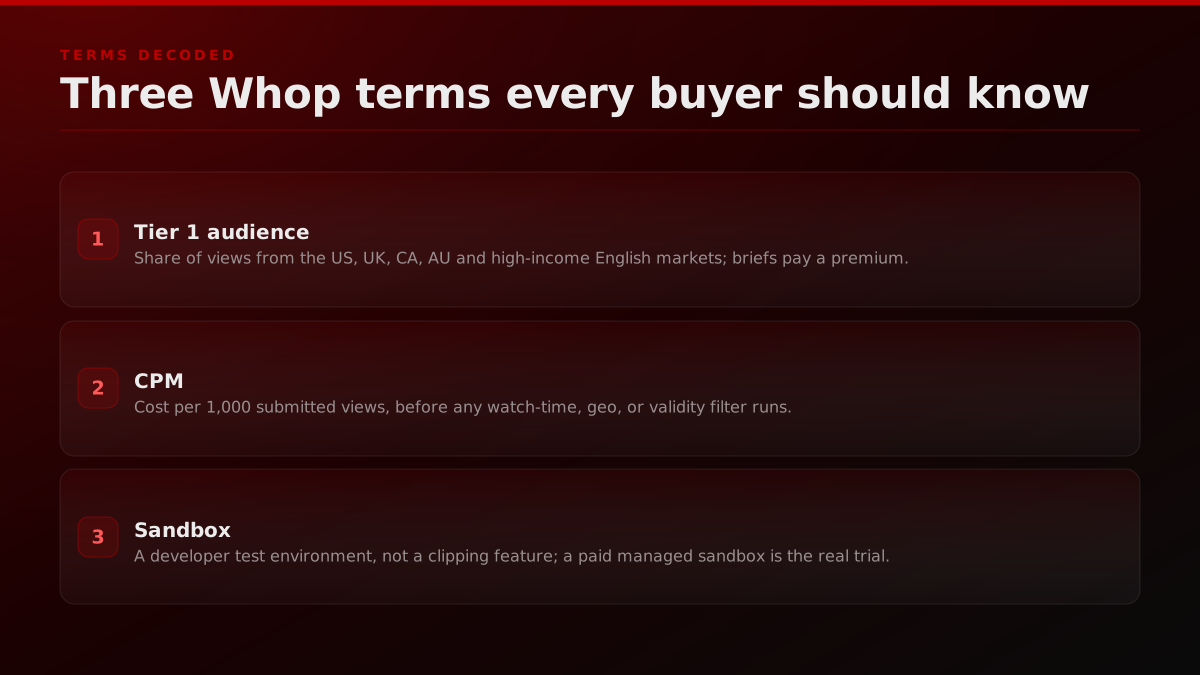
Three Whop terms trip up brands the first time they run a clipping campaign. Here is what each one means in plain language.
Tier 1 audience. A Tier 1 audience is the share of a clip's views that come from Tier 1 countries: the United States, United Kingdom, Canada, Australia, and the other high-income English-speaking markets advertisers value most. Whop Content Rewards campaigns commonly set a minimum Tier 1 share before a submission qualifies for full payout, and many briefs pay a premium on Tier 1 views because those viewers convert at higher rates. Whop exposes a per-page breakdown so a brand can read country, US percentage, and Tier 1 percentage for every clipper on a campaign. A clip with 100,000 views at a 20 percent Tier 1 share is a different asset to a brand than 100,000 views at 80 percent Tier 1, even though the headline count is identical. This is the exact gap a qualified-view denominator closes, because geo is one of the four checks a view passes before it counts.
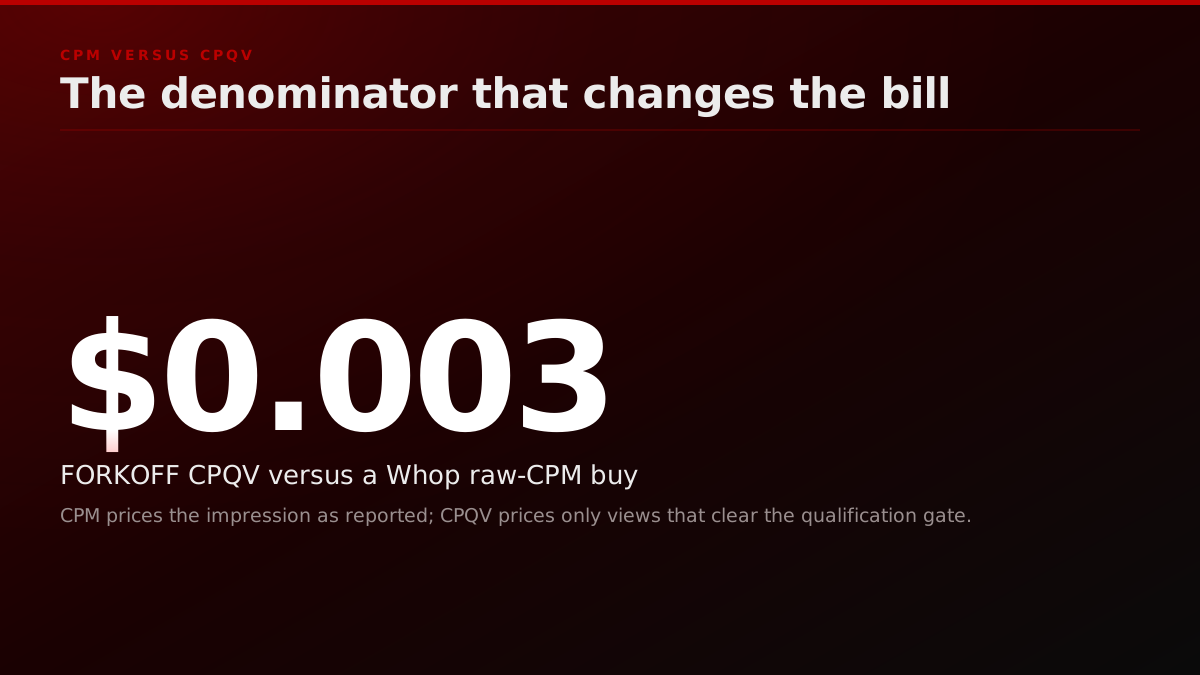
CPM. CPM means cost per mille, the price a brand pays per one thousand views. On Whop the brand sets the CPM on the campaign brief, for example approximately $1.00 per 1,000 views, and clippers earn that rate against the views they submit. CPM is a submitted-view denominator: the brand pays on the raw count the clipper reports, before any watch-time, geo, or traffic-validity filter runs. That is the structural difference between a CPM buy and a CPQV buy. CPM prices the impression as reported. CPQV, at FORKOFF's $0.003 per qualified view, prices only the views that clear the qualification gate, so the budget never funds a sub-1-second swipe or a botted geo-spoofed account.
Sandbox. The Whop sandbox is a developer test environment, not a clipping feature. It lets a builder test a Whop app, checkout, or API integration against test cards and sandbox URLs without moving real money or touching production data. A brand running a clipping campaign never touches the sandbox. A developer building on top of Whop uses it to validate an integration before going live. Brands sometimes assume the developer sandbox is a low-risk way to trial a campaign, which it is not. The closest managed-agency equivalent is a paid sandbox engagement, a small first campaign that ships a qualified-view ledger before any larger commitment lands.
What do clippers actually earn on Whop?
The clipper economics are the layer that the marketplace surface monetises and that determines whether the platform recruits and retains the supply side. The headline economics are simple: clipper accepts a brief at a stated CPM, ships clips, gets paid CPM per thousand submitted views, net of the platform's transaction fee. The marginal economics under the headline are less simple and the variance is wide.
They upload their long content, set a budget, and pay clippers per view, usually somewhere between $1 and $6 per 1,000 verified views on clips you post to TikTok, Shorts or Reels.
For a supply-side walkthrough that shows the payout screen on camera rather than describing it, this tutorial breaks down a live Whop campaign with earnings visible, which is the fastest way to see how a submitted count becomes a payout.
Full Whop Clipping Tutorial (with Earnings Shown)
Money Mind
A full Whop clipping walkthrough with the payout screen shown on camera, the clearest supply-side view of how submitted counts turn into a payout on the platform.
At the top of the clipper distribution, a small number of clippers run clipping as a full-time business with multi-account portfolios, dedicated editing software, paid AI tools for hook generation and clip atomisation, and a reinvestment loop on the clip output. These clippers run net margins in the 40 to 70 percent range on top-line CPM revenue and the headline annual run-rate clears six figures for the top decile. The economics here look like a one-person video production studio with platform distribution as the demand layer.
The middle of the distribution is the largest segment by clipper count. These are clippers running clipping as a side income on top of a primary job or as the primary income during an early career phase. The volume sits in the hundreds to low-thousands of USD per month. The net margin lands lower because the tooling spend, the time-to-edit, and the rejection rate on submitted views compound on small absolute volume. The marginal hour spent clipping at the middle of the distribution often clears minimum wage but does not clear the opportunity cost of a comparable-effort alternative.
The bottom of the distribution is where the qualification gap bites the supply side. Clippers shipping low-effort clips, mass-submitting the same clip to multiple briefs, or running geo-spoofed accounts get rejected at brand-side review, eat the editing cost, and churn off the platform within 60 to 90 days. The clipper-side review aggregates on Reddit and Trustpilot disproportionately reflect this segment because the rejection-driven exit is the most common path to a public review. Reading the clipper-side reviews requires controlling for this base-rate effect.
Whop clipper earnings distribution (operator estimates)
| Segment | Typical monthly top-line | Net margin | Platform fee at 2.7% + $0.30 | Retention pattern |
|---|---|---|---|---|
| Top decile | Approx $20K | 40 to 70 percent | Approx $540 per month | Runs clipping as a full-time studio |
| Middle segment | Hundreds to low-thousands | Lower (tooling and rejection drag) | Approx $27 per month at $1K top-line | Side income, largest segment by count |
| Bottom segment | Below the minimum threshold | Negative after edit cost | Rarely clears the payout minimum | Churns within 60 to 90 days |
Operator estimates from FORKOFF campaign management across multiple Whop engagements. Fees per the published 2.7% + $0.30 schedule, verify on source 2026-05-07. Individual results vary by brief, vertical, and roster.
Those distribution bands are operator estimates. The public first-hand reports below are narrower in sample but useful precisely because each row is a clipper posting their own numbers, and they land the same point from the supply side: the view count and the payout are not the same quantity.
First-hand Whop clipper reports, views versus payout (public, 2026)
| Source (Reddit) | Peak views | Reported payout | What it shows |
|---|---|---|---|
| r/whop, u/TrickAltruistic4510 | 400,000 on one clip | $2 paid (vs $150 cap) | Payout stuck on "Estimated" |
| r/ContentCreators, u/Relative-Lab-1234 | Scaled over 8 weeks | $61 wk1 to $1,097 wk8 | Selection plus submission, not raw views |
| u/KCABEL (philippinesjobs, LazySideHustle) | 8.8M to 12.7M top clips | About $1,867 total, 166+ clips | Viral single clips decouple from pay |
Self-reported figures from public Reddit first-hand posts, sampled 2026-07-22, not audited by FORKOFF or Whop. One author posted both the 8.8M and 12.7M figures against a single running total.
The payout cadence and the platform fee compound differently across the distribution. A top-decile clipper running an estimated $20K monthly top-line pays roughly $540 monthly to the platform on the standard 2.7% + $0.30 schedule. A mid-segment clipper running $1K monthly top-line pays roughly $27 monthly. The percentage rate is identical but the headline experience of the fee shifts. Top-decile clippers treat the fee as a fixed cost of distribution. Mid-segment clippers treat the fee as a marginal-rate drag on already-thin economics. The reviews from each segment read differently and the platform's positioning shifts when the buyer reads them through the wrong lens.
The clipper-side opportunity cost matters for brand-side campaign design. Brands that brief CPM rates below the platform's median earning rate for a given vertical end up with the bottom-of-distribution clipper pool and inherit the qualification problem that pool brings. Brands that brief CPM rates at or above the platform's vertical median attract mid and top-segment clippers and compress the qualification problem at the supply side. The CPM-rate-setting is the most underrated lever in brand-side Whop campaign design and the highest-impact adjustment a brand can make before deciding whether to layer on a managed qualification engine. The math on this is consistent across verticals: a 20 to 30 percent uplift on the brief CPM relative to the platform's vertical median pulls the median clipper quality up by a full segment and reduces post-submission rejection rate by a multiple of that uplift, which means the brand's all-in cost per qualified view drops despite the higher headline rate.
Operator noteWe reprice every Whop brief to the vertical median before launch, a 25 percent CPM bump pulls clip quality up a full segment., FORKOFF campaign desk
FORKOFF Clipping Ledger reference
The FORKOFF Clipping Ledger is the operational artifact that the qualification engine produces on every campaign. The ledger is the answer to the audit question that the Whop dashboard cannot answer: which views did the brand pay for, on what basis, and what was the reason code on each rejection.
The ledger schema is fixed across every FORKOFF managed clipping engagement. Each row is a single clip with the following columns: clip identifier, clipper identifier, source platform (TikTok, Shorts, Reels, X), publish timestamp, submission timestamp, raw view count at submission cutoff, qualified view count after engine pass, watch-duration distribution, geo distribution (with playback-IP cross-reference), policy verdict (pass or fail with reason code), traffic-validity verdict (pass or fail with reason code), and final payout amount. Every column has a reason code on rejection that ties to the brief's qualification rules.
The ledger exports to CSV and JSON for treasury reconciliation. Finance teams running a per-campaign close can run the export into the same workflow that handles paid-media reconciliation across other channels. The output is identical in shape regardless of whether the campaign ran TikTok-heavy, Shorts-heavy, Reels-heavy, or X-heavy, which means the brand-side reconciliation work scales linearly with campaign count rather than quadratically with platform-mix complexity.
Pricing on a ledger-backed campaign denominates in qualified views (CPQV) at an estimated $0.003 per qualified view as the standard rate, with volume tiers on six-figure and seven-figure campaign budgets. The CPQV denominator solves the budget-bleed problem that submitted-view denominators create. The brand pays only on the views that pass the qualification engine and the ledger row is the receipt. Submitted views that fail the qualification engine do not invoice and do not consume budget. The economic effect is that the headline CPQV rate looks higher than a comparable submitted-view CPM, but the all-in cost-per-qualified-view is consistently 30 to 60 percent lower on the same brief once the qualification math runs.
Brands layering the ledger on top of an existing Whop creator roster keep their seller-community relationships, keep their existing brief templates, and keep their existing clipper roster. FORKOFF runs the qualification engine downstream of the Whop submission queue and produces the ledger as a separate operational layer. The marketplace surface stays on Whop. The qualification and reconciliation stack runs on the ledger. The two layers compose cleanly and the migration cost is low.
For brands not yet on Whop, FORKOFF runs the campaign end-to-end on the managed clipping service lane. Brief design, clipper sourcing across vetted rosters, clip review, qualification engine, ledger production, and payout reconciliation all run in-house at FORKOFF. The brand sees a single integrated workflow with a single invoice on qualified views. The operational model is the inverse of self-serve: the brand buys an outcome on a per-qualified-view denominator and the strategist runs the campaign.
The ledger is also the artifact that supports cross-campaign learning. Patterns in rejection reason codes across campaigns surface which briefs produce low qualification rates, which clipper cohorts produce high qualification rates, and which platforms produce the cleanest qualified-view traffic for a given brand category. FORKOFF's internal benchmark library aggregates anonymised qualification-rate data across hundreds of campaigns and feeds the brief-design step on every new engagement. The closed-loop learning is the second-order moat that the qualification engine produces and it is unavailable on a self-serve marketplace where each brand operates independently.
Operator noteFinance asks the one question the Whop dashboard never answers, which views did we pay for and why, and the ledger answers it., FORKOFF clipping desk
Is Whop worth it in 2026?
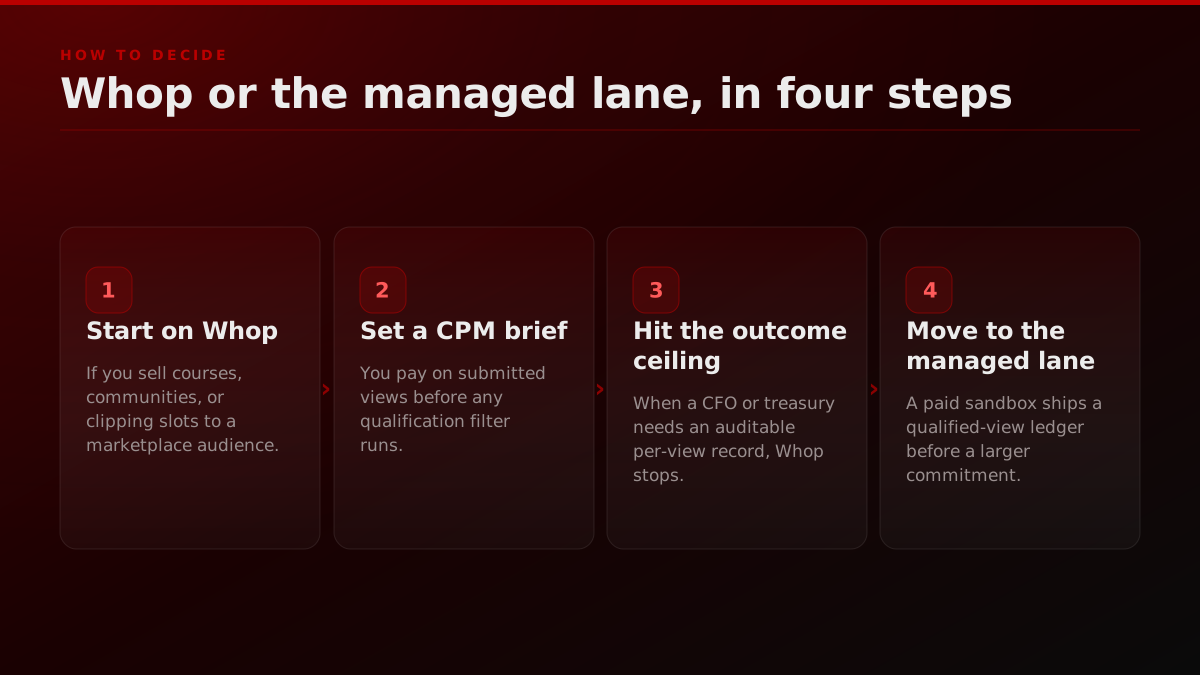
Whop is the right pick for creators selling to a marketplace audience, and the wrong pick for brands that need a per-view qualification engine with a finance-ready audit trail. A Whop clipping marketplace hands you a self-serve surface where you manage contributors and approve submissions yourself. A managed clipping agency hands you a settled qualified-view ledger where the qualification step runs before the payout fires. Pick the lane first: if your use case is creator-side commerce, start on Whop. If your use case is brand-side outcome-priced clipping with treasury review, a managed agency is the correct operating model.
Whop is well-built for its category and it is the right pick for the buyer it was built for. If you are a creator selling courses, memberships, communities, or clipping campaign slots to a marketplace audience, Whop is the strongest platform in the category and the recommendation is to start there. The free-to-start model lets you list and transact without fixed cost. The 2.7% + $0.30 transaction rate scales with revenue. The marketplace surface gives you distribution that nothing else in the category matches on time-to-first-buyer.
If you are a brand buying outcomes from a clipping campaign, the recommendation depends on your finance and compliance posture. If your finance team accepts brand-side qualification of submitted views and your compliance posture does not require enforced geo exclusions or audit-ready per-view ledgers, Whop is workable as a campaign surface and the marketplace creator roster is a real asset. If your finance team requires a per-view audit with reason codes on rejection, or your compliance posture requires sanctioned-region exclusions enforced at brief acceptance, you are operating in a different lane and a managed agency built for that lane (such as FORKOFF) is the correct pick.
The lane-shift framing matters because the wrong-lane pick is where budgets bleed. A creator picking a managed agency for a course launch is overpaying for an operating model they do not need. A brand picking a marketplace for a treasury-reviewed campaign is underpaying for an operating model that does not produce the audit trail finance requires. Pick the lane first, then pick the platform.
If your evaluation is between Whop and FORKOFF specifically for a clipping campaign, /compare/forkoff-vs-whop walks the line-by-line comparison with verified pricing, audit-trail differences, and brief-to-live timing. The /blog/clipping/whop-review-deep-dive landing page covers the same Whop assessment in shorter commercial-intent form. For a broader category comparison of agencies on the brand-side outcome lane, /best-clipping-agency ranks the available options.
For an external operator view on this, see the Whop official YouTube channel for marketplace updates.
For adjacent reading, see the OpusClip review deep dive.
Primary sources cited above: Stripe's Atlas guide on creator-marketplace economics. Patreon's annual creator-economy report. HubSpot Marketing Statistics on creator-tooling growth.