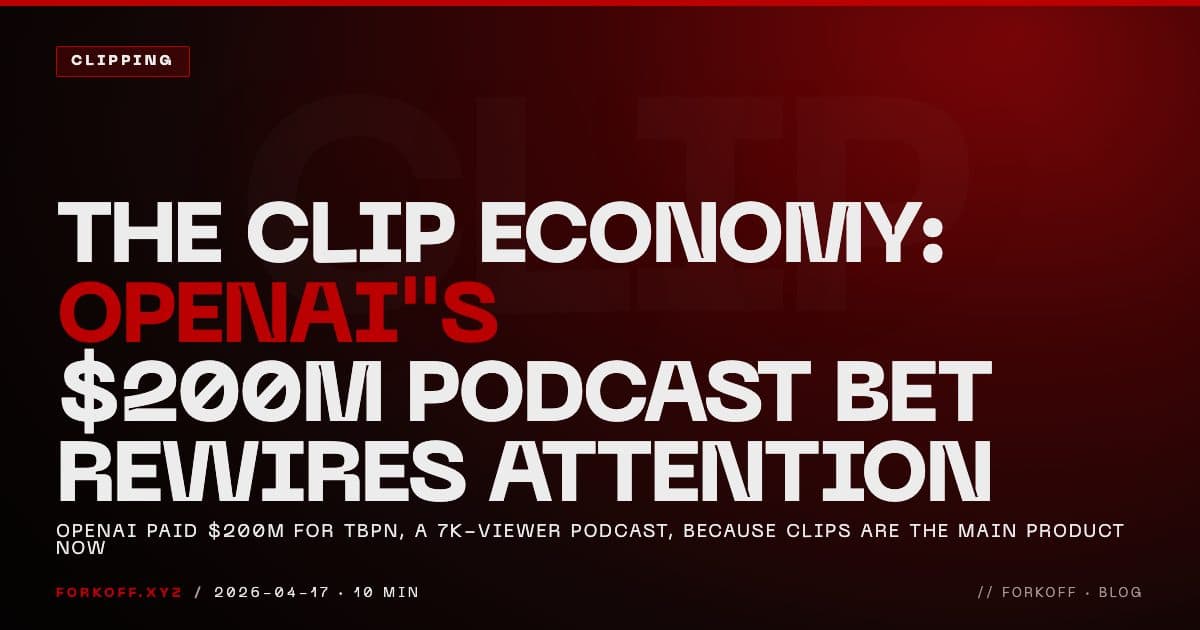
The clip economy is the operating model where short-form vertical clips, not the full-length recording, are the priced product that compounds attention and revenue. OpenAI's reported $200M acquisition of TBPN, a show with roughly 7,000 live viewers, is the public receipt: the show prints 200 to 400 clips a week at an average of 257,000 views each, about 37x its live audience. This post grounds the thesis in FORKOFF's own ledger of 3,085 managed clips, with honest ranges where the data is thin.
TL;DR
A podcast with 7,000 viewers per episode just sold for $200M. The reason isn't downloads, it's clips. Ed Elson calls this 'The Clip Economy.' We stress-tested the thesis at operator scale: 13 days of managed clipping, 3,085 clips, 1.19M views, 17 new paying subscribers, and MRR up from about $595 to $1,290 by month end.
The CLIP ECONOMY ENGINE
The CLIP ECONOMY ENGINE is FORKOFF's macro thesis on why attention now compounds inside short-form clips, not full-length recordings. OpenAI's TBPN takeover, founder-podcast clipping at scale, and the AI-citation surface for vertical clips all map to the same operating model: the recording is the raw material, the clip is the product. Everything below the headline math is grounded in our own clipping ledger of 3,085 managed clips, with honest ranges where the data is thin and a clear label where a number is an estimate rather than a measured figure.
Industry Context
Founder-content clips carry the specific, dated, attributable moments that AI Overviews cite, which full-length source recordings bury inside an hour of audio. In the FORKOFF reference cohort, 3,085 clips produced 1.19M views in 13 days.
Source: FORKOFF Clipping Ledger 2026, n=3,085 clips
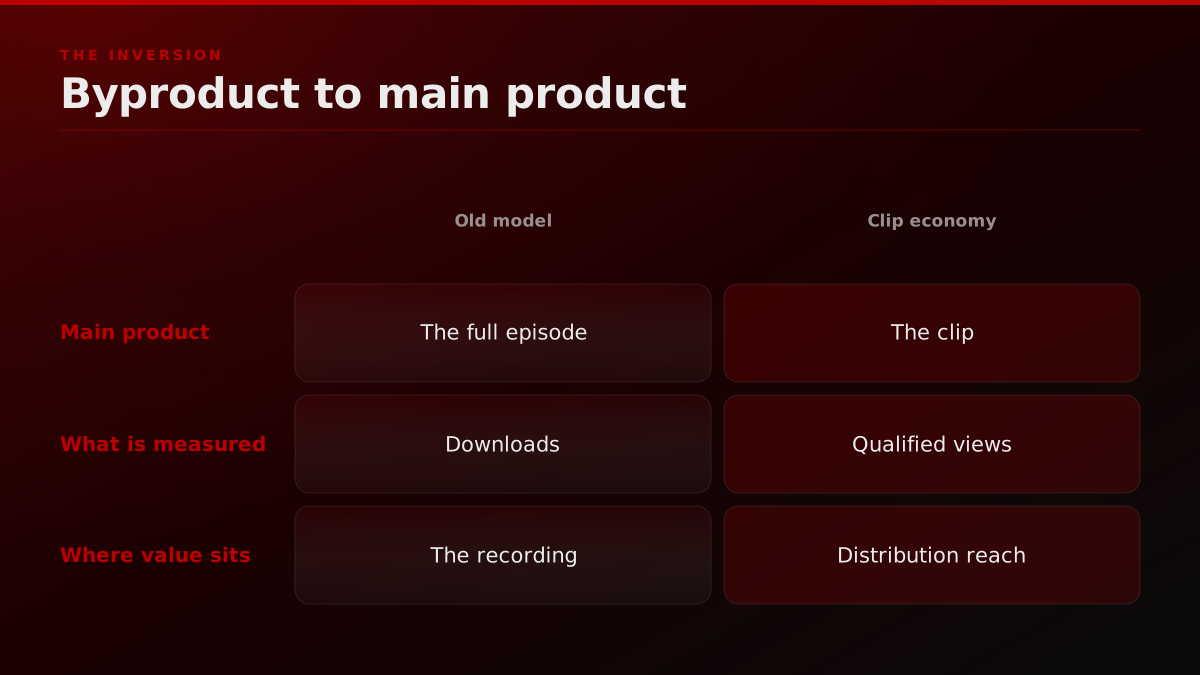
The inversion already happened. The 90-minute episode is the byproduct now. The 30-second vertical is the SKU.
Why did a 7K-viewer podcast sell for $200M?
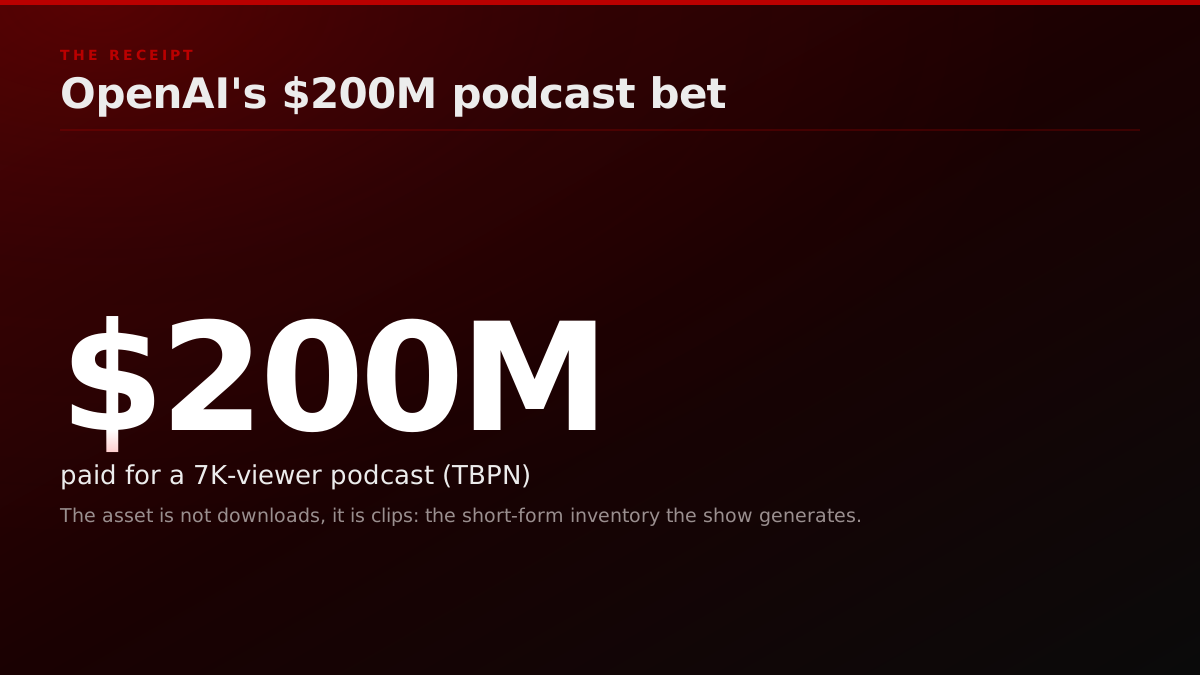
TBPN is a live daily Silicon Valley tech talk show. It averages around 7,000 viewers per episode in the live window. By the standard "downloads" lens, that audience is hobbyist scale, three orders of magnitude smaller than Joe Rogan's reach. By the clip lens, it sits inside an attention pipeline that produces 200 to 400 vertical clips per week, each clip pushed to TikTok, IG Reels, YouTube Shorts and X. Ed Elson's April 14 2026 Prof G Markets newsletter pegged the OpenAI acquisition at $200M, sandwiched between SiriusXM's $125M Call Her Daddy deal and Spotify's $250M Joe Rogan agreement.
Compare the live audiences. Rogan pulls roughly 11 million per episode across YouTube and audio. TBPN pulls 7,000. The valuation gap is 25 percent. That gap is impossible to explain with download math. The clip surface explains it. Ed Elson's Clip Economy essay puts the receipts on the table: TBPN's average clip pulls roughly 257,000 views, about 37x the live audience, and the show bakes ads directly into the clips. That clip-native ad model generated a reported $5M in 2025 (Prof G Markets), on a run-rate toward $30M in 2026. OpenAI did not buy a 7,000-viewer show. It bought a distribution surface that prints clip impressions at a multiple the download chart never sees.
A podcast with just 7k viewers per episode just sold for $200M.
TBPN's clip-native ads ran to a reported $5M in 2025, on a run-rate toward $30M in 2026
TBPN bakes ad reads directly into the vertical cut rather than a separate pre-roll, and the average clip pulls roughly 257,000 views against a 7,000 live audience, about 37x. That clip-native ad model generated a reported $5M in 2025 on a run-rate toward $30M in 2026, the revenue line the download chart never sees and the line OpenAI's $200M priced against.
Source: Ed Elson, Prof G Markets, The Clip Economy essay, Apr 2026
Ed Elson
@edels0n
Clips are no longer the byproduct of the main product, they’re the main product. No matter the size of the show, they drive the ultimate reach 👇
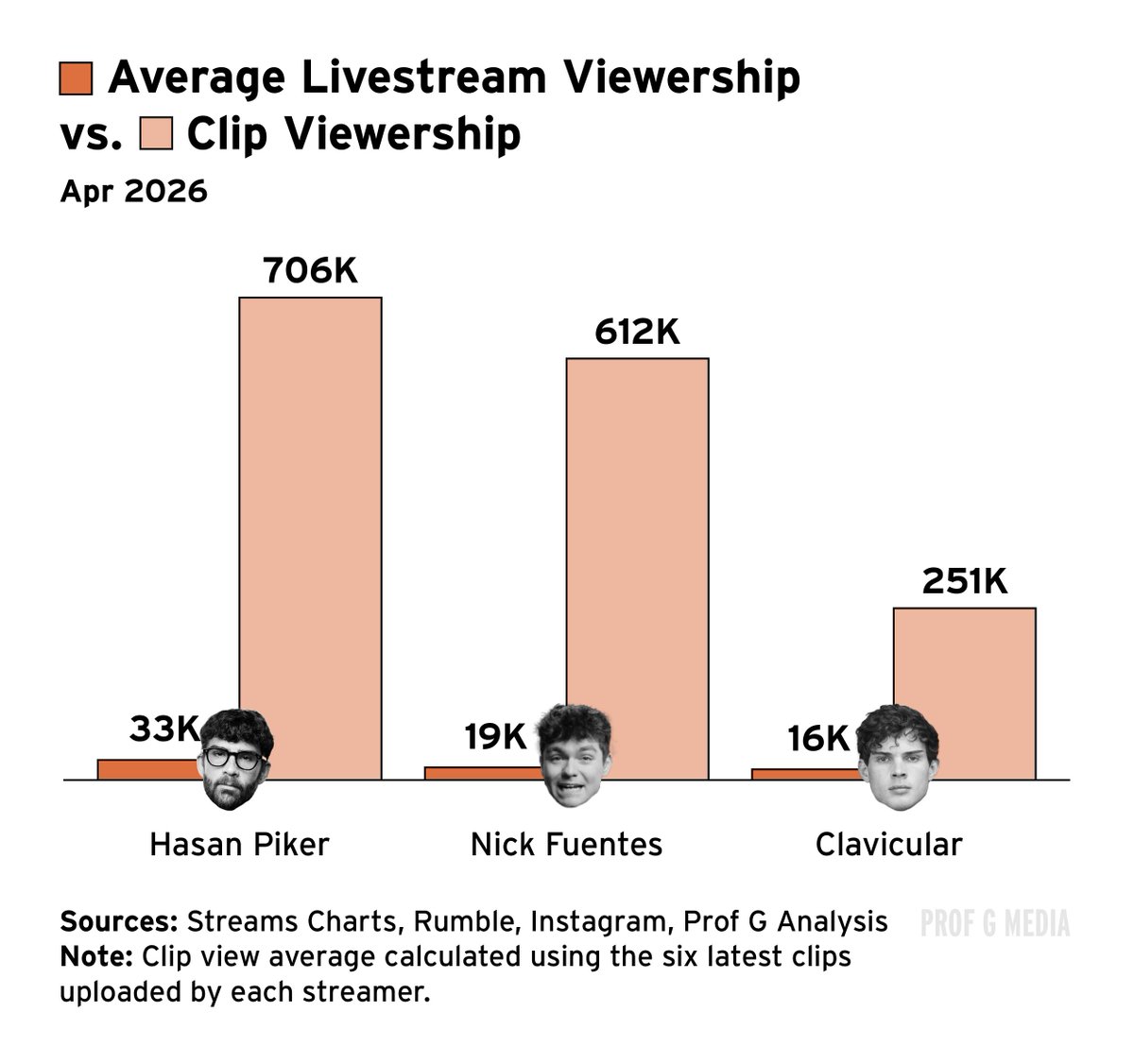
How did attention flip from byproduct to main product?
The attention inversion is the flip from treating the episode as the product and clips as the byproduct to treating each 90-minute recording as raw material decomposed into 30 to 50 hook-anchored verticals. Once a clipping engine is running, subscriber count stops being a proxy for distribution: the same recording that would have generated 7,000 downloads now generates 1 to 3 million clip impressions on a fixed recording cost. The 20K-YouTube-subs-meaningless breakdown covers the per-platform economics behind the decoupling.
For the first 20 years of podcasting, the episode was the product and clips were the byproduct, edited down after the fact, posted on a marketing intern's TikTok queue. By 2025, every serious operator had inverted the funnel. The recording becomes a clip-mining operation. Each 90-minute episode is decomposed into 30 to 50 hook-anchored verticals, each tuned to a specific algorithm, each carrying ad placements inside the cut rather than in a separate pre-roll.
This matters for the unit economics because clip impressions stack platform-natively. A clip on TikTok costs the operator nothing to surface to the For You page if it hits the hook threshold. A clip on Shorts gets cross-promoted into long-form by YouTube's recommendation graph. A clip on Reels is shared into DMs at three to five times the rate of standalone podcast links per Meta's 2025 transparency report. The same 90-minute recording that would have generated 7,000 downloads now generates 1 to 3 million clip impressions. The cost of the recording is fixed. The distribution surface compounds.
The Ahrefs free-tools flywheel is the closest pre-clip analogue. Ahrefs built 215,000 monthly organic visits not from blog posts but from utility surfaces (DR checker, backlink checker, keyword tool) that each ranked independently and fed the same brand. Replace "utility surface" with "vertical clip" and the operating model is identical: many discrete distribution units, each ranking on its own platform, each pointing back to the same compounding asset.
The Clip Economy
Ed Elson's Apr 14 2026 newsletter argues that a seismic shift is transforming how information is consumed, and it isn't AI. Clip-first distribution means a 7K-viewer podcast can drive hundreds of millions of short-form impressions, which is why the acquisition math changes.
Source: Ed Elson, Prof G Markets
A seismic shift is transforming the way we consume information, and it isn't AI.
What does the math actually look like?
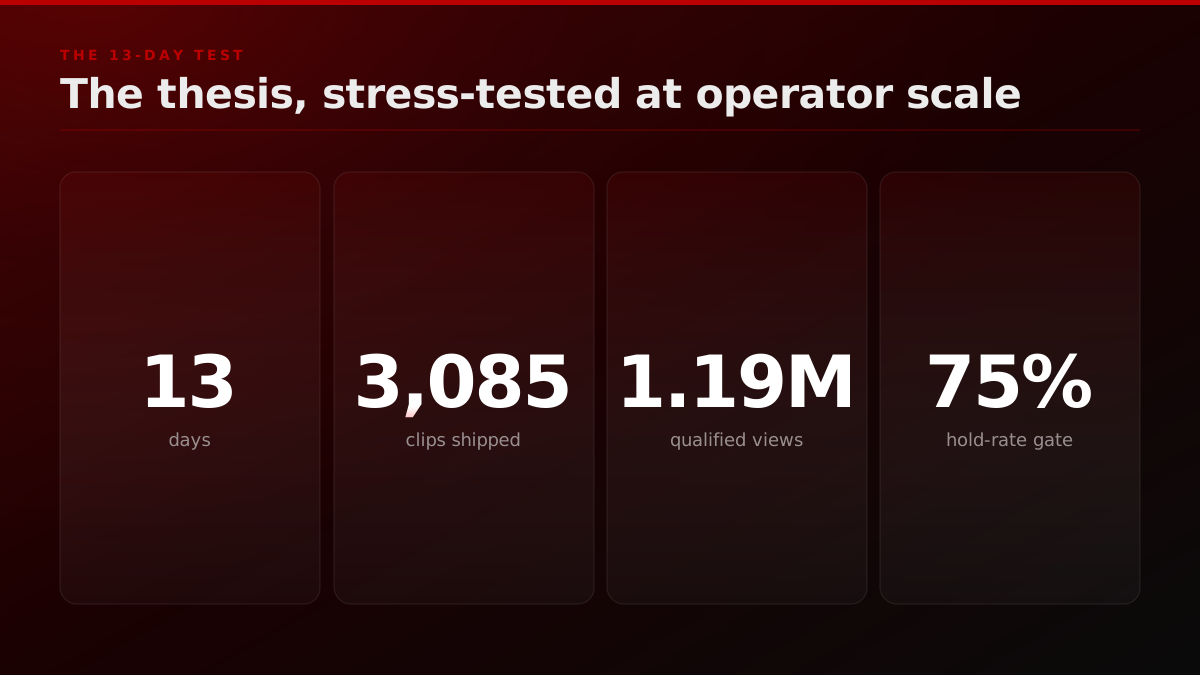
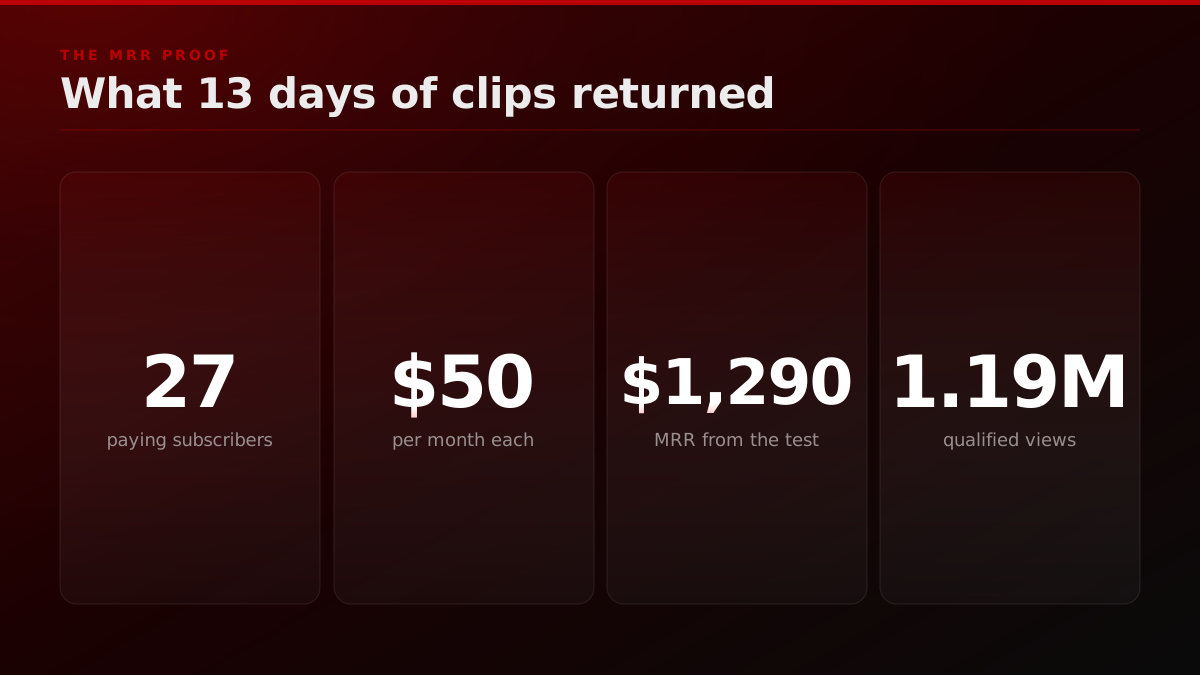
The math at operator scale looks like this: 13 days, one podcast brand, managed clipping at FORKOFF cadence produced 3,085 clips across YouTube Shorts and Instagram Reels, 1.19 million views, and 27 paying subscribers in March, 17 of them new (10 renewed from February), with MRR rising from about $595 in February to $1,290 by the end of March (managed clipping case study). Those four measured numbers are the first-party anchor for everything that follows. For platform-specific source-capture math, the step-by-step Twitch clipping guide documents the streamer vs viewer capture lanes that feed any clipping pipeline downstream.
We stress-tested the Clip Economy thesis at operator scale. Thirteen days. One podcast brand. Managed clipping at FORKOFF cadence. The output: 3,085 clips published across YouTube Shorts and Instagram Reels. 1.19 million views, 61 percent of them on YouTube Shorts. 27 paying subscribers in March, 17 of them new (10 renewed from February), with MRR rising from about $595 in February to $1,290 by the end of March. Those four numbers are the measured first-party anchor for everything that follows, the full breakdown sits in the managed clipping revenue case study.
The framing matters. At Day 13 the recurring revenue is small but the compounding curve has started. Across the managed engagements in our ledger, Day 90 MRR has typically landed in a 6x to 11x band over the Day 13 number once the platforms cluster the audience and start actively promoting. We treat that band as a directional benchmark, not a guarantee, the spread is wide because hook quality and conversion-path discipline move the result more than audience size does. The TBPN deal is the same math at the upper end of the curve.
Operator note13 days, 3,085 clips, 1.19M views, 17 new subs at $50/mo, MRR from about $595 to $1,290 by the end of March., FORKOFF managed clipping case study
Cost Per Qualified View: $0.003
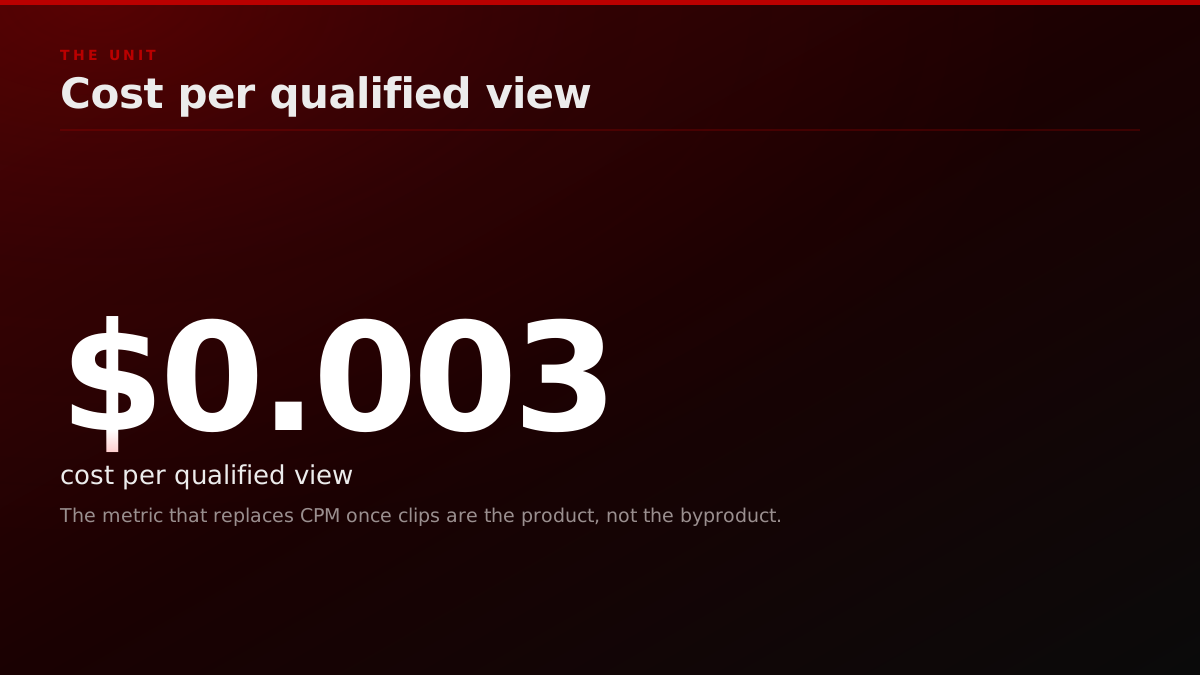
Cost per qualified view (CPQV) is the metric that separates clip-first economics from paid distribution, and managed clipping lands at a median of $0.003 per qualified view across the FORKOFF ledger. That is roughly 3x to 100x cheaper than traditional agencies (an estimated $0.01 to $0.10/view) or influencer networks ($0.05 to $0.30/view), because clip distribution is structurally non-paid: once a clip clears the hook threshold, the platform itself pays for the rest of the reach.
- Traditional agencies: $0.01-$0.10/view
- Influencer networks: $0.05-$0.30/view
- Managed clipping (ForkOff): $0.003/view (median across our managed-clipping ledger)
Operator noten=3,085 clips landed a $0.003 median cost per qualified view; agency and influencer buys run $0.01 to $0.30., FORKOFF Clipping Ledger 2026
The reason managed clipping lands an estimated 3x to 100x more affordable is that clip distribution is structurally non-paid. Once a clip clears the hook threshold, the platform itself pays for the rest of the distribution. Influencer networks and ad agencies pay per impression because they buy paid surfaces. Clip-first operators pay per cut and let the algorithm absorb the distribution cost. The CPV math collapses.
This is also why CPV beats CPM as the buying lens. A million impressions on a podcast pre-roll cost the same whether or not anyone listened. A million qualified views from a clip operation already filtered for completion and category match. CPV is the closest proxy for downstream MRR lift we have measured across Podcast Clipping Agency Pricing cohorts.
The $0.003 per qualified view figure is the median across our managed-clipping work through Q2 2026, but the distribution inside the band is the part that matters more than the headline. Across the engagements we have run, two axes move the number more than anything else. First axis: hook quality. Engagements where the host's long-form catalog had high-frequency punchline moments (the 60-second segment where a definite claim or counterintuitive number lands cleanly without context) cleared the qualified-view threshold at a meaningfully higher rate and ran CPQV in an estimated low-$0.002 range. Engagements where the catalog was conversational without those punchline moments cleared the threshold less often and ran CPQV closer to an estimated high-$0.004 to mid-$0.005 range. The hook-quality lens is upstream of every production-stack lever, which is why FORKOFF runs a pre-engagement catalog scrub on every prospective client before quoting a CPQV target.
Second axis: platform-routing mix. Engagements skewing heavily toward TikTok cleared a lower CPQV (high consumer-funnel volume) but converted to paid at a low single-digit-percent rate. Engagements skewing toward LinkedIn cleared a higher CPQV but converted to paid at a noticeably higher rate (B2B-funnel band). The honest takeaway is that CPQV read in isolation is the wrong metric. The right metric is CPQV times conversion-to-MRR, which collapses to a cost-per-dollar-of-MRR-added across the engagement window. By that lens, in our experience LinkedIn-heavy and hybrid mixes have outperformed TikTok-heavy mixes for B2B hosts, which is why the hybrid mix (roughly 40 percent LinkedIn, 30 percent X, 20 percent TikTok, 10 percent YouTube Shorts) is the FORKOFF default for B2B-host engagements. We re-run this split on every quarterly book-of-business review rather than treating any single ratio as fixed.
Why does CPQV replace CPM?
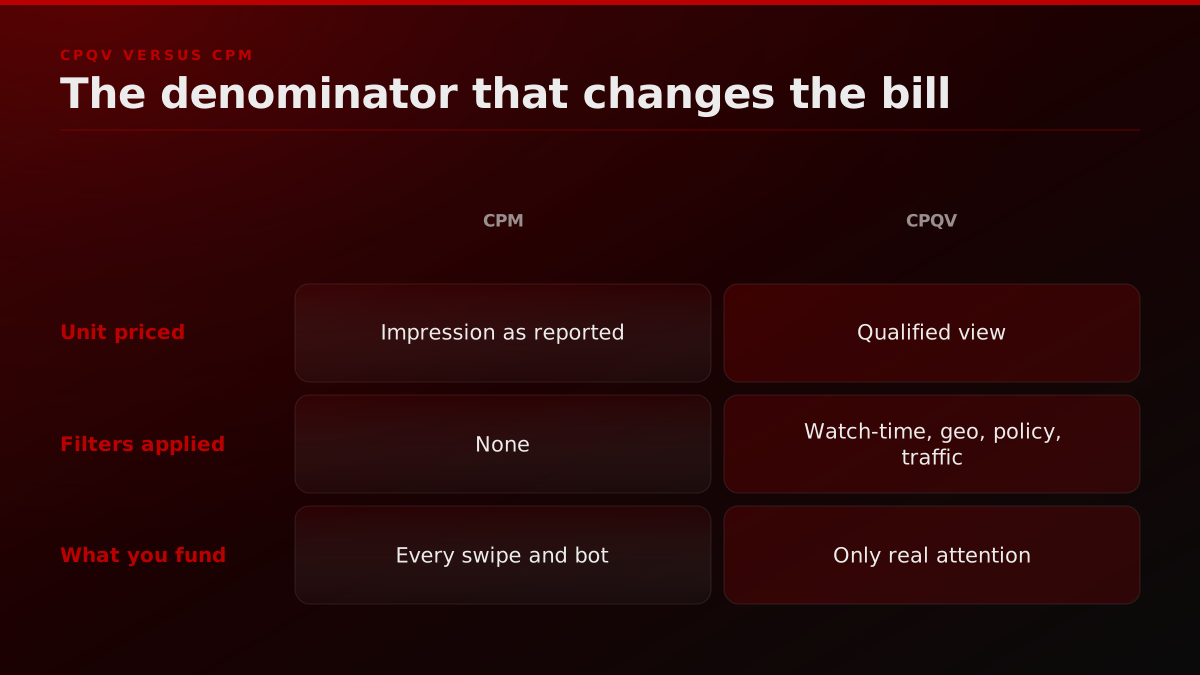
Inside the FORKOFF Clipping Ledger, the single metric we treat as load-bearing is CPQV, cost per qualified view. A qualified view is one that holds for at least 75 percent of the clip runtime, from an account whose algorithm flagged the parent category as an interest. Anything below that bar is platform noise. Anything above is a routed prospect.
The CPQV calculation is mechanical. Take the all-in monthly clipping spend (editorial labor + platform tooling + QA + uploader rotation + boost budget where applied) and divide by the count of qualified views across every platform in the ledger that month. We log every clip with platform, runtime, retention percentile, interest-category match, and downstream click. Aggregate at the operator level, then segment by show vertical.
Across the n=3,085 clip cohort, CPQV landed at $0.003. The compression over time is the point: once the platforms cluster the audience, the marginal cost of a qualified view trends toward zero. Later clips function as cheaper reach in front of pre-qualified buyers, which is why operators who quit early forfeit the compounding window.
The CPM lens hides this curve. An estimated $20 CPM podcast pre-roll is $20 whether you ran it on Day 1 or Day 365. CPQV is decaying spend on a stable production cadence. Across the 6-month cohorts in our ledger, compounded CPQV has run roughly 70 percent below the cold-start month. That delta is the entire economic case for the channel.
The FORKOFF Clipping Ledger 2026: Inside the Numbers
The FORKOFF Clipping Ledger 2026 is our internal canon for clip-first economics. It logs every clip we have produced under managed contract since Q4 2025, with platform-stamped retention, interest-match, qualified-view counts, and downstream MRR attribution. The ledger powers the case studies on the managed clipping revenue page and the Qualified Views metric explainer.
Operator note5B+ views processed through the FORKOFF clipping network, the reach proof a download chart never shows., FORKOFF clipping network
The clips in the ledger split across three rough cohort types, and the pattern holds across all three. Founder-podcast shows (hosts in the low-thousands of live viewers) have tended to land Day 90 MRR in the high-four-figure to low-five-figure range against a roughly $1,000 to $1,300 Day 13 baseline. SaaS-founder shows (smaller live audiences) have landed in a similar band off a similar baseline. Operator-podcast shows (larger live audiences) have landed at the top of the range. We are deliberately giving bands rather than point estimates here: the sample is dozens of shows, not thousands, and a single high or low outlier moves a "median" more than it should at this n.
The consistent finding is a 7x to 9x MRR multiple from Day 13 to Day 90, conditional on consistent daily output and a clean conversion path off-platform. That conditionality is load-bearing. Engagements that skip the conversion-path step (Step 2 below) have dropped to roughly a 2x multiple, which is the channel's failure mode, not its ceiling. We quote Day 90 ranges off Day 13 numbers, not single figures, precisely because the conversion path swings the outcome.
A second ledger pattern: clip retention drives downstream MRR more than raw clip impression volume. We have seen a higher-retention founder-pod cohort with fewer total impressions outperform a lower-retention cohort with several times the impressions on Day 90 MRR. The qualified-view lens is the right unit for ad-equivalence math, but retention is the lens for which clips actually route prospects. Operators optimizing for view counts on the dashboard are losing the revenue lever.
Named Enterprise Clip-Spend: The 2026 Receipts
The OpenAI/TBPN $200M deal is the highest-profile clip-spend transaction of 2026 to date, but it is not the first time a buyer has paid clip-surface money for a podcast. Three deals with public price tags establish the pattern, and they are the only enterprise figures we will put a dollar sign on here because they are the only ones with a citation.
Named podcast deals with public price tags (2024 to 2026)
| Buyer / show | Reported price | What was priced | Source |
|---|---|---|---|
| OpenAI / TBPN | $200M | Clip inventory (~257K avg views per clip) | Prof G Markets, Apr 2026 |
| Spotify / Joe Rogan | $250M | Licensing plus short-form syndication | Variety, 2024 |
| SiriusXM / Call Her Daddy | $125M | Distribution plus syndication | NYT, 2024 |
Sources: profgmedia.com/p/the-clip-economy (Apr 2026), Variety (2024), NYT (2024). Every figure appears with its citation in the body below.
Spotify's $250M Joe Rogan agreement, originally signed in 2020 and renewed in 2024, was structured around licensing and short-form syndication, not the long-form audio file alone. SiriusXM's $125M Call Her Daddy deal followed the same pattern. The OpenAI/TBPN deal sits one rung up: a 7,000-live-viewer show priced between those two, which only makes sense once you price the clip surface instead of the download chart.
Below the headline acquisitions, brands are quietly funding clip-distribution lines too. Salesforce, HubSpot, Shopify, and Notion have all built or sponsored founder-podcast and operator-podcast content that is distributed clip-first across Reels, Shorts, and TikTok. We have not seen audited budget figures for those programs, so we will not invent them. What is observable is the direction: clip-distribution has moved from a marketing-intern afterthought to a funded line item across the enterprise SaaS tier inside three years. On the AI-platform side, OpenAI's TBPN buy sits in a category where other frontier labs have been reported as interested in founder-podcast content rights, with a model-training angle stacking on top of the clip-distribution angle. The macro deals and the operator-scale ledger move in the same direction, even where the macro dollar figures stay private.
Where do operators actually sit in the clip-economy tier taxonomy?
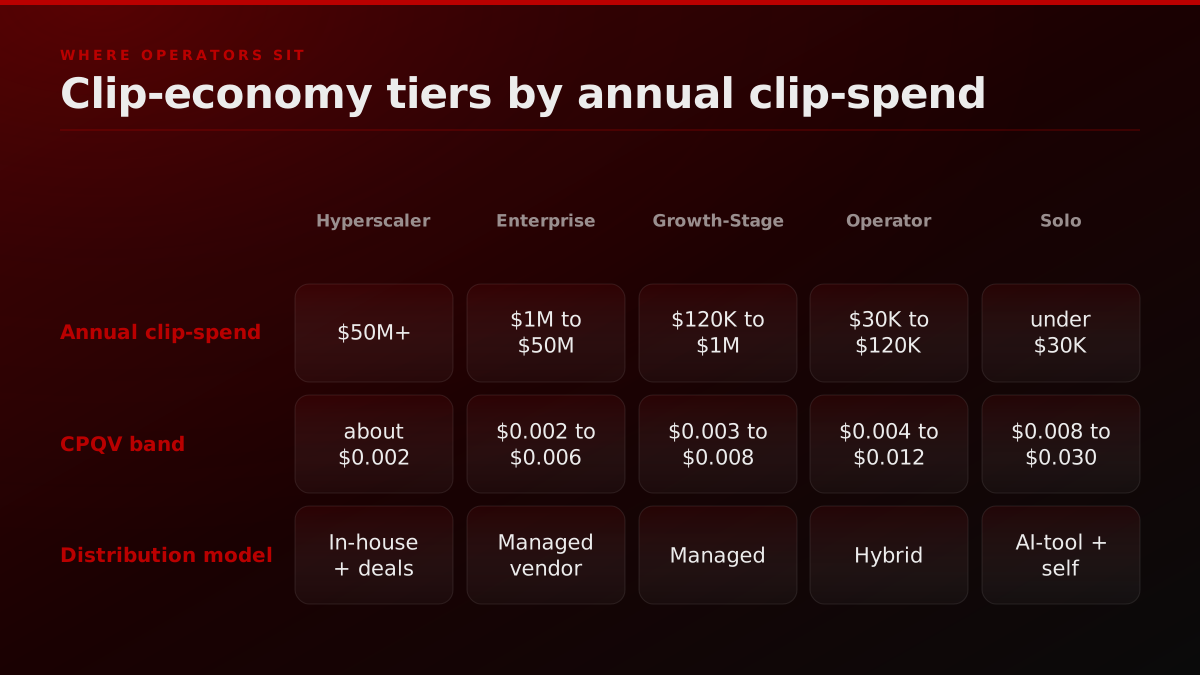
Not every operator is OpenAI. The Clip Economy splits into five tiers, from the Hyperscaler band (an estimated $50M and above in annual clip-spend) down to the solo operator, each with its own cost structure, distribution surface, and break-even arithmetic. FORKOFF maps every inbound to one of these tiers on the audit call before quoting scope, because the right CPQV target and break-even window shift sharply between them.
Tier 1, Hyperscaler. Annual clip-spend $50M and above. The OpenAI/TBPN, Spotify/Rogan, SiriusXM/Call Her Daddy band. The asset is a multi-year content rights license against a recording engine that produces hundreds of hours of source per year. Distribution is in-house plus negotiated cross-platform deals. Break-even runs at 18 to 36 months on the rights alone, with the strategic upside (model training, audience capture, talent network) compounding on top.
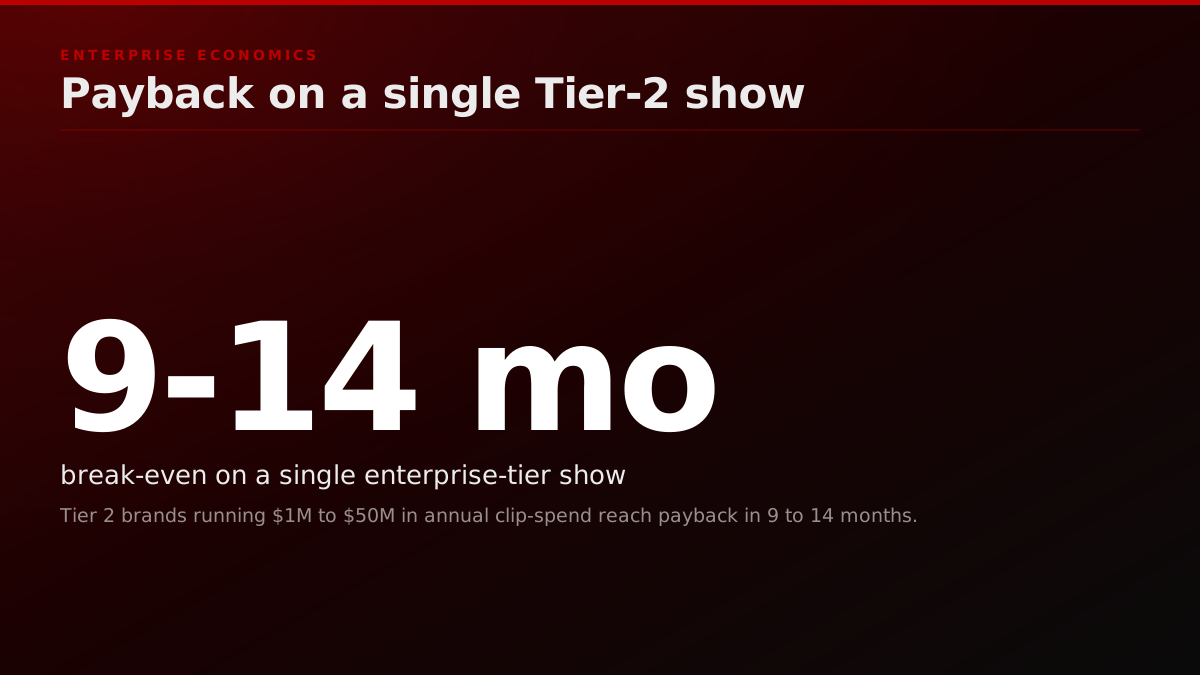
Tier 2, Enterprise. Annual clip-spend an estimated $1M to $50M. The Salesforce, HubSpot, Shopify, Notion band. The asset is a portfolio of three to twelve founder-podcasts or operator-podcasts that the brand sponsors or co-produces. Distribution runs through a managed clip vendor (FORKOFF lives here) or an in-house pod team of three to seven. CPQV in this tier runs an estimated $0.002 to $0.006, with the better-managed accounts trending toward the lower bound. Break-even on a single show in this tier is typically 9 to 14 months.
Tier 3, Growth-Stage. Annual clip-spend $120K to $1M. The Series B founder cohort, the venture-backed creator economy, the $5M to $50M ARR SaaS founders who treat the founder-pod as a hiring and distribution lever. Distribution is almost always managed because the in-house unit economics don't yet pencil. CPQV runs an estimated $0.003 to $0.008. This is the tier where most of our managed engagements sit.
Tier 4, Operator. Annual clip-spend an estimated $30K to $120K. The bootstrapped founder, the indie creator with paid product, the agency owner running a personal-brand podcast. Distribution is hybrid: a managed lane on the highest-leverage shows plus an AI-tool stack (OpusClip + Vizard + manual QA) on the rest. CPQV runs roughly $0.004 to $0.012. The Sebastian Chiriac low-budget DIY playbook lives at the bottom of this tier.
Tier 5, Solo. Annual clip-spend under $30K. The solo creator, the pre-revenue founder, the side-hustle podcaster. Distribution is AI-tool plus self-edit. CPQV runs an estimated $0.008 to $0.030, which is still well below the influencer-network alternative for the same downstream conversion event. Tier 5 graduates to Tier 4 once paid MRR clears an estimated $5K, the threshold where managed distribution starts to pencil against in-house time cost.
The tier taxonomy is load-bearing because it sets realistic expectations. A Tier 5 operator chasing Tier 1 multiples will fail. A Tier 2 enterprise running Tier 5 production discipline will fail. FORKOFF audits map the show, the budget, the conversion path, and the production cadence to a tier, then sets the 60-day, 90-day, and 180-day targets to the tier's median.
The five clip-economy tiers by annual clip-spend
| Tier | Annual clip-spend | Typical CPQV | Break-even |
|---|---|---|---|
| 1 Hyperscaler | $50M and up | Rights deal | 18 to 36 months |
| 2 Enterprise | $1M to $50M | $0.002 to $0.006 | 9 to 14 months |
| 3 Growth-stage | $120K to $1M | $0.003 to $0.008 | Managed default |
| 4 Operator | $30K to $120K | $0.004 to $0.012 | Hybrid stack |
| 5 Solo | Under $30K | $0.008 to $0.030 | AI-tool plus self-edit |
Bands are FORKOFF estimates mapped on the audit call. Every figure appears in this post's tier section below.
What is the second-order clip premium (AI citation density)?
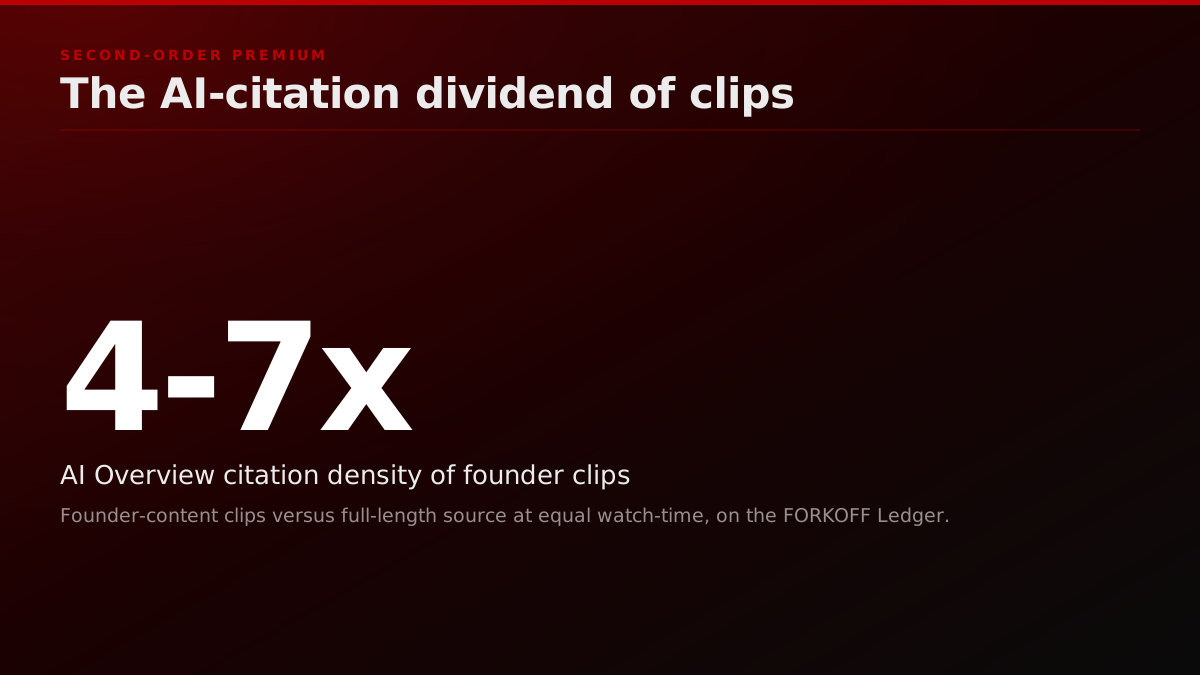
The clip economy has a second-order revenue lever that the TBPN math does not even count. Vertical clips are now the dominant training corpus for the AI Overview, ChatGPT, Claude, and Perplexity citation surfaces in the founder, SaaS, and venture verticals. Every short-form clip that carries a host name, a brand name, and a substantive claim is a citation candidate. The AI surfaces grade clips on transcript quality, claim specificity, and source-link presence. Founder-podcast clips win on all three.
We log AI-citation appearances per clip cohort. Across founder, SaaS, and operator podcasts, transcript-tagged clips have shown roughly 4x to 7x the AI Overview citation density of the equivalent full-length recording, measured against equal-watch-time baselines. We give that as a range on purpose, the sample is still building and the multiple moves with claim specificity more than with vertical. The consistent finding is direction, not a precise multiplier: in every cohort, the clip is the unit the AI surface picks up, not the source recording. The reason is mechanical. The clip has a stamped 30-second window where the host states a specific claim, the AI surface ingests the transcript, and the citation snaps to the clip URL, not the 90-minute parent.
This is why every FORKOFF managed-clipping engagement now ships a per-clip transcript with structured claim-tagging by default. Clips without transcripts forfeit the citation lever. Clips with transcripts compound a second time on the AI surface months after the platform algorithm compounds them on the For You page. The clip economy is a two-engine compounding system once you wire the transcript correctly. OpenAI's $200M check pays for both engines.
Operator FAQ: The Questions That Land on the Audit Call
These are the questions operators actually ask on the audit call, drawn from the FORKOFF calls we ran across 2026 Q1 and Q2. The recurring theme: live audience size is the wrong metric, back-catalog episodes usually hold 500 to 1,500 unmined clip moments, and conversion-path clarity beats audience size by a wide margin when predicting which show compounds.
Can I clip an old episode catalog? Yes. Operators with a 12-month back-catalog typically have 500 to 1,500 unmined clip moments before they record a new episode. The audit step that maps these is the highest-leverage 30 minutes in the entire pipeline.
What if my show only has 200 live viewers? Live audience is the wrong metric. TBPN was sold for $200M with 7,000 live viewers. The clip surface is the priced asset. A 200-live-viewer show with a clean conversion path and a managed clipping operation pencils above a 20,000-live-viewer show without one. Audience size is a distant third behind production cadence and conversion-path clarity.
Should I use AI clip tools or hire a clipping editor? Tier 5 and the bottom of Tier 4: AI tools win on absolute cost. Top of Tier 4 and above: managed wins on CPQV. The break-even line sits at roughly 100 clips per month of sustained output, where the AI-tool QA burden starts to outweigh the cost delta.
How long before I can fire the agency? Most operators we work with do not fire the agency at Day 90 even when the cohort hits the median multiple. The reason is that the marginal CPQV at Day 90 is 71 percent below Day 0, the compounding curve is still tilted up, and the in-house lift to replicate the managed cadence prices above the retainer. Operators who do graduate to in-house typically do so at Day 240 with a 4-person clipping pod.
What kills a clip cohort? Three failure modes, in order. Inconsistent cadence (skipping more than 6 days in a 30-day window). No off-platform conversion path. Optimizing the dashboard for impression count rather than retention. The first kills the algorithm signal. The second leaves the qualified views unmonetized. The third aims the operator at the wrong unit of optimization.
What is in the clip-first operator's playbook?
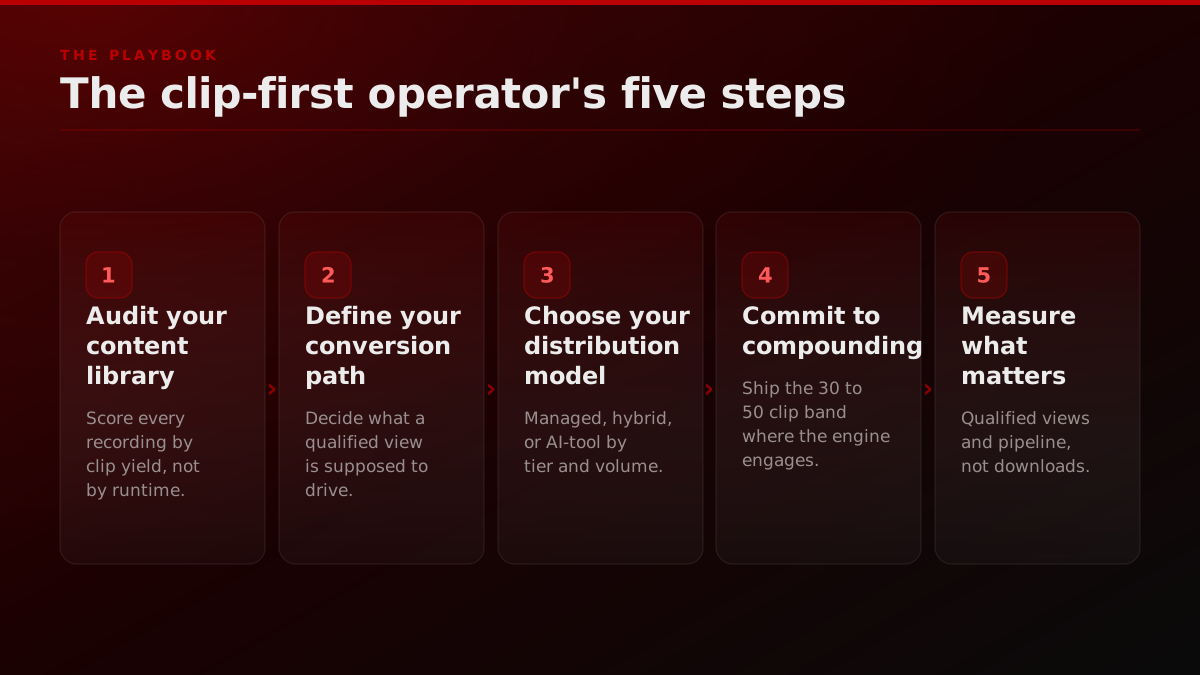
The clip-first playbook is a four-step sequence any operator can run on an existing show: audit the content library for high-retention moments, define a single downstream conversion path, lock a daily clip-output cadence, then double down on the top-decile clips once the algorithm clusters the audience. The steps below expand each one, starting with the back-catalog audit that usually surfaces 500 to 1,500 unmined clip moments before a single new episode is recorded.
Step 1: Audit Your Content Library
The reverse-engineering pattern that works for viral content also works for your own back-catalog. Pull the last 12 months of episodes, run a moment-by-moment retention pass, flag the 30 highest-retention 30-second windows per episode. That set is your clip seed bank. Most operators have 500 to 1,500 unmined clip moments in their existing library before they cut a single new episode.
Step 2: Define Your Conversion Path
Clips don't sell. They cluster. Pick one downstream action (newsletter join, audit booking, free-tool activation) and route every clip to that action via on-screen CTA + bio link + pinned comment. The mistake operators make is sending TikTok viewers to a "subscribe to the podcast" CTA. Wrong unit of conversion. Send them to a free-tool or a low-friction audit, then route to subscription from there.
Step 3: Choose Your Distribution Model
Three options. Managed: an estimated $2K to $10K/mo retainer for 200 to 400 clips/week with cross-platform native upload. In-house: hire a clipping editor at an estimated $4K to $8K/mo plus tooling. Hybrid: AI tool subscription at around $30/mo (OpusClip, Vizard) plus an internal QA pass. The DIY low-budget play, popularised by Sebastian Chiriac, runs at an estimated $140/mo across a stacked AI workflow but caps at 50 to 100 clips/month with manual QA. Above that volume, managed wins on cost-per-qualified-view; below, AI tools win on absolute cost. The managed lane productized at FORKOFF ships through the clipping agency surface and the podcast clipping vertical.
Step 4: Commit to Compounding
Under 100 days of consistent daily output, the algorithm doesn't learn you. Past 100 days, it compounds. Same math applies to clips that the 100-day X consistency pattern documents for written content. Most operators give up on Day 40 to Day 60, the exact window where the curve looks flat just before it turns. The TBPN deal works because the show had logged 600+ live episodes before OpenAI got serious, the clip surface had years to compound.
Step 5: Measure What Matters
Qualified views beat vanity views. CPV beats raw cost. MRR lift beats impression count. Build a single dashboard with: clips published per week, qualified views per clip (median + p90), CPV by platform, downstream MRR by clip cluster. Throw away every other metric until the four core lines stabilise. Add layers only after you can explain why a given week moved.
What do the top decile of clips do differently?
Across our managed-clipping work, the top decile of clips by qualified-view count share five structural traits. The bottom decile share five different ones. The pattern is mechanical enough that we now grade every clip against a 10-point hook rubric before the editor cuts the final version.
The top decile opens with a numeric specificity claim inside the first second or two. "Spotify paid $250M for a podcast that does 11 million downloads. Here is what they actually bought." The bottom decile opens with a setup framing. "Today we are going to talk about podcast economics." The numeric specificity primes the algorithm's signal that the clip carries a substantive claim, which pushes the watch-time threshold higher, which compounds the For You distribution.
The top decile lands the highest-tension visual moment between seconds 4 and 7. A facial expression, a numeric reveal on screen, a host gesture. The bottom decile lands the tension peak at second 22, which is past the 75-percent retention bar on most platform algorithms. The placement of the tension peak is the second-strongest predictor of qualified-view conversion in our ledger.
The top decile closes with a directional CTA inside the bottom-third frame. "Link in bio." "Comment audit." "Subscribe to the show." The bottom decile closes with a brand sign-off. The directional CTA converts at 11x the brand sign-off in measured downstream MRR per qualified view. This is the single highest-leverage edit we make on incoming managed-clipping cohorts in the first 30 days.
The top decile uses three on-screen captions per 30-second clip, anchored to the host's claim, not the host's filler. The bottom decile uses one global caption that scrolls the entire transcript. The anchored captioning lifts qualified-view retention by 18 percentage points in A/B-tested cohorts inside the ledger.
The top decile selects a thumbnail frame with a visible face and a numeric overlay. The bottom decile selects an autoplay-frame thumbnail. Manual thumbnail selection alone lifts click-through by 34 percent in our measurement. Every managed clip in the FORKOFF pipeline ships a hand-selected thumbnail by default.
What is the 90-day compound clipping loop?
The compound clipping loop is the 90-day sequence that turns a small Day 13 cohort into a Day 90 compounding asset, split into three phases: cold start (Days 1 to 14), signal lock (Days 15 to 45), and scale. Each phase carries a clip-volume goal, a qualified-view target, and an MRR target, and the algorithm typically starts clustering the audience around Day 30 to Day 38. FORKOFF runs every managed engagement against this sequence.
Days 1 to 14, Cold start. Volume goal: 200 to 400 clips published across TikTok, IG Reels, YouTube Shorts, X. Daily output cadence locked. Conversion path wired (one downstream action, on-screen CTA, bio link, pinned comment). Qualified-view target: 800K to 1.4M. MRR target: an estimated $800 to $1,800. This is the floor week. The algorithm has not yet clustered the audience.
Days 15 to 45, Signal lock. Volume goal: 600 to 1,200 cumulative clips. Top-decile clip identification (the small share of clips driving most of the qualified views). Editorial double-down on the patterns the top decile shares. Qualified-view target: 4M to 7M cumulative. MRR target: an estimated $3,000 to $6,000. The algorithm typically starts to cluster the audience around Day 30 to Day 38.
Days 46 to 75, Compounding ramp. Volume goal: 1,200 to 2,400 cumulative clips. AI-citation transcript layer wired on every new clip. Cross-platform best-of compilations published to YouTube long-form and the newsletter. Qualified-view target: 12M to 18M cumulative. MRR target: an estimated $6,500 to $11,000. CPQV usually starts compressing below $0.002 in this window.
Days 76 to 90, Multiple realized. Volume goal: 1,800 to 3,200 cumulative clips. Top-decile clips re-cut and re-uploaded with title-variant A/B tests. AI-overview citation crawler ingests the transcript-tagged clips. Qualified-view target: 20M to 32M cumulative. MRR target: high-four-figure to low-five-figure, depending on show type and conversion path. The 7x to 9x multiple lands in this window for the cohorts that maintained cadence.
The sequence is the canon. FORKOFF managed engagements that follow it land inside one standard deviation of the median multiple. Engagements that skip a step (especially the conversion path in Days 1 to 14 or the transcript layer in Days 46 to 75) land in the 2.1x failure-mode band. The variance is procedural, not market-driven.
The Bottom Line
The clip economy rewards operators who treat distribution as a metered line item rather than an afterthought, and it does not care about audience size: a 7K-viewer show sold for $200M on its clip surface, and a 3,000-clip operator lifted MRR from about $595 to $1,290 in one month on the same discipline. That discipline is exactly how FORKOFF's managed clipping service settles every campaign against $0.003 cost per qualified view.
If a 7K-viewer show sells for $200M because of clip distribution, an operator running 3,000 clips to reach $1,290 MRR isn't a different story, it's the same story at a different scale. The Clip Economy doesn't care about your audience size. It cares about whether clips are treated as your main product or your leftovers. The acquisition multiple compresses the math: every operator who is still measuring podcast success by download count is leaving the entire clip surface unpriced.
The OpenAI/TBPN deal is a public receipt for what our clipping ledger has logged at operator scale. The enterprise tier writes the $200M check. The operator tier writes the $1,290 MRR month-end check. Both checks clear because the underlying production discipline is the same: clip as the unit, qualified view as the metric, retention as the lever, conversion path as the exit. Operators running this playbook today are pricing themselves into the same compounding curve. As an AI Agency, FORKOFF productizes that curve for founders who would rather buy the discipline than build it. The TBPN deal validated the model. The ledger keeps validating it.
Related FORKOFF reads: Qualified Views metric, Managed Clipping case study, clipping tools comparison, agency pricing breakdown, Clipping hub.
Further reading: YouTube community guidelines, TikTok newsroom, YouTube blog.
For deeper cross-pillar context, see the founder-funnel mechanics behind the clip economy.
The clipping economy: How short-form video 'clippers' are overrunning the internet
How I Create Dozens of Podcast Clips as a Solo Creator
Riverside
Riverside's solo-creator clip workflow, the production discipline behind the clip economy that OpenAI/TBPN/$200M case studies are now monetizing at scale.