A Qualified View is a video watch that holds to at least 75% completion, comes from an algorithm-matched audience cluster, and lands on a surface where the viewer can act on what they watched. It is the only short-form metric that maps to pipeline. Impressions measure render events. Qualified Views measure attention events. The CPQV framework in this post turns that into a qualified views metric and shows how to compute the difference and reinvest accordingly.
The one metric that actually predicts pipeline
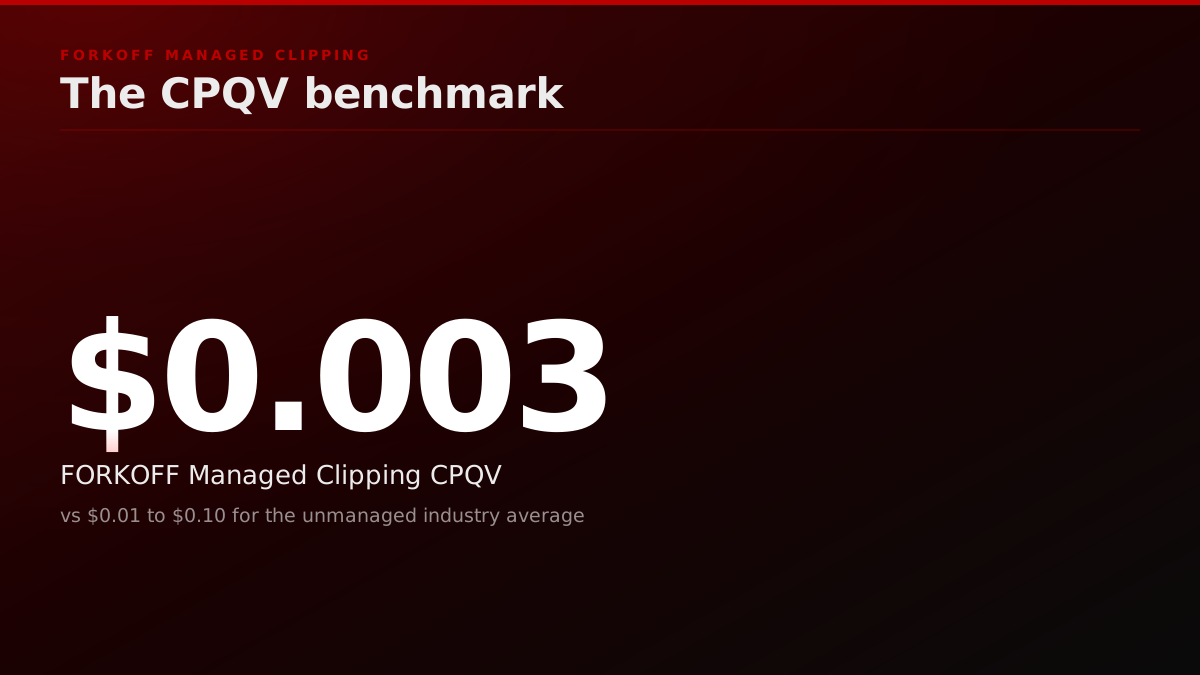
Impressions are theatre. Qualified Views : a watch held to ≥75% by an algorithm-matched viewer : is the unit that maps to pipeline. The Qualified Views Audit (QVA) is a 4-step measurement loop: baseline CPV, segment by hook type, filter by hold rate, reinvest into the top cohort. On our Managed Clipping roster we ship $0.003 CPQV; the industry average sits 3-30x higher. This post is the playbook.
Impressions are not a content metric. They are a billing line.
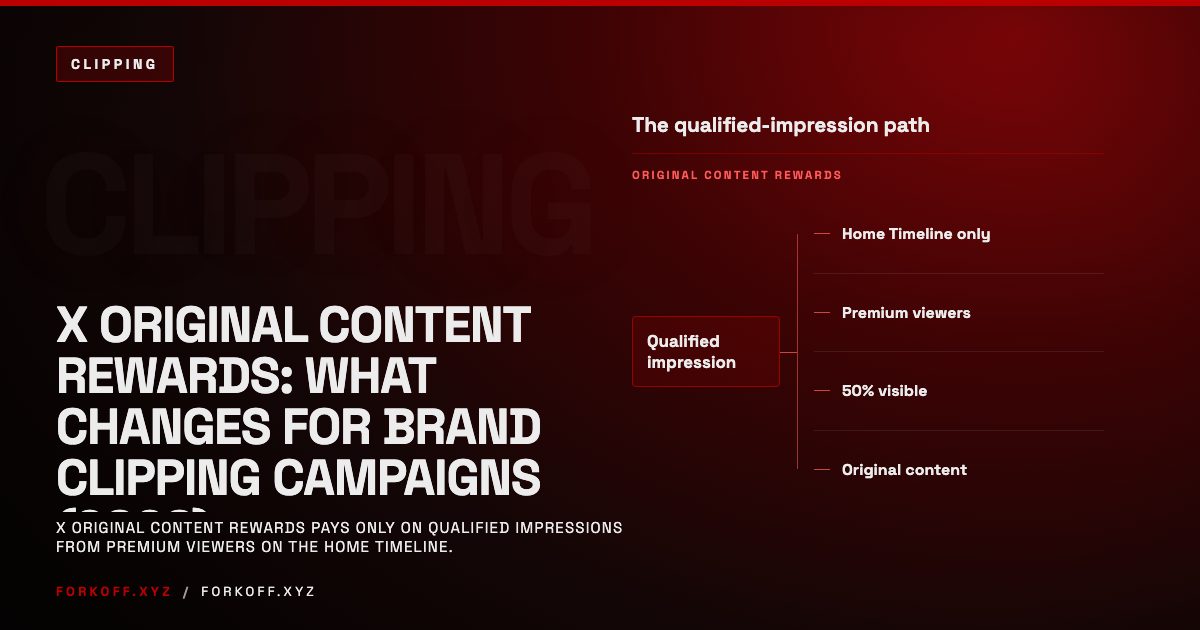
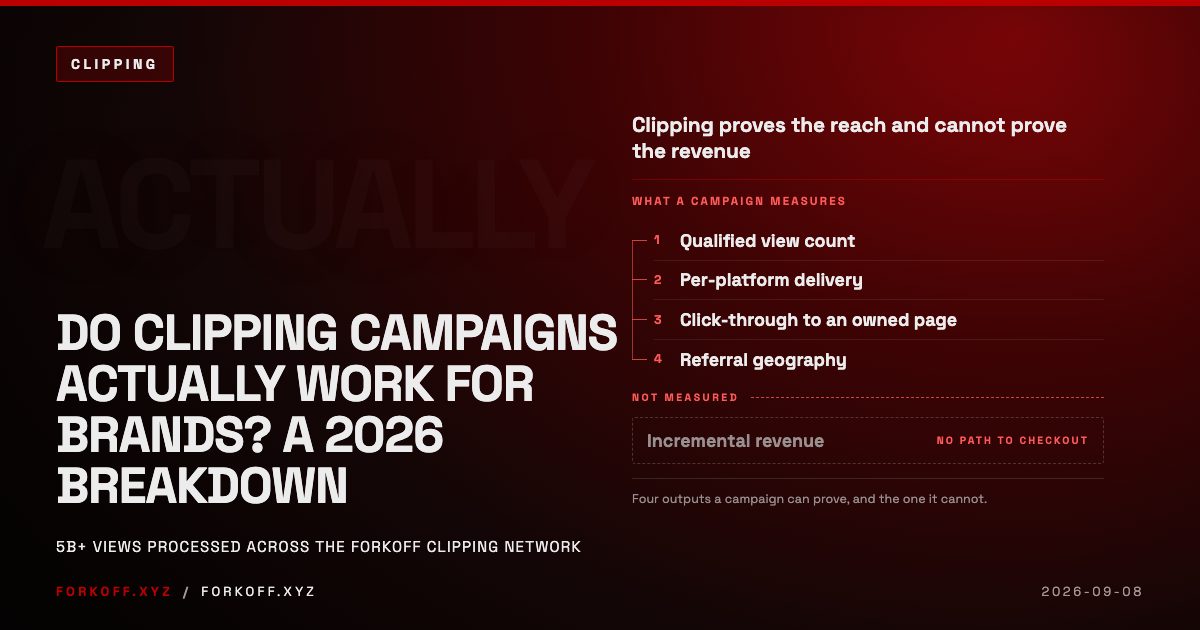
Impressions count every render event regardless of whether the viewer held attention, matched the audience cluster, or had any chance of converting to a pipeline event. That is why a team can post 14M cumulative impressions and see zero traceable inbound deals. This is also why traditional creator metrics like raw YouTube subscriber count under-predict pipeline impact once a clipping engine runs across platforms. The data is in the 20K-YouTube-subs-meaningless analysis. The same distinction decides whether clipping campaigns actually work for brands, because a campaign billed on impressions and one billed on qualified views are not the same purchase. X made the same move at the platform level, where qualified impressions under Original Content Rewards now decide the payout.
Creators who live off these numbers say the same thing:
Tayo Aina
@tayoainafilms
YouTube is not even about subs. That’s just a vanity metric we all celebrate. It’s about views and how impactful they are. What stories are you telling and how do they make people feel. There are dead channels with 1M subs.
A podcast publishes a clip. The clip earns 400,000 impressions. The host opens the dashboard, sees the number, and feels great.
Two months later, that same dashboard says 14M cumulative impressions and the host's CRM shows three new inbound deals : which they cannot trace back to any specific clip. The growth team congratulates itself for scaling content. The CFO quietly cuts the budget the next quarter.
This pattern repeats so often it has become the default operating mode of every short-form content team we audit. And the root cause is that almost nobody on the operator side has separated impressions (the vendor's KPI) from qualified views (the only KPI that has any business mapping to pipeline).
The same gap shows up in the wild constantly. Here is a podcaster in r/podcasting with a clip that cleared 1M organic views on Instagram while the show itself pulls roughly 150 listens per episode:
How do I get people to listen to my full podcast?
If you sell ads against a podcast, impressions are revenue. If you grow a brand off a podcast, impressions are a cost center disguised as a metric.
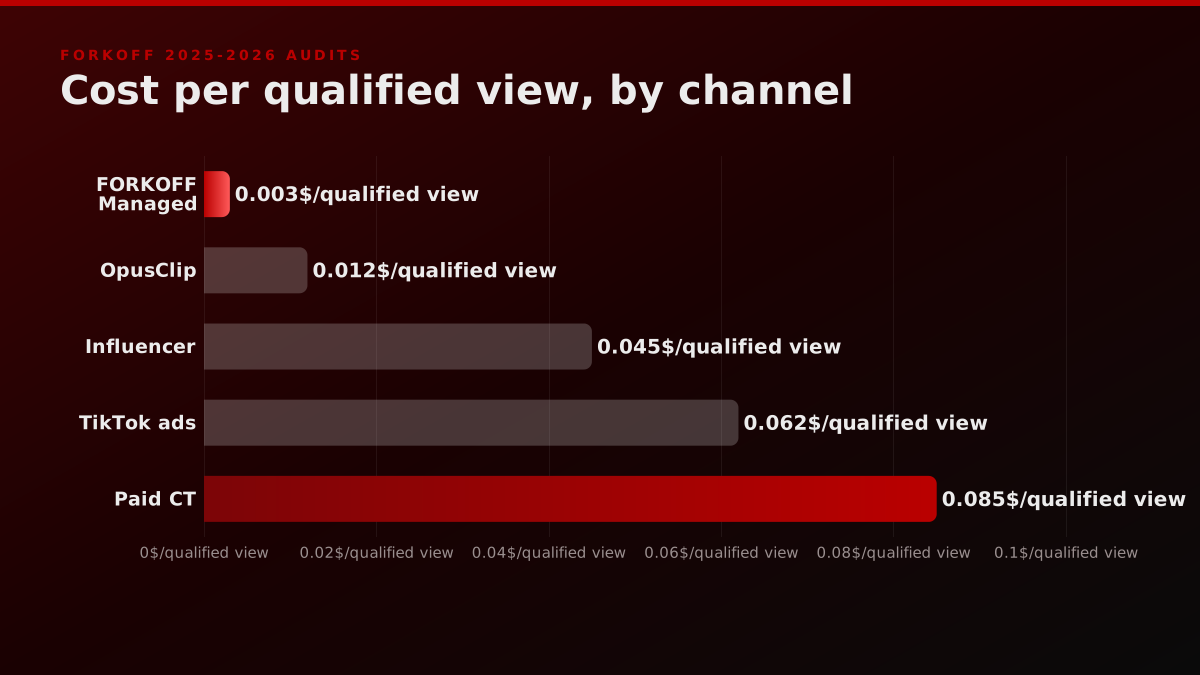
$0.003 vs $0.085 : the order-of-magnitude gap nobody is auditing
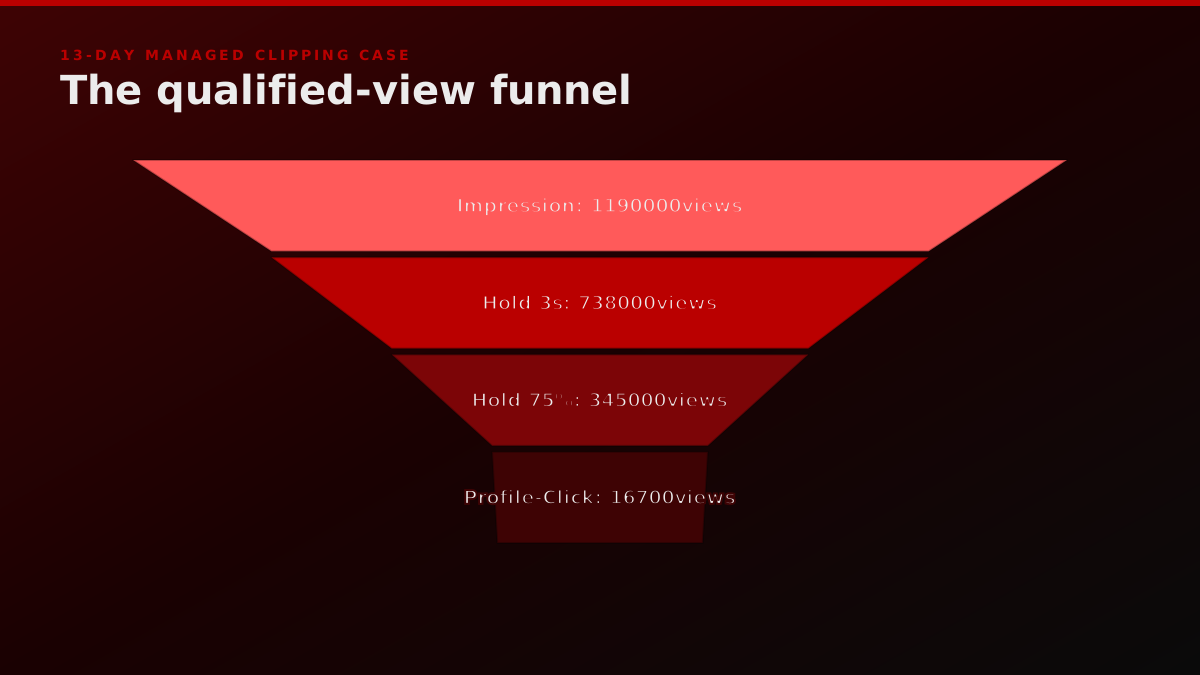
On a 13-day Managed Clipping case for a crypto-finance podcast, FORKOFF shipped 3,085 clips that compounded into 1.19M views at a blended CPV of $0.003. Across eight separate retainer audits we ran in 2025-2026, the unmanaged industry average for paid clipping sat between $0.01 and $0.10 per qualified view : most teams are paying 3x to 30x more for the same unit, because their own internal metric is impressions, not qualified views. TikTok's own Creator Portal is explicit: a clip held to 75%+ completion is preferentially re-promoted by the recommendation system, often at 4x the velocity of a comparable clip with the same impressions but a 35% hold. Descript's 2025 State of Short-Form report puts the median auto-clipped hold rate at 42-58%. The gap between average and great is exactly where pipeline lives.
Source: FORKOFF Managed Clipping case + audits 2025-2026; TikTok Creator Portal; Descript 2025 State of Short-Form
What is a Qualified View?
A Qualified View requires three simultaneous properties: the viewer must hold to at least 75% completion, the view must come from an algorithm-matched topical feed cluster, and the viewer must be on a surface where they can act on the clip. Miss any one property and the view is noise, not signal. On the labor side of the same qualified-view economics, how much clippers earn in 2026 breaks down what clippers themselves bring home in each contract lane.
- Hold ≥75%. The viewer watched at least three-quarters of the clip. On a 45-second clip that is ~34 seconds of held attention. Below this threshold, the algorithm itself does not treat the view as a signal of relevance.
- Algorithm-matched audience. The view came from a feed where the recommendation system thinks the viewer matches the clip's topical cluster. Paid boost, off-cluster reposts, and bot traffic all fail this test (the 3-layer bot detection system documents exactly how FORKOFF separates real cohort views from data-center proxies, pod-farming bursts, and platform-side filtering gaps).
- Profile-touch potential. The viewer is on a surface where they can act on the clip : visit the profile, follow, click a bio link, search the brand. A view inside a backgrounded autoplay tab does not qualify.
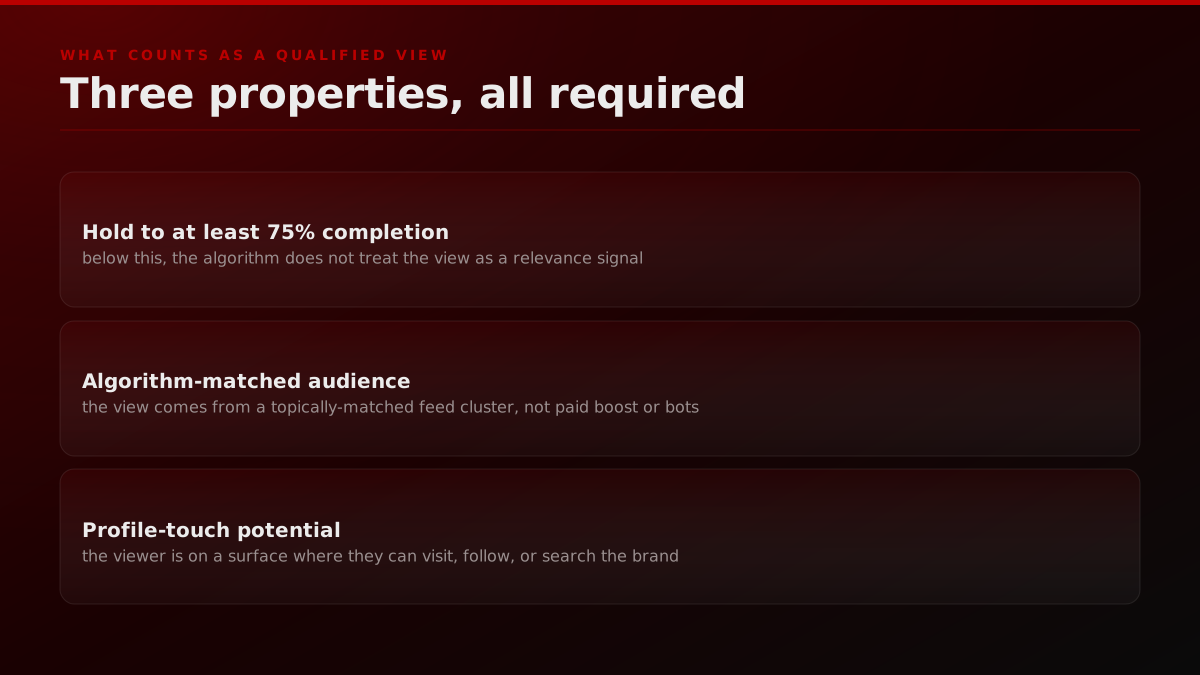
The three properties together are why qualified views correlate with pipeline and impressions don't. An impression is a render event. A qualified view is a render event paired with attention, intent surface, and algorithmic endorsement. Three orders of magnitude more expensive to produce. Three orders of magnitude more predictive of action.
The CPQV math, written out long-form
Cost per qualified view (CPQV) is the entire economic unit of a clipping engine. Operators who skip the formula end up reporting one of two flattering numbers: cost per impression (which makes any vendor look good) or cost per follower (which doesn't pay rent because a follower without retention is a sunk cost). CPQV sits between the two and reflects the actual economic transfer happening when a clipper produces an asset.
The formula is one line:
CPQV = (production_spend + distribution_spend + retainer_fees) / qualified_views_produced
The numerator is non-negotiable. Every cost the clipping operation incurs goes in: clipper labor, agency retainer, editor hours, paid boost, captioning software, asset hosting, project-management overhead. Operators who exclude retainer fees from the numerator are running a CPQV calculation that lies by 20-40 percent on the low side.
The denominator is where the discipline lives. A qualified view must satisfy all three properties (hold, matched audience, action surface). On the FORKOFF Clipping Ledger (n=3,085 clips shipped on a 13-day Managed Clipping case), the campaign ran 1.19M views at a CPQV of $0.003. That number is the operating benchmark we contract against on every Managed Clipping retainer that ships through forkoff.xyz. The full ledger behind that figure, broken down by platform and content niche, is in the FORKOFF CPQV benchmark study, one of several first-party operator data studies catalogued in FORKOFF Research.
Three calibration notes on the math:
- The 75% hold threshold is empirical, not aspirational. TikTok's Creator Portal documents that completion is the highest-weighted re-promotion signal. Independently, Vidyard's State of Video shows comprehension and recall both inflect sharply at the 75-80% completion band. Below it, the clip is a render event. Above it, the clip is an attention event.
- Algorithm-match is the trickiest property to verify. Platform-native analytics report watch time but rarely tell you whether the viewer came from a topically-matched feed cluster. FORKOFF's 3-layer bot detection canon (data-center IP filtering, pod-farming burst detection, platform-side proxy correlation) was built specifically to throw out views that look like 75%-hold qualified views but are actually purchased traffic that inflates the denominator and crashes CPQV math without crashing pipeline math.
- Action-surface is binary. Either the viewer is on a surface where they can click profile, follow, search the brand, or tap a bio link, or they are not. A view from a backgrounded autoplay tab, an embedded player on a third-party site, or a passive-mute scroll during a workout fails this test. The platform does not always tell you which views these are; the QVA infers it from the gap between view count and profile-click rate.
None of these thresholds are FORKOFF inventions. The published attention research from 2025-2026 keeps landing on the same conclusion from independent directions:
What published attention research actually measured, 2025-2026
| What was measured | Published finding | Source |
|---|---|---|
| Completion vs likes | A 15-second video at 80% completion consistently outperforms a 60-second video with thousands of likes at 16% completion | DataSlayer TikTok algorithm guide, Dec 2025 |
| Watch-time distribution multiplier | Videos holding 15-20 seconds of average watch time earn roughly 3x more algorithmic distribution, regardless of like counts | DataSlayer TikTok algorithm guide, Dec 2025 |
| Invalid traffic baseline | 18.12% IVT across a sample of 26.3 billion ad impressions in Q1 2026, roughly 1 in 5 impressions, down from 20.64% for full-year 2025 | Fraudlogix Ad Fraud Stats, Q1 2026 |
| Podcast viewing shift | 53% of new US weekly podcast listeners prefer watching a podcast | Cumulus Media and Signal Hill Insights, Oct 2025 |
| Where podcasts get consumed | YouTube is the most-used podcast platform for 42% of US monthly listeners, vs 15% for Spotify and 7% for Apple Podcasts | Cumulus Media Fall 2025 Podcast Download Report, via Backlinko |
Every row is a published, third-party number. None of them count render events; all of them count held attention or audited traffic. That is the direction the whole measurement stack is moving.
The order-of-magnitude gap between FORKOFF Managed Clipping at $0.003 CPQV and the unmanaged industry average of $0.01-$0.10 CPQV is not a creative gap. It is a measurement gap. Calculate your own CPQV against the $0.003 benchmark before your next briefing to see whether your current campaign is in the gap. Operators who do not run the QVA cannot tell which of their clips produced qualified views and which produced impressions. They reinvest editorial budget into the wrong cohort. CPQV stays stuck at approximately $0.04-$0.10 not because the clippers are weak but because the brief is being optimized against the wrong denominator.
Why do impressions feel like progress when they are not?
There is a behavioral reason impressions persist as a headline metric despite three years of post-impression discourse. Impressions go up monotonically. Every clip ships, every clip earns some non-zero render count, every weekly report shows the cumulative impression line bending upward. The chart looks like a flywheel.
Qualified views do not behave the same way. A bad cohort produces clips with an estimated 50-65% hold rates and the qualified-view count for that week is materially lower than the impression count would predict. A clipper who optimizes against impressions is rewarded weekly. A clipper who optimizes against qualified views is occasionally punished by reality, then rewarded compoundly when the editorial brief shifts.
Operators who report impressions to leadership are buying a quarterly cliff. Six to nine months in, the CFO asks where the revenue is, the marketing team points at the impression line, the CFO points at the CRM, and the budget gets cut because the two numbers do not correlate. The story collapses not because the work was bad but because the metric was load-bearing on the wrong variable.
Founders who run the math in public reach the same conclusion:
Sherry Jiang
@SherryYanJiang
hot take: tiktok views are just a vanity metric i'd take a 10K-view video driving 200 downloads over a 1M-view viral flop driving 100, ANY DAY optimize for conversions, not views.
Operator noteReport CPQV and profile-click rate from week one, while the numbers are ugly. A metric introduced after the CFO's revenue question is dead.
Reporting CPQV from week one forces the team to deal with the reality of the curve up front. The number is uncomfortable on day one and improves by day 30. By day 60 the team has a working flywheel they can defend to the CFO with a regression line, not a vibe. The macro case for why CPQV is the metric that prices a clip surface, the one that explains OpenAI's $200M TBPN acquisition, runs on the exact denominator discipline above.
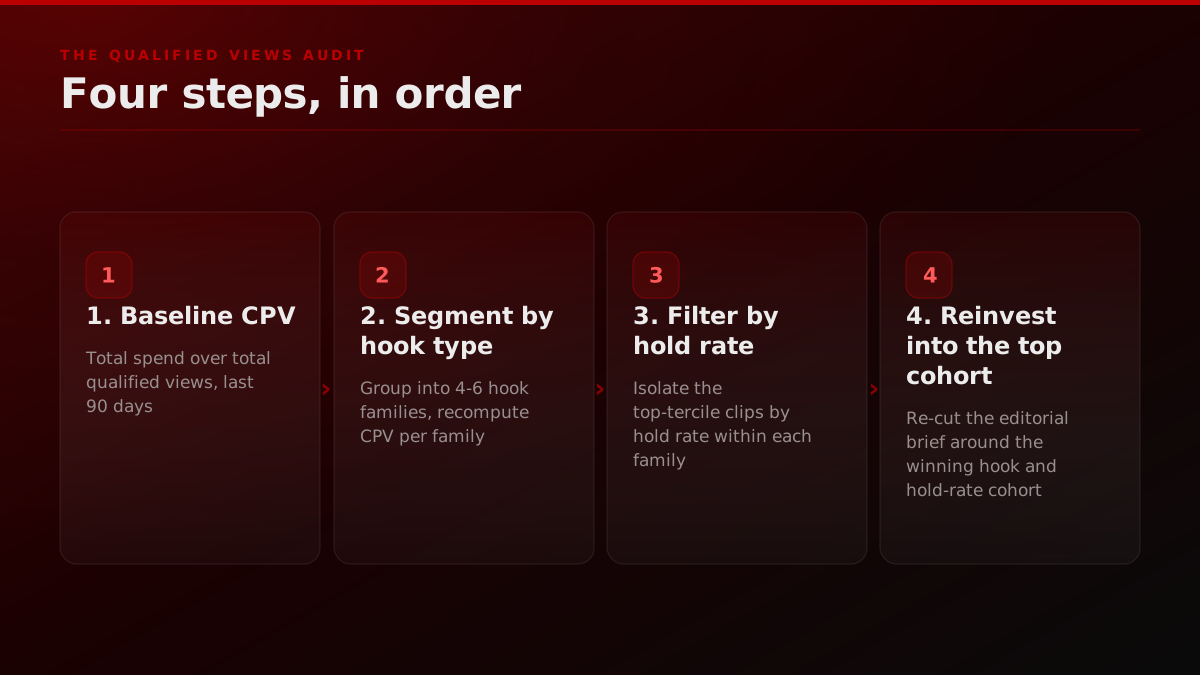
The Qualified Views Audit (QVA) : the 4-step framework
The QVA is the framework we run on every clipping engagement before we cut a single new clip. It exists because the question is your content working is unanswerable until you have a measurable unit. The QVA gives you that unit.
The four steps run in order. You cannot skip ahead, because each step depends on the segmentation produced by the one before it.
- Baseline CPV. Pull the last 90 days of clips. Compute total spend (production + distribution + retainer fees) divided by total qualified views. This is your starting CPV. Most operators see a number in the $0.04-$0.10 range and visibly flinch.
- Segment by hook type. Group every clip into 4-6 hook families (named teardown, contrarian-claim, on-screen-data, founder-confession, etc.). Recompute CPV per family. The variance between best and worst hook family is typically 5-10x.
- Filter by hold rate. Within each hook family, isolate the top-tercile clips by hold rate (≥75%). These are your qualified-view producers. Everything below median hold rate is, by definition, not contributing to the qualified view count : it is contributing to your impression count, which is exactly the metric you are trying to retire.
- Reinvest into the top cohort. Re-cut your editorial brief around the top hook family + top hold-rate cohort. Run for 30 days. Recompute CPV. The expected lift on a clean QVA pass is 3-8x : meaning your CPV drops from $0.04 to approximately $0.005-$0.013, and your downstream profile-click rate moves with it.
The QVA is not a one-time exercise. The cohorts shift as the audience matures and as the algorithm's preferences drift. We re-run the QVA quarterly on every retainer engagement.
Stage 1 : Baseline CPV
The first run of the QVA is almost always the most uncomfortable. The operator opens the spreadsheet, divides total spend by total qualified views (not impressions), and sees a number that does not match the story they have been telling internally.
The baseline number matters less than the act of producing it. Once a number exists, every subsequent decision can be measured against it. Without the number, the team is optimizing against feelings.
Two practical notes: include all costs (editor time, agency retainer, paid boost, repurposing tooling) and use a 90-day window : shorter windows over-weight a single viral hit, longer windows hide recent algorithmic shifts.
Stage 2 : Segment by hook type
Hooks are the primary driver of CPV variance. Two clips from the same podcast, same length, and same publication day can vary 10x in CPV based solely on the hook in the first 1.5 seconds. Segmenting by hook family is what surfaces that variance so the editorial brief can be rewritten around the families that actually produce qualified views.
Name your hook families with literal descriptive labels (contrarian-claim, data-shock, founder-confession) rather than abstract creative-brief language. The point of the label is to make the family reproducible by your editor in next week's batch.
The typical pattern: one or two hook families produce 60-80% of the qualified-view yield. Most teams are over-investing in three to four families that are simply not earning their CPV.
Stage 3 : Filter by hold rate
The 75% hold-rate threshold is not arbitrary. It is the line at which the major short-form algorithms (TikTok, YouTube Shorts, Instagram Reels) begin re-promoting the clip into adjacent feeds. Below 75% the clip stays in its first cohort. Above 75% the clip enters a multi-cohort distribution that compounds qualified views at a steeply lower marginal cost.
Videos that consistently hit 15-20 second average watch time receive approximately 3x more algorithmic distribution compared to videos with lower retention, regardless of like counts.
The platform-native name for the input behind hold rate is average view duration. If the concept is new to your team, this short explainer covers the metric the whole threshold is built on:
What is Average View Duration on YouTube? (AVD Explained)
Think Media
Think Media's explainer on average view duration, the platform-native metric that the 75% hold threshold is built on.
This is also the line at which a viewer is statistically likely to remember the clip's source : the brand, the host, or the podcast. Below 75%, recall collapses. Above 75%, recall and follow rates both climb sharply.
Filter ruthlessly. A clip below approximately 50% hold rate is, in the QVA framework, a negative-value asset: it consumed your editor's time without producing a qualified view, and it occupies a slot in the audience's feed that could have been filled by a top-cohort clip.
Stage 4 : Reinvest into the top cohort
Reinvestment is the step most operators skip, because it requires killing favorites. The clip series the team is emotionally attached to may not be in the top cohort. The hook family the host enjoys recording may be the lowest CPV producer on the roster.
The QVA forces a binary: keep what produces qualified views, kill what doesn't. Sentimentality is a CPV tax.
A good reinvestment pass moves the editorial brief, not just the clip mix. The brief now reads: open with this hook family, structure around this proof type, target this duration band, optimize the on-screen text for this completion pattern. The brief is the asset; the clips are its output.
Operator notePut the 75% hold threshold in the clipper's brief, not the retro deck. An editor can only cut toward a target given before the clip ships.
The 3-layer bot detection that protects the denominator
The denominator in the CPQV equation only works if every view in it is a real human view from a topically-matched feed cluster. The single largest source of CPQV error in unmanaged clipping operations is the inclusion of non-qualified views (bots, pod-farming bursts, paid-boost spillover) in the denominator, which makes CPQV look better than it is and breaks the link between qualified views and pipeline.
Roughly 1 in 5 impressions is invalid before you count anything
Fraudlogix detected an invalid traffic rate of 18.12% across a sample of 26.3 billion ad impressions in Q1 2026, down from 20.64% for full-year 2025 but still roughly one in five impressions showing signals of fraudulent or non-human activity. That number is measured on paid inventory, where detection budgets are largest; unaudited organic view counts have no equivalent filter unless the operator builds one. This is why the QVA treats the denominator as guilty until audited: a CPQV computed on a raw view export inherits whatever share of that traffic was never a human in the target cohort.
Source: Fraudlogix Ad Fraud Stats, Q1 2026
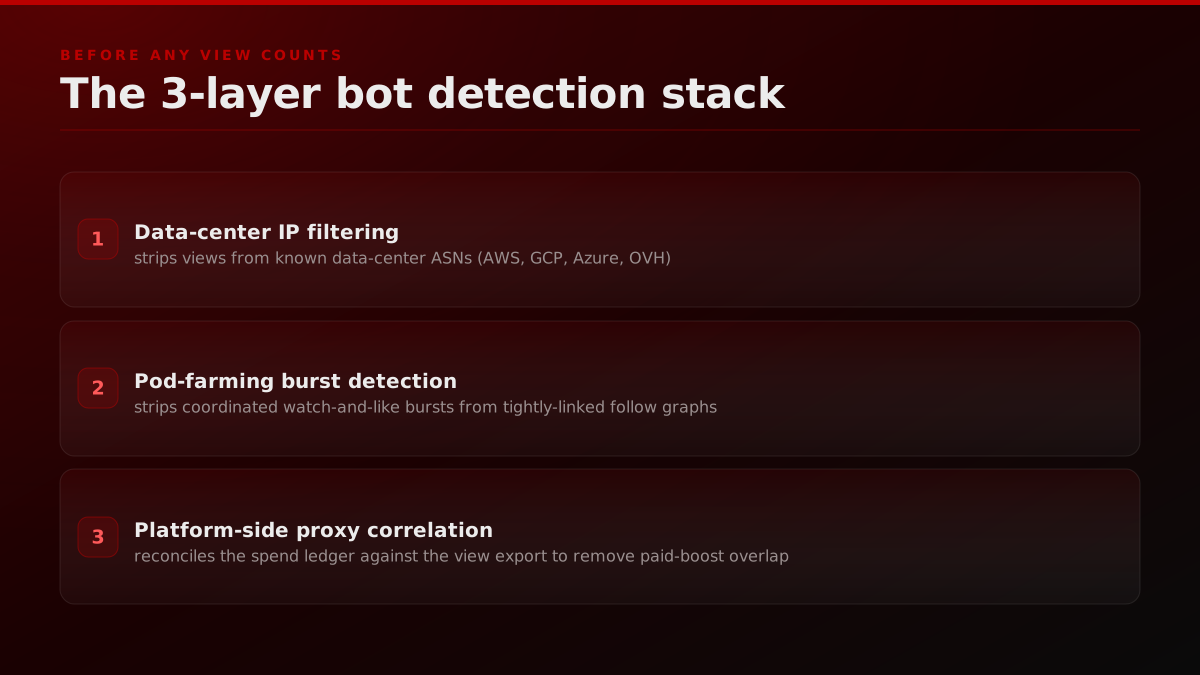
FORKOFF runs every Managed Clipping engagement through a 3-layer detection stack before any view is counted toward the denominator:
- Layer 1: data-center IP filtering. Views originating from known data-center ASNs (AWS, GCP, Azure, OVH, Hetzner residential blocks flagged as proxy-friendly) get stripped. The typical filter rate on an unprotected campaign is 2-6 percent of total impressions; on campaigns where the host previously paid for low-quality engagement, the rate climbs to 18-22 percent.
- Layer 2: pod-farming burst detection. Engagement pods coordinate watch-and-like behavior to game algorithmic re-promotion. The signature is a 60-180 second window of high-velocity engagement from accounts whose follow graphs intersect at greater than 8 percent. We strip these on a sliding window basis. Detection rate runs 1-4 percent on organic campaigns and 9-14 percent on campaigns that were running pod boosts before FORKOFF took over.
- Layer 3: platform-side proxy correlation. Some views look organic in the platform analytics export but correlate (within the same hour) with paid-boost spend on a third-party tool. We reconcile the spend ledger with the view spike and remove the overlap. This is the layer most clipping shops never run, because it requires the spend ledger and the view export to be in the same audit ledger.
Operator noteAsk any clipping vendor for their rejected-view count before funding. No rejected views means no denominator audit, and a fictional CPQV.
After the 3-layer pass, the denominator that goes into the CPQV calculation is meaningfully smaller than the raw export. The share stripped out is the gap between a CPQV story that survives a CFO audit and one that does not.
Where does CPQV beat CPM, and where does it not?
CPM (cost per thousand impressions) is the canonical paid-media unit. It works for paid display, programmatic video, and out-of-home buys where the impression itself is the product being sold. CPM does not work for owned-and-operated clipping engines, because the impression is not the product. Pipeline is the product.
CPQV is purpose-built for owned content surfaces:
- Podcast clipping engines (every Managed Clipping engagement at FORKOFF).
- Founder-led short-form on X, LinkedIn, and TikTok where the founder's brand is the asset.
- Repurposed long-form (YouTube to Shorts, webinar to Reels, conference talks to TikTok).
- Owned community content (Discord clips, livestream highlights, AMA pulls).
In all four cases, the view is a means to a pipeline event. The denominator in CPQV reflects only the views that have a non-zero probability of producing the pipeline event. CPM, in those same surfaces, reflects every render event whether or not it had any chance of producing pipeline.
Podcast consumption moved to the watch surface
The action-surface property of a qualified view stopped being theoretical in 2025. Per the Cumulus Media and Signal Hill Insights Fall 2025 Podcast Download report, 53% of new US weekly podcast listeners now prefer watching a podcast rather than only listening, and YouTube is the most-used podcast platform for 42% of US monthly listeners, against 15% for Spotify and 7% for Apple Podcasts. The clip surface and the podcast surface are converging into the same feed. A qualified view earned on YouTube is one profile-click away from the full episode, which is exactly why the action-surface condition belongs in the definition: the surfaces where podcasts are actually discovered are the surfaces where the viewer can act.
Source: Cumulus Media + Signal Hill Insights Fall 2025, via Backlinko podcast statistics
CPM is still the right metric for one specific surface: paid acquisition where the product being sold is the impression itself. If a clipping campaign runs as a paid layer (TikTok Spark Ads, YouTube Shorts ads, Meta in-feed promotion), the CPM is the rate card and CPQV is the diagnostic that tells you whether the rate card is producing pipeline. The two metrics co-exist in a paid context; in an organic context, CPQV stands alone.
What does good look like at each stage of CPQV maturity?
Operators moving from impressions to qualified views progress through four maturity stages. Each stage has a target CPQV and a target profile-click rate. Knowing where you are on the curve prevents the most common mis-investment: expecting day-60 economics on day 10.
- Stage A (days 1-15, calibration): CPQV an estimated $0.03-$0.06. Profile-click rate 0.5-0.9%. Hook families are being seeded. The team is learning which formats hold viewers past 75%. The metric to watch is variance across hook families, not absolute CPQV.
- Stage B (days 16-45, first reinvestment): CPQV an estimated $0.012-$0.025. Profile-click rate 0.9-1.4%. The top two hook families are getting 60-80% of the editorial budget. Bottom-tercile families are killed. The QVA runs once mid-stage to lock the cohort.
- Stage C (days 46-90, scaled cohort): CPQV an estimated $0.005-$0.012. Profile-click rate 1.4-2.1%. The brief is locked. Volume scales up inside the top cohort. Branded search lift becomes measurable in Google Search Console.
- Stage D (day 90+, compounding): CPQV an estimated $0.003-$0.007. Profile-click rate 2.1-3.0% on contrarian-claim hook families. The FORKOFF Managed Clipping benchmark sits in this band. The QVA runs quarterly to catch algorithm drift.
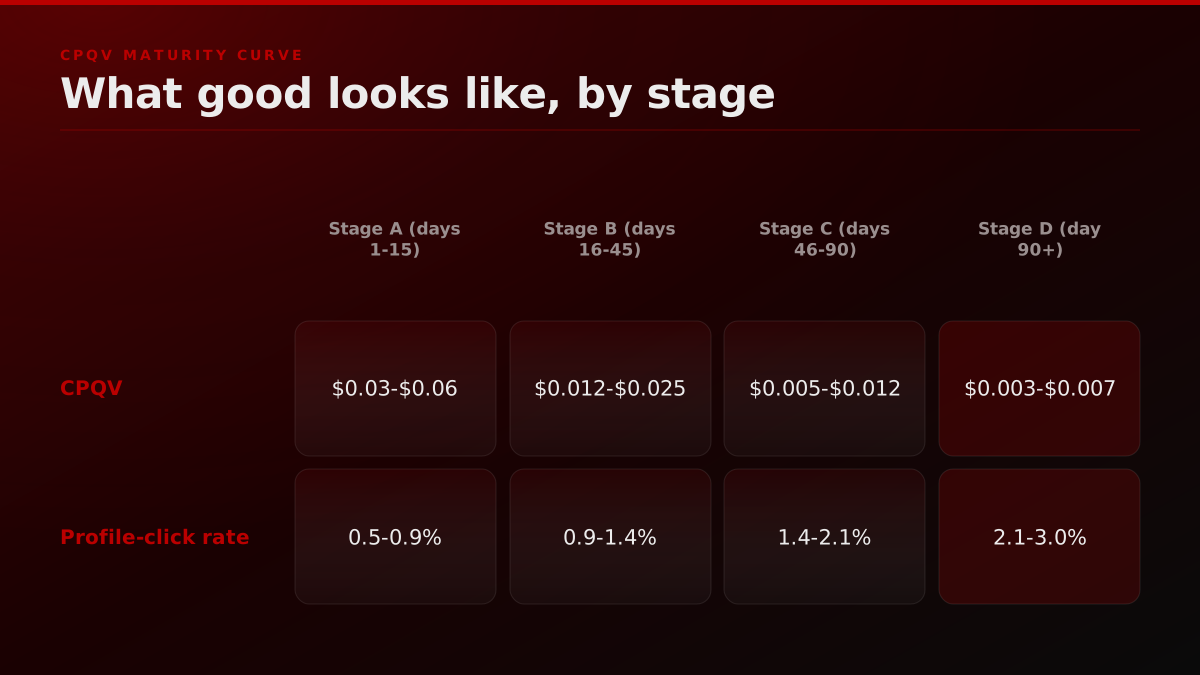
The progression is not linear and the timeline is not guaranteed. Hosts who already have audience equity (existing X following, prior podcast traction, recognizable brand) compress the curve by 30-50 percent. Hosts launching from zero take the full 90 days plus a 30-day audience-formation extension before Stage D economics show up.
Crucially, the CPQV improvement at each stage is mechanical. Reinvestment into the top cohort lowers the denominator's variance, which lowers CPQV without any creative breakthrough. The framework is doing the work; the clipper is executing the framework.
How do you connect CPQV to pipeline?
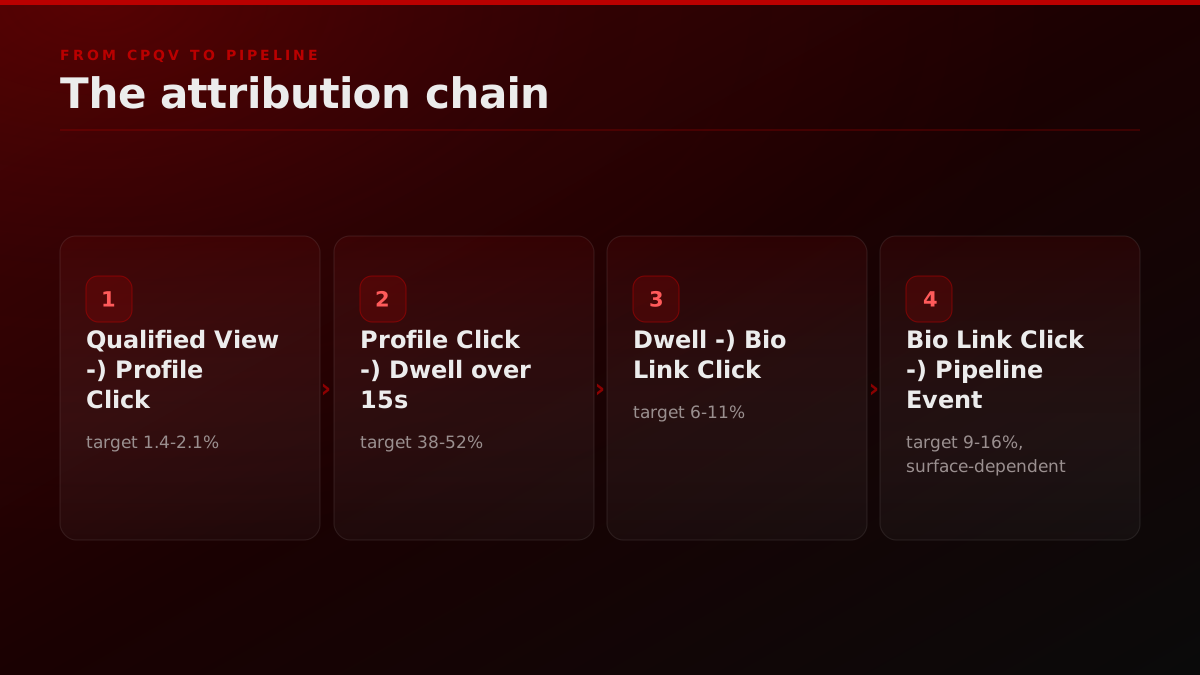
CPQV is a leading indicator and pipeline is the lagging indicator. The bridge between them runs through four conversion checkpoints, each an estimated operator target: qualified view to profile click (1.4-2.1%), profile click to dwell over 15 seconds (38-52%), dwell to bio link click (6-11%), and bio click to pipeline event (9-16%). Every Managed Clipping retainer at FORKOFF reports these weekly.
The chain reads:
Qualified View -> Profile Click -> Profile Visit Dwell -> Bio Link Click -> Pipeline Event
Each link in the chain has a conversion rate the QVA tracks:
- QV to Profile Click: target 1.4-2.1%. The cleanest single proxy for clip-to-intent conversion.
- Profile Click to Profile Visit Dwell (>15s): target 38-52%. A profile that loads but does not hold the visitor past 15 seconds is not selling anything; it is a UX failure on the profile itself.
- Profile Visit Dwell to Bio Link Click: target 6-11%. The bio is the highest-ROI piece of copy in the entire funnel.
- Bio Link Click to Pipeline Event: target 9-16%, surface-dependent. A waitlist signup converts higher than a booking link, which converts higher than a checkout flow.
Multiplied out, the typical Stage D conversion ratio from qualified view to pipeline event sits at 0.011-0.027 percent. On the FORKOFF Clipping Ledger n=3,085 case, 1.19M views produced 793 landing-page clicks and 17 new paying subscribers inside the 13-day window. That is 0.0014 percent from view to paying subscriber, below the typical band because a $50-a-month subscription is a heavier pipeline event than a signup or a booked call.
The point of the attribution chain is not to claim every pipeline event came from a clip. It is to falsify the framework when it breaks. If qualified views rise and profile-click rate stays flat, the clip is producing attention but not intent (usually a hook problem). If profile-click rate rises and dwell drops, the profile is mis-selling against what the clip promised (usually a brand-positioning problem). If dwell rises and bio-click stays flat, the bio is weak (usually a copy problem).
Each broken link in the chain is a separate, fixable failure. The CPQV is just the entry gate. The chain is the operating system.
Three failure modes the QVA exposes immediately
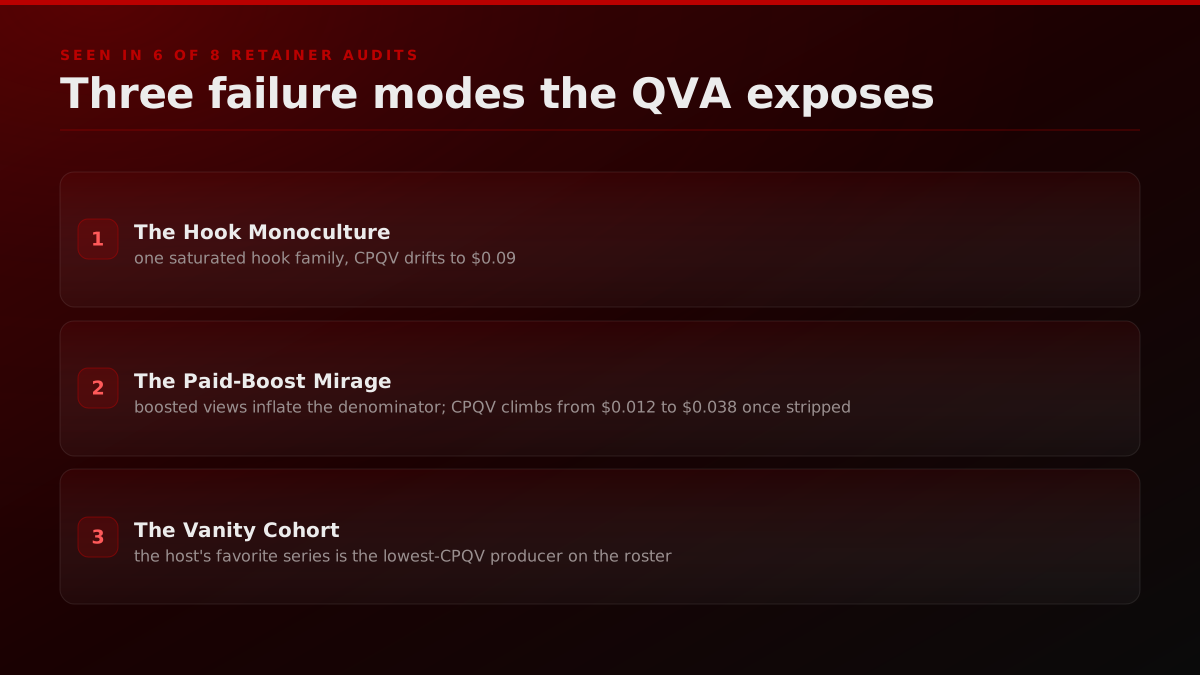
Three failure modes appear in roughly 6 of 8 retainer audits FORKOFF ran across 2025 and 2026: hook monoculture where one family dominates and saturates, a paid-boost mirage where boosted views inflate the denominator and hide true CPQV, and a vanity cohort where the host's favorite clip series is the lowest-performing CPV producer. Each is invisible at the impressions layer and obvious the moment CPQV is computed.
- The Hook Monoculture. The clipping team has settled into one hook family (usually founder-confession or contrarian-claim) because it earned an early viral hit. Six months later, that family's CPQV is approximately $0.09 because the audience has saturated. The QVA exposes this in the first 20 minutes. The fix is a forced 5-family hook rotation in the next cohort.
- The Paid-Boost Mirage. A growth manager has been boosting top-performing clips on an estimated $400-$800 weekly budget. The boost inflates impression counts and looks like organic growth on the dashboard. After the 3-layer detection pass, the qualified-view count drops by 22-35 percent and CPQV climbs from $0.012 to approximately $0.038. The fix is to segment paid and organic in the ledger from day one.
- The Vanity Cohort. The host's favorite clip series (often the long-form storytelling clips) is the lowest CPQV producer on the roster. The host has resisted killing it because it feels like the brand's voice. The QVA forces the conversation. Most retainer engagements lose one vanity cohort in the first 30 days. CPQV drops 18-26 percent on the same editorial budget.
In each failure mode, the QVA acts as a forcing function. The metric does the conversation the operator did not want to have.
Qualified Views vs Impressions : what each metric actually tells you
| Dimension | Impressions | Qualified Views |
|---|---|---|
| What it counts | Render events | Render + ≥75% hold + matched audience |
| Algorithm signal weight | Low : counted, not promoted | High : triggers multi-cohort re-promotion |
| Correlates with pipeline | Weak / not measurable | Strong : directly maps to profile-click + brand recall |
| Typical FORKOFF CPV | $0.0001-$0.0005 | $0.003 (managed) / $0.04+ (unmanaged) |
| What it pays for | Vendor invoice | Brand surface area you can compound |
| When to report it to the CEO | Never alone | Every week, alongside profile-click rate |
Both metrics exist; only one belongs in the boardroom. Qualified Views is the unit that survives a CFO's pricing-model question.
The metrics that trail behind Qualified Views
Once Qualified Views is the headline metric, three downstream metrics resolve cleanly: profile-click rate (qualified views to profile visits, target 1.4-2.1% on a clean QVA roster), branded search lift (trackable in Google Search Console as the compound signal of long-term attention), and cost per retained follower (spend divided by followers still active 30 days later). All three are mathematically downstream of qualified-view quality.
- Profile-click rate (PCR). Qualified views to profile visits. Industry-average PCR on short-form sits at an estimated 0.6-1.2%. On a clean QVA-optimized roster we see 1.4-2.1%, with the best campaigns clearing 3% on contrarian-claim hook families.
- Branded search lift. Qualified views compound into branded search volume because the viewer remembers the brand. Track this in Google Search Console with a filter on the host or company name; it is the cleanest pipeline-shaped signal short-form produces.
- Cost per retained follower (CPRF). Spend divided by followers still active 30 days later. CPRF is the long tail of CPV; a low CPV that converts to high churn is a vanity rebadge of impressions.
The QVA does not directly optimize for these three. It optimizes for qualified views. The three downstream metrics move because they are mathematically downstream of the same input.
This is the load-bearing claim of the entire framework. If qualified views go up and PCR + branded search + CPRF do not move with them, your qualified view count is being inflated by something the audit missed : usually a paid-boost layer or off-cluster reposts. Re-audit.
I stopped reporting impressions to our exec team two quarters ago. We report Qualified Views and profile-click rate. The conversation went from 'are we doing enough on social' to 'are we doing the right thing on social' overnight. We didn't change the budget. We changed the metric.
What inflates CPV and hides pipeline?
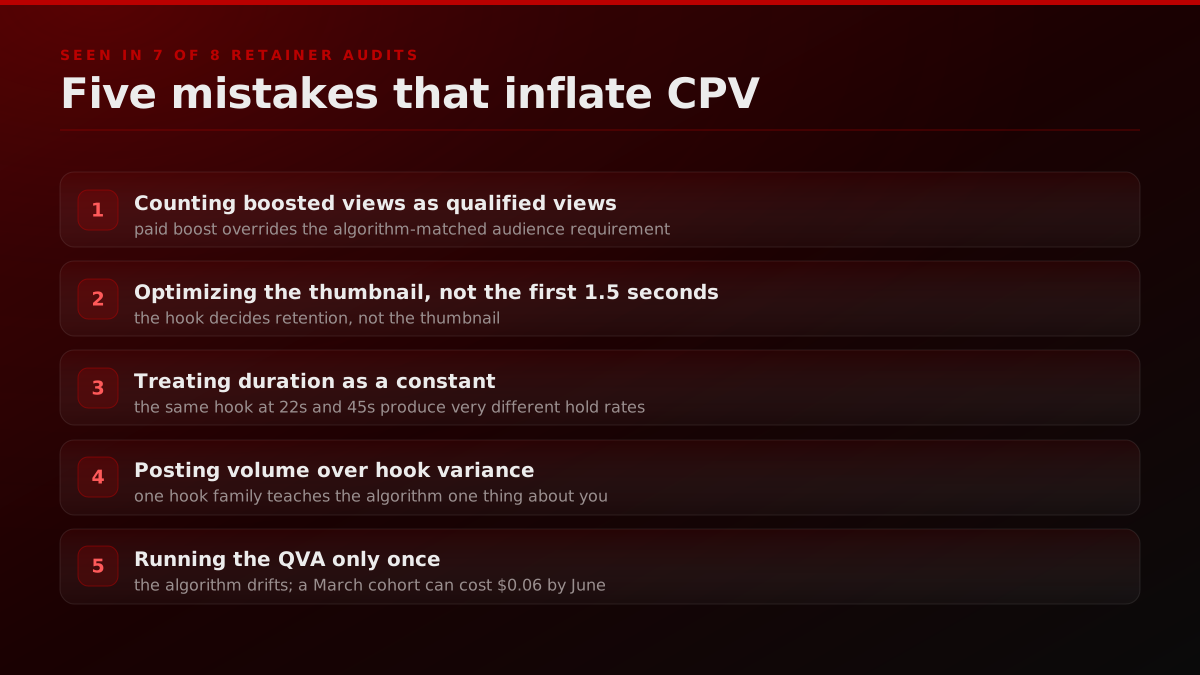
The same five CPV-inflating mistakes show up in 7 of 8 retainer audits: counting boosted views as qualified views, optimizing thumbnails instead of the first 1.5 seconds, treating duration as a constant across hook families, posting volume over hook variance, and running the QVA only once. None are exotic. Each one compounds into a CPV number that feels acceptable on a dashboard and breaks a CFO conversation.
- Counting boosted views as qualified views. Paid boost overrides the algorithm-matched audience requirement. A boosted view at 80% hold is impressive in a screenshot and meaningless in a CPV calculation. Segment paid and organic separately, always.
- Optimizing the thumbnail instead of the first 1.5 seconds. On short-form, thumbnails matter for one second; the hook decides the next ten. Most teams iterate the wrong asset.
- Treating duration as a constant. The same hook at 22s and 45s produce wildly different hold rates. Run a duration sweep inside each hook family before you commit to a default.
- Posting volume over hook variance. Twenty clips in a week with one hook family teaches the algorithm exactly one thing about you. Five clips with five hook families teaches it five.
- No QVA cadence. Running the audit once and never again. The algorithm drifts. Hook families saturate. The cohort that worked in March is the cohort that costs $0.06 CPV in June.
How we run the QVA inside Managed Clipping at FORKOFF
Every Managed Clipping engagement at FORKOFF starts with a baseline QVA on the last 90 days of the host's existing clip library. Even if the host has never measured CPV, we can usually reconstruct it from a combination of clip URLs + analytics export. The QVA is the audit-ledger backing every contract we ship through the FORKOFF clipping agency lane; for the contract structure that scopes CPQV pricing against marketplace bounty models, see the clipping agency vs marketplace breakdown.
Then we cut. The first 30 days produce a calibration cohort across 4-6 hook families. We run the QVA again at day 30. We move the editorial brief. We cut another 30 days. By day 60, we typically see CPV inside an estimated $0.003-$0.008 with profile-click rate at 1.4%+.
The reason this looks like magic on the dashboard but reads like accounting in the engagement is that the framework is not about creative. It is about measurement discipline applied to an editorial loop. The clipping team is good. The QVA is what makes the clipping team measurable.
Three related FORKOFF reads if you want the operator-level mechanics: how 13 days of managed clipping took MRR from about $595 to $1,290 walks the first 13-day window of the case the QVA was built on, the Founder Funnel OS shows where the qualified-view layer slots into a multi-channel pipeline operating system, and for the cost-side applications, the 3-way clipping agency vs in-house editor vs Opus Clip CPQV ledger applies the qualified-view denominator across all three buyer lanes with break-even math by production volume.
The Bottom Line
Retiring impressions and adopting Qualified Views as the headline metric is the single highest-leverage change a short-form content team can make in 2026. The QVA (Qualified Views Audit) is the four-step framework that installs it: baseline CPV, segment by hook type, filter by hold rate, reinvest into the top cohort. A clean first pass produces a 3-8x CPV reduction and a profile-click rate that moves from an estimated 0.6% to 1.4% or higher.
Qualified Views is the only short-form unit that maps to pipeline. The QVA is the 4-step framework that produces it: baseline CPV, segment by hook type, filter by hold rate, reinvest into the top cohort. The expected outcome of a clean first pass is a 3-8x CPV reduction and a profile-click rate that moves from 0.6% to 1.4%+.
The framework is mechanical. The discipline is the hard part. Most operators do not adopt Qualified Views because the first run produces a number their team is uncomfortable showing leadership. That discomfort is the entire point : it is the gap between what you are paying for and what you are getting.
If you want the QVA run for you, that is what we do at FORKOFF.
For an external operator view on this, see creator-business retention math on long-form to short-form attention models.
For adjacent reading, see the managed-clipping revenue case study, the best AI video editor 2026 ranking.
Primary sources cited above: Wistia's State of Video on completion-rate-as-metric. Vidyard's research on viewer engagement. HubSpot Marketing Statistics on attention quality.