
TL;DR
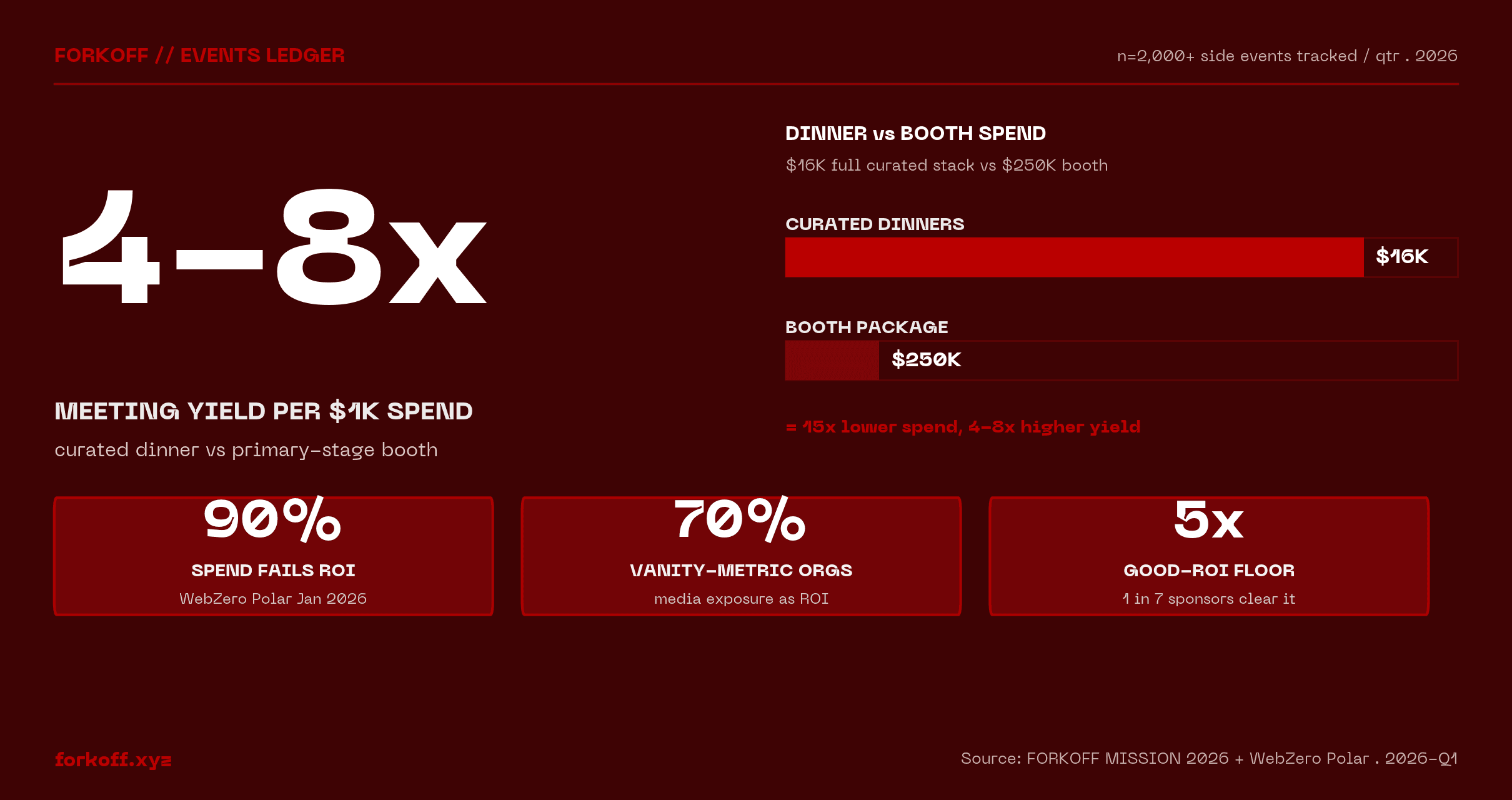
Over 90% of crypto events fail to deliver measurable ROI, per WebZero's January 2026 analysis. EthCC[9] Cannes proved the shift: 6,500 registered against 10,000 expected, and Marc Zeller said hardly anyone cares about the talks. The Agora pulled Bloomberg, BNP Paribas, and S&P Global for a 1,300 euro one-day ticket. Operators winning 2026 conference weeks now run one closed dinner, one co-hosted brunch, and one private villa for about $16K total, not a $250K booth.
The EVENT ROI MATRIX
The EVENT ROI MATRIX is FORKOFF's per-format cost-and-conversion table for crypto events. Founder-house, curated dinner, primary-stage booth, side-event, and content-only attendance compared on dollar cost, time cost, and qualified-meeting yield.
Industry Context
Across the FORKOFF MISSION 2026 ledger (50 ecosystem activations / 14 countries / $5M+ unlocked / 35K+ event attendees), curated-dinner formats produce 4-8x the qualified-meeting yield per $1K spent vs primary-stage booth presence.
Source: FORKOFF MISSION 2026
The $250,000 booth that returned nothing
Web3 founders are walking into 2026 with a bill they cannot justify. The default plan reads the same every year:
- Buy the booth at Consensus.
- Sponsor the stage at Token2049.
- Throw the open-bar party at EthCC.
- Collect 40 business cards.
- Close nothing.
WebZero's Roman Kemper put it bluntly at the Polar launch in January: "For too long, Web3 marketing spend has been a spectacle of smoke and mirrors with high-ticket parties and vanity metrics." He gave the pattern a name, the Party-to-Layoff pipeline, and it maps exactly onto the budget rounds we are seeing across 2026.
The real cost is not the cash. It is the attribution blackhole. A clicked Twitter ad can route a wallet to a protocol, and a trade show booth can brand a lanyard, but neither produces the tracked pipeline a CFO signs off on in a down market.
At FORKOFF we spend every week inside that problem. We track over 2,000 side events per quarter across Luma and Cryptonomads, and the operators winning conference weeks are running a playbook almost nobody on the main stage is using. This post is that playbook. If you want it applied to your next conference week directly, we cover it at /services/event-management.
The 90% failure rate is not editorial hyperbole
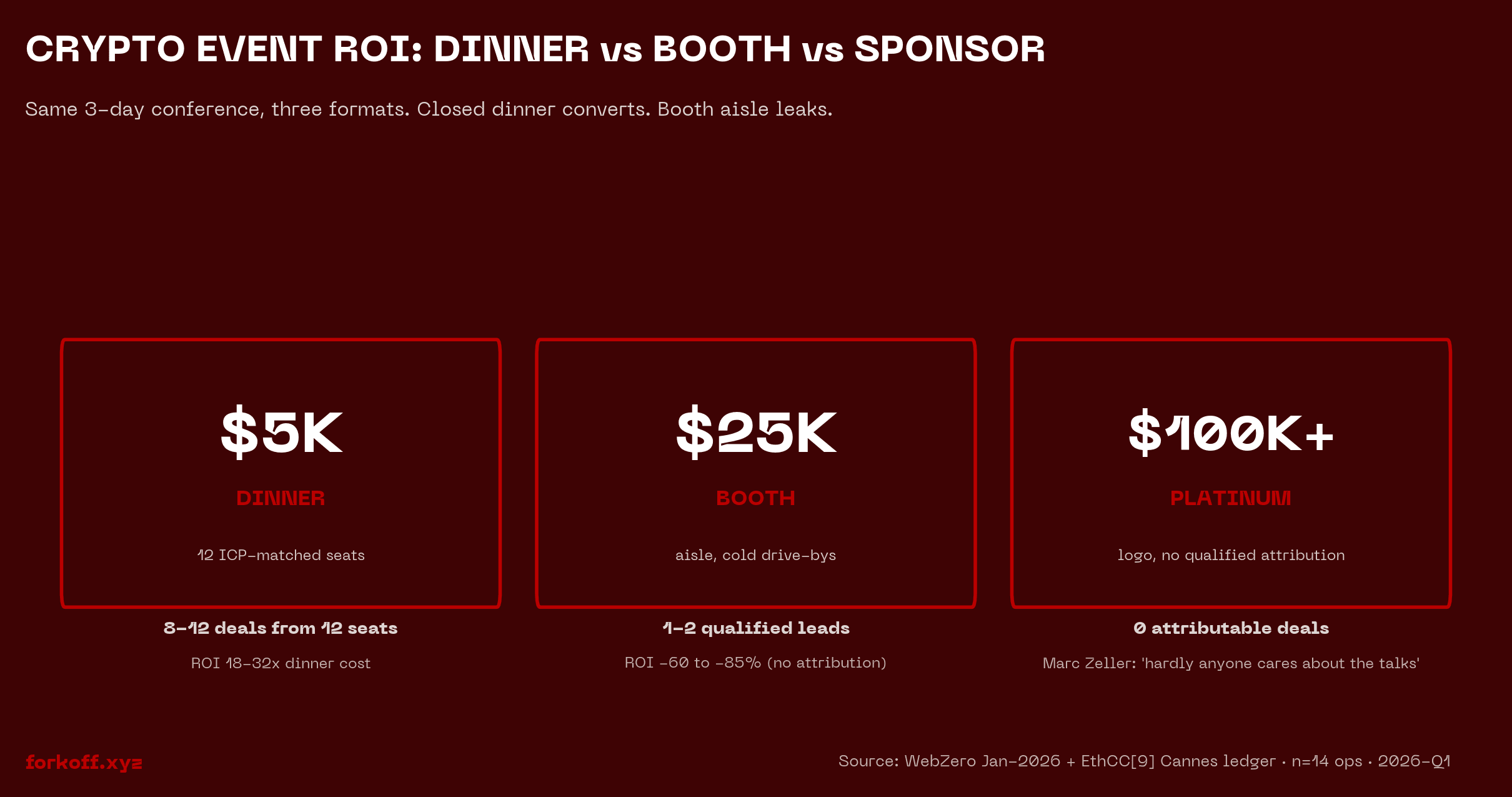
WebZero's January 2026 Polar launch framed the crypto event market as one where over 90% of sponsor spends fail to produce measurable ROI. The reference point they named publicly was the $250,000 conference booth, the classic vanity package that still ships at Consensus, Token2049, and the Bitcoin conference circuit. Party-to-Layoff pipeline is their phrase for what happens next.
Source: WebZero Polar launch (CoinDesk press release)
Why web3 event ROI breaks
The industry keeps trying to fix the booth. The booth is not the problem. Four root causes break crypto event ROI at the structural level:
- Attribution is broken by design. The funnel splits between web sessions and on-chain transactions. A campaign can drive 10,000 wallet clicks and $500 of volume while another drives 100 clicks and $50,000. Without blockchain-anchored attribution, nobody knows which event touch produced the signal.
- Attention is rented, not owned. A booth buys 30 seconds of footfall. A dinner buys a 3-hour conversation. The ratio is not close, and yet most budgets still allocate to footfall.
- Measurement optimizes for the wrong thing. 70% of marketers still use media exposure as the primary event ROI metric, per standard event-industry benchmarks. Impressions do not pay salaries.
- Unit economics are never calculated before the spend. Teams commit to a $250K booth six months ahead, without ever running the math on lead-to-retainer conversion rates.
The common thread is simple. Events are treated as a marketing line item instead of a sales funnel. Operators who reframe the event calendar as a pipeline input, not a brand spend, are the ones still profitable in a bear market.
What EthCC[9] Cannes just taught operators
EthCC[9] wrapped two weeks before this post. The takeaways from the field are structural, not anecdotal:
- Attendance gap. Organizers expected 10,000. Global Coin Research put registered participants at 6,500, a 35% shortfall from the projection.
- Palais des Festivals was quieter. The city was emptier at night than last year, and the big treasury-funded parties that defined EthCC[7] and [8] were gone.
- Keynotes lost their pull. The real content moved off stage and into the invite-only dinners that nobody was posting publicly on Luma.
Marc Zeller, one of Aave's best-known builders, summed it up on stage with the line that defined the week.
Side events became the conference. Infinite Games pulled a cross-pollinated crowd from GCRx, Eikyo Ventures, AWS, and the DeFi Founders Club. Lo Tech's rooftop brunch was the single most-photographed moment of the week. The ecosystem quietly voted with its feet.
The bear market sharpened the list. As Shiv put it in his recap thread: "Bear markets bring out solid builders." The operators who stayed home were the ones still chasing vanity. The operators who flew in had buyers.
The Agora and the institutional pivot
The single most structurally important event of EthCC week was not an EthCC event.
Kaiko's Agora was hosted in cooperation with EthCC on March 31. It ran one day. It pulled 800 attendees and 60 speakers. The roster is the tell:
- Standard Chartered Bank
- Euronext
- DTCC
- DRW
- S&P Global
- Tradeweb
- Broadridge
- Bloomberg
- Solana
- Aave
- Canton Network
- SG Forge (CEO Jean-Marc Stenger on stage)
- Aave founder Stani Kulechov on stage
- Euroclear, BNP Paribas, Amundi
For operators reading this: the ticket was €1,300. That is a 2.6x premium over the plain EthCC Full Pass for one day of programming. It was the single highest-ROI ticket bought at Cannes.
DL News called the Cannes edition a decisive shift from a builders' retreat to an institutional showcase. That is not a tagline. That is the new buyer map. The people who allocate capital in 2026 are sitting in the Agora, not in the booth hall.
Winning Web3: The Marketing Strategies That Actually Work - Organized by Cointelegraph
Anndy Lian
Cointelegraph's Consensus 2025 panel on Web3 marketing strategies that actually work - the crypto-event-ROI question framed at conference scale.
The 5-move post-EthCC playbook
The pattern the winning operators ran at Cannes is reproducible. Here is the 5-move version for any major 2026 conference week:
- Buy the institutional ticket, not the booth. The €1,300 Agora add-on was worth more than a €100K expo corner. For Consensus in Hong Kong, the analog is the private investor breakfast.
- Run one closed dinner for 6 to 10 people. Budget $5K including venue. Invite by name, never by open Luma link. Use the conference as the excuse, not the venue.
- Co-host one rooftop or villa with a complementary project. Split the cost, double the list. Co-hosting also gives you warm intro rights to your partner's invitees.
- Skip the open bar party. The ROI is negative. Every dollar spent on open-bar brand is a dollar not spent on the dinner that closed the retainer.
- Syndicate the week for 2 weeks after. Every dinner becomes a clip. Every clip becomes a tweet. Every tweet becomes a new intro. The compounding is outside the venue, not inside.
![Three crypto event format breakdown: dinner vs booth vs sponsor by cost, attendees, qualification rate, attribution, and ROI. EthCC[9] Cannes benchmark.](https://hel1.your-objectstorage.com/marketing-s3/uploads/crypto-event-roi-dinner-vs-booth__inline__717c68e1.png)
Event ROI benchmarks from outside crypto
Crypto operators assume the event model is uniquely broken for web3. It is not. Trade Show Labs data: 5% to 10% of trade show leads convert. 14% of Fortune 500 exhibitors report $5 per $1 spent. 70% of marketers still judge ROI by media exposure, a vanity metric. The floor for good ROI is 5x on spend. Fewer than 1 in 7 sponsors clear it.
Source: Trade Show Labs and Fortune 500 trade-show data aggregates
How we run event activation at FORKOFF
At FORKOFF we build event weeks around unit economics from day one. The process is simple, and it is the same whether the client is a DeFi protocol, an L2, or a cross-sector partner like our work referenced in the clip economy teardown:
- Week minus 6: we map the event calendar against the client's CRM, flag the 15 to 25 target accounts already attending, and plot the touch sequence.
- Week minus 4: we book or co-host the anchor dinner, negotiate speaker slots, and seed warm intros via founder funnels.
- Week minus 2: every side event gets a tracked Luma link with UTM params and a linked lead object. No blind RSVPs.
- Conference week: we run the pipeline. Every conversation gets a CRM entry the same day, including a signal score the operator can trust.
- Week plus 2: we syndicate the content across X and LinkedIn, then re-engage through the post-event trigger playbook.
It is boring. It is effective. It is why our clients stopped buying booths two seasons ago.
The Bottom Line
The booth era is over. Not because booths stopped working. Because the buyers stopped walking past them. In 2026, the institutional side of crypto is at the Agora, the builder side is at the villa, and the founders compounding pipeline are the ones running a 5-move playbook instead of a $250K dice roll:
- Book the dinner.
- Skip the open bar.
- Syndicate the week.
Your CFO will sign off again.
Related FORKOFF reads: crypto event ROI, Ecosystem hub. References: LinkedIn.
Further reading: ETHGlobal events, Luma discover.
For deeper cross-pillar context, see the founder-funnel motions that surface inside events.
ETHDenver Happy Hour
Hi all! We are going to ETHDenver and throwing a happy hour bringing together builders, founders, investors, and the broader crypto community for an on-the-ground update from Washington. Our team has been in D.C. this week meeting directly with policymakers and stakeholders on the issues shaping the future of digital… Show more

Y Combinator
@ycombinator
Replit is the leading no-code app builder for consumers and enterprise, letting anyone with an idea build real, deployed software using natural language. The company just raised a $400 million Series D at a $9 billion valuation. In this episode of Founder Firesides, co-founder a… Show more