
Ecosystem
Ecosystem activation is Layer 4 of the FORKOFF operating framework. The access layer that embeds founder narrative inside community structure. Qualified-engagement, not member-count vanity. The posts below cover Discord-as-Layer-4, the 3-tier cadence (monthly AMAs, retro threads, alpha drops), and why moderation-as-service is the lowest-tier ops layer in the stack. See the FORKOFF Discord ecosystem playbook.
Written by the operators running the engagements, measured on a clipping network that has processed 5B+ views.
16 articles in Ecosystem. All FORKOFF blog.
Ecosystem activation for protocols and AI platforms
A protocol or AI platform's Discord usually starts as a support channel and stays that way by default, holding announcements and help threads while the actual growth work happens elsewhere. Treating the server as Layer 4 of the distribution stack, the access layer where community structure and founder narrative meet, means building a real cadence into it rather than letting it sit as a passive inbox that only gets attention when something breaks.
Discord as Layer 4, not a chat room
The difference between a Discord that drives qualified engagement and one that's just a chat log is structure: dedicated channels for builder questions, a visible path from lurker to contributor, and moderation that actually enforces the server's stated purpose instead of letting every channel devolve into general chat. A server with that structure gives a founder somewhere specific to point new community members, and gives existing members a reason to check back in beyond waiting for an announcement.
The 3-tier cadence: AMAs, retro threads, alpha drops
A monthly AMA gives the community direct founder access on a predictable schedule, which matters more for retention than the AMA content itself. Retro threads, a founder or core team member posting what shipped and what didn't over the past cycle, build the kind of transparency that turns lurkers into repeat participants because it shows the project is being run by people who'll admit what didn't work. Alpha drops, information shared with the community before it's public, give active members a concrete reason to stay engaged between the scheduled touchpoints.
Why member count is a vanity metric
A server with 40,000 members and 200 people who've ever posted is not a bigger community than one with 3,000 members and 600 active posters; it's a bigger number attached to a smaller actual community. Qualified engagement, people who show up repeatedly, ask real questions, and refer others in, is the number that maps to actual ecosystem growth. Optimizing invite links and giveaway mechanics to inflate the member count produces a server that looks active in a screenshot and is dead in every channel that matters.
GameFi Player Acquisition: How Web3 Games Grow Players and Token Demand in 2026
The distribution-first playbook web3 game studios use to acquire real players, not airdrop farmers, and turn them into holders who mint and stay.
 Read
Read
Rollup Ecosystem Growth: How L2 Chains Win Developers, TVL, and Mindshare After Mainnet
Ecosystem growth for an L1, L2, or rollup is a two-sided distribution problem. The 2026 playbook to take a chain from mainnet to a living ecosystem.
Read
DeFi Protocol Marketing: Zero to First TVL
DeFi protocol marketing is a TVL problem. The 2026 playbook to take a protocol from zero to its first real Total Value Locked, backed by on-chain data.
Read
DePIN Marketing: From Testnet to Token
DePIN marketing is a distribution and trust problem, not a hardware one. The 2026 playbook to take a network from testnet to a token it keeps using.
Read
GEO for Crypto: Web3 SERPs Are AI-Driven Now
GEO for crypto is the discipline that decides whether AI answer engines name your Web3 project. Web3 SERPs are AI-driven now, and most projects are invisible.
Read
Web3 Marketing Agency: What a Category-Winning One Actually Delivers
A web3 marketing agency should move wallets and pipeline, not vanity metrics. The six surfaces that work, the pricing models, and how to vet one.
Read
The Claude Code SEO Stack 2026: Skills, MCP, Agents, Hooks
The Claude Code SEO stack composed end to end. Skills, MCP, agents, hooks across 4 operator playbooks. $1.8M revenue, 1,700% visibility lift, 1M+ emails.
Read
Best AI Visibility Tools 2026: 7 Platforms vs FORKOFF Methodology
Neutral 2026 comparison of Otterly, Profound, Athena, Goodie, Genrank, Prismic, and Semrush AI Visibility against the FORKOFF methodology.
Read
Web3 Ecosystem Growth 2026: The FORKOFF Distribution Stack
Web3 ecosystem growth 2026: the FORKOFF Founder-Funnel Cohort (n=42 retainers, 3.4x reply uplift, $487 blended CPQL) and the 6-stage Ecosystem Growth OS.
Read
Running Agentic SEO on 14 Sites: The 10-Check AEO Scorecard 2026
We ran Addy Osmani's open-source agentic-seo CLI against 14 properties on 12 May 2026. Median score 9 of 100. Every site graded F. Receipts inside.
Read
Web3 Marketing Dubai 2026: The 5-Layer MENA GTM Stack
Web3 marketing in Dubai needs 5 layers, not a CT KOL deal. The MENA-specific GTM stack that lifted day-90 retained wallets 4.1x across 17 audited Q1 2026 teams.
Read
Airdrop Marketing: 41% Retention in 4 Phases
Run the 4-phase airdrop playbook that lifted 30-day retention from 8% to 41%. Covers sybil defense, quest design, vesting math, and post-TGE hooks.
Read
Farcaster Mini App Distribution: 6 Loops, 14.6x WAU Gap
18 Farcaster mini apps audited: top quartile hit 4,200 weekly users vs 287 median. The 6 distribution loops behind the 14.6x gap, and 2 that stall.
Read
Guerrilla Marketing in Web3: 11 Plays That Still Work
Paid CT is saturated. The Web3 teams compounding in 2026 run 11 specific guerrilla plays, on-chain stunts, community hijacks, meme warfare, OSS bait.
Read
What Is a KOL in Crypto? The 4 KOL Tiers and What Each Costs [2026]
The CT KOL Tier Matrix ranks nano to anchor by price and retained-wallet cost. One $180K macro push kept zero wallets. The tiered mix that beats it.
Read
Web3 GTM Playbook 2026: Tactics That Actually Convert
Airdrops drop. KOLs churn. Grants dry up. The Web3 projects that compound run a 5-lever growth loop, the 2026 GTM playbook we run for ecosystem teams.
ReadShowing 1-16 of 16 blogs
All 16 Ecosystem posts
- GameFi Player Acquisition: How Web3 Games Grow Players and Token Demand in 2026
- Rollup Ecosystem Growth: How L2 Chains Win Developers, TVL, and Mindshare After Mainnet
- DeFi Protocol Marketing: Zero to First TVL
- DePIN Marketing: From Testnet to Token
- GEO for Crypto: Web3 SERPs Are AI-Driven Now
- Web3 Marketing Agency: What a Category-Winning One Actually Delivers
- The Claude Code SEO Stack 2026: Skills, MCP, Agents, Hooks
- Best AI Visibility Tools 2026: 7 Platforms vs FORKOFF Methodology
- Web3 Ecosystem Growth 2026: The FORKOFF Distribution Stack
- Running Agentic SEO on 14 Sites: The 10-Check AEO Scorecard 2026
- Web3 Marketing Dubai 2026: The 5-Layer MENA GTM Stack
- Airdrop Marketing: 41% Retention in 4 Phases
- Farcaster Mini App Distribution: 6 Loops, 14.6x WAU Gap
- Guerrilla Marketing in Web3: 11 Plays That Still Work
- What Is a KOL in Crypto? The 4 KOL Tiers and What Each Costs [2026]
- Web3 GTM Playbook 2026: Tactics That Actually Convert
Read sister categories
Clippings
Creator-led clipping that turns founder content into qualified organic reach. Geotargeted distribution. Audit ledger on every cycle.


Podcast
Founder podcasts that compound. Two to four founder hours per week converted into multi-platform recall, not vanity downloads.

Founder Funnel
Founder-led growth playbooks that survive past PMF. Distribution architecture, not single-channel hacks.

Event Management
Event activations that compound across the calendar. Founder houses, vox pops, hacker houses, and citation blitzes.

AI Search and AEO
Getting cited by ChatGPT, Perplexity, Claude and Google AI Overviews. Schema, answer units, and the signals AI crawlers actually read.
Reddit Marketing
Compliant, non-spam Reddit distribution. Operator accounts, subreddit fit, and the moderation rules that decide whether a post survives.
Twitter and X Growth
Founder-led distribution on X. Thread architecture, reply surface, and follower quality over follower count.
Launch Video
Product and company launch video that carries a real launch beat, not a sizzle reel. Format, timing, and what separates reach from noise.
UGC Videos
Creator-made video ads that read as native rather than produced. Briefing, rights, and the volume needed before a winner appears.
KOL and Influencer
Creator and KOL partnerships priced on qualified delivery. Roster screening, authenticity checks, and payout math shown before acceptance.
SaaS GTM
Go-to-market for B2B SaaS past PMF. Qualified pipeline over signups, and the product-health metrics that survive a board review.
Ecosystem engagements that compound
Outcome-priced engagements, audit-proof on every cycle. Five active engagements per quarter, capped on purpose.
Frequently asked questions
How does the FORKOFF blog organize categories?
Each category maps to a FORKOFF service line: clipping, founder-led growth, podcast, Reddit, Discord, activations, plus uncategorized for cross-cutting posts. Each category index aggregates articles in that lane and links to the underlying service.
How often are new articles added to each category?
We publish 2 to 4 operator-grade articles per week across all categories combined. Most categories see 1 to 2 new pieces per month. Higher-velocity lanes like clipping and founder-led growth get more weekly cadence.
Who writes the category content?
Articles are co-authored by FORKOFF operators and the founders we work with. Every claim ties to an audit ledger entry from a live engagement. Each piece is reviewed against our 3-tier verification matrix before it ships.
Can I subscribe to a specific category feed?
Category-specific RSS feeds are available at /blog/<category>/rss.xml (where supported). All categories also ship to @officialforkoff on X and to the FORKOFF newsletter within an hour of publish.
How do I apply for the related engagement?
Each category page has a primary CTA pointing at the matching FORKOFF service. Apply via Calendly for a 30-minute intro. Five engagements per quarter cap, by application only.
Talk to FORKOFF about your ecosystem engagement.
Receipts, deep dives, and playbooks.
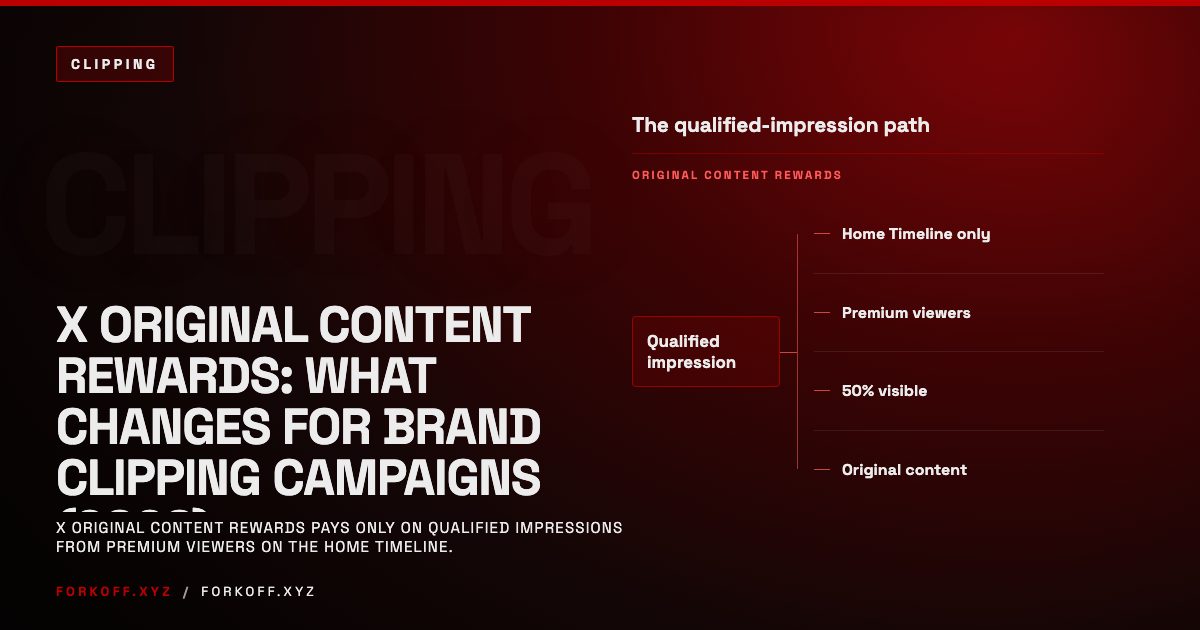
X Original Content Rewards: What Changes for Brand Clipping Campaigns (2026)
X swapped Creator Revenue Sharing for Original Content Rewards, so recycled-clip payouts are gone. What brands running clipping campaigns change now.
Read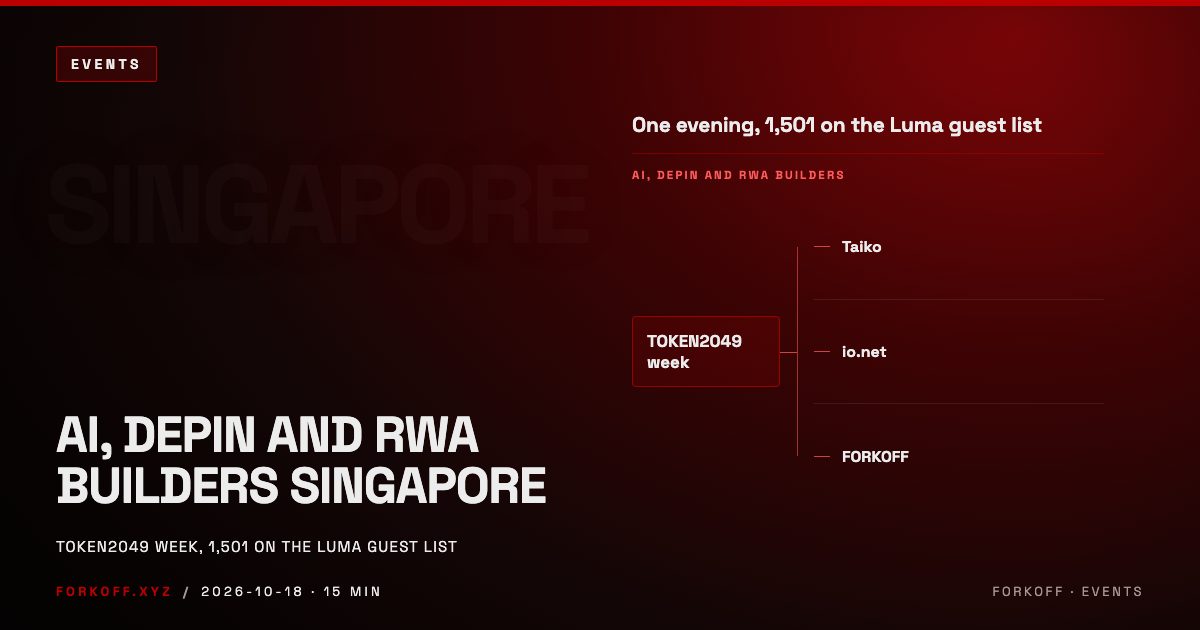
AI, DePIN and RWA Builders at TOKEN2049 Singapore 2025: 1,501 on the Guest List
A recap of AI, DePIN and RWA Builders, the evening side event FORKOFF hosted with Taiko and io.net during TOKEN2049 week in Singapore: panels, partners, data.
Read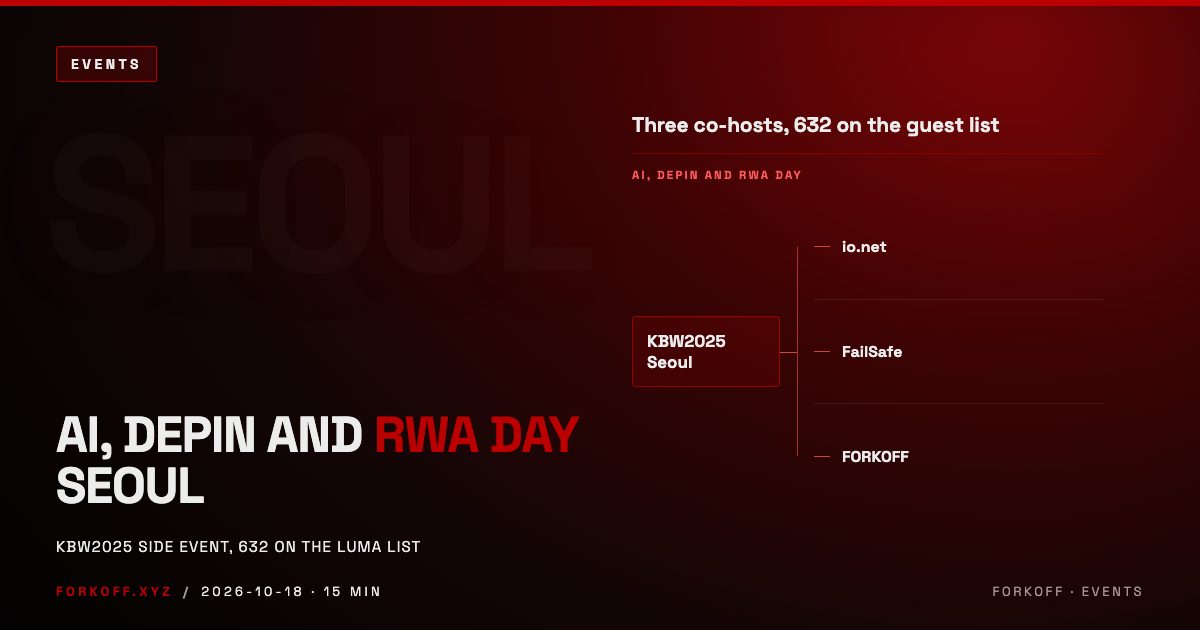
AI, DePIN and RWA Day at Korea Blockchain Week 2025: 632 on the Guest List
A recap of AI, DePIN and RWA Day, the half-day side event FORKOFF co-hosted with io.net and FailSafe in Seoul during KBW2025: hosts, agenda and real numbers.
Read