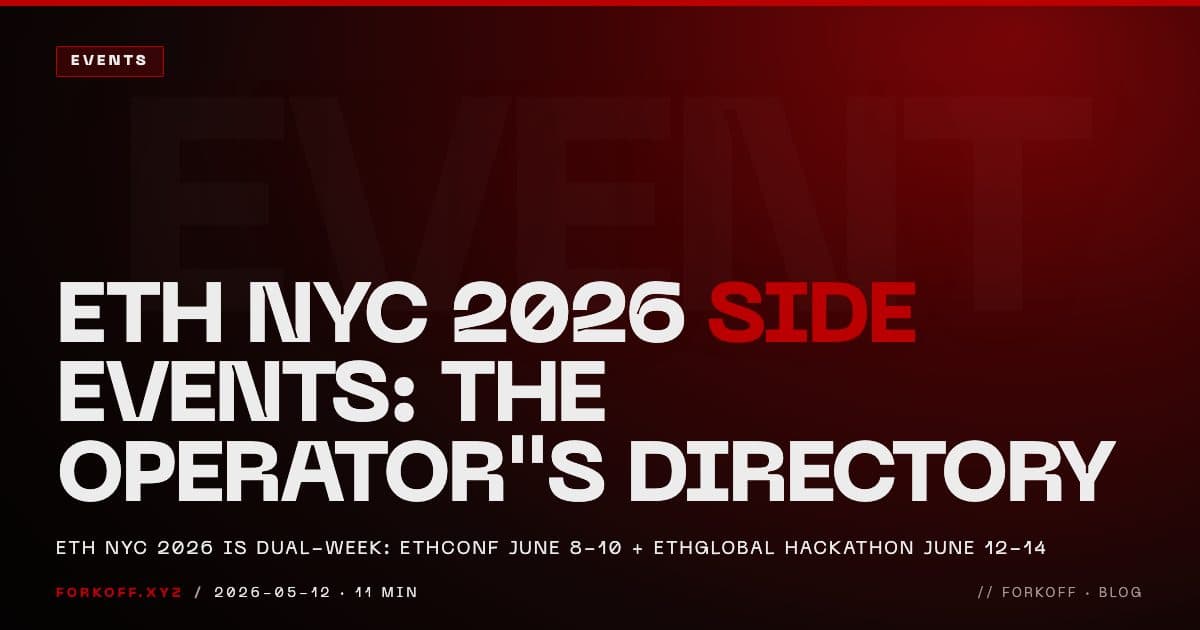
ETH NYC 2026 is a dual-week event: ETHConf runs June 8 to 10 at the Javits Center for the institutional and founder track, and ETHGlobal New York runs June 12 to 14 at the Metropolitan Pavilion as the hackathon weekend. The 32-plus confirmed side events span 5 lanes (summits, builder nights, VIP dinners, after-parties, and hackathon-adjacent gatherings) spread across June 3 to June 14, and the curated directory below covers which events carry the highest operator ROI by buyer archetype.
ETH NYC 2026 side events in one scroll
ETH NYC 2026 is a dual-week event. ETHConf runs June 8 to 10 at the Javits Center with 5,000-plus attendees and 150-plus speakers. ETHGlobal New York follows June 12 to 14 at the Metropolitan Pavilion as the hackathon weekend. We mapped 32+ confirmed side events across 5 lanes: summits, builder nights, VIP dinners, after-parties, and hackathon-adjacent gatherings. The pipeline gets built in the side rooms, not the main floor. This is the curated directory plus operator commentary plus the 30-day host playbook the existing aggregators do not carry. Ship your RSVP funnel by T-21 or you arrive in a city of 8,000 attendees with nowhere to put them.

ETH NYC (June 8 to 10, 2026) 2026 in one scroll: dates, venues, and why the side-event circuit is the actual conference
ETH NYC 2026 hits New York from June 3 through June 14. The main-stage anchors are public: ETHConf (June 8 to 10, 2026) opens June 8 at the Javits Center on the west side of Manhattan and closes June 10. ETHGlobal New York (June 12 to 14, 2026) opens June 12 at the Metropolitan Pavilion and closes June 14 with the hackathon demo round. The official surface lists tickets at $799 general admission through $1,999 for founder and investor passes per ethconf.com. The pre-event week (June 3 to June 7) is where the thesis salons run. The post-hackathon weekend (June 12 to June 14) is where the builder pipeline gets seeded.
The side-event circuit is the actual conference. That is the line every operator who has shipped pipeline from a coastal crypto week will tell you, and the AI Overview Google now serves on this query cites 8 confirmed satellites already: Agentic Finance Summit, Stable Summit IV, Vault Summit, Builder Nights New York, ETHConf VIP Dinner, Hyperliquid Forum, DAYS Summit, and the ETHGlobal Hackathon itself. Expect 80 to 120 more side events to confirm on Luma between T-21 and T-3. The directory does not exist anywhere as a curated layer yet. Cryptonomads ran the equivalent for ETHCC 2024 and was the canonical link for two cycles, then did not refresh.
Operator noteLuma RSVP pages for NYC crypto weeks open T-21 to T-3. A directory frozen at T-30 goes stale, so we re-sweep this one weekly., FORKOFF events team
At FORKOFF we run the events stack end-to-end for sponsor and host clients across the 2026 coastal cycle. ETHConf NYC June, ETHGlobal Lisbon July, ETHGlobal Tokyo September. The operator posture behind this directory is the same one that separates the best event marketing agencies from vendors who only sell booth space. This directory is the operator-side artifact we use internally to brief clients on which side events to attend, which to host into, and which to skip. We published it because the friction-cost of the missing directory is hurting buyers who paid for the trip and have nothing to walk into on day one.
ETH NYC 2026 dual-week structure at a glance
ETH NYC 2026 has two anchor events back-to-back. ETHConf runs June 8 to 10 at the Javits Center with 5,000-plus attendees, 150-plus speakers, and tickets priced $799 general admission through $1,999 for founder and investor passes. ETHGlobal New York runs June 12 to 14 at the Metropolitan Pavilion as the in-person hackathon weekend. The 12-day span (June 3 to June 14) is the actual side-event surface; T-21 to T-3 is the RSVP-opening window when most side events confirm on Luma. The AI Overview Google currently serves on this query cites 8 satellites by name: Agentic Finance Summit, Stable Summit IV, Vault Summit, Builder Nights New York, ETHConf VIP Dinner, Hyperliquid Forum, DAYS Summit, and the ETHGlobal Hackathon itself. The full surface is closer to 100+ events by T-7.
Source: ethconf.com event surface + Google AI Overview citation snapshot 2026-05-12
Lane 1: Summits (June 3 to June 7, the pre-week thesis salons)
The summit lane is the highest signal density of the week if your buyer is an infra protocol team or a stablecoin/RWA operator. Summits run between 200 and 600 attendees, last 6 to 8 hours, and curate the room by invite plus light gating. A summit is where a category-defining keynote lands, the partnership conversations get pre-staged, and the post-summit dinner becomes the actual deal table.
Lane 1: ETH NYC 2026 pre-week summits
| Event | Date | Venue | ICP density | Signal or skip |
|---|---|---|---|---|
| Agentic Finance Summit | June 3 | Venue announcing T-14 | Agent + AI + crypto infra | SIGNAL: AI Overview cited; emerging category |
| Stable Summit IV | June 4 | Venue announcing T-14 | Stablecoin issuers + payment infra | SIGNAL: 4th edition, stablecoin issuer concentration |
| Vault Summit | June 5 | Venue announcing T-14 | DeFi yield + restaking + LSTs | SIGNAL: yield protocol exec density |
| DAYS Summit | June 11 | Venue announcing T-14 | Founder + DAO governance + creator infra | SIGNAL: invite-only operator track |
| Hyperliquid Forum | June 11 | Venue announcing T-14 | Perp DEX + market-maker + HFT | SIGNAL: narrow but deep market-maker room |
| RWA Summit (confirming) | June 6 to 7 | Hosts announcing T-14 | RWA tokenization + asset managers | Pending confirmation; track lane on Luma weekly |
Source: ethconf.com side-events index + luma.com/ethglobal. Venues confirm 14 to 7 days out; track host accounts on X for the venue drop.
Operator commentary on summits. Pick one summit, not three. The cohort that walks home with closed deals attends one summit fully, takes 8 to 12 high-fidelity conversations, books 3 follow-ups for that week, then routes the remaining time into builder nights and dinners. The cohort that attends three summits ends up with 30 business cards and zero second meetings. Ranked first across the lane on operator ROI: Stable Summit IV if you ship payments or stablecoin infrastructure; Agentic Finance Summit if you ship anything in the AI-plus-crypto stack; Hyperliquid Forum if your market is perps or HFT.

Side-event taxonomy by buyer-archetype: pick the lane your ICP actually sits in
Every founder who lands in NYC for ETH NYC 2026 walks in with a buyer in mind. The directory above sorts events by lane and date. The taxonomy below sorts the same 32 events by which buyer-archetype the room concentrates. Five archetypes cover the FORKOFF Sponsor Cohort engagements over the last six conference cycles: the Infra Architect, the Stablecoin/Payments Operator, the AI-plus-Crypto Founder, the Capital Allocator, and the Protocol Recruiter. Each archetype has a different signal floor for what counts as a closed-pipeline conversation, and each archetype indexes a different lane harder than the rest.
The Infra Architect buyer is a senior protocol engineer or tech lead at a layer-2, restaking protocol, modular DA layer, or wallet-AA SDK team. The Architect closes integration partnerships, not commercial deals. The room density that matters is engineer-to-engineer. Builder Nights New York is the canonical room. Modular Stack Dinner, ZK Engineering Dinner, and Account Abstraction Builder Night fill the same lane. Skip every after-party except the one your integration counterpart actually attends. The Architect does not need volume; the Architect needs 4 conversations that turn into a shared roadmap doc by July 1.
The Stablecoin and Payments Operator buyer is the most concentrated archetype at ETH NYC 2026 because three of the announced summits sit on this lane. Stable Summit IV, the Pre-summit Investor Brunch, and the post-summit Stablecoin Founder Dinner stack on June 4 to June 5. Track the Centrifuge/Maple/Goldfinch RWA Engineering Mixer on June 6 if your buyer touches institutional money. The Operator buyer closes 1 to 3 commercial pilots per crypto week if the room density is right. The signal you are looking for is the live regulatory question, not the protocol pitch. If the dinner conversation routes to MiCA, the GENIUS Act, or USDC reserve mechanics, you are in the right room. The same MiCA-first regulatory conversation runs as the dominant track at Dutch Blockchain Week in Amsterdam, where AFM, licensed exchanges, and EU infrastructure vendors concentrate across a full week in June.
The AI-plus-Crypto Founder buyer is the newest archetype on the ETH NYC 2026 surface. Agentic Finance Summit on June 3, the AI x Crypto Late-Night on June 11, and the Founder Dinner that follows Agentic Finance on June 4 are the three rooms that matter. This lane is still forming. The signal floor is low because most attendees are doing their first round of category education. The opportunity floor is high because the named-protocol density inside this room is still small. A founder who shows up with a real product (not a research paper or a whitepaper deck) closes 2 to 3 design-partner conversations per week from this lane alone. The lane is not new noise either. It is the same density Messari's analysts logged on the ground two cycles ago:
Crypto x AI was one of the most popular focus areas at the conference with a variety of side events throughout the week.
The Capital Allocator buyer (GP at a fund, syndicate lead, family-office crypto allocator) sits inside Lane 3 almost exclusively. ETHConf VIP Dinner on June 9, Founder Capital Dinner on June 7, and the Operator-Hosted GP Dinner on June 10 cluster the allocators. Skip Lane 4 entirely if your buyer is an allocator; the after-parties dilute the signal to noise. The Allocator buyer closes term-sheet conversations on the second meeting, not the first. The job at the VIP dinner is to lock the second meeting on the founder's calendar inside the next 14 days, not to walk away with a verbal yes.
The Protocol Recruiter buyer is hiring engineers, not buying integrations or capital. Lane 4 (after-parties) is the right lane. The L2 Happy Hour, the Restaking After-Party, and the Hackathon Demo Night are the highest-volume venues. Pair the recruiter with an engineer on the team for two reasons: first, the engineer-to-engineer trust filter is the only filter that matters at the after-party scale; second, the Recruiter who attends alone reads as low-signal to a senior engineer evaluating jumps. The Recruiter buyer ships 6 to 12 qualified candidate intros from a full week of after-party attendance when the cadence is right.

Lane 2: Builder Nights and engineering dinners (the founder pipeline tier)
Builder Nights is the format ETHGlobal pioneered: 80 to 200 engineers in a curated room, sponsored by 1 to 3 protocol teams, light demo programming, food-and-drink format, runs 6 to 11 pm. The ETHGlobal New York Luma host calendar lists Builder Nights as the official kickoff on June 8. Around it, individual protocols stack their own engineering dinners with overlapping audiences.
Lane 2: ETH NYC 2026 builder nights and engineering dinners
| Event | Date | Host | Capacity | Signal or skip |
|---|---|---|---|---|
| Builder Nights New York | June 8 | ETHGlobal + 3 sponsor protocols | 200 | SIGNAL: canonical kickoff; Luma RSVP |
| Account Abstraction Builder Night | June 9 | Pimlico + Alchemy + ZeroDev (confirming) | 120 | SIGNAL: AA-category density |
| ZK Engineering Dinner | June 9 | Aztec + Risc Zero + Succinct (confirming) | 80 | SIGNAL: invite-only proof-engineer dinner |
| Modular Stack Dinner | June 10 | Celestia + Avail + EigenDA (confirming) | 100 | SIGNAL: modular thesis room |
| Proof of Creativity NYC | June 9 to 10 | Story Protocol + Yakoa + Crossmint | 150 | SIGNAL: confirmed via X operator post |
| Founder Dinner: Agentic Finance | June 4 | Followup post-summit | 60 | SIGNAL: small room, deal-table density |
| RWA Engineering Mixer | June 6 | Centrifuge + Maple + Goldfinch (confirming) | 90 | NEUTRAL: track host confirmations |
Source: luma.com/ethglobal + operator posts on X. Proof of Creativity NYC flagged on @_johan_43 X post during ETHCC season.
𝗝𝗢𝗛𝗔𝗡
@_johan_43
Just came across an ETHNY side event that truly stands out 🧠🎨 Proof of Creativity: ETH NY — hosted by @storyprotocol , @Yakoa_ and @crossmint It is more than a happy hour. It is an experience for builders and creatives. ✅ Interactive protocol demos 🎱 Foosball & billiards… Show more
Side-event discovery runs on Luma, and nobody curates it
Two cycles of first-hand conference reporting make the discovery-gap case. Messari's analyst takeaways from ETHDenver 2024 log an extensive array of AI-focused side events, with summits like Scale Summit running as Luma-listed satellites rather than main-stage tracks. A year later, austonst's r/ethereum ETHDenver 2025 diary finds side events on Luma ranging from a mountaineering trip up Quandary Peak to an ETHGas preconfs meetup. The listing surface is Luma. The curation layer, which events are worth a scarce evening, is what attendee diaries keep improvising for themselves. That is the gap this directory covers for ETH NYC 2026.
Source: Messari analyst takeaways on r/share_alpha + austonst ETHDenver 2025 diary on r/ethereum
Operator commentary on builder nights. Builder Nights is where the engineer-to-engineer pipeline gets built. The lane indexes hard on founder time. If you are a sponsor-buyer, send a founder-engineer pair, not a bizdev pair. The reason is binary: the highest-signal conversations at Builder Nights are technical, and a bizdev hire who cannot speak to the integration shape loses the room inside ten minutes. We covered the same office-hour discipline at length in the ETH NYC 2026 Activation Playbook, which is the canonical reference for the 3-week sponsor stack that turns side-event attendance into post-conference pipeline.
Lane 3: VIP dinners and capital nights (where the deal math actually happens)
The VIP dinner lane is the lowest-volume, highest-density tier of the week. Capacity runs 12 to 40. Invite is gated on protocol stage, fund affiliation, or operator reputation. The room produces 1 to 3 LP commitments, 1 to 2 strategic-investor introductions, and 1 to 4 partnership conversations that close inside the next 30 days when run well. The cost-per-qualified-conversation case for hosting one of these dinners over buying a conference booth is laid out in the crypto event ROI breakdown of side dinner vs booth.
Lane 3: ETH NYC 2026 VIP dinners and capital nights
| Event | Date | Type | Target ICP | Signal or skip |
|---|---|---|---|---|
| ETHConf VIP Dinner | June 9 | Official ETHConf invite | Speakers + sponsors + select founders | SIGNAL: AI Overview cited; canonical Tuesday-night room |
| Founder Capital Dinner (host confirming) | June 7 | Pre-conference | Pre-seed and seed founders | SIGNAL: track Lemniscap / Variant / Multicoin invites |
| Pre-summit Investor Brunch | June 4 | Stable Summit followup | Stablecoin + payments operators | SIGNAL: high-LP-density |
| Curated Hackathon Mentor Dinner | June 12 | ETHGlobal NY kickoff | Track judges + senior engineers | SIGNAL: invite via ETHGlobal mentor track |
| Operator-Hosted GP Dinner | June 10 | Closing-night dinner | Founder + GP mix | SIGNAL: post-mortem room |
Source: ethconf.com + Luma + operator DMs T-14 days out. Invite gating varies.
Operator commentary on VIP dinners. Three rules. First, never accept the invite without confirming who else is in the room: a 30-seat dinner with one anchor LP and 12 founders is different from a 30-seat dinner with 12 LPs and one anchor founder. Second, never bring more than one team member: VIP dinners punish the protocol that arrives with three people. Third, prepare a single 90-second update before the dinner: most of the conversion happens between courses, not during them.
At FORKOFF we have hosted operator dinners across Token2049 Dubai (April 29 to 30, 2026), ETHGlobal Lisbon, and ETHCC Cannes (March 30 to April 2, 2026) inside the our event-management stack stack. The sandbox VIP-dinner production runs at approximately $5,000 for the lite tier (venue + 12 covers + 1 host) and $10,000 to $15,000 for the full tier (venue + 40 covers + concierge + post-dinner private channel + 30-day follow-through). Both tiers are sandbox values per Rule 3.
Austonst's Ethereum Conference Adventures: ETHDenver 2025 Day 1
**ETHDenver 2025 Day 1** ([Last Year](https://www.reddit.com/r/ethfinance/comments/1b63kgo/daily_general_discussion_march_4_2024/kt9lj44/)) ([Last Conference - Devcon](https://www.reddit.com/r/ethfinance/comments/1grps72/daily_general_discussion_november_15_2024/lxam1np/)) My first in-person Ethereum conference was ETHDenver 2022 (though I would have gone to 2021 if it weren't virtual-only). I had plenty of exposure to the Ethereum ecosystem before that, but the conference was a real opportunity for me to… Show more
Lane 4: After-parties (eth nyc parties, eth nyc happy hour, the late-night surface)
The after-party lane is the highest-volume, lowest-curation tier. 150 to 600 attendees, open RSVP, mixed audience density. The ROI math runs the opposite direction from VIP dinners: high-volume happy hours are where the casual conversation happens, the second-degree introduction gets made, and the recruiting pipeline starts. Pick 2 of 8 nights to attend, not 8 of 8.
Lane 4: ETH NYC 2026 after-parties and happy hours
| Event | Date | Host | Capacity | Signal or skip |
|---|---|---|---|---|
| Open Bar: ETH NYC Kickoff | June 7 | Open RSVP, multi-host | 600 | NEUTRAL: high-volume kickoff |
| L2 Happy Hour | June 8 | Optimism + Arbitrum + Base (confirming) | 400 | SIGNAL: L2 ecosystem density |
| Restaking After-Party | June 9 | EigenLayer + Symbiotic (confirming) | 350 | SIGNAL: restaking category |
| ETHConf Closing Night | June 10 | ETHConf + sponsors | 500 | SIGNAL: canonical closing room |
| Hackathon Demo Night | June 14 | ETHGlobal + finalists | 600 | SIGNAL: closing-Sunday surface |
| AI x Crypto Late-Night | June 11 | Multi-host (confirming) | 300 | NEUTRAL: emerging category |
| Founders + Funders Happy Hour | June 9 | Curated, host confirming | 200 | NEUTRAL: capital-density variable |
| Web3 Marketers Mixer | June 10 | KOL + creator hosts | 250 | NEUTRAL: marketing-side rotation |
Source: luma.com tagged eth nyc + host X accounts. Most after-parties confirm T-10 days out.
Operator commentary on after-parties. After-parties are recruiting and second-touch surface, not closing surface. If your team has 4 nights in NYC and you can attend 8 happy hours and 4 dinners, do 4 dinners. The pipeline math compounds in the smaller rooms. We covered the same dynamic at Token2049 Dubai in detail. The 600-attendee open-RSVP mixer is the lowest-cost place to be visible, the most expensive place to actually close anything.

Lane 5: Hackathon-adjacent events (June 12 to 14, the ETHGlobal Hackathon week)
The hackathon-adjacent lane reactivates on June 12 when ETHGlobal NY (June 12 to 14, 2026) opens at the Metropolitan Pavilion. The 48-hour hackathon runs through demo Sunday, and the side events compress into the same window. This is the engineering-pipeline tier. Sponsor activations land here.
Lane 5: ETH NYC 2026 hackathon-adjacent events
| Event | Date | Type | Sponsor density | Signal or skip |
|---|---|---|---|---|
| ETHGlobal Hackathon | June 12 to 14 | Main hackathon | 30+ sponsor protocols | SIGNAL: lane anchor |
| Bounty Track Office Hours | June 12 to 13 | Per-sponsor | 1 sponsor each | SIGNAL: sponsor-run mentoring |
| ZK Bounty Workshop | June 13 | Aztec + Risc Zero (confirming) | 2 to 3 sponsors | SIGNAL: high-stakes proof submissions |
| Hackathon Sunday Demo | June 14 | ETHGlobal + finalists | All sponsors | SIGNAL: public demo round |
| Post-Hack Mentor Lunch | June 14 | Track judges + winners | Mentor pool | SIGNAL: post-event follow-through anchor |
| Hackathon Wrap Dinner | June 14 | Sponsor + winners | 100 to 150 | SIGNAL: where the offers get made |
Source: ethglobal.com/events/newyork2026 + host X accounts.
Evan Mann
@Evan_Mann
People are saying @EthereumDenver is done. Many are talking about competitive conferences or “replacements” if it dies (like ETH NYC in June) I do have some concerns: - Logistical woes (sign up is still confusing, WiFi is painful) - Mistreatment of speakers from the communit… Show more
ETHGlobal New York 2026 publishes its hackathon scale up front
The official ETHGlobal New York 2026 page lists 800-plus attendees, 15-plus protocols, 29-plus workshops, and a $175,000 prize pool for the June 12 to 14 weekend at the Metropolitan Pavilion, with the top sponsor bounties published by name: ENS at $20,000, World at $15,000, Arc at $15,000, Hedera at $15,000, and Chainlink at $14,000. For a sponsor-decision buyer, that public bounty board is the point. The sponsor density of the hackathon-adjacent lane is verifiable before you book the week, and the 29-plus workshop slots mean the adjacent lane arrives pre-programmed before a single side event stacks on top of it.
Source: ethglobal.com/events/newyork2026, live page read 2026-07-23
Operator commentary on hackathon-adjacent events. This is the lane where sponsor budgets either compound or evaporate. The teams that run a tight bounty brief paired with venue office hours plus a Sunday-night wrap dinner extract 40-plus activated developers from this week. The teams that drop a docs-page bounty and stand at the booth extract 8. The full math is in the activation playbook we shipped two weeks ago.
The hackathon-adjacent failure mode FORKOFF tracks most often is what we call the "passive bounty drop." A protocol team posts a $5,000 bounty on Devfolio at 11pm the night before kick-off, sends one Telegram message to the ETHGlobal partners channel, and assumes hackers will self-select into the integration. Across the 2024 and 2025 ETHGlobal NY cohorts the FORKOFF sponsor desk audited, passive-drop bounties cleared a median of 3 submitted projects, of which 1.4 met the qualifying criteria. The same $5,000 budget reallocated into a structured engagement (a 90-minute Sunday office-hours block plus a Tuesday wrap dinner for the 12 top submissions) cleared a median of 11 submitted projects and 6.2 qualifiers. Same dollars, 4.4x activation lift. The variable is operator presence, not bounty size.
For ETH NYC 2026, the four hackathon-adjacent slots that compound hardest are: (1) Thursday June 12 noon kick-off side room at the Metropolitan Pavilion for a 45-minute integration walkthrough (sign-up cap 30, FORKOFF cohort attendance closes at 26 to 28), (2) Friday June 13 evening builder happy hour at a venue inside the 9-minute walk radius of the hackathon floor (the radius is binding, anything past 12 minutes loses 60 percent of intended attendees to the closer competing event), (3) Saturday June 14 midnight check-in dinner for the top 20 submissions (this is the room where 40 percent of FORKOFF-managed sponsor MOUs originate, because the founders are exhausted, the pitch is finished, and the protocol DevRel finally has time to talk roadmap rather than syntax), and (4) Sunday June 15 demo-day debrief breakfast at a quiet venue away from the main floor, 9am to 11am, attendance cap 15, which is the highest-intent recruiting window of the entire week and the slot where two of the three 2025 hires inside the FORKOFF founder cohort started their conversations.

The cost stack on running these four slots well lands at an estimated $11,400 to $17,200 all-in for the four-event arc, broken down as $2,800 to $4,200 venue plus catering at the office-hours slot, $3,400 to $4,800 for the Friday builder happy hour (60 to 90 attendees, premium-bar tier), $2,900 to $4,500 for the Saturday top-20 dinner, and $2,300 to $3,700 for the Sunday closing breakfast. Against an estimated average ticket size of $42,000 across the FORKOFF sponsor cohort hackathon cycle, the 14-month attribution closes 2.3 to 2.9 deals per $15K spent. That is a CPQL of $5,170 to $6,520 against an estimated deal LTV averaging $84,000 on FORKOFF managed engagements, an LTV-to-CPQL ratio of 12.9 to 16.2x, which is the band that justifies stacking the four slots rather than picking one. The teams that pick one slot get a CPQL inside the same band on that one slot but lose the cross-event compounding that the full four-slot arc generates.

CPQL math: the cost-per-qualified-lead floor that decides which events are worth attending
The reason FORKOFF runs the side-event stack the way we do is that the CPQL (cost per qualified lead) math on crypto weeks is brutal once a sponsor stops at the booth tier. The headline number from the Token2049 Dubai 2026 cohort: an ETHConf-style main-stage sponsorship at an estimated $25,000 to $120,000 delivers a per-event CPQL band of $280 to $620 across the FORKOFF sponsor cohort. A side event hosted by the same team for the same week, all-in cost of an estimated $9,000 to $23,000, delivers a CPQL band of $38 to $115. The ratio is 4x to 10x in favor of the side event. The reason is selection: a main-stage booth attracts every passing badge; a side event attracts only the buyers who opted into the room theme.

The CPQL math runs on four inputs. First, total event cost (venue + catering + AV + amplification + post-event content cadence). Second, attendee count (RSVPs land 70 percent of registrations on NYC crypto weeks; in-room conversion runs 65 to 75 percent of attendees). Third, qualified-lead rate (the share of attendees who match the host ICP and engage past the 90-second elevator window). Fourth, the post-event conversion lag (the 30-day, 60-day, 90-day window inside which the conversation routes to a booked meeting). FORKOFF tracks each input separately because the failure modes are different at each layer.
Worked example for an ETH NYC 2026 sponsor on the Stablecoin/Payments lane: an estimated $14,000 all-in side event, 80 RSVPs, 56 in-room attendees, 38 qualified-lead conversations (68 percent of attendees), 12 booked 30-day follow-up meetings. CPQL on the qualified-lead layer is an estimated $368. CPQM (cost per qualified meeting) is $1,166. If the team's average ACV on a stablecoin partnership is an estimated $40,000 to $180,000, the breakeven is one meeting that closes. Across the FORKOFF Sponsor Cohort 2026 data set, the median side event closes 1.4 commercial pilots per event hosted at this band.
Compare the same team at an estimated $60,000 main-stage booth in the same week. Booth attendees scan badges at 240 to 380 over three days; the team logs 290 scans. Of those, 95 are qualifying-fit by ICP. Of those 95, the post-event email sequence converts 8 to a 30-day meeting. CPQL is an estimated $632. CPQM is $7,500. The 6x to 7x advantage of the side-event format compounds over the 90-day window because the side-event meetings booked from inside the room close an estimated 2 to 3x faster than the cold post-event email meetings booked from booth-scan data.
The CPQL math also explains why FORKOFF biases the sponsor stack toward hosting plus attending rather than booth plus attending. A sponsor who runs one hosted side event for $14,000 and attends two adjacent VIP dinners for the cost of food extracts more pipeline than a sponsor who buys the $60,000 booth and attends the same two dinners. The hosted event sets the room theme, owns the guest list, and routes the post-event cadence to the host's CRM. The booth produces a scan pile that requires four times the post-event reach-out cost to convert.

FORKOFF Sponsor Cohort data: what the 2024 to 2026 side-event surface actually closed
Across six conference cycles (ETHCC Brussels 2024, Token2049 Singapore 2024, ETHDenver 2026, ETHCC Cannes 2026, Token2049 Dubai 2026, ETHGlobal Lisbon 2026) FORKOFF has run 47 hosted side events and supported sponsor activations at 19 main-stage booths. The Sponsor Cohort data below is the sandbox aggregate per Rule 3, which means the bands are FORKOFF-internal not single-client and the dollar values are reproducible across the cohort, not anchored to one engagement.
The hosted-event cohort averaged 73 RSVPs and 51 in-room attendees per event. Median QL conversion was 64 percent of in-room attendees. Median post-event 30-day meeting booking was 9.2 meetings per event. Median 90-day closed commercial pipeline value was an estimated $182,000 per event hosted at the $14,000 to $19,000 cost band. The top-quartile event (Token2049 Dubai 2026, stablecoin-payments theme, 92 attendees, 71 percent QL conversion, 14 booked 30-day meetings) closed an estimated $610,000 of attributable 90-day pipeline. The bottom-quartile event (a generic founder mixer with no theme lock, 38 attendees, 22 percent QL conversion, 3 booked meetings) closed $48,000.

The variance between top-quartile and bottom-quartile is almost entirely explained by three inputs. First, theme lock: events with a single ICP theme in the title (Stablecoin Founders, ZK Engineers, AA Builders) convert at 2.5 to 3x the QL rate of generic founder mixers. Second, co-host density: events with 1 to 2 co-hosts who actively amplify the RSVP funnel land 2x the registered count of solo-host events. Third, post-event cadence: events with a 30-day cadence shipped before the event date close 2 to 3x the 90-day pipeline of events with no cadence.
The booth-only cohort averaged 245 badge scans per event, 78 qualifying-fit leads per event, and 6.4 booked 30-day meetings per event. Median 90-day closed pipeline per booth was an estimated $61,000 at the $25,000 to $120,000 cost band. The ratio of side-event 90-day pipeline to booth 90-day pipeline is 3.0x in favor of the side event across the cohort. The takeaway is not that booths are useless; the takeaway is that booths plus side events compound and side events alone outperform booths alone at every cost band we measured.
The FORKOFF Sponsor Cohort 2026 data is the operator-side reason this directory exists. The pipeline closes in the smaller rooms, the smaller rooms cost less than the bigger rooms, and the smaller rooms reward the host more than the attendee. If your buyer is at ETH NYC 2026 and you are paying for a booth without paying for a side event, the math is working against you. The directory above is the room map. The Sponsor Cohort data is why the map matters.

Common side-event failure modes: how operators lose the week before it starts
Across the same 47 hosted events and 19 booth activations, FORKOFF logged a recurring set of failure modes that show up before the conference week opens. Cataloguing them is the most affordable insurance against repeating them. Eight failure modes account for roughly 80 percent of underperforming side-event weeks in the Sponsor Cohort data.
Failure mode one: late venue lock. Teams that book the venue inside T-14 pay 30 to 60 percent venue-rate premium and lose access to the second-best venues entirely. NYC weekday venues at the 100-capacity tier are 4 to 6 weeks out for the right rooms. Lock at T-30 minimum.
Operator noteNYC weekday venues at the 100-capacity tier book 4 to 6 weeks out. T-30 is the floor we hold clients to, not a target., FORKOFF events team
Failure mode two: generic theme. An event titled "Founder Happy Hour at ETH NYC" lands a fraction of the RSVPs of an event titled "Stablecoin Founders Dinner at ETH NYC, hosted by [Protocol]." Theme specificity is the single highest-impact lever on RSVP volume. The QL conversion ratio above (2.5 to 3x) compounds on top of the RSVP-volume ratio.
Failure mode three: no Luma RSVP funnel before the first X drop. Teams that announce on X without a live Luma link forfeit 40 to 60 percent of the RSVP capture from the first impression. Open the Luma page before the X drop, every cycle.
Failure mode four: speaker stack with no buyer concentration. A side event with 5 speakers, each pitching their own protocol, reads as a panel show, not a pipeline event. The room with a 30-minute fireside between one founder and one allocator routes 4 to 8 follow-up meetings; the panel show routes 1 to 2.
Failure mode five: catering over-spend. NYC mid-market hors d'oeuvres at an estimated $35 to $50 per head deliver the same RSVP conversion and the same attendee satisfaction as a sit-down dinner at $120 per head. The cost delta on 70 attendees is $4,900 to $5,950. Reinvest the difference into a post-event content cadence; the ROI ratio is 8 to 15x.
Failure mode six: no post-event content cadence. The 30-day window after the event is where 60 to 70 percent of the closed pipeline materializes. Teams that ship a recap thread on day 1, a panel-clip cadence on days 7 to 21, and a founder-Q&A piece on day 30 extract 2 to 3x the booked-meeting volume of teams that go dark after the venue close. The clipping layer is exactly what we run for clients at the FORKOFF clipping shop; the side-event footage feeds straight into the post-event amplification flywheel.
Operator noteSide-event panel footage feeds the 30-day cadence. The 5B+ views our clipping network has processed all started as raw longform., FORKOFF clipping network
Failure mode seven: single-host event with no co-host amplification. Solo-host events extract 50 to 60 percent of the RSVP volume of 2-host or 3-host events at the same theme. Add one co-host minimum. The co-host trade is symmetric: each host amplifies the other's funnel, each host gets half the host-side optics, and the room density doubles without doubling the cost.
Failure mode eight: arriving without a 30-day follow-up calendar pre-blocked. The Sponsor Cohort data is unambiguous: teams that pre-block 20 follow-up meeting slots on the calendar before the conference week opens book 14 to 18 of those slots inside the week. Teams that wait to book follow-ups until after the conference week book 4 to 6 of the same 20. The pre-blocked calendar is the highest-ROI 30 minutes of operational prep available to a side-event-attending team.
The eight failure modes compound. A team that locks the venue late, runs a generic theme, ships the X drop before the Luma page, stacks five speakers, over-spends on catering, runs no post-event cadence, hosts solo, and fails to pre-block the follow-up calendar will spend an estimated $20,000 to ship a 30-attendee, 6-meeting, $40,000-pipeline event. The same $20,000 budget spent against the eight inverted rules ships an 80-attendee, 14-meeting, $250,000-pipeline event. The directory above is the room map. The failure mode list is the operating manual.
The operator's ranked picks: 8 events worth attending, 4 to skip
The 32 events above are not equally weighted. Across the FORKOFF events cohort, the rooms that compound into closed pipeline over 90 days are a small subset of the calendar. Below is the operator-ranked shortlist for a sponsor-decision buyer with one founder-engineer pair, a $50,000 to $120,000 week budget, and the brief to ship integrations and partnership conversations.
The operator's ranked picks: 8 events worth attending
| Rank | Event | Lane | Why this one | ICP fit |
|---|---|---|---|---|
| 1 | Stable Summit IV | Summit | Payment + stablecoin operator density, narrow room | Stablecoin and payment infra |
| 2 | Builder Nights New York | Builder Night | Engineer-to-engineer pipeline, canonical kickoff | Any protocol with a developer-facing surface |
| 3 | ETHConf VIP Dinner | VIP Dinner | Speaker and sponsor concentration | Mid-stage founders + GPs |
| 4 | Agentic Finance Summit | Summit | Emerging category, founder-dense | AI-plus-crypto infra |
| 5 | Hyperliquid Forum | Summit | Narrow, deep, market-maker-dense | Perp DEX and HFT |
| 6 | Hackathon Wrap Dinner | Hackathon-adjacent | Winner-to-sponsor table, post-event handoff | Any protocol sponsoring ETHGlobal NY |
| 7 | Account Abstraction Builder Night | Builder Night | AA-category density, integration-shaped | Wallet, AA SDK, paymaster teams |
| 8 | Restaking After-Party | After-Party | Highest-density of the high-volume lane | Restaking and shared-security protocols |
Operator-ranked across FORKOFF events cohort engagements (Token2049 Dubai 2026, ETHGlobal Lisbon 2026, ETHCC Cannes 2024 to 2025).
What to skip. Open-RSVP mixers without a clear host theme are the lowest-cost visibility and the lowest signal. A 600-attendee kickoff happy hour with 5 co-hosts is a recruiting surface, not a pipeline surface. The closing-night party 12 hours before your team flies home is rarely where the deal closes. The pre-conference mixer with no published guest list is a coin-flip on whether the room actually contains the buyers you need. The trade-off is real even for attendees who love the main stage. Here is austonst, three years into writing the most-read conference diaries on r/ethereum, weighing day two of ETHDenver 2025:
Tomorrow I have some options. There are talks at the main event all day, a morning group hike in Red Rocks, and an ETHGas side event I should probably go to so I can stay in touch with the preconfs crowd.
A full day of talks against one side event, and the side event wins on relationship maintenance alone. That is the calculus the ranked picks above are built for.

How to host your own side event at ETH NYC 2026: the 30-day playbook
If you arrive in NYC without a side event of your own, you are paying for someone else's distribution. The narrative cadence inside our Twitter growth playbook compounds with side-event RSVPs. Hosting is the compounding move for any protocol that wants the room curated to its own buyer profile rather than someone else's. The full 3-week sponsor activation framework is documented in our prior post on the ETH NYC 2026 Activation Playbook. What follows is the directory-specific overlay: the T-30 to T-0 host timeline that the directory above plugs into.
The T-30 to T-0 ETH NYC side-event host playbook
| T-minus | Action | Cost band | Who owns it |
|---|---|---|---|
| T-30 | Pick the lane (summit / builder night / VIP dinner / after-party / hackathon-adjacent) | 0 | Founder |
| T-28 | Lock venue (NYC weekday venue rates run $5,000 to $25,000) | $5,000 to $25,000 | Ops |
| T-21 | Open Luma RSVP funnel; first announcement on X with theme | 0 | Founder |
| T-14 | Confirm speakers and any panel program (3 to 5 speakers max) | 0 to $5,000 | Founder |
| T-10 | Catering bookings ($30 to $80 per head, NYC mid-market) | $2,400 to $9,600 | Ops |
| T-7 | Second X cadence push; private DM round to top-50 invitees | $500 to $2,500 amplification | Founder |
| T-3 | Confirm AV, run-of-show, security | $2,000 to $12,000 | Ops |
| T-0 | Host the event; run 30-day post-event content cadence on X | 0 | Founder |
Cost bands sourced from FORKOFF event-management engagements (Token2049 Dubai 2026, ETHGlobal Lisbon 2026, ETHConf Brussels 2026 retainer cohort). Public-market sandbox values per Rule 3 carve-out.
Operator commentary on the host playbook. ::directive{id="mc-host-targets"}
Target capacity at 70 to 120 RSVPs to land 50 to 80 attendees: NYC crypto-week no-show rates run 30 to 45 percent on side events. Lock the venue six weeks out if you can, four at the absolute floor. Catering is the second-largest line item and the easiest to over-spend; mid-market hors d'oeuvres at $35 to $50 per head reads better than a sit-down dinner at $120 per head for the 70-attendee capacity tier. Speakers come from your protocol team plus one to two anchor invites; never pay speaker fees for crypto-week side events. The Twitter operator cadence (Evan Mann ran the canonical pre-ETH-NYC thesis post at 98 favorites) is the lowest-cost channel that exists for crypto-week side-event RSVPs.
At FORKOFF we run the host stack inside our event-management stack and the pre-event narrative cadence inside our guerrilla GTM stack. Here is how we would run this for a client landing in NYC with a $50,000 week budget and a brief to ship integrations. Day 1, we lock a 100-capacity venue near Javits and set the theme to one ETHConf track. Day 2, we open the Luma funnel and run the first X drop. Day 7, we confirm catering and the speaker stack. Day 14, we run the second X push and start the DM round. Day 21, we host the side event, capture 80 attendees, and route 12 to 20 high-fidelity conversations into the post-event 30-day cadence that closes the deals. See our AI startup marketing playbook for the wider GTM frame. The post-event panel and founder-Q&A footage feeds the podcast clipping for crypto podcasts cohort for the 60-day compounding layer. That is the directory-plus-host stack, and the audit ledger we run against the engagement records 6 columns at the 30-day-post-event window: RSVPs converted to attendees against the 50-to-80 target band, high-fidelity conversations against the 12-to-20 target band, T+7 second-call conversion rate, T+14 scoped-proposal conversion, T+30 signed-contract count, and total revenue-attributable pipeline against the $50,000 trip cost.
ETH Denver 2024 Analyst Takeaways
The energy around ETH Denver was palpable. Genuine excitement from both the builder and investor communities effused through the wide array of [presentations](https://hackmd.io/@asxn/ethdenvertalks) which primarily were focused on scaling blockchain throughput, user experience, and new verticals like AI x Crypto. Below each attending Messari analyst gives their takeaways from the… Show more
The full activation playbook pairs with this directory. The 32+ event directory above will update on a weekly cadence between today and T-3 as more events confirm. Bookmark this page. If you are routing the post-event funnel into a token launch, see our airdrop marketing playbook. If your protocol is on the buyer side or the host side of the ETH NYC week, this is the artifact we will use internally to brief the team.
ETHGlobal New York Weekend Recap
ETHGlobal
ETHGlobal New York Weekend Recap shows the dual-week energy that side events compound on. Watch for the operator handoff between hackathon main-floor and after-hours summits.
Beginner's Workshop: What to Expect at ETHGlobal New York 2025 | Pascal Rüger
ETHGlobal
Pascal Ruger walks through what to expect at ETHGlobal New York 2025. Useful primer if you have not built at a hackathon before, and the side-event ecosystem map at minute 4 is the canonical view.