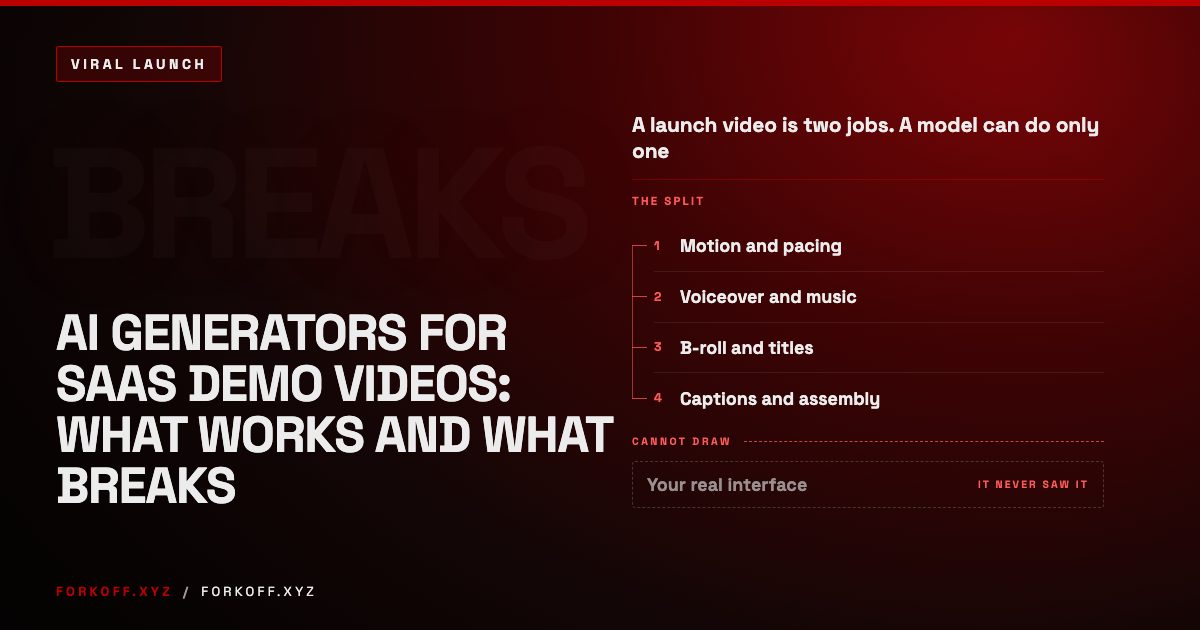
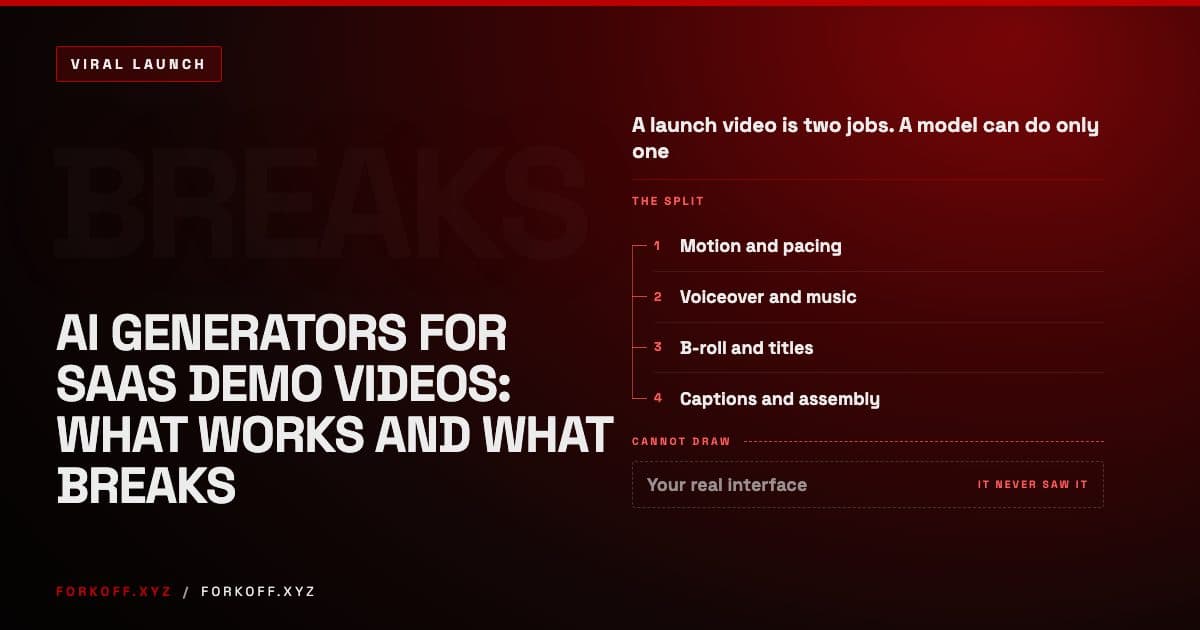
An AI product video generator can now make most of a SaaS launch video for roughly the price of a coffee, and it cannot make the part the video is actually judged on. It will write, score, pace, narrate and cut a clean sixty seconds from a prompt. Ask it to show your product and it draws software in general: buttons in the wrong places, menu items worded almost but not quite like yours, a flow no user of your app would recognise. On a launch video that single failure is disqualifying, because the entire job of a launch video is to make a stranger believe a working thing exists. This post is the split, in both directions: which half to hand a model without hesitation, and which half to keep.
The short version
An AI product video generator is now good enough to do most of a launch video, and the part it cannot do is the part the video is judged on. Motion, pacing, voiceover, music, titles and b-roll all come out usable in minutes for a few dollars. Your actual interface does not. A model asked to render your product invents an interface that looks like software in general: the buttons move, the labels change wording, the flow is not your flow. On a marketing asset for a physical product nobody notices. On a SaaS launch video it is the only thing anyone is looking at, because a launch video's entire job is to make a stranger believe a working thing exists. The split is therefore clean and it is not a compromise. Give the model everything around the screen and keep the screen itself real, which means a screen recording you captured, edited on a timeline, with zooms and cuts placed by a person who knows which two seconds of the flow are the product. Founders keep discovering this the expensive way: the generator output looks polished, it gets posted, and the replies are about the video rather than the product. The market backs the split rather than the shortcut. Nielsen puts trust in earned and peer content at 92 percent against every paid format, Nosto and Stackla measured 81 percent perceived authenticity for human content against 63 percent for AI content, and the IAB found 86 percent of ad buyers using or planning to use generative AI for video creative, which means the polish itself has stopped being a differentiator. What still differentiates is whether the thing on screen is your product.

We ship launch video and launch distribution as separate components, so this question reaches us constantly and almost always in the same shape. A founder has a screen recording, a launch date, and a quote from a studio that made them wince. They try a generator, the output looks genuinely good, they post it, and the replies are about the video instead of the product. Nothing in that sequence is stupid. The generator did exactly what it is good at, and the founder asked it for the one thing it cannot do.
What an AI product video generator actually is, and the two jobs a launch video has to do
An AI product video generator is a tool that takes a text prompt, and sometimes a product URL or a few images, and returns a finished video with motion, music, voiceover and titles already assembled. The good ones produce something watchable in under twenty minutes with no editing skill involved. What separates them from an AI video editor, which matters more than any feature comparison, is the input: a generator starts from a description and invents footage, while an editor starts from footage you already captured and improves it. Both are sold with the same words. Only one of them can contain your product.
A launch video has two jobs and they have different requirements. The first job is evidence: convince a stranger that a real, working thing exists and that it does a specific thing they want. The second job is frame: hold attention long enough for the evidence to land, which is where pacing, music, motion, voiceover and titles do their work. The second job is now close to free. The first job has not moved at all.
One file, two jobs, and only one of them is scarce

That split is the whole post, and it is worth stating before anything else because it decides every downstream question. Budget, tool choice, length, structure and who you hire all resolve once you accept that the frame is a commodity and the evidence is not. If you want the longer argument about which FORMAT the evidence should take, we wrote that separately in cinematic launch video versus raw demo, which is a different question from the one here: that post asks whether to film or to record, this one asks what a model may touch.
Operator noteGive the model everything around the screen. Keep the screen itself real. That is the entire rule.
One more thing is worth settling before the mechanics, because it changes how you read every claim in this post. There is a version of this argument that is really an argument about taste, where a person who likes handmade things explains that handmade things are better. That is not this. The claim here is narrow and testable: a model that has not seen your build cannot reproduce your build, and a launch video is the one format where reproducing your build is the whole deliverable. Everything else about the video, including whether it is beautiful, is downstream of that.
It is also worth naming the direction founders usually get this wrong in, because it is not the direction the internet argues about. The loud argument is whether AI video is good enough yet, and the answer to that is a moving target that will keep moving. The quiet mistake is different and it does not move: a founder pays a human to build the frame, which is now cheap, and gives a model the evidence, which is the expensive part, because the frame is what they can see and the evidence is what they take for granted. Getting the allocation backwards costs more than either choice on its own.
Generated footage versus captured footage, the one distinction that decides your video
A capture reproduces pixels that existed. A generator synthesises pixels that plausibly could have existed. Everything that follows in this post is a consequence of that sentence, and it is the sentence most tool marketing is carefully written to blur. When a vendor page says AI product video, it may mean either thing, and the landing pages look identical because both show a polished result. The difference only appears when you ask what the tool did with your actual software.
A screen recording of your app is a document. It is admissible in the way a photograph is admissible: the thing on screen happened, in that order, with those labels. A generated sequence of your app is an illustration. It is a model's best guess at what your category of software looks like, rendered convincingly enough that a casual viewer accepts it and a prospective user does not. Nobody in your market is a casual viewer of your product. They are the one audience trained to spot exactly this.

The same frame, captured against generated
Interface elements that match your build
All
Same, when the frame is synthesised
None guaranteed
Label drift across two prompts
Common
Cost of the capture itself
Zero
Illustrative comparison of the two workflows rather than a reading from any specific tool or any specific product. No tool is named and no benchmark is implied; the point is the difference in what the two processes can guarantee, which is a property of the process rather than of any vendor.
The practical consequence is a purchasing rule rather than an opinion. Before you spend an afternoon on a tool, look at the first step of its workflow. If it asks you to upload something, it is going to show your product. If it asks you to describe something, it is going to draw one. That single question separates the market better than any feature table, and neither the vendor pages nor the search results make the distinction for you.
The URL-ingesting category deserves a specific warning because it is the one that looks most like a solution. Feed it your marketing site and it will pull your logo, your palette, your headline and often a hero screenshot, then build a video around them. That is genuinely useful and it is still not a demo: a hero screenshot is one frozen state, and what a launch video has to show is a transition between states. A still image of your dashboard, panned across with a music bed under it, tells a viewer that a dashboard exists. It does not tell them the product works.
What do AI generators genuinely do well on a SaaS launch video?
They are good at everything that is not your product, and that is a longer list than founders expect. Voiceover from your own script is now hard to distinguish from a careful human read, and because the words are yours, a synthetic delivery makes no false claim. Music and sound design are pure craft with no truth conditions attached. Titles, captions and lower thirds are typesetting. B-roll, abstract motion and environment shots have no obligation to be true of anything. First-draft pacing is usually reasonable, aspect-ratio variants are close to free, and the whole assembly arrives in minutes rather than weeks.
That is not a small contribution. Measured against the traditional pipeline it is most of the labour and nearly all of the calendar time. A vendor study published by Superscale in January 2026 puts AI-assisted production at roughly 99 dollars to test fifty video variations and about sixteen minutes per asset, against 7,500 to 10,600 dollars and two to three weeks for the traditional equivalent. Treat the exact figures with the caution any vendor study deserves, since the company publishing them sells into the category it is measuring. The order of magnitude is the part that matters and it is corroborated by how the market is behaving.

The behaviour is unambiguous. The IAB's 2025 Digital Video Ad Spend and Strategy Report found 86 percent of ad buyers using or planning to use generative AI to build video creative, with 50 percent already actively doing it, a figure Marketing Dive reported independently from the same study. When most of a market can produce a clean, well-paced, well-scored video for almost nothing, production quality stops being a differentiator. It becomes the floor. Anyone still trying to win a launch on polish is competing on the one axis that just got commoditised.
Polish stopped being the differentiator, and the data says so plainly
The IAB's 2025 Digital Video Ad Spend and Strategy Report found 86 percent of ad buyers using or planning to use generative AI to build video creative, with 50 percent already actively doing it. When most of the market can produce a clean, well-paced, well-scored video for the price of a coffee, production quality stops separating anyone. What remains scarce is the thing a generator cannot supply, which on a launch video is evidence that a working product exists. That is a strategic point rather than an aesthetic one: the moment a capability becomes universal it stops being a reason to choose you.
Source: IAB 2025 Digital Video Ad Spend and Strategy Report, with Advertiser Perceptions and Guideline
There is a second-order point hiding in that statistic and it is the reason this post is not simply a warning. If the frame is free, you should take the free frame. A founder who spends four thousand dollars having a person build the motion graphics around a screen recording is buying something the market now gets for nothing, and spending nothing on the part that is actually scarce. The generator is not the enemy of a good launch video. Misallocating it is.
It is also worth being specific about what good looks like on the generated side, because founders who accept the argument often then under-use the tools out of caution. A well-generated opening for a SaaS launch video is usually four to six seconds, contains no interface at all, establishes the situation the product is for, and hands off cleanly. A well-generated closing is shorter still. The b-roll in between exists to cover a spoken explanation that would otherwise be a static screen. None of that is decoration, all of it is cheap now, and doing it badly by hand is a real cost that nobody needs to pay in 2026.
The same is true of variants. Once you have a master edit, generating fifteen alternative openings to test against each other costs almost nothing and is one of the few places where volume genuinely helps. The hook is the part of a launch video most likely to be wrong and least expensive to change, and it is entirely in the half a model can do. A founder who tests two hooks has tested fewer than they should have.
Where they break: the model redraws your interface
Ask a text-to-video model to show your product and it will produce an interface that is not yours, in five recognisable ways. The labels are wrong, usually plausible synonyms of your real ones. The controls are in different places and sometimes belong to a different kind of application entirely. The flow does not resolve, so screens follow one another without a task ever completing. Text inside the interface is almost words, legible at speed and nonsense when paused. And nothing is ever actually clicked, because there is no input driving the motion, so the whole sequence has the quality of software being demonstrated by a ghost.

Each of those is survivable alone and together they are fatal, because a viewer does not itemise them. They arrive as a single impression: this does not look like a real product. That impression is expensive precisely because it is not articulated. Nobody comments that your button labels drifted. They scroll.
I need to make a short launch video for my SaaS, but it has to show the real product UI not an AI-generated version of the interface that changes buttons, text, or the flow. I already have a screen recording of the key workflow. The problem is making it feel intentional: clean pacing, zooms at the right moments, a few polished motion elements, and something I can use on a landing page or social without it looking like a raw Loom recording.
What AI tool can I use to make SaaS product demo videos?
That is a founder on r/SaaS describing the exact constraint this section is about, and it is worth noting what he already had: a working screen recording of the key workflow. The problem was never capturing the product. It was getting the capture to feel intentional, and the tool he reached for solved that by replacing the capture rather than improving it. This is the most common version of the mistake and it is entirely reasonable, because the tool did not announce which of the two things it was doing.
Operator noteRun the same prompt twice. If the button labels change, nothing in that footage is your product., Behaviour of text-to-video generators, observed
There is a cheap diagnostic buried in the mechanism. Run the same prompt twice and compare the interfaces. If the button labels changed, nothing in that footage is anchored to your product, and no amount of prompt refinement will anchor it, because there is nothing to anchor to. That instability is not a bug being fixed in the next release. It is what synthesis means.
Why can a generative model not hold your interface steady?
The model has never seen your build. It has no access to your component library, your copy deck, your feature flags or your routing, so when asked for your app it synthesises one from the distribution of interfaces it has been trained on. That synthesis is why the output is simultaneously convincing and wrong: it is an excellent average of software, and your product is a specific instance rather than an average.
Text is the hardest surface for this, and interfaces are made of text. A model renders letterforms as shapes rather than as symbols with meaning, which is why interface text so often reads correctly at a glance and dissolves when you pause. Your product name, your menu labels, your empty-state copy and your pricing tiers are all text, all specific, and all exactly the parts a viewer reads to decide whether the thing is real.
Two different products are sold under one label, and the input tells you which is which
The phrase AI video generator covers two workflows that fail in opposite ways. One starts from a text prompt and synthesises footage, which is where invented interfaces come from. The other starts from footage you upload and improves it, which is closer to an editor with a model attached. Both are marketed with the same words and the same landing-page screenshots, and the search results do not separate them either. The cheap way to tell them apart before you spend an afternoon: look at the first step of the workflow. If it does not ask you for a file, it is going to draw your product rather than show it.
Source: FORKOFF read of the ten ranking vendor pages for the head term, 2026-09-12
Frame-to-frame consistency compounds the problem. Each frame is generated with only loose obligation to the one before it, so an element that is correct at second three drifts by second seven. A sparse consumer interface with four large controls survives this reasonably well. A dense B2B interface with a sidebar, a data table, a filter row and eight labels breaks immediately, and dense B2B interfaces are what most SaaS launches are showing. The tools demo best on exactly the products least like yours.
This is also why the problem will not simply be fixed by a better model. A larger model draws a more plausible average interface. It does not gain access to your build. The category that solves this is the one that starts from your footage, and that is a workflow difference rather than a capability difference.
Operator noteEvery product has two seconds that are the product. A model cannot find them. You already know which they are.
A related question comes up often enough to answer directly: will this be fixed. Probably not in the way founders hope, and the reason is structural rather than a bet about capability. Generation improves by learning the distribution better, and your interface is not in the distribution. The route that does solve it is the one already shipping, where a tool ingests your live application or your recording and animates that, and those tools are not competing on model quality at all. They are competing on capture, on zoom logic and on export. So the honest forecast is not that generators will learn your product. It is that the capture tools will keep absorbing the polish that generators currently sell.
That forecast has a practical implication today. If you are choosing a tool you will still be using in a year, choose on the capture side rather than the generation side, because the capture side is where your product stays yours and the polish is arriving there anyway.
There is a variant of the mechanism worth understanding because it explains an otherwise baffling experience. Founders often report that the first generated clip looked great and the second and third got worse, and conclude the tool degraded. It did not. The first clip was usually of a simple state, often an empty or marketing-like screen, and the later ones asked for the states with data in them. Complexity is what breaks the illusion, and the states with data are both the harder ask and the ones a buyer needs to see, so the difficulty curve runs exactly opposite to the usefulness curve.
That inversion is the single most useful thing to internalise from this section. The screens a generator handles best are the screens that persuade nobody, and the screens that persuade are the ones it handles worst. Any workflow that lets the tool choose which screens appear will therefore drift, by default and without anybody deciding it, toward a video full of the least convincing material.
The five-minute test: will a generator survive your product
Before you spend anything, run this on your own product. Pick the single screen you would show a prospect first. Write a one-paragraph description of it, the kind you would give a contractor, and ask a generator for a ten-second clip of that screen in use. Then do it again with the identical prompt. You now have two pieces of evidence and they cost you nothing.
Look at three things. First, compare the two outputs: any label, control or layout element that differs between them is unanchored, and unanchored means invented. Second, pause on any frame containing text and read every string out loud. Plausible-but-wrong is the failure mode, not gibberish, so this has to be done slowly. Third, ask whether a task completes. Watch for a beginning state and an end state with a causal step between them, because a montage of screens is not a demonstration.

The pass condition is narrow and honest: the generator survives your product if the interface it produced is one you would be willing to put in front of a customer as a representation of your software. In practice, for a real SaaS product with real data on screen, it rarely passes. That is useful to establish in five minutes rather than after a production cycle, and it turns an abstract argument into something you have personally seen.
One caveat on the test, because a clean result can mislead. A simple product with three large controls and almost no text will often pass, and that pass is a fact about your interface rather than about the tool. If your product genuinely looks like that, a generator may be able to carry more of your video than this post implies, and you should take that win. What you must not do is generalise a pass on your simplest screen to your densest one. Run the test on the screen you would actually show a buyer, which is usually the one with the data in it.
How do you spot a redrawn interface in a video you did not make?
This is a reader-side skill worth having, partly to audit your own output and partly because watching competitor launch videos this way tells you a great deal about how seriously they took the launch. A video can look excellent at full speed and fail completely at quarter speed, and full speed is the only speed most people ever watch it at, which is precisely why the tells survive into published work.
Freeze on any frame where an interface is visible and read the smallest text on screen. Check whether the cursor is ever in a position that would have produced the thing that just happened. Look at whether the same screen appears twice and whether it is identical both times. Watch for cuts that move away from the interface every two seconds, which is usually an edit hiding instability rather than a stylistic choice. And ask the blunt question at the end: could I now describe, in one sentence, a task this product performs? If not, the video showed you software without showing you a product.

The reason this matters commercially is that the people most likely to run this check are the people most likely to buy. Engineers and operators look at interfaces for a living. A video that passes with a general audience and fails with them has failed with the only audience a B2B launch was for, and it fails quietly, because nobody writes a comment explaining that your menu looked synthetic.
brett goldstein
thatguybg
spectacular and creative launch video - amazing music. aligned perfectly to visuals and is fun. - elite editing. so much diversity but still cohesiveness in the shots. great transitions too - love seeing the REAL product doing stuff - font is great. good example of a simple font… Show more
The hybrid build: capture the product, generate everything else
Here is the workflow, end to end, and it is not a compromise between two positions. It is the allocation that follows from everything above. Record the real interface performing one real task. Cut that recording down to the two seconds that are actually the product. Hand a model everything that surrounds it: the opening, the voiceover, the music, the titles, the b-roll, the closing frame. Assemble the two on a timeline. Test it on somebody who has never seen the product. Then attach the distribution, because the file is the cheaper half of a launch and always was.

The seam is the part people get wrong. A generated opening that cuts hard into a raw screen recording reads as two videos stapled together, and the fix is not more generation, it is treating the captured segment as the hero and letting the generated material inherit its palette and pace. Match the motion: if the generated opening moves fast, your screen recording needs a zoom or a cut inside its first second or the energy falls off a cliff at the join. Match the colour: pull the dominant colour from your actual interface and specify it for the surrounding footage.

Capture quality is worth more attention than founders give it. Record at a high resolution, hide personal data, use a clean account with realistic-looking content rather than test data called asdf, slow your own mouse movements down, and perform the task twice so you have a second take to cut to. Most of the perceived cheapness of a raw demo comes from these details rather than from the absence of production value. We keep the full handover list in the launch video creative brief, which is the artefact that turns a production into a job rather than a discovery project.
Yeah bro, I'd keep the actual screen recording as the source of truth and use AI mainly for the polish. Record the workflow cleanly, then use something that can auto-zoom around clicks, smooth the cursor, cut dead space and add captions/callouts. That way the UI stays 100% real but the final video doesn't feel like a raw Loom recording.
What a model can do on a launch video, and what it cannot
| Part of the job | Can a generator do it | Why | Source |
|---|---|---|---|
| Voiceover from your script | Yes | The words are yours, the delivery is a rendering problem | derived |
| Music and sound design | Yes | No claim about the product is being made | derived |
| Titles, captions, lower thirds | Yes | Text you supply, typeset by a machine | derived |
| B-roll and abstract motion | Yes | Nothing on screen has to be true | derived |
| Pacing and transitions | Mostly | Good defaults, but it cannot know which 2 seconds matter | derived |
| Your product interface | No | It has never seen your build, so it draws software in general | derived |
| The specific flow a new user sees | No | The order of steps is a product fact, not a visual style | derived |
| Deciding what to show at all | No | That is positioning, and it is the founder job | derived |
as of 2026-09-12
Method: Every row is a judgement derived from what a text-to-video model has access to, not a benchmark. A row is wrong if a generator can be shown reproducing a specific real interface, labels and flow intact, from a text description alone. Run the same prompt twice and compare the two outputs; that is the falsification test.
Read the last three rows together. They are the whole video. Everything above them is the frame around it.
Operator noteAn hour on the brief saves a week of production. Nobody believes this until they have paid for the week.
If you want the argument for why the recording has to lead rather than follow, the startup launch video distribution gap covers what happens to videos that never establish the product early, and the launch video readiness checklist covers what has to be true before you shoot anything at all.
The four categories of tool, and which one you are actually shopping for
The search results for this question do not separate four genuinely different products, which is why founders open three tabs and come away confused rather than informed. Category one is screen capture and interactive demo: you record your app, the tool adds zooms, motion, captions and pacing. Category two is avatar and presenter: a synthetic person delivers your script to camera. Category three is generative b-roll: the model invents footage of anything that is not your interface. Category four is ad assembly: the tool takes assets you supply and produces a large number of variants for testing.
Make Scroll-Stopping Product Demos with AI I Descript AI
Descript
The editor half of the market rather than the generator half, at 218,580 views read on 2026-09-12. This is AI polish applied on top of footage you recorded, which is the workflow this post recommends.
Only category one touches your product, and it does so by starting from your recording rather than replacing it. Categories two, three and four are all legitimate and all safe, precisely because none of them is claiming to show your software. The failure this whole post describes happens when a category three tool is used for a category one job, which is easy to do because the marketing for both says AI product video.
The keyword terms this post was scoped against, measured the same day
| Term | Volume per month | KD | Intent | Source | Source |
|---|---|---|---|---|---|
| ai video generator | 246000 | 65 | informational | DataForSEO, billed live | measured |
| product launch video | 260 | 0 | informational | keyword canon | published |
| ai product video generator | 260 | 20 | informational | DataForSEO, billed live | measured |
| ai product video | 210 | 29 | informational | DataForSEO, billed live | measured |
| product demo video | 170 | 23 | informational | keyword canon | published |
| saas demo video | 50 | 1 | informational | keyword canon | published |
| ai generated product video | 30 | 17 | informational | DataForSEO, billed live | measured |
| ai product launch video | no reading | no reading | navigational | sub-threshold against a firing control | measured |
n = 8 · as of 2026-09-12
Method: Resolved through the sanctioned keyword front door on 2026-09-12, canon first and a billed call only where canon held nothing. The positive control is that four rows returned live billed values in the same batch, so the bottom row's no-reading is a real sub-threshold result rather than a dead connection. A row is wrong if the same term returns a materially different volume from the same front door on the same date and geography.
The top row is 946 times the third. That gap is the entire reason this post targets the third and links up to the money page for the second.
Nine of the ten pages answering this question are selling you a generator
We pulled the live United States results for the head term on 2026-09-12 through firecrawl. Eight of the ten organic slots are vendor tool pages, one is a video walkthrough of a single tool, and one is a practitioner writing up a test of six of them. On the closely related query the ranking flips in an instructive way: that same practitioner thread takes the top slot, above every vendor. Read those two results together and the market is telling you what it is short of. It is not short of generators, it is short of anyone who has used them on a real launch and said which half worked.
Source: Live SERP via firecrawl.dev, location United States, pulled 2026-09-12

Look at what that composition is telling you. Eight of the ten organic slots for the head term are vendor tool pages, one is a video walkthrough of a single tool, and one is a practitioner writing up a test of six of them. On the closely related query the ranking flips in a way worth sitting with: that practitioner thread takes the top slot, above Canva, above invideo, above Luma. Google is already seating a first-hand written assessment above every vendor page on this intent. The market is not short of generators. It is short of anyone who has used them on a real launch and reported which half worked. For context on how unowned this was: forkoff.xyz publishes 237 posts, 252 blog URLs sit in the sitemap, and 24 of them are in this category. Not one covered the tooling question.
I tested 6 AI video tools for product marketing. What actually helped
Two practical notes on the capture itself that account for most of the difference between a demo that looks cheap and one that does not, and neither of them costs money. The first is data. Test accounts with placeholder content are the fastest way to make a real product look fake, and it is the one thing in this entire post that is both free to fix and almost always neglected. Populate the account with content that looks like a real customer's, spend twenty minutes on it, and the same footage reads completely differently.
The second is motion. Human mouse movement at normal speed reads as frantic on video. Slow every movement down, pause briefly before each click, and let each state settle for a beat before moving on. Editors do this by hand afterwards and it is much cheaper to do it during capture. Between realistic data and slow deliberate motion, most of the perceived production gap between a raw recording and a studio edit closes, and you have not yet opened a video tool.
What should a SaaS demo video say, and in what order?
Open with the outcome or the interface, never with the logo. Establish one task inside the first ten seconds. Perform that task on real footage, start state to end state, with the causal step visible. Then, and only then, explain why it is different. Close with exactly one thing to do next. That order is not a style preference, it is a consequence of how a feed works: a viewer decides whether to keep watching before your build-up has finished building.

The default founder ordering inverts almost every one of those. Logo, mood shot, abstract statement of the problem, feature montage, second logo, and the product arriving somewhere around twenty-two seconds in. That video is not badly made. It is made in the order a product marketing deck is made, and a deck has a captive audience while a feed does not. If you want the format-level variants of this, launch video types covers when a teaser, a trailer and a sizzle reel each earn their place, which is a different decision from the ordering inside any one of them.
Operator noteIf your interface is not on screen in the first five seconds, the rest of the video is decoration.
Quality itself is read as a trust signal, which is worth knowing before you decide how much of the frame to automate: Wyzowl's State of Video Marketing 2026 reports 89 percent of consumers saying a video's quality affects how much they trust the brand behind it, and 85 percent saying a video has convinced them to buy something. That is usually quoted as an argument for spending more. Read against everything above, it is better read as an argument for consistency, because a beautifully rendered video of a product that does not exist in that form spends the trust it just earned.
The one sentence a viewer should be able to repeat afterwards is the thing to write before anything else. Not a tagline, a sentence: it does X for Y so that Z. If your video does not leave a viewer able to say that sentence, the production quality is irrelevant, because the viewer has nothing to carry into the next conversation. Most launch videos that underperform are not badly shot. They are unrepeatable.
Two structural points that sit underneath the ordering and are easy to miss. The first is that the product reveal has to be real footage and everything around it does not, which means the ordering above is also a production plan: the only segment with a hard dependency on your build is the one in the middle, so it can be captured last, after the rest of the video already exists. Teams that discover this stop treating the launch video as a single blocking task and start treating it as a frame that is waiting for one clip.
The second is that a demo video and a launch video are not the same artefact even though this post has been using the terms together. A demo video answers how does it work, runs longer, and lives on a pricing page or in a sales follow-up. A launch video answers does this exist and is it for me, runs shorter, and lives in a feed. They share footage and they do not share structure, and the most common version of this confusion is a launch video that is secretly a demo, which is the one that opens with a feature tour and loses everybody at eleven seconds.
Voiceover, captions and pacing, the parts to hand to AI without hesitation
Voiceover is the cleanest win in the entire production. The script is yours, so no claim about the product is being delegated, and modern synthesis reads a sentence with appropriate stress well enough that most listeners do not flag it. The two places it still gives itself away are your own product name, which needs an explicit pronunciation, and any sentence longer than about twenty words, where the prosody flattens. Write shorter sentences and supply the pronunciation and the problem mostly disappears.
Captions are equally safe and matter more than founders assume, because a large share of feed viewing is silent. Burn them in rather than relying on platform captions, keep them to a few words per card, and place them where they cannot collide with the interface you worked so hard to capture. Pacing is the one item on this list where a model gives you a good default and not a good answer: it will space your cuts evenly, and a demo video needs to slow down exactly where the task completes, which is a judgement about your product rather than about video.

The one place to keep a human voice is a founder-led launch on a personal account. There the video is not only evidence, it is a person vouching for a claim, and a synthetic read subtracts the vouching while adding nothing. That is a positioning decision rather than a quality one, and it is worth being explicit that it cuts the other way for a committee purchase, where the founder adds little and the interface carries the entire weight.
Video quality is already read as a trust signal, which cuts both ways
Wyzowl's State of Video Marketing 2026 reports 89 percent of consumers saying a video's quality affects how much they trust the brand behind it, and 85 percent saying they have been convinced to buy something by watching a video. That is usually quoted as an argument for spending more on production. On a launch video it is better read as an argument about consistency: if quality is a trust input, then a beautifully rendered video of a product that does not exist in that form is not a neutral event, it is a trust cost that lands after the click rather than before it. The people most likely to notice are the ones who would have bought.
Source: Wyzowl State of Video Marketing 2026
There is a question hiding inside the ordering that founders rarely ask themselves explicitly: what does the viewer doubt. A launch video is an argument, and an argument is only persuasive if it addresses the actual objection. For an unknown product from an unknown team the doubt is usually does this exist and does it work, which is why the evidence job dominates everything else in this post. For a known team shipping a second product the doubt is different, closer to why this and why now, and the video can afford to spend more of its time on positioning and less on proof.
Writing the doubt down before you script anything is a ten-minute exercise that changes the structure. It is also the step that tells you whether you need a founder on camera: if the doubt is about credibility, a person answers it and an interface does not; if the doubt is about capability, the interface answers it and a person cannot.
How long should a SaaS demo video be, per surface?
One edit, several cuts. The main asset runs between thirty and ninety seconds with the interface on screen inside the first five. From that master you cut a fifteen-second version for a feed post, a six to ten second silent autoplay loop for a landing page hero, a vertical crop for short-form surfaces, and a still or short loop for the social card. Those are not separate productions and treating them as separate productions is where launch video budgets quietly double.
The surface decides the crop and the length, not the message. A landing page hero has a viewer who already clicked, so it can be shorter and more literal. A feed post has a viewer who did not choose you, so it must earn the first three seconds. A launch-day post on a founder account is doing a different job again, and the launch week video sequencing piece covers what goes out when across a launch week rather than what goes in any single file.
What does a SaaS demo video cost in 2026?
Three tiers, and every figure below is a reported number with a named source rather than a FORKOFF price. Generator-only sits near the bottom of the range: the Superscale study puts fifty variations at roughly 99 dollars and about sixteen minutes per asset. The traditional equivalent in that same study runs 7,500 to 10,600 dollars and two to three weeks. Above that, the market gets wide and strange: a growth specialist publicly relayed a quote she attributed to another founder, 17,000 dollars for launch video production with 25,000 dollars alongside it for fifty accounts to repost it, and an angel investor posted an account of a seed-stage company spending 600,000 dollars on a single launch film. Both of those are second or third hand. We did not read the original quote in the first case and both companies are unnamed in the second, so treat them as anecdotes about the SPREAD rather than as prices anyone can be held to.
Monthly search volume across the terms this post was scoped against
Read the first bar against the rest. The generic term is 946 times the specific one, which is exactly why an agency competes on the specific one and not the generic one.

What the three tiers actually cost, with each figure's source
| Tier | Cost | Turnaround | Source of the figure | Source |
|---|---|---|---|---|
| AI-assisted asset production | About 99 dollars for 50 variations | About 16 minutes per asset | Superscale study, January 2026, vendor study | published |
| Traditional equivalent in that same study | 7,500 to 10,600 dollars | Two to three weeks | Superscale study, January 2026, vendor study | published |
| A quoted startup launch video | 17,000 dollars production | Not stated | RELAYED on X, August 2026, original not read by us | unknown |
| The reposts quoted alongside it | 25,000 dollars for 50 accounts | Launch day | Same relayed X thread, August 2026 | unknown |
| A reported seed-stage launch film | 600,000 dollars | Not stated | THIRD HAND on X, August 2026, both companies unnamed | unknown |
n = 5 · as of 2026-09-12
Method: The top two rows are published figures from one vendor study of the category that vendor sells into. The bottom three are social posts relaying a quote or an anecdote, so they are tagged unknown rather than published: we did not read the original quote and neither company is named. A row is wrong if the cited post is edited or the study is revised. The only claim this table makes as a whole is the SHAPE, that asset cost fell and reach did not.
Every row is reported, none is a FORKOFF price. Two come from a vendor study of its own category, and the bottom three are relayed or third hand. Only the pattern survives those caveats: asset cost collapsed, distribution cost did not.
Those numbers do not tell you what to spend. What they tell you is that the two halves of a launch moved in opposite directions. The asset collapsed in price. The audience did not. A founder who reads the cheap half and concludes launch video is now a solved problem has optimised the part that was never the constraint, and we have the same finding from the measurement side: across thirty tracked product launches on X, 110.4 million combined views, 67 percent carried an amplified reach signature rather than an organic one. Reach is bought, built or absent. It was never a property of the file.
What the evidence in this post was verified against, and when
| Artefact | Figure read | How it was verified | Source |
|---|---|---|---|
| r/SaaS thread on AI demo tools | 4 upvotes, 11 comments | Our own Reddit data infrastructure, post fetch | measured |
| r/SaaS repo-driven demo counter-example | 30 upvotes, ratio 0.77 | Our own Reddit data infrastructure, post fetch | measured |
| r/AIAssisted six-tool test | 10 upvotes, 27 comments | Our own Reddit data infrastructure, post fetch | measured |
| Launch-video critic teardown | 20 favourites, 5,313 views | Our own X data infrastructure, tweet detail | measured |
| Angel investor cost anecdote | 182 favourites, 23,048 views | Our own X data infrastructure, tweet detail | measured |
| Editor-category vendor walkthrough | 218,580 views | yt-dlp, live read | measured |
n = 6 · as of 2026-09-12
Method: Every figure was read from the platform on 2026-09-12 through our own data infrastructure, never from a search listing and never pasted from a web result. Reddit fuzzes vote counts, so two of these returned slightly different numbers minutes apart and the direct fetch is what is printed. A row is wrong if a fresh read on the same day returns a materially different figure, and engagement on all six will drift upward after publication.
Six artefacts, three platforms, one verification date. The counts move after publication; the date is what makes them checkable.

The asset got cheap and the reach did not, which moves the whole budget question
Set the two reported extremes beside each other. Asset production at roughly 99 dollars for 50 variations at one end, and 25,000 dollars relayed as a quote for 50 accounts to repost a single video at the other, that second figure second hand and carried here as an anecdote rather than a price. Those are the same launch, priced on its two halves, and only one half fell. A founder who reads the cheap half and concludes that launch video is now a solved problem has solved the part that was never the constraint. Our own tracking of 30 product launches on X, 110.4 million combined views, found 67 percent carrying an amplified reach signature rather than an organic one, which is the same finding from the other direction: reach is bought, built or absent, and it was never a property of the file.
Source: FORKOFF State of Launch Videos 2026, 30 tracked launches, plus reported figures from X, August 2026

If you want the full cost breakdown for the production side specifically, what a launch video actually costs goes through production against distribution line by line, and how to get 100k views on a launch video covers the roster approach on the distribution side.
Operator noteThe asset got cheap. The audience did not. Budget the half that did not move.
The launch-day asset set: one edit, many cuts
The main video is one item on a list of about eight, and the other seven are what decide whether anybody sees it. You need the fifteen-second cut, the silent autoplay loop, the vertical crop, a thumbnail that reads at small size, a still frame for the social card, a short looping GIF for the changelog or the email, burned captions on every cut that will autoplay, and a plain-language description that works as post copy without the video attached.
Every one of those comes out of the same timeline, which is why the sequencing matters: build the master first, cut down from it, and never let a surface-specific version become its own production. The cost of ignoring this is not obvious on launch day. It shows up two weeks later when someone asks for a version for a newsletter and it turns into a half-day of work that should have taken ten minutes.

Short-form cuts are their own discipline once the launch window closes, and that is where a clipping motion takes over from a launch motion: the launch video proves the product exists, and the ongoing cuts keep it in front of people afterwards. Those are different jobs with different economics and conflating them is how a launch video ends up being asked to carry a quarter of distribution on its own.
Worth saying plainly, because the cost section can read as an argument for spending more: the correct spend on a launch video is frequently zero on production. A founder who records a clean flow, slows the mouse down, populates realistic data, generates a voiceover and titles, and cuts ninety seconds together has produced something that will outperform a large share of studio work, because it has the evidence the studio work is often missing. The money, if there is money, belongs on the half that did not get cheaper. That is not a pitch against production. It is what the numbers in this section say once you separate the two halves.
The pre-ship QA pass: auditing a generated video frame by frame
Twenty minutes, ordered, before anything is published. Play the video at quarter speed and read every string that appears inside an interface. Freeze on each cut point and confirm the frame you land on is legible rather than mid-transition. Check that the cursor is present and in a plausible position whenever something changes on screen. Confirm the task visibly completes: start state, action, end state. Listen to the voiceover once with the video hidden and check that no sentence claims something the product does not do yet.
Then run the two checks that are not about the file. Show it to somebody who has never seen the product and ask them what it does, and write down their exact answer rather than interpreting it. Then ask whether they believe the product exists. That second question feels blunt and it is the only one that measures what a launch video is for.
The measured authenticity gap is 18 points, and product video is where it bites hardest
Superscale's January 2026 comparison measured perceived authenticity at 81 percent for human-made content against 63 percent for AI-made content, an 18 point gap on a vendor's own study of the category it sells into. Treat the exact number carefully because of who published it, and treat the direction as settled, because it agrees with everything around it: Nielsen has trust in earned and peer content at 92 percent against every paid format, and Nosto and Stackla found people 2.4 times more likely to read user content as authentic than brand-made content. On a launch video the gap is not a feeling, it is a verdict about whether the product is real.
Source: Superscale AI vs Real UGC Performance Study, January 2026, vendor study, alongside Nielsen and Nosto and Stackla
The authenticity gap here is measured rather than felt. Superscale's comparison put perceived authenticity at 81 percent for human-made content against 63 percent for AI-made content, which is a vendor study and should be read as a direction rather than a constant. It agrees with everything around it: Nielsen has trust in earned and peer recommendations at 92 percent above every paid format, and Nosto and Stackla found people 2.4 times more likely to read user content as authentic than brand-made content, a direction Bazaarvoice reaches from the commerce side and one Stackla's own report on authentic visuals reached before the current wave of tooling existed. On a product launch the penalty is sharper than a general authenticity discount, because the failure is not that the video feels synthetic. It is that the product might be.
The brief that keeps a generator away from your interface
| Brief line | What it prevents | Source |
|---|---|---|
| Supply the screen recording as an asset, never a description of the screen | The model inventing an interface | derived |
| Name the single flow, start state to end state | A montage of features nobody can follow | derived |
| State the one sentence the viewer should repeat afterwards | A video that looks good and says nothing | derived |
| List the claims that may not be made | A voiceover promising a feature that ships in Q2 | derived |
| Give the real product name and its pronunciation | A synthetic read mangling your brand in the first line | derived |
| Set the cut point for the interface, in seconds | The product arriving after the viewer left | derived |
as of 2026-09-12
Method: Six lines derived from the failure modes named earlier in this post, one line per mode, rather than from a survey. A line is wrong if following it still produces the failure it claims to prevent, which is testable on any single production.
Six lines. Every one of them is a decision only the founder can make, which is why handing them over is the part that actually saves time.
When should you stop using a generator and hire a human?
Four inputs decide it, and none of them is budget on its own. Interface density: the more your product depends on a dense, text-heavy screen, the sooner a generator fails, and a dense B2B interface fails immediately. Launch stakes: if a fundraise, a board moment or a partner announcement is attached to the date, the cost of a video that reads as fake is not the production fee, it is the launch. Brand requirements: if you have a design system that people recognise, a synthesised approximation of it is worse than no brand at all. And repeat usage: an asset that will be on your landing page for a year is not the same purchase as a test variant that lives for a week.
Who answers the AI product video question on page one, and what they sell
| Result type | Count in the top 10 | What it wants you to do | Source |
|---|---|---|---|
| Vendor tool page | 8 | Start a free trial of that generator | measured |
| First-hand practitioner test | 1 | Read someone who tried 6 of them | measured |
| Video walkthrough | 1 | Watch a tutorial for one tool | measured |
| Independent editorial with no tool to sell | 0 | Nothing on page one fits this row | measured |
n = 10 · as of 2026-09-12
Method: One live United States results page for the head term, pulled through the sanctioned SERP client on 2026-09-12 and classified by reading each ranking URL rather than by matching the domain against a list. A row is wrong if a re-pull on the same date and geography returns a different top 10, which it will over time; the classification, not the ranking, is the claim.
Live United States results for the head term, pulled 2026-09-12. On the sibling query the practitioner test ranks first, above every vendor page, which is the whole opening for a post like this one.
zam
zamdoteth
Some friends of mine from a VC that shall remain unnamed gave a $1.5m seed round check to a startup working on b2b ai healthcare solutions The founders decided to spend $50k on a domain And $600k on the production of a launch video For a b2b healthcare saas
The honest exception list is short and it is real. If you are pre-product with a waitlist, there is no interface to show and nothing is being faked. If the video is a category or concept teaser, the claim is about an idea rather than a build. If you are testing fifty hooks to find the two worth producing properly, generation is the correct tool and the winner gets reshot. If the audience already knows the product exists, as with investors or an internal launch, the evidence job is already done. And if the product is physical, none of this applies, because the thing is the thing.
What we do on a launch is the split this post argues for, run as two components you can take separately. Launch video production builds the asset with the product captured rather than drawn, and launch distribution puts it in front of an audience that could actually buy, priced on audited reach rather than on a production fee. If you want the wider frame, video production covers the lanes either side of a launch and UGC video covers the creator-led format, where the AI question has a genuinely different answer that we worked through in is AI UGC as effective as real UGC and the AI UGC guide.
The people selling generative video already agree with this, and they say so in the instructions
The strongest evidence for the split in this post does not come from anyone sceptical of AI video. It comes from the three loudest advocates we could find, each of whom builds an escape hatch for the interface and none of whom frames it as a concession. That convergence is worth more than any argument we could make, because these are people whose commercial interest runs the other way.
never describe what should be on screen. upload a screenshot of it and let the model only generate the motion. this is the single move that separates pro outputs from AI slop
Read what that is actually saying. It is a workflow instruction from an account with 117,564 followers whose stated business is engineering virality for AI companies, and it is the same rule as this post: never let the model draw the screen, hand it the real screen and let it move the camera. The same thread puts the literal string no AI-generated fake UI into a negative prompt, which is a defect being routed around by somebody who knows the defect intimately. He is not conceding the point. He has simply never been confused about it, because he does this for a living.
The second advocate makes the same move from a different direction. A promoted tool in this category advertises its inputs as your UI, or your code, which is an admission dressed as a feature: the product's own marketing concedes that a prompt is not sufficient input for a product video and that something from the real build has to enter the pipeline. And the third is the most interesting, because it is a working counter-example rather than an argument.
Claude Fable 5 cooked with my product demo video!
That founder's demo video was produced by a model that had the repository. It had the components, the theme and the features, so it emitted render code that draws the real interface deterministically rather than synthesising an approximation of it. Read the thread's 0.75 upvote ratio as the community being split rather than persuaded, but read the mechanism carefully, because it is not the thing this post argues against. It is a third category: not prompt-to-video, not capture-and-polish, but code-driven rendering from the actual source. It is early, it requires your product to be the kind of thing a model can read, and it is the only route we have seen that gets a machine to draw a real interface correctly. If it matures, the split in this post stays exactly where it is and the tooling on the evidence side simply gets better, which is what we said would happen.
The best argument against this post, and what it gets right
The strongest objection to everything above is not that generators are good enough yet, because that is a moving target and arguing about it settles nothing. It is that a captured video is a maintenance liability in a way a generated one is not, and that this is a real recurring cost which the recommendation in this post makes worse rather than better. It deserves a straight answer rather than a footnote.
startups spend weeks and thousands of dollars making launch videos... storyboarding, motion designers, revisions, delays. and the moment the UI changes, the video is useless.
That last line is correct and it is the thing nobody selling launch video wants to discuss. A hand-cut screen recording is a photograph of your product on one day. Ship a redesign, rename a menu, change your pricing tiers, and the video is quietly wrong in a way that is worse than generic, because now it misrepresents a product the viewer can go and check. Most companies never re-record. They leave a stale demo on the landing page for two years and stop noticing it.
Three things follow, and none of them is stop capturing. First, budget the re-record rather than the record: a launch video is a recurring asset and the second capture is far cheaper than the first because the brief, the script and the timeline already exist. Second, capture in a way that survives small changes, which mostly means recording tighter, avoiding long pans across a full page, and not filling the frame with labels that will be renamed. Third, and most usefully, keep the generated frame and the captured centre as separate items on the timeline, because then a refresh replaces one clip rather than rebuilding a video. Teams that structure the edit this way re-record in an afternoon. Teams that baked the interface into a single rendered file do not re-record at all.
It is also worth conceding the narrower version of the objection outright. If your interface changes weekly, and it genuinely does for some pre-product-market-fit teams, then a heavily interface-led launch video is the wrong asset and you should lean on outcome, customers and category instead. That is a real exception and it is not the situation most founders reading this are in, because most launches happen on the day a build stabilises rather than in the middle of a redesign.
One concrete reference point, read from the launch post the critic above was scoring. That video ran 39 seconds and the post carried 3,008,767 views, 12,836 favourites, 969 reposts and 575 replies. It is a video-editing tool, so the product is the thing on screen and the screen is real throughout. The length is the part worth copying: 39 seconds, one product, no build-up.
How this post was measured, and what would falsify it
Every figure above is either ours, read live on 2026-09-12, or published by a named third party. The scoping pass ran 10 seed terms through the public autocomplete endpoint across 410 calls with 0 errors, returning 1,594 unique completions, of which 26 form the AI-tooling tail that decided the angle. The topic pass declares 17 of 21 sources run, 1 structurally blocked and 3 skipped with reasons.
Keyword readings, United States, same day: "ai video generator" 246,000 a month at difficulty 65; "ai product video generator" 260 at 20; "ai product video" 210 at 29; "product launch video" 260 at 0; "product demo video" 170 at 23; "saas demo video" 50 at 1; "ai generated product video" 30 at 17; "product hunt launch" 320 at 25. Four of those were billed live in one batch, which is the positive control that makes the two sub-threshold no-readings real rather than a dead connection.
Search results, 7 head terms pulled through one sanctioned client: People Also Ask present on 7 of 7, an AI Overview on 6 of 7, a video pack on 4 of 7, a local pack on 0 of 7. On the head term the top 10 splits 8 vendor pages, 1 practitioner test and 1 walkthrough, leaving 0 independent editorial pages.
Community and video evidence, read through our own infrastructure: the founder thread at 4 upvotes and 11 comments, the repo-driven counter-example at 30 upvotes and a 0.77 ratio, the six-tool test at 10 upvotes and 27 comments, one teardown at 20 favourites and 5,313 views, one cost anecdote at 182 favourites and 23,048 views, and one vendor walkthrough at 218,580 views. Follower counts on the three accounts quoted: 29,163, 5,088 and 44,596.
Third-party figures, each named at the point of use: 86 and 50 on generative-AI adoption among ad buyers, 81 against 63 on perceived authenticity, 92 on trust in earned media, 2.4 as an authenticity multiple, 89 and 85 from the video-marketing survey. Our own launch tracking covers 30 launches and 110.4 million views, 67 percent of them carrying an amplified signature against 33 percent organic.
What would falsify the argument: a text-to-video generator reproducing a specific real interface, labels and flow intact, from a description alone, stable across 2 identical prompts. Until that exists, the split holds.
The blunt answer
Use the generator. Use it for the voiceover, the music, the titles, the b-roll, the pacing and the first assembly, and do not feel clever about paying a person for any of that in 2026. Then record your actual product doing one actual thing, put it in the middle, and protect it from the model entirely. The reason is not craft and it is not authenticity in the abstract. It is that your launch video has exactly one job a stranger cares about, and a model that has never seen your build cannot do that job, however good the thirty seconds around it look.
The measurement is what settles it afterwards. Track hold rate at three seconds, completion across the product segment, click-through to the product, and qualified views inside the audience that could buy, which is the same set the first thirty days of launch metrics is built on. Ignore the raw view count on its own. It is the easiest number to buy, the hardest to read, and the one most likely to convince you that a video worked when the only thing that moved was the counter. If you want the worked examples rather than the argument, the best product launch videos of 2026, scored against one rubric is the companion piece, and how to make a viral startup launch video is the short-form version of this whole page.