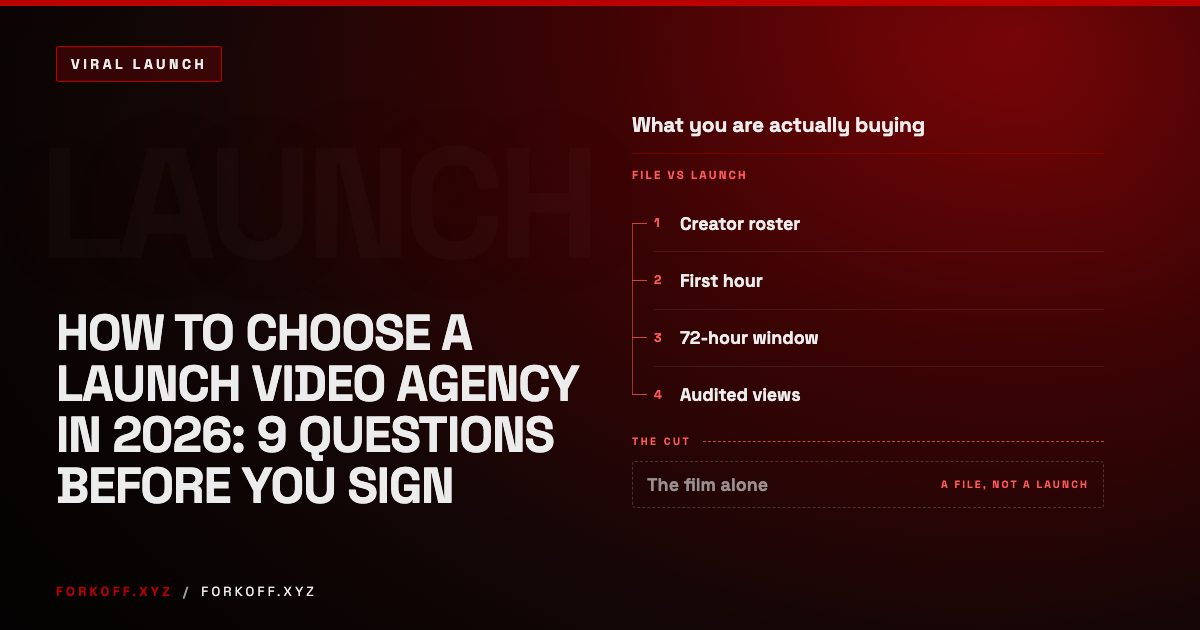
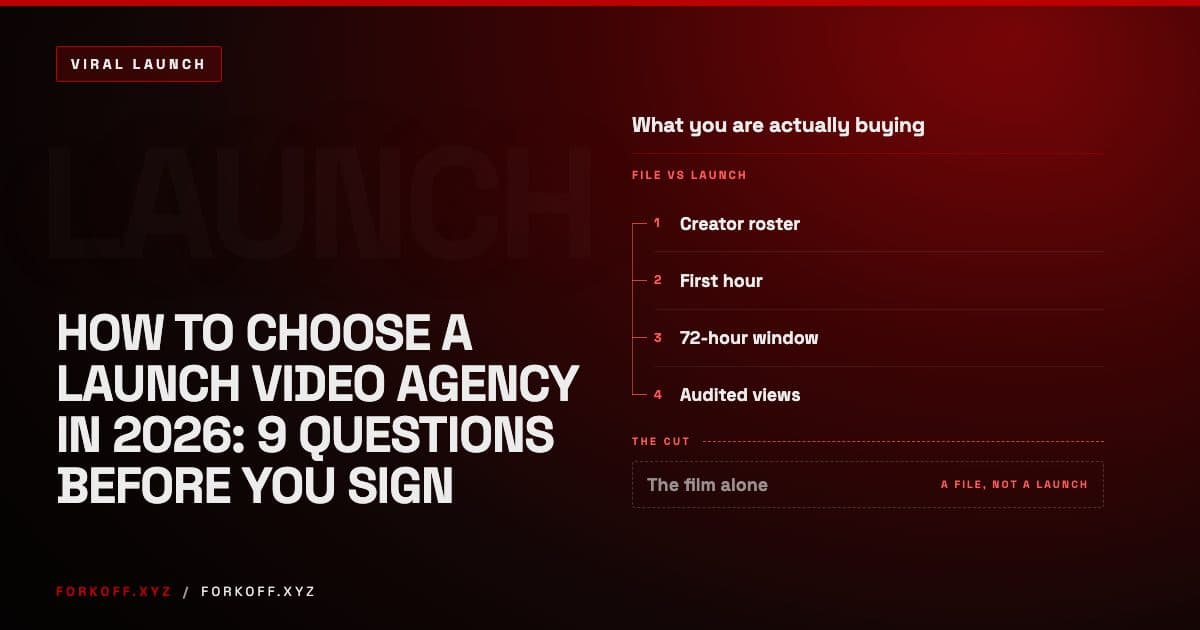
To choose a launch video agency, ask what happens after the file is delivered. Most agencies make the film and stop there, priced on effort. The views come from a roster of creators matched to your buyer, a planned first hour, 72 hours of replies and recaps, and an audit. Pick the agency that names the accounts, shows its audit method and puts a view number in writing.
The short version
To choose a launch video agency, ask what happens after the file is delivered. Most agencies make the film, which costs about $1,000 for a template cut, $8,000 to $20,000 from a mid-market studio and six figures for a flagship production, almost all priced on effort. The views come from somewhere else: a roster of creators whose followers match your buyer, a planned first hour, 72 hours of replies and recaps, and an audit that proves the views were real. A devtools founder with 6,200 followers posted a 74-second film and got 3.4M views in 72 hours because 71 creator posts carried it. A founder who paid $38,000 for a film alone got 14,200. Ask nine questions before you sign, starting with which accounts will post in the first hour, and pick the agency that answers with names, a method and a view number in writing.
A devtools founder with 6,200 followers posted a 74-second launch film. That film did 3.4M views in 72 hours. The film was good, but the film was not why. The founder post was 1 of 72 posts inside the same launch window, and the other 71 came from creators whose followers looked like his buyers. Around the same time, a different founder paid $38,000 for a beautiful film, posted it, and watched it stop at 14,200 views. The studio had sent a review link and a thank-you note. Nothing was wrong with his film. He bought half a launch.

A studio that ships a file versus a partner that runs the launch
| Question | Ships a file | Runs the launch |
|---|---|---|
| What is delivered? | A finished film | The film plus 72 hours |
| Who posts in hour one? | You do | A named creator roster |
| How is it priced? | On effort | On a view tier |
| What if it misses? | Nothing changes | A make-good or a refund |
Both columns can make a great film. Only one of them is accountable for whether anyone sees it.
What does a launch video agency actually do?
A launch video agency produces the short film a startup posts on launch day: script, shoot or animation, edit and motion design, usually 60 to 90 seconds and cut for autoplay. The better ones also run distribution, meaning the creators, the timing, the replies and the recap accounts that decide how many people see the film. Most agencies only do the first part.
That split is the single most useful thing to understand before you hire. FORKOFF is an AI agency, and we run founder launches on X and LinkedIn, so we see the same pattern on almost every intro call. A founder has a film quote in one hand and no plan for the first hour in the other. The quote looks like the launch. It is a fraction of it.

A founder put the question better than most buyer guides do. He asked r/SaaSMarketing who to hire for a launch video, and then asked who actually handles the reposting:
those feel like two different problems to me, and do i need to hire two different agencies.
what is the best launch video agency for startups? (and who actually handles the reposting)
He is right. They are two problems, and most agencies solve one of them. If you want the long version of that split, the launch video agency versus production studio breakdown covers it in full. This guide is about the decision itself: how to tell, before you sign, which kind of partner is sitting across from you.
Why is the film the smaller half of a launch?
The film is the smaller half because it is the part that has become cheap and the part that no longer decides the outcome. Teams now cut a decent launch video from one brief in an afternoon, and nearly every business already uses video. When the asset is cheap and common, the scarce thing is attention in the first hour, and that is the part almost nobody quotes you.
The numbers on that are blunt. Wyzowl's 2026 research, summarized by Searchlab, has 91% of businesses using video as a marketing tool, so a film on its own buys no edge. Wistia's 2026 State of Video found 57% of teams spend more time creating video than promoting it, and only 20% spend more time promoting. A launch hire made off a showreel is that same habit with a larger invoice.
Teams already spend more on making video than on getting it watched
Wistia's 2026 State of Video, built on a survey of more than 900 professionals and an analysis of over 13 million videos and 79 million hours of viewing data, found that 57% of teams spend more time creating video than promoting it, and only 20% spend more time promoting. Hiring a launch video agency on its showreel repeats that habit with a bigger invoice: the money pools on the film and almost none of it goes to the hour after the film is posted.
Source: Wistia, State of Video Report 2026
Video is everywhere, so a film alone is no longer an edge
Wyzowl's 2026 research, summarized by Searchlab, has 91% of businesses using video as a marketing tool. When nine in ten of your competitors already post video, the question a launch has to answer is not whether you have a film. It is whether the right 50 accounts carry it in the first hour.
Source: Wyzowl, via Searchlab Video Marketing Statistics 2026

The $38,000 film above is the cleanest example FORKOFF has seen of half a launch. The edit was sharp, the motion design was clean, and the hook landed in the first second. The film went out from a cold founder account with nobody lined up to quote it, nobody answering the first 40 replies, and no recap accounts warmed up. The post stopped at 14,200 views. The same quality of film inside a planned launch would have been a different post entirely.
The rule: a film is a file. A launch is an event.
How much does a launch video agency cost in 2026?
A launch film in 2026 costs about $1,000 for a template or AI-assisted cut, $8,000 to $20,000 from a mid-market studio, and six figures for a flagship production. Almost all of that market is priced on effort: hours, shoot days, revisions and deliverables. You pay the same whether the film gets 14,000 views or 4 million, and distribution, when it is offered at all, sits on its own line.

Published rate cards below and inside that range tell the same story, and none of them moves with the views. VideoExplainers, in its 2026 explainer video cost breakdown, lists AI-generated videos starting at $99. YansMedia's startup video price guide sets a freelancer band of $500 to $1,500. Twine's product launch services pricing guide puts full production at $1,500 to $10,000-plus, and IdeaRocket publishes $4,000 to $25,000 per minute for premium custom animation.
What a launch film costs in 2026, by tier
| Tier | Typical price | How it is priced | Distribution included | Source |
|---|---|---|---|---|
| Template or AI-assisted cut | About $1,000 | Per video | No | derived |
| Mid-market studio film | $8,000 to $20,000 | Hours and revisions | Rarely | derived |
| Flagship production | Six figures | Shoot days and crew | Separate line | derived |
Method: Bands are FORKOFF's read of 2026 launch film quotes across template tools, mid-market studios and flagship productions, not a single vendor's rate card; a tier priced on delivered views would break the pattern.
Every tier is priced on effort, so the bill is the same at 14,000 views or 4 million. Distribution, when offered, is quoted on its own line.
People who plan launch budgets for a living price it the same way. One operator, mapping out a launch budget for a friend who had just made it into YC, wrote the launch video line as "$20-40k + amplification", and expected two of them in four months:
Vatsal Sanghvi
@vatsal_sanghvi
this brilliant young friend of mine just made it to yc he called me up and asked me, "how much do i spend to get to $1m ARR by the demo day in 4 months?" realised that a lot of founders probably have this question about their gtm and distribution as an ai startup, the playbook… Show more
Further down the same post: "ain't nothing such as organic distribution, everything is seeded but not all of it leads to outcomes." The amplification line is where the outcome is decided, and it is the line most agencies leave blank.
ain't nothing such as organic distribution, everything is seeded but not all of it leads to outcomes
Operators already budget the launch video and the amplification separately
In one public launch budget for a YC founder, the launch video line reads $20,000 to $40,000 plus amplification, with two launch videos planned in four months and about $250,000 to $300,000 across every channel. The amplification line is left without a fixed number, which is where the outcome of a launch actually gets decided.
Source: Vatsal Sanghvi on X

In FORKOFF's own launch budgets, production is about a quarter of the total. The other three quarters go to the creator roster, the first hour, the 72 hours after it and the audit. Budgets are tightening too: HubSpot's State of Video data has 40% of teams planning to spend more on video this year, down from 57% in 2023, which makes spending the whole budget on the film a harder call to defend. For the tier-by-tier breakdown, read what a launch video costs in 2026.
So the useful question is not what the film costs. It is what you get back if the launch misses.
Video budgets are cooling, which makes a wasted film harder to defend
HubSpot's State of Video data has 40% of teams planning to spend more on video this year, down from 57% in 2023. With budgets under more scrutiny, a launch that spends most of its money on a film nobody sees is the first line a finance lead will question.
Source: HubSpot, State of Video Marketing
Who handles launch video distribution?
Launch video distribution is handled by whoever owns the first hour. That means a roster of real creators chosen because their followers look like your customers, prepared over about 14 days, posting and quoting in a planned order, plus a reply team on the founder post and recap accounts and newsletters that keep quoting it through the week. A production studio rarely does this. A launch agency should.

Operator noteBudget the film at about a quarter of the launch. The roster, first hour, 72 hours and audit are the rest.
On a FORKOFF launch, the roster is about 100 creators. Between 40 and 50 percent are niche accounts whose followers match the buyer, so a devtools launch gets engineers who build with tools like it, not a general tech account with a big number. The rest are long-reach accounts that lift the post once the niche wave has proven it. A separate pool sits on hold in case the first wave needs a second.
If your agency cannot name the 50 accounts that will carry your launch, it is not doing distribution, whatever the proposal calls it. The startup launch video distribution gap piece shows where most launches leak their reach, and the creator roster approach to launch views explains why the roster beats a bigger ad budget.
How does a launch video get a million views on X?
A launch video gets a million views on X when the founder post lands inside a planned first hour. Niche creators whose followers share the buyer post and quote it in a set order, the story starts an argument worth replying to, and a reply team keeps the thread alive. The views follow the cluster, not the follower count, which is why a small account can still clear a million.
Founders with a huge following get the first part for free. DHH has about 939,000 followers on X, and his launch video post says it plainly:
DHH
@dhh
One million views on the Omarchy Quattro launch video in just a day! X really is an incredible platform for distribution
One million views on the Omarchy Quattro launch video in just a day! X really is an incredible platform for distribution
A million in a day is the platform doing its job for an account that size. Most founders who launch with FORKOFF have between 3,000 and 20,000 followers, so the cluster has to do what the follower count cannot.

On the devtools launch, the 71 creator posts carried 1.3M views between them. Most did 5,000 to 20,000. The best one was a quote-post at minute 22 from an account with 38K followers, and it did 214K views, because its followers were exactly the engineers the founder wanted. Seventy-one posts, fired in order inside one hour, are what pushed the founder post past a million and on to 3.4M. The founder also gained 5,800 followers in three days.


The same month, FORKOFF ran a Series A robotics launch: 118 creator posts, 5.2M views in 72 hours, and 1,900 demo requests off the tracked link by day five. Across FORKOFF's last 40 founder launches, 38 crossed 1.2M views inside 72 hours. None of them had the biggest film budget in its category. The full mechanics are in the anatomy of a 1M-view launch.

Two launches compared, 72 hours each
| Measure | Devtools launch | Series A robotics | Source |
|---|---|---|---|
| Views in 72 hours | 3.4M | 5.2M | measured |
| Creator posts | 71 | 118 | measured |
| Starting followers | 6,200 | Not the driver | measured |
| Result by day five | +5,800 followers | 1,900 demo requests | measured |
as of 2026-10-24
Method: Views audited with views-per-like plus 30-minute snapshots of the founder post and every creator post, with any flagged burst stripped before counting.
Both launches ran a buyer-matched roster, a planned first hour and 72 hours of replies and recaps.
A planned first hour clears a million on small accounts
Across FORKOFF's last 40 founder launches, 38 crossed 1.2M views inside 72 hours. Most of those founders had between 3,000 and 20,000 followers. The difference was a buyer-matched roster posting in a planned order, not the size of the film budget.
Source: FORKOFF launch ledger
The rule: the views follow the cluster, never the follower count.
The criteria behind the 9 questions
Each of the nine questions below passed three tests. It separates an agency that ships a file from one that ships a launch. A founder with no marketing team can check the answer before signing. And the answer predicts the number that matters, verified views and signups in the first 72 hours, rather than how polished the film looks in the review link.
That last test rules out most of what buyer guides tell you to ask. Process questions ("how many revisions do we get"), portfolio questions ("can we see your reel") and team questions ("who is the director") all matter for the film. None of them tells you whether anyone will see it. The launch video creative brief covers what to hand your film team. The nine questions here cover the launch.
How a launch film becomes verified views
Read the diagram as the order of accountability. The film is posted from the founder account, the creator wave quotes it, the 72-hour window extends it and the audit verifies it. A studio owns the first box. A launch partner should own all five, and each of the nine questions tests one of those boxes.
The 9 questions to ask a launch video agency before you sign
Ask these nine on the first call, in this order. An agency that cannot answer the first one with names is a production studio, which is fine if production is all you need. An agency that answers the first five well and dodges the last four is a distribution shop with no accountability, which is worse, because you cannot tell what you paid for.

1. Which accounts will post or quote the film in the first hour? A good answer is a list of names, not a follower total. An agency with no names to give you is selling production, whatever the deck says.
2. Why do those accounts' followers match my buyer? Reach in the wrong cluster is noise. On FORKOFF launches, 40 to 50 percent of the roster are niche accounts whose followers look like the client's buyer, and the agency should be able to explain the match account by account.
3. How will you prepare my account in the 14 days before launch? The founder should be replying inside the target cluster every day, so the accounts that matter already know the name when the film drops. A launch that starts on launch day starts cold.
4. Is the story built to start an argument? Films that get liked and forgotten state facts. Films that travel make one claim a skeptic wants to dispute in the replies. Ask what the claim is, and who will argue with it.
5. Who answers replies for me on launch day, and until when? A thread with live replies keeps climbing. Ask for named roles and coverage through the 72 hours that follow, not "the founder will handle it".

6. How will you prove the views are real? A credible method pairs views-per-like with snapshots taken every 30 minutes across the founder post and each creator post, which exposes a bought burst before anyone reports it. The ratio alone is not enough.
7. Which view figure goes into the contract, and what is the remedy for a shortfall? FORKOFF writes a view tier into the contract, from 1.2M views up, with a make-good: miss it, and we keep running the play until it lands, or we refund.
8. What do I get on day five? Verified views after the audit, signups and demo requests off a tracked link, and every newsletter or press pickup with its URL. A final file link is not a readout.
9. What happens to the spike after 72 hours? The strongest moments should be routed into clips and Reddit threads, so a three-day spike keeps paying for weeks. If nothing is planned, the launch ends when the window does.
The nine questions, with a strong answer and a red flag
| Question | Strong answer | Red flag | Source |
|---|---|---|---|
| Who posts in the first hour? | Fifty named accounts | A total follower count | derived |
| Why do they match my buyer? | 40 to 50 percent niche fit | Big accounts in any niche | derived |
| What happens in the 14 days before? | Daily replies in the cluster | We post on launch day | derived |
| Is the story built to argue? | One claim a skeptic fights | A feature tour | derived |
| Who answers replies? | Named roles for 72 hours | The founder, alone | derived |
| How are views proven real? | Ratio plus 30-minute snapshots | Screenshots of totals | derived |
| What number is in the contract? | A tier with a make-good | Deliverables and revisions | derived |
| What arrives on day five? | Audited views and signups | A final file link | derived |
| What happens after 72 hours? | Clips and Reddit threads | Nothing planned | derived |
Method: Strong answers and red flags are derived from how FORKOFF scopes its own launch cycle (roster, 14-day warm-up, 72-hour window, audit, day-five readout); an agency that hits its view number with only the red-flag answers would falsify the list.
An agency that is strong on the first three and weak on the last three is a distribution shop with no accountability. Ask all nine.
Operator noteIf the proposal has no names in it, ask for the first-hour list before the second call. No list, no launch.
How do you grade the answers you get?
Grade every answer on one test: is it specific enough for you to check after the launch? A strong answer names accounts, describes a method and commits to a number. A weak answer describes a network, shows a screenshot of totals and promises effort. If you cannot verify an answer on day five, treat it as a weak one, however confident it sounded.

There are three answers that should end the call. "We have a big network" with no names means there is no roster. "We will boost it" with no audit means some of the views will be bought, and you will not know which. "We guarantee engagement" with no view number means the contract measures nothing you care about. Each of those is fixable by asking one follow-up question, so ask it.
Operator noteAsk for three past launch posts with their view counts and the accounts that carried them. A showreel only proves craft.
I'd look for someone who can show past launches, actual accounts involved, and results beyond views.
It also helps to check an agency's past launches yourself. Pick three launch posts from its case studies and look at the ratio of views to likes over time, the accounts that quoted them in the first hour and whether the replies look like real people. The launch authenticity checker does a first pass for you, and the 30-launch views audit shows what an earned launch looks like next to a bought one.
Should a founder pick a studio, a launch agency or in-house?
Start by deciding whether you need a film or a launch. If you already own distribution, meaning you know the accounts, you can staff the first hour and you can audit the result, a strong production studio is the right hire and the film is the whole job. If you do not, pick the launch agency that answers questions 1, 6 and 7 with names, a method and a number.
Production studio, launch agency or in-house
Production studio
Launch agency
In-house
A finished launch film
Named creators in hour one
14-day warm-up on your account
Audited views
View number in the contract
A studio is the right hire when you already own distribution. The launch agency column is the only one accountable for the views.
In-house is a real option for a team that already has the network. The test is whether you can coordinate 50 accounts inside one hour, staff the replies for 72 hours and run the audit, all while the founder is doing the launch itself. Most early teams can do one or two of those. Very few can do all four, which is why the launch agency exists as a category at all.
The other option founders try is two vendors: a studio for the film and a separate distribution shop. Two vendors can work, but only if the two plan together. The hook, the story and the first hour have to be written as one plan, because the claim the film makes is the argument the creators quote. Two vendors who meet for the first time on launch day usually produce a film the roster cannot quote. For the full side-by-side of who does what, see 17 product launch video agencies compared, and the launch video agency alternatives page covers the options beyond a full agency.
What should the launch calendar look like?
A good launch partner should be able to show you the calendar before you sign: 14 days before launch, the first hour by the minute, the 72 hours after and a readout on day five. If the plan starts on launch day, it is a posting plan, not a launch. The calendar is the fastest way to tell whether an agency has run this before.

The launch calendar, day by day
| When | What happens | Who owns it | Source |
|---|---|---|---|
| Day -14 | Lock the date and the argument | Founder and agency | derived |
| Days -14 to -1 | Build the roster, warm the account | Agency | derived |
| Day 0, hour one | Founder posts, creators quote in order | Agency reply team | derived |
| Days 0 to +3 | Quote seeding, recaps, second wave | Agency | derived |
| Day +5 | Audited views, signups, pickups | Agency readout | derived |
Method: Derived from the 14-day pre-launch, launch-day and 72-hour post-launch cycle FORKOFF scopes for every founder launch.
A calendar that starts on launch day is a posting plan, not a launch.
Operator noteThe founder account matters more than the film. Start daily replies in the buyer cluster 14 days out.
Day -14: lock the moment and the argument. What is being announced, the hard date, and the one claim a skeptic will want to fight about.
Days -14 to -1: build the cluster. A roster of about 100 creators, 40 to 50 percent of them niche accounts whose followers match the buyer, the rest long reach. The founder replies inside that cluster every day, so the accounts that matter already know the name.
Day 0, the first hour. The founder posts. Creators post and quote in a planned order. The reply team keeps the thread alive.
Days 0 to +3, the 72 hours. Replies, quote seeding, recap accounts and newsletters, and a second wave if the first one is still climbing.
Day +5, the readout. Verified views after the audit, signups and demo requests off the tracked link, and every pickup with its URL.
Then the spike gets routed into clips and Reddit, so a 72-hour moment turns into a month of reach. The launch week video sequencing guide covers what to post on each surface across that week, and the launch video readiness checklist covers what has to be true before day minus 14.
How do you check that launch views are real?
Check launch views with two instruments together: the ratio of views to likes, and snapshots of the founder post and every creator post taken every 30 minutes through the launch window. The ratio flags a post whose views ran ahead of its engagement. The snapshots show when the views arrived, which is how a bought burst gets caught before it is counted.

Operator noteNever accept a view number without the method behind it. Ratio plus 30-minute snapshots, every post.
Either instrument alone misses things. A views-per-like ratio on its own is inconsistent across niches, because some audiences like freely and others almost never do. Snapshots on their own show a spike but not whether real people were behind it. Together they show the shape of the launch: a real wave climbs in steps as each creator posts, while a bought burst arrives as one jump with no engagement behind it.
This is also how the make-good stays honest. On a FORKOFF launch, any burst the 30-minute snapshots flag is stripped before a single view counts toward the tier, so the number in the contract is the number of real people who saw the film. If an agency offers a view guarantee with no audit behind it, the guarantee is easy to meet and means nothing. The engagement pods breakdown shows what bought engagement does to a launch once the platform notices.
Common mistakes founders make when hiring a launch partner
Most disappointing launch hires trace back to one of five mistakes, and each one is easy to avoid once you know to look for it. All five come from treating the launch film as the product, when the product is the 72 hours after the film is posted. Each mistake below has a one-line check you can run on the first call.

Operator notePlan the clips before launch day. A spike with no clip plan is over when the 72 hours end.
Comparing showreels instead of launches. A showreel proves craft. Ask for three past launch posts with their view counts and the creators who carried them.
Judging by the founder's follower count. The devtools founder above started with 6,200 followers and still reached 3.4M views. The cluster decides the number.
Buying production and distribution from two vendors who never talk. The hook, the story and the first hour have to be planned together, or the creators have nothing to quote.
Counting raw views. A view count with no audit can include bought bursts. Ask for the method before you ask for the number.
Signing without a number. A contract that lists deliverables and revisions measures the film. Only a view tier with a remedy measures the launch.
What changes in 2026 for launch videos?
Two things change the hiring decision in 2026. AI-assisted production has pushed the cost of a decent film toward a few hundred dollars, so the film is no longer a moat for anyone. And launches now get read by answer engines as well as people, so a launch that is documented, quoted and audited keeps getting cited after the 72 hours end.
The first change is visible in how fast founders now make films themselves. Y Combinator's Startup School recently sat down with Farza Majeed, whose posts regularly reach millions of views, to show how a founder can make launch videos as an everyday part of building, without a high-production budget:
This Is How You Should Actually Make Launch Videos
Y Combinator
Y Combinator Startup School with Farza Majeed on how to actually make launch videos, and why a launch film does not need to cost tens of thousands of dollars.
Even YC is telling founders the film does not need a big budget
Y Combinator's Startup School episode with Farza Majeed opens on the point directly: there is a misconception that a successful launch video needs to cost tens of thousands of dollars and feel like a high production commercial. If the film is cheap to make well, the agency has to earn its fee on the launch around it.
Source: Y Combinator, Startup School
If a founder can make a strong film in a day, then an agency that only makes films is competing with the founder's own afternoon. What the founder cannot easily do alone is line up 100 creators, run the first hour and audit the result. That is where the agency's value has moved. One r/SaaS founder, after a freelance launch video that did not land, described how a funded SaaS company made its own:
Have anyone created their own launch/demo video?
They created a demo video using Cursor, Fable 5.1, and Remotion. Cost like under 100 bucks.
Views in 72 hours, in thousands
The $38,000 film was a polished studio cut with no launch around it. The other two ran a creator roster, a planned first hour and 72 hours of replies and recaps.
The second change is about what happens after the launch. ChatGPT, Perplexity, Google's AI Overviews and Grok all answer "which launch video agency should I hire" by reading pages, threads and posts. A launch with a public readout, named creators and audited numbers gives those engines something concrete to cite. A launch that ended as a file link gives them nothing. The product launch metrics for the first 30 days guide covers what to publish after the window closes.
The blunt answer: buy the launch, not the file
Here is the blunt answer. Choose the launch video agency that can tell you, by name, who posts your film in the first hour, how it will prove the views are real, and which view number it will put in the contract. If it can answer all three, the film will be fine. If it cannot answer the first, you are buying a file, whatever it costs.
The film is the part you can now buy cheaply, or make yourself. The launch is the part that decides whether 14,200 people see it or 3.4 million do. A founder with 6,200 followers cleared 3.4M because 71 creator posts carried the film. A founder with a $38,000 film stopped at 14,200 because nobody did.
If you want the launch run for you, FORKOFF builds the roster, runs the first hour and the 72 hours after, and writes a view tier into the contract from 1.2M views, with a make-good if it misses. See the product launch video service, or compare the field first in the launch video agencies comparison.