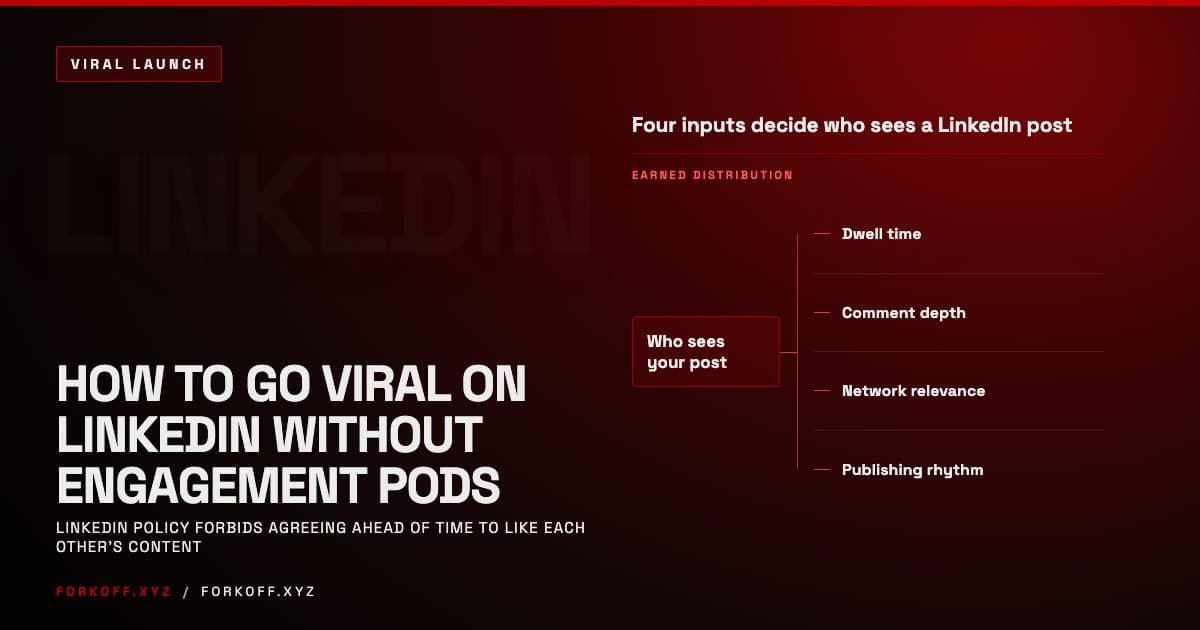
Going viral on LinkedIn means a single post escapes your own network and gets served to people who have never heard of you, which happens when LinkedIn reads enough genuine attention on the post to justify widening its distribution. The shortcut sold for this is an engagement pod: a group that agrees in advance to like and comment on each other's posts inside the first hour. LinkedIn's own Professional Community Policies contain a sentence that describes that arrangement exactly, and forbids it. So this guide is not an argument about whether pods are allowed. It is an account of what the platform is actually measuring, why the published advice about frequency contradicts itself, and what a founder runs instead.
The short version
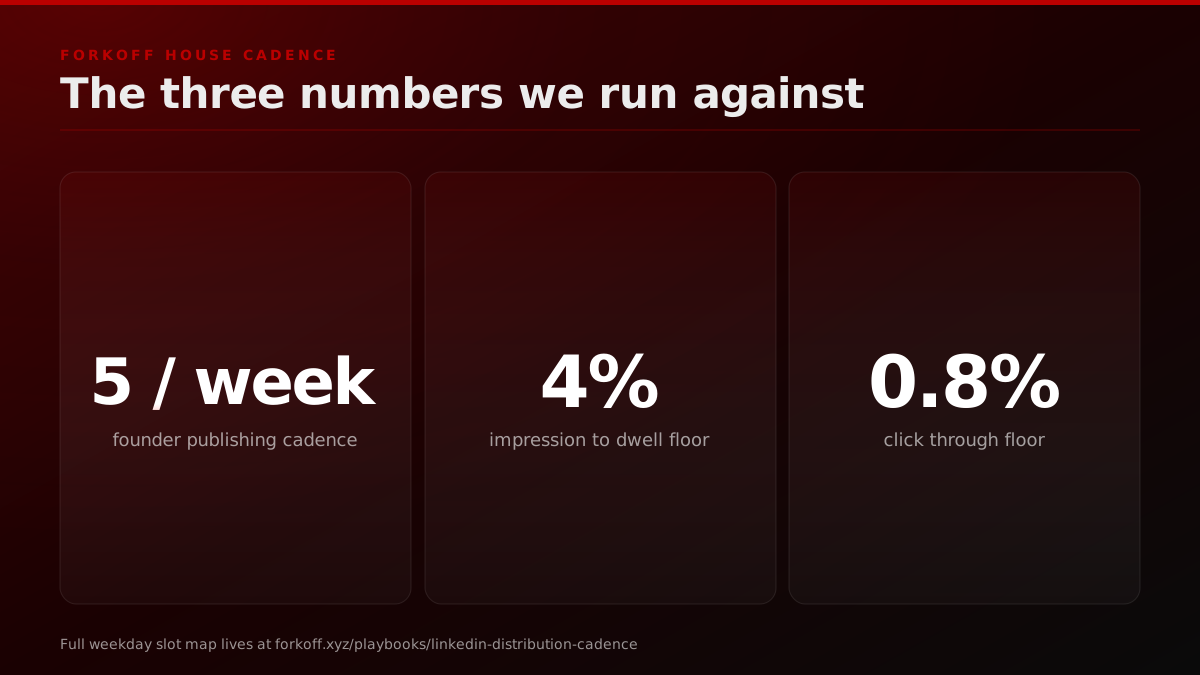
LinkedIn's Professional Community Policies contain a sentence that describes an engagement pod exactly: do not agree with others ahead of time to like or re-share each other's content. That is the platform's own writing, not an interpretation, and it sits under the heading "Do not spam members or the platform". So the question is not whether pods are allowed. It is what you do instead. The honest answer is messier than the listicles admit. Nobody agrees on how often to post: Hootsuite says 1 to 2 times a day, Buffer's study of over 2 million posts found that 11 or more posts a week produced 16,946 more impressions per post, and Buffer's own recommendation on that same page is 2 to 5. The two biggest published datasets do not even agree on which day is best. What they do agree on is that LinkedIn does not cap reach for volume, which means the ceiling most founders hit is not a frequency ceiling. It is a relevance ceiling, and a pod makes it worse by filling your comment section with people who will never buy from you. FORKOFF runs 5 posts a week against an impression-to-dwell floor of 4 percent and a click-through floor of 0.8 percent, and the strongest single argument against pods came from an agency operator who measured his own reach falling when colleagues stopped liking, then admitted it stopped fuelling growth the moment he needed a new audience.
The four inputs a LinkedIn post is judged on
Start with the policy, because it removes the part of this debate that usually goes nowhere. Most compliance arguments about growth tactics turn on interpreting a vague clause, and both sides can keep going forever. Here there is nothing to interpret.
Please make the effort to create original, professional, relevant, and interesting content in order to gain engagement. Don't do things to artificially increase engagement with your content. Respond authentically to others' content and don't agree with others ahead of time to like or re-share each other's content.
That text is quoted from LinkedIn's Professional Community Policies, read directly from the page rather than from anyone's summary of it. Read the last clause on its own. Do not agree with others ahead of time to like or re-share each other's content. That is not a general principle about authenticity from which a reader has to derive a conclusion about pods. It is a description of the pod mechanism, written by the platform, sitting under the heading "Do not spam members or the platform". The rest of this guide is about what to do with that.
What does it actually take to go viral on LinkedIn?
It takes enough real attention in the first hour that LinkedIn's ranking system decides to widen the audience, and the inputs it reads are attention-shaped rather than count-shaped: how long people stayed on the post, how substantive the comments were, and whether the people engaging look like the people the post is for. That is why a post with forty thoughtful comments from your buyer set can outrun a post with four hundred from strangers. LinkedIn is a big enough surface for this to matter, with 1.3 billion members and 1.4 billion monthly visits recorded in February 2026, according to Sprout Social's LinkedIn statistics roundup. Most founders never hit a reach ceiling on that surface. They hit a relevance ceiling.
The advice on how to feed that system is where things fall apart. Here are the three most-cited recommendations, side by side.
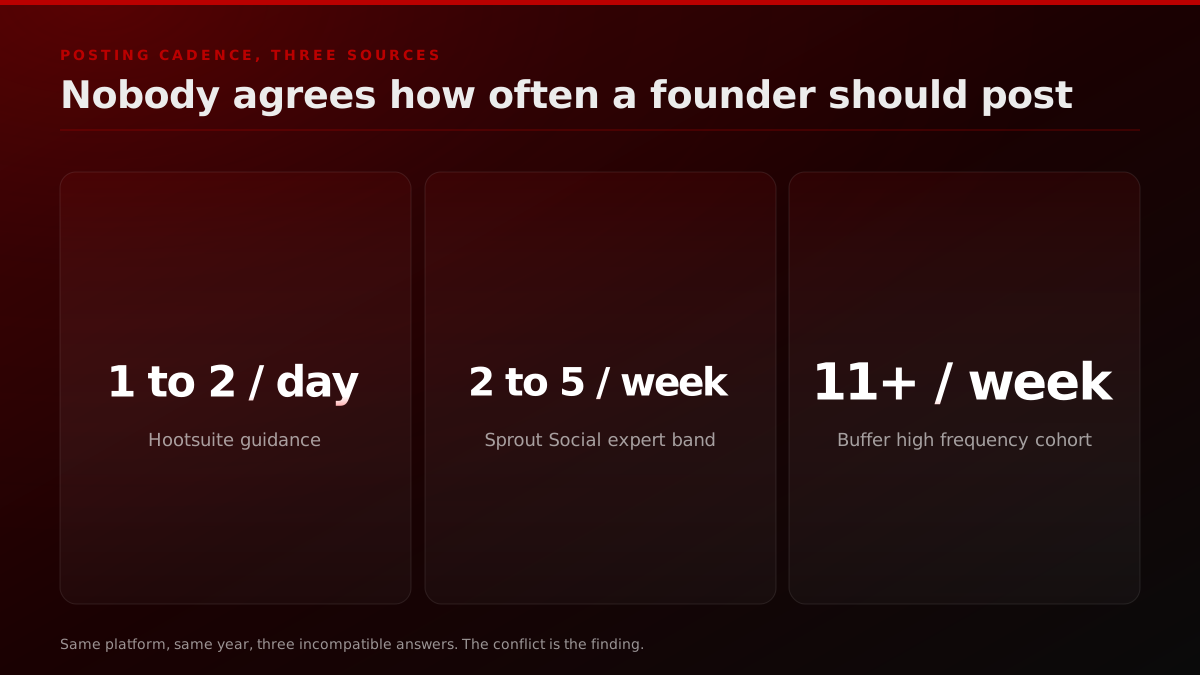
Those are not three ways of saying the same thing. One is roughly seven to fourteen posts a week, one is two to five, and one is eleven or more. A founder trying to follow the consensus will discover there is no consensus to follow, which is worth knowing before spending three months optimising the wrong dial.
What the major sources tell a founder to do
Hootsuite's 1 to 2 per day converted to a weekly figure. Buffer names both 2 to 5 and 11 plus on the same page.
The instability is not limited to institutional sources. One operator whose entire business is LinkedIn content for executives posted on 2 January 2026 that founders who commit to posting daily "will never look back", then on 18 January that "Post every day" is the WORST LinkedIn advice in 2026. Same account, sixteen days apart. He is not being dishonest. Cadence advice is genuinely unsettled, and every listicle on page one presents it as settled.
Operator noteOne account called daily posting essential on 2 January 2026 and the worst advice of 2026 on 18 January., same handle, sixteen days apart
It is worth being concrete about what "viral" even means on this platform, because the word imports expectations from TikTok that do not apply. LinkedIn does not have a For You page in the sense that short-form platforms do. Distribution widens through the graph: your first-degree network sees the post, and if enough of them engage in a way the system reads as genuine, it starts appearing in the feeds of their connections, and occasionally the connections of those. That is a fundamentally different growth curve from an algorithmic recommendation surface. It means the ceiling on any given post is largely set by who your first-degree network is, and no amount of engagement volume changes who those people are.
This is the single most useful reframe available here, and it is the one that dissolves most of the pod argument on its own. If distribution propagates through your network graph, then the quality of that graph is the constraint. A founder with 800 connections who are all actual buyers has a higher realistic ceiling on a B2B post than a founder with 8,000 connections collected from follow-for-follow threads, because the second founder's post propagates into a graph full of people who will never buy anything. A pod does not improve the graph. It adds engagement from a set of people specifically assembled on the basis that they will engage with anything, which is close to the worst possible input to a system that is trying to work out who else might care.
What is a LinkedIn engagement pod, and why is one being sold to you?
An engagement pod is a private group, usually run through a browser extension, a Telegram channel or a Facebook group, whose members agree to like and comment on each other's LinkedIn posts shortly after publication. The pitch is that the early spike convinces LinkedIn the post deserves wider distribution, so the post reaches people who would otherwise never see it. It is sold hard because it works on the visible counters immediately, and because the alternative takes months. The tooling is not obscure, either.
Natia Kurdadze
@natiakourdadze
LinkedIn influencers will hate me for this, but here’s the secret growth hack they use to generate leads and get more clients: 1. They find POD groups on Lempod, Linkboost, FB, and Telegram. 2. After posting the content, they distribute it to these engagement groups. 3. Then htt… Show more
There is a real business behind this, which is worth saying plainly rather than treating the category as fringe. A pod builder posted his own numbers publicly on Hacker News, describing taking his LinkedIn pod product "from zero to $500 in just a week and then we fall again". Supply exists because demand exists, and the demand comes from founders who have been told that reach is the constraint.
Operator noteA pod builder posted his own revenue on Hacker News, 500 dollars in a week, then the drop., Hacker News, 2024-05-21
The question founders actually ask is narrower and better than the one the vendors answer. It is not "do pods produce engagement", because they obviously do. It is whether that engagement is worth anything.
Are LinkedIn engagement pods still effective in 2025?
Are engagement pods against LinkedIn's rules?
Yes, and unusually for a growth tactic, the answer does not depend on how you read the policy. LinkedIn's Professional Community Policies address artificial engagement in four consecutive clauses, and a pod breaks all four rather than skirting one. The clauses ask for original content, forbid doing things to artificially increase engagement, ask you to respond authentically to other people's content, and then name the reciprocal arrangement directly.
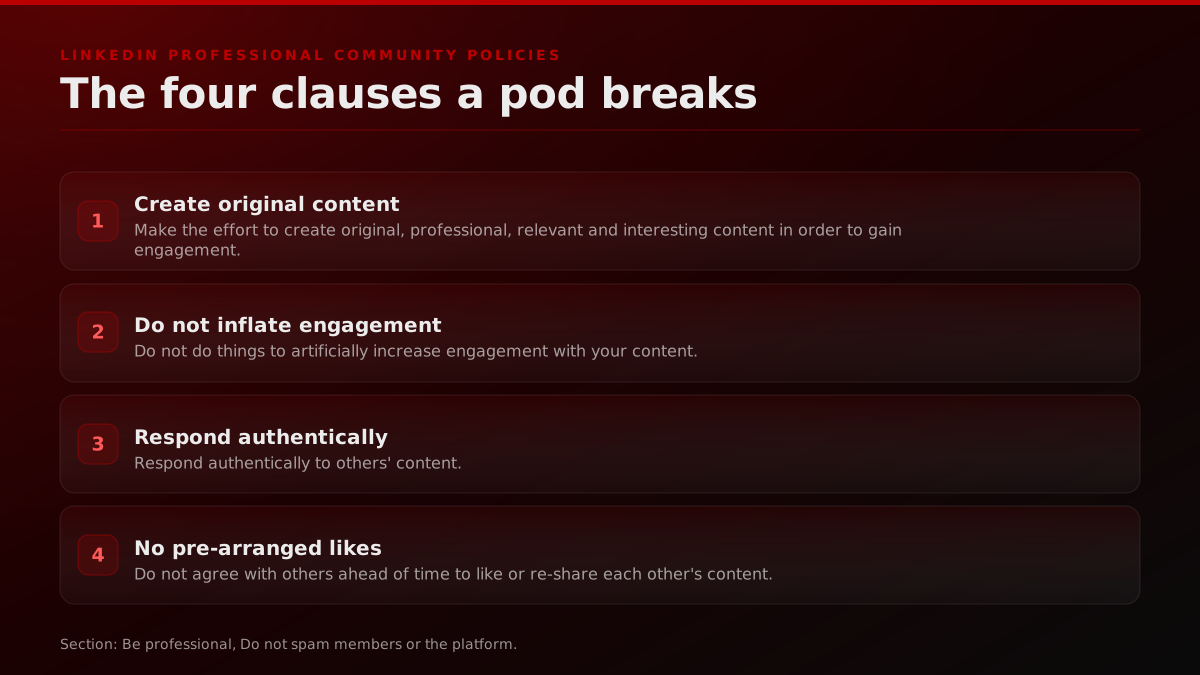
Notice what kind of rule that is. It does not describe a threshold you can stay under, or a volume of activity that becomes a problem past some point. It describes an agreement. The violation is in having made the arrangement, not in how vigorously you use it, which is why "we only use a small pod" is not a mitigation.
The platform wrote the rule, so nobody has to interpret it
Most compliance arguments about growth tactics turn on interpretation, which is why they never resolve. This one does not. LinkedIn's Professional Community Policies name the mechanism in a single clause: do not agree with others ahead of time to like or re-share each other's content. There is no reading of a pod that survives that sentence, and it sits under the heading "Do not spam members or the platform".
Source: LinkedIn Professional Community Policies, read live 2026-08-05
What LinkedIn does not publish is any detection method, any detection rate, or any penalty schedule. That absence is important later in this guide, because it is the gap that unsourceable statistics rush in to fill.
LinkedIn Is Fighting Back Against Engagement Pods
LinkedIn® Tips and Updates with Scott Aaron
A walkthrough of platform action against engagement pods and what happens to distribution when coordinated engagement is detected.
What actually happens to your reach when you run a pod?
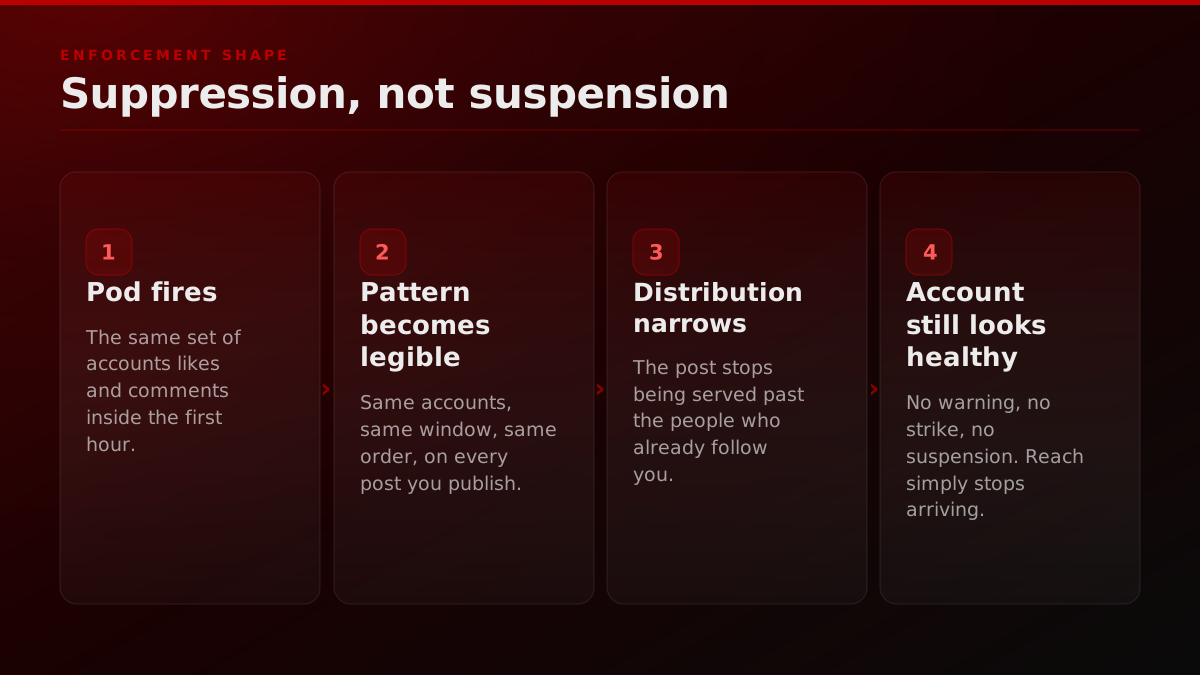
The failure mode operators consistently describe is not a ban. It is distribution suppression: the account stays active, no warning arrives, no strike appears on the profile, and posts simply stop being served past the people who already follow you. Because nothing visibly breaks, the effect is almost always attributed to something else. Founders in this position report that "the algorithm changed", and from inside the account that is exactly what it looks like.
An agency operator running client LinkedIn campaigns put the consequence in the plainest terms available, and it is worth weighing precisely because he is running campaigns rather than selling a course on them.
Working at an agency that handles campaigns for clients on LinkedIn, we stopped recommending pods years ago. The algorithm actually penalizes content that gets obvious fake engagement, so you end up with worse reach than if you posted normally.
Two things about that quote deserve care. He is describing a penalty, which LinkedIn does not confirm, so treat the mechanism as his read rather than as documented platform behaviour. His second claim is the sturdier one and does not depend on any penalty existing at all: the engagement is worthless because the people producing it were selected for their willingness to reciprocate, not for any interest in what you sell.
Operator noteNo warning, no strike, no suspension. The account looks healthy and the reach just stops arriving.
There is a related fact that is easy to verify and easy to over-read. Lempod, for years the default pod extension, is no longer findable in the Chrome Web Store, where a search for it now returns nothing at all.
The best-known pod extension is no longer in the Chrome Web Store
A Chrome Web Store search for Lempod, for years the default pod extension, returns no search results as of 2026-08-05. A control search for a known extension on the same page returned results normally, so the empty result is a real absence rather than a broken search. What is measured here is absence today, not the reason for it. The store does not publish a reason, and neither will we.
Source: Chrome Web Store search, read live 2026-08-05
The detectability of bought engagement by humans, meanwhile, is not theoretical. Sellers spot it in each other's comment sections constantly, from the timing, the wording and the geography of the commenters.
In my quest to be snarky on our SDR lead Gen sales bros on LinkedIn I found that they use a service for comments. The audacity
That last point is the cost nobody prices in. A suppressed post costs you one post. A buyer working out that your comment section is staged costs you the account's credibility, and it is the same class of problem as a launch that turns out to have been botted, where the tells are legible to anyone who looks.
How can you tell whether an account you admire is using a pod?
You look at the comment section rather than the counter, and you look at it in the first hour. Pod engagement has a signature, and the signature is consistency where real conversation is erratic. The r/sales thread linked above is a good worked example of somebody doing this deliberately: the seller noticed that a set of lead generation posts were collecting immediate, near-identical praise, went looking, and traced several of the commenters to a paid service's own case studies.
The tells cluster into four groups, and none of them require special tooling to check. The first is timing. Real comments trickle in over hours and days, with the distribution skewed towards the first few hours but long-tailed. Pod comments arrive in a tight cluster shortly after publication and then stop, because the pod fires once. If an account's posts reliably collect thirty comments inside twenty minutes and then nothing for two days, that is a mechanism, not an audience.
The second is content. A comment written by somebody who read the post refers to something specific in it. Pod comments are generic because they have to be: a member commenting on forty posts a week cannot read forty posts a week. "Great insights!" and "This is so true, thanks for sharing" are the recognisable form, but the more sophisticated pods now generate slightly longer comments that restate the post's own thesis back at it, which is a harder tell to spot and an easier one once you know to look.
The third is the commenter set. Open five of the account's recent posts and list who commented on each. If the same twenty names appear on all five, that is a standing arrangement. Real audiences overlap partially, not completely. This is also where the mismatch between the commenters and the subject matter becomes obvious, and it is why an agency founder was able to point at seventeen unrelated theme pages praising a B2B post and treat it as self-evident.
The fourth is the reply pattern. Genuine comments produce genuine conversation, so the author replies with something substantive and the commenter sometimes replies again. Pod threads are flat: comment, thanks, done. The post has a hundred comments and no conversation in it.
Why this matters is not schadenfreude. It is calibration. If you are benchmarking your own unassisted account against an assisted one, you will conclude that your content is failing when it may be performing perfectly normally for its stage. That misreading is what drives founders to buy a pod in the first place, which makes it the actual mechanism by which the category grows.
Why this guide does not quote a percentage reach penalty
Two figures dominate this topic: a 45 percent reach penalty for pod use, and a 96 percent reach drop. Neither appears in this guide, and the reason is worth stating out loud rather than leaving as a silent omission. Every trace we could follow for both numbers ended at a marketing blog or at a vendor selling a competing engagement or automation product. None resolved to LinkedIn, and LinkedIn publishes no detection or penalty figures at all.
The numbers we deliberately left out
Two figures circulate constantly in this topic: a 45 percent reach penalty for pod use, and a 96 percent drop. Every trace we could follow ended at a marketing blog or at a vendor selling a competing engagement or automation product. LinkedIn publishes no detection figures and no penalty figures at all. A precise number attached to an untraceable source reads as stronger evidence than an honest description of a mechanism, which is exactly why it is worse.
Source: FORKOFF sourcing pass, 2026-08-05
A precise number attached to an untraceable source is worse than no number, because it reads as better evidence. "Pods cut your reach by 45 percent" sounds like a measurement. "Operators report their posts quietly stop being distributed, and the platform publishes nothing about how it detects this" is an honest description of the state of knowledge, and it is less persuasive for exactly that reason. We are choosing the second, and applying the same standard to figures that would flatter us.
Two claims that circulate alongside those numbers get the same treatment. An operator selling LinkedIn lead generation asserted in January 2026 that reach had dropped 90 percent for people posting unchanged content, and a commenter attributed the current crackdown to new FTC rules on fake engagement. Both are positions held by practitioners, and we have verified neither. They are recorded here as things operators believe, which is genuinely useful information, and not as facts about the platform or the regulator.
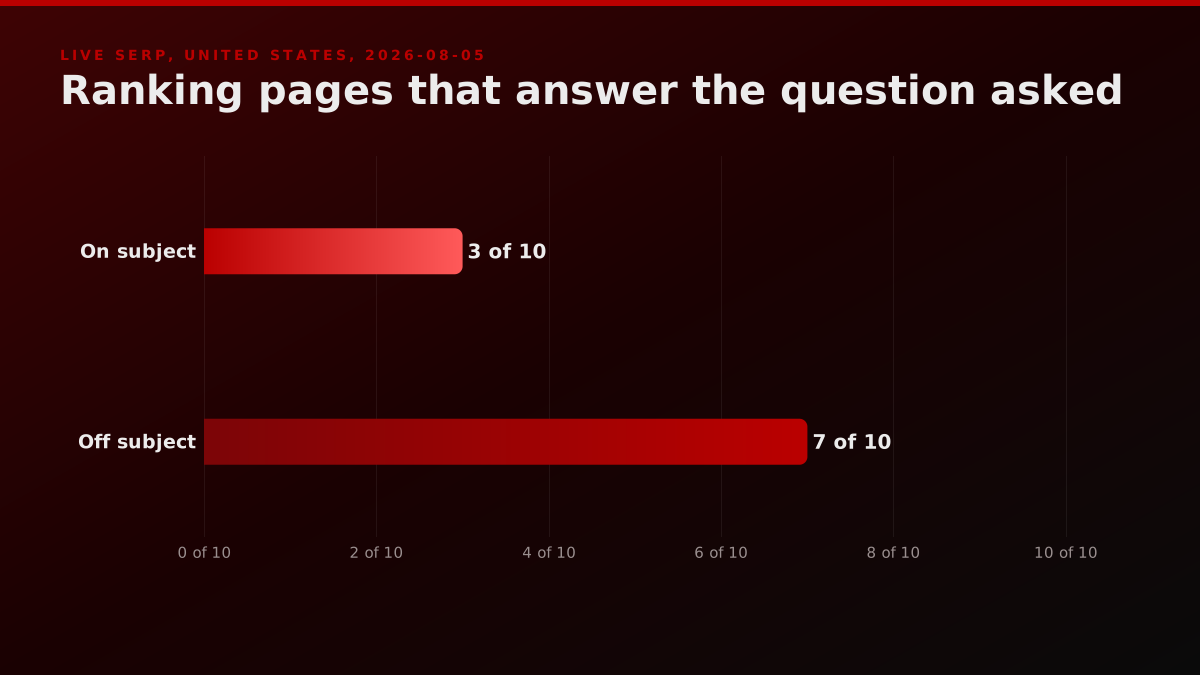
While being precise about sources: the search results this guide is written into are themselves mostly not answering the question.
So how often should a founder actually post?
Five times a week, on fixed weekday slots, is where FORKOFF lands for a single founder. That number is a judgement about sustainable quality rather than a maximum extracted from a dataset, and the honest way to present it is alongside the published data it sits against, including the parts that point the other way.
What each source recommends, and what the same source measured
| Source | What it recommends | What it measured | Dataset |
|---|---|---|---|
| Hootsuite | 1 to 2 posts per day | Businesses actually posted 5.5 times per week on LinkedIn in Q1 2025 | Its own expert panel plus platform measurement |
| Buffer, frequency study | 2 to 5 posts per week as the sweet spot | 11 or more per week gave 16,946 more impressions per post and 1.40 points more engagement | Over 2 million posts, 94,000 plus accounts |
| Sprout Social | Tuesdays and Wednesdays, 11am to 6pm | Sunday is the worst day across almost every platform | Nearly 2 billion engagements, roughly 307,000 profiles |
| Buffer, timing study | Wednesday is the best day, late afternoon and evening slots | Monday and Tuesday saw the lowest engagement | 4.8 million posts |
| FORKOFF | 5 posts per week, fixed weekday slots | Decays 30 to 45 percent at 7 posts per week | First-party founder accounts |
Two of the largest datasets disagree on which weekday is best. That is the finding, not a rounding error.
The most interesting row is Buffer's. Its analysis of over 2 million posts from more than 94,000 accounts found that frequency compounds hard, with 11 or more posts a week producing about 16,946 more impressions per post, a 1.40 percentage point engagement lift, and three times more engagements than posting once a week. Buffer states in its own words that LinkedIn does not cap your reach or punish you for volume. And then the same page recommends 2 to 5 posts a week as the sweet spot, a band worth around 1,182 extra impressions per post.
The largest public frequency study argues with itself on the same page
Buffer analysed over 2 million posts from more than 94,000 LinkedIn accounts and found that 11 or more posts a week produced about 16,946 more impressions per post, a 1.40 percentage point engagement lift, and 3 times more engagements than posting once a week. The same article then recommends 2 to 5 posts a week as the sweet spot, a band worth about 1,182 extra impressions per post. Both statements are on the page. Anyone citing only one of them is selling you something.
Source: Buffer, How Often Should You Post on LinkedIn, read 2026-08-05
Operator noteBuffer's own wording: LinkedIn does not cap your reach or punish you for volume., Buffer, over 2 million posts
Both statements are true at once, and the resolution is not statistical. Eleven posts a week is achievable for someone whose job is posting. A founder producing eleven posts a week alongside a company will produce eleven worse posts, and the quality collapse does not show up in a study that treats posts as interchangeable units. This is also where our own cadence playbook puts the ceiling: on a single-operator account, impression-per-post decays 30 to 45 percent at seven posts a week.
Timing is in the same state. Sprout Social's dataset of nearly 2 billion engagements across roughly 307,000 profiles puts the best window on Tuesdays and Wednesdays between 11am and 6pm, with Sunday the worst day. Buffer's study of 4.8 million posts makes Wednesday the best day and finds Monday and Tuesday the lowest, favouring late afternoon and evening. Those two readings do not reconcile. Pick a slot, hold it long enough for your audience to learn it, and stop reading timing posts.
What is LinkedIn measuring when it decides who sees your post?
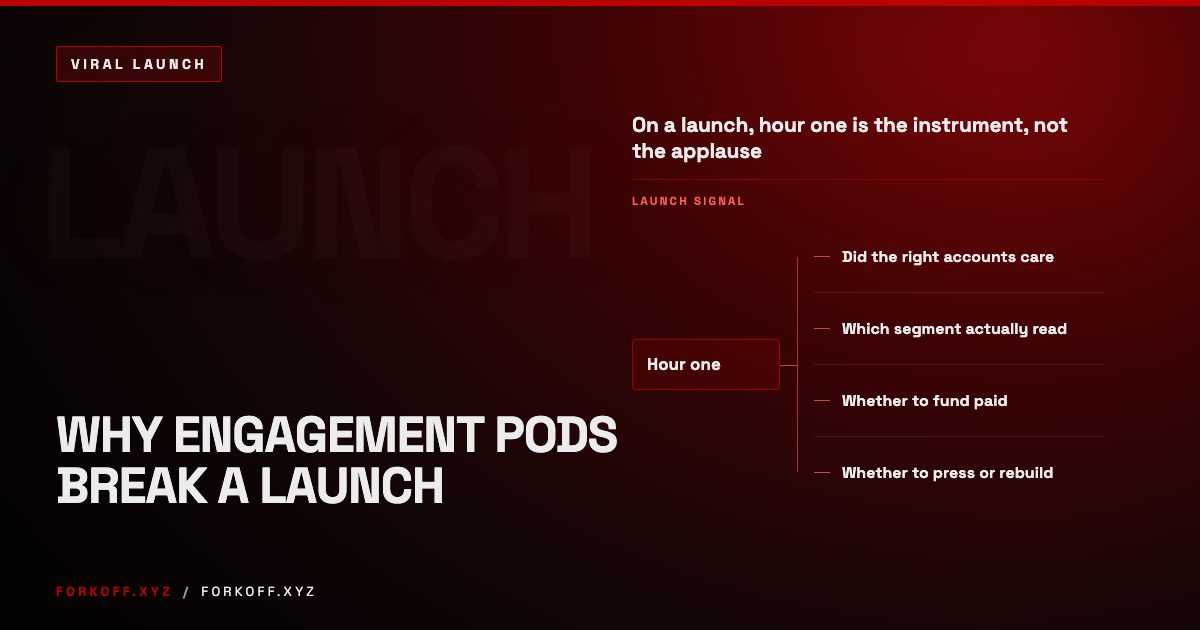
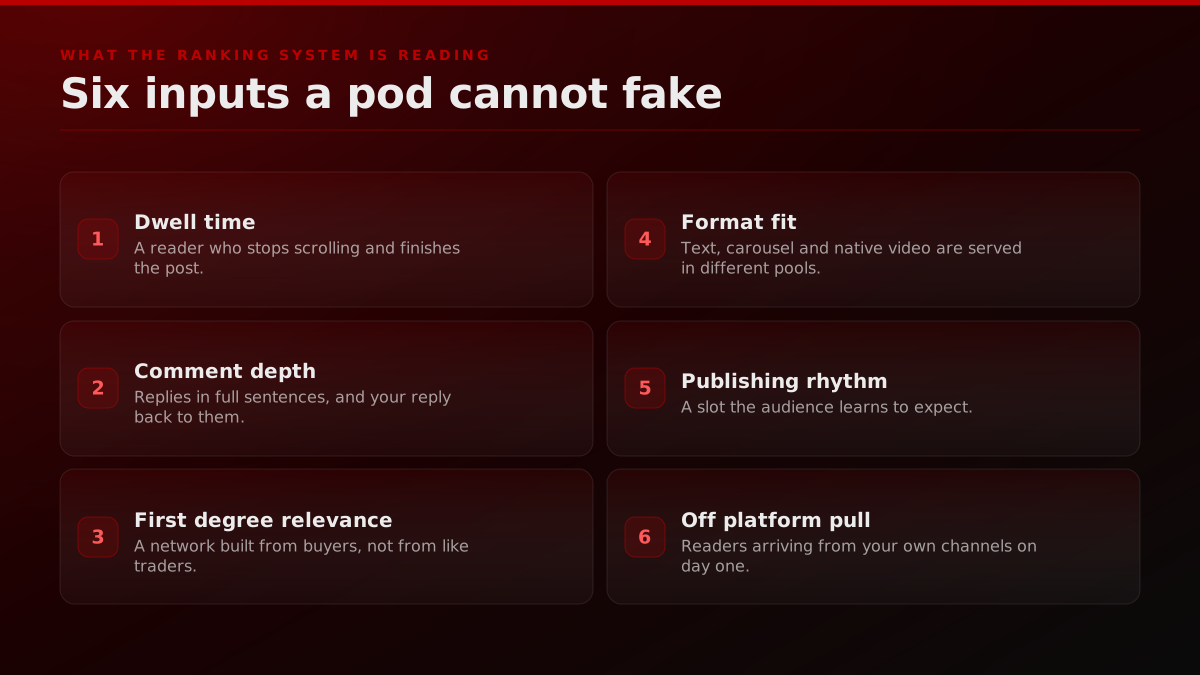
It is measuring attention and fit, not applause. The signals that move distribution are how long a reader stayed with the post, whether the comments carry actual sentences, whether the people engaging resemble the people the post was written for, and whether you replied. A pod can raise a like count and a comment count. It cannot raise dwell time, it cannot make a "Great post!" into a substantive reply, and it cannot make a stranger who trades likes look like your buyer.
There is one more mechanism worth knowing, because it explains a chunk of the reach loss that founders try to fix with a pod. Two separate Hacker News commenters, eighteen months apart, describe LinkedIn heavily reducing distribution on posts carrying outbound links, in 2024 and again in 2026. Two independent observers reporting the same effect across that gap is the closest thing to corroboration in this entire topic.
Part of the reach problem is where you put the link
Two separate Hacker News commenters, eighteen months apart, describe the same effect: LinkedIn heavily reduces distribution on posts that carry outbound links, because it wants the session to stay on the platform. That is the closest thing to independent corroboration in this whole topic, and it matters because it is a reach problem people try to solve with a pod when the actual fix is moving the link into the first comment.
Source: Hacker News, 2024-07-24 and 2026-01-03
If that is what is happening to your posts, a pod is the wrong tool by a wide margin. Move the link into the first comment and the problem is solved for free. It is worth mapping which layer of the stack you can actually reach before deciding what to change.
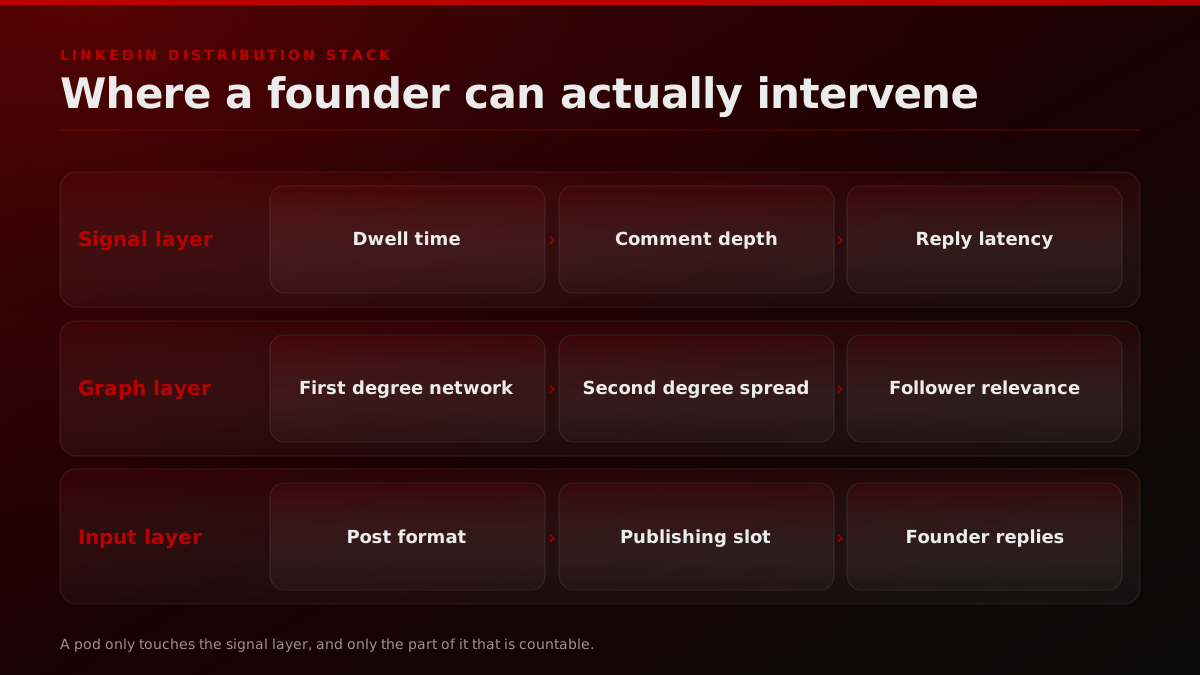
Operator noteImpression-to-dwell above 4 percent moves months before follower count does., FORKOFF house cadence
What do you run instead of a pod?
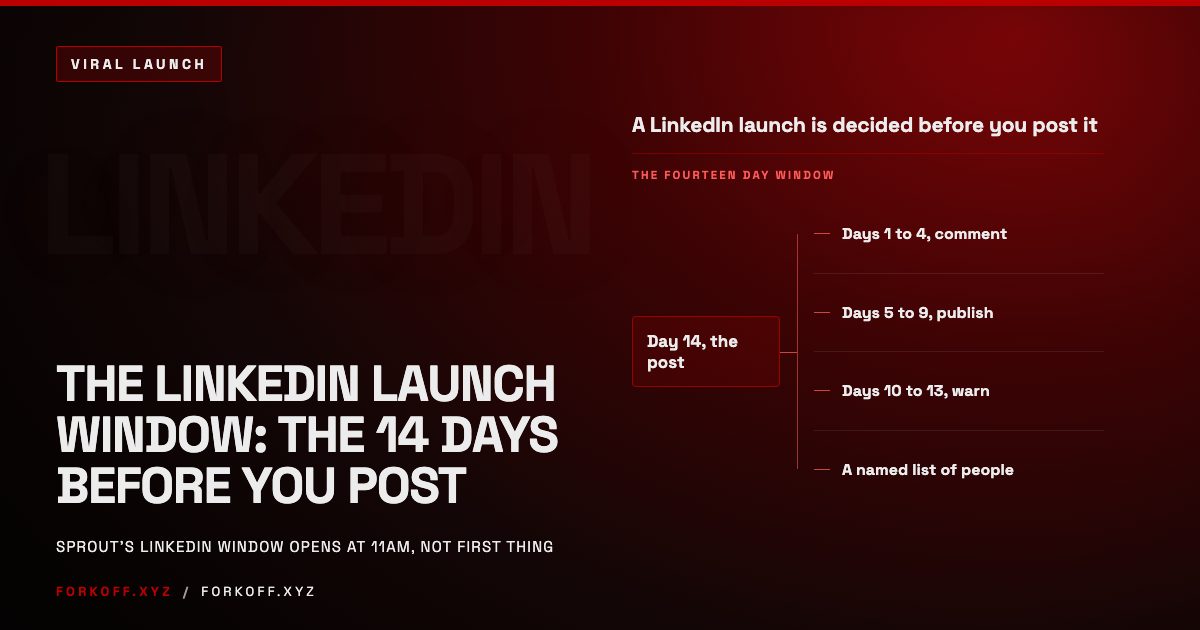
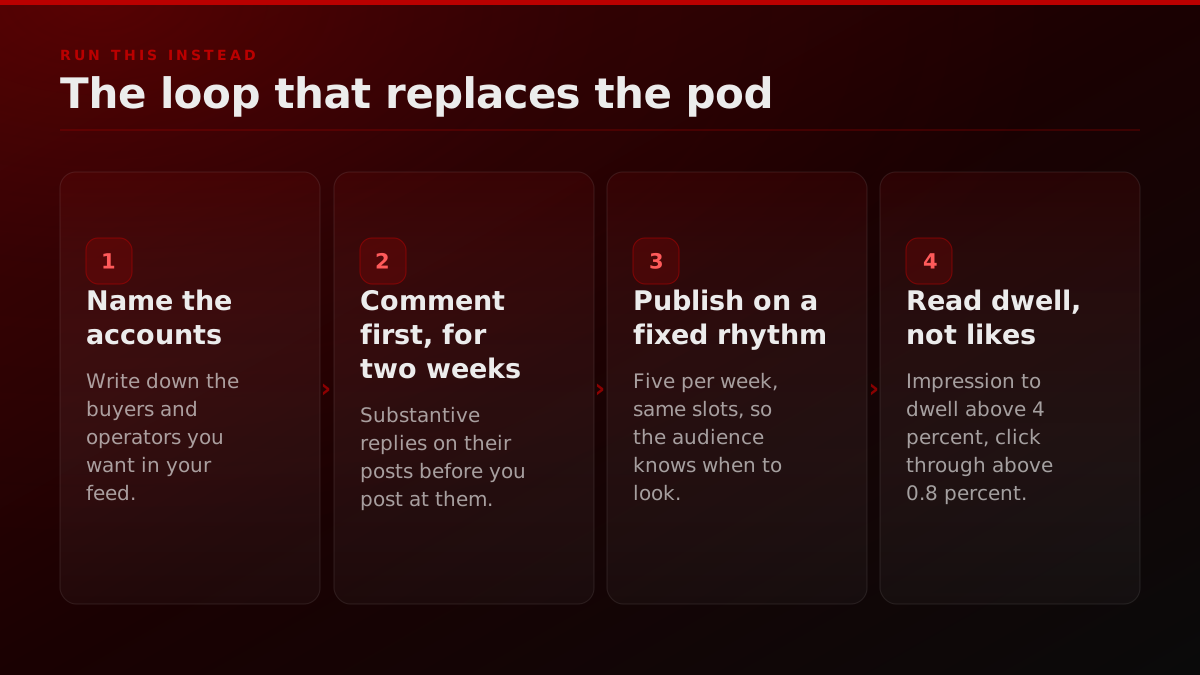
You run a warm-up. Before publishing anything, name the accounts you want reading you, and spend two weeks commenting substantively on their posts. This is the step everyone skips, and it is the step that does the work, because a cold account publishing into a network of strangers has no signal for LinkedIn to widen.
This is also where an important distinction lives, because there is a respectable version of the pod argument that deserves a real answer rather than dismissal. An exited founder with a large following argued that "the most underrated LinkedIn growth strategy is using engagement and comments to create reach", and that posting daily is not the lever. He is right, and he is not describing a pod. Commenting substantively on other people's posts puts your reasoning in front of their audience, and LinkedIn's policy asks only that you respond authentically. A pod is reciprocal engagement on your own posts, agreed in advance, for the purpose of inflating a counter. One is distribution work you do in public. The other is the thing the policy sentence names.
What a pod buys you and what it costs you
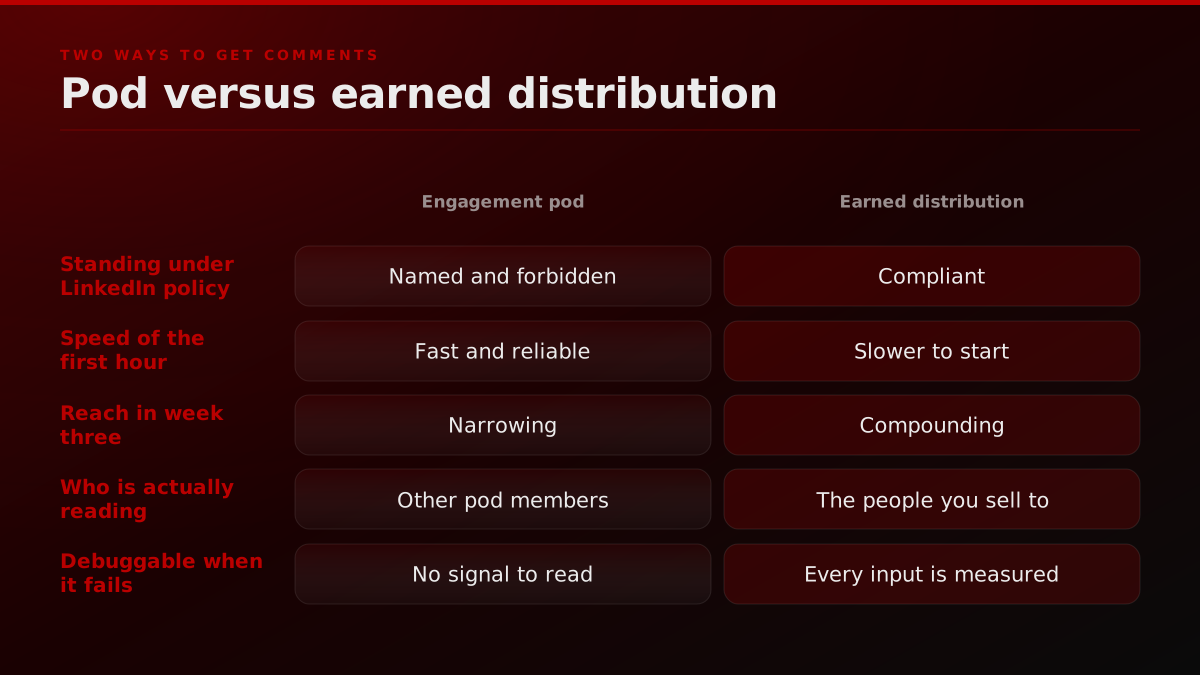
| Dimension | With a pod | Without a pod |
|---|---|---|
| Comment count in hour one | High and predictable | Low, often single digits for weeks |
| Who is commenting | People selected for willingness to reciprocate | People selected by interest in the problem |
| Standing under LinkedIn policy | Named in the policy text | Compliant |
| What happens when you stop | Back to baseline, no residual | The network you built stays |
| Diagnostic value of the numbers | None, the signal is manufactured | Every input can be read and adjusted |
| Reputational exposure | Discovery is a credibility event with your buyers | None |
The middle two rows are the ones founders underweight, and they are the ones that decide whether the account ever produces pipeline.
The honest counter-argument comes from the same r/b2bmarketing thread as the agency operator quoted earlier, and points the opposite way. It deserves attention because it is a measurement rather than an opinion.
I notice, that when my colleagues get lazy with liking, i get overall lower reach. But after some time it's not fueling growth anymore, because you have to reach out to new audiences.
His first sentence is real and should not be waved away: early likes from a genuine, relevant network do help, and an account whose colleagues engage does better than one whose colleagues ignore it. His second sentence is the answer to his first. It stops fuelling growth once you need new audiences, which is the moment growth was supposed to start. A team liking a colleague's post is not the same as a standing arrangement with strangers, and the ceiling he describes is precisely where a pod's usefulness ends.
The other structural problem with a pod is that it destroys your ability to learn anything. If the comment count is manufactured, the number tells you nothing about whether the post was good, so there is no feedback loop and no way to improve. This is the same reason we report LinkedIn work against an impression-to-dwell floor of 4 percent and a click-through floor of 0.8 percent rather than against engagement counts, and the same logic behind measuring cost per qualified view rather than raw views on the video side.
Exposing LinkedIn Engagement Pods - Growing or Harming Your Business?
Daisy Ilaria
A breakdown of how pods work and why engagement from outside your buyer set degrades the quality of your reach.
How long does earned LinkedIn distribution take?
Plan in months. The first two weeks usually produce no posts at all, only comments. After that, expect single-digit comment counts for several weeks while the useful numbers move underneath them. Dwell rate and click-through respond well before follower count does, which is what makes them the right things to watch: they tell you the content is landing while the vanity metrics still look flat enough to panic about.
What's the point? LinkedIn treats every post as a clean slate basically. So as soon as you stop using the engagement pod you're back to square one.
That treadmill framing is the cleanest argument against pods that does not require any penalty to exist. LinkedIn treats each post as close to a fresh start, so pod engagement does not accumulate into anything. Stop paying and you are back where you began, having built nothing. Contrast that with a network of two hundred relevant people who now recognise your name, which is an asset that persists whether or not you post next week.
How are these people getting 1000+ comments on LinkedIn?
That thread ran to 101 comments precisely because the question underneath it is the real one. Thousands of comments on a lead magnet post look like proof of a working channel. Whether any of them became a call is a completely separate question, and one operator in this space made the point with a counter-example: a founder with roughly 2,000 followers, posting once or twice a week about the specific problems he solves, reportedly closing 380,000 dollars in new business from LinkedIn. That figure is a second-hand claim about an unnamed founder and we have not verified it, so read it as the position operators are arguing rather than as a case study. The shape of the argument is what matters: small audience, low frequency, high relevance.
Here is a realistic month-by-month expectation, offered as a planning shape rather than a promise, because the actual curve depends entirely on how good the starting network is. Month one is warm-up and publishing with almost nothing to show: comments in the low single digits, impressions largely confined to your first-degree network, and the strong temptation to conclude it is not working. The thing to watch in month one is not volume but whether dwell rate is climbing at all, because that tells you whether the writing is landing on the few people who do see it.
Month two is where the graph starts changing. The people whose posts you commented on for two weeks begin recognising your name, some of them connect, and their engagement pulls your posts into second-degree feeds for the first time. Comment counts stay unimpressive. Click-through usually moves before comments do, which surprises people, and it is the more commercially meaningful number anyway.
Month three is where compounding either starts or does not. If it does, the tell is specific and unmistakable: comments start arriving from people you did not recruit, did not comment on, and do not recognise. That is the graph widening on its own. If month three arrives and every comment is still from someone you personally engaged first, the problem is upstream of distribution and is almost always positioning. More posting will not fix it, which is the legitimate core of the argument that daily posting is bad advice.
The reason to stay patient through that curve is the asymmetry at the end of it. Pod engagement is rented, and the rent is due every month forever. A relevant network is owned, survives a month where you post nothing, and keeps producing inbound after you stop optimising for it.
Where does this sit inside a product launch?
LinkedIn is the second window on most launches, not the first. The launch itself usually lands on X, which is why our launch playbook and the breakdown of how to go viral on X and clear a million views are built around that channel, and why going viral on X is a different mechanical problem from this one. LinkedIn is where the operators and investors who missed the launch day thread catch up, which makes it the place a B2B or developer-tools launch converts rather than the place it spikes. The channel choice itself is worth thinking through, and we have compared Reddit against LinkedIn for B2B distribution at some length.
The pod problem is the same problem as the botted launch problem, one channel over. Both substitute a purchased signal for a real one, both look fine on the dashboard, and both fail at the point where somebody who matters looks closely. We have written about why credibility campaigns and user-acquisition campaigns are not interchangeable, and about the organic against amplified benchmark that makes the difference legible. The discovery moment is the expensive part.
Vin Matano
@vinmatano
The creator everybody looked up to on LinkedIn about 4-5 years ago uses an engagement pod. I recently found this out. Sad. Think about it, you know who this is.
Sit with that for a second, because it is the argument most founders have not considered. If the LinkedIn accounts you are modelling yourself on are pod-assisted, then copying their apparent tactics means copying a system you cannot see, and benchmarking your unassisted numbers against their assisted ones will tell you that you are failing when you are not. This is the same distortion the state of launch videos research found on the video side, and the same reason we published a views-to-likes benchmark: you cannot calibrate against numbers that were bought.
The visible artefacts are usually not subtle, either.
Tommy Clark
@tclarkmedia
Brother that paid LinkedIn engagement pod isn’t going to save your content strategy. Nice comments from 17 different AI theme pages. Doesn’t look fake at all. Why are people still falling for this in the year of our lord 2025?
Seventeen unrelated theme pages leaving praise on a B2B post is not a near-miss. It is the tell. And the reputational objection is not new: a brand agency founder was posting "Good morning to everyone except those in #linkedin engagement pods. Your engagement is fake." back in 2022. The framing has not moved in four years, which tells you how the people you are trying to reach read it.
For the mechanics of running this properly, week by week and slot by slot, the cadence playbook has the full weekday map, the post-type mix and the amplification trigger. It pairs with the founder-led growth playbook for the positioning work that has to happen first, and with launch week video sequencing if there is a launch attached. If the problem is that the launch content never reaches anyone, the distribution gap post is the diagnosis, and what to measure in the first 30 days is how you tell whether it worked. On X specifically, how to grow on Twitter covers the parallel mechanics, and for short-form there is going viral on TikTok.
The verdict
Engagement pods are not a grey area. LinkedIn wrote a sentence that describes them and forbids them, and that sentence sits under a heading about spam. If you want a single line of justification for not using one, it is that one, and it does not require a penalty statistic to be persuasive.
But the reason not to run a pod is not really the policy. It is that a pod solves a problem most founders do not have. The published data says LinkedIn does not cap reach for volume, the largest frequency study on record cannot agree with itself about how often to post, and the two biggest timing datasets disagree about which day is best. In that environment, the constraint on your account is almost never that LinkedIn is throttling you. It is that not enough relevant people have a reason to stop scrolling, and a pod addresses that by adding people who have no reason to stop scrolling either, then hiding the evidence in an inflated counter.
The alternative is slower and duller and it is the only thing that accumulates. Name the accounts you want. Comment on their posts for two weeks before you publish anything. Publish five times a week in slots you keep. Read dwell rate and click-through instead of likes, and be willing to see a bad number, because a bad number you can trust is worth more than a good one you manufactured. Somewhere in month three the comments start arriving from people you did not recruit, and at that point you have something a pod could never have given you: a channel that keeps working when you stop paying attention to it.