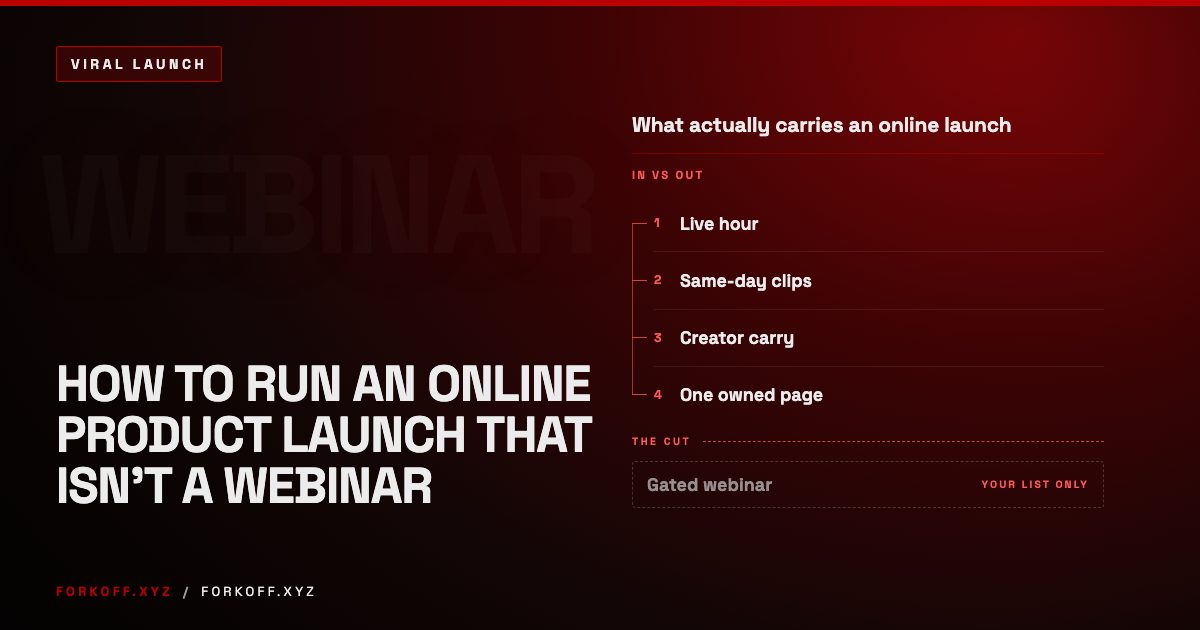
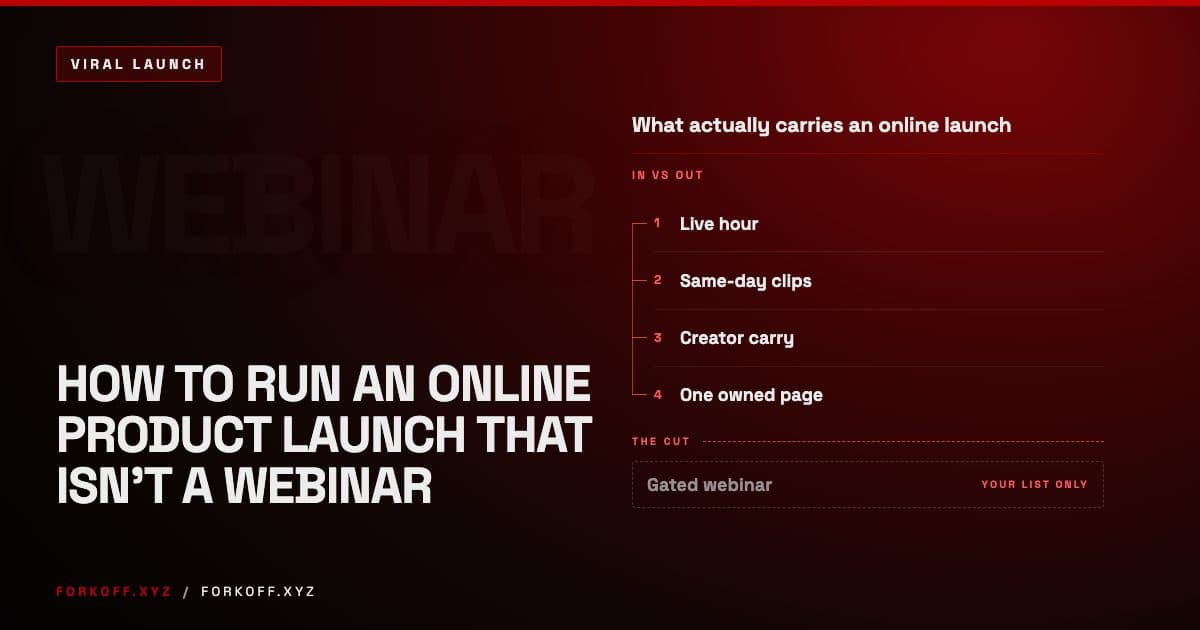
An online product launch is a dated, public moment where you reveal a product live on a channel your buyers already use, then distribute that moment as clips so it reaches far past the people who showed up in real time. The strong version in 2026 is not a gated webinar. It is a live hour that gets cut into 15 to 30 native clips the same day, carried by accounts the audience already follows. The live moment is the raw material. The clips are the launch.
The short version
An online product launch in 2026 is not a webinar. A webinar gates the room behind a registration form, plays slides to the few hundred people already on your list, and leaves a replay nobody reopens. A distributed online launch does the opposite. It runs one live moment, an X Space, a YouTube Live or a streamed demo, cuts that hour into 15 to 30 native clips before the day ends, and hands those clips to the accounts your buyers already follow, so the reach starts inside an existing audience instead of inside your own small one. The live hour is the raw material. The clips and the creators are the launch. The single number that frames this whole guide is simple: a gated webinar produces one asset, while one live launch hour produces thirty, and the first-party benchmark behind the distribution case is the FORKOFF clipping network, which has processed 5B+ views. This piece lays out the stack, the run of show, the budget split and the metrics, and names the six traps that quietly turn a launch back into a webinar.
If you searched "online product launch" you probably got a page of strategy checklists that end with "host a webinar or a virtual event" and move on. That advice is a decade old. A webinar reaches the people already on your list, produces one replay nobody reopens, and counts registrations as if they were results. It is a meeting you recorded, not a launch you distributed. This guide is about the other model, the one a growing number of founders are running without a name for it: a live moment built to be cut up and carried, so the reach starts somewhere other than your own small audience.

The webinar launch versus the distributed online launch
| Question | Webinar launch | Distributed online launch |
|---|---|---|
| Where does reach come from? | Your own email list | Accounts the buyer already follows |
| What does the hour produce? | One gated replay | 15 to 30 native clips |
| What is counted? | Registrations | Watched views and signups |
| How long does it live? | Dead by morning | Compounds across 72 hours |
A webinar is a meeting you record. An online launch is a moment you distribute. The two are not the same job.
What is an online product launch in 2026?
An online product launch in 2026 is a live, public reveal on a channel your buyers already use, engineered from the first planning meeting to become clips that travel beyond the room. The definition matters because the default picture, a slide deck and a Zoom link, is exactly the version that fails. The useful picture is a dated moment with a run of show, a clipper working in real time, and a set of creators ready to carry the cuts the minute they land.
The shift is driven by a simple change in what is scarce. Building a product and recording a clean video are both cheap and close to solved now, and 91% of businesses now use video, with Wyzowl's research finding most buyers say a video has convinced them to buy, so the format itself buys you nothing. Getting anyone to watch is the hard, expensive part. So a launch that spends all its energy on the hour itself, the polish, the slides, the rehearsal, and none on the distribution of that hour, is optimising the part that no longer decides the outcome. We lay out the full reach-first case in the three-ring distribution model, and the launch platforms beyond Product Hunt guide maps where the moment can actually land.

The first-party number that frames everything below is the FORKOFF clipping network, which has processed 5B+ views moving short-form content across platforms. No launch checklist carries a reach figure like that, because most launch advice is written by people who sell the event software, not the distribution. The full product launch playbook sets the broader launch context this piece narrows into one question: how do you run the online moment so it does not die as a webinar.
Why a webinar is the wrong model for a launch
A webinar is the wrong model because every structural choice it makes trades reach for control. It gates the room behind a registration form, which throttles the exact distribution a launch needs. It plays to people already on your list, so it cannot win new attention. And it produces one long replay, which is close to zero feed-native clips, so the moment cannot travel after it ends. None of that is a knock on webinars as a nurture tool. It is a knock on using one as a launch.

The honest way to see the gap is to compare the two models side by side on the dimensions that decide a launch. A webinar's reach is your list. A distributed launch's reach is other people's audiences. A webinar's output is a replay. A distributed launch's output is 15 to 30 clips. A webinar counts registrations. A distributed launch counts watched views and signups. Hold those against each other and the webinar stops looking like a launch and starts looking like a meeting that happens to have a product in it.
Webinar, live only, or the full distributed launch
Webinar
Live only
Live + clips + creators
Reach beyond your list
Same-day feed-native clips
Creator distribution
Signups measured live
Compounds past launch day
A live stream with no clip and creator plan is better than a webinar, but it still caps at your own audience. The distributed column is the only one built to escape it.
Founders have worked this out in public faster than the launch guides have. The pattern repeats in thread after thread: the product shipped, the launch platform did nothing, and the signups came from wherever the actual people were. One r/SaaS founder posted their launch-day numbers plainly.
Product Hunt position: #254, near zero votes. Every signup today came from Reddit, Discord, Instagram and YouTube instead. Distribution is the whole game. I spent a year building and a month marketing. Should have been the other way around.
Launched my freelance business SaaS on Product Hunt today, after my first month of marketing got exactly 1 signup. Honest numbers inside
That is the whole argument in one post. Product Hunt at #254 with near zero votes, and every signup from Reddit, Discord, Instagram and YouTube. The launch was not the platform. The launch was the distribution into places the buyers already were. A webinar is the opposite instinct: it pulls people toward you and hopes enough of them come.
The online launch stack: live moment, clips, creators
The stack has three layers, and the live moment is only the first. Layer one is the live hour, the thing people show up for. Layer two is the clips, the 15 to 30 native cuts you make from that hour before the day ends. Layer three is the carriers, the creators and operators your buyers already follow who post those cuts into their own audiences. Miss any layer and the launch degrades: with no clips it is a one-time event, with no carriers it reaches only your followers, and with no live moment there is nothing worth clipping.
How a live hour becomes signups
Read the stack as a loop rather than a line. The live hour feeds the clips, the clips feed the carriers, the carriers drive an owned page, and the clips also link straight to that page, so the two paths compound. Every arrow in that loop is distribution the webinar model does not have. This is the same engine behind our launch video playbook, applied to a live event instead of a produced film.
How far a launch hour travels, by format
Multiples are illustrative and relative to a gated webinar's reach, not measured figures. The shape is the point: each layer of distribution multiplies the same live hour.
The reach math is why the stack is worth the effort. A gated webinar is the baseline, call it one unit of reach. A founder-account live stream multiplies that a few times over, because at least the feed is open. Add same-day clips and it multiplies again, because the moment now travels in formats the feed rewards. Add creators carrying those clips and it multiplies once more, because the reach starts inside audiences that already exist. The numbers are illustrative, but the shape is not: each layer of distribution you bolt onto the same live hour multiplies what that hour was worth.

Which live format should you run?
Run the live format that sits where your buyers already are, and that yields the clips you can actually use. There are three strong options and one weak one. An X Space is the lowest-setup choice and the natural home if your buyers are founders and operators, and it yields audio pulls and quote cards. A YouTube Live suits a product that needs a walkthrough, and it yields screen-share cuts. A streamed demo or webcast is the highest-production option and the right call for a reveal your warmest buyers will show up for, and it yields hero and montage cuts. The gated webinar is the weak option, useful only when all you want is leads from an existing list.

The online launch surfaces, compared
| Live surface | Best when | Setup effort | Where the clips come from | Source |
|---|---|---|---|---|
| X Space (audio) | Your buyers are founders and operators who live on X | Lowest, no video setup | Audio pulls and quote cards | derived |
| YouTube Live | The product needs a walkthrough to make sense | Medium, needs screen share | Screen-share cuts and chaptered highlights | derived |
| Streamed demo / webcast | A reveal moment your warmest buyers will show up for | Highest, needs a run of show | Montage and hero cuts | derived |
| Gated webinar | You want leads from an existing list and nothing more | Medium, plus a registration wall | One replay, close to zero feed-native clips | derived |
Method: Surfaces and their clip yields are derived from how each platform feed rewards native short-form in 2026; no vendor figures are quoted, and a format that out-distributes its native clips would falsify the ranking.
Pick the surface by where your buyers already are, not by which tool your team knows. The gated webinar row is here to show what you give up.
The mistake here is picking the surface by what your team is comfortable with instead of where the audience lives. A beautifully produced webcast to an audience that lives on X is a worse launch than a scrappy Space in the same place. Match the room to the buyer first, then raise the production to the ceiling your budget allows. If you want the surface-by-surface reach teardown, the startup launch video distribution gap piece shows where most launches leak reach, and the best product launch videos of 2026 teardown reads which formats actually earned their views.
How do you run the launch hour?
Run the launch hour on a tight run of show, and start clipping while it is still live. The hour is not a presentation you deliver and then process. It is a source you mine in real time, so the first cuts are out while the moment is still warm. The sequence is simple and it starts before you go live.

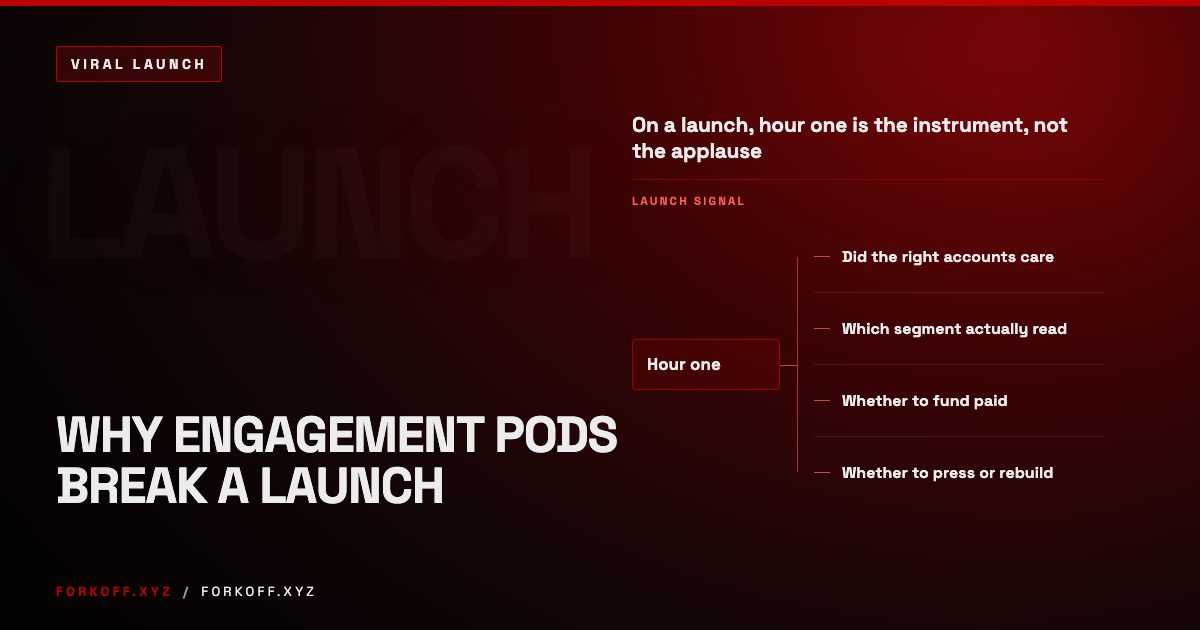
At T minus 60 minutes, your carriers post the teaser cut and the countdown, so the room fills instead of trickling in. At T-0 you go live and demo the product, not slides, because nobody clips a slide and everybody clips a working thing doing something surprising. Through the hour, your clipper pulls hooks as moments land, marking timestamps in real time. By T plus two hours the first cuts are published while attention is still high. Across the next 72 hours the winning clips get paid amplification and the rest archive into your library. That 72-hour window is where launch attention actually compounds, and a webinar spends it sending a replay link.

The 14 days before the hour matter as much as the hour. Warm your own account by posting the build daily for those 2 weeks, so the live moment opens to a seeded audience rather than an empty room. Brief the carriers early. Decide the owned page every clip will point to. And scope the vertical cuts into the production brief now, before the stream, because the single most common budget leak on launch work is paying to re-edit clips that should have been planned from the start.
Operator noteScope the vertical cuts into the live production brief. Clips scoped after the stream are a re-edit invoice, the leak we flag most.
Turning one live hour into thirty assets
Turn the hour into assets by treating the recording as raw material for a repurposing pipeline, not as a finished video. One live hour, run well, yields 15 to 30 clips. That is the number that makes the whole model work, and it is the number a webinar cannot produce because a webinar is built to be watched once, start to finish, by people who registered.

The pipeline has five steps. Pull the hooks, marking every moment that landed while the stream was live. Cut vertical first, 9
for the feed, with 16 only where a surface demands it. Caption and hook each cut so the first three seconds carry the point, because the opening seconds decide whether a viewer stays and a slow intro is a dead clip. Seed each clip natively from the account that fits its audience. Then put budget behind the cuts that already earned watch time, instead of guessing in advance which clip will win. This is the same clipping discipline we run as a managed clipping service, applied to a live launch recording.
The funnel this produces is counterintuitive the first time you see it. The live viewers are the smallest number in the whole launch. The clip views, across 72 hours, are often two orders of magnitude larger. The clicks and signups flow from the clips, not from the live room. So the live hour that felt like the launch is really just the seed, and the clips are the plant. A webinar stops at the seed and wonders why nothing grew. For the budget math behind this, the what a launch video costs breakdown shows why distribution, not production, is the bill that decides return, and the launch week video sequencing guide maps when each cut should land.
Who carries the clips, and why not just your account?
The clips are carried by people your buyers already follow, which is the entire reason a launch with no audience can still land. If only your account posts the cuts, you reach only your followers, and you are back to the webinar's ceiling with extra steps. The answer is distribution through other people: creators, operators, and the debate principals in your category who will quote, react to, or repost the moment.

Think of the live hour as a hub that feeds six surfaces at once: the Space or Live itself, the vertical clips, the creator posts, your founder thread, the recap accounts, and the one owned page. A webinar feeds exactly one surface, the replay page. The gap between six and one is the gap between a launch and a meeting. We run the carrier layer as KOL marketing and compound the founder's own surface through Twitter marketing, and the founder funnel ties the live moment to the pipeline behind it.

Running this well needs five roles, and most failed online launches are missing at least two of them. The host runs the hour and demos live. The clipper pulls hooks and ships cuts within two hours. The amplifier decides which cuts get paid reach once the data is in. The carriers post the cuts to their own audiences. And the owner watches the one page and the live signup count, and nothing else. A solo founder can wear several of these hats, but someone has to be doing each job, or the clips never ship and the launch quietly becomes the webinar it was trying not to be.
snaptic
snaptic_
SNAPTIC - LIVE NOW ON KICKSTARTER!!
The live launches that work are not subtle about this. A hardware product going live on Kickstarter can draw millions of views off one well-timed launch-day post, because the moment was built to be shared and the people who shared it already had audiences. The reach did not come from a registration list. It came from one live moment landing in the right feeds at the right time. The same logic runs through creator advice on launching a product without a following: when the audience is not your own, the launch has to travel through people who have one. The live launches worth studying in 2026 are specific. A 3-day build-and-launch stream drew 60,732 views. A founder-camp demo day streamed live drew 57,059. The hardware post above reached 96,866 likes, 15,375 reposts and 31,276 bookmarks off one moment. A model-launch reveal hit 39.7 million views before it plateaued, and the no-following video has 229,486. None of those numbers came from a webinar.

Where should the launch budget actually go?
Put the larger share of the budget into distribution, at every stage, because the live hour is cheap to make and expensive to get watched. The instinct is to spend on the production, the webcast setup, the polish, because that part is tangible. That instinct is the exact mistake the 2026 State of Video data measures, where 57% of teams already spend more time making video than moving it, only 20% the reverse and 23% evenly, across a survey of more than 900 professionals, 13 million videos and 79 million hours of viewing, and reversing it is the single most valuable budgeting decision you make around a launch. It matters more now that budgets are tightening: HubSpot's data has 40% of teams planning to spend more on video this year, down from 57% in 2023, and Think with Google has long shown video shaping buying decisions, so the reach-per-dollar winners are the teams that distribute, not the ones that polish.
Teams already over-invest in the asset and under-invest in the reach
Wistia's 2026 State of Video, built on a survey of more than 900 professionals and an analysis of over 13 million videos and 79 million hours of viewing data, found that 57% of teams spend more time creating video than promoting it, and only 20% spend more time promoting. A launch run as a webinar is that same mistake wearing a calendar invite: the whole effort pools on producing the hour, and almost none goes to getting the hour watched by anyone who was not already on the list.
Source: Wistia, State of Video Report 2026

A launch budget that assumes distribution looks lopsided compared to what most teams do. Live production is the smallest slice. Clipping is the largest, because it is the layer that turns one hour into thirty assets. Creator carry is the next largest, because it is what moves those assets into real audiences. Paid amplification is a smaller, surgical slice spent only on the cuts that already proved they earn watch time. Scale that split to your stage and the ranges are concrete.
What to budget for an online launch, by funding stage
| Stage | Live production | Distribution (clips, creators, paid) | Who runs it | Source |
|---|---|---|---|---|
| Pre-seed / bootstrapped | $0 to $500, founder on a webcam | $500 to $2,000, founder plus 2 to 3 creators | The founder, with one clipper | derived |
| Seed | $1,000 to $5,000, a produced live hour | $3,000 to $15,000, clips plus a creator wave | A small team or a launch partner | derived |
| Series A and up | $5,000 to $25,000, a real webcast | $15,000 to $60,000, full creator and paid layer | A distribution partner who owns the loop | derived |
Method: Ranges are derived from 2026 production and distribution market rates for scoping a budget conversation, not from a FORKOFF price list; a stage where distribution is cheaper than production would falsify the split.
Figures are directional 2026 planning ranges for scoping a conversation, not a FORKOFF rate card. The split is the point: distribution is the larger line at every stage.
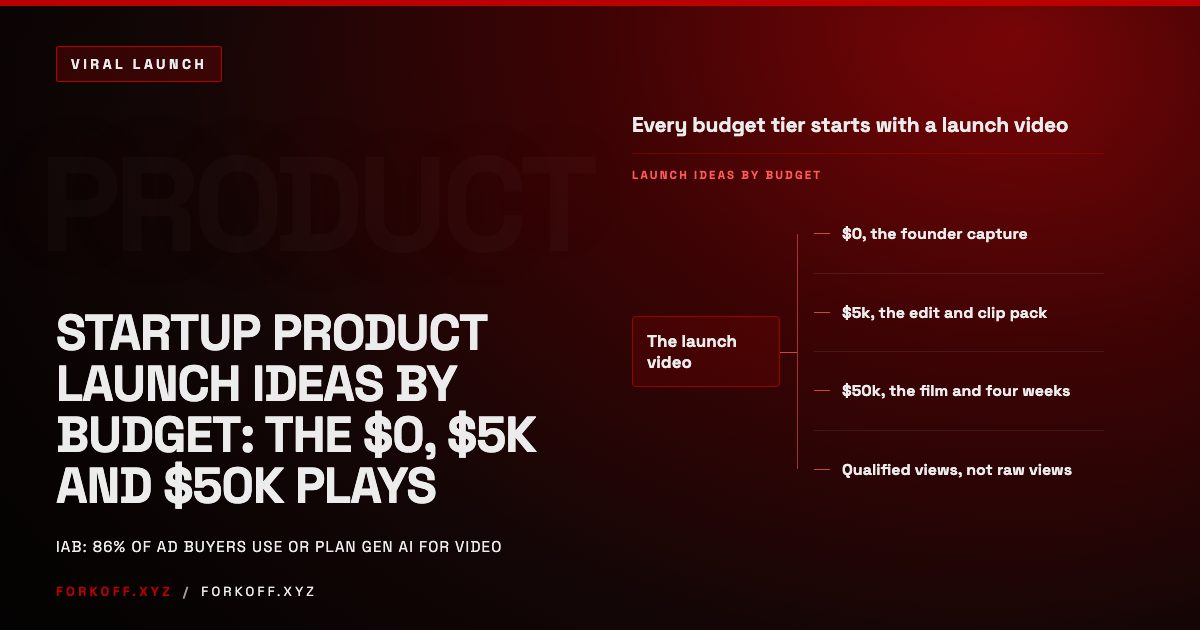
A pre-seed founder can run a credible online launch for under $2,500 total, mostly their own time on a webcam plus two or three creators. A seed-stage launch lands around $4,000 to $20,000 with a produced live hour and a creator wave. A Series A launch runs $20,000 to $85,000 for a real webcast and a full creator and paid layer. At every one of those stages, the distribution line should be larger than the production line. If an agency quotes you a launch where production is the whole number and distribution is an afterthought, they are selling you a webinar with better lighting. The product launch ideas by budget guide breaks down what the moment and the distribution should be at each spend level.
What a real founder's launch day looked like
A real founder's launch day is the cleanest proof that the platform is not the launch. Take the r/SaaS launch-day post again, now as a case rather than a quote. The founder spent a year building and a month marketing, launched on Product Hunt, landed at position #254 with near zero votes, and still pulled every one of their signups from Reddit, Discord, Instagram and YouTube. The launch platform produced nothing. The communities, the places the buyers already were, produced everything. The raw count was small and honest: 11 signups on launch day, 30 in total, and 1 paying customer, every one of them from a community rather than the launch board.

Look at where the signups came from and the lesson is impossible to miss. Product Hunt, the thing the founder treated as the launch, was a flat zero. Every other bar, the community channels, carried real signups. That is the distributed-launch pattern showing up by accident, without the clips and carriers that would have multiplied it on purpose. Imagine the same founder with a live moment, a clipper, and three creators pointing at one page, and the community bars get several times taller.
Building is too easy now. Most founders get stuck in the building loop. They build a feature. Then another feature. Months pass, and no real user ever touched the product. Set the official launch date, attract and onboard as many potential customers as you can through your network, chats and social media.
Building is too easy now. Here's how to actually launch your startup in 2026
The second founder, 15 years in, names the deeper reason the launch moment matters: building is now so easy that founders get stuck building forever and never force the distribution to happen. A dated, public launch is the forcing function, the same discipline accelerators teach through demo days and resources like the Y Combinator library. It puts a line in the calendar that makes you brief the creators, cut the clips, and point them somewhere. A webinar is a weak version of that forcing function, because it only forces you to book a room. A distributed launch forces you to build the reach.
The metrics that survive the week
Measure watched views, clicks, and signups inside 72 hours, broken down by clip and by creator, and ignore everything a webinar optimises for. Registrations are the webinar's favourite number and they are close to meaningless for a launch: a registration is a promise to maybe show up, not a result. Replay views are the same trap one step later. The metrics that survive the week are the ones tied to a buyer doing something.

Watched views, not raw impressions, tell you whether a clip actually held attention. Clicks to your one owned page, counted per clip and per creator, tell you which cut and which carrier moved people. Signups in the first 72 hours tell you whether the moment converted while it was warm. Those three numbers let you do the one thing a webinar never can: reallocate in real time toward the clip and the creator that are working, and cut the ones that are not. You can model the whole bill against reach with the cost-per-qualified-view approach below.
Demand for video is settled, so distribution is the only variable left
Wyzowl's 2026 research, summarized by Searchlab, has 91% of businesses now using video as a marketing tool. When the format is this accepted and the cost of making a video has collapsed, the launch does not win on production value. It wins on whether the right person sees the right 20 seconds of it, which is a distribution problem and the entire reason a live hour has to become clips.
Source: Wyzowl, via Searchlab Video Marketing Statistics 2026
Before you model your own launch on a viral one, check whether the launch you admire earned its reach or bought it. A launch that looks organic but ran on paid engagement or a bot-inflated follower base will not reproduce for you, and planning against a mirage is worse than planning against nothing. Run the reference launch through the checker first.
Six traps that turn a launch back into a webinar
An online launch collapses back into a webinar through six specific traps, and each one trades reach for comfort. Knowing them by name is most of avoiding them, because they all feel reasonable in the moment and only reveal themselves as mistakes when the views never come.

The first trap is gating the room, putting a registration wall in front of the exact reach you are trying to build. The second is slides over product, because nobody clips a slide and everybody clips a working demo. The third is one long asset, a 60-minute replay that yields zero feed-native clips. The fourth is briefing no carriers, so only your account posts and you reach only your followers. The fifth is counting registrations, which optimises the launch for a vanity number instead of signups. The sixth is scoping the clips late, which arrives as a re-edit invoice after delivery instead of a plan before the stream. Every one of these is the comfortable choice, and every one of them caps your reach at the size of the audience you already had.
How FORKOFF runs an online launch
At FORKOFF we run the live moment and the distribution as one system, priced on the outcome rather than a production day rate, which is the structural opposite of how event-software vendors sell. We produce the live hour, cut it into platform-native clips the same day, place those clips with creators your buyers already follow, seed them from the accounts that fit each audience, and put paid behind the cuts that earn watch time. The distribution side is not a claim, it is infrastructure, backed by a clipping network that has processed 5B+ views. The product launch video service page lays out the full mechanism, and RADAR tracks real launches by reach so you can see which ones earned it.
Operator note5B+ views through the FORKOFF clipping network is the benchmark here. A launch is a reach problem, and reach is what we measure.
How to Launch a Product Without a Following (What Actually Works)
Greg Lav
Greg Lav on launching a product without a following, a video with over 229,000 views. The throughline matches this guide: when you have no audience of your own, the launch has to travel through other people.
The honest disclosure, because this guide is published by FORKOFF: if all you need is one recorded video and you already own a reliable way to get it watched, a plain production shop is a cleaner and cheaper fit, and you should hire one. The case for running the full distributed launch only holds when reach is the thing you are actually short on. For most launches it is, which is exactly why the webinar-shaped advice keeps leaving founders with a polished hour and no audience.
The verdict: run a launch, not a webinar
The verdict is blunt. A webinar is a meeting you record for the people already on your list. An online product launch is a moment you distribute to the people who are not yet. In 2026, with building cheap and attention scarce, the launch that wins is not the one with the best-produced hour. It is the one whose hour travels furthest, cut into clips and carried by audiences that already exist. Run the live moment, yes, but treat it as the raw material it is, and spend your real effort on the layers that carry it.
So when you plan your next launch, ask the distribution questions out loud before you book anything. What will this moment become after the hour ends, in concrete clips and numbers? Who, other than our own account, is going to carry those clips? What are we counting, registrations or signups? The answers sort a launch from a webinar instantly. When you want the live moment, the clips and the creator wave scoped and costed as one system, talk to us or book a call and we will map it before you commit a date.