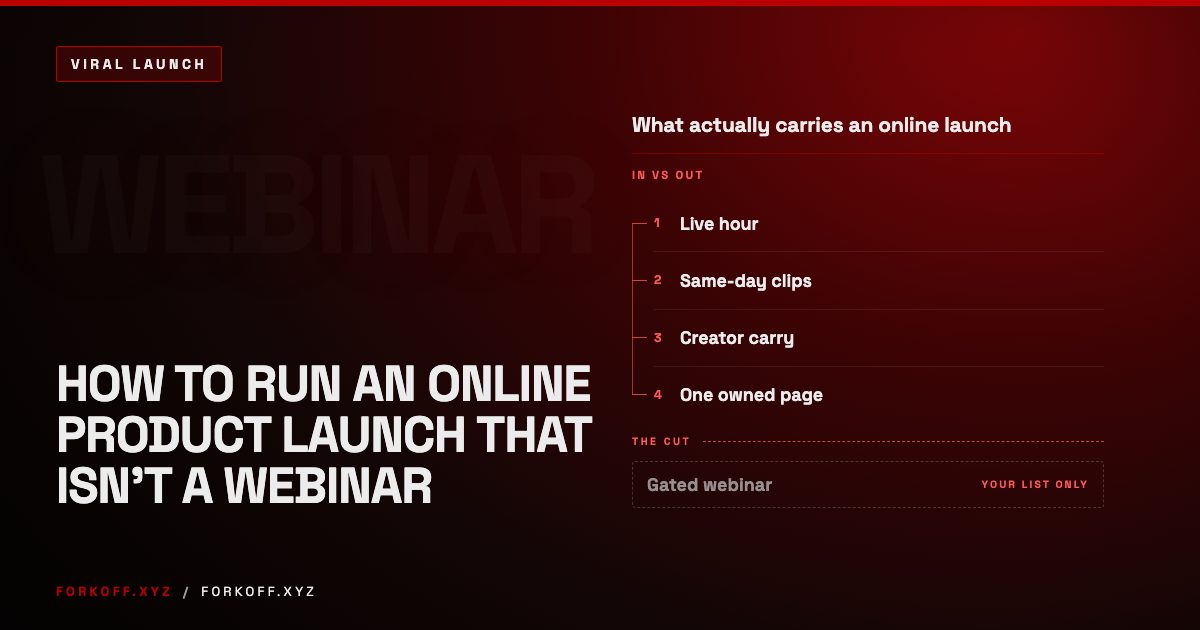
A product launch plan is the dated, owned checklist that moves a product from pre-launch prep through launch day into post-launch follow-up. It names your goal, audience, message, channels, timeline, and one owner per task, so the launch executes instead of improvising. This playbook is the full plan: the three phases, an hour-by-hour launch-day runbook, and the channels that actually move traffic.
Last updated 2026-07-09.
TL;DR
Most product launch guides stop at a Gantt template and the words "execute your marketing." That is where launches die. A real product launch plan covers three phases (pre-launch, launch day, post-launch), a 12-week countdown calendar, an hour-by-hour launch-day runbook, and a sequenced distribution plan across Product Hunt, Reddit, X, clipping, and PR. Below is all of it, plus the KPIs that separate a launch that trends from a launch that converts. According to a widely cited r/SaaS audit, 487 of 500 Product Hunt SaaS launches were dead within a year, and the difference is almost always distribution, not the product.
The 30-second version
A product launch plan is a dated, owned checklist across three phases: pre-launch (8 to 12 weeks of waitlist, assets, and amplifier recruitment), launch day (an hour-by-hour runbook from the T-24h freeze to the T+24h recap), and post-launch (the 30 to 90 day motion that converts the spike into retention). Sequence the channels instead of firing them at once: email and Product Hunt open the day, Reddit and X carry the high-intent middle, clipping and PR extend the tail past the 72-hour decay. Measure activation and paying conversion, not the badge. A widely cited r/SaaS audit found 487 of 500 Product Hunt SaaS launches dead within a year, and the difference is almost always the distribution plan that runs before and after the day itself.
How you know the product is ready, and what to review after launch
How do you know if your product is ready to launch? When three things are true and written down: the felt-absence test passes (a defined group of users would be disappointed if the product disappeared, measured by asking them), the support path can absorb a bad day (every failure the beta produced has a documented answer), and the launch-day runbook has an owner for each hour. A product that fails any of the three is ready for a beta, not a launch.
What mistakes derail launches in complex B2B environments? Launching to everyone at once instead of to the segment where the felt absence is strongest; announcing before sales and support have the same document the marketing team has; and treating launch day as the finish rather than the start of the review cycle below.
How should revenue leaders plan a launch that aligns teams? With one document, one owner per phase, and one metric per phase that everyone can see: signups for the announcement phase, activated accounts for the onboarding phase, qualified pipeline for the sales phase. The phase checklists in this post are built to be that document.
What should GTM teams review after a product launch? Within a week: what the day's numbers were against the pre-written targets, which messages produced replies, which channel's traffic activated, and every support question that had no answer. Within a month: retention of the launch cohort against the beta cohort, and the two or three things the next launch will do differently. Write the review before the next launch is planned, not during it.
For the Product Hunt specifics, including maker-comment timing, read the Product Hunt launch playbook; for the distribution model behind the phases, the three-ring SaaS launch.
Reviewed 2026-09-22 against the live search results for this topic: the questions people ask about it, and the pages that rank for it, are reflected in the section above.
The 2026 product launch landscape: why the old playbook stopped working
The product launch landscape today is distribution-bound, not build-bound. Shipping software is easier than it has ever been, so the bottleneck moved downstream: attention. A launch is no longer a single day when you flip a switch and press writes about you. It is a coordinated push across owned, earned, and paid channels, anchored by a founder voice that has been warming an audience for months.
The evidence is loud in founder communities. On X, Lemon Squeezy cofounder JR Farr summed up the shift: distribution is no longer optional, and most durable growth comes from doing a lot of small things for years, not one viral moment. Y Combinator's own Startup School guidance on launching tells founders to launch early and often, and to treat a launch as a repeatable motion rather than a one-time event. According to CB Insights research on why startups fail, the single most common reason (roughly 35 percent of failures) is building something with no market need, a problem a real launch plan surfaces early by putting a mediocre version in front of real users fast.
Distribution is no longer optional. Everyone wants a growth hack or a viral loop, but most of the growth at Lemon Squeezy came from doing a lot of small things for years.
JR Farr
@jrfarr
Distribution is no longer optional. Everyone wants a growth hack or a viral loop, but most of the growth at Lemon Squeezy came from doing a lot of small things for years. 1. Shipping constantly...
"Launch now, not when it is 'ready'. A mediocre product in front of real users teaches you more in a week than six months of building."
Pierre-Eliott Lallouet, cofounder, who reported going from 0 to 2,200 paying customers in under a year following YC's rules.
The top startup killer is a launch-timing problem
CB Insights' running analysis of startup post-mortems puts no market need at roughly 35 percent of failures, the single most common cause. That statistic is usually read as a product lesson, but it is equally a launch lesson: the only reliable way to surface no-market-need early is to put a mediocre version in front of real users fast, which is exactly what an 8-to-12-week launch plan with a real waitlist forces. Teams that polish for two quarters before any public launch discover the demand gap at the most expensive possible moment.
Source: CB Insights, top reasons startups fail
The teams that win in this landscape treat launch as a system. If you have shipped and heard crickets, the gap was rarely the code. It was the plan. This is the plan.
What is a product launch plan?
A product launch plan is a dated, owned document that sequences every task required to take a product to market, from pre-launch readiness through the launch-day execution window to post-launch follow-up. It answers six questions in writing: what is the goal, who is the audience, what is the message, which channels carry it, when does each thing happen, and who owns it. The plan is the operating manual your team runs on launch day when there is no time to think.
Distinguish the plan from the artifacts around it. A launch plan is not a launch-day tweet, and it is not a marketing campaign. It is the connective tissue that makes the tweet, the Product Hunt post, the email, the PR pitch, and the clipping wave fire in the right order, owned by named people, against a shared clock. Product School's launch plan guide frames it as the bridge between product strategy and go-to-market execution, and that is exactly the job: it turns intention into a checklist.
The best plans are boring to read and brutal to execute. Every line has an owner and a due date. There are no orphaned steps ("someone should post on Reddit") and no vague verbs ("promote the launch"). If a task cannot be assigned a name and a time, it is not in the plan yet.
A launch plan also has a shelf life. It is a living document you revise as pre-launch reveals reality: a channel that will not be ready, a hunter who falls through, an asset that takes longer than planned. The pre-launch window is also where demand gets built rather than assumed, the subject of pre-launch marketing that builds demand before launch day. The plan on the day you launch should look meaningfully different from the plan you wrote at T-12 weeks, because you learned things. What stays constant is the spine (the goal, the audience, and the three phases); what flexes is the tactics. Teams that treat the plan as fixed either miss reality or blow the date. Teams that revise it weekly arrive at launch day with a plan that matches the world they are actually launching into.
What should a product launch plan include?
A complete product launch plan should include nine components: launch goals and KPIs, positioning and messaging, a defined ICP and core message, launch assets, a channel and distribution plan, a dated countdown calendar, a named owner per task, an hour-by-hour launch-day runbook, and a post-launch follow-up plan. Miss any one and the launch develops a predictable failure mode, usually a traffic spike that never converts because the post-launch plan was blank.
Here is the anatomy, in the order you build it.
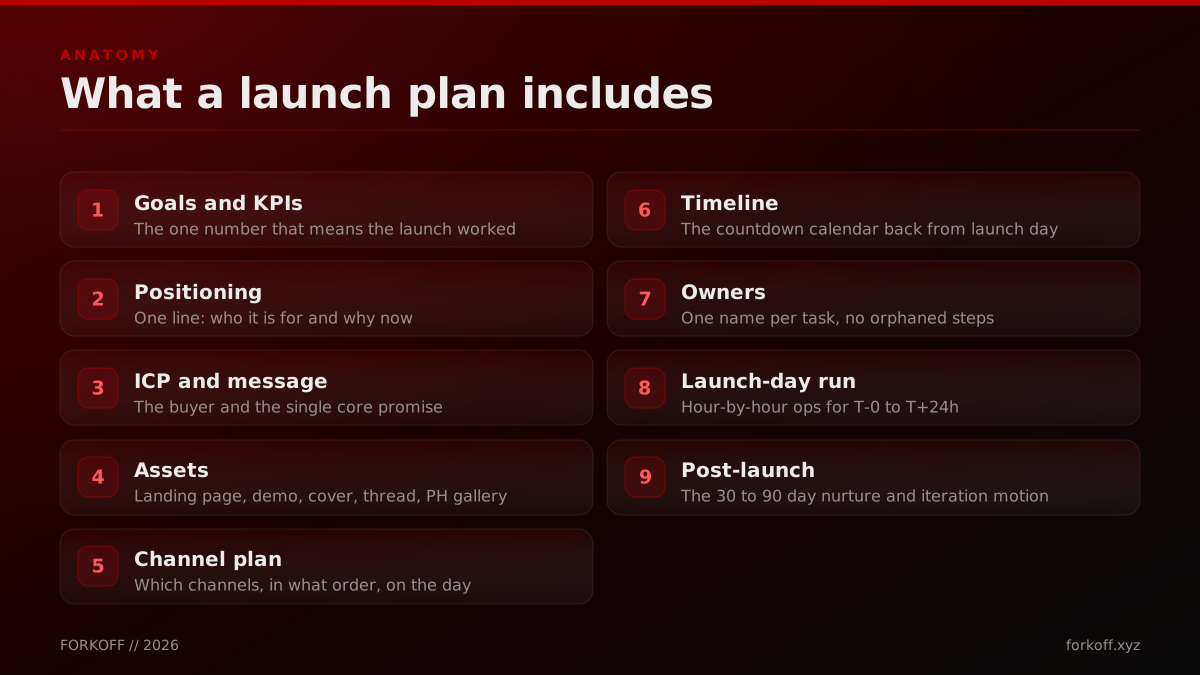
- Goals and KPIs. Pick the one number that means the launch worked (signups, activated users, revenue, waitlist conversions). Everything else is secondary.
- Positioning. One line: who it is for, and why now. If you cannot say it in a sentence, your launch-day copy will wander.
- ICP and core message. The specific person you are talking to, and the single promise you are making them.
- Assets. Landing page, product demo or video, OG cover, launch thread, Product Hunt gallery, email copy, PR one-pager.
- Channel plan. Which channels, in what order, on what hour of launch day.
- Countdown calendar. The dated backward schedule from launch day (covered below).
- Owners. One name per task. Shared ownership is no ownership.
- Launch-day runbook. The hour-by-hour ops for T-0 to T+24h.
- Post-launch plan. The 30 to 90 day nurture and iteration motion that turns the spike into retention.
The most-skipped components, per the launch-readiness discussions surfaced across r/indiehackers, are the last three: owners, the launch-day runbook, and the post-launch plan. Skip them and you get the classic complaint we see constantly, a founder who launched, spiked, and then posted "1.5 months in, one active non-paying user, how do I get traction?" The traction plan needed to exist before launch day, not after.
What is the difference between a product launch plan and a product launch strategy?
The difference is altitude and time horizon. A product launch strategy is the why and the who: your positioning, target segment, pricing bet, and the wedge you are driving into the market. A product launch plan is the how and the when: the dated tasks, owners, channels, and launch-day runbook that execute that strategy. Strategy is decided in quarters and rarely changes; the plan is built in weeks and is revised constantly. You cannot substitute one for the other, and most stalled launches have a strategy but no plan.
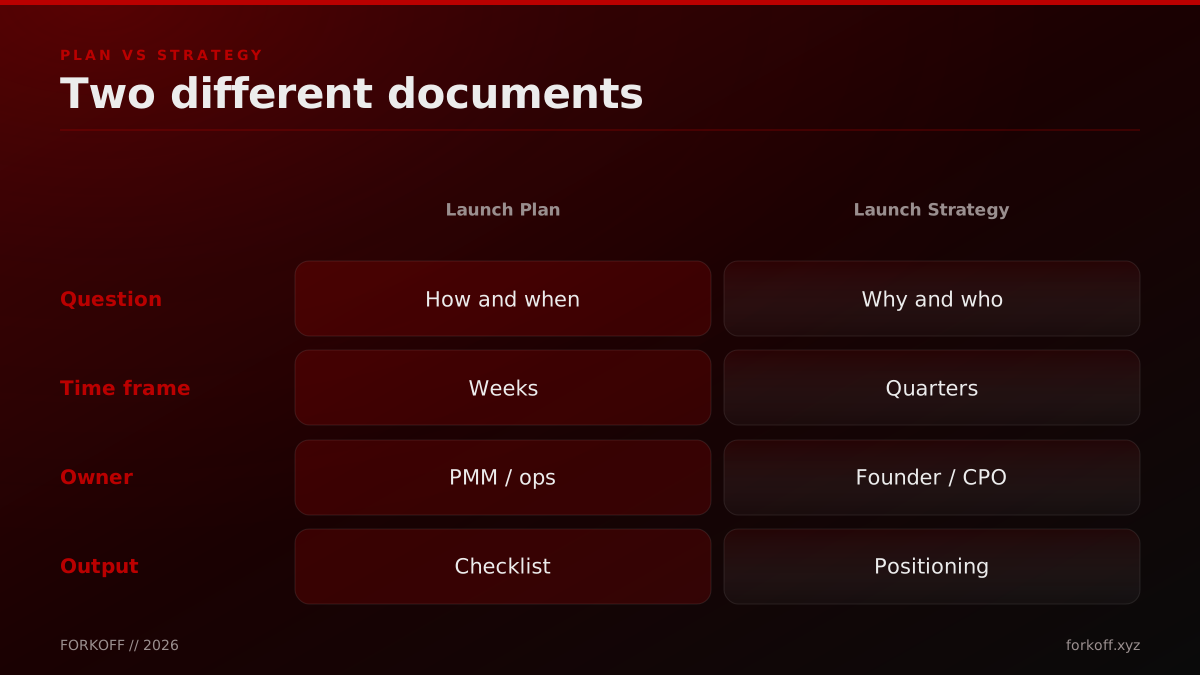
A useful test: if a document tells you why buyers will choose you over the incumbent, that is strategy. If it tells you what to post at 12 PT and who hits publish, that is the plan. Productboard's launch strategy guide and Highspot's 2026 go-to-market launch checklist both sit on the strategy side; this playbook is deliberately the execution side, because the execution side is where the SERP and the AI Overviews are thin. On forkoff.xyz, the strategy layer for a market-entry motion lives in our founder funnel work and the go-to-market playbooks; the plan layer is what follows.
What are the three phases of a product launch (pre-launch, launch day, post-launch)?
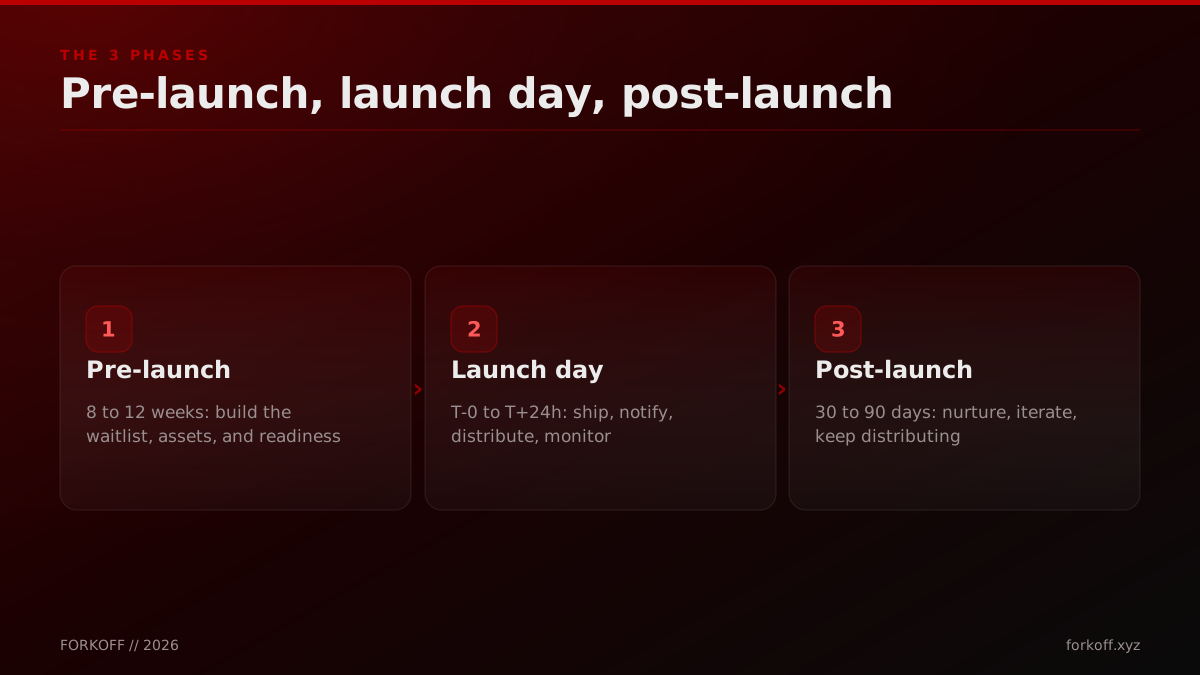
Every product launch runs in three phases. Pre-launch is the 8 to 12 week readiness window where you build the waitlist, create assets, line up amplifiers, and warm your audience. Launch day is the compressed T-0 to T+24h execution window when every channel fires in sequence. Post-launch is the 30 to 90 day follow-through where you nurture the users the launch produced, iterate on their feedback, and convert the one-day spike into a compounding distribution motion. Most guides name these phases; almost none tell you what to actually do inside each one, which is the rest of this playbook.
The phases are not equal in effort. Pre-launch is roughly 70 percent of the total work, launch day is the visible 10 percent, and post-launch is the 20 percent that determines whether the launch mattered in 90 days. Teams invert this, pouring energy into launch day and treating pre-launch as an afterthought, which is why Asana's product launch resources and every serious operator emphasize readiness. Launch day is where a good plan gets executed, not where it gets made.
The three launch phases, their windows, and where the effort goes
| Phase | Window | Share of total effort | Core job |
|---|---|---|---|
| Pre-launch | T-12 weeks to T-24h | Roughly 70 percent | Waitlist, assets, amplifiers, warm audience |
| Launch day | T-0 to T+24h | Roughly 10 percent | Execute the hour-by-hour runbook |
| Post-launch | 30 to 90 days | Roughly 20 percent | Activation, nurture, continued distribution |
Effort split per the phases section of this playbook; FORKOFF launch ops framing.
Think of the phases as a relay, not three separate races. Pre-launch hands the launch day a warm audience and finished assets; launch day hands post-launch a cohort of signups and a set of channel-attribution data; post-launch hands the next launch a set of activated customers and the knowledge of which channels actually convert. A break in the handoff wastes everything upstream. A brilliant launch day with no post-launch plan drops the baton at the most expensive moment, right after you spent 12 weeks and real money getting the audience to show up.
What are the 7 steps of a product launch?
The 7 steps of a product launch are: (1) define the goal and audience, (2) lock positioning and messaging, (3) build the launch assets, (4) choose and sequence distribution channels, (5) build a dated countdown calendar, (6) execute the launch-day runbook, and (7) measure and iterate in post-launch. Each step has exactly one owner and a due date. The steps map cleanly onto the three phases: steps 1 through 5 are pre-launch, step 6 is launch day, and step 7 is post-launch.
Run the steps in order, but keep them live. Step 1 (goal and audience) is the constraint that every later step answers to. If step 4 (channels) does not serve step 1 (goal), you picked the wrong channels. Paddle's 5-step launch process and HubSpot's launch checklist compress or expand this list, but the spine is identical: decide, prepare, distribute, execute, learn. The number of steps matters less than whether each one is owned and dated.
What are the six steps of a product launch plan?
The six-step version of a product launch plan is: (1) set goals and KPIs, (2) define the audience and message, (3) prepare launch assets, (4) plan channels and the timeline, (5) launch, and (6) analyze and iterate. It is the 7-step model with the standalone "build the countdown calendar" step folded into planning. Whether you count six or seven, the coverage is the same: you decide what success is, prepare, distribute, ship, and measure.
Do not agonize over the count. We have seen founders lose a week debating six versus seven versus Reforge's launch templates versus a nine-step model. The step count is a packaging choice. What actually predicts a good launch is whether every step is assigned, dated, and connected to the one KPI you defined in step one. A well-owned six-step plan beats a beautiful nine-step plan with no owners every time.
What are the 4 Ps of a product launch?
The 4 Ps of a product launch are Product, Price, Place, and Promotion, the classic marketing mix applied to a launch. Product is what you ship and how ready it is. Price is your packaging and any launch offer. Place is the set of channels and platforms where the launch happens. Promotion is the messaging, assets, and distribution that carry it. The 4 Ps map directly onto the launch plan: Product and Price sit in the strategy and positioning sections, while Place and Promotion are the channel plan and the distribution runbook.
The 4 Ps are a useful pre-flight checklist, not a plan by themselves. They force you to notice, for example, that your Place (Product Hunt, an English-speaking, developer-heavy, US-timezone platform) has to match your Product and your ICP, or the launch misfires. If Product Hunt is that place, the Product Hunt launch playbook on maker-comment timing covers the launch-day mechanics that decide the finish. A B2B fintech tool with a compliance-officer buyer does not "launch on Product Hunt and hope." Its Place is a wire release, a LinkedIn motion, and a targeted answer engine optimization push so the buyer's AI search returns you. Use the 4 Ps to sanity-check, then build the dated plan.
How To Have A Successful Product Launch: My 4-Step Process | Alex Cattoni
Alex Cattoni
Alex Cattoni's 4-step product launch process.
How far in advance should you start planning a product launch?
Start planning a product launch 8 to 12 weeks before launch day for most software products. You need that runway to build a waitlist, create every asset, recruit hunters and KOLs, warm your email list and founder audience, and dry-run the launch-day runbook at least once. Hardware and physical-product launches usually need 4 to 6 months because manufacturing, inventory, and retail timelines are unforgiving. The single most common launch mistake we see is compressing pre-launch to two weeks, which guarantees a cold list and unbuilt assets on the day.
The pre-launch window is where launches are won. Indie-hacker threads on preparing a Product Hunt launch "ahead of time" and frameworks like the "four dimensions of launch readiness" all point at the same truth: the visible launch is the tip of an iceberg of unglamorous preparation. If you only have two weeks, do not launch in two weeks. Move the date, build the list, and launch when the audience exists. A warm audience on a later date beats a cold audience on the original one.
When to Launch Your Startup and When to Wait
Y Combinator
Y Combinator on when to launch your startup, and when to wait.
What is launch readiness, and how do you know you are ready?
Launch readiness is the state where every dependency for a successful launch exists and has been tested: the product delivers its core promise reliably, the assets are built, the audience is warm, the channels are lined up, and the team knows the launch-day runbook cold. The useful framing that circulates in indie-hacker communities is the "four dimensions of launch readiness": product readiness, market readiness, channel readiness, and team readiness. You are ready when all four clear a checklist, not when the calendar says so.
Run each dimension as a gate, not a vibe. Product readiness: the signup and payment paths work, the core feature delivers the promise, and you have handled the top three edge cases a new user will hit in the first five minutes. Market readiness: you have a waitlist with genuine intent (not just an email dump), and you have validated that the message resonates by testing it on real prospects. Channel readiness: your Product Hunt listing is queued, your thread is drafted, your hunter is confirmed, and your KOLs are booked. Team readiness: every owner knows their launch-day slot and you have completed at least one full dry-run.
The trap the "ready enough" debate misses is that readiness is not binary and it is not perfection. You do not need every feature; you need the four gates to clear for the smallest version that delivers the promise. A tool that does one thing reliably, launched to a warm list, beats a ten-feature product launched cold. Readiness is about the launch system being whole, not the product being finished. If a dimension is not ready, that is your signal to move the date, not to launch and hope.
The countdown calendar: a concrete 12-week schedule to launch day
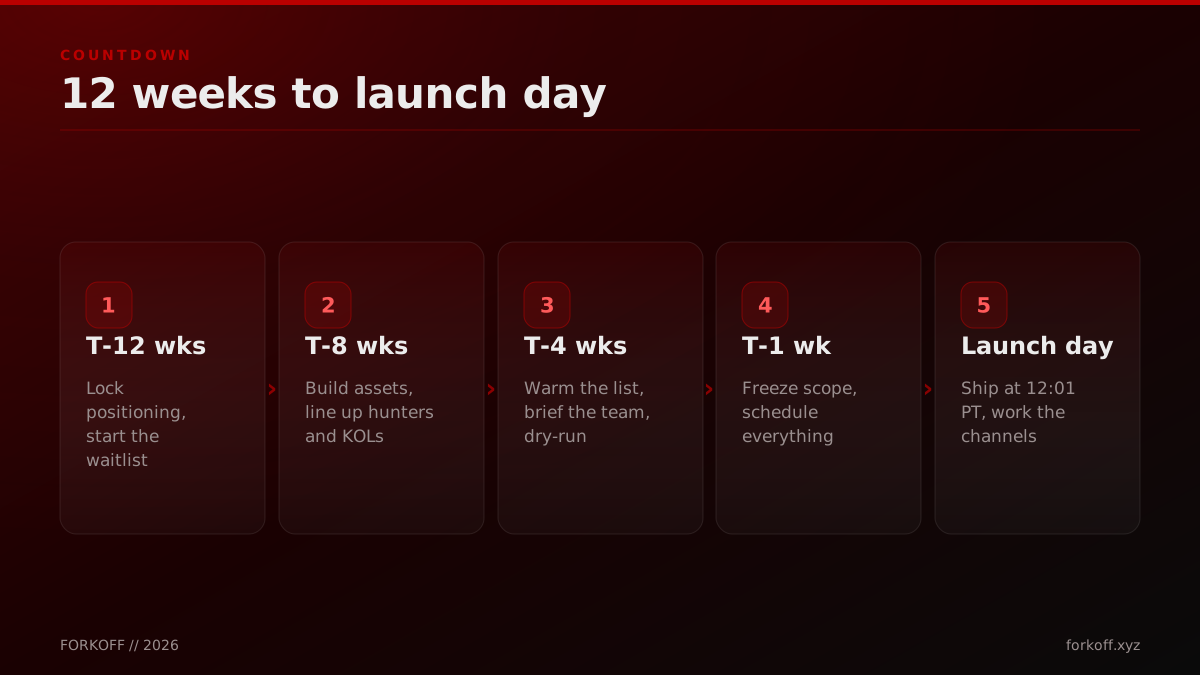
A product launch countdown calendar is the backward-dated schedule that turns "plan far in advance" into specific tasks on specific weeks. Rather than an abstract instruction to prepare, it assigns each pre-launch job to a week and an owner, so nothing collapses into the final scramble. Below is the concrete 12-week version we run for software launches. Compress it to 8 weeks for a feature drop; extend it to 16 for a bigger platform launch.
T-12 weeks: Positioning and the waitlist. Lock the one-line positioning and who-it-is-for. Stand up a waitlist landing page and start capturing emails. Begin the founder's pre-launch content cadence on X so there is an audience to launch to. This is when Twitter marketing and founder-voice warming start paying off later.
T-8 weeks: Assets and amplifiers. Build the landing page, demo video, OG cover, and Product Hunt gallery. Identify and reach out to a hunter with a real following, plus 3 to 8 KOLs in your category. Draft the launch thread and email sequence. Our KOL marketing desk runs a tier analysis here so spend goes to accounts that convert, not just accounts with follower counts.
T-4 weeks: Warm and dry-run. Warm the waitlist with a "launching soon" sequence. Brief the team on the launch-day runbook and assign every task an owner. Run one full dry-run of the launch-day timeline. Line up the clipping and short-form assets so the podcast clipping and distribution wave is ready to fire on the day.
T-1 week: Freeze and schedule. Freeze product scope (no new features), finish QA, and schedule every post, email, and thread. Confirm every owner knows their launch-day slot. Pre-write the recap thread. By now nothing should be improvised.
Launch day: ship at 12
PT and work the channels per the runbook below.The 12-week countdown calendar at a glance
| Checkpoint | Job | Key deliverables |
|---|---|---|
| T-12 weeks | Positioning and the waitlist | Positioning locked, waitlist live, founder posting |
| T-8 weeks | Assets and amplifiers | Landing page, demo, PH gallery, hunter, KOLs |
| T-4 weeks | Warm and dry-run | Warm-up sequence, owners assigned, one dry-run |
| T-1 week | Freeze and schedule | Scope frozen, QA done, posts scheduled |
| Launch day | Execute | Live at 12:01 AM PT, run the runbook |
Compress to 8 weeks for a feature drop, extend to 16 for a platform launch; the structure holds, only durations change.
The calendar is a backward schedule for a reason: you fix the launch date, then work backward to place each dependency where it has enough runway. Forward-planning ("what should we do next?") lets tasks slip until the date arrives with half the plan undone. Backward-planning from a fixed date forces the hard question early, which is whether a task actually fits in the time remaining. If the assets cannot be built in the four weeks the calendar allots, you learn that at T-8 weeks and can adjust, rather than discovering it at T-3 days. Compress the whole thing to 8 weeks for a small feature drop by halving the asset and warm-up windows, or extend it to 16 weeks for a platform launch that needs more audience-building and more amplifier coordination. The structure holds; only the durations change.
How do you build pre-launch buzz and a waitlist before launch day?
You build pre-launch buzz by giving your future audience a reason to care before the product exists, then capturing their intent on a waitlist. The mechanics: run a waitlist landing page with a clear promise, have the founder build in public on X for 8 to 12 weeks (sharing the problem, the progress, and the learnings, not the product pitch), seed the category communities where your buyers already gather, and offer early access or a launch-day perk to waitlist members. Buzz is not manufactured on launch day; it is accumulated in the weeks before it.
There are four reliable pre-launch buzz mechanics, and you can run all of them at once. Build in public: the founder posts the problem, the progress, and the honest setbacks, which earns an audience invested in the outcome before the product exists. The waitlist with a real perk: a landing page that promises early access, a launch-day discount, or a founding-member status, so signing up costs the visitor a moment and earns them something. Community pre-seeding: genuine participation in the subreddits, Discords, and Slack groups where your buyers already gather, months before you have anything to sell, so you have standing when you launch. Amplifier recruitment: lining up the hunter, the KOLs, and the friendly accounts weeks ahead, so launch day has a pre-built amplification layer rather than a cold ask.
The waitlist is not a vanity metric; it is the launch-day fuel supply. A waitlist of 500 genuinely interested people that converts at 30 percent gives you 150 signups in the first hour, and those early signups create the social proof and the Product Hunt momentum that pull in everyone else. An empty waitlist means launch day starts at zero and has to manufacture momentum from nothing, which is far harder. Every hour spent building the waitlist in the pre-launch window pays back multiples on launch day.
Operator noteA 500-person waitlist converting 20 to 40 percent is 100-plus signups in hour one; early velocity is the whole Product Hunt game., FORKOFF distribution ledger, n=12 launches
The compounding lever here is the founder's voice. A founder who has posted four times a week for three months arrives at launch day with a warm audience that amplifies for free. This is the core of the three-ring distribution model we detailed for SaaS launches: the founder is ring one, the team is ring two, and paid amplification is ring three, and ring three only works once ring one exists. Build-in-public buzz plus a waitlist means launch day starts with momentum instead of from zero. For the distribution engine that carries this, our founder funnel and clipping engagements exist to run it while the founder ships.
What goes on a launch-day checklist? The hour-by-hour runbook (T-0 to T+24h)
A launch-day checklist is an hour-by-hour operations runbook, not a to-do list. It specifies exactly what happens and who does it across the T-24h to T+24h window, so the launch executes like a flight plan instead of a scramble. Competitors name "launch day" as a phase and stop; here is the granular execution timeline we run, calibrated to a US-Pacific Product Hunt launch (12
AM PT go-live, the moment the day resets).The hour-by-hour launch-day runbook (T-24h to T+24h)
STEPS- 01
T-24h: freeze the build
Final QA on the landing page, signup flow, and payment path. Schedule every post and email. Confirm the Product Hunt listing is queued and tracking fires.
- 02
T-1h: war room live
A shared Slack or call. Assets staged. Every owner on standby. Hunter confirmed and ready to publish.
- 03
T-0: Product Hunt goes live
Pin the listing. Founder posts the first comment (the story, not the sales pitch). Notify the inner circle to engage authentically.
- 04
T+1h: launch thread and email blast
Founder posts the launch thread on X. Email blast to the full waitlist. Personal DMs to the warmest supporters.
- 05
T+3h: seed Reddit and communities
A genuine, value-first post in the right subreddits. Reply to every Product Hunt comment within minutes.
- 06
T+8h: fire the clipping and UGC wave
Short-form cuts of the demo and founder reaction. KOLs post scheduled amplification. Send the PR or wire release.
- 07
T+12h: mid-day rally
Post a progress update with real numbers. Re-engage the network. Answer every DM and comment.
- 08
T+24h: post the recap
Post the recap thread with the numbers. Thank every supporter by name. Log every metric against your KPI.
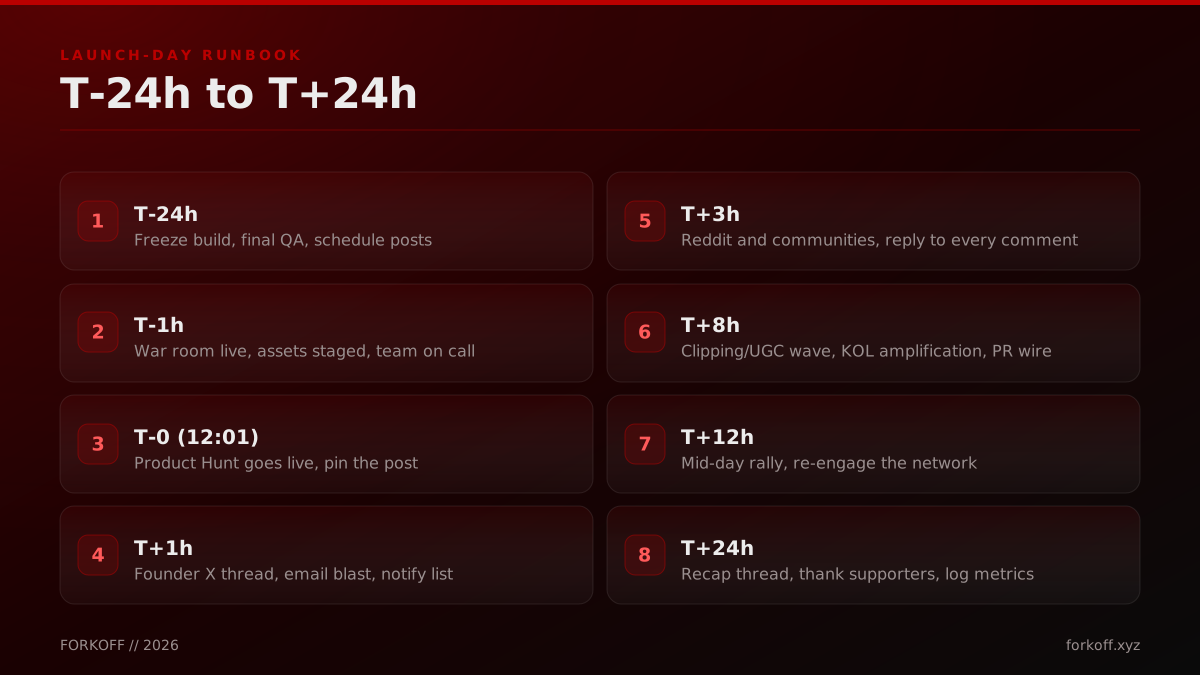
- T-24h (day before): Freeze the build. Final QA on the landing page, signup flow, and payment path. Schedule every post and email. Confirm the Product Hunt listing is queued and the gallery, tagline, and first comment are drafted. Verify tracking (UTMs, analytics events) fires.
- T-1h (11 PM PT): War room live (a shared Slack or call). Assets staged. Every owner on standby. Hunter confirmed and ready to publish.
- T-0 (12 AM PT): Product Hunt goes live. Pin the listing. Founder posts the first comment (the story, not the sales pitch). Notify the inner circle (team, advisors, closest supporters) to engage authentically, never with fake votes.
- T+1h: Founder posts the launch thread on X. Email blast to the full waitlist. Personal DMs to the warmest supporters asking for genuine feedback, not upvotes.
- T+3h (as US wakes up): Seed Reddit and niche communities with a genuine, value-first post in the right subreddits (mod-safe, see below). Reply to every Product Hunt comment within minutes. Post in relevant Slack and Discord communities.
- T+8h (US midday): Fire the clipping and UGC wave (short-form cuts of the demo, founder reaction, use-case clips). KOLs post their scheduled amplification. Send the PR or wire release so it lands during business hours.
- T+12h: Mid-day rally. Post a progress update ("we are number three, here is what we shipped"). Re-engage the network. Answer every DM and comment.
- T+24h: Post the recap thread with the numbers. Thank every supporter by name where possible. Log every metric against your KPI. The launch day is over; the post-launch motion begins.
The rule that saves launches: reply to everything. The launches that convert are the ones where the founder answered every comment, DM, and question on the day. Attention is fleeting, and responsiveness on launch day is the cheapest trust you will ever buy.
The launch-day wave sequence, channel by hour
| Time | Channel wave | Why then |
|---|---|---|
| T-0 (12:01 AM PT) | Product Hunt live, founder first comment | The PH day resets; a full 24 hours for votes |
| T+1h | Founder X thread, email blast, warm DMs | Owned audience converts highest, feeds velocity |
| T+3h | Reddit and community seeding | US wakes up; high-intent readers arrive |
| T+8h | Clipping wave, KOL posts, PR or wire release | US midday; press lands in business hours |
| T+12h | Progress-update rally | Real numbers re-engage the network |
| T+24h | Recap thread, thank supporters, log KPIs | Closes the day and opens the post-launch motion |
The sequencing logic: each wave feeds the next instead of burning every amplifier at 12:01.
War-room roles. A launch-day runbook only works if each row has a named owner, so staff four roles even on a small team. The founder is the voice: the first Product Hunt comment, the X thread, the personal DMs, and the replies to high-value questions. The community lead works the comment sections and communities: Product Hunt, Reddit, Slack, and Discord, replying within minutes and flagging anything the founder needs to answer. The distribution lead fires the scheduled waves on time: clipping, KOL amplification, and the PR or wire release. The ops lead watches the dashboards: traffic, signups, error rates, and the payment path, and raises the alarm the instant something breaks. On a solo launch, the founder wears all four hats but should still run the checklist in role order so nothing is dropped. The tools that stitch this together are simple: a shared launch doc, a live chat channel, and a single dashboard everyone watches. Templates like Atlassian's Confluence product launch template are useful for the pre-launch planning artifact, but on the day itself the runbook and the named owners matter more than any tool.
What distribution channels should a product launch use (Product Hunt, Reddit, X, PR, clipping)?
A product launch should use a sequenced mix of channels, not a simultaneous blast: Product Hunt for the credibility spike, an X launch thread for founder-led reach, Reddit and niche communities for high-intent traffic, short-form clipping and UGC for volume, PR or a wire release for authority and backlinks, and your own email list as the single highest-converting channel. The mistake is firing all of them at 12
and burning your amplifiers in one hour. Sequence them across the launch-day runbook so each wave feeds the next.Operator noteThree waves, not one blast: email and PH at T-0, Reddit and X at T+3h, clipping and PR at T+8h. Firing all at 12:01 burns amplifiers., FORKOFF launch ops
Here is the channel-by-channel playbook the generic PM-tool guides skip.
Product Hunt. Launch at 12
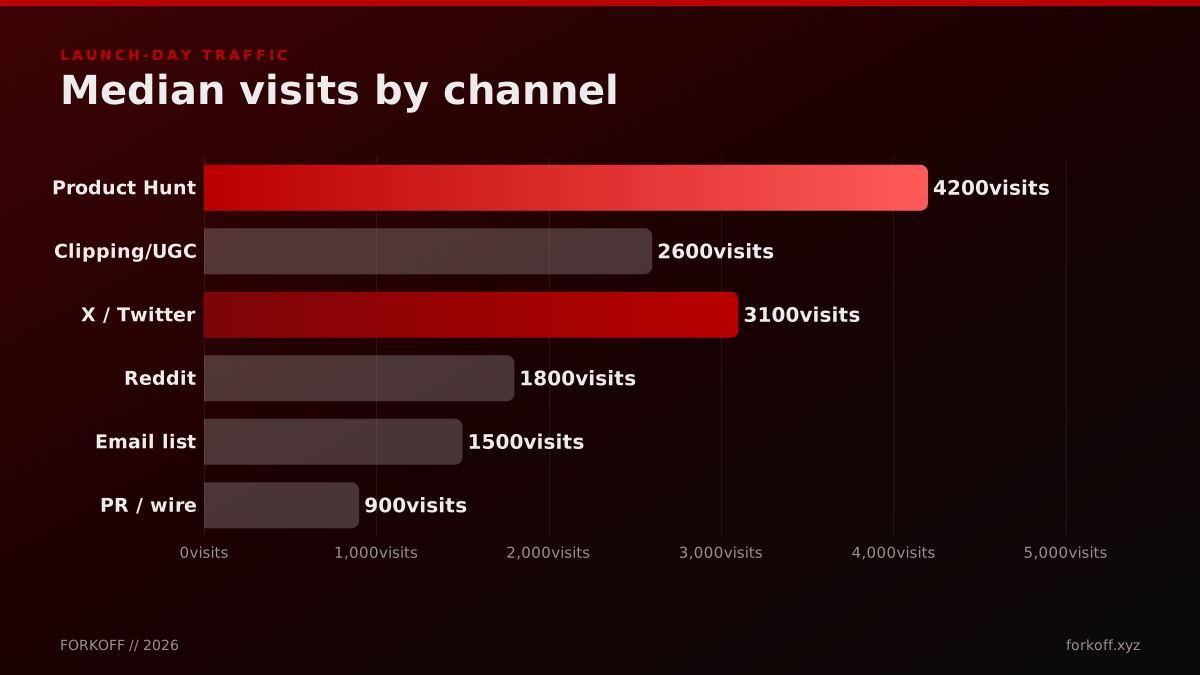
AM PT (the day resets then, giving you a full 24 hours to accumulate votes). Line up a hunter with a real following if you can, but self-launching works. Prepare the gallery, a sharp tagline, and a founder first comment that tells a story. Never buy votes or ask for upvotes directly; Product Hunt penalizes it and the community notices. Notify your network to check it out and engage honestly. A top-five finish typically drives 4,000 to 15,000 visits.The Product Hunt mechanics reward preparation, not hype. Your first comment should tell the origin story (what problem, why you built it, what is different) in a human voice, because that comment is pinned and read by everyone who lands on the listing. Your gallery should lead with the product in action, not a logo. And your notification list (the people you personally tell to check it out) should be warmed in advance so they engage in the first two hours, when early velocity determines whether the algorithm surfaces you for the rest of the day. Momentum compounds on Product Hunt: the ranking you hold at hour two shapes the traffic you get at hour twelve.
Reddit. This is the channel most launches botch. Pick 2 to 4 subreddits where your buyers actually are, read the rules, and post value first (a genuine build story, a lesson, a free resource), with the product as the supporting detail, not the headline. Never spam the same post across subreddits. Reply to every comment. Done right, a single Reddit thread that lands drives high-intent traffic that converts better than the Product Hunt spike. This is exactly the discipline our Reddit marketing team runs, because a mod ban on launch day is a self-inflicted wound.
The Reddit-specific rule is that the platform punishes self-promotion and rewards contribution. Before launch, spend weeks genuinely participating in your target subreddits so you have karma and standing. On launch day, lead with a story or a lesson the subreddit values ("I spent six months building X, here is what I learned about Y"), and let the product be the natural supporting evidence. Read each subreddit's self-promotion rules, because many require a ratio of contribution to promotion, and a mod removal on launch day deletes your highest-intent channel in one click. The reward for getting it right is disproportionate: a single well-received Reddit thread routinely out-converts the entire Product Hunt spike, because the traffic arrives already convinced it has a problem you solve.
X / Twitter. The founder launch thread is the anchor. Hook in the first line, show the product in a 20 to 40 second video, tell the origin story, and end with a clear call to action and the link. Then the team quote-tweets from their own accounts, and the paid amplification layer (reply presence, KOL posts) extends reach into non-overlapping networks. This is the three-ring distribution model in motion.
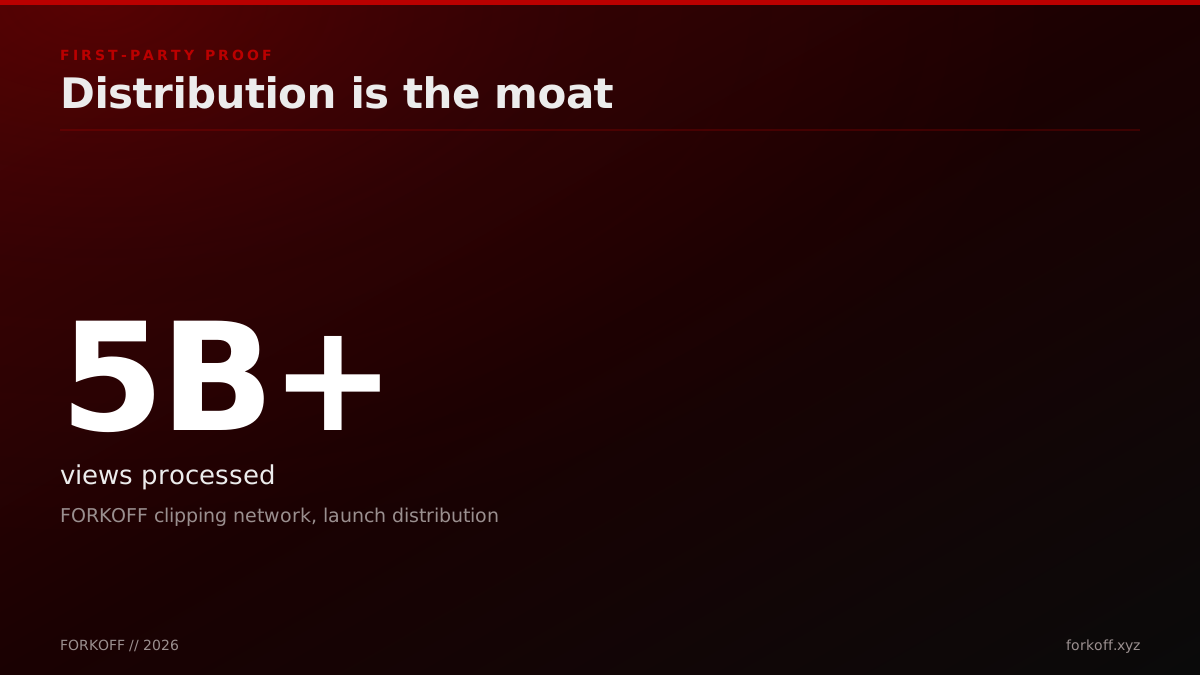
Short-form clipping and UGC. The most under-used launch channel. Cut the demo and founder content into short vertical clips and push them across TikTok, Reels, Shorts, and X. Volume compounds: a launch that produces 20 clips seeds weeks of discovery, not one day. This is our core competency; our clipping network has processed over 5 billion views, and we run this wave on client launches through our podcast clipping and distribution service.
Operator note5B+ views processed across our clipping network; the clipping wave is what carries week two after the Product Hunt spike decays., FORKOFF clipping network
PR and wire. A wire release (or a targeted journalist pitch) buys authority and backlinks, which feed both traditional SEO and AI-answer visibility. Time it to land during business hours on launch day. For AI search specifically, pair it with generative engine optimization and AI answer engine optimization work so the launch shows up when buyers ask ChatGPT or Perplexity for "best tool for X."
Post-launch compounding now runs through AI search
Tally's public $5M ARR update, five years after its 2021 Product Hunt launch, names AI search as its number one acquisition channel and a trusted community as its emerging moat, while staying bootstrapped with a tiny team. That is what the compounding end-state of a launch actually looks like: the launch-day spike is long gone, and the durable channels are the ones the post-launch plan built, organic content, AI-answer visibility, and community. A launch plan that budgets nothing for AEO and community after T+24h is planning to rent attention it could have owned.
Source: Tally $5M ARR update, r/SaaS, April 2026
Email list. Your own list is the highest-converting channel you have. It is warm, it is yours, and it does not depend on an algorithm. Which is exactly why the pre-launch waitlist is the highest-leverage pre-launch task.
Here is how the channels compare on the three things that actually matter on launch day: how fast they spike, how well they convert, and how long the effect lasts.
| Channel | Speed of spike | Conversion quality | Longevity | Best used for |
|---|---|---|---|---|
| Product Hunt | Fast (24h) | Medium | Low (72h decay) | Credibility, badge, backlink |
| Reddit / communities | Medium | High (high intent) | Medium | Qualified traffic, feedback |
| X launch thread | Fast | Medium to high | Medium | Founder-led reach, network |
| Clipping / UGC | Slow build | Medium | High (compounds) | Volume, ongoing discovery |
| PR / wire | Medium | Low direct | High (SEO/AI) | Authority, backlinks, AI answers |
| Email list | Instant | Highest | N/A (one-shot) | Warm conversion on day one |
The Product Hunt launch guide itself stresses preparation over the day, and that is the pattern: no channel rescues a cold launch. Sequence them so each wave has a job. Email and Product Hunt open the day for the spike, Reddit and X carry the high-intent middle, and clipping plus PR extend the tail past the 72-hour decay.
The YC "launch-max" playbook that circulates on X (Product Hunt, Hacker News, DevHunt, BetaList, Peerlist, and the indie directories) is a real tactic, but sequence it: lead with your two strongest channels, then roll the long tail of directories over the launch week rather than all on day one. If you want the launch-platform tail mapped in full, we broke it down in launch platforms beyond Product Hunt, and the developer-audience angle in how to launch on Hacker News. Model and feature drops move faster still; the 48-hour model-drop marketing playbook covers that compressed variant.
in @ycombinator they have a playbook on how to get customers ASAP for your startup. if you follow this, you'll brute force your way to 100 customers, almost no matter what your product is.
Finn Mallery
@fin465
in @ycombinator they have a playbook on how to get customers ASAP for your startup. if you follow this, you'll brute force your way to 100 customers... 1/ launch-max. product hunt, hackerNews, devhunt, betalist, peerlist, indie...
How we hit Product Hunt #1 (30x): the week-by-week launch timeline
Should you launch on one platform or launch-max across many?
Launch on your two strongest platforms with full effort, then roll the long tail of directories across launch week, rather than firing everything on day one. The "launch-max" instinct (Product Hunt, Hacker News, DevHunt, BetaList, Peerlist, indie directories, all at once) feels thorough but usually produces a shallow presence everywhere and a strong presence nowhere. Depth on two channels beats a token post on ten. The right number is not "all of them"; it is "the ones where your buyers are, done properly."
The YC launch-max playbook is about repetition, not reach
Finn Mallery's widely shared breakdown of YC's customer-acquisition playbook (3,700-plus likes, 300,000-plus views) leads with launch-max: Product Hunt, Hacker News, DevHunt, BetaList, Peerlist, and the indie directories, as the brute-force path to 100 customers. The operational nuance most readers miss is sequencing: the playbook works as a rolling launch week, with the anchor platforms on day one and the directory tail spread across the following days, not as a single simultaneous blast that gives every platform a shallow token presence.
Source: Finn Mallery on YC's launch-max playbook, X, June 2026
Sequence the tail so each platform gets a real moment. Day one is your anchor pair (for most software, Product Hunt plus the founder's X thread). Day two is Hacker News if your audience is technical, because a "Show HN" competes for attention and does not want to share the day with your Product Hunt push. Days three through seven are the directories: BetaList, Peerlist, DevHunt, and the niche lists in your category, one or two per day, each with a tailored blurb. Spreading the tail keeps you visible across a launch week instead of a launch day, and it gives you multiple bites at the algorithm.
The deeper point, echoed by operators from First Round Review to Lemon Squeezy, is that a launch is a distribution habit, not a distribution event. The founder who documented hitting Product Hunt number one 30 times did not win by launching on more platforms in one day; he won by turning launching into a repeatable system he ran again and again. Pick your platforms by where your ICP actually is, execute them fully, and treat the calendar as a rolling week, not a single Tuesday.
Distribution is a habit, not an event
JR Farr, who cofounded Lemon Squeezy and sold it to Stripe, describes the growth behind one of the most-watched SaaS exits as doing a lot of small things for years, led by shipping constantly, not one viral moment. That is a direct indictment of the launch plan that ends at T+24h: the operators with the best documented outcomes treat launching as a repeatable habit inside a distribution system, which is why this playbook weights pre-launch and post-launch so heavily against the visible day itself.
Source: JR Farr, cofounder, Lemon Squeezy, X, May 2026
How do you plan a SaaS product launch specifically (and how does it differ by segment)?
A SaaS product launch leads with Product Hunt, an X launch thread, and the founder's audience, measures activation rather than raw signups, and runs an 8 to 12 week countdown. The critical SaaS-specific move is instrumenting the funnel from visit to signup to activated to paying, because SaaS trials convert over weeks, not on launch day. A SaaS launch that spikes signups but never activates them is a vanity launch. Plan the post-launch onboarding and nurture with the same rigor as the launch-day runbook.
The SERP treats "product" as one-size-fits-all. It is not. The plan shifts by segment.
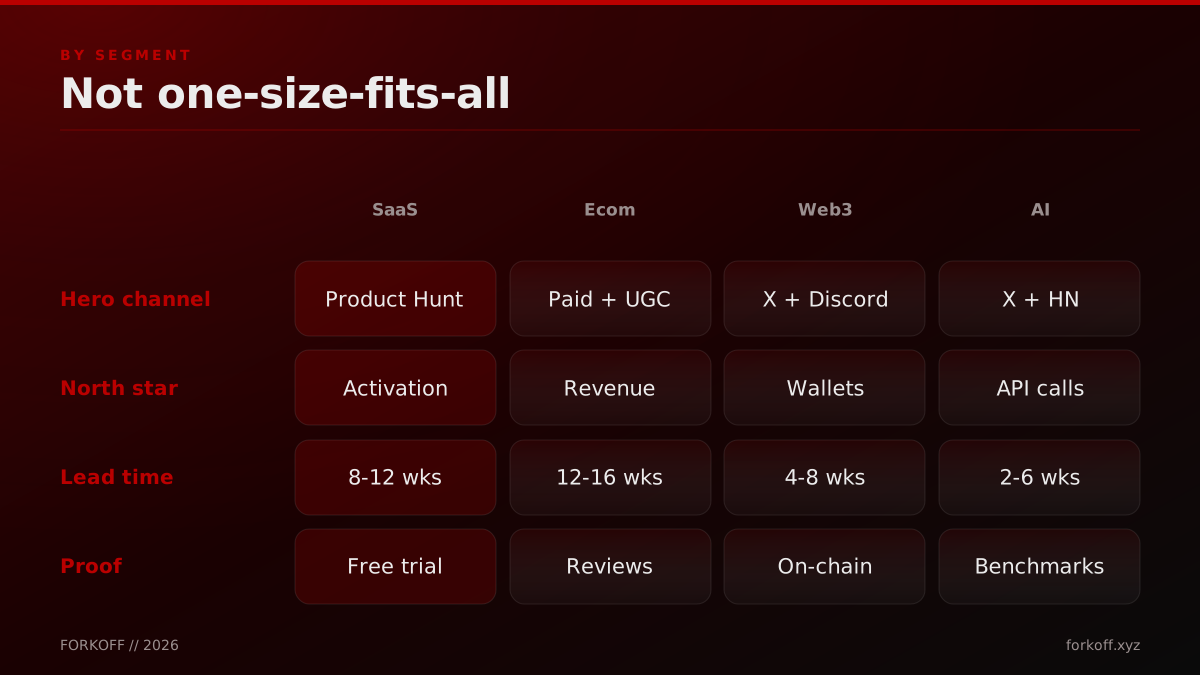
- SaaS. Hero channels: Product Hunt, X, developer communities. North star: activation, then paying conversion. Lead time: 8 to 12 weeks. Proof: a frictionless free trial or freemium tier.
- Physical / ecommerce. Hero channels: paid social, UGC, creator seeding, and often a crowdfunding pre-launch. North star: revenue and units. Lead time: 12 to 16 weeks (inventory and manufacturing). Proof: reviews and unboxing content. Physical launches lean far harder on UGC and paid than software does.
- Web3 / crypto. Hero channels: X (crypto Twitter), Discord, and KOL amplification. North star: wallets, TVL, or volume. Lead time: 4 to 8 weeks (the market moves fast). Proof: on-chain metrics and community size. Web3 launches live or die on community and KOL trust, which is why our events and KOL work concentrate there.
- AI model or feature drop. Hero channels: X and Hacker News, with a technical benchmark as the hook. North star: API calls or usage. Lead time: 2 to 6 weeks. Proof: reproducible benchmarks. These launches reward speed and a credible number over polish.
The through-line: the plan structure is constant (three phases, a countdown, a runbook), but the hero channel, the north-star metric, and the lead time all flex by segment. Copy a SaaS launch plan onto a hardware product and you will under-invest in the four-month manufacturing runway and over-invest in a Product Hunt audience that does not buy physical goods.
What KPIs measure a successful product launch?
The KPIs that measure a successful product launch are the full funnel, not the vanity spike: launch-day visitors, signups, signup conversion rate, activation rate, and paying conversions, plus channel-attributed traffic (via UTMs), waitlist-to-signup rate, and 30-day retention. A launch that drives 12,000 visitors but activates 600 and converts 95 to paying is a real result; a launch that hits number one on Product Hunt but produces zero retained users is a failure wearing a badge.
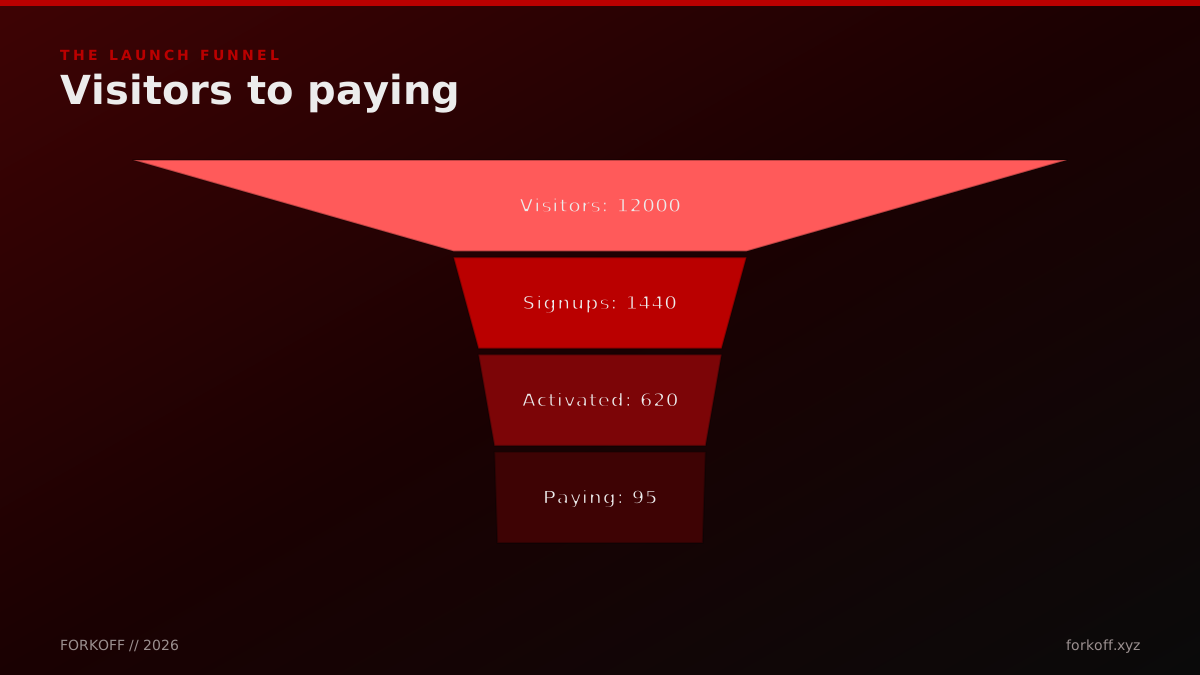
Instrument the funnel before launch day, not after. The most common measurement failure is launching with no UTMs and no activation event defined, so on T+1 you know you got "a lot of traffic" and nothing else. Below is a representative launch-day funnel from a SaaS launch we instrumented (per our n=12 client launches, FORKOFF distribution ledger, 2025 to 2026), and the KPI panel we report against.
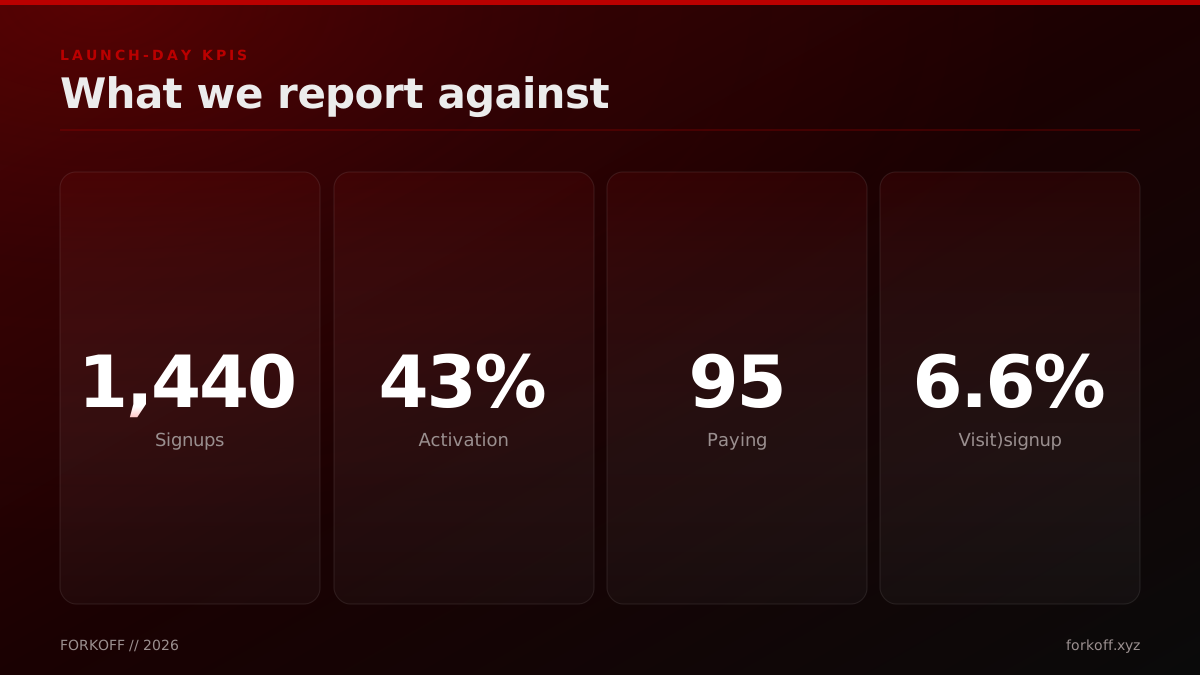
| KPI | What it measures | Healthy launch-day range | Why it matters |
|---|---|---|---|
| Launch-day visitors | Total unique traffic | 5,000 to 20,000 | The top of the funnel; channel-attributed |
| Signup rate | Visitors who sign up | 8% to 15% (n=12) | Landing-page and offer strength |
| Activation rate | Signups who reach the aha moment | 35% to 50% (n=12) | Onboarding quality, the real launch signal |
| Paying conversion | Activated users who pay | 3% to 8% (n=12) | Product-market and pricing fit |
| 30-day retention | Users still active at day 30 | 25% to 40% (n=12) | Whether the launch mattered at all |
| Waitlist-to-signup | Waitlist that converts on day one | 20% to 40% (n=12) | Pre-launch buzz quality |
These ranges are our own launch-instrumentation benchmark (per our n=12 client launches, FORKOFF distribution ledger, 2025 to 2026), not an industry-wide average; treat them as a band to grade your own launch against, not a guarantee.
Track these per channel. If Product Hunt drove the most visitors but Reddit drove the most paying conversions, next launch you weight Reddit. This is the loop that compounds. We build the same instrumentation into every client launch, and you can pressure-test the economics with our marketing ROI calculator and price reach quality with the CPQV calculator.
Operator noteUTM-tag every launch link before midnight; retroactive attribution never recovers the launch-day channel split., FORKOFF funnel instrumentation
The single most important KPI distinction is between reach metrics and outcome metrics. Reach metrics (impressions, visitors, upvotes, a Product Hunt ranking) feel good and mean almost nothing on their own, because they measure attention, not value. Outcome metrics (activation rate, paying conversion, 30-day retention) measure whether the launch produced a business. The failure mode we see constantly is a founder celebrating a number-one Product Hunt finish while their activation rate sits in single digits, which means the launch produced a badge and no customers. Report both, but decide with the outcome metrics.
Set your targets before launch day so you can grade the launch honestly afterward. A useful pre-launch exercise is to write down the number that would make the launch a success (for example, 100 activated users or 20 paying customers in the first week) and the number that would make it a failure. Without a pre-declared target, every launch feels like a success because there is always some metric that went up. With a target, you learn whether the plan worked and what to change, which is the entire point of measuring at all.
Why most product launches quietly die after the spike
Most product launches die after the launch-day spike because the plan ended on launch day. The traffic pulse decays within 72 hours, and with no post-launch nurture, no retention plan, and no continued distribution, the users the launch produced churn before they ever activate. The failure is not the launch; it is the absence of anything after it. This is the single most cited pain across founder communities, and the numbers are stark.
487 of 500 launches were dead within a year
The widely shared r/SaaS audit of 500 Product Hunt SaaS launches found 487 dead within a year, a 97 percent mortality rate among products that all cleared the bar of actually shipping and launching. The survivors were not the best launch days; they were the teams with a motion after the launch day. Read against the launch-day obsession of most guides, the audit is the strongest available argument that the post-launch section of the plan, onboarding, nurture, feedback, continued distribution, is the part that decides whether the launch mattered.
Source: r/SaaS audit of 500 Product Hunt launches
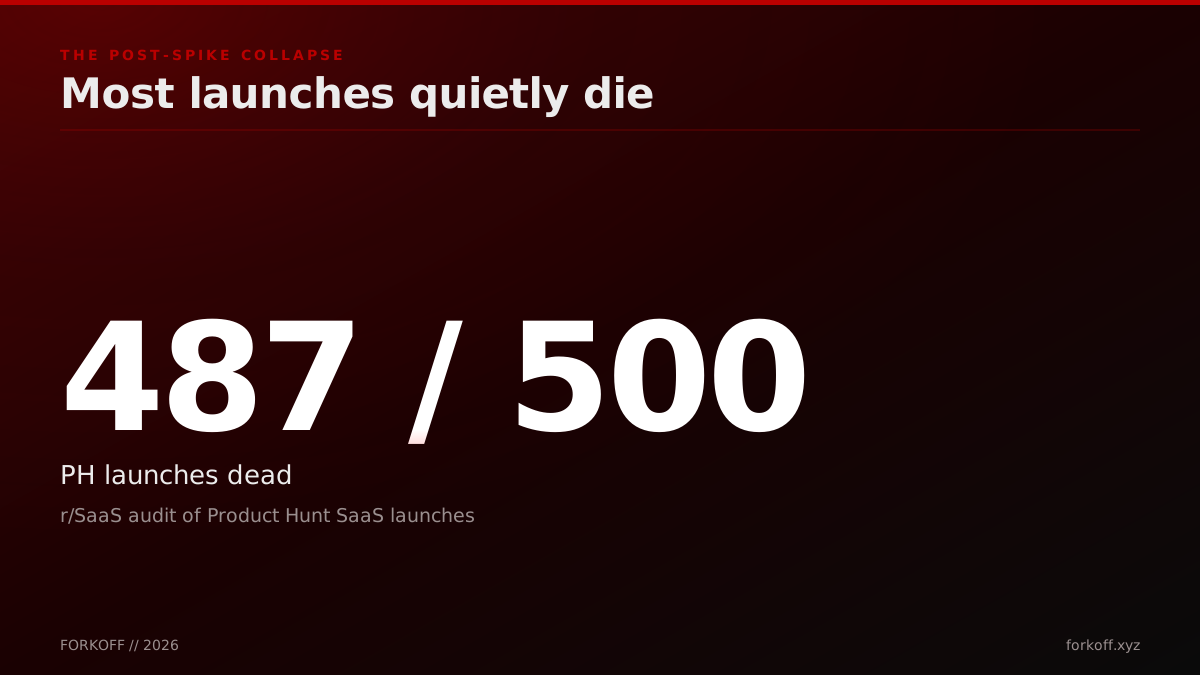
A widely shared r/SaaS audit put a number on it: of 500 Product Hunt SaaS launches analyzed, 487 were dead. Serial launchers feel it too; one founder's much-discussed thread, "I have launched 37 products in 5 years and I am not doing that again," is a warning that volume of launches is not the goal, a compounding motion is. Launching more is not the fix. Launching with a post-launch plan is.
I analyzed 500 Product Hunt SaaS launches. 487 are dead.
Operator noteWrite the post-launch plan before launch day; the 72-hour decay starts on schedule whether or not the nurture sequence exists., FORKOFF launch ops
The post-launch plan is the cheapest insurance you can buy. It has four moving parts. Onboarding to activation: an automated plus human sequence that gets a new signup to the aha moment inside the first session, because a signup who never activates will never pay. A 30-day trial nurture: a sequence of value emails, in-product nudges, and a check-in that moves trials toward the paid decision, since most SaaS trials convert over weeks, not on day one. A feedback loop: a fast channel for the top requests and a public commitment to ship the most-requested fix within two weeks, which turns launch-day critics into advocates. Continued distribution: the clipping, community, and founder-content motion keeps running after launch day so new audiences keep discovering the product long after the spike decays.
Map these four parts before launch day, not after. The reason the "487 of 500 are dead" statistic exists is that those teams shipped all four as blanks. They had a launch-day plan and nothing after it, so the spike arrived, the traffic left, and the signups churned before anyone onboarded them. A launch without a post-launch plan is a party with no follow-up: everyone shows up, has a moment, and never comes back. The teams that compound are the ones whose plan does not end at T+24h. Post-launch is where our founder funnel and ongoing Twitter marketing motions live, because the launch is the beginning of the distribution engine, not the end of the project.
We dropped revenue targets, instead we're optimizing for product quality. AI search is our #1 acquisition channel. A trusted community is becoming our moat.
How do you get your first 10 paying customers from a launch?
You get your first 10 paying customers from a launch by treating the launch as the top of a hands-on sales funnel, not a self-serve traffic event. Reply to every signup personally, DM the warmest 20 waitlist members and offer a walkthrough, put a founder-run onboarding call on the confirmation page, and ask the people who love the product what would make them pay today. The first 10 customers almost never come from anonymous launch traffic; they come from the founder doing things that do not scale during the launch window.
Launched my first SaaS yesterday. Woke up to 3 paying users and broo I’m actually shaking 😭 😭 😭 😭
I didn't have a marketing budget or a big following. I just shared my story on a couple of subreddits, like genuinely, no spamming and then went to sleep.
This is the resolution to the "launched to crickets" complaint. A founder who launched 1.5 months ago and has one active non-paying user did not have a traffic problem; they had a follow-up problem. The launch produced signups, and then nobody reached out to those signups. The fix is not more launches. It is working the list the launch already produced: personal outreach, a real onboarding, and a direct ask. Y Combinator's entire "do things that do not scale" doctrine exists for exactly this window.
Launched my SaaS 1.5 months ago, 1 active user (non-paying). Need help with traction & SEO strategy
First-10-customers motions in the launch window
| Motion | When | Why it works |
|---|---|---|
| Reply to every signup personally | T-0 to T+72h | Responsiveness is the cheapest trust on launch day |
| DM the warmest 20 with a walkthrough offer | Launch day | Warm intent plus a personal ask converts |
| Founder onboarding call on the thanks page | Week one | Hands-on onboarding beats churn to the aha |
| Ask activated users what would make them pay today | Week one | The direct ask surfaces the price objection |
| Log which channel produced each early customer | Ongoing | The first 10 are your best channel signal |
The do-things-that-do-not-scale window; the launch produces the list, the founder works it.
Then instrument the loop. Track which channel produced each of the first 10 paying customers, because that is the channel you double down on next. If eight of your first ten came from a single subreddit thread, your next launch weights Reddit and your ongoing distribution runs Reddit marketing hard. The first 10 customers are not just revenue; they are the highest-signal data you will get about where your real demand lives. Treat them as a research asset, not just a milestone. You can sanity-check the unit economics of each channel with our marketing ROI calculator before you scale spend.
The most common product launch mistakes to avoid
The most common product launch mistakes are: waiting until the product is "perfect" to launch, compressing pre-launch to two weeks, launching to a cold audience with no waitlist, firing every channel at once, defining success as a Product Hunt ranking instead of activated users, and having no post-launch plan. Each one is predictable, and each one is avoidable with the plan in this playbook. The meta-mistake underneath all of them is treating launch as an event instead of a system.
The "ready enough" trap deserves special attention because it paralyzes founders. The loud advice ("launch now, not when it is ready") clashes with a real fear of shipping something half-baked. The resolution is not to launch garbage; it is to define the smallest version that delivers the core promise, and launch that to a warm audience you have been building. A mediocre product in front of real users on a warm list beats a polished product launched into silence. The point of launching early is not to embarrass yourself; it is to start the learning and distribution loop sooner.
Launch now, not when it's 'ready'. A mediocre product in front of real users teaches you more in a week than 6 months of building.
Pierre-Eliott Lallemant
@pierreeliottlal
We went from 0 to 2,200 paying customers in under a year by following @ycombinator's 15 rules: 1/ Do things that don't scale... 2/ Launch now, not when it's 'ready'. A mediocre product in front of real users teaches you more in a week than 6 months of building.
The other silent killer is going wide before going deep. Founders spread across ten platforms on launch day, do a shallow job on all of them, and convert on none. Pick your two strongest channels, execute them fully, and roll the long tail across launch week. Depth beats breadth on the day.
Here are the specific mistakes, each with the fix, because "avoid mistakes" is useless without the correction.
- Perfectionism. Waiting for a flawless product means launching to a cold, forgotten audience. Fix: define the smallest version that delivers the core promise, and launch that to a warm list.
- Compressed pre-launch. Two weeks of prep guarantees an unbuilt asset stack and a cold list. Fix: run the 8 to 12 week countdown, and move the date if you cannot.
- No waitlist. Launching to zero warm demand is launching into silence. Fix: stand up the waitlist at T-12 weeks and warm it before the day.
- Simultaneous channel blast. Firing every channel at 12 burns your amplifiers in one hour. Fix: sequence the channels across the runbook so each wave feeds the next.
- Vanity success metric. Optimizing for a Product Hunt badge instead of activated users produces a trophy and no revenue. Fix: define success as activation and paying conversion before launch day.
- No post-launch plan. The spike decays and the signups churn unmanaged. Fix: build the four-part post-launch plan (onboarding, nurture, feedback, distribution) before you ship.
- Ignoring the replies. A silent founder on launch day forfeits the cheapest trust available. Fix: reply to every comment, DM, and question on the day.
Each of these is a plan gap, not a talent gap. The founders who avoid them are not more brilliant; they wrote the plan down, assigned owners, and executed the boring parts. That is the entire difference between a launch that trends and a launch that converts.
Real launch case studies with numbers (and what the winners did)
Real launch results, not abstract theory, are what the ranking pages all miss. Here are documented outcomes and the mechanics behind them. The pattern is consistent: the launches that produced durable numbers all ran a pre-launch audience-building motion and a sequenced, distribution-heavy launch, not a single-channel blast.
On Reddit, one founder open-sourced the week-by-week SOP behind hitting Product Hunt number one 30 times by running a repeatable "launch system," not one-off tactics, evidence that the system, not the day, is the unit of work. The Gojiberry cofounders reported going from 0 to 2,200 paying customers in under a year by executing YC's rules, with "launch now, not when it is ready" and "do things that do not scale" at the top of the list. Lemon Squeezy's growth, per cofounder JR Farr, came from shipping constantly and doing many small distribution things for years, not a single viral moment.
Our own first-party data reinforces the distribution-first thesis. The FORKOFF clipping network has processed over 5 billion views, and across the launches we have run distribution for, the clipping and UGC wave routinely out-produces the Product Hunt spike on total launch-week reach, precisely because short-form volume keeps discovering new audiences after the launch-day pulse decays.
The failure data points the same direction. The Harvard Business Review analysis of why most product launches fail attributes the majority of failures not to bad products but to companies that under-prepare and under-distribute, launching before the market and the channels are ready. Lenny Rachitsky, whose product and growth writing is widely cited by operators, repeatedly makes the same case: durable growth comes from a distribution engine, not a launch-day event. Every credible source, first-party and secondary, converges on the same conclusion, which is why the plan in this playbook weights pre-launch and post-launch so heavily.
Documented launch outcomes cited in this playbook
| Operator | Reported outcome | Source |
|---|---|---|
| Gojiberry (Pierre-Eliott Lallemant) | 0 to 2,200 paying customers in under a year | X, June 2026 |
| r/SaaS launch-system founder | Product Hunt number one 30 times, one SOP | r/SaaS, open-sourced timeline |
| r/SaaS audit of 500 launches | 487 of 500 PH SaaS launches dead within a year | r/SaaS |
| Tally | $5M ARR bootstrapped, five years post-launch | r/SaaS, April 2026 |
| FORKOFF clipping network | Over 5 billion views processed for clients | FORKOFF first-party ledger |
Each row is linked from the section where it is discussed; self-reported figures are attributed to their operators.
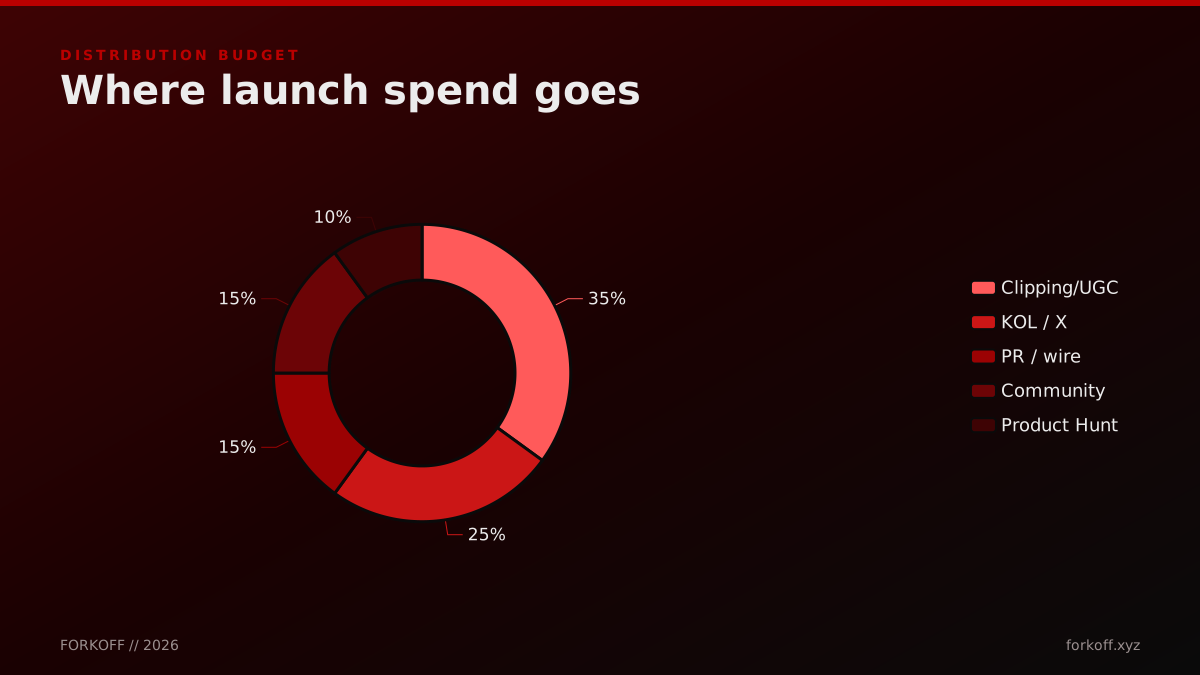
Here is roughly what the distribution layer costs to run at launch, so the budget is concrete rather than abstract. These are representative ranges from launches we have run; your numbers will vary by category and ambition.
| Distribution channel | Typical launch-window cost | What it buys |
|---|---|---|
| Short-form clipping / UGC | Operator time to mid-four-figure | 20-plus clips, weeks of ongoing discovery |
| KOL / creator amplification | Per-post, mid-tier best value | 5,000 to 50,000 impressions per placement |
| Reddit / community seeding | Operator time only | High-intent traffic, direct feedback |
| PR / wire release | Wire fee plus prep | Authority, backlinks, AI-answer eligibility |
| Product Hunt | Prep time only | Credibility spike, badge, one strong backlink |
| Founder X thread | Founder time only | Owned, compounding, highest-trust reach |
The pattern in the cost table is the point: the two most valuable launch channels (the founder's voice and community seeding) cost time, not money. The paid layers (clipping at volume, KOL placement, PR) amplify what the free layers establish. Spend on amplification only after the founder voice and the waitlist exist, or the money amplifies nothing.
The lesson across every case: the winners were not the products with the best code. They were the products with the best distribution plan, executed by someone who had been building an audience for months before launch day.
How FORKOFF runs launch distribution
At FORKOFF, we run the distribution layer of a product launch as a system, not a one-day push. We are an AI growth agency running distribution, content, and go-to-market for startups across AI, SaaS, Web3, DevTools, and Fintech, and our clipping network has processed over 5 billion views. On a launch, we own the channels most founders cannot staff on the day: the clipping and UGC wave, the Reddit marketing motion, the Twitter marketing and influencer marketing amplification, and the answer engine optimization and generative engine optimization work that makes the launch findable when buyers ask an AI engine for the best tool in your category.
The founder still has to be the voice (ring one), and the plan still has to exist. What we add is the execution capacity and the distribution reach to make launch day compound instead of decay. If you are building the plan and want the distribution engine run for you, our founder funnel and events engagements plug into exactly this. You can see where we have been cited and featured on our press page.
The bottom line
Here is the blunt answer: a product launch plan is not a template you fill in the week before you ship. It is a three-phase system that starts 8 to 12 weeks out, runs an hour-by-hour runbook on launch day, and continues for 90 days after, anchored by a founder voice and carried by sequenced distribution across Product Hunt, Reddit, X, clipping, and PR. The teams that win define success as activated users, not a Product Hunt badge, and they treat the launch as a starting line.
Build the plan. Start the waitlist today. Warm the audience for the next eight weeks. Then execute the runbook, and keep distributing after the spike. Distribution, not the build, is the bottleneck now, and a plan that respects that is the difference between a launch that trends for a day and a launch that compounds for a year. That is the whole game.