Building in public means sharing a startup's real progress, metrics, and decisions openly while it is being built, instead of only revealing a finished product on launch day. Used well, it is one tactic inside a bigger pre-launch marketing system, the waitlist, the cadence calendar, and the launch-day distribution plan, that turns an audience into signups. Used badly, it is a diary nobody reads. This playbook is the full system, not just the tactic.
Last updated 2026-07-23.
The 30-second answer
Build in public is not a strategy on its own, it is the top layer of a three-layer pre-launch demand system: an audience built through consistent, real posting, a waitlist that captures intent, and a sequenced launch-day distribution plan that converts followers into signups. The tactic works when it is structured and fails when it becomes content for its own sake. Run the cadence for 8 to 12 weeks, share metrics and decisions instead of vibes, hold a disclosure boundary around pricing, IP, and investor terms, and pick the platform where your buyer already spends attention. The founders who complain it does not work are almost always missing the waitlist or the distribution plan, not the posting.
The 2026 build-in-public landscape: from scarce differentiator to saturated feed
The build-in-public landscape in 2026 is saturated, not novel. The tactic earned its reputation between roughly 2019 and 2022, when scarcity made any founder posting real metrics stand out and an authenticity premium rewarded the first movers. By 2026, #buildinpublic is a 69,000-follower community hashtag and a recognized content genre, and a widely shared Reddit post argues flatly that it has become "the worst advice in SaaS right now", precisely because the same generic posts now blend into noise instead of standing out.
Stop building in public. It's the worst advice in SaaS right now
The scarcity premium is gone
Build in public earned its reputation between roughly 2019 and 2022, when any founder posting real metrics stood out by default. By 2026 the #buildinpublic community hashtag sits at 69,000 followers, the format is a recognized content genre, and a widely shared r/SaaS post calls it "the worst advice in SaaS right now" precisely because generic daily updates now blend into noise. The founders still winning with it run it as one instrumented channel inside a larger demand system, not as the system itself.
Source: r/SaaS community discussion, 2026
That shift matters for how you should run the tactic in 2026. The founders who still win with it are not doing more of what worked in 2019, posting daily updates for the sake of transparency. They are running it as one instrumented channel inside a larger demand system, with a waitlist behind it and a distribution plan ahead of it. The Y Combinator Startup School library still tells founders to launch early and treat launching as a repeatable motion, and that same logic now applies to the pre-launch phase: build in public as a system you run on purpose, not a vibe you maintain by habit.
The evidence of saturation is direct. One X user posted, bluntly, "mention just one successful product that was 'build in public.' Are you all building or creating content?", a fair challenge in a feed where the format has decoupled from the underlying product shipping at all. According to CB Insights' research on why startups fail, roughly 35 percent of startup failures trace back to building something the market did not want, and a build-in-public feed full of engagement-optimized posts with no real user validation behind them is a symptom of exactly that risk, not a cure for it.
Engagement is not validation
CB Insights' analysis of startup post-mortems attributes roughly 35 percent of failures to building something the market did not want. A build-in-public feed optimized for likes and replies, with no waitlist or revenue signal behind it, is a symptom of exactly that failure mode, not a defense against it: the founder is collecting engagement data when the system should be collecting intent data.
Source: CB Insights, The Top Reasons Startups Fail
Is build in public secretly a content business, not a growth tactic?
Build in public is not secretly a content business for most founders who run it, but the skepticism has a real target: a visible subset of "build in public" accounts monetize the audience-building tactic itself, through cohorts, courses, and coaching, rather than proving the tactic works for an actual shipped product. The honest read is that both things coexist in the same feed, and telling them apart is the actual skill.
The suspicion is loud and specific. One widely discussed Reddit post argues plainly that "every founder who actually hit revenue built in silence and shipped, while the loud build-in-public crowd seems mostly busy selling courses about building in public", a claim that lands because it is at least partly true: a format built on visible follower counts is structurally attractive to anyone selling an audience-growth product, whether or not their underlying product ever shipped. A popular explainer video asking why the format doesn't work for most people makes the same point from a different angle, most visible build-in-public accounts optimize for the metrics that grow a personal brand, not the metrics that grow a company.
Why #BuildInPublic Doesn't Work
Millionaire Millennial
Why #BuildInPublic doesn't work for most founders, and what that critique gets right.
Stop building in public. It's the worst advice in SaaS right now
The test that separates the two is simple and testable. A content-business account's success metric is followers, likes, and course sales, its own audience is the product. A founder actually building a company measures the same posts against signups, waitlist conversions, and revenue, the audience is a distribution channel toward a different product entirely. If you cannot point to a real, shipping product behind a build-in-public account, per the X thread bluntly asking founders to name one successful product that came out of building in public, you are looking at a content business wearing a founder costume, not a growth tactic. This is exactly why every section of this playbook anchors build-in-public content to a real metric, a real waitlist, and a real launch day, not to follower growth as an end in itself.
Your MVP Guy
@Sherifdeenolat2
Mention just one successful product that was build in public. Are you all building or creating content??
One further, unglamorous truth about the format helps here: it is fine to build in public purely because a real audience will catch you building something pointless before you waste months on it. As one widely shared post frames the actual reason to do it, "build in public so that in case you're building nonsense, people will tell you", a use case that has nothing to do with follower growth and everything to do with low-cost, early validation. That is the version of build in public worth running.
John
@AdemoyeJohn
Build in public so that in case you're building nonsense, people will tell you.
What does it mean to build in public?
Building in public means sharing a startup's real progress, metrics, and decisions openly as it is being built, rather than only revealing a finished product on launch day. It usually happens on X, LinkedIn, or Reddit, and its purpose is to earn an audience and trust before there is anything to sell. In regulated categories the trust bar is higher, which is why a fintech go-to-market motion has to sequence proof of safety before it sequences reach. Mercury's guide to build in public or private frames it precisely: there is no universally right approach, the choice depends on your market, your product maturity, and your risk tolerance, and building in public exists on a spectrum from full financial transparency to narrated progress with sensitive details withheld.
The core mechanic is exposure with intent. A founder who posts "shipped a new dashboard today" with no context is not building in public in any useful sense, that is a status update. A founder who posts "signups dropped 20 percent this week after we changed onboarding, here is what we are testing to fix it" is building in public, because the post carries a real number, a real decision, and a real stake the reader can follow. The Paddle guide to the build-in-public strategy lists the concrete mechanics: sharing screenshots and quotes of customer feedback, publishing real company stories including the roadblocks, and offering insight into the product roadmap and how the company actually operates.
The format traces to a specific cultural moment. Pieter Levels, who built Nomad List starting in 2014, is widely credited with popularizing the movement by posting his Stripe dashboard screenshots and exact revenue figures on X in real time, across every product in his portfolio. Buffer's public revenue dashboard, live since 2013, is the enterprise-scale version of the same instinct, publishing revenue, salaries, and diversity metrics as a standing transparency commitment rather than a one-off campaign. Both examples share the same structural trait: the transparency is a system with a cadence, not an occasional post.
What is the build in public method?
The build in public method is a repeatable cadence: pick one channel, post real work such as screenshots, metrics, and setbacks on a fixed schedule, reply to every comment, and give each post a genuine payoff for the reader. It is not a one-off launch announcement or a single viral thread, it is a system you run for weeks or months before you ever ship. Paddle's build in public framing treats it as a strategy with a purpose: create space to share information about the business, grow public support, and find early adopters before launch, not simply "post more."
The method has four repeatable moves. Channel selection: pick the one platform where your buyers already spend attention, not the one you personally find easiest to post on. Content selection: decide upfront whether you will share metrics, design updates, or personal wins and failures, and stay consistent so followers know what to expect. A fixed cadence: weekly at minimum, daily during the final stretch before launch, because sporadic posting never earns the algorithmic or human trust that consistent posting does. Engagement discipline: reply to every comment and DM, because the method's entire value is the relationship it builds, and a founder who posts and disappears gets none of the trust dividend.
Failory's guide to building in public, which catalogs 20 real startups running the tactic, adds a fifth move that most guides skip: search for channel-market fit the same way you search for product-market fit. The channel that works for a developer tool (X, technical Discords) is rarely the channel that works for a consumer app (TikTok, Instagram), and picking the wrong channel means the method never gets a fair test. Our own Twitter marketing work runs exactly this channel-fit diagnostic before a founder commits months of cadence to the wrong platform.
Channel-market fit decides the whole experiment
Failory's catalog of 20 real startups building in public surfaces the move most guides skip: search for channel-market fit the way you search for product-market fit. The channel that works for a developer tool, X and technical Discords, is rarely the channel that works for a consumer app, and the highest-engagement posts across every account studied carry a specific number, never an adjective standing in for one.
Source: Failory, Building in public guide
A worked example makes the method concrete. Take a founder building a B2B analytics tool. Week one, they post the core problem they are solving and why existing tools fail at it, no product mention yet. Week two, they post the first prototype screenshot alongside the one metric they will track publicly, say, query latency. Week three, they post a real setback, an architecture choice that had to be rebuilt, and what they learned. Week four, they open a waitlist and post the launch date publicly for the first time. By week eight, they have a documented, followable story instead of a cold announcement, and the method has done its job before a single line of launch-day copy is written.
Is building in public a good idea?
Whether building in public is a good idea depends on your market and your risk tolerance, not on a universal yes or no. It generates early interest, trust, and a warm pre-launch audience, per Mercury's analysis of build in public tradeoffs, but it also exposes competitors to your metrics, your roadmap, and your mistakes in real time. The honest answer is that it is a spectrum: decide deliberately how much to share, rather than defaulting to either full transparency or total silence.
Public versus private is a spectrum, not a switch
Mercury's build-in-public analysis frames the choice precisely: there is no universally right approach, the decision depends on market, product maturity, and risk tolerance, and transparency runs on a spectrum from full financial openness to narrated progress with sensitive details withheld. The founders who get burned are usually the ones who never made the choice deliberately, they defaulted into full transparency and discovered the disclosure boundary afterward.
Source: Mercury, Build in public or private
The benefits case is concrete. Sharing progress gives people a reason to follow along before a finished product exists, and that early audience becomes early users, partners, or advocates once you launch. Those advocates are also what makes a customer referral program that does not attract bots work later, because a referral loop only pays off once genuine advocacy already exists to amplify. Failory's research on building in public frames this as a durable authority effect: the founder who is the most public voice in a niche becomes the person that niche associates with the category, which compounds well beyond the pre-launch window. The tradeoffs case is equally concrete. Building in private lets a team experiment freely without external scrutiny, change direction without explaining why, and keep mistakes contained, which matters more in regulated industries, highly competitive markets, or situations where timing is the whole advantage.
The numbers behind the tradeoff are directional but consistent across the founders who track them: a build-in-public account run for 8 to 12 weeks with a genuine niche angle typically converts somewhere between 2 and 5 percent of engaged followers into waitlist signups, while an audience built with generic, everyone-facing content converts closer to a fraction of a percent, the gap this playbook keeps returning to between metrics-and-decisions content and vibes content. That spread alone should settle the "is it worth it" question for most founders: the tactic is worth running well, and close to worthless run generically.
The Reddit debate captures the real tension. One post asks whether it is genuinely "a competitive risk", and its own author-proposed answer, a 3-step framework for staying safe, implicitly concedes the risk is real but manageable. A related critique argues the deeper failure mode is not competitive exposure at all, it is founders chasing likes and comments instead of revenue, optimizing for a metric that does not correlate with paying customers. Both risks are real. Neither is a reason to avoid the tactic entirely, they are reasons to run it with a disclosure boundary and a revenue-anchored goal, which is exactly what the rest of this playbook builds.
What does building in public actually look like?
In practice, building in public looks like a founder posting on a fixed weekly rhythm: one real metric such as signups, revenue, or churn, one honest lesson from the week, and a screenshot or short clip of the actual work in progress. It does not look like a generic diary. The most-cited failure case on Reddit describes exactly the trap: 15 days of daily posts structured as "day 1, idea. day 2, progress. day 3, features", with zero traction, because a bare journey log gives the reader nothing to act on or care about.
I spent 15 days building in public. Nobody cared. Here's what I realized.
The difference between content that builds an audience and content that gets ignored is the payoff. A post that says "shipped the onboarding flow" is a status update. A post that says "onboarding completion was at 40 percent, we cut the signup form from 7 fields to 3, completion is now at 68 percent" is a lesson the reader can apply to their own product, and that payoff is what earns a follow, a bookmark, or a reply. Failory's 20-startup review of real build-in-public accounts finds the same pattern: the posts that compound engagement share a specific number or a specific decision, never a vague status.
Even a small, honest number earns more engagement than a vague success claim. One founder posted on day one of a 180-day build-in-public challenge that they had earned 195.16 dollars in referral commissions, a modest, unglamorous figure, framed candidly as "not template revenue yet" but a real signal the consistent sharing was starting to create opportunities. That kind of specific, small, verifiable number is precisely what the "6 elements" checklist above rewards, and precisely what a generic "excited to share progress" post never earns.
Just earned $195.16 in Framer commissions from a referral. This isn't template revenue (yet), but it's a nice reminder that sharing your work consistently online creates opportunities.
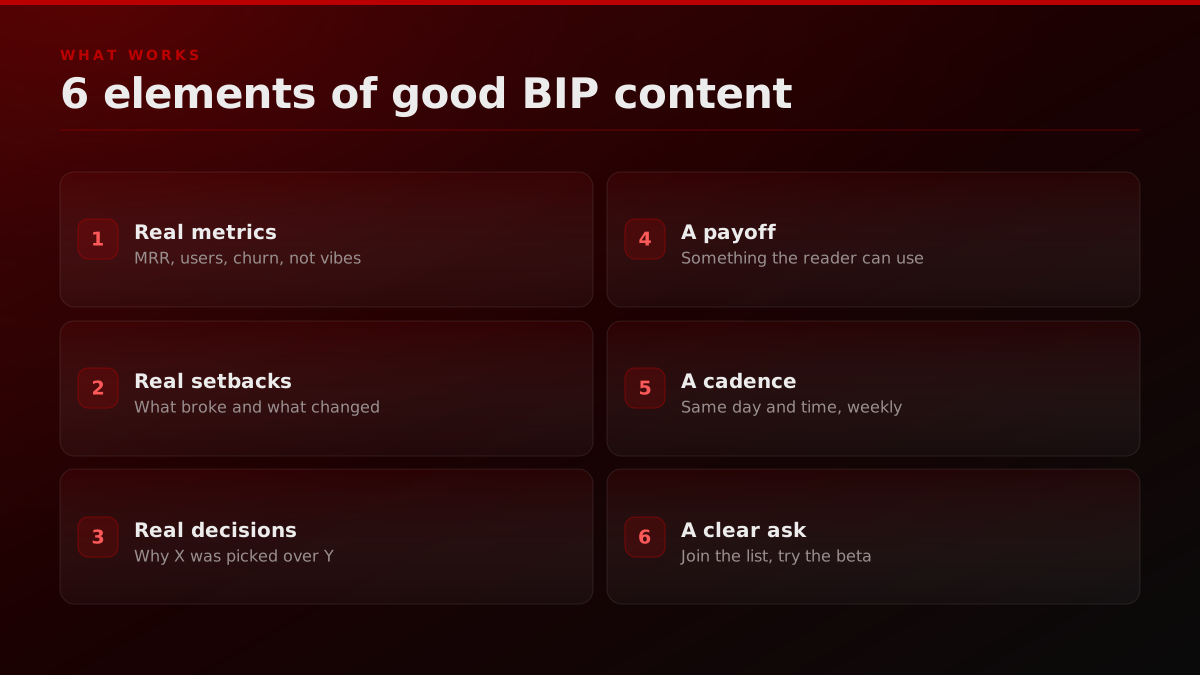
Six elements separate content that works from content that does not. Real metrics, MRR, users, or churn, not adjectives. Real setbacks, what broke and what you changed, because unbroken success reads as marketing, not a journey. Real decisions, why you picked one approach over another, since the reasoning is what other founders actually learn from. A payoff, something the reader can use or apply to their own build. A cadence, the same day and time, because irregular posting never earns the habit of a returning reader. A clear ask, join the waitlist, try the beta, reply with your own experience, since content with no next step converts nobody. Skip the last three of these and you get exactly the diary complaint that dominates the Reddit threads on this topic.
How do you actually build in public?
To actually build in public, pick the one platform your buyers already use, post on a fixed cadence of at least once a week, and share a real number, a real decision, or a real setback every time, never a bare status update. Reply to every comment personally. The GitHub buildinginpublic guide, a living, community-maintained document, frames the practice as consistency plus authenticity, not volume: a content calendar for posting rhythm, honest sharing of challenges alongside wins, and visual communication through screenshots, clips, and diagrams rather than text alone.
The practical sequence looks like this. Start by deciding the story arc: what are you building, for whom, and why does it matter, in one sentence you can repeat for months. Then pick the content types you will rotate through: a metric update, a design decision, a customer quote, a personal reflection, so followers know roughly what to expect from your feed without every post being identical. Set the cadence before you start, weekly at minimum, because founders who post only when they "have something exciting" fade out within weeks, exactly the pattern behind the 15-day-and-nobody-cared complaint above.
Operator noteNarrative lock comes before the first post on every engagement; a cadence without one story drifts into diary posting., FORKOFF pre-launch engagements
Community participation matters as much as posting. The GitHub guide specifically calls out supporting other builders, liking, commenting, and resharing their content, and using the shared hashtag to reach a wider audience of creators. This is not a courtesy, it is the mechanism: build-in-public communities are reciprocal, and a founder who only broadcasts and never engages with peers gets a fraction of the reach a founder who participates gets, the same dynamic our Reddit marketing team runs deliberately inside subreddit communities rather than treating them as a billboard.
The most common beginner mistake is waiting too long to start. A common founder question frames the confusion honestly, asking what feels like a stupid question, but how do you build in public, unsure whether to start posting from day one or wait until there is something presentable to show. The answer is always day one. Founders who default to sharing only once a project is finished kill the entire pre-launch community-building effect before it starts, because the audience that would have followed the early, messy progress and felt invested in the outcome never had the chance to form. There is nothing to lose by posting on day one and everything to lose by waiting for a polish that never quite arrives.
What is a pre-launch marketing strategy?
A pre-launch marketing strategy is the 8 to 12 week plan that builds an audience, a waitlist, and distribution readiness before a product ships. It names the channels, the content cadence, the launch-day sequence, and the one KPI that defines success, so launch day converts a warm audience instead of starting cold. Search demand for the exact phrase sits around 70 monthly searches with a rising 3-month trend, evidence that founders are actively searching for the system, not just the build-in-public tactic inside it.
The strategy answers questions build-in-public alone does not. Where does the audience you build actually go, a waitlist, a Discord, an email list? What is the conversion mechanism from "follows your posts" to "signs up on launch day"? Which channels carry the launch-day push, and in what order? A pre-launch marketing strategy is the connective tissue between the audience-building tactic and the launch-day execution plan we detailed in our product launch plan playbook, and skipping it is the single most common reason a build-in-public following never converts into revenue.
Positioning the strategy correctly also resolves the debate about whether build-in-public "works." It is not supposed to work alone. A pre-launch marketing strategy treats build-in-public as the top-of-funnel awareness layer, feeding a waitlist as the mid-funnel capture layer, feeding a launch-day distribution plan as the bottom-funnel conversion layer. Judging build-in-public in isolation, the way most of the Reddit skepticism does, is judging one stage of a funnel as if it were the whole funnel.
How do you build demand for a product before it launches?
You build demand for a product before it launches by combining three layers: build in public to earn an audience, a waitlist landing page to capture intent, and a sequenced launch-day distribution plan across Product Hunt, Reddit, X, and email to convert that audience into signups. Demand compounds across the weeks before launch, not inside the 24 hours of launch day itself, which is why the pre-launch window deserves roughly 70 percent of total launch effort.
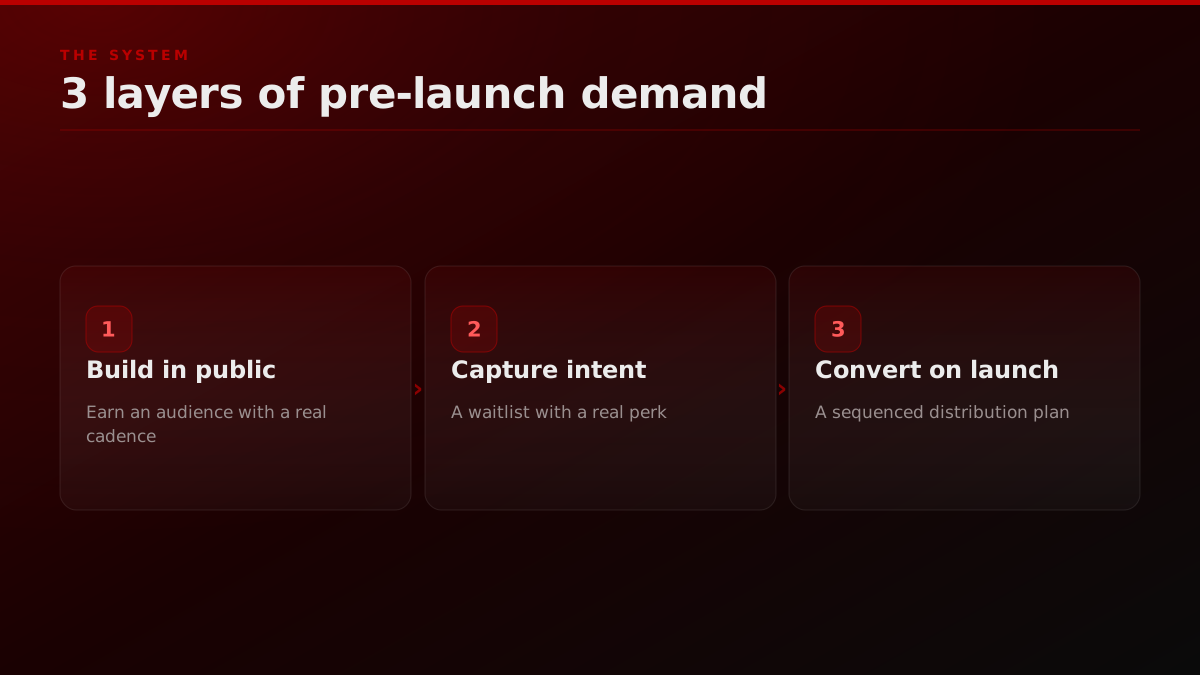
We call this the FORKOFF Pre-Launch Demand System, and it is deliberately three layers, not one tactic. Layer one, earn attention. Build in public on the one channel your buyers use, on a fixed cadence, with real metrics and real decisions. Layer two, capture intent. A waitlist with a genuine perk turns a passive follower into a named lead you can email directly. Layer three, convert on launch day. A sequenced distribution plan across Product Hunt, Reddit, X, KOL amplification, and clipping turns that warm list into signups the hour you go live. Each layer feeds the next; skip any one and the system leaks demand at exactly that seam.
The evidence for why all three layers matter, not just the first, comes from the r/SaaS community itself: founders repeatedly report the same failure pattern, 15 days of daily build-in-public posts producing zero traction, where the common thread was not a lack of pre-launch content, it was a lack of a conversion mechanism connecting that content to a funded launch day. Building an audience with no waitlist behind it, or a waitlist with no launch-day distribution plan behind it, produces exactly this outcome: attention that never becomes revenue.
How do you build an audience before launch day?
You build an audience before launch day by posting consistently on one platform for 8 to 12 weeks, sharing real progress and real metrics rather than polished announcements, and personally engaging every comment and reply. An audience is built through a cadence of genuinely useful updates, not a single viral post the week before launch. The compounding lever is consistency: a founder who posts four times a week for three months arrives at launch day with a warm audience that amplifies for free, the exact mechanic behind the three-ring distribution model we detailed for SaaS launches.
A recurring question founders ask each other is whether anyone had actually found their core audience by building in public, a fair question given how much of the visible activity is engagement without a clear payoff. The honest answer from operators who have done it: yes, but only when the content had a specific niche angle and a specific cadence, not when it was generic startup-journey posting aimed at everyone and no one. Audience-building rewards specificity, a post aimed at "founders solving churn in B2B SaaS" earns a smaller but far more convertible following than a post aimed at "entrepreneurs" in general.
The other lever is reciprocity. The #buildinpublic community account still pulls 300 or more replies on a simple weekly prompt asking what people are working on, proof that structured, recurring hooks outperform ad-hoc solo posting for the same content. Participating in that kind of recurring community ritual, rather than only broadcasting your own updates, is one of the highest-leverage, lowest-cost audience-building moves available, and it costs nothing but the time to show up weekly.
Build in Public
@buildinpublic
What are you working on this week?
What is founder-led growth, and how does it connect to build in public?
Founder-led growth is a go-to-market motion where the founder's own public presence, not a company account or a paid campaign, is the primary distribution channel. Build in public is founder-led growth's most common pre-launch expression: the founder's face, voice, and real story carry the audience-building work that a faceless brand account cannot replicate, because followers are following a specific person's judgment and journey, not a logo.
The connection matters because it explains why build-in-public content underperforms so badly when it is ghostwritten or handed to a marketing team. A follower can tell the difference between a founder narrating their own real decisions and an agency narrating a founder's decisions on their behalf, and the entire trust premium the tactic depends on collapses the moment the voice stops being authentic. This is also why founder-led growth scales differently than paid acquisition: it is bounded by the founder's own time and credibility, not by a media budget, which is exactly why the cadence calendar in this playbook protects the founder's build time as carefully as it protects the posting schedule.
Founder-led growth compounds across launches in a way paid channels do not. A founder who builds a real following before their first product launch carries that same audience into their second and third products, at zero incremental acquisition cost, the exact dynamic behind Pieter Levels' multi-product portfolio and the reason his newer products convert faster than his first ones did. Treat the founder's public presence as a compounding asset you are building once, not a campaign you run per launch, and the pre-launch system in this playbook becomes cheaper every time you run it.
There is a practical limit worth naming honestly: founder-led growth does not scale past one founder's attention and credibility, which is exactly why it pairs with, rather than replaces, the paid and PR layers of a traditional pre-launch marketing plan. A solo founder building a first product should lean almost entirely on the founder-led layer, because there is no brand reputation yet for paid or PR spend to borrow against. A team with an established founder voice and venture backing can layer paid acquisition and PR on top of that same founder-led foundation, using the personal audience as the credibility base the paid spend then amplifies. Skipping the founder-led layer entirely and going straight to paid acquisition is the single most common reason a well-funded pre-launch campaign still launches to a cold, skeptical audience.
How do you build a waitlist before launch day?
You build a waitlist before launch day by standing up a landing page with a specific perk such as early access, a launch-day discount, or founding-member status, driving traffic to it from your build-in-public posts and target communities, and warming the list weekly with real updates. A waitlist with a genuine perk converts at meaningfully higher rates than a bare email capture, because it gives the visitor a reason to trade their email for something concrete.
The mechanics matter more than the existence of the page. A waitlist that only says "get notified when we launch" captures curiosity, not intent. A waitlist that says "the first 100 signups get lifetime founding pricing" or "join now for early access two weeks before the public launch" captures commitment, because the visitor is trading their email for a specific, time-boxed benefit. Once someone joins, the list is not a static asset, it needs the same weekly cadence as your public posts: a real update, a countdown milestone, a behind-the-scenes look at the launch prep, so the list stays warm instead of forgetting they signed up.
HubSpot's product launch checklist treats the waitlist as a standing pre-launch asset for exactly this reason, not a box to check the week before shipping. The waitlist is the fuel supply for launch day, not a vanity number. A waitlist of 500 genuinely interested people converting at even 20 to 30 percent produces 100 to 150 signups in the first hour of launch, and those early signups create the social proof and momentum that pull in everyone else watching the launch unfold. An empty waitlist means launch day starts at zero and has to manufacture momentum from nothing, which is measurably harder than converting warm intent that already exists. This is the exact mechanism our founder funnel engagements build before a client ever reaches launch day.
Operator note20 to 25 percent waitlist-to-signup is the client benchmark, and only when the list got a weekly warm-up., FORKOFF pre-launch benchmark, 2025 to 2026
Add referral rewards to the waitlist
A waitlist grows fastest when every signup has a reason to bring the next one. The simplest version gives each person a unique referral link and moves them up the queue, or unlocks a better perk, for every friend who joins through it. Robinhood's pre-launch waitlist, which showed each signup their place in line and let referrals move them forward, is the example most founders have seen. Keep the reward tied to the product itself (earlier access, a founding-member badge, an extra seat) rather than cash or gift cards, because a product reward attracts people who want the product, while a cash reward attracts people who want the cash and never activate.
Two guardrails keep a referral loop honest. Cap the reward so a single account cannot farm hundreds of fake signups, and confirm email addresses before a referral counts. A waitlist padded with throwaway addresses looks healthy until launch day, when the notification email bounces and the conversion math collapses.
Build an email nurture sequence for the waitlist
A waitlist that hears nothing between signup and launch day forgets why it signed up. A short nurture sequence fixes that. The version we recommend has five emails: a welcome that restates the perk and the expected launch window, a founder story email on why the product exists, a progress email with a real screenshot or metric, a "what you will get on day one" email that previews the first use case, and a launch-eve email with the exact time and link. Space them across the runway rather than bunching them in the final week, and send the weekly build-in-public update to the same list so the sequence and the public cadence reinforce each other.
Measure open rate and click rate per email. A drop on one specific email tells you which part of the story is not landing, which is far more useful than a single blended list average.
How early should you start building in public before launching?
Start building in public 8 to 12 weeks before launch day, following a staged cadence: lock the narrative around T-90 days, launch the waitlist by T-60, reach daily posting by T-30, and run a countdown from T-7. Starting fewer than 4 weeks out rarely builds an audience warm enough to matter on launch day, because trust and reach both compound over weeks, not days.
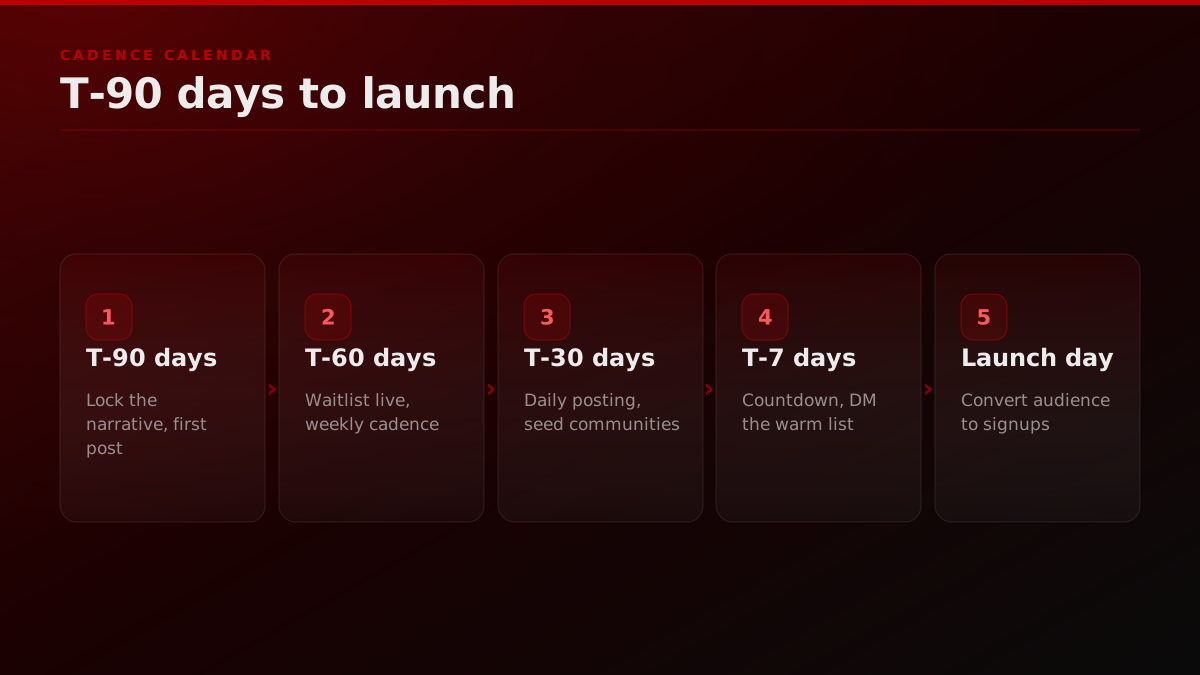
The build-in-public cadence calendar (T-90 days to launch day)
STEPS- 01
T-90 days: lock the narrative
Decide the one channel, the one story arc, and the one metric you will track publicly. Post the first "here is what I am building and why" update.
- 02
T-60 days: waitlist goes live
Stand up the waitlist landing page with a real perk. Start posting weekly, real metrics and real setbacks, not status updates. Begin seeding relevant communities.
- 03
T-30 days: daily cadence
Move to a near-daily posting rhythm. Share screenshots, demo clips, and one honest struggle per week. Start warming the amplifiers who will help on launch day.
- 04
T-7 days: countdown mode
Post the countdown. DM the warmest waitlist members personally. Freeze scope, finish QA, and pre-write the launch-day thread and the recap thread.
- 05
Launch day: convert the audience
Publish on your primary channel, notify the list, and work the sequenced launch-day runbook so the audience you spent 90 days building actually converts.
Market research and positioning before T-90
The calendar only works if the narrative it repeats is the right one, so the first two to three weeks belong to research rather than posting. Read the threads where your buyers already complain about the problem (subreddits, X replies, review sites for the incumbent tools), write down the exact words they use, and interview ten to fifteen people who match the buyer you have in mind. The output is one positioning sentence (who it is for, what it replaces, why now) and a short list of phrases lifted from real buyers. Those phrases become the hooks for the build-in-public posts, the waitlist headline and the nurture emails, which is why this step comes before anything goes public.
Create a launch calendar backward from T-0
Here is the concrete cadence calendar we run for clients. T-90 days: lock the one-sentence narrative and the one metric you will track publicly, then post the first "here is what I am building and why" update to set the frame for everything that follows. T-60 days: the waitlist goes live with a real perk, weekly posting becomes the standing cadence, and you begin seeding the two or three communities where your buyers actually gather. T-30 days: move to near-daily posting, mixing metric updates, screenshots, and one honest struggle a week, while quietly warming the hunters, KOLs, and amplifiers you will need on launch day. T-7 days: countdown mode, personal DMs to the warmest waitlist members, scope freeze, final QA, and the launch-day and recap threads pre-written so nothing is improvised under pressure.
The calendar is backward-dated from a fixed launch date for a reason. Forward planning, "post whenever there is news", lets the cadence slip until launch day arrives with a cold audience and an empty waitlist. Backward planning from T-0 forces the harder question early: does this task actually fit in the runway remaining? If your narrative is not locked by T-90, you already know at T-89 that the calendar needs compressing or the launch date needs moving, instead of discovering the gap at T-3 days when nothing can be fixed.
A single week inside the T-30-to-launch stretch, when cadence matters most, looks like this in practice. Monday: a metric update, the one number you are tracking, with one line on why it moved. Tuesday: reply day, no new post, just working through every comment and DM from the week's activity so far. Wednesday: a decision post, the reasoning behind something you chose or changed, framed so another builder could apply the same thinking. Thursday: a short-form clip, 20 to 40 seconds, showing the actual product or a founder reaction to real feedback. Friday: a community post in one of your two or three seeded subreddits or Discords, leading with a lesson, not a plug. Weekend: light engagement only, liking and replying to peers in your niche, no new content, protecting the actual build time. Repeat with fresh content each week, and the cadence stops feeling like a second job and starts feeling like a rhythm.
The pre-launch cadence calendar at a glance
| Stage | Posting rhythm | The one job |
|---|---|---|
| T-90 days | First narrative post | Lock the one story and the one public metric |
| T-60 days | Weekly | Waitlist live with a perk, seed communities |
| T-30 days | Near daily | Metrics, screenshots, warm the amplifiers |
| T-7 days | Daily countdown | DM warmest members, pre-write launch threads |
| Launch day | Sequenced runbook | List first, then channel, then communities |
Backward-dated from a fixed launch date, the FORKOFF client cadence calendar.
Which platforms are best for building in public (X, Reddit, LinkedIn)?
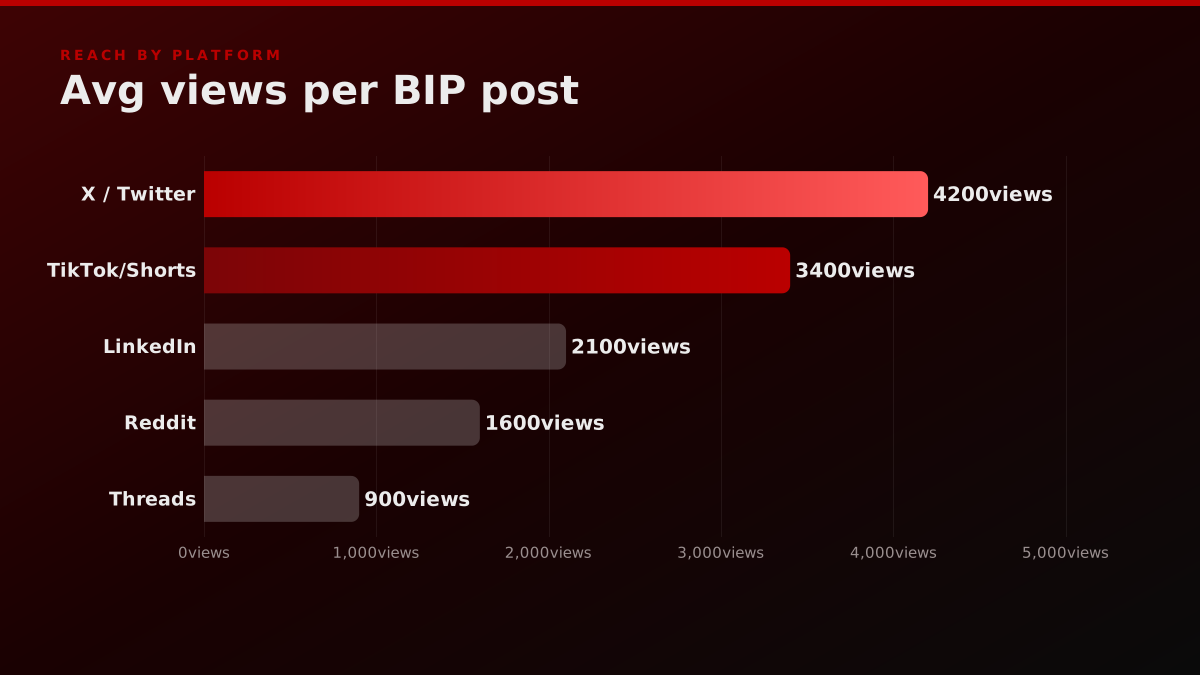
The best platform for building in public depends on where your buyers already spend attention, not on which platform feels easiest to post on. X rewards frequent, real-time threads and reply-based discussion, Reddit rewards genuine, value-first posts inside niche subreddits under a strict self-promotion norm, and LinkedIn's 2026 algorithm specifically favors native video and long dwell time over text posts and external links. Pick one platform to lead with, then extend to a second only once the first has real traction.
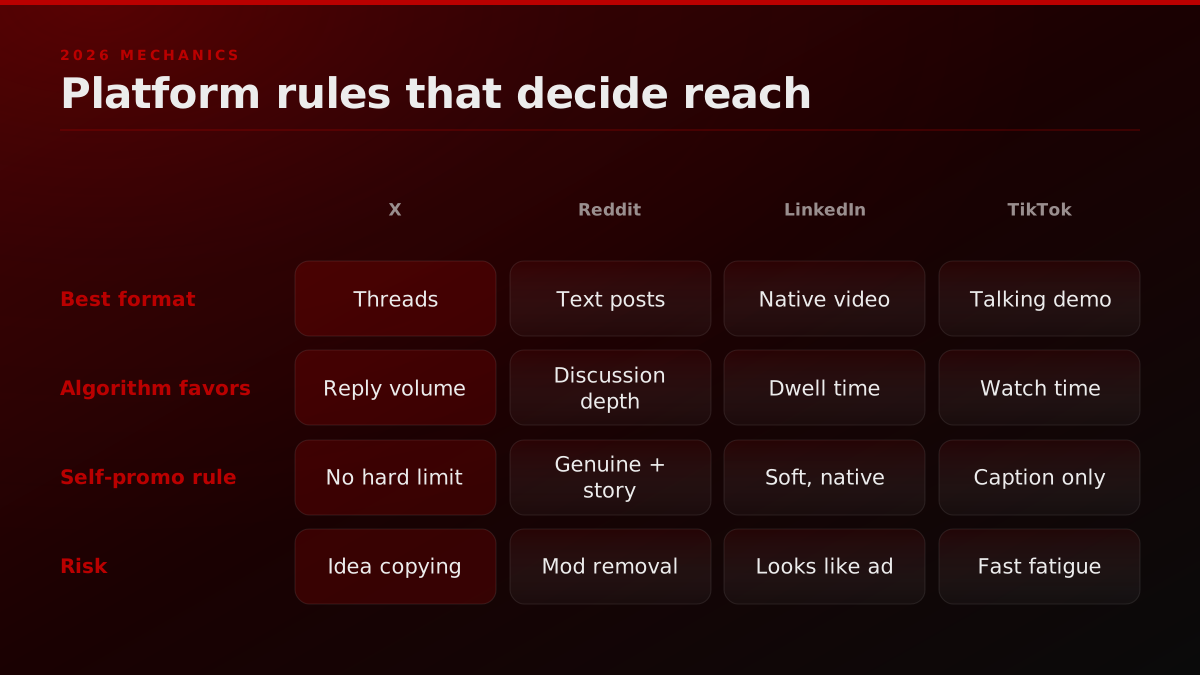
X / Twitter. The platform's real-time, thread-native format still rewards the classic build-in-public post: a short thread with a real number, a screenshot, and a clear takeaway. Reply volume is the strongest distribution signal, the #buildinpublic community account's weekly "what are you working on this week" prompt still draws 300-plus replies because the hook is structured and recurring, not because it is novel. Our Twitter marketing work builds exactly this kind of recurring hook cadence for founders rather than one-off viral attempts.
Reddit. This is the channel most build-in-public founders mishandle. Reddit's official policy on running promotions does not use the phrase "self-promotion" directly, it addresses the underlying behavior through its spam rules, which prohibit posting content primarily to drive traffic to an external product. The community-level heuristic that still circulates widely, an informal 90-to-10 ratio of genuine participation to self-promotion, was never a formal site-wide rule and has been retired in most subreddits, but the underlying principle it encoded, "it's fine to be a redditor with a product, not okay to be a product with a reddit account," remains exactly the standard individual subreddit moderators enforce. Lead with a real story or lesson, let the product be supporting evidence, and read each subreddit's specific rules before you post, because a mod removal on launch day deletes your highest-intent channel in one click.
The mod-safe recipe we run for clients has four parts. Build karma before you need it, comment and contribute in your target subreddits for at least two to four weeks before you ever mention your product, so your account reads as a real community member, not a fresh drive-by. Lead every post with the lesson, not the link, the product mention, if it appears at all, belongs in a reply to your own post or a low-key line at the end, never the headline. Pick two to four subreddits, not twenty, cross-posting the same content broadly reads as spam even when each individual post would have been fine, and moderators across subreddits do compare notes on repeat offenders. Reply to every comment inside the first hour, because Reddit's own ranking rewards fresh discussion activity, and a post that gets ignored by its own author sinks fast regardless of how good the content was.
Operator noteTwo to four weeks of real subreddit participation before any product mention; a fresh drive-by account reads as spam., FORKOFF Reddit marketing playbook
LinkedIn. The 2026 algorithm change is specific and measurable: native video and long dwell time are now weighted far more heavily than text posts or external links, and Hootsuite's 2026 algorithm breakdown reports posts holding attention past 61 seconds averaging roughly 13 times the engagement rate of posts abandoned within 3 seconds. For a build-in-public post on LinkedIn, that means a 30 to 90 second native video clip of the actual product or a founder talking through a real decision now meaningfully outperforms a text update, a shift from even a year earlier.
LinkedIn now pays for dwell time, not text
Hootsuite's 2026 LinkedIn algorithm breakdown reports posts that hold attention past 61 seconds averaging roughly 13 times the engagement of posts abandoned within 3 seconds, with native video weighted far above text posts and external links. For a build-in-public founder that means a 30 to 90 second native clip of the actual product now outperforms the classic text update on LinkedIn, a reversal from even a year earlier.
Source: Hootsuite, LinkedIn algorithm report 2026
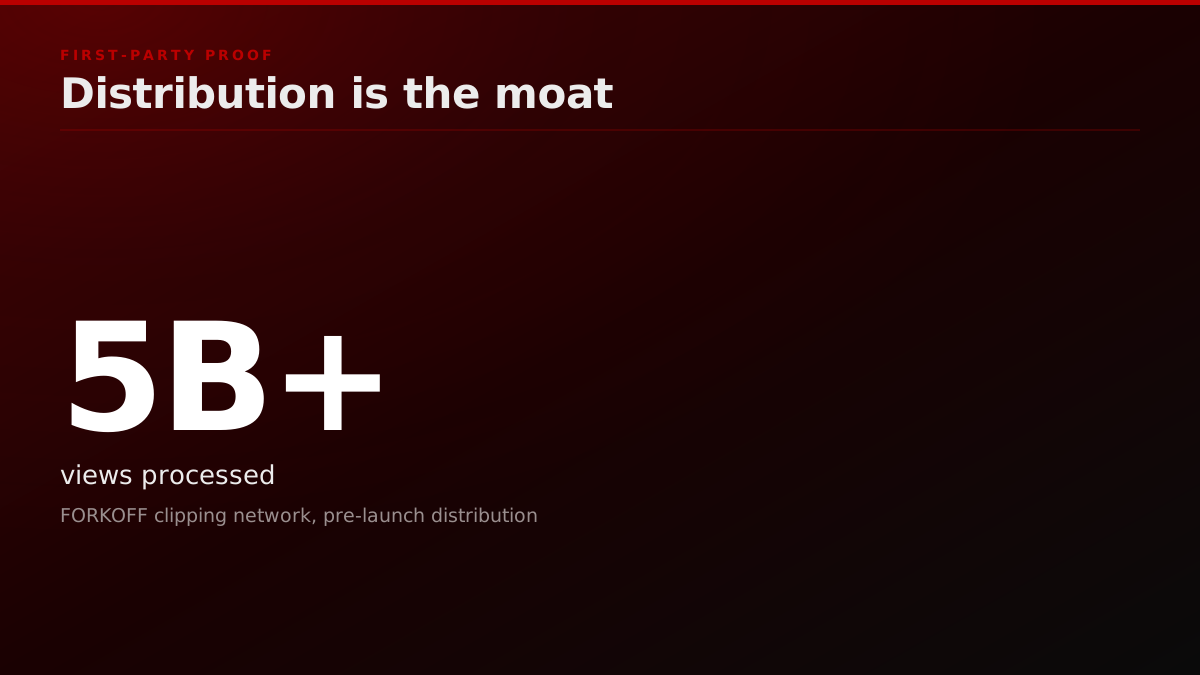
TikTok and Shorts. The short-form build-in-public format, a 15 to 60 second clip of the actual build, a metric screenshot with voiceover, or a reaction to a real setback, is the fastest-growing channel nobody in the classic build-in-public guides addresses, because those guides were written when the format meant "post on Twitter." Short-form volume compounds differently than a single platform's feed: a founder who produces 10 to 20 short clips during the pre-launch window seeds weeks of ongoing discovery across TikTok, Reels, and Shorts simultaneously, the exact mechanic our clipping work runs at scale for client launches, on a network that has processed over 5 billion views.
Operator note5B+ views processed on the clipping network; short-form discovery is the layer most pre-launch calendars skip., FORKOFF clipping network
2026 platform mechanics for build-in-public content
| Platform | Format that wins | What the algorithm rewards | The rule to respect |
|---|---|---|---|
| X / Twitter | Short threads with a real number and screenshot | Reply volume and recurring hooks | Consistency beats virality, fixed cadence |
| Value-first story or lesson in a niche subreddit | Fresh discussion activity in the first hour | A redditor with a product, not the reverse | |
| 30 to 90 second native video | Dwell past 61s, roughly 13x engagement | Native video over text posts and external links | |
| TikTok / Shorts | 15 to 60 second build clips with voiceover | Volume, 10 to 20 clips seed weeks of discovery | Short-form is a discovery layer, not a diary |
Sources, Hootsuite 2026 LinkedIn algorithm report, Reddit promotions policy, FORKOFF campaign benchmarks.
Is building in public risky for a startup?
Yes, building in public is risky for a startup in specific and manageable ways: it can tip off competitors, expose unfiled IP, or reveal investor terms you have not cleared to share publicly. The fix is not silence, it is a disclosure boundary, share the journey and the lessons openly, keep pricing math, unfiled IP, and confidential terms private until they are locked. Treating the choice as binary, either full transparency or total secrecy, is the actual mistake, not the tactic itself.
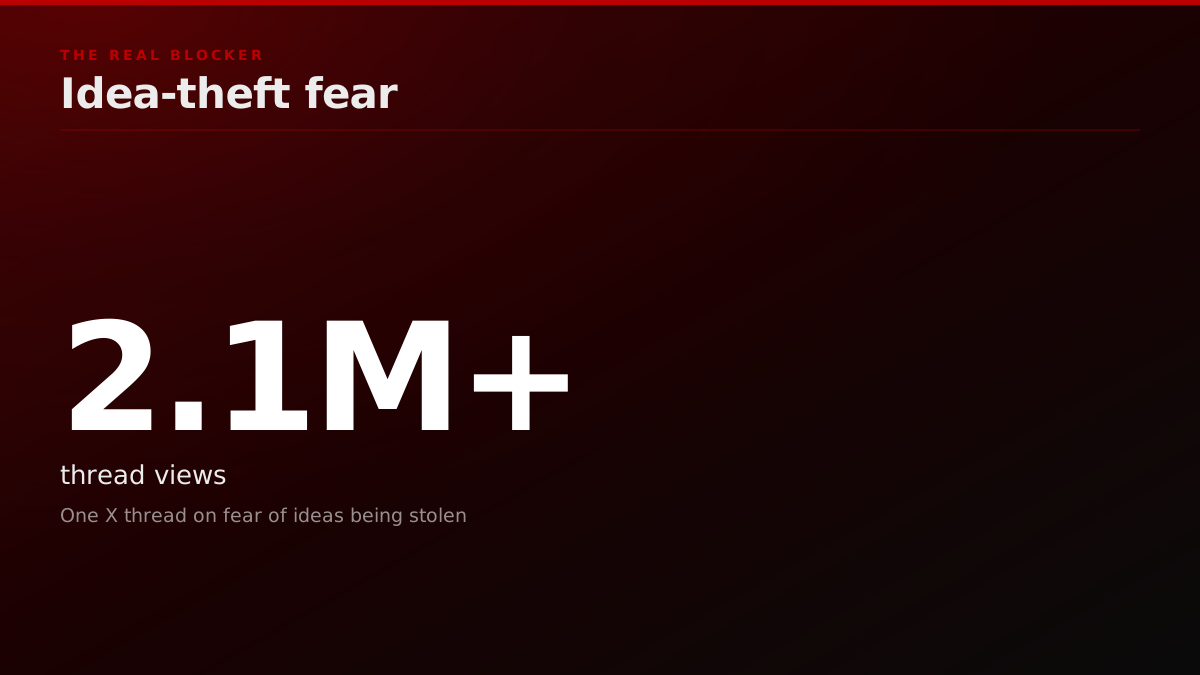
The fear is real and common. An X thread that asked simply, "I hesitate to build in public for fear of my idea being stolen, how are you dealing with this?", passed 2.1 million views before its author deleted it, and that reach alone confirms this is one of the most common blockers stopping founders from starting pre-launch marketing at all. The counter-evidence is equally well established: as one widely cited analysis of the idea-theft myth puts it, execution is in far shorter supply than ideas, and most first-time founders overestimate how much their specific idea, versus their specific execution of it, is actually at risk of being copied successfully.
The risk calculus also shifts by industry, and a founder should calibrate accordingly rather than applying one universal rule. A consumer app with a fast-moving, low-barrier feature set faces real copying risk, because a competitor can rebuild a visible feature in weeks; sharing feature-level roadmap detail there deserves real caution. A deep technical product, a regulated fintech tool, or a hardware business faces much lower copying risk, because execution, compliance, and manufacturing timelines are themselves the moat, and openly sharing the journey costs comparatively little. Founders in regulated industries, healthcare, financial services, anything touching personal data, carry an additional layer entirely separate from competitive risk: compliance and disclosure obligations that have nothing to do with competitors and everything to do with regulators, and those founders should route any public disclosure decision through counsel before publishing, not after.
Still, the fear is not irrational, it is imprecise. The real risk is not "someone copies my idea", it is specific categories of disclosure that carry real consequences. Five categories deserve a hard boundary: exact pricing math, until it is locked and defensible, because a competitor undercutting a number you floated publicly costs you the pricing negotiation itself. Unfiled intellectual property, before a provisional patent or trademark is filed, because public disclosure can start clocks running against you in some jurisdictions. Investor terms, cap table details, valuation, or runway remaining, because these carry real legal and negotiating sensitivity beyond simple competitive exposure. Uncommitted roadmap dates, because a public date you miss becomes a credibility problem, not just a competitive one. Unannounced partners or vendors, anything under an NDA or awaiting the other party's own announcement.
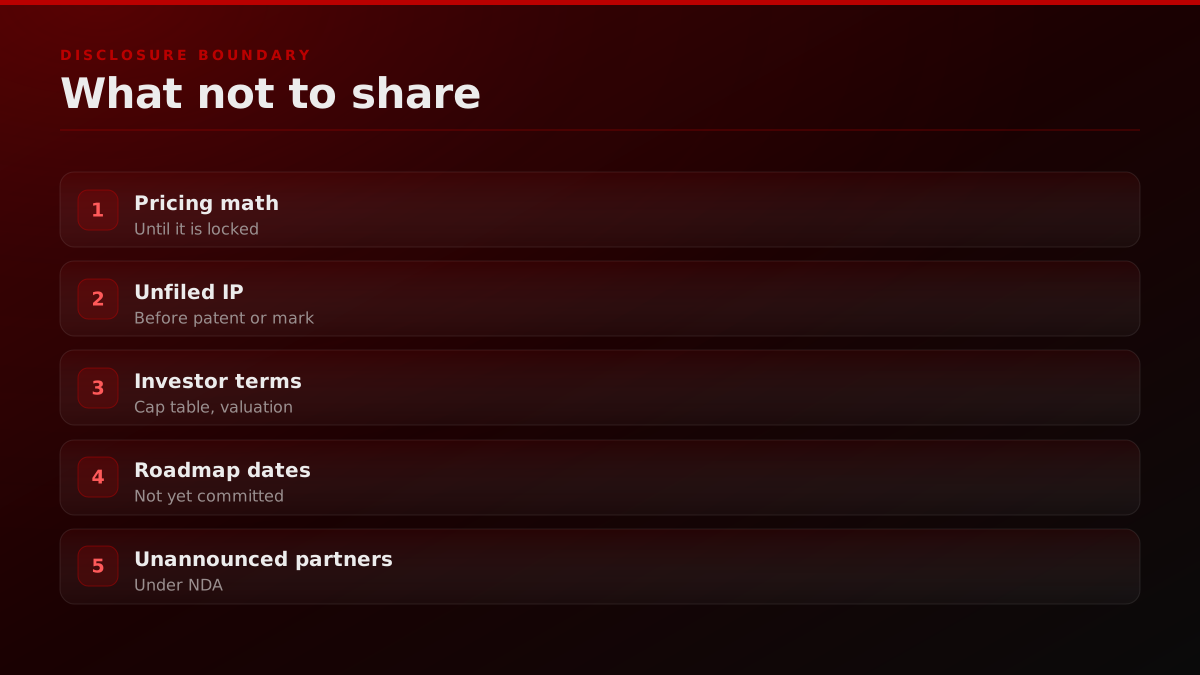
The disclosure boundary: five categories to keep private until locked
| Category | Why it stays private | When it unlocks |
|---|---|---|
| Exact pricing math | A floated number invites a competitor undercut | When pricing is locked and defensible |
| Unfiled IP | Disclosure can start legal clocks running | After the provisional filing |
| Investor terms | Cap table and valuation carry legal weight | When the round is announced |
| Uncommitted roadmap dates | A missed public date becomes a credibility problem | When the date is committed |
| Unannounced partners | NDAs and the partner's own announcement timing | After both sides announce |
Share the journey and the lessons openly, keep these five categories private until they are locked.
One Reddit founder built an entire practical answer around exactly this boundary, proposing a 3-step framework for what to share and what to withhold while still building in public as a B2B SaaS founder. The framework converges on the same conclusion this section reaches independently: transparency about the journey builds trust, transparency about the five categories above builds risk, and a founder who cannot articulate which bucket a given post falls into before hitting publish has not actually made the choice, they have defaulted into it.
Is 'Building in Public' a Competitive Risk? (My 3-step Framework to Stay Safe)
How do you turn a build-in-public audience into launch-day signups?
You turn a build-in-public audience into launch-day signups by running a sequenced distribution plan the moment you launch: notify your waitlist first, post the launch thread on your primary build-in-public channel, seed the communities you have already participated in for months, and layer in KOL amplification and short-form clipping to extend reach past your existing following. The audience you built is the starting fuel, distribution execution is what converts it.
This is the gap every incumbent build-in-public guide leaves open, and it is the reason a warm following on launch day still frequently converts to almost nothing. The classic complaint captures it exactly: a founder posts, months later, that they launched 1.5 months ago and have one active, non-paying user, despite having done the build-in-public work. The traffic problem was never the issue, the follow-up problem was. An audience that saw your posts is not the same as an audience that was personally notified, asked to act, and followed up with on launch day itself.
The conversion sequence we run has four steps. Personal notification first. DM your warmest 20 to 50 waitlist members individually before the mass email goes out, because personal outreach converts at a rate no broadcast channel matches. The launch thread on your primary channel. The audience that has followed your build-in-public posts for months is your single highest-intent traffic source, treat the launch post as the payoff to a story they have been reading, not a cold pitch. Community reactivation. Post in the same subreddits and communities you seeded during pre-launch, the trust you built there over weeks converts differently than a cold post on launch day would. Amplification layer. KOL posts, a short-form clipping wave, and a PR or wire release extend reach beyond your existing following into adjacent audiences who never saw your pre-launch content at all, exactly the distribution layer detailed in our Product Hunt launch playbook.
The launch-day conversion sequence
| Step | Action | Why it converts |
|---|---|---|
| 1. Personal notification | DM the warmest 20 to 50 waitlist members | Personal outreach outconverts any broadcast |
| 2. Launch thread | Post the payoff thread on the primary channel | Months of story make this the warmest source |
| 3. Community reactivation | Post in the communities seeded during pre-launch | Built trust converts where a cold post fails |
| 4. Amplification layer | KOL posts, clipping wave, PR or wire release | Extends reach into adjacent audiences |
The four-step sequence FORKOFF runs on client launch days.
Product Hunt deserves specific mention here, because it is where a build-in-public audience most visibly converts into external validation. Product Hunt's own launch guidance stresses preparation over the day itself, and a warm build-in-public following is exactly that preparation: a founder with a real audience arrives at their Product Hunt launch with a built-in first wave of upvotes and comments in the crucial first two hours, when the platform's own ranking algorithm decides how much additional traffic to send. A cold Product Hunt launch and a build-in-public-warmed Product Hunt launch are different products from a distribution standpoint, even when the underlying software is identical, a pattern the Harvard Business Review's analysis of why most product launches fail attributes largely to under-preparation rather than a bad product.
Instrument every step. Track which channel produced which signup, because the founder who does not know whether their waitlist, their X following, or their Reddit seeding actually drove conversions cannot improve the system for the next launch. You can sanity-check the expected return on each distribution channel before you commit spend to it with our marketing ROI calculator.
How do you measure whether your pre-launch system is actually working?
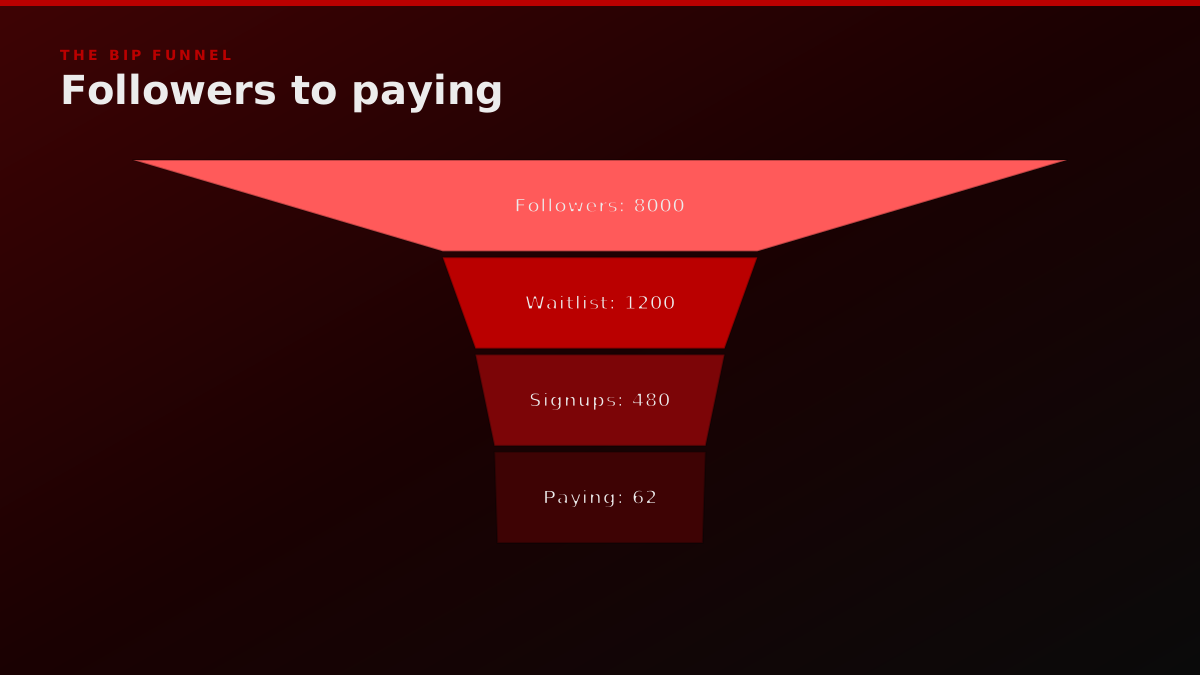
Measure the pre-launch system by tracking conversion rates between layers, not raw activity counts: follower growth alone tells you nothing, the ratios between followers, waitlist signups, and eventual paying customers tell you everything. A founder who cannot answer "what percentage of my followers joined the waitlist" and "what percentage of the waitlist paid on launch day" is flying blind between build-in-public activity and actual revenue, regardless of how good the engagement numbers look.
Four ratios matter more than any absolute number, because they diagnose exactly where the system is leaking.
| Metric | What it diagnoses | Healthy pre-launch range | If it is low |
|---|---|---|---|
| Follower-to-waitlist rate | Whether content has a real payoff and a real ask | 2% to 5% of engaged followers | Content is vibes, not metrics; add a clearer ask |
| Waitlist-to-signup rate | Whether the waitlist perk and warm-up cadence worked | 20% to 30% on launch day | Waitlist was never warmed weekly; add a perk |
| Comment-to-DM rate | Whether warm engagement is being personally followed up | 5% to 10% of commenters | Missing the personal-outreach step in the launch-day sequence |
| Signup-to-paying rate | Whether the product delivers on the story the content told | 5% to 15% in the first 30 days | The pre-launch story oversold what the product actually does |
Track these weekly during the cadence window, not just on launch day. A founder who sees the follower-to-waitlist rate stall at 0.5 percent has four weeks to fix the content before launch day arrives, versus discovering the same problem the day after launch when there is no runway left to correct it. This is the same discipline our clients run through the marketing ROI calculator before committing distribution budget: model the expected ratio, then measure the real one, and adjust the system, not just the spend.
The instrument itself does not need to be sophisticated. A simple spreadsheet with four columns, week, follower count, waitlist signups that week, and a one-line note on what content ran, is enough to catch a stalling ratio early. What matters is the discipline of checking it every week rather than only glancing at follower counts and assuming a rising number means the system is working. Follower count rising while waitlist signups stay flat is the single clearest early warning sign in this entire playbook, and it is invisible unless you are actually tracking the ratio between the two.
What is the difference between building in public and traditional pre-launch marketing?
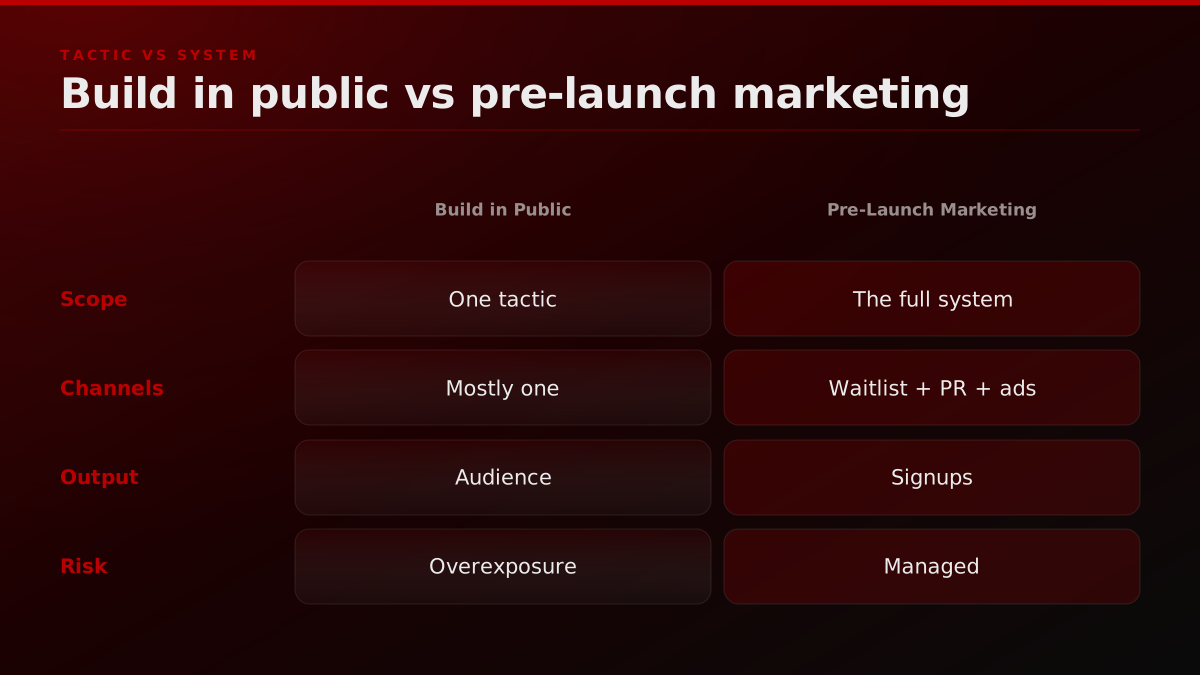
The difference is scope and channel mix, not intent. Building in public is one tactic, an ongoing, personal, founder-voiced narrative usually run on a single social channel like X. Traditional pre-launch marketing is the broader system: paid acquisition, PR, email list building, partnership seeding, and content marketing, often run by a team rather than a single founder voice, and rarely as personally transparent about real metrics and setbacks.
The two are not competitors, they are complementary layers of the same pre-launch marketing strategy. A founder running build in public without any traditional pre-launch marketing misses paid amplification, PR reach, and partnership distribution that a personal social feed cannot generate alone. A team running traditional pre-launch marketing without any build-in-public layer misses the trust and organic reach that a founder's authentic, followable voice generates, which is precisely why even venture-scale companies increasingly pair a founder's personal build-in-public presence with a professional marketing and PR function running in parallel.
The practical test: build-in-public content should feel like it came from a specific person with a specific stake in the outcome. Traditional pre-launch marketing content, a PR pitch, an ad, a partnership co-post, can and often should feel more polished and more company-voiced. Mixing the two registers in the same channel confuses the audience about who is actually talking; keep the founder's build-in-public voice personal, and run the traditional marketing layer through separate, clearly-branded channels.
| Dimension | Build in Public | Traditional Pre-Launch Marketing |
|---|---|---|
| Voice | The founder, personal and ongoing | The company, campaign-scoped |
| Cost | Time, no media spend | Media spend, PR retainers, ad budget |
| Trust mechanism | Consistency and specificity over months | Brand reputation and paid reach |
| Typical channels | X, Reddit, LinkedIn, short-form | Paid social, wire, partnerships, email |
| Failure mode | Generic vibes content, oversharing risk | Polished but untrustworthy, easy to ignore |
Run both, sequenced. Build in public earns the trust and the organic audience across the pre-launch window, and traditional pre-launch marketing extends reach to buyers who were never going to find a founder's personal feed on their own. Neither replaces the other; the strongest pre-launch systems layer them deliberately rather than picking a side.
What should founders actually share when building in public (metrics vs. vibes)?
Founders should share concrete, verifiable content: real metrics such as signups, revenue, or churn, real product decisions and the reasoning behind them, and real setbacks alongside what changed as a result. Founders should avoid vague vibes content, generic motivational posts, unfalsifiable claims about momentum, or status updates with no specific number or decision attached, because vibes content is precisely the pattern behind the "nobody cared" complaint that dominates the community's own criticism of the tactic.
The metrics-versus-vibes distinction is testable with one question: could a reader disagree with or learn something from this post? "We're crushing it" is vibes, nobody can learn anything from it or apply it to their own build. "Signup completion rose from 40 to 68 percent after we cut our form from 7 fields to 3" is a metric, a specific, falsifiable, applicable claim a reader can test against their own product. Failory's review of 20 real build-in-public accounts finds this pattern consistently: the highest-engagement posts in every account studied carry a specific number, never an adjective standing in for one.
Build in public so that in case you're building nonsense, people will tell you.
Rotate through four content types to avoid both extremes, pure metrics fatigue and pure vibes emptiness. A number, weekly or biweekly, tracking the one metric that matters most to your story. A decision, the reasoning behind a specific product or business choice, which teaches readers your thinking process, not just your outcome. A setback, honestly described, because unbroken success reads as marketing copy and setbacks are what earn the trust the whole tactic depends on. A community moment, replying to or amplifying another builder, which signals you are a participant in the ecosystem, not only a broadcaster inside it.
Why doesn't warm engagement convert into signups?
Warm engagement fails to convert into signups when a build-in-public post asks for nothing. Comments, DMs, and "I love this idea" replies measure interest, not intent, and interest only becomes a signup when the post itself contains a specific, low-friction next step. The gap founders describe, real warmth in the replies and near-zero clicks on the actual link, is almost always a missing call to action, not a weak product or a cold audience.
This exact gap is one of the most common questions in build-in-public communities: founders asking what the missing piece is between people saying "this is awesome" and people actually signing up. The honest answer is structural. A post that shares a metric or a decision earns a comment. A post that shares the same content and then explicitly says "join the waitlist, link in the next reply" earns a click. Warm engagement and conversion are two different behaviors the reader has to be asked to do separately, and most build-in-public content only ever asks for the first one.
Alex Ibragimov
@alexwtlf
how to get your first 100 users with $0 marketing budget. 20 things that actually work: 1. pick ONE channel and dominate it before adding a second 2. post where your users already are, not where you're comfortable 3. talk to 50 potential users in DMs before spending on ads...
The underlying vanity-metric trap makes this worse. Founders who track likes and comments as their success signal optimize their content for exactly the behavior that produces likes and comments, which is emotionally resonant storytelling, not a specific ask. A post engineered for engagement and a post engineered for conversion are not the same post, and a founder who never separates the two ends up with a feed full of warm reactions and an empty waitlist, precisely the pattern behind the "murder your startup" criticism of chasing dopamine over revenue.
Two related habits compound the gap further. Sharing only once something is finished kills the pre-launch community-building effect entirely, because the audience that would have followed the journey, and converted on the strength of that relationship, never got the chance to form. Never balancing content time against build time burns the runway a founder needs to actually ship, a real and reasonable worry founders raise when they ask how much of the week should go to posting versus building. The practical answer: cap build-in-public content time at roughly 20 to 30 minutes a day during the cadence window, one real post, replies to comments, nothing more, so the tactic supports the build instead of competing with it.
Real build-in-public case studies with numbers
Concrete, quantified case studies, not abstract advice, are what separates a credible build-in-public playbook from a motivational post. Here are documented, publicly reported outcomes and the mechanics behind them.
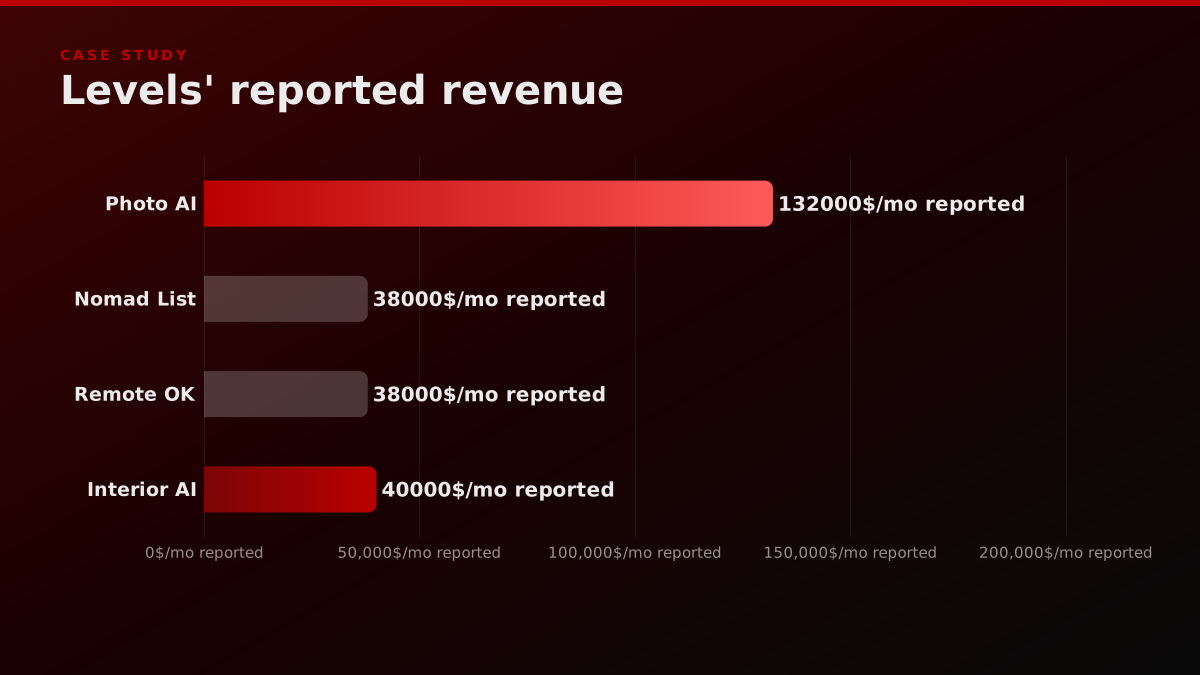
Pieter Levels is the most-cited build-in-public case study for a reason: the transparency is structural, not occasional. Levels posts real Stripe dashboard screenshots and exact revenue figures on X across his entire product portfolio, and the publicly reported figures, per multiple independent write-ups of his business, put Photo AI at roughly 132,000 dollars per month, Nomad List at roughly 38,000 dollars per month, and his combined portfolio at over 200,000 dollars per month, run with effectively no employees. The audience he built through years of public posting is the distribution channel every product in his portfolio launches into, which is why each subsequent launch converts faster than the one before it.
Pieter Levels' publicly reported build-in-public portfolio
| Product | Publicly reported revenue | What it shows |
|---|---|---|
| Photo AI | Roughly $132,000 per month | A newer product converting off the same audience |
| Nomad List | Roughly $38,000 per month | The original 2014 product, still compounding |
| Combined portfolio | Over $200,000 per month | No employees, the audience is the distribution |
Figures as publicly reported across independent write-ups; Levels posts real Stripe dashboards on X.
Buffer's public revenue dashboard, live continuously since 2013, is the enterprise-scale version of the same instinct: revenue, salaries, and diversity metrics published on an ongoing basis, not as a launch campaign. The company has explicitly credited this radical transparency with building the trust and brand differentiation that a purely feature-based marketing strategy could not have produced on its own, a form of earned authority that compounds over years rather than expiring after one news cycle.
A third documented case makes the same point from a different starting position: one founder's publicly recorded journey building a company to 10 million dollars entirely in public shows the pattern was not a single viral moment, it was a multi-year cadence of real updates, wins, and setbacks, published on a schedule and compounding into an audience that carried every subsequent product launch.
How I Built a $10M Company in Public (and how you can too!) - Billion $ Company - Episode 10
jayhoovy
How one founder built a $10M company in public, documented end to end.
The pattern across all three cases is consistent: the founders who produced durable, compounding results ran build in public as a standing system for years, not a pre-launch campaign for weeks. A founder starting today should expect the first 8 to 12 weeks to build the foundation of a much longer-running practice, not a one-time push that ends the day the product ships.
The AI-era build-in-public angle: shipping in public with Claude Code and Cursor
The newest build-in-public content format in 2026 is the AI coding-agent build log: founders sharing the actual prompts, session transcripts, and before-and-after diffs from tools like Claude Code and Cursor as they ship features in real time. Where 2019-era build in public meant "here is my roadmap", 2026-era build in public increasingly means "here is the prompt that shipped this feature, and here is how long it took," a content format that documents AI-assisted build velocity as a distinct, quantifiable differentiator.
This angle exists because the underlying practice, often called vibe coding, a term Andrej Karpathy popularized describing development where a founder states intent in plain language and an AI agent implements it, has become a normal part of how solo founders and small teams ship in 2026. A founder who ships a feature in three days using an AI coding agent has a genuinely new kind of build-in-public content available: not just the finished feature, but the actual velocity and the actual agent interaction that produced it, content no 2019-era build-in-public guide anticipated because the underlying practice did not exist yet.
The credibility mechanics are different from classic build-in-public content, and worth naming directly. A screenshot of a metric dashboard asks the reader to trust the founder's honesty. An agent session log, showing the actual prompt and the actual diff it produced, is closer to a verifiable artifact than a claim, because another builder can attempt the same prompt against the same tool and compare results. That shift, from a trust-based claim to a reproducible artifact, is exactly the kind of specificity this playbook has argued for throughout: it is metrics-and-decisions content taken to its logical extreme, where the decision itself is externally checkable.
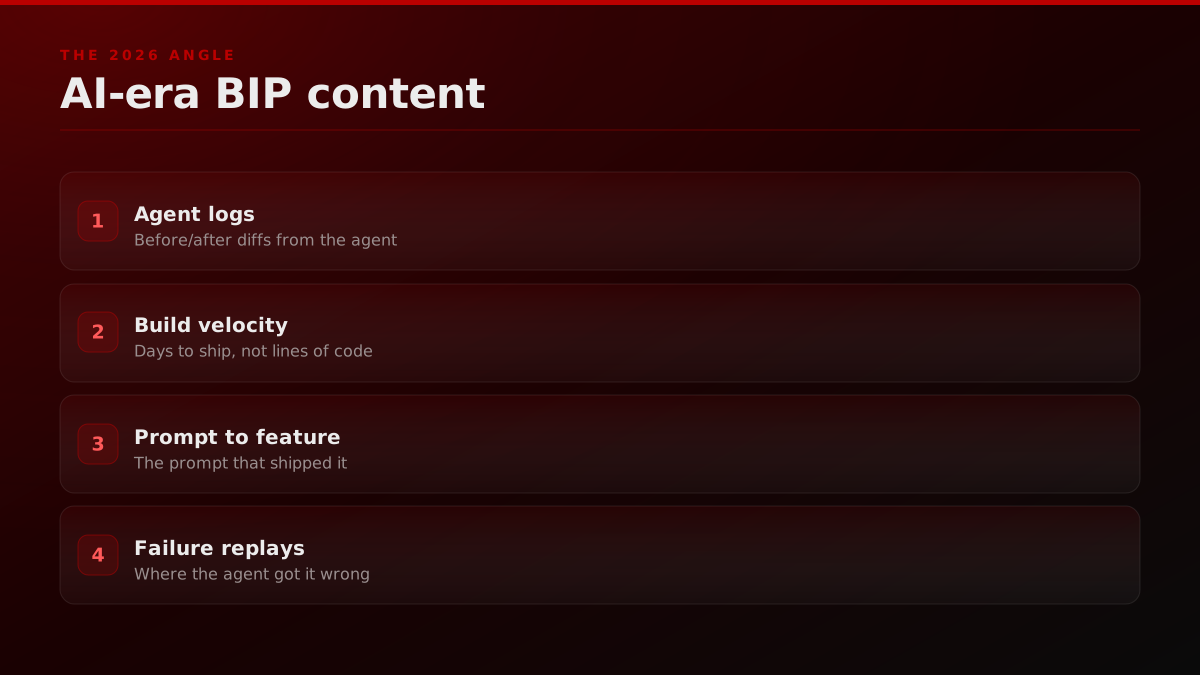
Four formats are working right now for founders running this angle. Agent session logs, a before-and-after diff or a short clip of the actual coding-agent session that shipped a feature, packaged as a specific, verifiable artifact rather than a claim. Build velocity as the headline metric, "days to ship," a number that is both a build-in-public metric and a direct signal of the team's execution speed to a technical audience. Prompt-to-feature posts, sharing the actual prompt that produced a shipped feature, which is genuinely novel content nobody was producing three years ago and carries real informational value to other builders experimenting with the same tools. Failure replays, honestly documenting where the agent got something wrong and what the founder had to fix manually, which does more for credibility than a highlight reel of only the wins, for the same reason honest setback posts always outperform unbroken success narratives.
At FORKOFF, this is exactly the kind of first-hand, verifiable content our own team produces when running growth systems: we cite real throughput, real cost-per-call, and real client outcomes rather than adjectives, because that specificity is what both readers and AI answer engines reward, per the Princeton GEO research on data density and dated statistics improving AI-citation rates.
Founders adopting this angle should apply the same disclosure boundary covered earlier in this playbook, not a separate one. An agent session log showing how a feature was built is exactly the kind of "real decision" content this playbook has argued for throughout. A session log that happens to reveal unfiled IP, an unreleased pricing model, or a partner integration under NDA is a disclosure-risk problem wearing a new format, and the same five categories, pricing math, unfiled IP, investor terms, uncommitted dates, and unannounced partners, apply whether the artifact is a screenshot or a coding-agent transcript.
The most common build-in-public mistakes to avoid
The most common build-in-public mistakes are posting generic diary updates with no payoff, treating the tactic as a complete strategy instead of one layer of a demand system, oversharing the five disclosure-risk categories, picking the wrong platform for the audience, and stopping the moment the product ships instead of carrying the cadence into post-launch. Each mistake is avoidable, and each one maps directly to a fix already covered in this playbook.
Almost every build-in-public failure story traces back to one of these five, and rarely to the market or the product itself. That distinction matters because it changes what a founder should actually fix after a disappointing pre-launch window. A founder who concludes "build in public doesn't work" after one of these mistakes is drawing the wrong lesson, the tactic did not fail, the execution of it did, and the fix is almost always cheaper than abandoning the channel entirely and starting over with a different one.
I spent 15 days building in public. Nobody cared. Here's what I realized.
- The generic diary. "Day 1, idea. Day 2, progress." with no metric, decision, or setback attached gets ignored, exactly as one founder's 15-day experiment demonstrated firsthand. Fix: every post needs a number, a decision, or a setback, never a bare status.
- Treating build in public as the whole strategy. An audience with no waitlist and no launch-day distribution plan behind it converts to almost nothing, the exact pattern behind the "1.5 months in, one non-paying user" complaint. Fix: run all three layers of the demand system, not just the first.
- Oversharing the five risk categories. Exact pricing, unfiled IP, investor terms, uncommitted dates, and unannounced partners are not "transparency," they are unforced errors. Fix: share the journey, keep those five categories private until locked.
- Wrong platform for the audience. Posting daily on X when your buyers live on LinkedIn or in a specific subreddit wastes months of cadence on an audience that was never going to convert. Fix: match the platform to where your specific buyer already spends attention, not the platform you find easiest.
- Stopping at launch day. The cadence that built the pre-launch audience is exactly what should continue post-launch, turning the launch spike into a compounding distribution motion instead of a one-time event. Fix: carry the same posting rhythm into the 30 to 90 days after launch.
Should you build in public alone, or bring in help for distribution?
Build in public itself should stay the founder's own voice, but the distribution layer around it, seeding communities, running the launch-day sequence, producing short-form clips, and instrumenting the funnel, is exactly the work most founders cannot staff alone while also building the product. The tactic scales with the founder's time; the system around it scales with execution capacity, and those are two different constraints.
The tell that a founder needs help is specific: the cadence calendar is slipping because posting keeps losing to shipping, the waitlist has gone quiet for more than two weeks, or launch day arrived with no one dedicated to working Reddit and X simultaneously while the founder handles Product Hunt. None of these are reasons to stop building in public, they are reasons to hire the execution layer around it so the founder's own cadence never has to compete with the distribution mechanics that convert it.
The division of labor that works best keeps the founder's voice as the irreplaceable asset and moves everything else to a team or an agency: the founder posts and replies personally, while a distribution partner handles community seeding, short-form production, KOL coordination, and the instrumentation that tells the founder which channel is actually converting. That split protects the one thing an audience actually trusts, the founder's authentic voice, while removing the operational load that most commonly causes the cadence to collapse under real-world time pressure.
This is not an argument for outsourcing the voice, and it should never become one. The moment a build-in-public account is visibly written by someone other than the founder, the entire trust premium the tactic depends on evaporates, because followers were never following the company, they were following a specific person's real judgment. What gets delegated is everything downstream of the post: the seeding, the clipping, the amplification, and the measurement. What never gets delegated is the sentence itself.
How FORKOFF runs pre-launch distribution
At FORKOFF, we run the pre-launch demand system as a coordinated engine, not three disconnected tactics. We are an AI growth agency running distribution, content, and go-to-market for startups across AI, SaaS, Web3, DevTools, and Fintech, and our clipping network has processed over 5 billion views. On a pre-launch engagement, we run the channel-specific execution most founders cannot staff alone: the Reddit marketing motion that seeds communities without triggering a mod ban, the Twitter marketing and influencer marketing cadence that keeps a founder's build-in-public voice consistent for months, the short-form clipping wave that turns build updates into discovery content across platforms, and the answer engine optimization (AEO) and generative engine optimization (GEO) work that makes a founder's pre-launch story findable when buyers ask an AI engine how real founders build demand before launch.
The engagement starts the same way every time: an audit of the founder's existing following and posting history, a channel-fit diagnostic against the specific ICP, and a locked narrative before a single new post goes out. From there, we run the cadence calendar alongside the founder, week by week, while our team handles the community seeding, the short-form production, and the launch-day sequencing that turns the audience into a funded day one. The founder keeps the microphone; we build and run everything the microphone needs to actually reach the room.
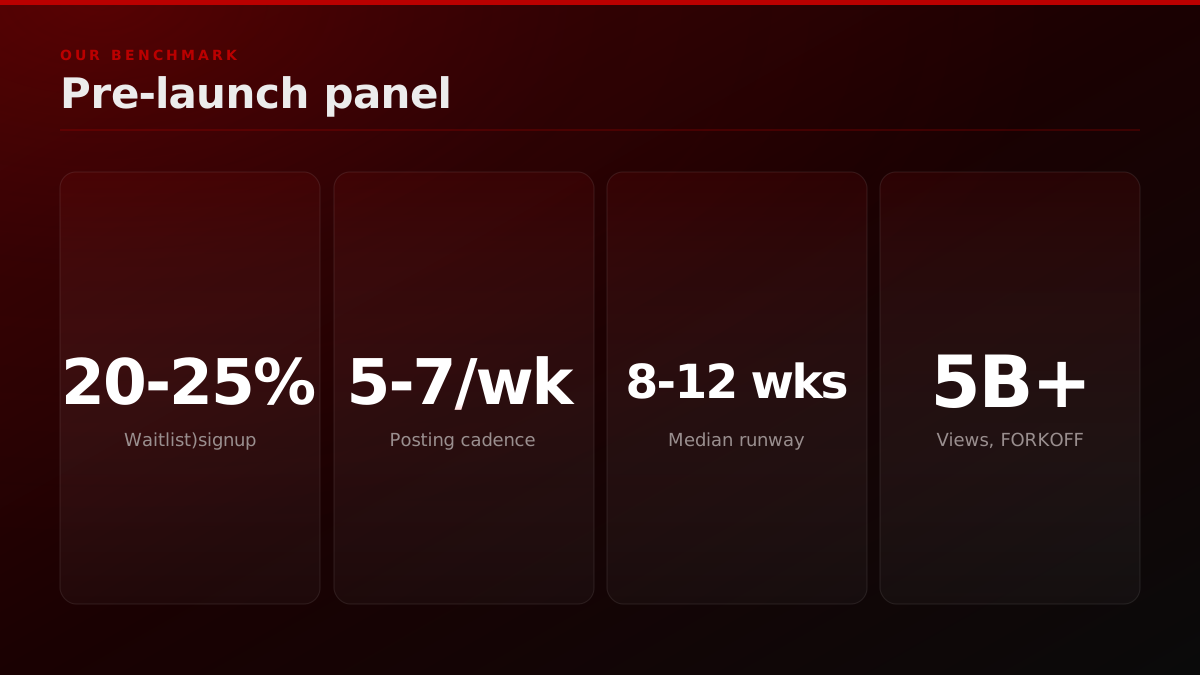
Across the client pre-launch campaigns we have run, a representative benchmark panel looks like a 20 to 25 percent waitlist-to-signup conversion rate, a 5 to 7 posts per week cadence sustained across the full pre-launch window, and a median 8 to 12 week runway from narrative lock to launch day (first-party FORKOFF pre-launch benchmark, representative range across client campaigns, 2025 to 2026). The founder still has to be the voice, the audience trusts a person, not an agency account. What we add is the execution capacity and distribution reach that turns months of consistent posting into a launch day that actually converts, instead of a warm feed that goes quiet the moment the product ships.
Operator note5 to 7 posts per week sustained across the full window is what client campaigns hold; sporadic weeks show up in the ratios., FORKOFF pre-launch benchmark, 2025 to 2026
Every pre-launch engagement also gets an AEO pass, because buyers increasingly ask ChatGPT or Perplexity how real founders build demand before launch, and a founder's own pre-launch story should be the answer that gets cited, not a competitor's. Check whether your own launch page is structured to earn that citation with our AEO checker.
If you want the distribution engine run for you while you build, our founder funnel and clipping engagements plug in directly here, a launch video gives the day one asset to point at, and you can see where we have been cited on our press page.
What do the critics get right, and what do they miss?
The critics of build in public are right about the symptom and wrong about the cure. One Reddit post goes as far as calling it "the biggest lie indie hackers tell themselves", and a related take calls it flatly the most overrated advice of the last five years. Both are describing something real: a large share of visible build-in-public activity produces engagement and nothing else, and founders who mistake that engagement for progress are, in fact, being sold a lie about what the activity accomplishes.
One blunt X post lists build in public alongside a set of habits it calls, collectively, "stupid shit you can stop doing", grouped with chasing 12 startups in 12 months and buying Twitter ads with no strategy behind them. Read generously, the post is not arguing against transparency, it is arguing against activity that substitutes for a real plan, exactly the distinction this playbook draws between build in public as a whole strategy versus build in public as one instrumented layer of a system with a waitlist and a launch-day plan behind it.
Mention just one successful product that was 'build in public'. Are you'all building or creating content??
Where the critics miss is the leap from "this is often done badly" to "this cannot work." Every criticism above describes build in public run without the other two layers, an audience with no waitlist, a waitlist with no launch-day distribution plan, content optimized for engagement instead of a specific ask. None of it describes a failure of the tactic when it is run as a system. The documented case of a founder building a 10 million dollar company in public and Pieter Levels' multi-product portfolio are not exceptions that prove the critics wrong by luck, they are what the tactic looks like when the surrounding system is actually built.
The honest synthesis: the critics are describing the median build-in-public account, and they are right that the median account is closer to noise than to a growth engine. This playbook is not a defense of the median account. It is the difference between running build in public as a habit and running it as the top layer of a demand system, and that difference is the entire reason some founders compound an audience across years and most founders quit after fifteen days wondering why nobody cared.
The bottom line
Here is the blunt answer: building in public is not a strategy, it is one tactic inside a pre-launch marketing system that also needs a waitlist and a sequenced launch-day distribution plan to actually convert. The founders who make it work run a real cadence for 8 to 12 weeks, share metrics and decisions instead of vibes, hold a clear disclosure boundary around pricing, IP, and investor terms, and pick the platform where their specific buyer already spends attention. The founders who complain it does not work are almost always missing layer two or three, the waitlist or the distribution plan, not layer one.
The debate this playbook opened with, whether build in public is genius or a trap, dissolves once you see it this way. It is neither. It is a tool that behaves exactly like the system it sits inside: powerful when it feeds a waitlist and a launch-day plan, a diary when it does not. The founders posting "day 1, idea, day 2, progress" and getting nothing are not proof the tactic is broken, they are proof the system around it was never built. The founders posting real metrics for years and compounding an audience across multiple product launches are not lucky, they built the system this playbook describes and ran it for long enough to see it work.
Start the narrative today. Stand up the waitlist by week four. Hold the cadence for 8 to 12 weeks. Then run the launch-day distribution plan against the audience you built, and keep the cadence running after launch day instead of stopping. Build in public is real leverage when it is one tactic inside a system. Alone, it is a diary. That is the whole difference.