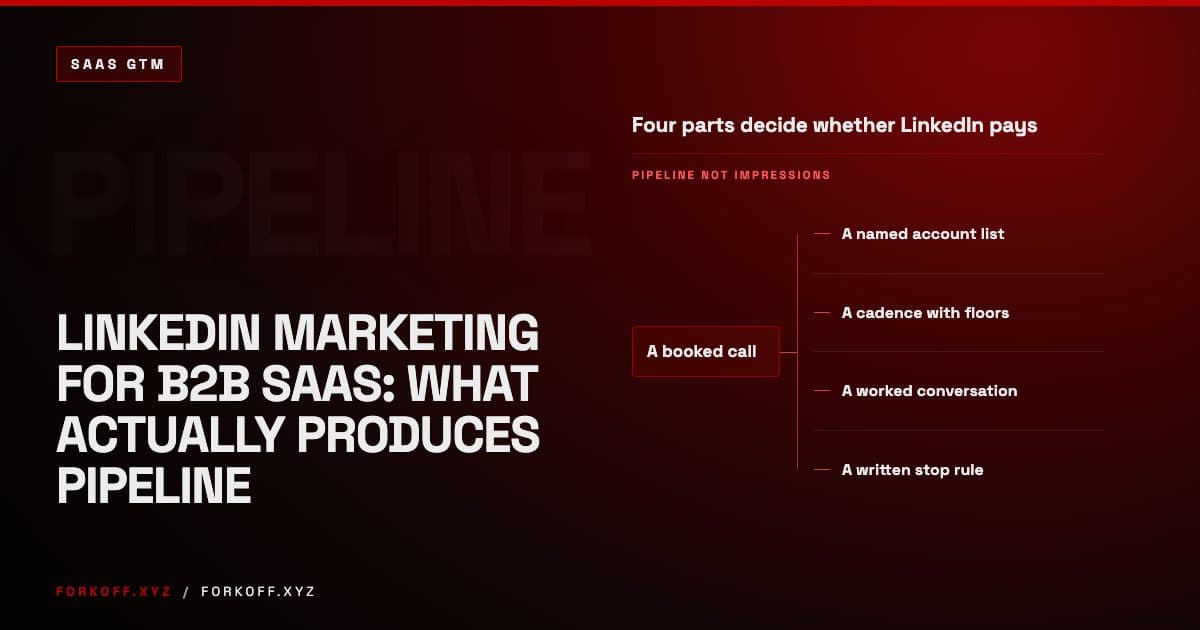
LinkedIn marketing for B2B SaaS is the practice of using a named account list, a fixed publishing cadence, and a deliberate conversation layer to move specific buyers from never having heard of you to a booked call. It is not a posting subscription, and impressions are not its output. The output is a qualified reply from somebody on a list you chose in advance, and everything in this playbook exists either to produce more of those or to tell you sooner that you are not going to get any.
That framing matters because it is the part almost nobody publishes. This guide assumes you have already settled whether the channel works for a B2B SaaS at all, which turns on proximity to your buyer rather than raw reach. What follows is the operating side: which accounts, what cadence, what you publish, how a reply becomes a call, and the specific numbers at which you should stop.
The short version
LinkedIn marketing for B2B SaaS is not a posting subscription and impressions are not its output. The output is a qualified reply from an account you named in advance. Here is the arithmetic almost nobody publishes: take a thousand impressions on a good founder post, apply our four percent impression-to-dwell floor and forty people read it to the end, apply our nought point eight percent click-through floor and eight people act on it. That is what a strong post does, which tells you immediately that the lever is not more impressions but a different impression pool. The conversation layer is a second, separate funnel measured on a different population, and multiplying it through the first is the most common analytical mistake in this channel. Run five posts a week into fixed weekday slots, because seven trips audience fatigue on a single-operator account and impression-per-post drops thirty to forty-five percent. Work a named list of two hundred to five hundred accounts and read connection accept rate as a list diagnostic, not a message diagnostic. Move a reply to a call in four steps rather than one. And write your stop rules down before you start, because impression rate under fifteen percent, dwell under two percent, accept rate under twenty percent, and a month with no qualified reply each point at a different broken thing, and none of them means post more.
The chain from a named account to a booked call
Every stage in that chain has its own conversion rate, and most teams measure exactly one of them, the first, because it is the one the platform shows you for free.
Blake Emal
@heyblake
Every B2B SaaS company eventually discovers that their best marketing channel is one guy who posts on LinkedIn three times a week and gets invited to podcasts
What does LinkedIn marketing for B2B SaaS actually involve?
It involves four components running at once, and dropping any one of them breaks the other three. You need a named list of accounts you want to reach, so that reach can be judged against something other than its own size. You need a publishing rhythm frequent enough to compound and slow enough not to exhaust a single-operator account. You need somebody answering comments and messages as a human, because the conversation is where a reply becomes an exchange and an exchange becomes a call. And you need two or three numbers you have committed to in advance, so that a bad month is a measurement rather than an argument.
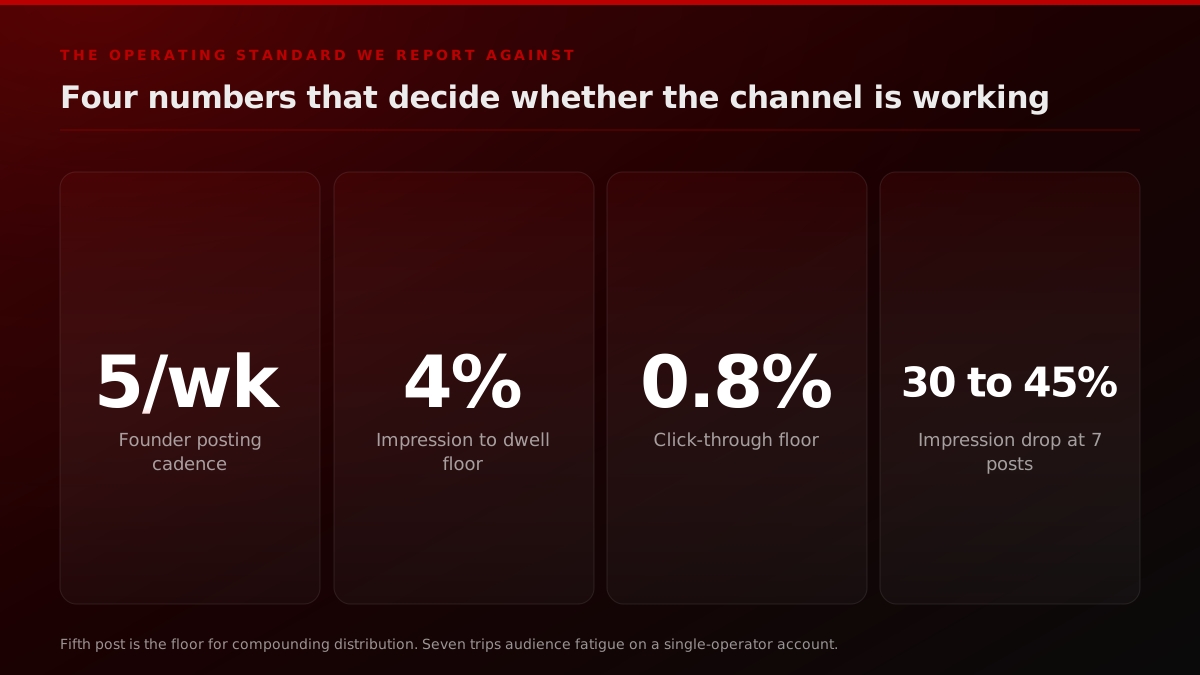
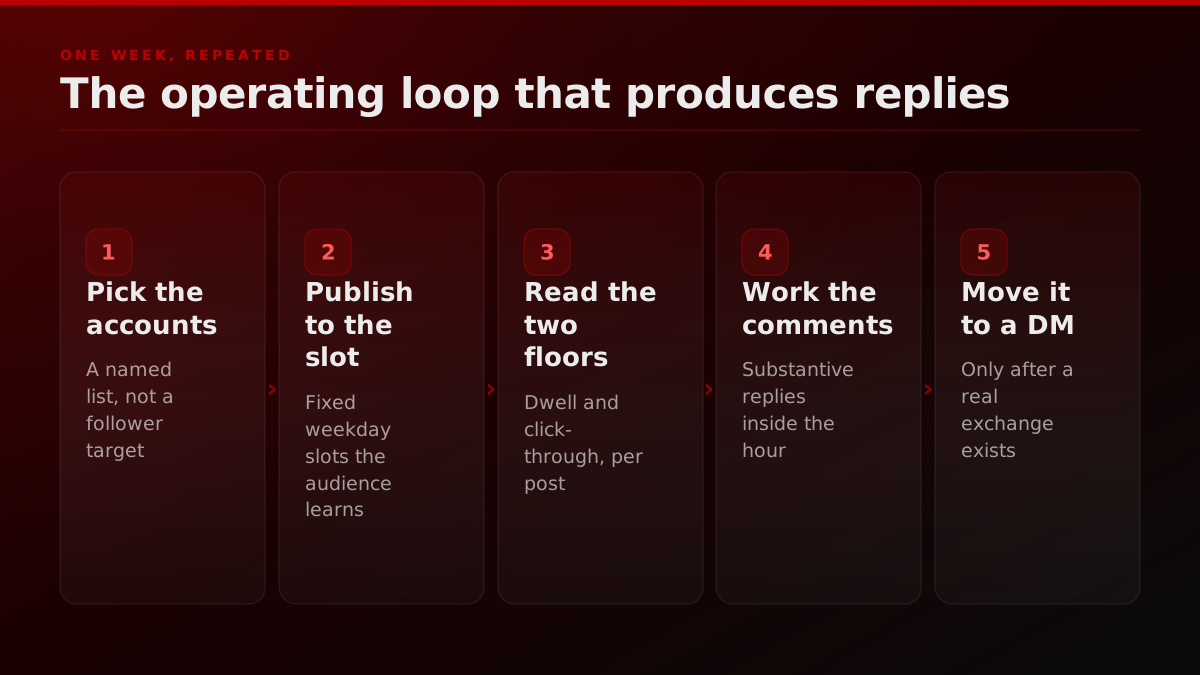
Those four numbers are worth stating plainly, because so much of the published advice in this category refuses to commit to any. Five posts a week is the founder cadence. Four percent impression-to-dwell is the floor at which a post counts as read rather than merely served. Nought point eight percent click-through is the floor at which a post counts as acted on. And seven posts a week is where it breaks: on a single-operator account, seven trips the audience fatigue line and impression-per-post drops thirty to forty-five percent. The full slot grid, the post-type mix and the amplification triggers live in our LinkedIn distribution cadence playbook, so this guide will not restate them.
Operator noteDrop any one of the four components and the other three stop working. A cadence with no list is broadcasting.
The reason the four have to run together is that each one makes another one legible. The list makes reach meaningful. The cadence makes the list reachable. The conversation converts what the cadence surfaces. The floors tell you which of the other three is failing. Teams that run three of the four usually drop the conversation layer, because it is the only one that cannot be scheduled, and then report impressions because it is the only thing left to report.
What does a LinkedIn post actually convert, at those floors?
This is the arithmetic the tactic guides leave out, and it is the single most useful thing in this post. Take one thousand impressions on a compliant, well-written founder post. At the four percent dwell floor, forty people read it to the end. At the nought point eight percent click-through floor, eight people act on it. Not eight leads. Eight clicks. That is what a good post does, and a good post is already at the top of a distribution most accounts never reach.
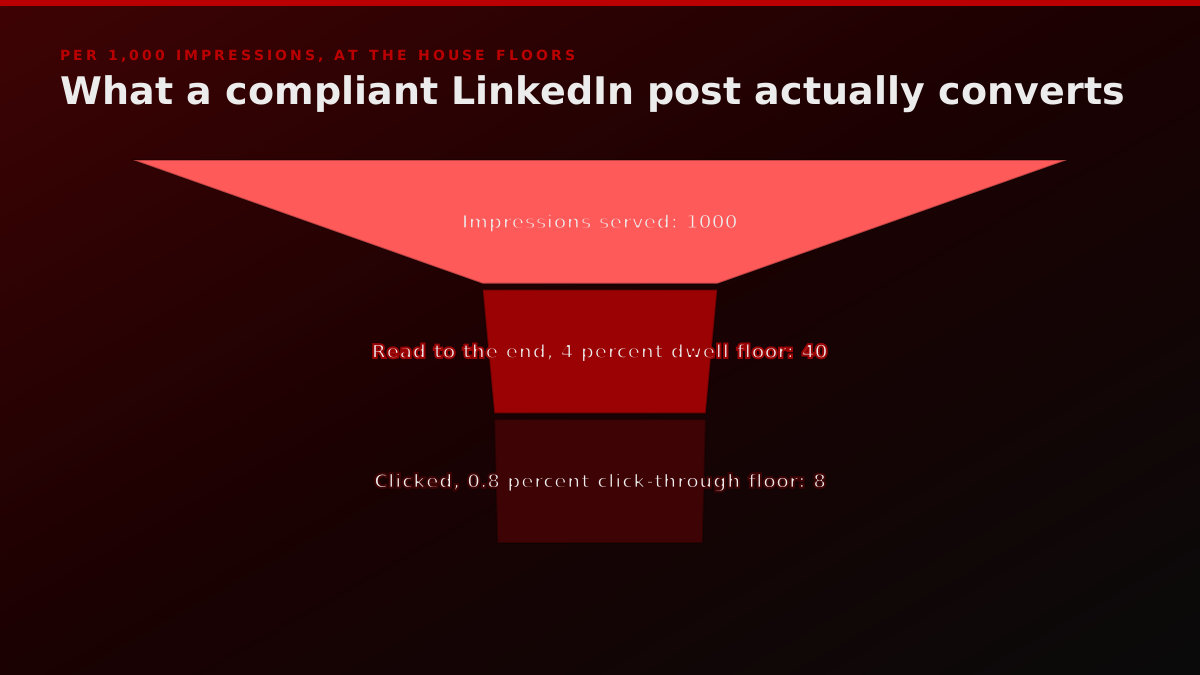
Read that as clarifying rather than depressing. It tells you immediately that a strategy resting on one viral post is not a strategy, because the ceiling on a single post is roughly eight interested clicks. It tells you the lever is not more impressions, which multiplies a very small fraction, but a different impression pool. Forty readers from your named account list is a fundamentally different asset to four hundred readers who will never buy. This is the same logic that makes cost per qualified lead a more honest channel comparison than cost per click, and the same reason we qualify views rather than counting them on the distribution side of the business.
paolo trivellato
@paolo_scales
a founder with 47,000 linkedin followers asked me to audit their pipeline last month. he had ZERO booked calls from content in 90 days… let me explain why this happens to almost every B2B account that "goes viral": the posts that get the most likes and the posts that sign
There is a second funnel, and the most common analytical mistake in this channel is multiplying it through the first one.
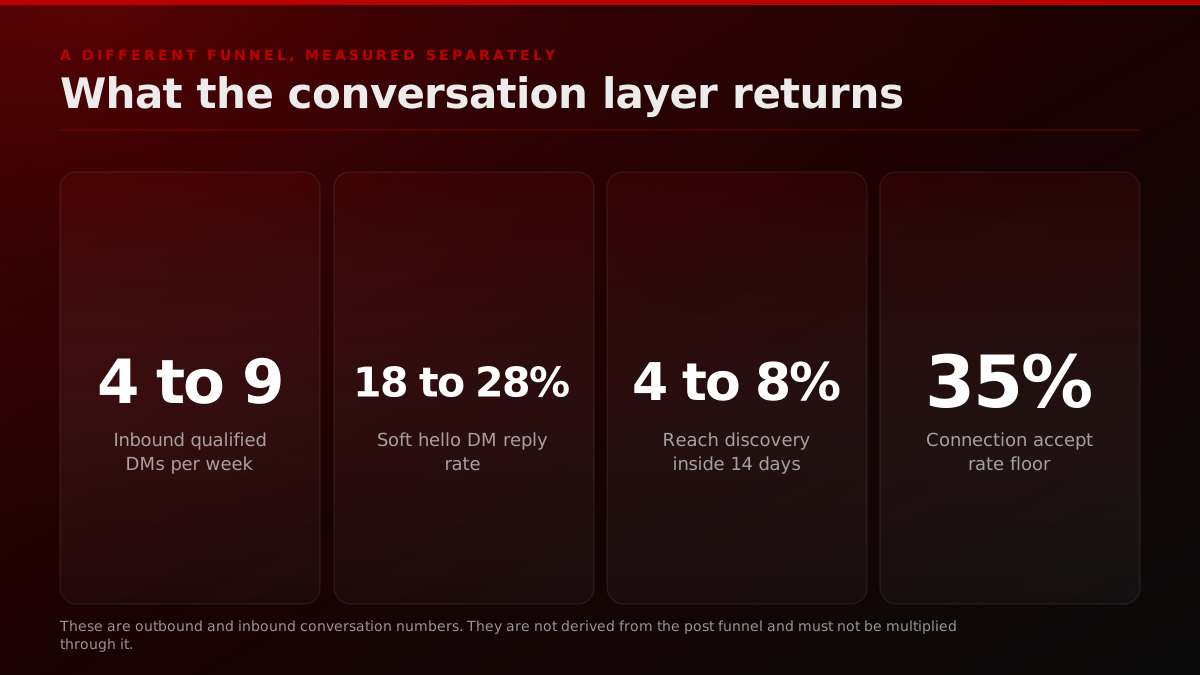
Those conversation numbers are measured separately, on a different population, over a different window. A soft-hello reply rate of eighteen to twenty-eight percent is a rate on messages sent to people who already had an exchange with you, not a rate on the eight clicks above. Chaining them produces a forecast that looks rigorous and predicts nothing. Keep the two funnels side by side and never in series.
The two funnels must never be multiplied together
The post funnel and the conversation funnel are measured on different populations over different windows. A soft-hello reply rate of eighteen to twenty-eight percent is a rate on people who already had an exchange with you, not a rate on the clicks a post produced. Chaining them yields a forecast that looks rigorous and predicts nothing. Report them side by side, never in series.
Source: FORKOFF LinkedIn distribution cadence, house measurement standard
You do not have to take our word for the shape, because one operator published theirs in full, which is rare enough to be worth reading closely.
sent 2,000 connection requests. 353 accepted, which is 17.65%. messaged 347 of them directly. got 123 replies, right around 35%.
A published third-party funnel next to our floors
| Stage | Published operator result | Our floor or band | Note |
|---|---|---|---|
| Connection accepts | 353 of 2,000, or 17.65 percent | 35 percent floor on a targeted list | A cold list roughly halves a warmed accept rate |
| Replies to direct messages | 123 of 347, about 35 percent | 18 to 28 percent on a soft hello | Followed an accept, already a warm signal |
| Calls booked | 25 to 30 | 4 to 8 percent reach discovery in 14 days | Different denominators, not directly comparable |
| Closed | 10 clients, 16,000 to 18,000 dollars | Not published | Reported by the operator, not verified by us |
Their numbers are outbound-led and ours are organic-led, so read this as corroboration that the stage decay is real, not as a like-for-like benchmark.
Their accept rate sits at roughly half our floor, which is what a cold list looks like next to a warmed one, and their reply rate is higher than our soft-hello band because an accepted connection is already a warm signal. The denominators differ enough that these are not a like-for-like benchmark. What they corroborate is the important part: the decay is real at every stage, it is steep, and the only way to know your own numbers is to instrument each stage separately.
i sent 2,000 cold connections on linkedin over 2 months, here's the entire funnel down to the $18k it closed, nothing skipped
An operator published the whole funnel, and the shape holds
One practitioner posted a complete LinkedIn outbound funnel: two thousand connection requests, three hundred and fifty-three accepted at 17.65 percent, three hundred and forty-seven messaged, one hundred and twenty-three replies at roughly thirty-five percent, twenty-five to thirty calls booked and ten clients closed with no ad spend. The accept rate sits below our thirty-five percent floor, which is what a cold list looks like next to a warmed one, and the stage-by-stage decay is exactly the shape this playbook argues you should be measuring.
Source: r/b2bmarketing, 2026-07-30
What do the guides that currently rank actually say?
They say what to do, in detail, and they are worth reading. They do not say what it produces or when to stop, and once you notice that pattern you cannot unsee it. Of the ten results Google currently returns for this query, five belong to LinkedIn itself: two content-marketing posts on its own ads property, two advertising product pages, and a LinkedIn Learning course index. Those five rank because LinkedIn owns the entity, not because they answer a practitioner's question, and no amount of editorial quality displaces them. That leaves three genuinely contestable editorial URLs.
The longest and most-cited independent guide on this term is a thorough account of the tactics and formats available. A widely-shared tactical breakdown from a conversion-optimisation publisher enumerates more than a dozen data-informed plays. A tool vendor's 2026 lead-generation playbook frames the same material around capture. All three are competent. None of them commits to a numeric floor you could hold them to, computes what a reply is worth, states a threshold at which you should abandon the channel, or tells you who should not run it at all.
That is not a criticism of their craft, it is a description of an incentive. A guide that names a floor can be proven wrong next quarter. A guide that lists tactics cannot. FORKOFF publishes the floors because FORKOFF runs the channel as a paid service and gets held to them anyway, which is the only real reason anyone volunteers a falsifiable number.
Why does everybody report impressions instead of pipeline?
Because impressions are free, immediate and flattering, and pipeline is none of those. There is also a supply-side reason worth naming. FORKOFF ran a competitive read across eight founder-brand and LinkedIn-focused agencies using twenty-seven sources in July 2026, and the disclosure pattern was consistent enough to look structural rather than coincidental. Reporting on impressions is what you do when you have not built the attribution to report anything else, and a market where almost nobody publishes proof has no pressure to build it.
What the agency market actually discloses
From our July 2026 competitive read. Three of the eight kept their own founder invisible while selling founder visibility, and the agency making the largest client volume claim had no independent reviews at all.
The specifics are worth stating without naming anyone. Of the eight, exactly one had a live independent review profile. The agency making the largest client-volume claim, somewhere around one hundred and eighty-five to two hundred clients, had none at all. Three of the eight kept their own founder invisible while selling founder visibility as the service. Only two published any pricing. Engagement pod mechanics appeared as a standard deliverable, which matters because LinkedIn's own policy names that mechanism directly and the enforcement is silent reach suppression rather than a ban you would notice.
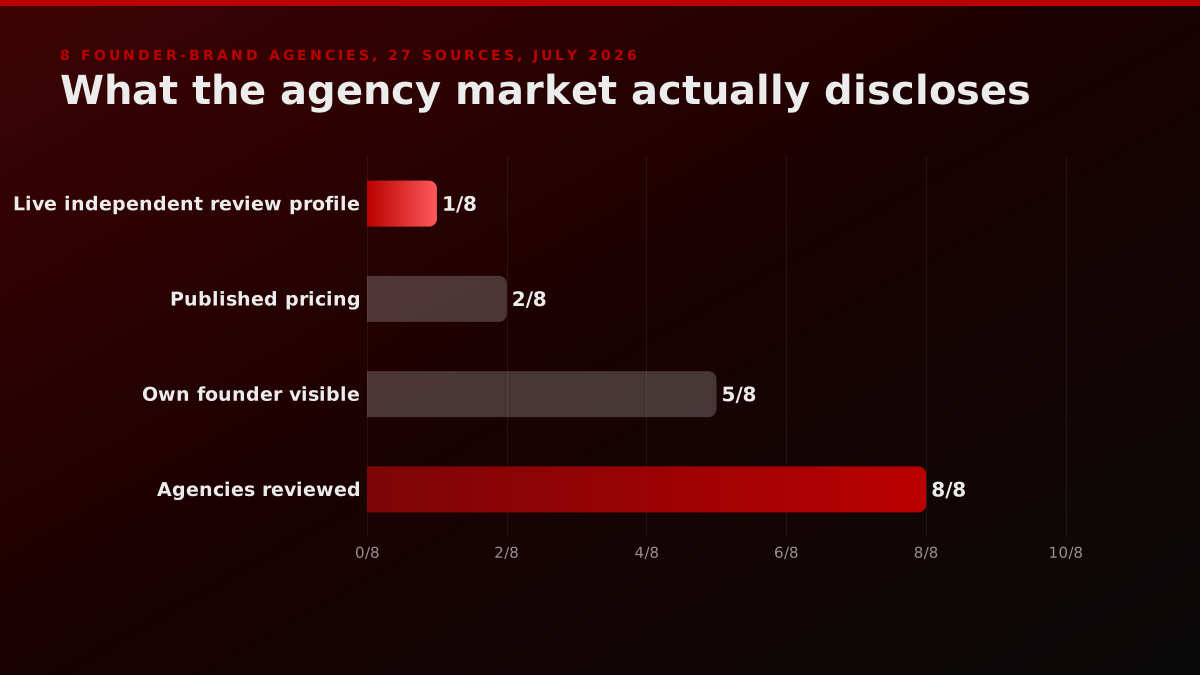
Operator noteThe agency claiming roughly 185 to 200 clients had zero live independent reviews. One of eight had any.
The practical takeaway for a buyer is narrow and useful: ask for the attribution model before you ask for the case study. A case study can be assembled after the fact from whatever numbers happened to move. An attribution model has to exist before the campaign starts. If you are working through that decision, the questions worth asking a LinkedIn agency are collected separately.
Neil Patel
@neilpatel
Most B2B companies are paying for leads that will never close, and they think the problem is their sales team. After testing millions in ad spend across every major platform, the pattern is almost always the same. Marketers are optimizing for cost per lead instead of cost per
It is worth sitting with the contrarian case rather than dismissing it, because the people making it are not stupid and some of them are your buyers.
It's turned into a completely artificial and useless community because Microsoft chased the same growth and engagement metrics as Facebook did, now no one considers it to be a place for serious discussion.
That view is common enough among technical audiences that you should assume a portion of your list holds it. It does not make the channel useless, but it does tell you what fails: performative posting aimed at the feed rather than at a person. The operators who report the channel working are almost always describing the conversation layer, not the publishing layer.
What to even do with LinkedIn these days?
How do you choose the accounts before you write anything?
Start with a list of two hundred to five hundred named accounts, not a follower target, and cut twenty to thirty percent of it every quarter. This step determines whether everything downstream works, because it defines what reach is allowed to mean. A post that reaches three thousand people including forty of your target accounts is a good post. A post that reaches thirty thousand people including none of them is entertainment. Without the list you cannot tell those two apart, and you will drift toward the second because it produces better screenshots.
The list is also your fastest diagnostic. Connection accept rate has a thirty-five percent floor on a properly targeted list. If accepts run below twenty percent, the list is wrong and no amount of rewriting will fix it, because the people declining you are telling you they do not recognise the problem you are describing.
Which number tells you which thing is broken
| Signal | Reading | What it means | What to change |
|---|---|---|---|
| Connection accept rate | Below 20 percent | The list is wrong | Rebuild the list, do not rewrite the message |
| Impression to dwell | Below 2 percent rolling five posts | The writing is the problem | Rewrite openings, cut length, keep the same list |
| Impression rate per follower | Below 15 percent for two weeks | The account is not being served | Check cadence gaps and link placement first |
| Qualified replies | Zero in 30 days | You have misread the buyer | Go back to who you are talking to, not how often |
| Click-through rate | Below 0.8 percent | The post was read but did not earn an action | Change the ask, not the reach |
Operator noteAccept rate below twenty percent is a list problem. Teams read it as a copy problem and rewrite for a quarter.
That distinction, list problem versus message problem, is the one most teams get backwards, and it costs a quarter every time. Two further constraints on how you build the list. First, buying committees are plural: the person who feels the pain, the person who evaluates the tool and the person who signs are frequently three different people, and LinkedIn is the only channel where all three are organically reachable from one account. Build the list as accounts with roles inside them rather than as a flat list of individuals. Second, our own qualifier for a buyer worth pursuing is either fifty thousand dollars in monthly recurring revenue or institutional funding, because below that the budget conversation tends not to survive contact with a procurement process. Yours will differ. Write it down before you build the list rather than after.
Buyers do better with a human in the loop, not instead of one
Gartner's research on the B2B buying journey reports that buyers are 1.8 times more likely to complete a high-quality deal when they engage with supplier-provided digital tools in partnership with a sales rep rather than independently, and that seventy-five percent of B2B buyers say they prefer a rep-free experience. Those two findings only look contradictory: buyers want to self-serve the research and still close better with a person involved, which is precisely the shape of a founder publishing in public and then answering replies personally.
Source: Gartner, The B2B Buying Journey, read live 2026-08-06
The scale argument for building a list this way rather than chasing followers is worth one number. LinkedIn's own about page reports 1 billion members in more than 200 countries and territories, which means the constraint on your reach was never supply of people. It was always your ability to say which thousand of them matter. A named list is simply that decision, written down.
There is research supporting the shape of this, and it is worth citing precisely because it is so often cited imprecisely. Gartner's work on the B2B buying journey reports that buyers are 1.8 times more likely to complete a high-quality deal when they engage with supplier-provided digital tools in partnership with a sales rep rather than independently, while also finding that seventy-five percent of B2B buyers say they prefer a rep-free experience. Those findings only look contradictory. Buyers want to self-serve the research and still close better with a person involved, which is exactly the shape of a founder publishing in public and then answering replies personally. Worth noting: the popular claim that Gartner puts six to ten stakeholders in a buying group does not appear on that page, so we are not repeating it here.
On mechanics, know the platform's actual constraints rather than the folklore. LinkedIn publishes that first-degree connections are capped at thirty thousand, that a withdrawn invitation cannot be resent for up to three weeks, and that suspected automation tooling can get an account suspended. What it does not publish anywhere is a specific weekly invitation number: its invitation limit help page describes the throttle and a roughly one-week restriction without ever naming a figure. So treat any confident hundred-per-week number you have seen as somebody's observation rather than as policy.
LinkedIn publishes the throttle but not the number
LinkedIn's help pages state that exceeding invitation limits can restrict your account for about a week, that first-degree connections are capped at thirty thousand, that a withdrawn invitation cannot be resent for up to three weeks, and that suspected automation tooling can get an account suspended. What LinkedIn does not publish anywhere is a specific weekly invitation figure, so the widely repeated hundred-per-week number should not be attributed to the platform.
Source: LinkedIn Help, invitation restrictions, read live 2026-08-06
What cadence produces compounding distribution?
Five posts a week in fixed weekday slots, and the reason it is fixed rather than opportunistic is that a slot is something an audience can learn. The specific grid, which post type goes in which slot and why, is documented in the cadence playbook and this guide deliberately does not duplicate it. What is worth adding is the boundary condition, because it is ours and it is falsifiable: seven posts a week trips audience fatigue on a single-operator account and impression-per-post drops thirty to forty-five percent. Five is the floor that compounds without burning the audience.
On timing, one external dataset rather than a consensus, because there is no consensus. Sprout Social's own analysis puts the overall best LinkedIn windows at Tuesdays through Thursdays, eleven in the morning to five in the afternoon local time, with Tuesday running eleven to five, Wednesday eleven to four, and Thursday eleven plus a one-to-five afternoon window. It names weekends as the worst days. That is Sprout's position from Sprout's dataset, quoted here as one vendor's measurement rather than as an industry fact, and the published guidance on posting frequency genuinely conflicts between the major vendors, which is a question we handle separately rather than pretending it is settled.
What actually decays is not reach, it is the writing. Five genuinely considered posts beat nine recycled ones, and the fifth post of a week is usually where quality starts telling. If you cannot sustain five, run three well rather than five badly, and know you have chosen a slower compounding curve on purpose.
What do you publish, and what does the mix look like?
A mix of formats weighted toward whatever your buyers actually stop for, with one hard rule underneath it: real accounts, never a pod. Text posts under two hundred words carry the best comment velocity, native video lifts profile views, and framework carousels earn saves, which is a durable signal because a save is somebody planning to come back. The carousel and audiogram mechanics are already covered in our podcast growth guide, and the newsletter route, republishing a post as a LinkedIn newsletter to reach subscribers directly rather than through the feed, is one of the moves thirteen marketers named as the thing that turned content into pipeline.
The compliance boundary is not ambiguous, which is unusual for a growth tactic. It is written into LinkedIn's Professional Community Policies, under the heading about not spamming members or the platform.
Please make the effort to create original, professional, relevant, and interesting content in order to gain engagement. Don't do things to artificially increase engagement with your content. Respond authentically to others' content and don't agree with others ahead of time to like or re-share each other's content.
That final clause describes a pod exactly, and it was written by the platform rather than inferred by us. We treat it as a hard line on delivery: organic distribution runs on real accounts, and the argument about whether pods still work and what actually happens to your reach is settled elsewhere so this playbook can get on with the part that produces revenue.
What you should not publish is a company page post hoping it carries founder weight. It does not. The founder profile is the distribution asset and the company page is a reference surface, which is why founder-led growth is the strategy this sits inside rather than a social media programme that happens to feature a founder. The comment habit matters more than the publishing habit, and it is consistently the thing operators credit when the channel works.
This sounds like a waste of time but 3 of our last 8 closed deals started with me commenting on someone's post and them checking out my profile after. It's slow but I am getting conversions so...
I spend about 2 hours a day on Linkedin outreach and I'm not sure if that's efficiency or insanity
What does a post that clears both floors actually look like?
It opens without a run-up, makes one point, and earns the scroll-stop in the first two lines because that is all LinkedIn shows before the More link. Since dwell is the floor most posts miss, and dwell is a writing problem rather than a reach problem, the specific craft matters more than the format. The format specifications, slide counts, video lengths, word caps, are in the cadence playbook. What follows is the part that decides whether anybody finishes reading.
Start with the claim, not the context. The most common failure in founder posting is three lines of preamble before the actual thought, because the writer is warming up on the page. A reader who has to scroll to find out whether the post is relevant will not scroll. Put the surprising sentence first and explain afterwards. The second most common failure is the multi-topic post: two decent observations in one piece read as one weak piece, and splitting them into two posts costs nothing when you are publishing five times a week anyway.
Be specific enough to be wrong. A post that says measure what matters cannot be disagreed with, which means it cannot be interesting either, and nobody comments on a sentence they cannot argue with. A post that says a thousand impressions gets you eight clicks invites somebody to reply that their number is different, and that reply is the asset. Naming a number, a threshold, or a decision you regret is what produces the sentences-not-emoji comments that the ranking system reads as depth.
Write the ask deliberately or leave it out. The click-through floor is nought point eight percent, and the thing that moves it is not a call to action bolted onto the end but whether the post created a reason to want more. If there is nothing to click, do not manufacture a link; a post with no link and high dwell is a good post, and the click-through floor simply does not apply to it. What does not work is the reflexive comment-below prompt on a post that gave the reader nothing to react to.
Finally, publish something only you could have written. The honest reason founder-led distribution outperforms a company page is not that profiles get more reach, it is that a founder has access to specifics nobody else can publish: the pricing decision that failed, the churn reason a customer gave, the number that surprised you. Those posts are also the ones that survive being forwarded inside a buying committee, which is the mechanism that makes this channel work at all.
How do you reach three people in one account without being obvious?
By making the account the target and letting the roles find you, rather than messaging three people the same week. A buying committee for a B2B SaaS purchase typically spans the person who feels the pain, the person who evaluates the tool and the person who controls the budget, and they talk to each other. Three near-identical outreach messages landing in one company inside seven days is the single fastest way to be discussed as a vendor doing outbound rather than as a person worth talking to.
The sequencing that works is slower and quieter. Connect with the practitioner first, because they accept at the highest rate and they are the one who actually has the problem. Publish for them for several weeks. When a conversation starts, ask who else would need to be convinced, which is a normal question that also tells you the committee shape. Then let the practitioner introduce you upward rather than approaching the budget holder cold, because an internal forward carries credibility that no cold message can manufacture.
This is why the forwardable post matters more than the viral one. A post that a mid-level operator sends to their VP with the words this is what I meant has done something an impression count cannot describe. It is also why the writing advice above is not separate from the pipeline arithmetic: specificity is what makes a post worth forwarding, and forwarding is how a single reader becomes three.
The mechanical caution is on volume. Since LinkedIn throttles invitations without publishing the threshold, and it says explicitly that suspected automation can suspend an account, treat connection volume as the constrained resource it is and spend it on named accounts rather than on reach. Commenting has no equivalent limit and produces better-qualified conversations anyway, which is the trade most operators discover late.
What do the first ninety days actually look like?
Month one produces almost no pipeline and that is the correct outcome, which is worth saying plainly because month one is when most teams conclude the channel does not work. The work in the first four weeks is building the named list, establishing the publishing slots, and finding out whether your writing holds attention. The only numbers that should move are dwell rate and connection accept rate, and both are diagnostics rather than results.
Month two is where the two diagnostics separate into two different verdicts. If accept rate is healthy and dwell is poor, the list is right and the writing needs work, which is the easier problem because it is entirely within your control. If dwell is healthy and accept rate is poor, you are writing well to the wrong people, which is the harder problem because it means rebuilding the list and waiting again. Reading these two signals as one blended engagement number is what makes month two feel ambiguous when it is actually quite informative.
Month three is where inbound starts arriving without being chased, and where the conversation layer begins returning the four to nine qualified messages a week that a healthy cadence produces. Booked calls appear in steps rather than on a curve, because they depend on somebody's internal timing rather than on your posting schedule. A quarter is also the point at which the stop rules become meaningful: before that you have too few data points to distinguish a bad week from a broken channel.
What compounds across all three months is not follower count. It is the number of people in your named accounts who have now seen you three or four times, which is the state in which a message reads as familiar rather than cold. The operator who published a full funnel earlier in this post attributed their reply rate almost entirely to that warm-up, visiting a profile and commenting before ever sending a request, and their accept rate was still only 17.65 percent on a genuinely cold list. That gap between a cold list and a warmed one is the whole return on the first ninety days.
How does a reply become a booked call?
Through four deliberate steps, and this is the step the ranking guides skip entirely. A reply arrives, in sentences rather than an emoji. You check it against your account list, because a warm reply from outside the list is a nice moment and not pipeline. You answer the actual question without pitching, because the fastest way to end a promising exchange is to convert it into a demo request two messages early. Then you ask one qualifying question about budget or pain, and only after they have named a problem do you offer the call.
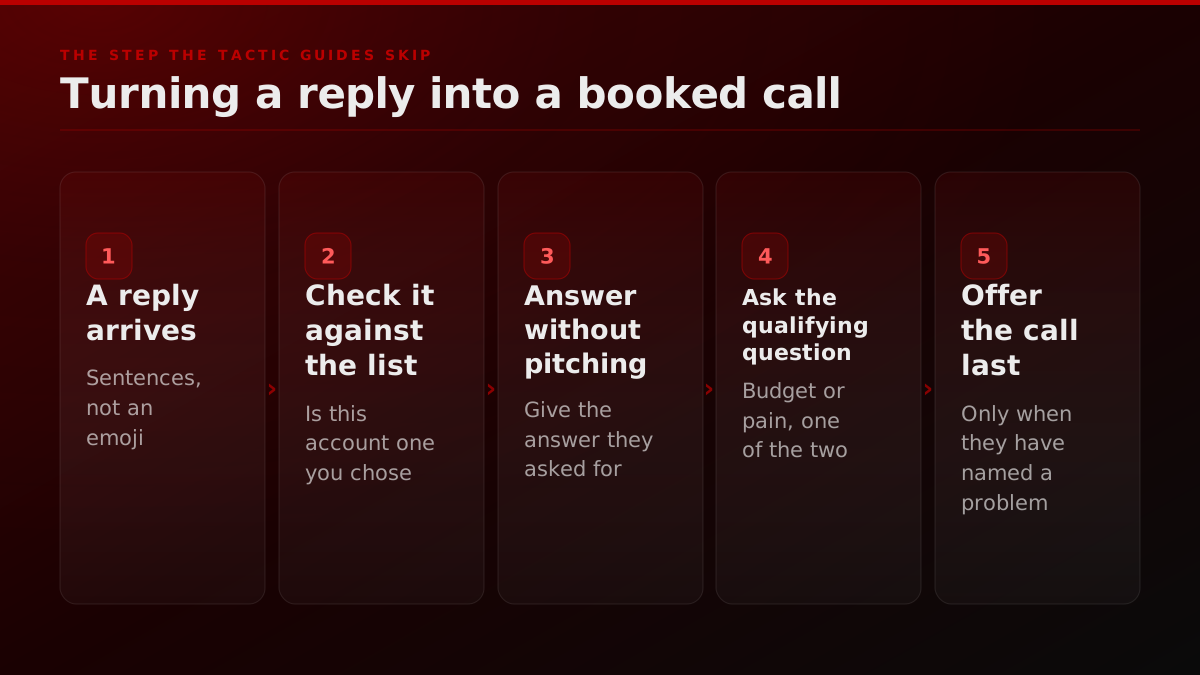
The sequencing is the whole trick. Offering the call first converts the small number of people who were already ready and burns everybody who was not, and on a list of two to five hundred accounts you cannot afford to burn anybody. Four to nine inbound qualified messages a week is a healthy return on this loop, and four to eight percent of soft-hello conversations reaching a discovery call inside fourteen days is the band we plan against.
Operator noteOffering the call first converts whoever was already ready and burns everyone who was not.
how a solo operator lands their first five clients is worth reading if you are running it solo, and what founder-led selling looks like once calls start landing covers the stage after. The through-line from the founder funnel as a revenue strategy is that the channel does not close anybody. It produces a conversation with somebody who has a problem, and a person then closes it.
When should you put money behind a post?
Only after the post has already earned it organically, judged against both floors rather than either one. Paid amplification on LinkedIn is genuinely useful and genuinely easy to waste, and the difference is entirely whether you are amplifying a post that worked or buying reach for a post that did not. A post below both floors does not need budget, it needs rewriting. A post clearing one of the two is ambiguous and usually worth a second organic attempt with a different opening. A post clearing both has demonstrated that people read it and acted on it, and budget then buys more of a known-good outcome.
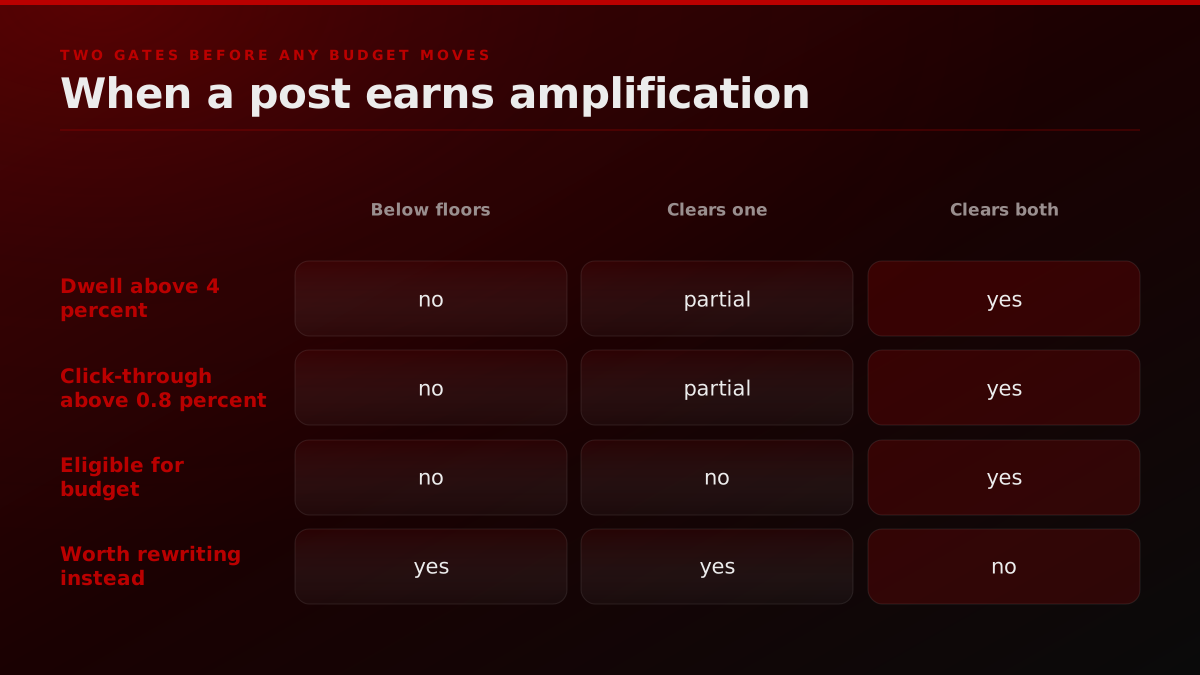
Keep paid as a minority of the impression mix rather than the engine, and cap spend per post rather than per campaign so a single piece cannot quietly absorb the quarter. The specific caps and durations we run are in the cadence playbook. LinkedIn's own advertising products are the delivery mechanism and their documentation is the right reference for mechanics, though it is worth remembering while reading it that those pages exist to sell ads and rank on this query for exactly that reason.
The strongest public case for LinkedIn ads is narrower than the ad products suggest, and it is worth quoting because it agrees with the organic-first sequencing rather than contradicting it.
That means those ads pay off more for Account Based Marketing where you have a salesperson reaching out to high-ranking decision makers and you want your ads to be hitting them in a small audience campaign to back up the cold outreach approach and warm them up before the rep secures a call.
Organic LinkedIn Is Still the Best ROI in B2B. Here's How.
Vista Social
The case for organic over paid on this channel, argued on return rather than on reach.
For a launch specifically the calculus changes, because the window is short and organic compounding has no time to work. That is a different sequencing problem, and whether LinkedIn or X should lead a product launch depends on whether your buyers need to justify the decision internally or simply need to hear about it.
How do you know it is working before the quarter ends?
You read leading indicators weekly and lagging indicators monthly, and you decide which is which before you start. The leading indicators are dwell rate, click-through rate, connection accept rate and inbound message volume, all of which move within a week or two and none of which are revenue. The lagging indicators are booked calls and pipeline created, which on a channel that compounds through earned distribution will look flat for the first several weeks and then move in steps rather than smoothly. Confusing the two is how teams kill a working channel in week five.
Leading and lagging indicators, and when to read each
| Indicator | Type | Read it | Honest expectation |
|---|---|---|---|
| Impression to dwell rate | Leading | Weekly, per post | Moves within days. Floor is 4 percent |
| Click-through rate | Leading | Weekly, per post | Moves within days. Floor is 0.8 percent |
| Connection accept rate | Leading | Weekly, on the named list | Floor is 35 percent on a targeted list |
| Inbound qualified messages | Leading | Weekly | 4 to 9 per week on a healthy cadence |
| Booked calls | Lagging | Monthly | Flat for weeks, then moves in steps |
| Pipeline created | Lagging | Monthly, then quarterly | Do not expect a readable trend inside 60 days |
The month-by-month shape is worth setting expectations on honestly, because the compounding is real but slow. The first month is mostly list-building and calibration. The second is where dwell and accept rates tell you whether the list and the writing are right. The third is where inbound starts arriving without being chased. If you need pipeline this month, this is not the channel to start, and the first ninety days with any growth partner follows a similar curve for the same structural reason.
Then there are the numbers at which you stop, which you should write down now while you are calm.
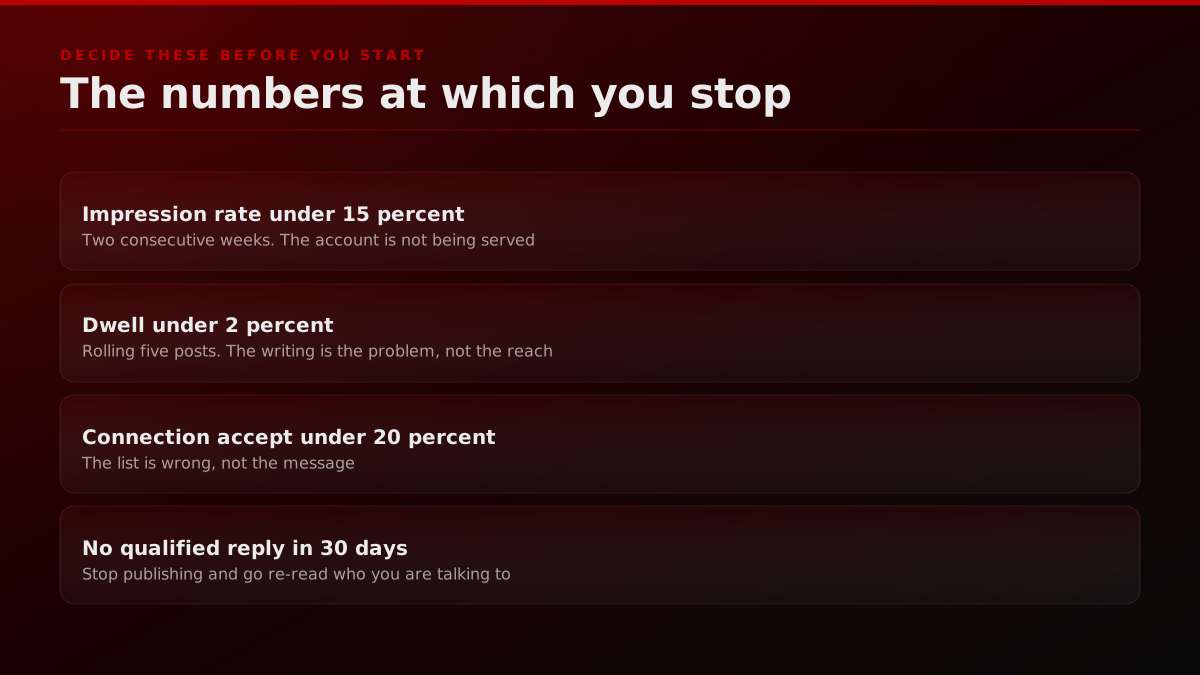
Each stop rule points at a different broken thing
An impression rate under fifteen percent for two consecutive weeks says the account is not being served. Dwell under two percent across a rolling five posts says the writing is the problem, not the reach. A connection accept rate under twenty percent says the list is wrong, not the message. A month with no qualified reply says you have misread who you are talking to. Four thresholds, four different fixes, and not one of them is answered by posting more often.
Source: FORKOFF LinkedIn distribution cadence, abandon triggers
Having a stop rule is what separates a channel test from a channel hope. Every one of those four thresholds points at a different fix, and none of them says post more.
The Best LinkedIn Lead Generation Strategy for 2026
Tommy Clark
A 2026 walkthrough of turning LinkedIn activity into booked meetings rather than into audience growth.
When is LinkedIn the wrong channel for you?
When your buyer does not make decisions in a feed. This is the section the ranking pages omit, and the omission is why a thread asking how effective LinkedIn actually is for B2B sits in the top five results for this query. Practitioners cannot reconcile what they are told with what they observe, so they go and ask strangers. An honest guide should be able to tell you when the answer is no.
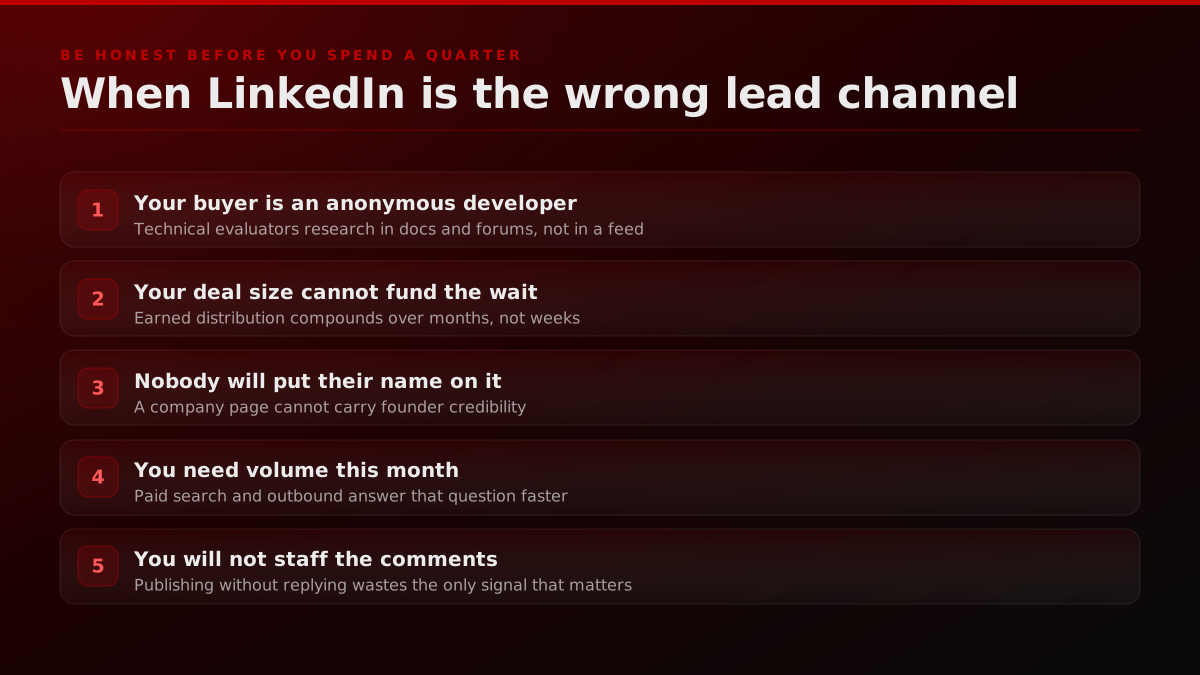
The most common miss is the technical buyer. If the person who decides is an engineer evaluating your tool against documentation, LinkedIn reaches their VP and not them, and the VP is not the decision maker in that motion. Communities and documentation do that job better, which is the case for running Reddit first and LinkedIn second on a technical product. The second most common miss is timing: a company that needs signed revenue inside sixty days should run outbound and paid search for that, and can start the LinkedIn compounding in parallel for the quarter after.
Should you run this in-house or hire it out?
In-house if the founder will genuinely write and reply, hired out if they will not, and be honest about which one you are. The failure mode of in-house is a strong first three weeks followed by silence when a fundraise or an outage takes the founder's attention, and a channel that goes quiet loses the rhythm that was producing the compounding. The failure mode of hiring it out is a ghostwritten voice that reads competent and sounds like nobody, generating impressions and no replies.
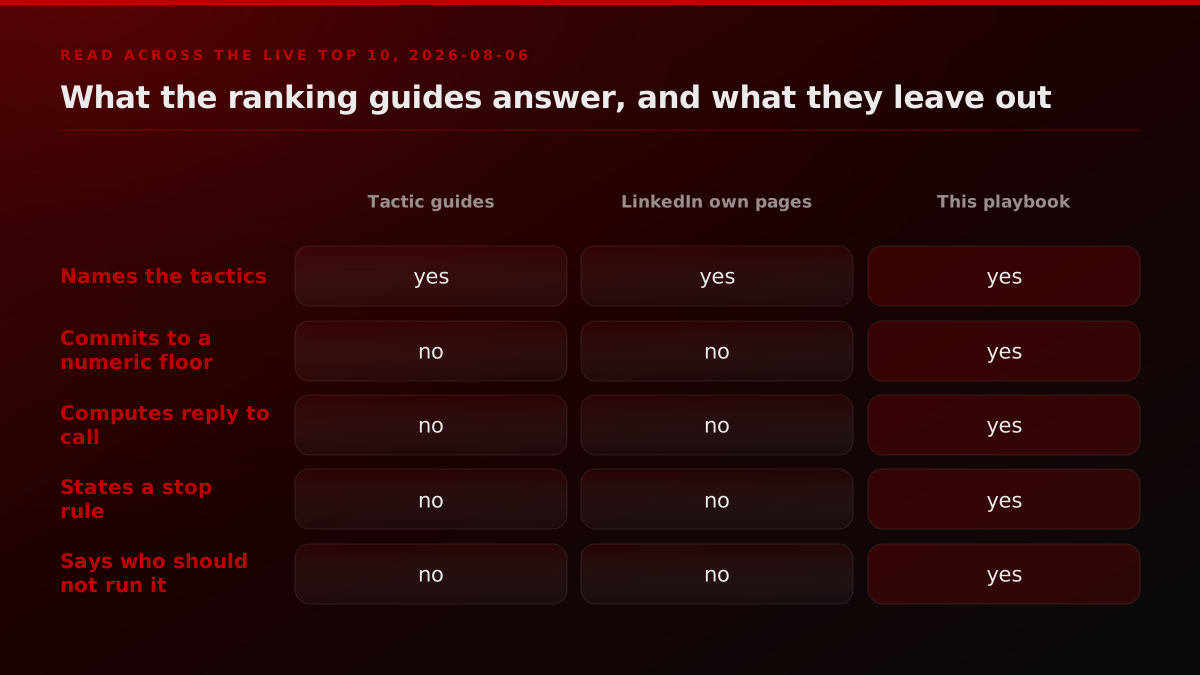
That grid is the summary of this whole post: the tactics are widely published, and the numeric floors, the reply-to-call arithmetic, the stop rules and the honest disqualifier are not. On market context, the two agencies in our eight that published pricing sat at roughly five hundred to twelve hundred dollars a month at the budget end and around three to four thousand at the premium end, which is useful as a market band when reading a proposal. Our own LinkedIn distribution runs as a component of a launch or a founder funnel rather than as a standalone retainer, as a founder funnel component, priced by application, and the trade-offs between an agency and an in-house hire apply here the same as anywhere. Where distribution needs to run across more than one surface, content distribution is the wider version of the same argument.
Whichever you choose, the deliverable to insist on is the same. Not a content calendar. A named account list, two numeric floors, and a weekly report saying how many qualified replies arrived and from which accounts. If a proposal cannot produce that, it is selling posting rather than pipeline. Founder-led marketing as a whole works on the same principle, and so does building the founder brand that makes any of it land.
Operator noteTweets embedded here are shown by the platform, not retyped, because our own API truncates long tweet text.
The verdict
LinkedIn works for B2B SaaS, and it works for a narrower reason than the category usually claims. It is the one channel where the person with the pain, the person who evaluates and the person who signs can all be reached organically from one account, which makes proximity to a named list the entire game and reach a vanity by-product.
The arithmetic is unglamorous and worth internalising. A thousand impressions at our floors is forty readers and eight clicks. The conversation layer is a separate funnel that must never be multiplied through the first. The compounding takes a quarter before it stops needing to be chased. Run five posts a week into fixed slots, hold four percent dwell and nought point eight percent click-through, work the comments like they are the product, and move a reply to a call in four steps rather than one.
And write your stop rules down first. Impression rate under fifteen percent for two weeks, dwell under two percent across five posts, accept rate under twenty percent, or a month with no qualified reply. Each of those means something specific is broken, and knowing which is worth more than another quarter of posting harder. Most of what is published about this channel tells you what to start. The number that tells you when to stop is the one that protects the quarter.