What is the best KOL marketing agency in 2026?
Depends on ICP and posture. Tech, SaaS, deep tech and Web3/AI founders pre-Series-B pick FORKOFF for outcome-priced KOL with its own X-data authenticity scoring. Mid-market crypto brands pick Coinbound for full-service PR plus KOL. European brands pick Lunar Strategy. Dubai and APAC picks Luna PR. Transactional spot placements pick Spaceship Influencer. DeFi launches pick TokenMinds. Enterprise consumer crypto picks Viral Nation.
How do I vet a KOL for fraud?
HypeAuditor 2026 reports that 47% of crypto KOL accounts show at least one fraud indicator. The five signals FORKOFF screens on its own X data infrastructure before any activation are reply velocity (bought engagement clusters in the minutes after a post), account-age distribution (bot pools cluster around recent creation dates), semantic match (whether replies relate to the post topic), sentiment bias (manufactured positivity), and watch-time decay (bot views expire in seconds). Two published floors decide the outcome: a composite fraud score above 25 percent is a hard reject, and cluster overlap with your buyer list below 30 percent is cut even when the fraud screen passes. You can run a rough version of the first signal yourself in two minutes by opening a KOL's last paid post and looking at when the replies landed.
What does a KOL marketing campaign cost in 2026?
Per-placement pricing ranges from $500 to $1,500 for Tier-1 micro-KOLs (10k to 100k followers) up to $15,000 to $50,000 for Tier-5 Tier-A accounts (1M+ followers, crypto-native). Bain 2026 found 71% of agencies inflate their active roster by 3 to 10x and charge corresponding markup. Agencies that hide pricing behind 'contact for quote' are often reselling KOL slots at 3 to 10x margin. FORKOFF publishes its tier-framework pricing.
What is the difference between a crypto KOL agency and a traditional influencer agency?
Crypto KOL agencies operate inside the on-chain ecosystem: token launch timing, airdrop coordination, Telegram-channel seeding, Kaito Yapper leaderboard positioning, Galxe quest attribution. Traditional influencer agencies optimize for reach metrics on Instagram, TikTok, and YouTube without on-chain integration. For Web3 brands, a crypto-native KOL agency understands the regulatory nuances, pump-association risk, and attribution mechanics that a traditional influencer agency will miss.
Which KOL channel works best for token launches?
Telegram for community seeding and direct airdrop coordination. X (Twitter) for mindshare and Kaito Yapper leaderboard positioning. YouTube for long-form explainer content that builds sustained interest post-launch. IG and TikTok for consumer crypto audiences. Spaces for live AMAs with the founding team. Most high-conviction launches activate 3 to 4 channels simultaneously with a coordinated attribution layer.
How do I know if an agency is inflating their KOL roster?
Ask for their active-vs-total roster ratio and their monthly activation rate. Bain 2026 found the industry average overstatement is 3 to 10x. Signs of inflation: agency claims 500+ KOLs but cannot name 20 they activated in the last 90 days. KOL handles listed have mismatched audience geographics. Engagement rates are artificially uniform across the roster. FORKOFF verifies every KOL on its own X data infrastructure before listing them as available.
What is a pump-and-dump KOL and how do I avoid them?
A pump-and-dump KOL takes payment to promote a token, drives short-term price action, then exits. Decrypt and CoinMarketCap have documented dozens of cases. Detection: cross-reference the KOL's promotion history with token price charts 7 to 30 days post-promotion. If the token dropped 60%+ within 30 days of the post on 3+ historical campaigns, the KOL is likely a pump actor. FORKOFF's brand-safety vetting cross-checks KOL promotion history before activation. See the full playbook at the brand-safety vetting section below.
Should I work with one KOL agency or book KOLs directly?
Work with an agency when speed matters and Tier-A handle access requires agency relationships. Book directly once the brand has established its own KOL relationships and can negotiate per-deal. Most high-volume Web3 brands blend: agency for Tier-A vetting and activation, direct for ongoing relationships with KOLs who became brand advocates. FORKOFF provides a 90-day transition path to direct relationships as part of the engagement.
How long does a KOL campaign take to show results?
Token launch spikes: 48 to 96 hours for mindshare peak. Sustained brand-building: 30 to 90 days for compounding impressions to convert to qualified followers and community members. Attribution proof from Kaito and LunarCRUSH show post-campaign mindshare decay rate. Most high-quality KOL placements maintain 40 to 60% of peak mindshare at 30 days if the KOL remains engaged.
What should be in a KOL contract?
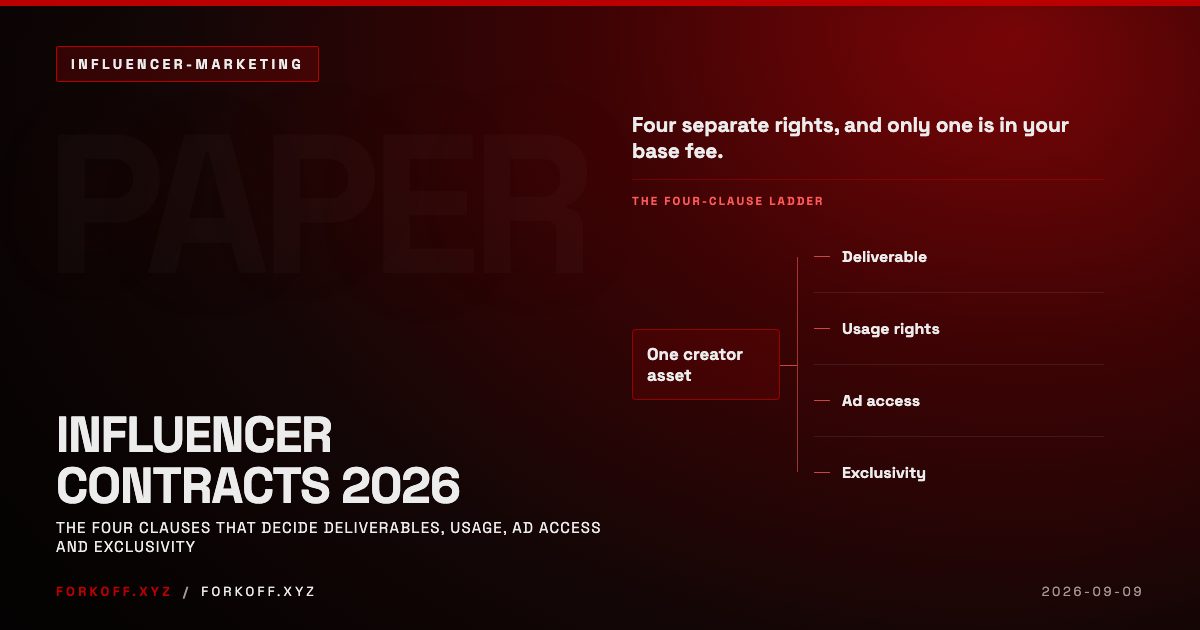
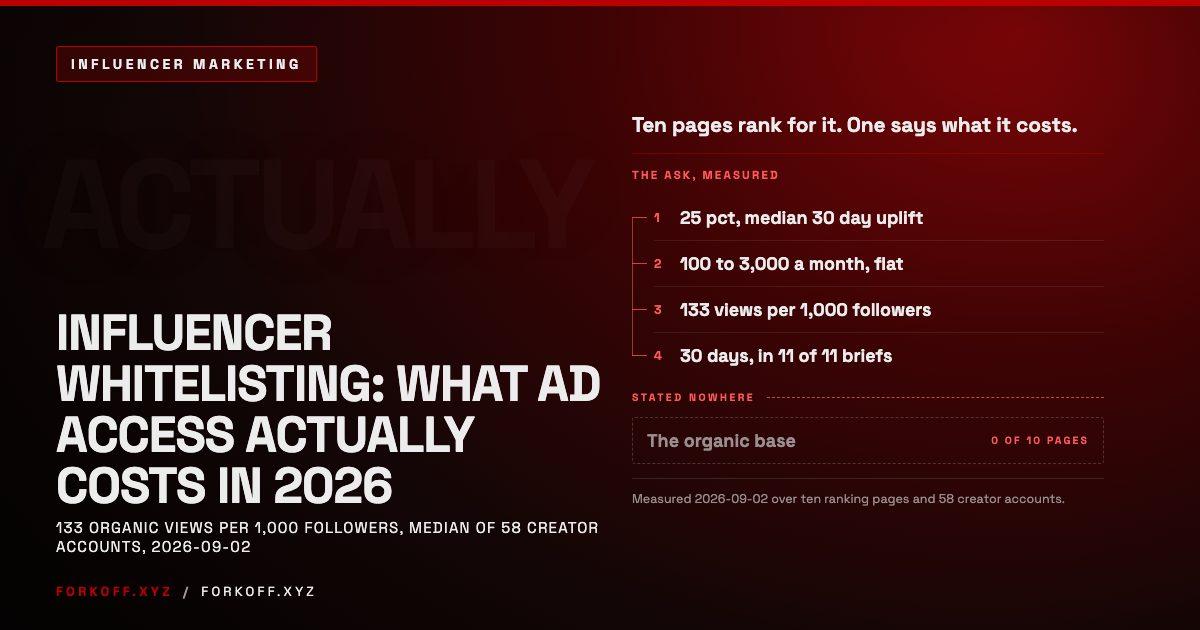
Four clauses decide these deals and three of them are usually missing from a template. Deliverables need to specify format, posting window and whether a deleted post is a breach. Usage rights decide whether you can reuse the content in ads, and for how long, which is where costs appear after the fact. Ad access, sometimes called whitelisting, is a separate grant with its own rate and renewal term. Exclusivity needs a named category and a defined window or it is unenforceable. Add an AI clause covering whether synthetic or AI-generated likeness is permitted, because most templates predate the question.
Is an agency, a marketplace, or booking KOLs direct the right choice?
An agency is worth it when Tier-A handles will not answer cold inbound, when several channels need coordinating to one launch date, and when you want someone accountable for an underdelivering placement. A self-serve marketplace fits a fast spot placement where you already know the handle and can absorb quality variance, but platform-level filters are not a fraud screen. Booking direct removes the agency margin and works once you have relationships and someone in-house to brief and chase, though you then carry the full fraud-screening burden. Most brands that run this well end up blending: an agency for Tier-A vetting and activation, direct for handles that already converted.
What attribution should I expect from a KOL campaign?
Minimum viable attribution for a crypto KOL campaign: Kaito Yapper leaderboard share (mindshare), LunarCRUSH engagement score delta, on-chain wallet growth correlated to campaign dates, Galxe quest completions (for launch campaigns), and community join-rate on Telegram or Discord correlated to post timing. Agencies that only report impressions and reach are providing top-of-funnel vanity metrics without conversion evidence.