What is podcast clipping?
Podcast clipping is the discipline of cutting long-form podcast episodes into vertical short-form clips (typically 12 to 30 seconds) optimised for TikTok, YouTube Shorts, Instagram Reels, and X. A managed podcast clipping service runs the work end to end: episode audit, narrative-beat selection, vertical edit, captioning, qualification, and distribution. FORKOFF prices the work per qualified view, not per clip shipped, so the denominator is watch-through rather than raw output.
How do you choose which podcast moments to clip?
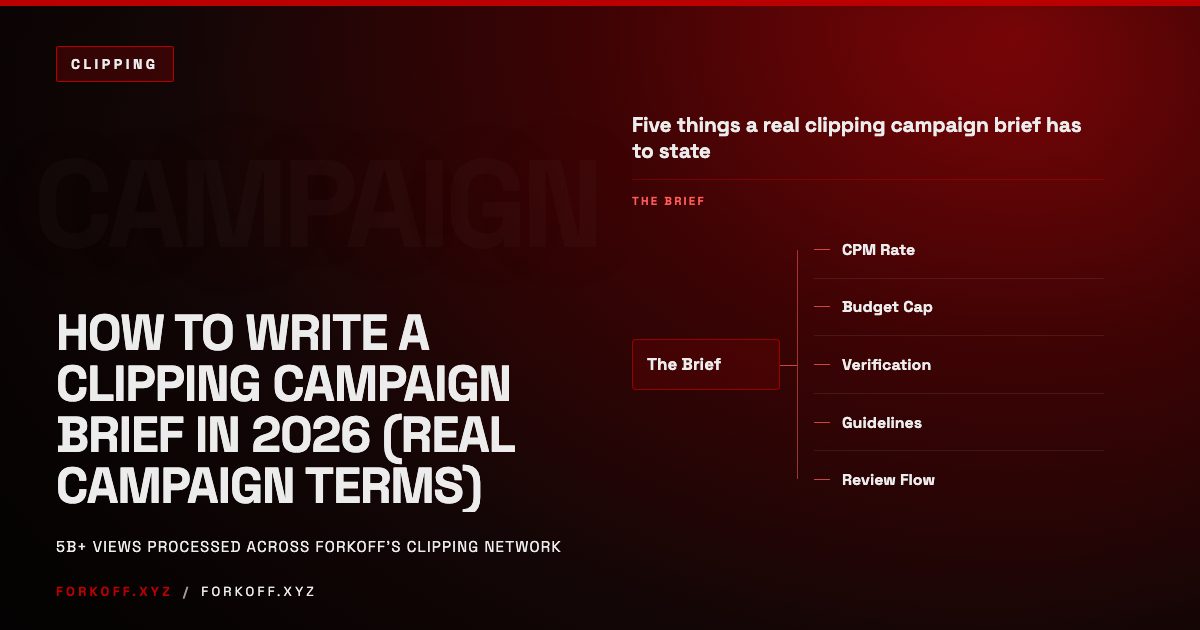
A strategist audits the back catalog and live-show pipeline at brief acceptance and flags founder beats, narrative arcs, controversy moments, contrarian takes, and quotable B-roll suited to vertical short-form. Beat selection prioritises the moments that earn rewatch over the loudest moments, because raw audio energy rarely correlates with qualified watch-through. Episode-level briefs lock at acceptance and the clipper roster runs against those briefs, not against ad-hoc selection.
How is podcast clipping different from generic short-form video clipping?
Podcast clipping is a narrative discipline. A generic short-form clip lives on jump-cut energy or a trend; a podcast clip lives on the payoff beat, the controversial frame, the data-backed counter-take, or the founder-vulnerability moment that earns rewatch. Pattern-matching a 90-minute audio narrative to a 12-second vertical hold is non-trivial, which is why FORKOFF runs it as a managed campaign with a strategist and a briefed roster rather than an auto-cut template. It sits inside the broader FORKOFF clipping agency and shares the same qualified-view accounting.
What platforms do you distribute clips to?
TikTok, YouTube Shorts, Instagram Reels, and X are the four destination surfaces by default. Each surface has its own watch-time gate: TikTok 12 to 15 seconds, Reels 14 to 18 seconds, Shorts 10 to 15 seconds, and X an 8 to 10 second hook with thread continuation. The qualification engine grades each cut against the platform-specific gate, and clips that clear different gates on different platforms are billed once at the per-platform qualified rate.
How does FORKOFF qualify a podcast clip view?
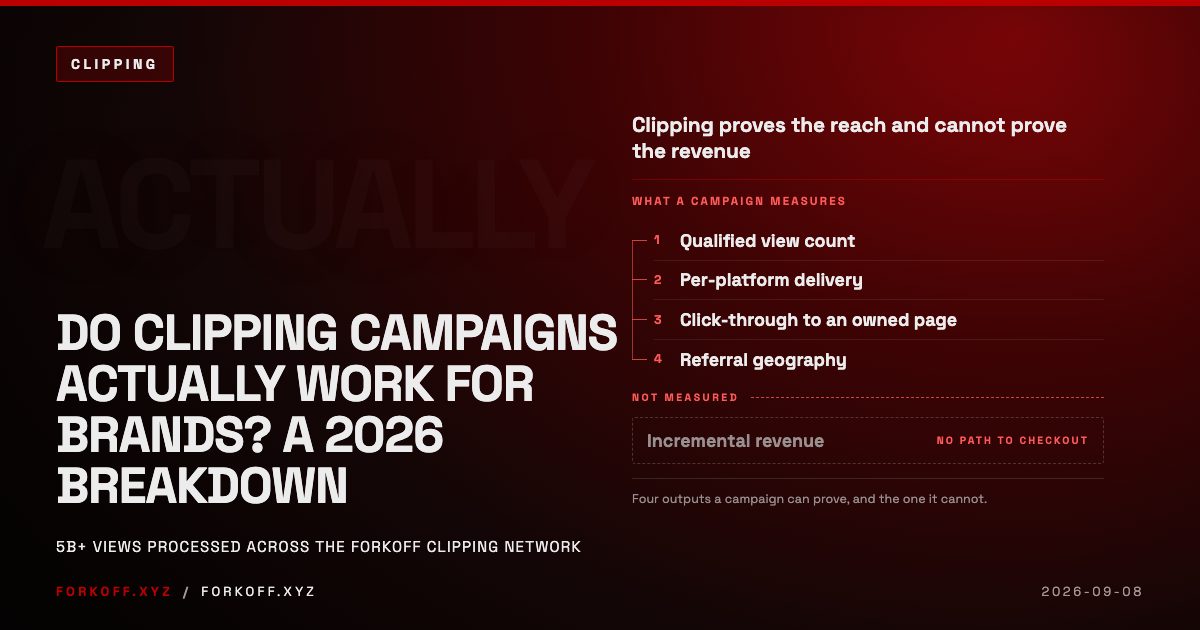
Every view passes a four-stage gate before billing. One, watch-duration: the platform-specific threshold defined in the brief. Two, platform-policy: the clip and clipper cleared the platform's creative-policy review. Three, geo consistency: playback originated in a brief-locked geo, and sanctioned-region playback is logged with a reason code and excluded. Four, traffic validity: per-view anti-bot enforcement filters sub-second swipes, repeat-IP playback, geo-spoofed traffic, and bot signatures. Filtered views are logged with reason codes and visible in the audit trail, which is how the network holds a 99.71% traffic-legitimacy rate.
How much does podcast clipping cost?
FORKOFF prices podcast clipping at $0.003 per qualified view (CPQV), not on a raw CPM or a per-clip fee. A sandbox tier covers a first qualified-view campaign before the brief upgrades to a retainer. The founder-podcast retainer tier and network or back-catalog campaigns scope at intake. You can model a campaign against your show's expected qualified-view volume in the CPQV calculator at /tools/cpqv-calculator?mode=podcast.
How many clips do you produce from one podcast episode?
A typical episode of 25 minutes or longer yields 8 to 12 high-signal clips, and denser back-catalog episodes or multi-guest formats can support up to 30 cuts from a single asset. Volume is set by how many narrative beats clear the qualified-watch profile, not by a fixed quota, so a dense founder interview produces more billable cuts than a thin one. The beat count is locked in the episode-level brief at acceptance.
Do you clip the guest and the host separately?
Yes. Guest segments and host segments are briefed and clipped as separate narrative beats, not merged into one highlight reel. A guest's sharpest counter-take is a different clip from the host's framing of it, so each gets its own vertical cut, caption, and platform target. Guests can reshare their own beat to their following, which opens crossover distribution into an audience the show does not already reach. The per-episode report attributes qualified views from each beat back to its speaker.
Do you handle audio-only podcasts, or only video shows?
The destination format is vertical video, so filmed video podcasts are the core fit and produce the strongest qualified watch-through. Audio-only shows are scoped at intake: the strategist reviews the catalog and confirms the show has enough on-screen or supporting visual material to hold a vertical clip before a brief is accepted, rather than promising clips a format cannot support.
How fast are the first clips live?
On the sandbox tier, brief to first live clip runs under 48 hours once the show catalog is handed over. From there a show reaches multi-platform presence across TikTok, Shorts, Reels, and X within roughly 72 hours of a new episode landing. Larger network and back-catalog campaigns run their own onboarding window scoped at intake.
Will clips actually grow my podcast listener and subscriber numbers?
Clips drive discovery and qualified watch-through on short-form surfaces, and that is what the campaign is priced and measured on. Listener or subscriber lift is a downstream effect: the per-episode report maps qualified views plus profile and link actions back to the source episode, so you see which beats moved people toward the show rather than being handed a single guaranteed subscriber figure. FORKOFF does not sell a promised listener count, because raw view totals and subscriber conversion are not the same denominator.
Can you handle multiple episodes a week, or a whole network?
Yes. Weekly and multi-episode cadences run inside a single show brief, and podcast networks onboard at the network level rather than one show at a time, so briefs, clipper rosters, and the qualification denominator stay consistent across every show. Cadence and volume are set at intake against the publishing schedule.