
Marketing agency vs marketing tool: which do you actually need?
Updated Aug 22, 2026
A marketing tool sells you access to a capability (a scheduler, an ad platform, an analytics dashboard) and leaves the strategy, execution, and judgment to you. A marketing agency sells you the outcome itself: the strategy, the execution, and someone accountable for the result. The honest split is by what you are short of. If you have a team and know the plan but need the software to run it, a tool is cheaper and faster to adopt. If you do not have the operating capacity, the channel expertise, or the time to run the loop yourself, a tool without an operator behind it usually sits unused. Most companies that fail with a tool did not fail on features, they failed on execution capacity. The two are not mutually exclusive either: an outcome-priced agency like FORKOFF runs on its own tooling internally and charges for the result, not the software license, which is a different commercial shape from a self-serve SaaS seat.
Per our own outreach ledger of 1,247 first-touch sends, a warmed domain with a named operator opened at 52 percent. FORKOFF Cold Email Benchmarks 2026
- 01Name the actual gap Write down what is missing: is it a capability you do not have access to, or is it the operating capacity to run a capability you already have. A tool fixes the first. Only a team, in-house or outsourced, fixes the second.
- 02Price the tool at full utilization, not the sticker price A $99 a month tool that sits half-used because nobody has the hours to run it is not a $99 spend, it is a $99 spend plus the opportunity cost of the channel it was meant to cover. Price a tool by what it costs when someone actually operates it daily, not the license fee alone.
- 03Check whether the tool ships judgment or just access A scheduling tool ships access to a posting API. It does not ship what to post, when, or to whom. An agency (or an in-house hire) ships the judgment layer. If the gap is judgment, a tool alone does not close it.
- 04Test outcome pricing against your own numbers Outcome-priced work (FORKOFF's clipping network runs at $0.003 per qualified view, gated by a four-stage qualification filter) ties spend directly to a result you can measure, rather than to a seat count or a feature tier. Compare that to a tool's monthly fee divided by the outcomes you are actually generating with it today.
- 05Decide by team size and channel count, not budget alone A single-channel, single-operator team with real in-house expertise is usually well served by a tool. A team trying to run 3 or more channels (paid social, organic content, PR, influencer, SEO) at once with no dedicated headcount per channel is the profile that benefits most from an agency, because the coordination cost across channels is itself the thing software does not solve.
- 06Re-evaluate at scale The right answer changes as a company grows. An early team with a hands-on founder can often run lean on tools alone. Once the founder's time becomes the constraint, or the company needs a channel it has no in-house expertise in, that is the point an agency's judgment and execution capacity starts paying for itself.
What each one is actually selling
A marketing tool sells software: access to a channel, a dashboard, an automation, or a distribution mechanism, priced per seat or per usage tier. The buyer supplies the strategy, the content, the judgment calls, and the labor to operate it. A marketing agency sells an operating team and, increasingly, an outcome: the strategy, the execution, and accountability for a measurable result, priced either as a retainer or, in FORKOFF's case, directly against the outcome (cost per qualified view for clipping, for example, rather than a flat monthly fee). Neither model is universally better. A tool is the right unit of spend when the buyer already has the operating capacity and just needs the software rail. An agency is the right unit of spend when the buyer needs the operating capacity itself, not just the rail underneath it.
Why tools alone often underdeliver, and it is rarely the tool's fault
The most common failure mode with marketing software is not a bad tool, it is an unstaffed one. A scheduling tool, an ad platform, or an SEO dashboard requires someone to log in daily, interpret the data, and make a call. When that person does not exist inside a company (a common state at seed and Series A, when the founder is doing five jobs at once), the tool becomes a subscription nobody opens. This is the gap outcome-priced agency work is built to close: FORKOFF's clipping network processes over 5 billion views through a four-stage qualification gate and prices at $0.003 per qualified view, which means the buyer is paying for a delivered, measured result rather than for a dashboard they still have to operate themselves. If a team already has that operating capacity in-house, the calculus flips and a tool is the more capital-efficient choice.
Frequently asked questions
Is a marketing agency always more expensive than a marketing tool?
Not necessarily. A tool's sticker price is lower, but that price does not include the labor to operate it, which is a real cost most comparisons leave out. An outcome-priced agency ties spend directly to a measurable result, so the honest comparison is total cost per outcome, not license fee versus retainer.
Can a small team use both a marketing tool and an agency at the same time?
Yes, and it is common. Many companies use tools for channels they can run in-house (a scheduler, an analytics dashboard) and bring in agency capacity specifically for channels they lack the expertise or headcount to run themselves, such as clipping distribution, influencer sourcing, or Reddit marketing.
When should a startup switch from tools to an agency?
The clearest signal is when the founder's own time becomes the bottleneck, or when the company needs a channel with no in-house expertise. A tool without an operator behind it tends to sit unused; that is the point where an agency's execution capacity starts paying for itself.
Does an agency replace marketing tools entirely?
No. A capable agency typically runs on its own tooling internally, often more sophisticated than what a single company would license on its own, and charges for the operating outcome rather than the software access. The tool and the operator are different layers, not substitutes.
What is the biggest mistake companies make choosing between the two?
Comparing the sticker prices instead of the actual gap. A tool fixes a missing capability; it does not fix missing operating capacity. Buying a tool to solve a staffing problem is the most common way a marketing budget gets spent without producing a result.
Receipts, deep dives, and playbooks.
The Distribution Learning Curve: Sell Your Own Growth Before You Buy It
Sequoia says founders must close their own first deals before scaling sales. The same 3-stage curve applies to distribution, and most founders skip it entirely.
 Read
Read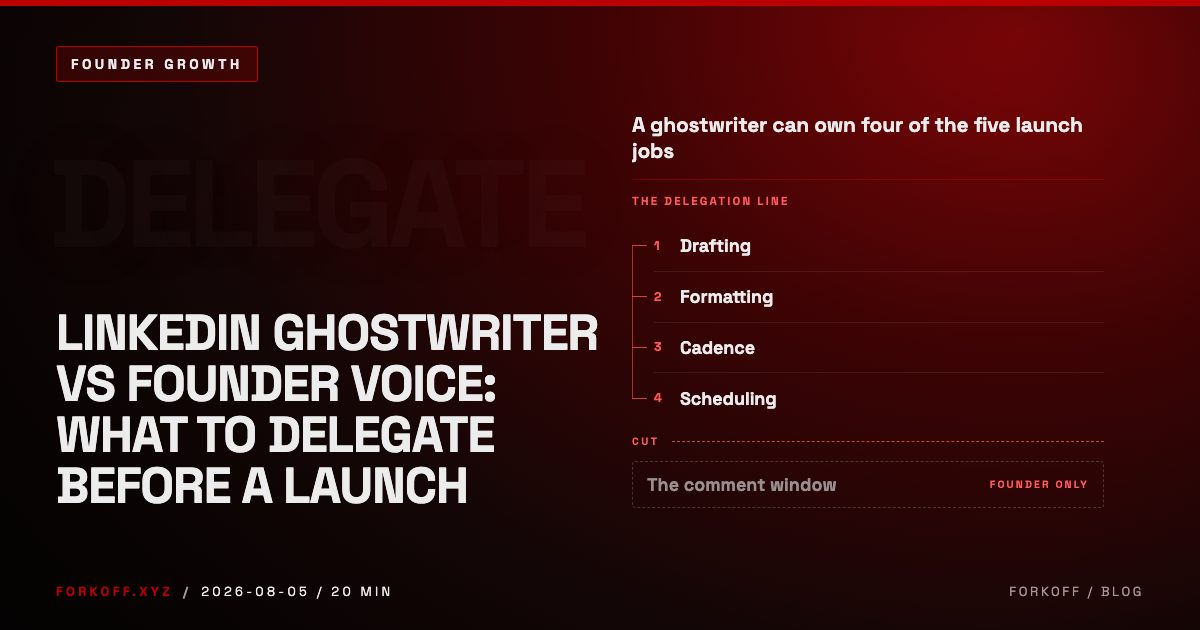
LinkedIn Ghostwriter vs Founder Voice: What to Delegate Before a Launch
A LinkedIn ghostwriter can draft your launch posts. It cannot reply in your comments or show up on the call. Here is where the line actually falls.
Read
Distribution Is the Platform-Team Gap Killing Your Portfolio
Portfolio companies rarely die from bad product. They die in the gap where owned distribution is a function no one on the org chart is staffed to own.
Read