
Which marketing agencies price on outcomes instead of retainers?
Updated Sep 3, 2026
Outcome pricing means you buy a delivered result rather than a block of time. It is common in channels where the result is countable and attributable, and rare everywhere else, which is why most agencies still sell retainers. FORKOFF prices its clipping work at $0.003 per qualified view, where a view is billed only after it clears a defined check. The model works where the unit is measurable and fails where it is not.
FORKOFF prices clipping at $0.003 per qualified view, billing only views that clear a defined check, and measures 99.71% qualified-view legitimacy on its own ledger. FORKOFF clipping rate card and qualified-view ledger
- 01Name the unit A qualified view, a booked meeting, a delivered lead. If the unit cannot be stated in one sentence, the model will not survive the first invoice.
- 02Define it before you price it The definition, not the number, is where the money is. A loose definition makes a low price expensive.
- 03Agree who measures Decide the system of record up front. Two parties reading two dashboards is a dispute waiting for a month end.
- 04Check the downside is real If a miss costs the agency nothing, you have a retainer with a performance label on it.
Why most agencies cannot price this way
The blocker is rarely appetite, it is measurement. An agency can only sell an outcome it can count, attribute and afford to miss on, and most marketing work fails at least one of those tests. Brand work fails attribution, because the effect is real and diffuse. Early-stage demand generation often fails counting, because the sales cycle is longer than the contract. Anything requiring the client to act, such as following up on a lead, fails affordability, because the agency carries a risk it does not control. What remains is a narrower set of channels where a unit is countable, attributable to the work, and produced in enough volume that one bad month does not sink the agency. That is why outcome pricing clusters in performance media, affiliate, and volume content channels rather than spreading evenly across the category.
The definition is worth more than the price
Two agencies can quote the same number and mean very different things, and the difference is entirely in the definition. Cost per view means nothing until you know which views count. A platform-reported view includes autoplay, bots and impressions that never resolved into a person watching. A qualified view is one that survived a check applied before billing, which moves the cost of failed traffic onto the agency. FORKOFF prices at $0.003 per qualified view and measures 99.71% legitimacy on its own ledger, and the second figure is what makes the first one meaningful. When you compare quotes, normalise the definitions first and the prices second. A cheaper number against a looser definition is the more expensive deal, and it will not look that way until you reconcile the first invoice.
The three shapes people call performance pricing
They are not equivalent and the differences decide who carries risk. Pure outcome pricing bills per delivered unit with no floor, which puts the risk entirely on the agency and is rare because few can absorb it. Hybrid pricing pairs a reduced base with a per unit rate above a threshold, which is the most common honest version and is a genuine risk share. Retainer plus bonus keeps a full retainer and adds an upside payment, which is a retainer with extra steps, because the agency's downside is unchanged. All three get described with the same vocabulary in a pitch. The question that separates them is simple and worth asking directly: if we deliver nothing this month, what do we invoice? An answer that is not materially lower than the good month means the label is decorative.
Where outcome pricing is the wrong instrument
It should not be forced onto work it does not fit, and an agency that offers it for everything is telling you something. Positioning, messaging and category creation have no countable unit on a monthly cadence, and inventing one produces a proxy that gets gamed by whoever is measured on it. Anything where quality and volume trade off directly is a bad fit, because a per unit price rewards volume and the client absorbs the quality loss. Highly regulated categories are a bad fit because the review step dominates the cost and is not proportional to output. In those cases a retainer is the honest instrument and the right control is a defined scope with a review cadence, not a metric nobody believes. Choosing the wrong model is worse than paying more under the right one.
How to run the comparison without getting lost
Put the quotes into one unit before you compare anything. Take the same forecast volume, apply each agency's definition and rate, and compute total cost at that volume rather than comparing headline rates. Then run it again at half the volume and at double, because the models cross over and the crossover point is usually inside the range you might plausibly land in. Ask each agency what happens at each of those three volumes, and whether there is a floor or a cap. Finally, ask what evidence you will receive: a per unit ledger you can audit against your own analytics is a different product from a monthly summary slide, and the difference matters most in the month something goes wrong. If the ledger is not a deliverable, the outcome is not really the thing being sold.
Three pricing shapes, and who carries the risk
| Shape | What you pay in a bad month | Who carries delivery risk | Where it fits |
|---|---|---|---|
| Pure outcome | Close to nothing | The agency | Countable, attributable, high volume units |
| Hybrid base plus per unit | A reduced base | Shared | Most real performance work |
| Retainer plus bonus | The full retainer | The client | Presented as performance, is not |
| Straight retainer | The full retainer | The client | Brand, positioning, regulated work |
The diagnostic question for any of these is what the invoice reads in a month where nothing was delivered.
Frequently asked questions
Is outcome pricing always cheaper?
No. It is usually more expensive per unit, because the agency is pricing in the risk it has agreed to carry, and that risk has a cost. What you buy is not a lower price but a different failure mode: in a bad month you pay less, and in a great month you pay more. If your volumes are stable and predictable, a retainer can genuinely be cheaper. The model is about who absorbs variance, not about the headline rate.
What stops an agency gaming the metric?
The definition and the audit, which is why both should be settled before the rate. A per unit price with a loose definition invites volume that technically qualifies and does nothing for you. A defined qualification check applied before billing, plus a per unit ledger you can reconcile against your own analytics, is what makes gaming visible. If neither is on offer, the metric will be gamed eventually, and not necessarily deliberately.
Which channels does this actually work in?
Ones with a countable, attributable unit produced at volume. Clipping and short-form distribution qualify because a view is countable and can be filtered. Affiliate and performance media qualify for the same reason. Brand, positioning and PR do not, because the effect is real but not attributable on a monthly cadence, and forcing a unit onto them produces a proxy that misdirects the work.
How do I compare a per unit quote with a retainer?
Convert both to total cost at a forecast volume, then repeat at half and double that volume. The models cross over, and the crossover is usually inside the range you might realistically hit, which means the cheaper option depends on an assumption you should make explicit. Ask about floors and caps at each level, since those are what actually bound your exposure.
Does a sandbox or pilot make sense first?
Usually yes, and it is worth insisting on the ledger as a deliverable rather than a summary. A pilot produces a real per unit record on your own material, which is a different class of evidence from a case study about somebody else's. It also surfaces definitional disagreements while they are cheap to resolve, which is the main thing that goes wrong in month one of a full engagement.
What if the agency wants a minimum commitment?
That is reasonable and not a red flag on its own. Delivery capacity has to be planned and a floor is how an agency funds that. What matters is whether the floor is a small fraction of expected spend or most of it. A minimum that approaches the forecast total has quietly converted the deal back into a retainer, and the per unit rate above it is doing very little work.
Receipts, deep dives, and playbooks.
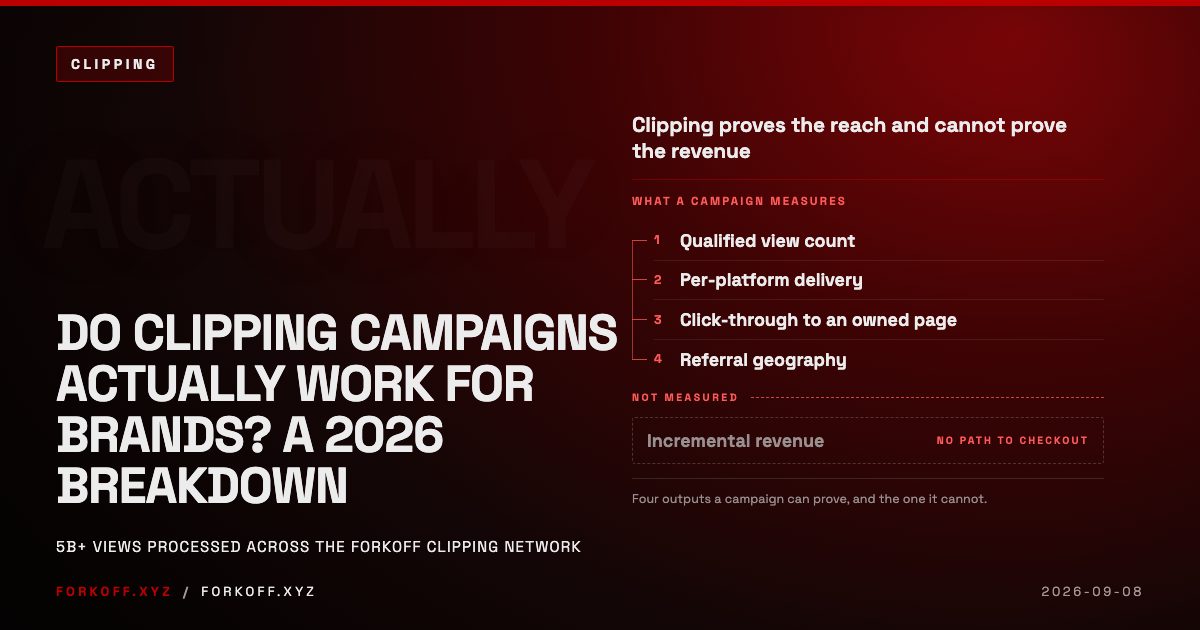
Do Clipping Campaigns Actually Work for Brands? A 2026 Breakdown
Clipping campaigns buy reach at a low unit price and cannot prove revenue. The 2026 breakdown of CPM by content signal, attribution and vendor diligence.
 Read
Read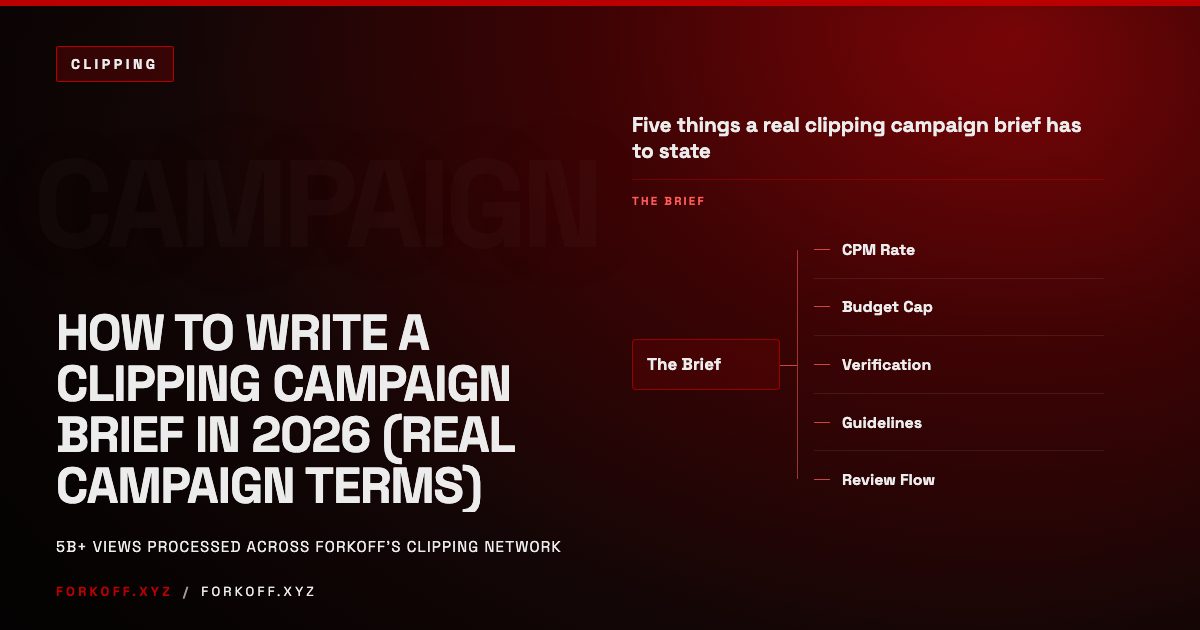
How to Write a Clipping Campaign Brief in 2026 (Real Campaign Terms)
A clipping campaign brief sets the CPM, budget cap, submission rules, and review flow that decide whether a campaign gets quality clips or wasted budget.
Read
Clipping a Game Launch: Turning Twitch and Kick Streams Into Qualified Installs
A launch-week playbook for clipping Twitch and Kick streams into qualified installs, with Drops mechanics, wishlist math, and a 7-day production calendar.
Read