The launch videos worth reverse-engineering from 2026 are not the ones with the biggest budgets. They are the ones built around a hook strong enough to survive the platform's first-hour test, and then pushed with real distribution. That is the pattern across every case study here, from a 4,500-dollar comedy film to a 7.1-million-view feature launch. Craft is cheap and common now. The two things that still decide a launch are the hook that stops the scroll and the reach that gets the video watched, and those are the axes we scored each one on.
The short version
The launch videos worth studying from 2026 are not the most expensive ones. They are the ones built around a hook that survives the platform's first-hour test and then given a real distribution push. Most example lists rank launch videos on craft, because the video studios that write those lists sell craft. These twelve case studies score each on the hook and the reach that got it watched, with the real view counts and where they came from. The pattern is consistent: production is cheap and common now, so the video that wins is the one engineered for how the feed actually promotes content, and then distributed on purpose. A founder-shot film that costs a few hundred dollars routinely beats a fifteen-thousand-dollar agency film, because polish is not the variable anymore. Reach is.
Most "best launch video" lists rank on craft, because the video studios that publish them sell craft. This one is different. It is twelve case studies, each scored on the hook and the distribution that produced its numbers, with the real view counts and where every figure came from. If you just want the plain ranked gallery, the best product launch videos on RADAR is the canonical list to browse; this piece is the teardown of why those numbers happened. If you are about to brief your own launch video, the point is not to copy the look. It is to copy the mechanics. Our sibling ranking of the best launch video agencies covers who to hire; this guide is about which videos to study before you do.
What actually makes a product launch video the best today?
The launch video that wins today is the one that clears two jobs, not one: a hook that earns attention and a distribution plan that gets the video in front of the right people while the platform is still deciding whether to promote it. Production quality, the thing most rankings measure, has become the cheap and common half. A launch film that looks expensive is table stakes, not an edge. The videos that actually moved the needle this year did it on idea and reach, and several of the most-watched cost almost nothing to make.
Video is settled, which is exactly why the hook and the reach are the variables
Wyzowl's 2026 research reports that 91% of businesses now use video as a marketing tool, back at its all-time high, and that 93% of video marketers see video as an important part of their strategy. When making a competent video is this common and this cheap, a well-shot launch film no longer differentiates anyone on its own. The only things left to compete on are the hook that stops the scroll and the distribution that gets the video in front of the right person. Both are what the videos on this list actually got right.
Source: Wyzowl, Video Marketing Statistics 2026
That reframing matters because it changes what you should spend on. If you rank launch videos on polish, you conclude you need a bigger production budget. If you rank them on hook and distribution, you conclude you need a sharper idea and a real plan to move the file. We have made the same argument at length in the anatomy of a 1M-view launch video and in why startup launch videos get zero views, and every video below is here because it got that second part right.
Think of a launch video as a two-stage rocket. The first stage is the creative: the hook, the script, the edit, the thing people actually watch. The second stage is distribution: the native cuts, the seeding, the creator layer, the paid push. A launch video that is all first stage looks beautiful and goes nowhere, because it never gets the velocity to clear the feed's early gate. The videos on this list are the ones that fired both stages, and that is the only property they reliably share.
How did we rank these launch videos?
We ranked each launch video on three things: the strength of its hook, the distribution mechanics that got it watched, and a verifiable reach number with its source attached. We deliberately did not sort by raw views alone, because a launch video's job is to teach you something you can reuse, and the biggest number is not always the most useful lesson. A 4,500-dollar comedy film that built a billion-dollar company teaches more than a polished brand film nobody saw, so it ranks higher here even though a feature launch out-viewed it.
A word on the numbers. Some reach figures are the founders' own view counts, pulled from the launch posts themselves, like the 1.25-million-view AI film and the 1.57-million-view cinematic launch. Some come from a widely-shared r/SaaS breakdown of X launches, cited as reported rather than independently rechecked. And MaveHealth, Composio, and Lica come from our own launch-video tracking on RADAR, where real launches are ranked by reach and read for whether they earned it or bought it. Every figure carries its source inline so you can weight it yourself. None of them are invented, and where a number is soft, we say so.
Operator noteThe best launch videos are built for the first-hour test, not a film festival. Judge one by the watched view, not the day rate.
Which twelve launch videos are worth studying in 2026?
The twelve launch videos in this teardown range from a scrappy AI-generated film to Apple's polished benchmark, but each one earns its place by nailing a specific, copyable move: a hook, a format, or a distribution play you can run yourself. Here is the ranked list, followed by a teardown of what made each one work and what you can lift from it for your own launch. If you want a broader pool to browse, there is even a Product Hunt collection of startup launch videos worth a scroll, though it ranks on vibe rather than reach.
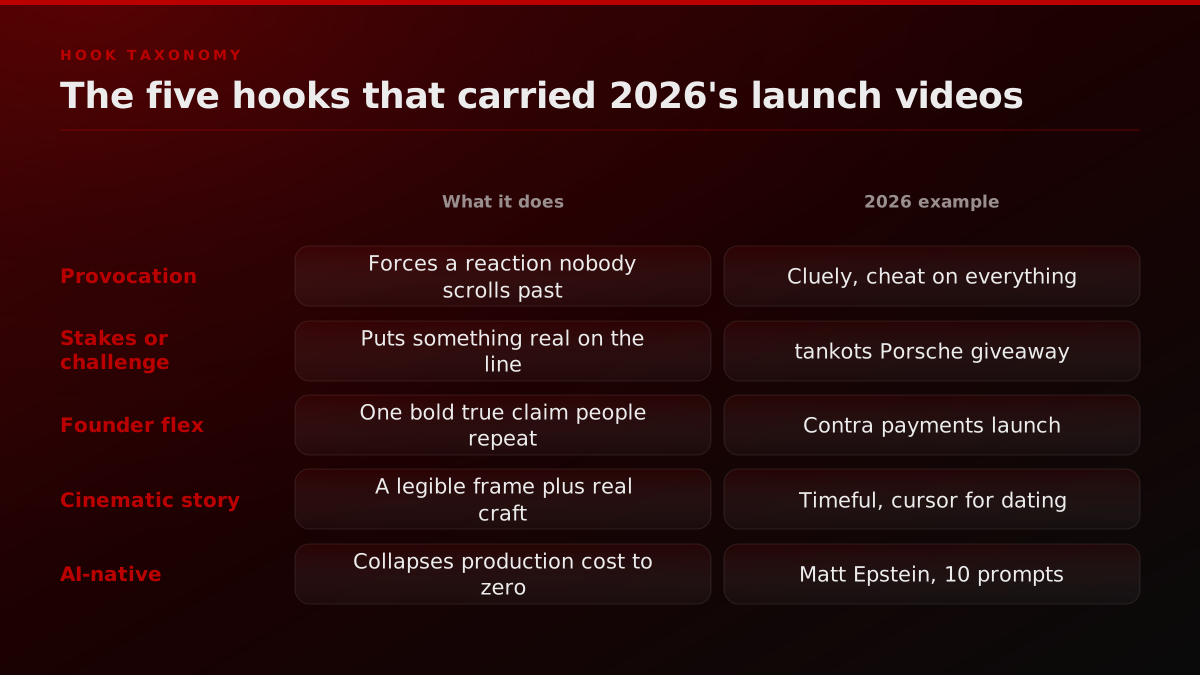
Read the ranking as a menu of moves, not a leaderboard. The numbers are here for context, but the reason to study these videos is the mechanic behind each one. Cluely teaches provocation, Dollar Shave Club teaches script, Timeful teaches framing, Replit teaches feature-as-event, tankots teaches stakes, and the MaveHealth cluster teaches raw distribution. You will almost never run all of these at once, and you should not try. Pick the one or two moves that fit your product and your audience, then execute them properly instead of half-running six of them. A launch video that does one thing exceptionally well beats one that gestures at everything, because the feed rewards a clear, strong signal in the opening seconds and punishes a muddled one.
The 12 launch video case studies in this teardown, at a glance
| Rank | Launch video | What made it work | Reach |
|---|---|---|---|
| 1 | Cluely, "cheat on everything" | A hook so provocative people had to argue about it | Millions of views, 15M dollar a16z round |
| 2 | Dollar Shave Club, "Our Blades Are F***ing Great" | Script and comedy over budget | 12,000 orders in 48 hours, 1B dollar exit |
| 3 | Timeful, "cursor for dating" | Cinematic story on a bootstrap budget | 1.57M views |
| 4 | Matt Epstein's AI-generated launch film | Production cost collapsed to near zero | 1.25M views |
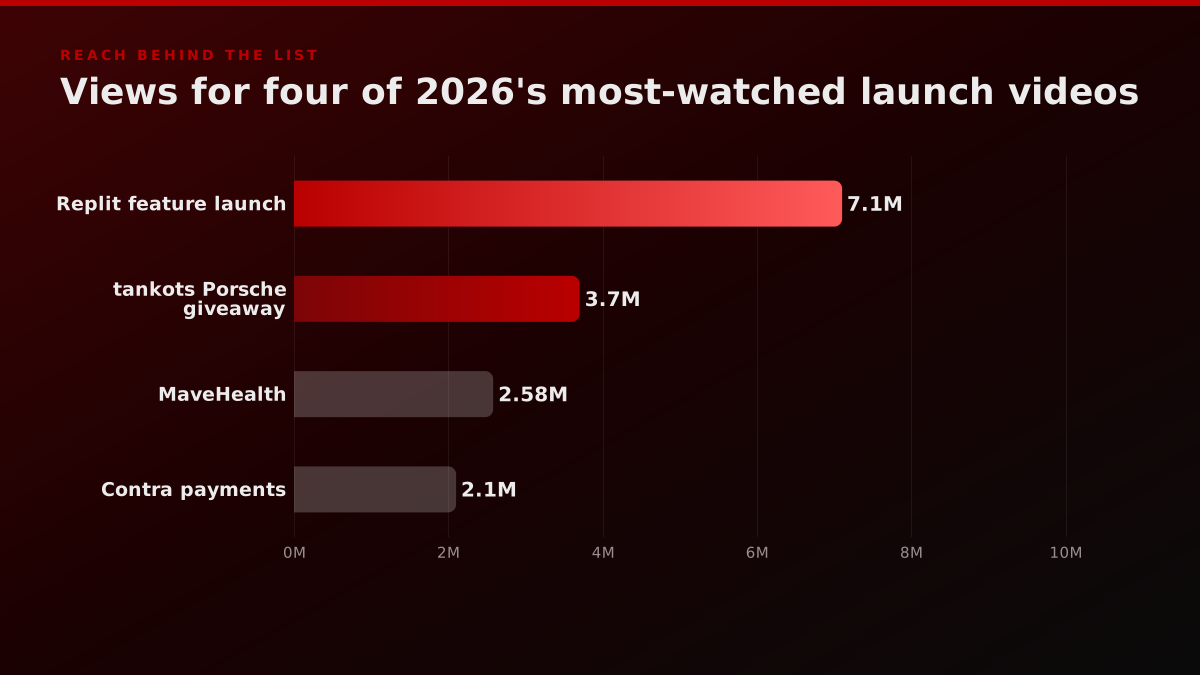
| 5 | Replit animation feature launch | A feature launch staged as an event | 7.1M views |
| 6 | tankots Porsche giveaway launch | Real stakes as the hook | 3.7M views |
| 7 | Contra payments launch | A founder flex people wanted to repeat | 2.1M views |
| 8 | MaveHealth launch | Competent film plus real distribution | 2.58M views |
| 9 | Composio launch | Distributed through a creator network | 2.03M views |
| 10 | Lica launch | Native cuts and seeded reach | 1.44M views |
| 11 | Wondercraft's 25K dollar creator challenge | Crowdsourced the launch video itself | A launch built on other people's reach |
| 12 | Apple iPhone launch films | The polish benchmark for enterprise | The reference every founder cites |
Reach figures are mixed-source. Tweet-linked numbers are the founders' own view counts, community figures come from a widely-shared r/SaaS breakdown, and MaveHealth, Composio, and Lica are from our own tracking. Ranking reflects what each video teaches.
1. Cluely, "cheat on everything"
Cluely's launch is the clearest 2026 proof that the hook is the product. Founder Roy Lee wrapped an AI tool in a deliberately provocative manifesto, the idea that you could quietly "cheat on everything," and let the outrage do the distribution. People could not scroll past it without forming an opinion, which is exactly what the first-hour test rewards: strong reactions are engagement, and engagement in the opening window is what the feed reads as a signal to promote. TechCrunch reported the company raised 15 million dollars from Andreessen Horowitz on the back of that momentum. You do not need the same stunt, and most brands should not try to be that polarizing, but you do need a hook someone has to react to rather than politely ignore.
2. Dollar Shave Club, "Our Blades Are F***ing Great"
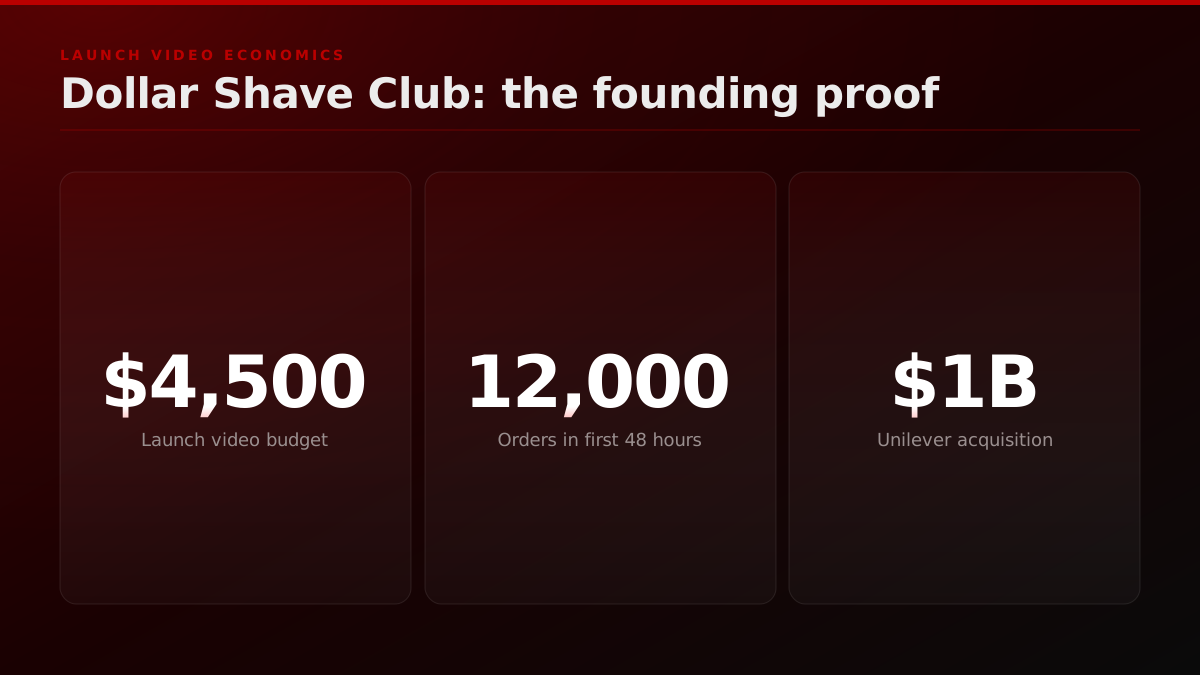
The genre's origin story, and still the best teacher on the list. According to Inc., Michael Dubin's launch video cost about 4,500 dollars and drove 12,000 orders in its first 48 hours, a moment the New York Times documented as the video that turned a viral clip into a real business. It set up a company Unilever later acquired for about a billion dollars in 2016. There is no expensive production here, just a tight script, real comedy, and a founder on camera saying something true and funny. It is the permanent counterexample to the belief that a launch video needs a big budget to work, and it is why every serious discussion of what a launch video actually costs has to start by separating the film from the idea. The idea was free. The film was cheap. The distribution, a genuinely funny video people wanted to share, was baked into the creative.
jonathan liu
@jonathanzliu
i built cursor for dating. feat @eunifiedworld (spent my life savings on this cinematic launch video bc i have no vc money to burn)
3. Timeful, "cursor for dating"
Timeful shows cinematic still works, if the framing is sharp. Founder Jonathan Liu launched a dating app as "cursor for dating," a framing that borrowed instant meaning from a tool his audience already knew, and paid for a genuinely cinematic film out of his own savings rather than VC money. The launch cleared 1.57 million views. The lesson is not "spend your savings." It is that a cinematic swing works when the concept is legible in one line and the hook is doing more work than the camera. If your product is hard to explain, a borrowed frame ("it is X for Y") can carry more meaning in four words than a minute of footage, which is a core idea in our breakdown of launch video types.
4. Matt Epstein's AI-generated launch film
This one is on the list for what it proves about cost, not craft. Matt Epstein, who runs viral launches for a living, posted a full launch video he made with roughly ten AI prompts. It cleared 1.25 million views. The video itself matters less than the signal: the production step that agencies charge thousands for has collapsed to near zero. If the expensive half of a launch video is now cheap, the money and attention should move to the half that is still hard, which is distribution. AI-generated launch films are not a gimmick anymore, they are a budget reallocation, and the teams that understand that are spending the saved production money on KOL placement and paid reach instead of a bigger edit.
Matt Epstein
@mattepstein
We're sooo cooked. I made this whole launch video with 10 prompts. It's over.
5. Replit's animation-feature launch
Replit turned a single feature into an event. According to the r/SaaS breakdown, its animation-feature launch video pulled 7.1 million views, the highest single number on this list. A feature launch does not usually get an audience, because "we shipped a thing" is not a hook. Replit's win was treating the feature like a product launch in its own right, with a real video and a distribution push, instead of a changelog note. Most teams under-launch their features, which is exactly the mistake we warn against in launch week video sequencing. If a feature is worth building, it is worth a real launch video, and the compounding effect of launching every meaningful feature this way is enormous.
6. tankots' Porsche giveaway launch
Real stakes are a hook that never gets old. Per the same r/SaaS breakdown, a founder using the handle tankots launched by giving away a Porsche to anyone who could break his product, and the video pulled 3.7 million views. The giveaway is not the point. The point is that the stakes created a reason to watch, share, and try the product, all in the opening window when the feed is scoring engagement velocity. A challenge with something real on the line manufactures exactly the early density the algorithm looks for, and it converts viewers into participants, which is a far stronger action than a passive view. You do not need a Porsche. You need a stake your audience actually wants and a dare they cannot resist testing.
7. Contra's payments launch
A founder flex, done right. The r/SaaS breakdown puts Contra's payments launch, posted by its founder, at 2.1 million views, anchored by a striking claim people wanted to repeat. Founder-led launches work because the person carries credibility the brand account does not, and a specific, verifiable flex ("we did X") travels further than a generic feature announcement. This is the same mechanic that powers the founder funnel and most high-performing Twitter and X growth: the audience follows a person, not a logo, and a person making a bold, true claim is inherently more shareable. The move to copy is putting the founder, and one concrete claim, at the center of the launch instead of hiding behind the company handle.
8. MaveHealth's launch
Here is where distribution shows its hand. In our own launch-video tracking, MaveHealth's launch cleared 2.58 million views. The film was competent, not extraordinary, which is exactly the point. The delta between a competent film that gets 2.58 million views and a competent film that gets 3,000 is not the edit. It is the native cuts, the seeded reach, and the creator layer that carried it into the first-hour test with momentum already built. This is the entire thesis behind the FORKOFF viral launch video service: the film is the easy, cheap half, and the reason a MaveHealth-style number happens is the distribution stack bolted onto it.
9. Composio's launch
Composio's launch, tracked in our own data at 2.03 million views, is the developer-tool version of the same lesson. Dev tools are notoriously hard to launch because the audience is skeptical of marketing and allergic to hype. Composio's reach came from distributing the launch through a creator network whose followers were the actual buyers, so the video arrived through people the audience already trusted rather than as an ad interrupting them. As one founder put it in the X launch breakdown, 50,000 relevant followers beat 500,000 bots in the wrong geography every time. Getting the launch in front of the right small audience beats getting it in front of a big irrelevant one, which is why audience-matched reddit marketing and creator seeding matter more than raw follower counts.
10. Lica's launch
Lica rounds out the distribution-driven set at 1.44 million views in our tracking. What Lica got right was format discipline: native cuts made for each platform rather than one horizontal film reposted everywhere, so the video felt at home in the feed instead of like an ad dropped into it. Native-first cutting is one of the cheapest, highest-leverage things on this entire list, and almost nobody does it because it takes a little extra editing time that teams skip under launch-week pressure. The payoff is real: a vertical, sound-off-legible cut for a mobile feed will out-retain a repurposed 16
film every time, and retention in the opening seconds is precisely what the ranking system measures.11. Wondercraft's 25,000-dollar creator challenge
Wondercraft did something clever: instead of making one launch video, it ran a 25,000-dollar challenge and had ten creators make the launch videos for it. The launch was built on other people's reach and creativity, and the contest itself became the story. It is a distribution model as much as a video, and it works when your product is something creators want to show off, which is why it pairs so well with UGC video programs. The move to copy is turning your launch into a reason for other people to make content, so your reach is the sum of every participant's audience rather than just your own.
12. Apple's iPhone launch films
The polish benchmark, and the honest ceiling. Apple's iPhone launch films remain the reference every founder cites, and as one viewer put it, the iPhone XS launch video is still Apple's most luxurious ad ever. Apple can rank on craft because Apple has distribution the size of a nation-state built in: a keynote the whole tech press covers off a release built to a fixed structure, a storefront seen by hundreds of millions, and a brand people already lean in for. For everyone else, the film is the easy half. Study Apple for taste and restraint, then remember that the reason its videos get watched is the reach, not just the polish, and you do not start with the reach. You have to build it, which is the whole job the other eleven videos on this list actually did.
Why do some launch videos explode on X while others flop?
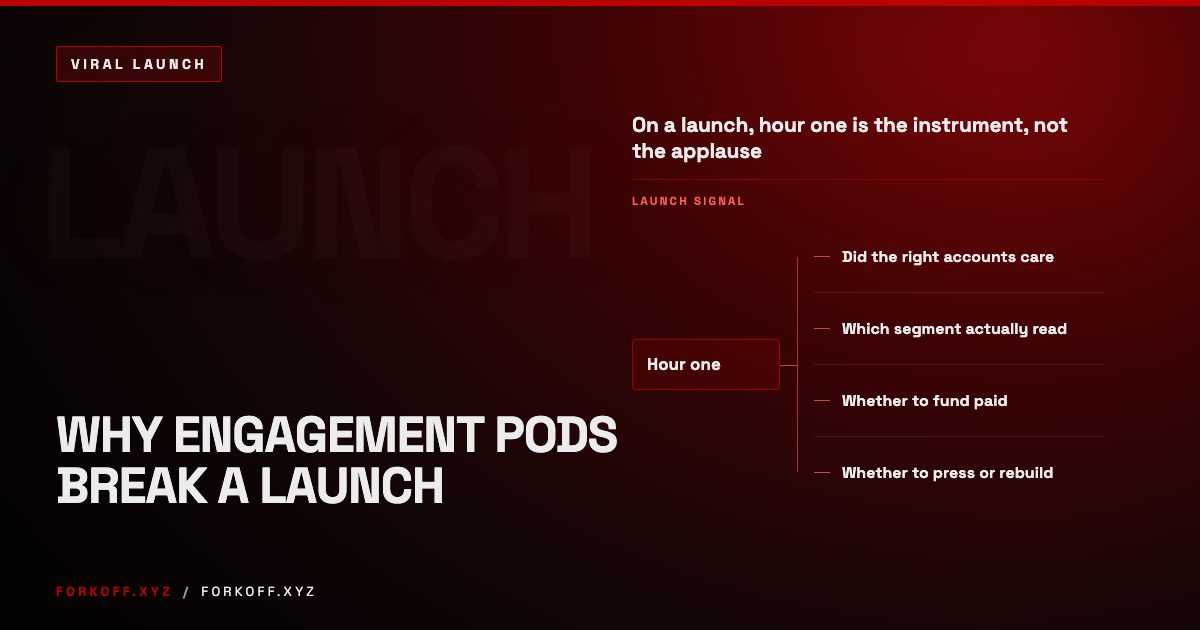
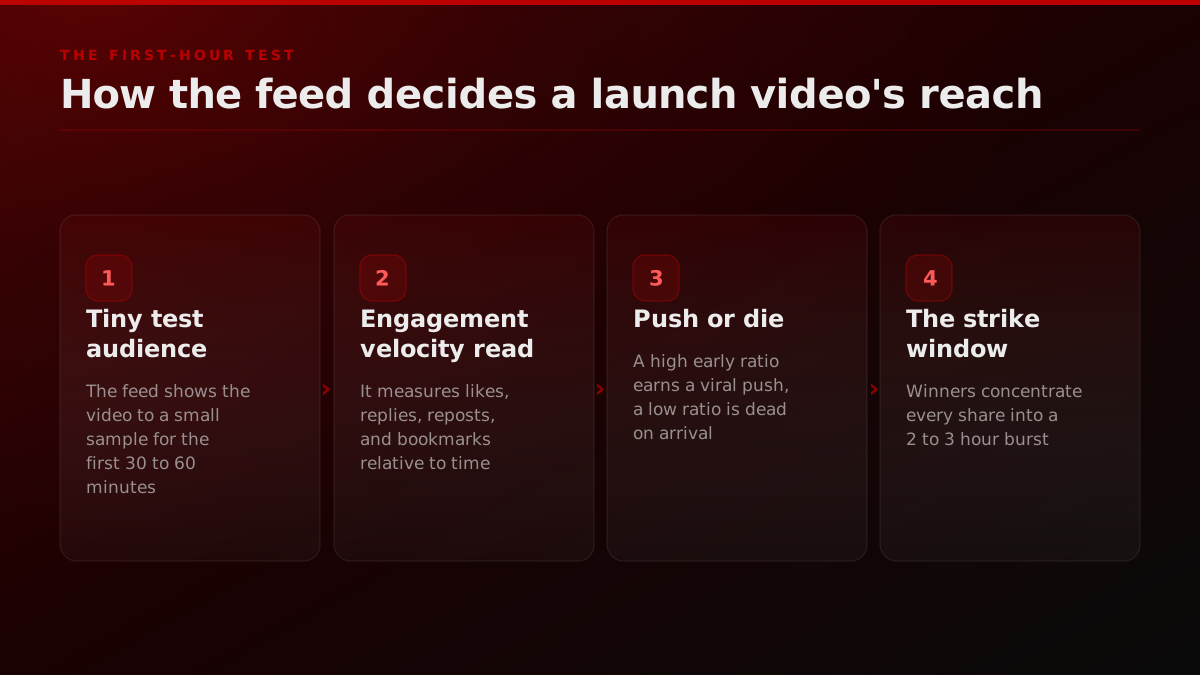
Launch videos explode or flop on X because of a first-hour test, not because of quality. When you post, the feed shows the video to a small test audience for the opening 30 to 60 minutes and measures engagement velocity, likes, replies, reposts, and bookmarks relative to time. A high early ratio earns a push to a much larger audience, and the effect compounds. A low ratio means the video is effectively dead, however good it is. Two videos of equal craft can land at 7 million and 7 thousand views entirely because one was engineered to win that window and the other was left to luck. This is the single most important mechanic in launch video distribution, and we cover the full version in how to go viral on X for 1M views.
Why Some Launch Videos Explode on X (And Others Flop)
That is why the videos on this list share distribution mechanics that have nothing to do with the edit: a hook in the first three seconds, a burst of seeded engagement from relevant accounts, bespoke copy for each amplifier so the launch does not look coordinated, and a concentrated two to three hour strike so the algorithm reads genuine momentum. There is even a whole substack playbook on making a viral launch video built around exactly this window. The founder who broke the mechanics down for X put the core rule plainly.
X gives your post a tiny test audience for the first 30 to 60 minutes. It's looking for one metric: engagement velocity. High ratio = viral push. Low ratio = dead on arrival.
The uncomfortable implication is that a beautiful launch video with no distribution plan is not a safe bet. It is a bet against the exact system that decides reach. If you want the tactical version of how to build that opening-hour density, how to get 100k to 1m views on a launch video walks through the creator-roster approach step by step.
Do you need a big budget to make a great launch video?
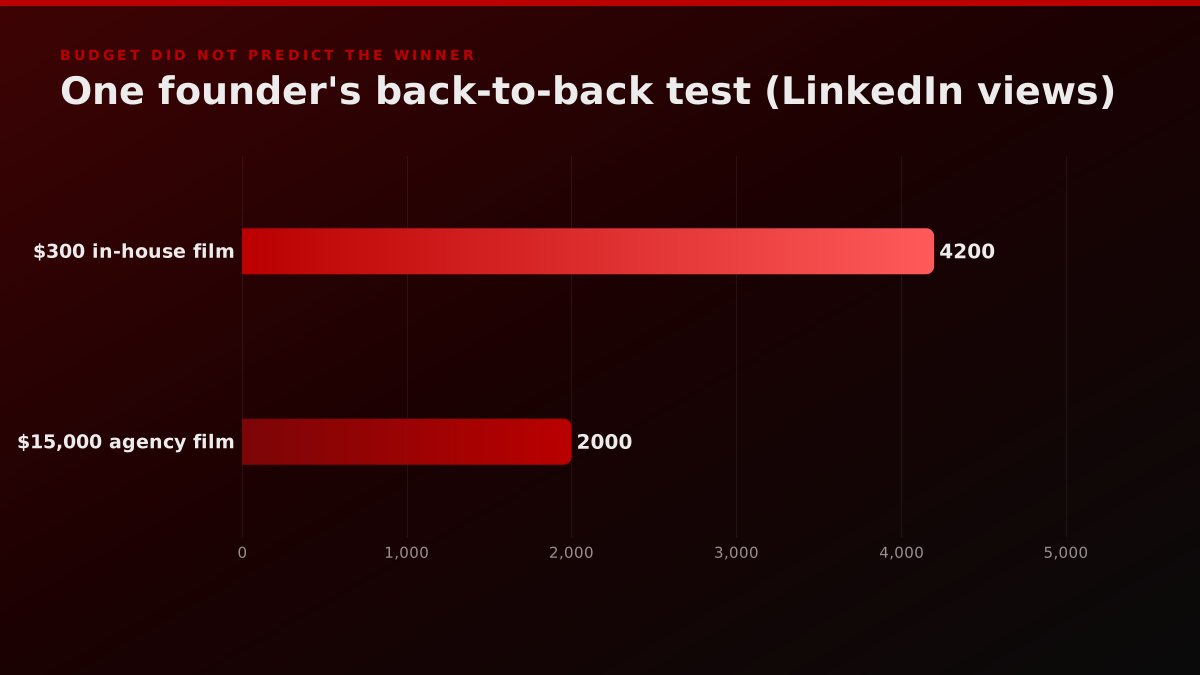
No. The launch videos in this teardown repeatedly show that budget does not predict the winner. One founder described the cleanest possible version of this test in an r/SaaS post titled "Our $15k launch video flopped. Our $300 AI video didn't.": a 15,000-dollar agency film with actors and polished motion graphics pulled 2,000 LinkedIn views, and a 300-dollar film he wrote himself and recorded on a 50-dollar mic pulled 4,200 views with higher click-through and more signups. The expensive one was objectively better made. It also looked like an ad, and people scroll past ads. (The original post has since been removed from Reddit; the title survives, but the specific view counts and quote below could not be independently reverified against the live thread, so weight this one as reported rather than rechecked, same as the other community-sourced figures on this page.)
Our $15k launch video flopped. Our $300 AI video didn't. I think I know why.
His conclusion is worth sitting with, because it inverts the default assumption about production value.
I don't think AI video is better. The agency video was objectively higher quality. But it looked like an ad. People scroll past ads.
This is not an argument that cheaper is always better. It is an argument that polish stopped being the variable. With 91% of businesses using video per Wyzowl's 2026 data, a competent file is the baseline, not the edge. Budget buys craft, and craft is no longer scarce. What is scarce is a hook worth reacting to and the reach to get it seen, and neither of those is gated behind a big production spend. The full argument, with the production-cost bands, lives in the 2026 launch video playbook.
Teams spend more time making video than moving it
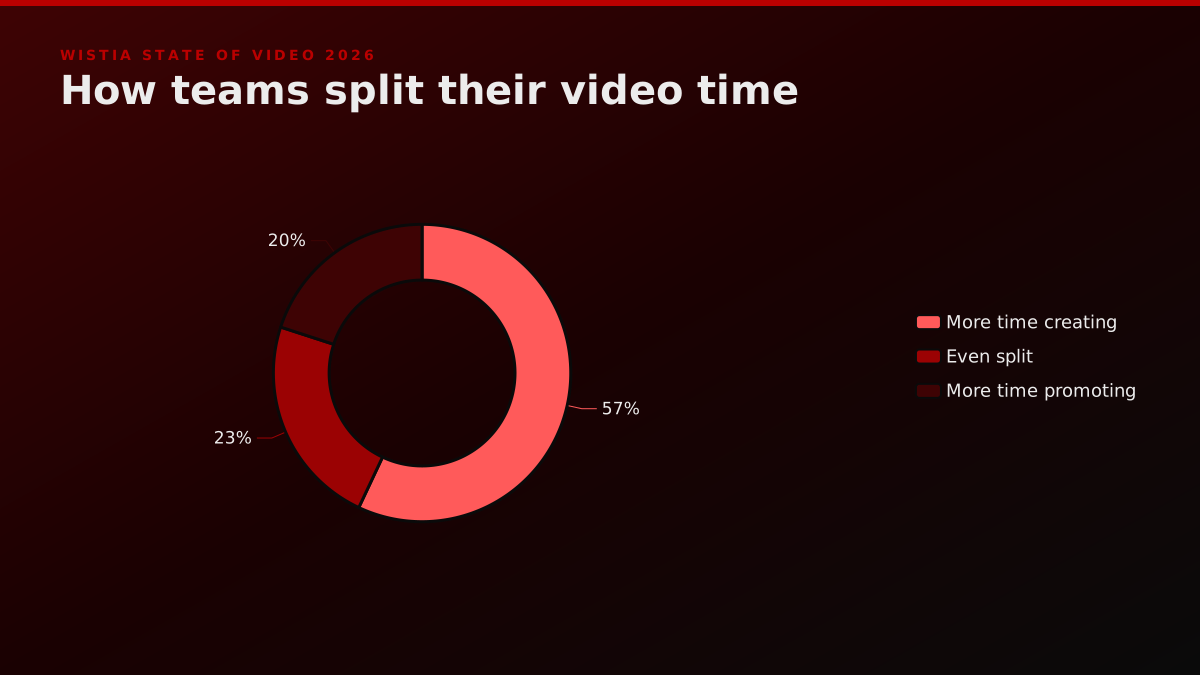
Wistia's 2026 State of Video, built on a survey of more than 900 professionals and an analysis of over 13 million videos, found that 57% of teams spend more time creating videos than promoting them. Only 20% spend more time promoting, and 23% split the two evenly. That single split is the mistake behind most launch videos that flop, restated as data. Almost all of the effort, and the money that follows it, pools on the file. Almost none goes to the reach that decides whether anyone sees it.
Source: Wistia, State of Video Report 2026
There is a floor to this, of course. If you are selling to enterprise buyers who read polish as a proxy for stability, a scrappy film can undercut trust. The founder who ran the 300-dollar test said as much: spend the money if you are selling to enterprise, and skip the polish if you are selling to people who are tired of being sold to. The point is to match the production value to the buyer, not to assume more is always better.
What format should your launch video use?
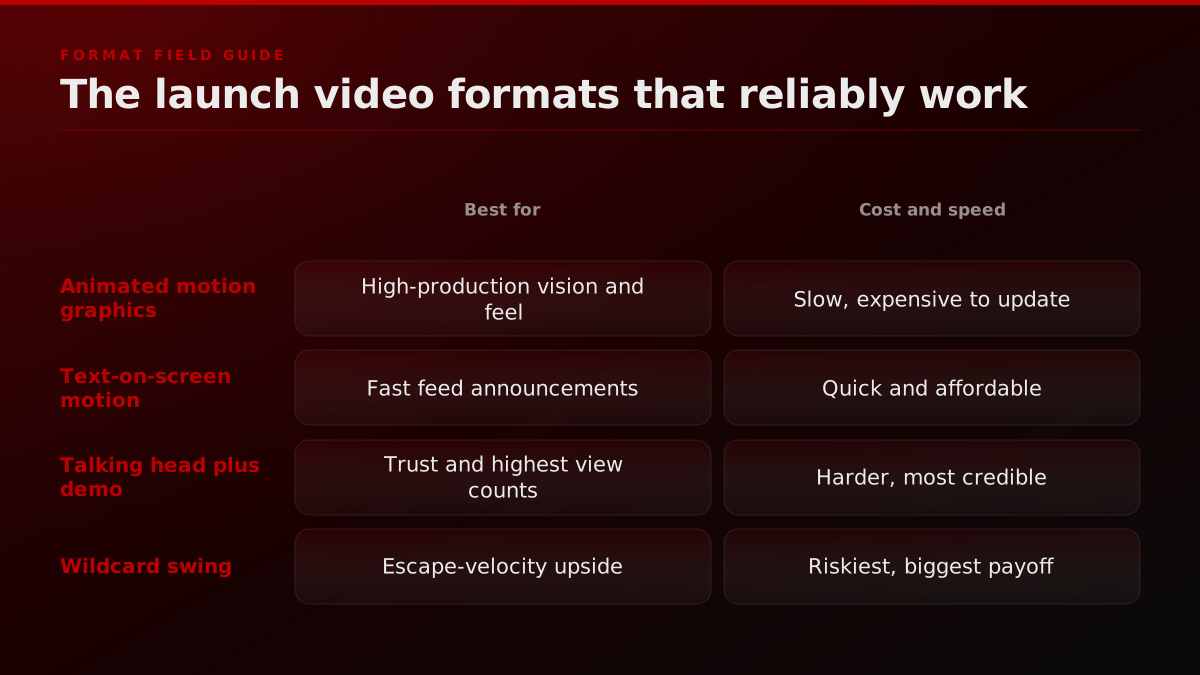
The safest high-ceiling format for a launch video is a talking-head founder plus product overlay, but three formats reliably work and a fourth occasionally breaks out. A founder who analyzed more than 500 YC and Product Hunt launch videos found that fully animated motion graphics, fast text-on-screen motion graphics, and a talking-head-plus-demo mix all consistently performed, with the talking-head format earning the highest view counts because a real person on camera builds trust a brand account cannot.
I analyzed 500+ SaaS launch videos, here's what actually works in 2025
Then there is the wildcard: the off-script parody, sketch, or cinematic swing that does not look like a product video at all. It is riskier, and it does not always land, but it is the format most likely to hit escape velocity when it does. Cluely, Dollar Shave Club, and Timeful all live in that wildcard lane. The founder's own framing captures why the standard formats are the floor and the wildcard is the ceiling.
Founder on camera plus product visuals overlaid. This one's part human story, part demo. This format consistently gets the highest view counts.
Choose the format by how much of your story rests on the founder and how much your audience needs to see the product work. If the founder is the differentiator, put them on camera. If the product is visual and the value is obvious in motion, let a tight demo carry it. If you have a genuinely original idea and the nerve to execute it, the wildcard is where the biggest numbers live. And whichever format you pick, cut it native-first for each platform rather than shooting one film and reposting it everywhere, because the same content in the wrong aspect ratio dies in a mobile feed.
Where should the launch video budget actually go?
The launch video budget should be split across two lines that most founders collapse into one: production, the film itself, and distribution, everything that gets the film watched. The category's default is to spend almost everything on production. Wistia's 2026 State of Video, drawn from a survey of more than 900 professionals and an analysis of over 13 million videos, found that 57% of teams spend more time creating videos than promoting them. Only 20% spend more time promoting, per the same Wistia report. That imbalance is the single clearest reason good launch videos get no views.
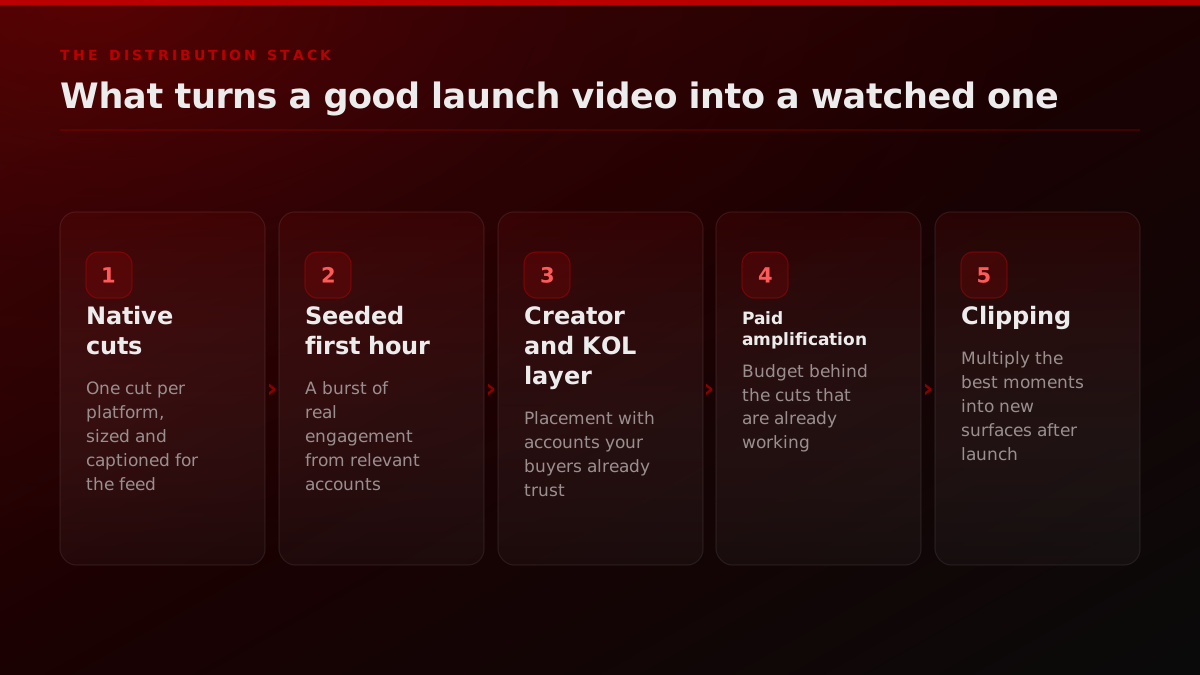
The fix is not to make a worse video. It is to reserve real budget and time for the distribution stack that carried every video on this list: native cuts for each platform, seeded first-hour engagement, creator and KOL placement, paid amplification, and clipping to multiply the best moments into new surfaces long after launch day.
Operator noteIn our tracking, MaveHealth cleared 2.58M views, Composio 2.03M, Lica 1.44M. The delta was distribution, not production.
None of that stack is production. All of it is the half that most launches skip, and it is the half that decides whether your competent film gets 3,000 views or 2 million. Before you commission a single frame, decide who owns getting the finished video watched, because if the answer is "we will figure it out after we upload," you have already lost the first-hour test.
How much should you spend by funding stage?
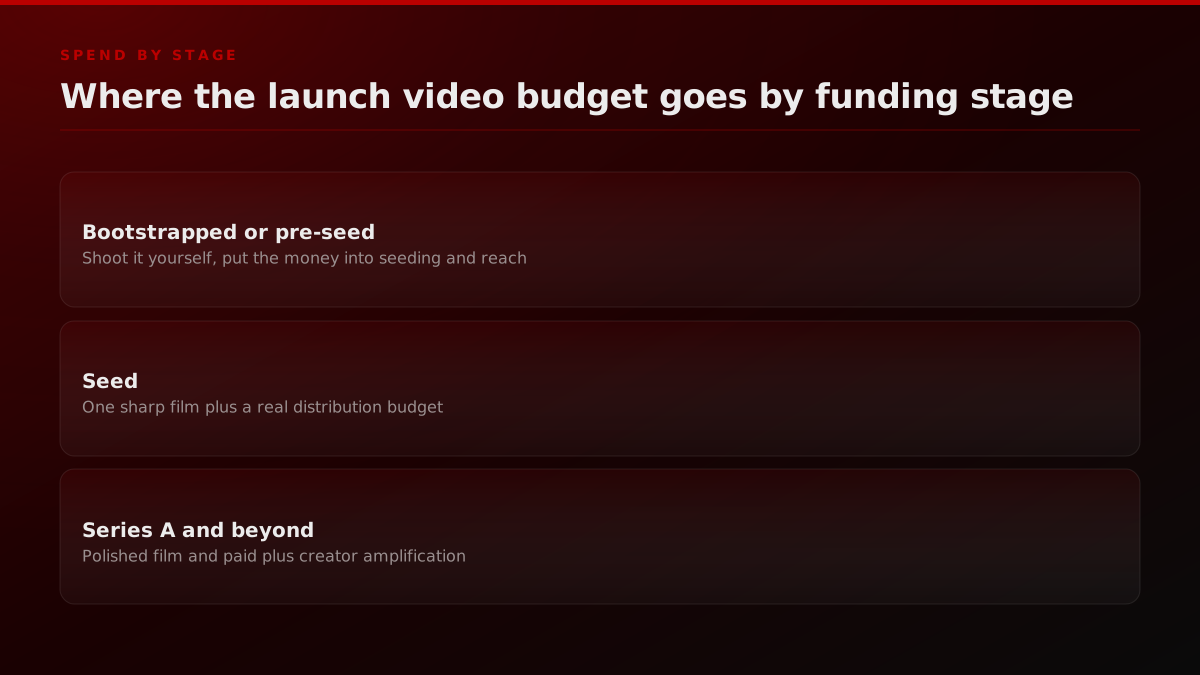
How much to spend on a launch video depends on your stage, but the rule that holds at every stage is to fund distribution as a real line item, not an afterthought. A bootstrapped founder should shoot the film themselves and put the money into seeding and reach. A seed-stage team should commission one sharp film and pair it with a genuine distribution budget. A Series A team can afford both a polished film and paid plus creator amplification. What ruins launches at every stage is spending the whole budget on the film and leaving nothing for the reach, a trap covered in more detail in the launch video agencies guide.
For reference, here is what production alone costs by type in 2026. Read it as the production half of the bill, then add a distribution line to every row. You can pressure-test any vendor's reach claim against real numbers with the qualified view auditor, and model the economics with the cost-per-qualified-view calculator before you sign anything.
What a launch video costs by type in 2026 (Vidico published bands)
| Video type | 2026 price band | What it includes |
|---|---|---|
| Product demo video | $3,000 to $15,000 | Screen capture, motion graphics, voiceover |
| Animated explainer video | $3,000 to $25,000 | Script, storyboard, animation, voiceover, music |
| Live-action product video | $5,000 to $50,000-plus | Talent, location, filming, post-production |
| Product launch video | $10,000 to $150,000-plus | Concept, filming, post-production, music |
| Social media video package | $2,000 to $10,000 per month | Multiple formats, iterations, channel cuts |
Published 2026 bands from Vidico's product video agency guide. Every number here is production only. None of them include the distribution spend that decides whether the video is watched, which is the recurring blind spot across the category.
The feed decides reach in the first hour, before most people ever see it
Platforms rank and throttle content at ingestion, on early signals like engagement velocity and retention in the opening seconds, before a meaningful audience is reached. A launch video with almost no views did not lose an audience test, it never reached the test. This is why the best launch videos of 2026 are engineered around that first-hour window: a hook in the first three seconds, a seeded burst of real engagement, and a tight strike window while the video is being scored. Craft alone does not clear that gate.
Source: Platform distribution mechanics, founder field reports
The contrarian view is worth keeping in the room too: sometimes the honest answer is that you do not need a video at all, and a fast GIF or a clear paragraph converts better than a two-minute film nobody finishes.
Is video that important? I hate it when the only way I can understand what a product does is by spending 2 minutes to watch a video.
8 Best Product Launch Video Examples in 2026 (The 60-15-6 Strategy)
Vidico: Video Production Company
A production teardown of eight strong product launch video examples for 2026, organized around a 60-15-6 structure. Useful for judging craft, and a clean illustration of the blind spot on this ranking: it is all about the file, never the reach.
If your product is genuinely simple, a launch video can be an expensive way to say something a single screenshot already says. Spend the money where the confusion actually is.
What should you steal from these launch videos for your own?
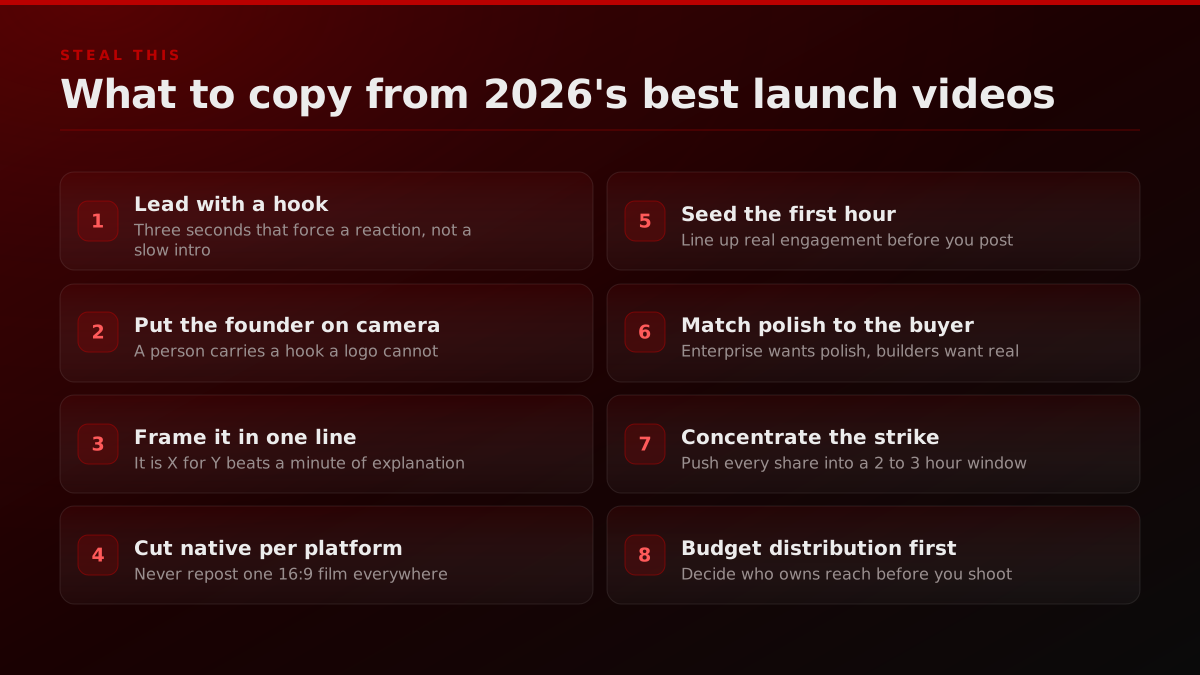
The move is not to copy the look of any video on this list. It is to copy the mechanics that got each one watched: a hook someone has to react to, a format matched to your story, native cuts per platform, seeded first-hour engagement, and a concentrated strike window. Do those five things and a modest film will beat an expensive one that skips them, which is the whole story of 2026's best launch videos in one sentence.
Operator note5B+ views through the FORKOFF clipping network is distribution proof no example gallery can match. That is the half these videos won on.
One more pattern worth naming: every video on this list had a person willing to put their name and face behind it. Cluely had Roy Lee's manifesto, Timeful had a founder who spent his savings on camera, Contra and tankots were founder-posted, and even Dollar Shave Club was Michael Dubin talking straight to the lens, a launch the New York Times later credited with helping change how people buy everyday basics. Brand-account launches almost never make a list like this, because a logo cannot carry a hook the way a person can. If you are deciding who fronts your launch video, the answer is almost always the founder, not the marketing department, and almost always the messiest, most human version of them rather than a polished spokesperson reading a script.
For a case where the mechanic worked and the distribution system did not exist underneath it, see why Sora went viral in 5 days and shut down in 6 months: the download curve did everything a launch is supposed to do, and it still was not enough on its own.
If there is one thing to take from this teardown, it is that the launch videos worth studying from 2026 are not a production achievement. They are a distribution achievement wearing a good film. Spend accordingly, plan the reach before you plan the shoot, and treat the upload as the middle of the process rather than the end of it. The teams that internalize that are the ones whose launch videos show up on next year's version of this list, and the teams that keep spending the whole budget on a beautiful file are the ones still wondering why nobody watched. Watching the view count is only half the job, our guide to product launch metrics covers what to actually track once the video is live. None of them post the video into a vacuum either: pairing it with the actual announcement copy sent across email, X, Product Hunt, and Reddit, plus a press release template if the launch needs press coverage, is what gets the film watched by more than the people already following the founder.